Wednesday, October 7, 2026ArchiveSearchAsk the paper

The Computomatix Times

All the posts fit to save — curated from @computomatix's bookmarks & likes on X

Edition of Friday, March 27, 2026

12 stories

AI9/10

Claude and GPT Help Resolve Knuth's Hamiltonian Cycle Problem
Claude and GPT Help Resolve Knuth's Hamiltonian Cycle Problem

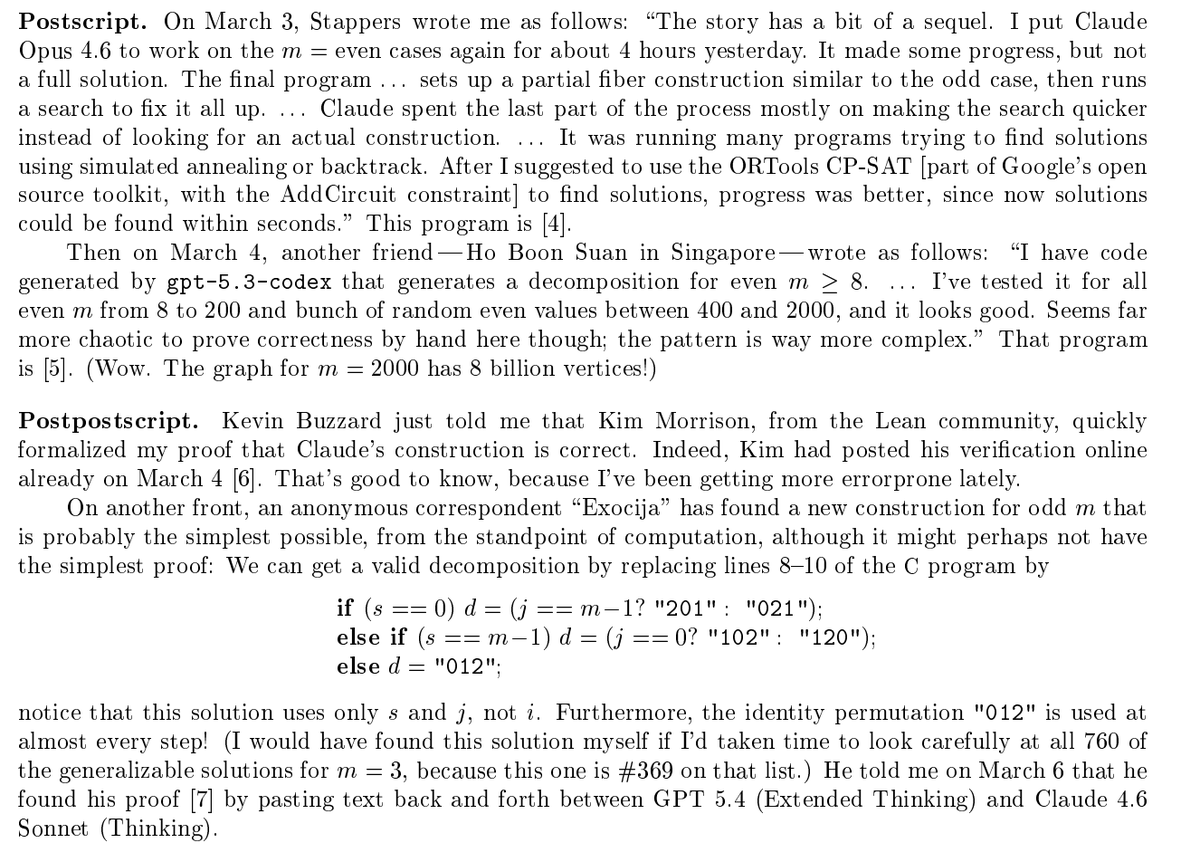
Bo Wang reports that Claude Opus 4.6 found an odd-m construction for Donald Knuth's open Hamiltonian decomposition problem, and that later work using GPT-5.4 Pro, multi-agent workflows and Lean formalization resolved the even case and simplified constructions. Knuth's updated paper, Claude's Cycles, is linked.

Original post · 1 min read
Three weeks ago I shared that Claude had shocked Prof. Donald Knuth by finding an odd-m construction for his open Hamiltonian decomposition problem in about an hour of guided exploration. Prof. Knuth titled the paper Claude’s Cycles.

The story didn't end there.

The updated paper shows the story got much bigger. For the base case m=3, there are exactly 11,502 Hamiltonian cycles. Of those, 996 generalize to all odd-m, and Prof. Knuth shows there are exactly 760 valid “Claude-like” decompositions in that family.

The even case, which Claude couldn’t finish, was then cracked by Dr. Ho Boon Suan using GPT-5.4 Pro to produce a 14-page proof for all even m≥8, with computational checks up to m=2000.

Soon after, Dr. Keston Aquino-Michaels used GPT + Claude together to find simpler constructions for both odd and even m, by using the multi-agent workflow.

Dr. Kim Morrison also formalized Knuth’s proof of Claude’s odd-case construction in Lean.

So yes: the problem now appears fully resolved in the updated paper’s ecosystem of human + AI + proof assistant work!

We went from one AI solving one problem to a full mathematical ecosystem (multiple AI systems, multiple humans, formal verification) running in parallel on a problem that stumped experts for weeks.

We are living in very interesting times indeed.

Paper (updated): www-cs-faculty.stanford.edu/~knuth/papers/clau…
Bo Wang @BoWang87
Prof. Donald Knuth opened his new paper with "Shock! Shock!"

Claude Opus 4.6 had just solved an open problem he'd been working on for weeks — a graph decomposition conjecture from The Art of Computer Programming.

He named the paper "Claude's Cycles."

31 explorations. ~1 hour. Knuth read the output, wrote the formal proof, and closed with: "It seems I'll have to revise my opinions about generative AI one of these days."

The man who wrote the bible of computer science just said that. In a paper named after an AI.

Paper: cs.stanford.edu/~knuth/papers/claude-cycles.pdf
♥ 1.4K · ⟲ 259 · 👁 177.3KView on X ↗

Paul Solt Says App Store Screenshot Text Drives Downloads More Than Design

The Screenshot Mistake That's Costing You Downloads Every Day

iOS developer Paul Solt argues that the text overlays on App Store screenshots matter more than the UI, citing a case where rewritten copy lifted conversions 80%. He recommends describing user outcomes rather than features and points to a screenshot optimization playbook.

Original post · 6 min read
X ArticleThe Screenshot Mistake That's Costing You Downloads Every Day
I've been building iOS and macOS apps for a while, and there's one thing I kept getting wrong after shipping: the screenshots.
I treated them like a design task. Pick five good screens, add overlay text describing the features, and export at the right sizes. Done. Meanwhile, downloads were flat (I'm looking at you: Super Easy Slides).

Here's what I learned from Theodora: 70% of screenshot effectiveness comes from the text overlay — not the UI. One app saw an 80% conversion lift just from rewriting the copy on existing screenshots.

The design didn't change.
The words did.
This is the thing most developers never fix.
Want the Full Playbook?
Download the App Store Screenshot Optimization Playbook — 100 best practices drawn from @DesignerAnts, the expert behind 1,000+ App Store screenshots. Drop it into Claude or Codex and fix your listing this afternoon.

Want her to do it for you? Hire Theodora →
The mistake is easy to make
When you're deep in building, you know your app inside out. So when it's time to write screenshot text, you naturally describe what the app does:
"Dark mode support."
"iCloud sync."
"Customizable widgets."
Those statements are true. They're also completely useless to someone who doesn't know why they'd want your app.
Feature descriptions answer the wrong question. A user scanning your App Store page isn't asking "what does this app do?" They're asking "is this for me?" Feature lists don't answer that.
Your screenshots read like patch notes to someone who hasn't bought in yet.

What actually works
Change your mindset: stop describing features. Show what changes for the user.
Not: "customizable dashboard"
Rewrite: "see everything that matters, at a glance."
Another example:
Not: "workout tracking"
Rewrite: "you'll never forget what you lifted again."
Same app. Same screen. Different download rate.
The reason this works: specificity makes the promise real. "Productivity app" is invisible. "Never lose a meeting note again" is a reason to download. The more precisely you describe the user's life after your app, the more they can see themselves using it.
Cover your UI with your hand and read only the text. Does it tell a story? Or does it list features?
Most apps fail this test immediately. Mine included.
The sequence that converts
Your screenshots should only make sense in order. If they work in any sequence, you have a catalog, not a story.
Here's the sequence @designerants recommends:
Screenshot 1 — Name the pain. Their frustration, before they found you. ("Buried in notes you'll never find again?")
Screenshot 2 — State the shift. What changes when they use your app. ("Everything you capture, organized automatically.")
Screenshot 3 — Show proof. Numbers, users, and a concrete result. ("Used by 10,000 developers every day.")
Screenshots 4–5 — Feature delivery. The one or two capabilities that actually deliver the promise from Screenshot 2.
Each screenshot does one job. One message. If it needs two sentences to explain, split it into two screens.

One more rule: text is the product
Your UI is evidence. Your text is the argument.
Write the headline for each screenshot before designing the screen. If you can't say the change in 8 words, you don't understand it well enough yet. Then let the UI behind it serve as the visual proof.
Treat the words as the product. Everything else is supporting material.

What I Shipped vs. What I’d Ship Now
I never planned to publish this app. I built it for myself.
But a friend asked about it—so I quickly put together my App Store sales page before I discovered these screenshot tactics.

This is the copy Super Easy Slides launched with:
Notes -> Slides. Instantly.
Full Screen Always Readable.
Slides Over Any App.
Auto-Numbering that Works.
At the time, this felt right.
I was trying to:
Clearly explain what the app does
Highlight key features
Keep everything simple and direct
And on paper, it checks out.
What’s wrong with this
Looking at it now, the problem is obvious:
This describes the product—but it doesn’t sell it.
These read like feature labels, not headlines
There’s no clear user pain or motivation
Nothing really grabs attention or stops the scroll
It assumes the user already understands why this matters
This is the mistake I made:
I focused on what the app does instead of why someone would want it.
The rule I missed
From Theodora’s approach:
Each screenshot should work like an ad.
That means:
Lead with a pain or desire
Show the outcome
Support it with the feature
Not the other way around.
What I’d change
Here’s how I’d rewrite the same ideas:
Before
Notes → Slides. Instantly.

After
Stop Designing Slides
Write notes. Start presenting.

Before
Full Screen Always Readable
After
Stay Focused While You Present
Clean slides. No distractions.
Before
Slides Over Any App
After
Stay In Your Flow
Present without breaking your momentum.
Before
Auto-Numbering that Works
After
Never Fix Slides Manually Again
Your structure stays clean automatically.
Why… continue on X ↗
♥ 898 · ⟲ 60 · 👁 539.9KView on X ↗

Cursor Releases Plugin for Building CLIs That AI Agents Can Use

Cursor Releases Plugin for Building CLIs That AI Agents Can Use

Eric Zakariasson shares a Cursor marketplace plugin that helps developers build command-line tools suited to agents, addressing issues like interactive prompts and help pages lacking examples. A linked post explains the problem in more detail.

Original post · 1 min read
i turned this into a plugin you can use when building cli's
install here: cursor.com/marketplace/cursor/cli-for-agent
eric zakariasson @ericzakariasson
Building CLIs for agents — If you've ever watched an agent try to use a CLI, you've seen it get stuck on an interactive prompt it can't answer, or parse a help page with no examples. Most CLIs were built assuming a human is at
♥ 502 · ⟲ 24 · 👁 79.5KView on X ↗

Claude Subconscious Adds Persistent Background Memory to Claude Code

Claude Subconscious Adds Persistent Background Memory to Claude Code

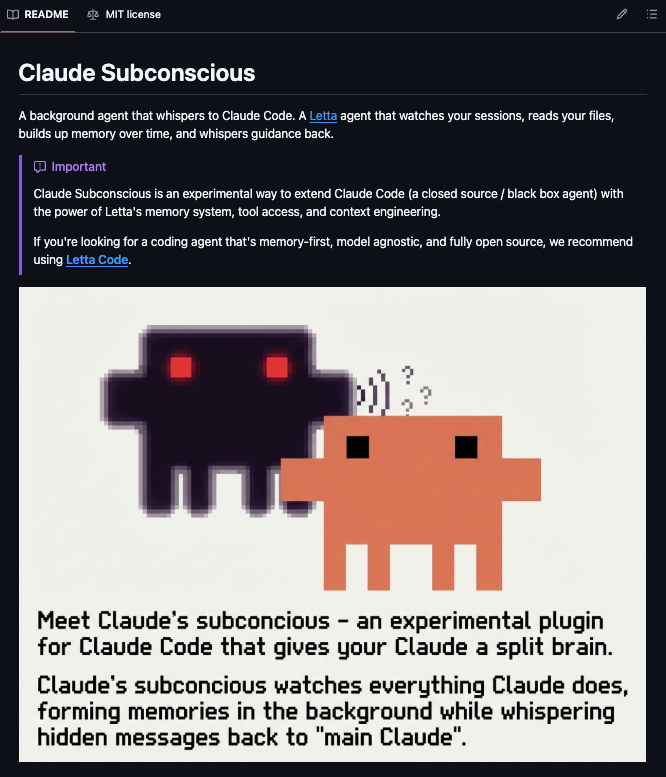
Ihtesham Ali describes Claude Subconscious, an MIT-licensed tool that sends Claude Code session transcripts to a background Letta agent, which maintains eight memory blocks covering preferences, architecture, patterns and pending items across projects.

Original post · 1 min read
🚨BREAKING: Someone built a second brain for Claude Code that runs silently in the background and never lets it forget a thing.

It's called Claude Subconscious, and it solves the biggest problem with every AI coding agent the amnesia that hits the moment you close a session.

Here is how it works:

After every Claude Code response, your full session transcript gets sent to a background Letta agent running underneath Claude. That agent reads your files, searches your codebase, updates its memory, and whispers back the most relevant context before your next prompt all without adding a single second of delay to your workflow.

The agent maintains 8 persistent memory blocks that grow smarter over time:

→ Your coding preferences and style choices it has learned from watching you
→ Project architecture - decisions and known gotchas it has read from your codebase
→ Session patterns - recurring struggles, time-based behaviours, common mistakes
→ Pending items - unfinished work and explicit TODOs it tracks across sessions
→ Active guidance it surfaces before each prompt when it has something useful to say

One agent brain connects across all your projects simultaneously, so the context you built in one repo carries into the next one you open.

Claude Code gets smarter the more you use it, without you changing a single thing about how you work.

MIT License. 100% Open Source.
♥ 874 · ⟲ 128 · 👁 79.0KView on X ↗
AI6/10

Keach Hagey Investigates Why Anthropic Co-Founders Left OpenAI

Keach Hagey Investigates Why Anthropic Co-Founders Left OpenAI

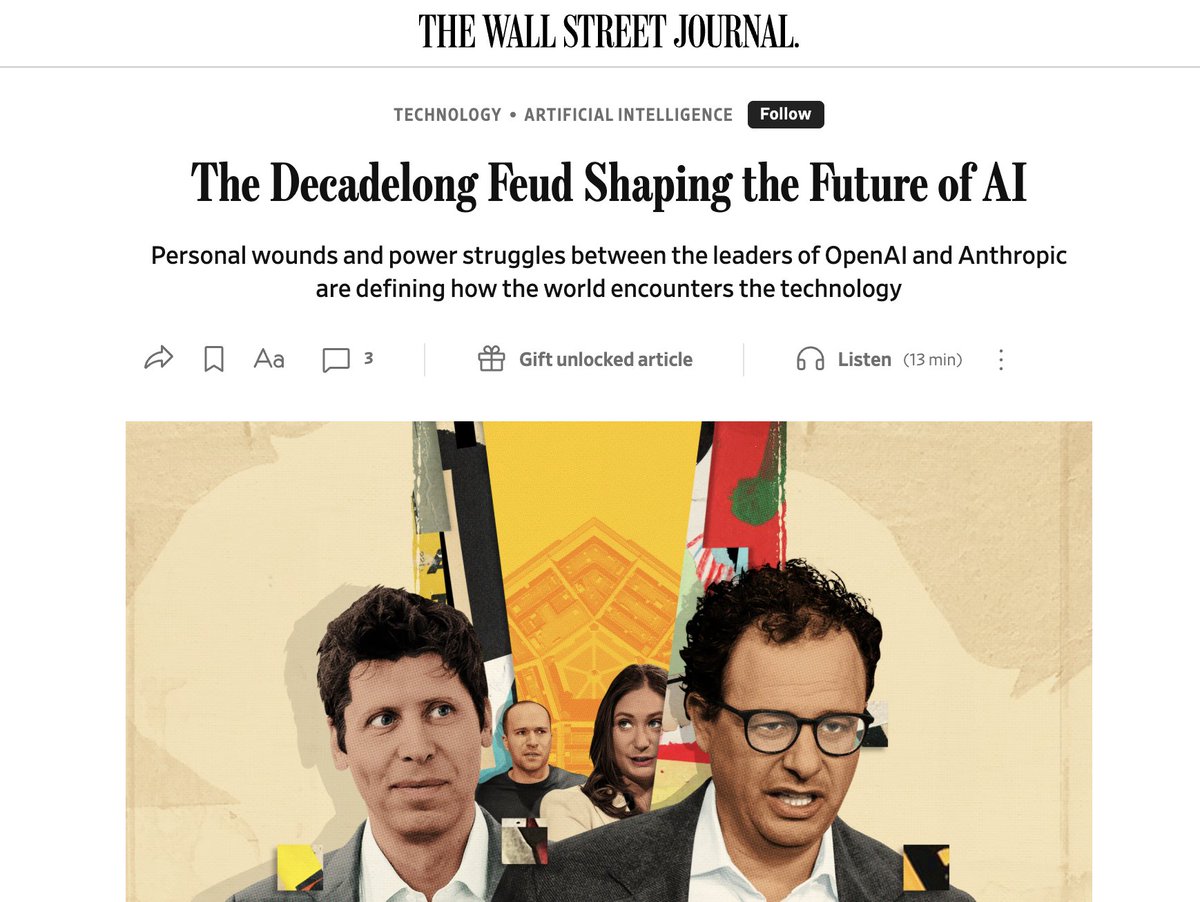
Keach Hagey says she set out to explain why Dario Amodei and other Anthropic co-founders left OpenAI, which she describes as never fully clear. The post shares an accompanying image and points to reporting.

Original post · 1 min read
It’s never been entirely clear why Dario and the other Anthropic co-founders left OpenAI. I set out to find out.
♥ 2.0K · ⟲ 168 · 👁 901.7KView on X ↗

Paperclip Open-Source Project Sees Early Business Adoption by Roofers and Dentists

Paperclip Open-Source Project Sees Early Business Adoption by Roofers and Dentists▶

The Startup Ideas Podcast reports that Paperclip, a three-week-old open-source AI agent project, is being used by a roofing company for lead generation, a dentist for practice management, and a security firm for audits. The post frames these as non-tech businesses running AI agents.

Original post · 1 min read
Paperclip has been live for 3 weeks.

A roofing company is already using it to close more deals.

Here's how:

They built agents that
- pull satellite imagery
- cross-reference hail damage data
- find neighborhoods likely to have insurance coverage

than feed these warm leads straight to their sales team

They're not a tech company.

They're a blue-collar business running AI agents.

And they're not alone:
- A dentist is using it to manage his foundation.
- A security firm ran automated audits on Paperclip itself.
- Marketing agencies are replacing manual workflows with agents.

3 weeks. Roofers. Dentists. Security firms.

And they're just getting started.
GREG ISENBERG @gregisenberg
I met the guy behind Paperclip. he won't show his face, but he just built one of the FASTEST growing open-source projects in AI.

how to use Paperclip to hire AI agents to ACTUALLY run a startup with 0 employees:

1. with paperclip, you hire a team of AI agents like CEO, engineer, QA, video editor, content strategist and manage them from one dashboard.

it works with Claude Code, Codex, OpenCode, or any model on OpenRouter. you're not locked into one provider.

2. your AI agents wake up capable but with zero memory. they don't know who they are, where they are, or what they're supposed to be …
♥ 993 · ⟲ 71 · 👁 161.6KView on X ↗

Midday Launches CLI With 80-Plus Business Tools for AI Agents

Midday Launches CLI With 80-Plus Business Tools for AI Agents▶

Pontus Abrahamsson announces the Midday CLI, offering over 80 tools for invoicing, reconciliation, exports, time tracking and reporting so agents can run business operations. Examples are provided in an accompanying video thread.

Original post · 1 min read
Let agents run your business.

Introducing the Midday CLI. 80+ tools. Invoicing, reconciliation, exports, time tracking, reports.

One backbone for every agent.

Examples ⬇️🧵
♥ 899 · ⟲ 40 · 👁 295.0KView on X ↗

Vista Equity Partners Publishes Report on Agentic AI and Enterprise Software

Marc Lehman recommends a March 2026 report from private equity firm Vista Equity Partners titled 'Agentic AI and the Future of Enterprise Software,' linking the PDF and framing it as a major paradigm shift relevant to software stocks such as Microsoft and IGV.

Original post · 1 min read
Yesterday we saw Thoma Bravo, today Vista Equity Partners

If your involved in $MSFT $IGV etc , would recommend reading

Vista Equity Partners , one of the largest PE firms specializing in Software

titled "Agentic AI and the Future of Enterprise Software". It visualizes a major paradigm shift in enterprise software

vistaequitypartners.com/wp-content/uploads/202…
♥ 559 · ⟲ 47 · 👁 167.7KView on X ↗

Open-Source AI Security Tool Tests Apps for Breaches Inside CI/CD Pipelines

Open-Source AI Security Tool Tests Apps for Breaches Inside CI/CD Pipelines

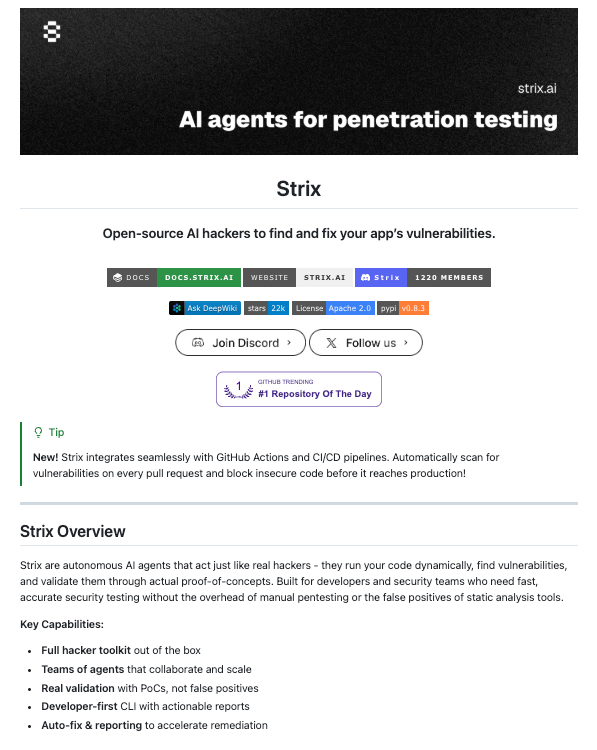
Charly Wargnier announces a free, open-source alternative to a startup that raised 117 million dollars for an AI app hacker, saying it tests apps by attempting intrusion, data theft and suggesting fixes, and runs in CI/CD pipelines. The repo link is in a thread.

Original post · 1 min read
🚨 A startup got $117M to build an AI app hacker.

An open-source alternative just dropped that does the exact same thing.

It breaks into your app, steals your data, and hands you the fix.

Now running directly in your CI/CD pipeline.

100% Free & Open-source.

Repo in 🧵↓
♥ 133 · ⟲ 22 · 👁 15.9KView on X ↗
AI5/10

George Pu Finds Open-Source Qwen Model Can Replace Costly ElevenLabs Subscription

George Pu says he nearly paid 330 dollars a month for ElevenLabs to narrate his blog, but found the open-source Qwen 3.5 14B model runs well on his laptop for the cost of electricity. He argues many AI subscriptions are a UI over free models.

Original post · 1 min read
Almost signed up for ElevenLabs to narrate my blog. $330/month.

Then I tried running an open-source model on my own laptop. Qwen 3.5 14B.

Sounds fine. 200 posts a month. Costs me electricity.

I almost paid $4,000 a year to rent a model I can run myself.

Most AI subscriptions right now are just a nice UI on top of something free.
♥ 2.6K · ⟲ 91 · 👁 186.1KView on X ↗

Jio Studios Rejected 175 Crore Offer for Dhurandhar Films, Finshots Reports

Jio Studios Rejected 175 Crore Offer for Dhurandhar Films, Finshots Reports

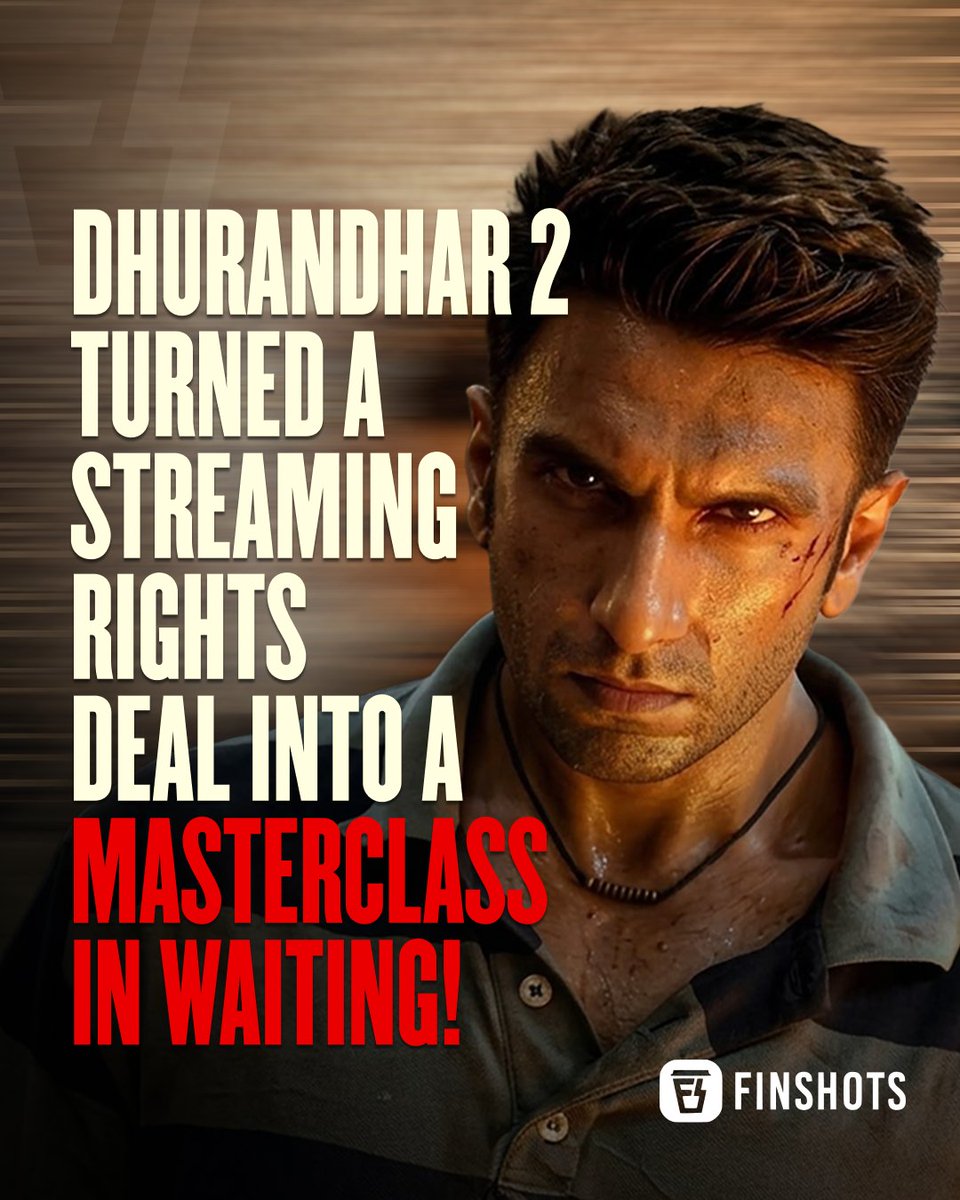
Finshots posts a thread on the economics of the Dhurandhar films, stating that Jio Studios turned down 175 crore rupees for both films before Part 1 reached theatres. The post includes a photo and no further detail in text.

Original post · 1 min read
Jio Studios turned down ₹175 crore for both Dhurandhar films before Part 1 even hit theatres! Here is how the economics of the Dhurandhar films is a pure masterclass 🧵
♥ 1.2K · ⟲ 72 · 👁 311.5KView on X ↗

Sahil Bloom Argues Courage Matters More Than Intelligence

Sahil Bloom writes that intelligence is abundant while courage is scarce, suggesting intelligent people overthink and wait for permission. He concludes that successful people simply acted when others did not.

Original post · 1 min read
The older I get, the more I realize intelligence is overrated. Intelligent people are more likely to overthink, overplan, and overanalyze. They hide behind motion that doesn't create progress. They fear the judgment of others if they're proven wrong.

The truth is that intelligence is abundant. Courage is not. The people you admire are the ones who had the courage to act. They aren’t more talented than you. They aren’t smarter than you. They just took action when you didn’t.

I often wonder how many extraordinary people wasted their entire lives waiting for permission that never came. Permission isn't granted. It's taken. You get to tap yourself in whenever you want. You can just do things.

Courage beats intelligence.
♥ 8.5K · ⟲ 1.1K · 👁 669.7KView on X ↗