Wednesday, October 7, 2026ArchiveSearchAsk the paper

The Computomatix Times

All the posts fit to save — curated from @computomatix's bookmarks & likes on X

Culture & Ideas

Careers, essays, history, media and life

How Avery Wang's Shazam Algorithm Identified Songs Without AI

Aakash Gupta explains that Shazam's 2002 system, invented by Stanford PhD Avery Wang, used spectrogram peaks, constellation maps and hash lookups instead of AI, and was published openly in 2003. Apple acquired the company in 2018.

Original post · 2 min read
Shazam could name any song back in 2002, on flip phones, with zero AI. You dialed the number 2580, held your phone up to the speaker, and hung up. 15 seconds later, a text came back with the song name. That same core trick still runs the app today.

The inventor was Avery Wang, a Stanford PhD in audio signal processing. His problem was brutal. Match a short clip recorded on a 2002 cell phone mic, in a noisy bar, against a database of a million songs, in seconds, over a phone call.

His solution treated music as geometry instead of sound.

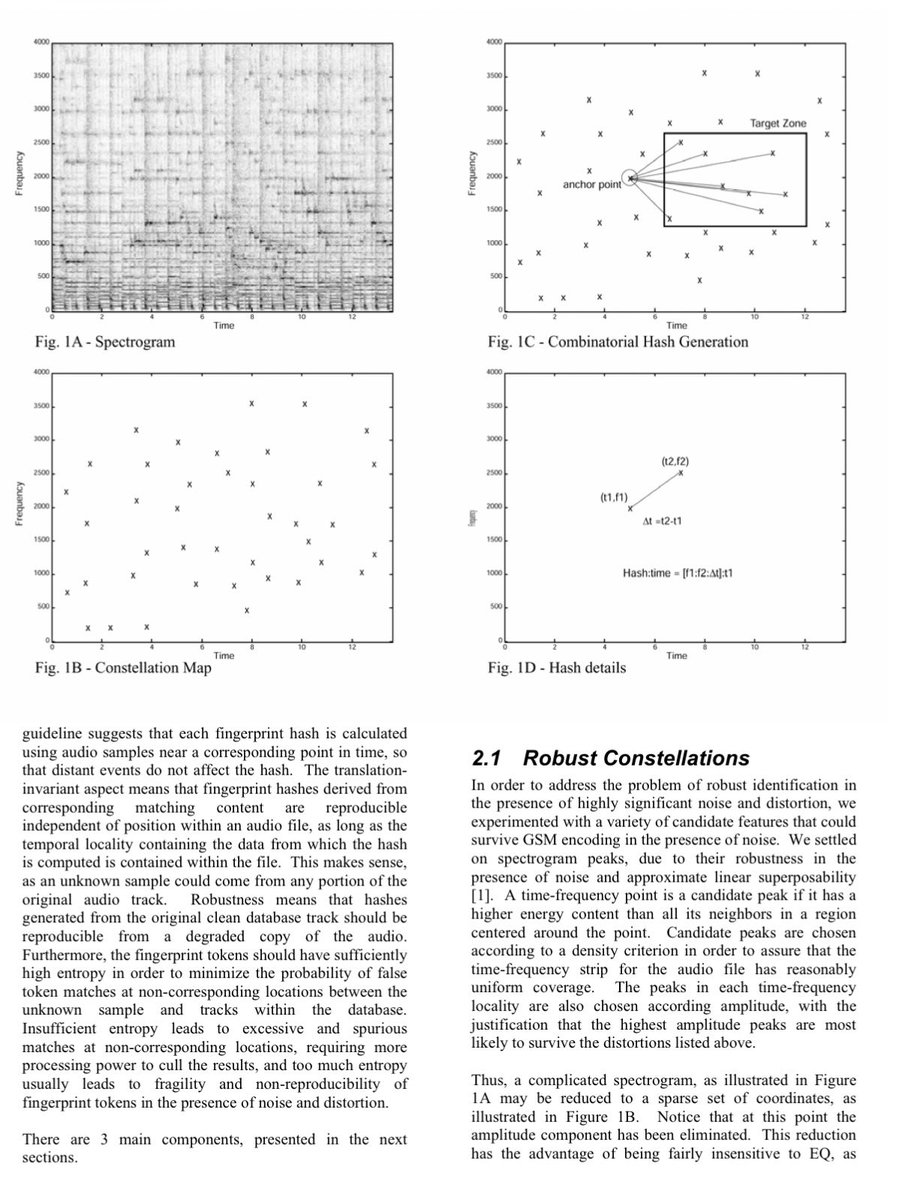
The algorithm converts audio into a spectrogram, a picture of the song, then throws almost all of it away. It keeps only the peaks, the loudest frequency points at each moment in time. Bar chatter and blown-out speakers can wreck most of a recording. The peaks survive. Shazam only ever needed the peaks.

Those surviving points form what Wang called a constellation map, because it looks like a star field. Pairs of peaks get converted into hash numbers, and identifying a song becomes a dictionary lookup rather than an audio comparison. That made it fast enough to search a million tracks on 2002 hardware.

Wang published the full method openly in 2003 in a paper called "An Industrial-Strength Audio Search Algorithm." Anyone could read exactly how the magic worked. The moat was the database and the deals with carriers, never the secret.

Apple bought the company in 2018 for a reported $400 million. People have tagged over 100 billion songs since the very first one, Jeepster by T. Rex, during the beta in April 2002.

One deterministic signal-processing trick, written before most people had heard the phrase machine learning, and it's still so good that in 2026 everyone assumes it must be AI.
Nathan Ruff @TheNathanRuff
Dude, how did Shazam work 15 years ago without AI!?
♥ 10.9K · ⟲ 1.9K · 👁 543.5KView on X ↗
FBI Arrests Fortnite Player Using Epic's Voice Chat Recording

Aakash Gupta reports that the FBI arrested Edward Frith after Epic Games reviewed a reported voice clip of his threat and sent it to authorities, and explains how Fortnite's rolling five-minute voice buffer and reporting system work.

Original post · 2 min read
The FBI just arrested a Fortnite player using a recording the game made of his own voice. He had no idea his headset was taping him. Almost nobody playing does.

Edward Frith, 29, had logged into his account over 1,700 times. In September he told another player that if the FBI showed up at his door he'd shoot them too. Someone in the lobby pressed the report button. Epic reviewed the clip, sent it to the FBI on September 20, and agents arrested him within days.

The design of the system is the clever part.

Recording every player would be a privacy disaster and a storage bill nobody wants. So Epic built voice reporting in 2023 to work like a flight recorder. The audio buffer lives on your own device, overwrites itself every five minutes, and never leaves your machine unless another player in the match reports it. The moment someone does, the clip gets packaged and sent to Epic's safety team with the speakers tagged.

He said it to one stranger in a lobby. That stranger had a button that turns the last five minutes into a federal exhibit.

I was a producer on Fortnite, and this is the part people outside the building never see. Threats of real-world violence got treated with the same urgency as a revenue outage. The game is full of kids, and Epic acts like it.

Fortnite is actually the conservative version of this. It still requires a human to press the button. Call of Duty has run AI moderation directly on live voice chat since 2023, no report needed. Every major platform with a microphone is converging on the same architecture.

The era where anything said into a gaming headset stayed in the lobby is ending one match at a time.
Dexerto @Dexerto
A Fortnite player who threatened to shoot the FBI in voice chat was arrested by the FBI

WagesOfNinja told another user "Let's see if the FBI is going to show up at my door because I'll shoot them motherf**kers too"
♥ 158 · ⟲ 41 · 👁 37.8KView on X ↗

Ohio's New Rome Dissolved Over Speeding Ticket Revenue

Aakash Gupta describes how New Rome, Ohio, and Macks Creek, Missouri, depended on speeding fines for most of their budgets, leading to dissolution in Ohio and bankruptcy in Missouri. Missouri subsequently capped ticket revenue at 20% of city budgets.

Original post · 2 min read
Ohio once dissolved an entire town because its main business was writing speeding tickets.

New Rome had 60 residents and a 14-officer police force. One cop for every four people in town. They collected around $400,000 a year in fines, 92% of the village budget, mostly by working a stretch of road where the speed limit dropped from 45 to 35.

A state audit then found the village was spending 82% of that budget on the police force. The town's only real industry was funding the thing that funded the town. In 2004 a judge ruled New Rome had effectively dissolved itself through corruption and erased it from the map. Its land got absorbed into the neighboring township.

Missouri ran the same experiment with Macks Creek, population 272, sitting on the highway to Lake of the Ozarks. The town wrote 2,900 tickets a year. Eight a day, almost all tourists who would never drive back to fight them. More than 75% of town revenue came from fines.

Then an officer there pulled over a state legislator. He went back to the capitol and passed a law capping how much of a city's budget can come from traffic tickets. Macks Creek lost its revenue stream, went bankrupt, laid off its entire police force, and disincorporated. The IRS seized the town's bank account.

Speed traps cluster wherever a highway full of out-of-towners meets a sudden limit drop in a state that lets the town keep the money. Missouri now caps ticket revenue at 20% of a city's budget. Ohio had to pass a law aimed at one specific village.

A speeding ticket heatmap doubles as a map of who's allowed to keep the fine money.
Terrible Maps @TerribleMaps
Where you’re most likely to get a speeding ticket in the U.S.
♥ 260 · ⟲ 44 · 👁 70.4KView on X ↗

Deedy Explains Shazam's Spectrogram Peak Hashing Method

Deedy Explains Shazam's Spectrogram Peak Hashing Method

Deedy outlines how Shazam extracts high-amplitude spectrogram peaks, hashes them with timestamp and track ID, and performs recognition via a hash table lookup. He notes that his college CS class built a version and recommends the original paper.

Original post · 1 min read
The serious answer to how Shazam worked is it took the peaks of a spectrogram of short clips of every song, find the peaks from the highest amplitude bits, hash it with the value being (time stamp, track id) and then the actual recognition is a hashtable lookup.

We did this for a college CS project. The original paper is fantastic:
Nathan Ruff @TheNathanRuff
Dude, how did Shazam work 15 years ago without AI!?
♥ 3.8K · ⟲ 357 · 👁 111.6KView on X ↗

Aakash Gupta Offers Formula for Valuing Private Company Equity Grants

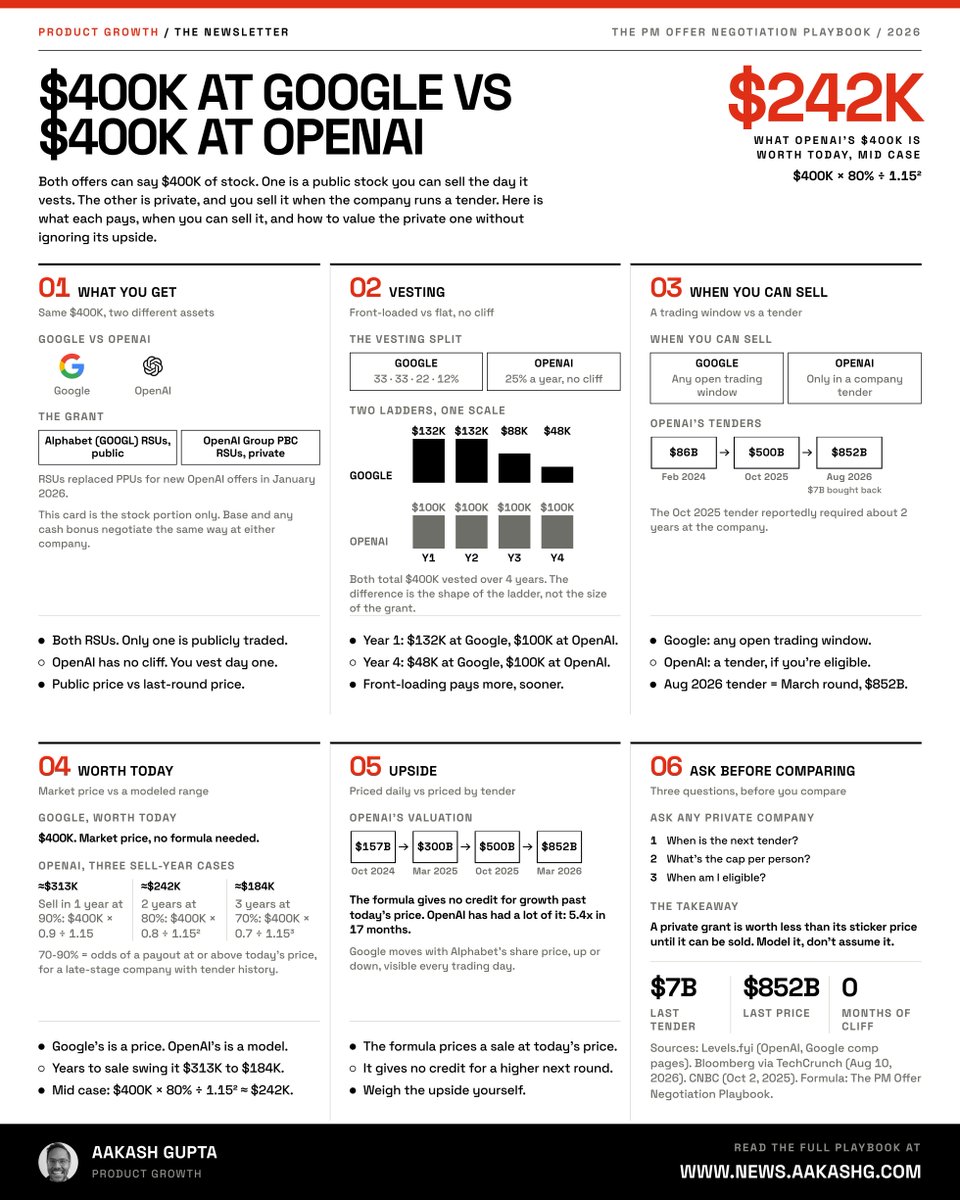
Card comparing Google and OpenAI offers

Aakash Gupta shares a formula for valuing private equity grants by discounting quoted equity by payout probability and years to liquidity. He compares a $400K Google grant to a $400K OpenAI grant, estimating the latter at about $242K.

Original post · 1 min read
A $400K grant from Google is worth $400K.

A $400K grant from OpenAI is worth about $242K today.

Same number on the offer letter. You can sell Google stock the day it vests. OpenAI is private, so you sell only when the company runs a tender.

Here's the formula I use for any private grant:

Value = Quoted equity × P(payout) ÷ 1.15^years to liquidity

The 15% is your discount for money you can't touch. For a late-stage company with real revenue and a tender history, P(payout) is 70-90%.

OpenAI, 2 years to a sale at 80% odds: $400K × 0.8 ÷ 1.15² = ~$242K.
1 year at 90%: ~$313K. 3 years at 70%: ~$184K.

Earlier stage gets brutal. A $400K grant at a Series C with an IPO 5 years out at 40% odds: $400K × 0.4 ÷ 1.15^5 = ~$80K.

The formula gives no credit for growth past today's price, and OpenAI has had a lot of it: $157B to $852B in 17 months. So treat the number as your floor.

Compare offers on what the equity is worth today. Then negotiate the gap in base and sign-on.
♥ 94 · ⟲ 6 · 👁 29.1KView on X ↗

Aakash Gupta Lays Out Six-Stage Path to Becoming an AI Product Manager

Aakash Gupta Lays Out Six-Stage Path to Becoming an AI Product Manager

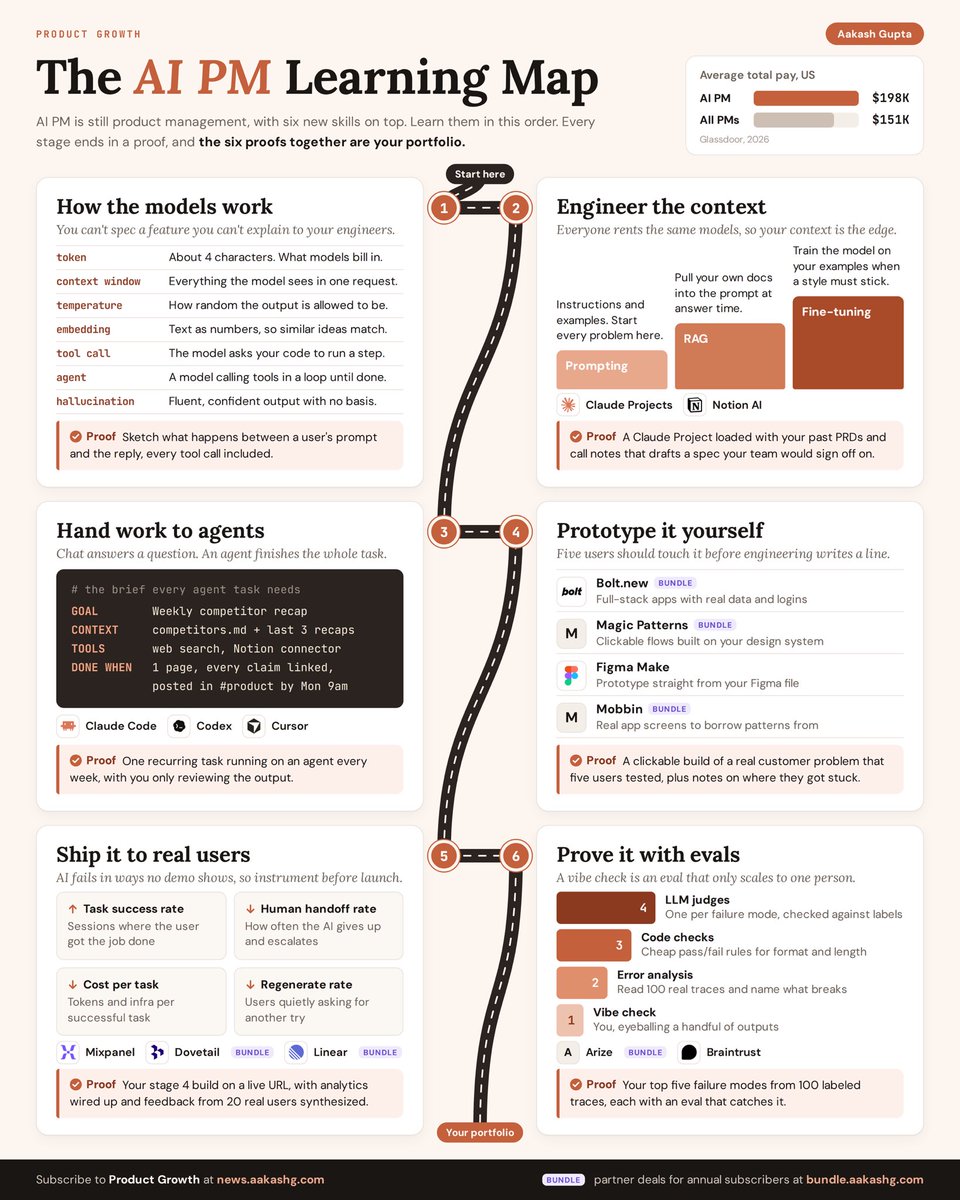
Aakash Gupta outlines a six-skill learning path for becoming an AI product manager, citing Glassdoor data showing average AI PM total pay of $198K versus about $151K for PMs overall. Each stage ends in a portfolio artifact, such as a Claude Project of past PRDs or a recurring agent task.

Original post · 3 min read
To become an AI PM, you need six skills on top of core PM. Here's the order to learn them.

The pay gap is why it's worth it. Glassdoor puts the average AI PM at $198K in total pay, against about $151K for PMs overall.

Most AI PM learning maps I see are generic PM concepts with "AI" in the title. They skip what hiring managers screen for, which is proof you've done the work.

So in this map, every stage ends in something you can show.

1. Learn how the models work

Tokens, context windows, embeddings, tool calls, agents. You don't need to train a model, but you should be able to sketch everything that happens between a user's prompt and the reply. A PM I coach hit exactly this depth check in technical screens at both Nvidia and Glean.

2. Engineer the context

Everyone rents the same models, so the edge is what you feed them. Climb only as far as you need. Prompting first, RAG when answers depend on your data, fine-tuning when a style has to stick. Your proof is a Claude Project loaded with your past PRDs that drafts a spec your team would sign off on.

3. Hand work to agents

Chat answers a question. An agent finishes the whole task, as long as your brief has a goal, the right context, the tools it can touch and a clear definition of done. Your proof is one recurring task, like a weekly competitor recap, running on Claude Code or Codex while you only review the output.

4. Prototype it yourself

Alex Danilowicz, CEO of Magic Patterns, said on my podcast that the classic mistake is spending two hours debugging a database when all you needed was a clickable mockup to show five customers. Reach for Bolt.new when you need real data and logins, and Magic Patterns for flows on your design system.

5. Ship it to real users

AI fails in ways no demo shows. Before launch, instrument task success rate, human handoff rate, cost per successful task and how often users hit regenerate. Then put your prototype on a live URL and synthesize feedback from 20 real users.

6. Prove it with evals

A vibe check is an eval. You're using your own brain as the scoring function, which works right up until you're the bottleneck. Hamel Husain and Shreya Shankar walked me through the sequence I'd copy. Read 100 real traces, name the failure modes, add cheap code checks, then build one LLM judge per failure mode and check it against your own labels.

Your proof is your top five failure modes, each with an eval that catches it.

Stack all six proofs and you have an AI PM portfolio.

A deep dive for each stage

1. AI foundations → news.aakashg.com/p/ai-foundations-for-pms
2. Context engineering → news.aakashg.com/p/context-engineering
3. AI agents → news.aakashg.com/p/ai-agents-pms
4. Bolt.new guide → news.aakashg.com/p/pm-guide-bolt
5. AI evals → news.aakashg.com/p/ai-evals
6. LLM judges → news.aakashg.com/p/ai-pm-llm-judge
7. AI PM portfolio → news.aakashg.com/p/vibe-code-pm-portfolio

Learn the stage. Then ship the proof.
♥ 223 · ⟲ 28 · 👁 17.8KView on X ↗

Puneet Patwari Outlines Path to Senior Distributed Systems Career

Amazon Principal Engineer Puneet Patwari describes compensation for L5 and L6 engineers and offers a learning path for distributed systems: mastering fundamentals, building systems with real tradeoffs, and reverse-engineering engineering blogs from major tech companies.

Original post · 3 min read
At Amazon, a strong L5 with 7 to 8 years of experience can cross ₹1 Cr+ CTC. At L6, compensation can go well beyond ₹1.5 Cr+ depending on team, location, stock, and level.

But the interesting part is not just the money.
Look at why recruiters reach out for these roles.

It is because their background shows they understand hard systems, and they have enough proof of work that people can see it.

Today I am a Principal Engineer, but if I were starting in distributed systems from scratch and wanted to turn that skill into career leverage, this is exactly how I would do it.

[1] Build the fundamentals before touching big scale

I would first get comfortable with the building blocks:
→ networking and request lifecycle
→ databases, indexes, transactions
→ caching
→ queues and async processing
→ replication
→ sharding
→ consistency
→ retries, idempotency, backpressure
→ observability and failure handling

Basically, have the understanding to see what happens when one normal backend service gets slower, busier, or partially unavailable.

[2] Build systems where the tradeoffs come into the picture.

Do not only watch architecture videos.
Build things.

Start with:
→ URL shortener
→ rate limiter
→ notification service
→ job scheduler
→ file upload system
→ search service
→ payment workflow

Then deliberately make them harder.
– What happens at 10x traffic?”
– What if Redis dies?”
– What if the same event arrives twice?”
– What if one shard becomes hot?”

[3] Read engineering blogs and reverse-engineer decisions

Uber, Netflix, Stripe, Discord, Cloudflare, LinkedIn, Meta, Amazon.
There’s golden material out there.

While reading, ask yourself:
– Why did they choose this?
– What was breaking before?
– What tradeoff did they accept?
– What new problem did their solution create?

That is how engineers actually learn architecture.

[4] Put your thinking in public

This part is massively underrated.
Write about what you learn.

Publish:
→ design breakdowns
→ architecture diagrams
→ GitHub projects
→ incident analyses
→ open-source contributions
→ performance experiments

Build enough public proof that when someone searches your name, they can tell what kind of engineer you are.

That is when learning starts compounding.

You study distributed systems to become better at engineering.
Then that knowledge helps you design better systems.
Those systems give you better stories.
Those stories become public proof.

And eventually, opportunities start finding you instead of you constantly chasing them.

That is the leverage.
Jordan @ Jobbie @i7solar
getting cold emailed by amazon is crazy
♥ 999 · ⟲ 80 · 👁 140.9KView on X ↗

Gergely Orosz Says Hand-Written Code Era Is Ending as AI Writes Most Code

Gergely Orosz Says Hand-Written Code Era Is Ending as AI Writes Most Code

Gergely Orosz comments on DHH saying the age of hand-writing code is over, arguing this has been clear since January to engineers using AI models. He links to his free article on what happens to software engineering when AI writes most code.

Original post · 1 min read
That DHH saying out loud that the age of writing code by hand is over for the industry, and causing such a huge uproar is a bit interesting, given this was clear enough since ~January for most of us using the models + paying attention.

Removed paywall: newsletter.pragmaticengineer.com/p/when-ai-wri…
newsletter.pragmaticengineer.comWhen AI writes almost all code, what happens to software engineering?No longer a hypothetical question, this is a mega-trend set to hit the tech industry
♥ 2.6K · ⟲ 225 · 👁 175.7KView on X ↗

Aakash Gupta Argues PMs Should Build Public GitHub Portfolios

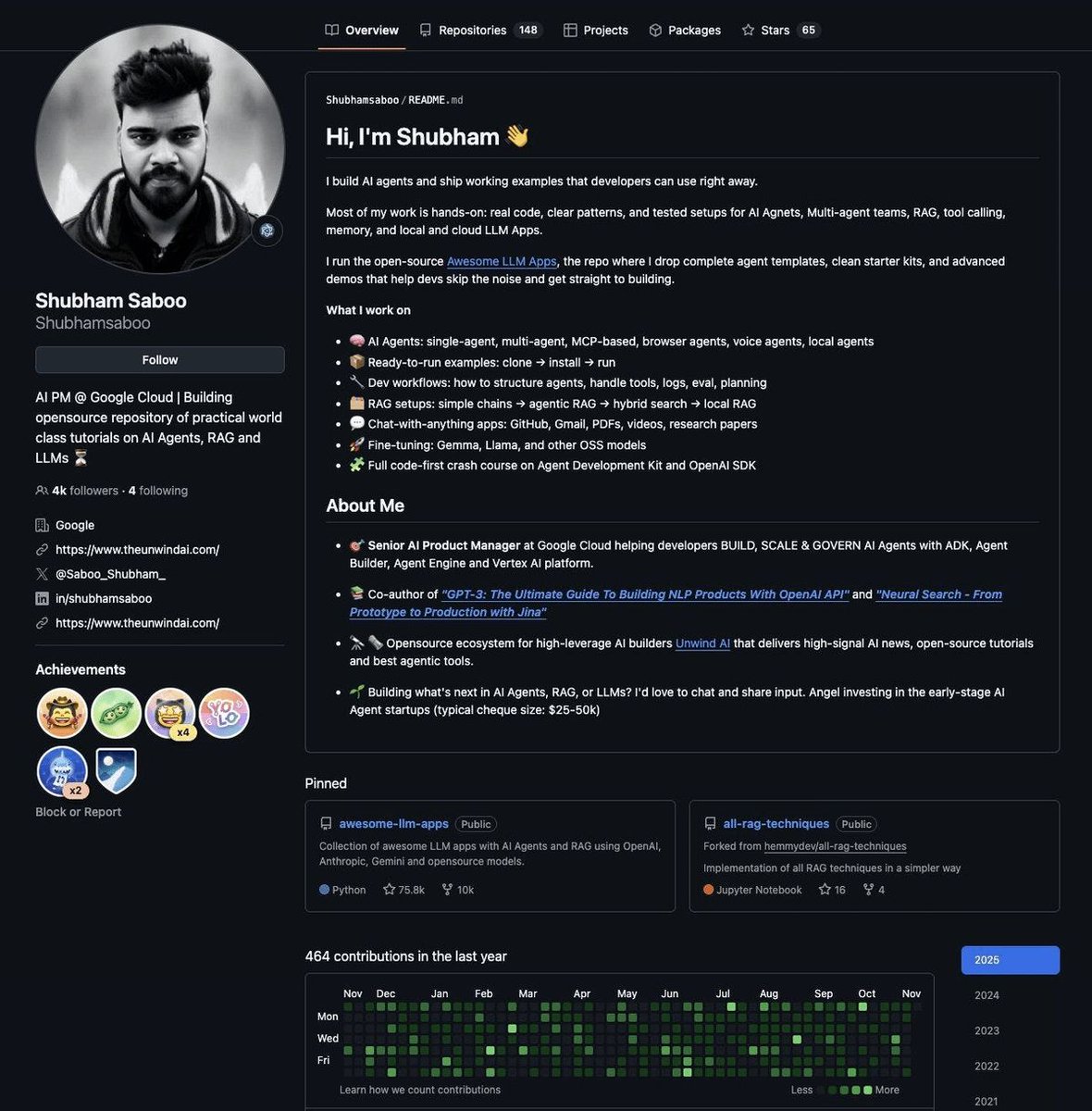
Shubham Saboo's GitHub profile.

Aakash Gupta writes that only 24% of PM candidates link a GitHub, and hiring managers at top AI companies check it. He cites Shubham Saboo's move from Dev Rel to a senior AI PM role at Google and urges building one small project weekly.

Original post · 1 min read
All PM candidates have resumes. Only 24% have a GitHub.

When I interviewed 10+ AI PM leaders at top companies, the hiring managers told me the same thing: if there's a GitHub linked, they will check it.

Shubham Saboo went from Dev Rel to senior AI PM at Google in 3 months. Google reached out because of his GitHub, and because of the way he shared his work on X.

You don't need one his size. PMs I placed at OpenAI, Anthropic and Meta AI all had GitHubs. None of them had 76K-star repos.

Build one small thing a week. A new prompt in your prompt library counts.

How to build yours:
news.aakashg.com/p/you-should-build-a-pm-githu…
♥ 82 · ⟲ 4 · 👁 11.0KView on X ↗

Mitchell Hashimoto Says Top Performers Often Hide Their Intelligence

Mitchell Hashimoto Says Top Performers Often Hide Their Intelligence▶

Mitchell Hashimoto argues that many highly successful people across industries are very smart, even when they present themselves as unserious, and reacts to a clip of Ben Affleck discussing his machine learning knowledge.

Original post · 1 min read
An uncomfortable truth for a lot of people is that a lot of the most successful people in any industry are wicked smart. We apply stereotypes based on the loudest people, but its not representative of norms. Most are crazy smart and got to where they are because of it.

I grew up in LA, one of my parents was a TV producer, my wife was an actor, many friends "in the industry." I've been constantly surrounded by it, and some of the stupidest seeming people (cause its their bit) are actually insanely smart and strategic in private. It sometimes is just beneficial for various reasons to... not show that side of you.

My favorite anecdote was when a friend (a model) was dating a phD in physics and a very rude person made some off the cuff degrading comment to model friend about it without realizing model friend has their own phD in math lol. You wouldn't know from their instagram though!

For the quoted video, I don't know Ben Affleck. I don't know how deep his knowledge goes. He's almost certainly not going to be more knowledgable than someone who professionally does this area of work full time, but he also to me on the surface sounds like someone who knows a LOT more than the average person and possibly even the average software engineer (on this topic).

Anyways, this applies to tech too. I see it constantly.
Fireside Alpha @firesidealpha
Ben Affleck reveals he writes Python, understands convolutional neural networks, worked extensively with GPUs, and used his celebrity status to get private looks at Google and OpenAI’s video models

“I’ve always been kind of into computers since I was young. Then, when film started to move from analog film to digital, I became more interested in that aspect of it. The visual-effects workflow for many years has included machine learning, so I can write pretty shitty Python scripts and stuff like that.

“With convolutional neural networks, which were the precursors to what the transformer can do…
♥ 2.5K · ⟲ 88 · 👁 113.1KView on X ↗

Levelsio Predicts Coastal and Mountain Land Will Gain Value After AGI

Pieter Levels says he owns property in scarce coastal and mountain areas and plans to keep buying there, reflecting a thesis that people with money will move to the nicest places once AI makes work pointless. He is quoting a post by IterIntellectus making the same claim.

Original post · 1 min read
I own land and property in exactly these areas and will keep buying land and property in these areas

This is exactly my post-AGI thesis too

Scarse coastal or mountain land with clean air
vittorio @IterIntellectus
once ASI is here and living somewhere because of "work" becomes pointless, people with money will just move to the nicest places on earth

Mediterranean climate, ocean, mountains, good food, beautiful isolated towns

places like this are going to become insanely valuable
probably worth buying real estate there now
♥ 7.3K · ⟲ 238 · 👁 785.9KView on X ↗

Angela Duckworth Discusses How External Factors Shape Success

Harvard Business Review promotes a Q&A with University of Pennsylvania professor Angela Duckworth on how situations shape high achievers, how to diagnose a bad work situation, and how organizations can bring out the best in people.

Original post · 1 min read
While many high achievers rely on positive internal attributes like intelligence, passion, and perseverance, research shows that external factors also play a big role in their success.

In this Q&A with University of Pennsylvania professor Angela Duckworth, she explains why leaders' situations often matter as much as their mindsets and behaviors. She also offers advice on how to diagnose and change a bad work situation, and outlines what managers and organizations can do to create workplaces that bring out the best in their people.

Read the full Q&A: s.hbr.org/4xY2UZg
♥ 41 · ⟲ 9 · 👁 17.2KView on X ↗

Lauren Argues Coding Is Dead but Programming Is Reborn With AI

Coding is dead, long live Coding

A long X article by Lauren argues that coding as a loved craft is ending, but that AI will let a new generation build faster and at higher quality, quoting Thorsten Ball on craft disappearing. The author reflects on their self-taught programming roots and optimism about abundance.

Original post · 3 min read
X ArticleCoding is dead, long live Coding
To my friends mourning the loss of their most loved activity, I feel your pain. I got into programming as a hobby, my first introductions to it being in high school and discovering the <marquee> tag. Ever since that joyful discovery, I couldn't stop myself from making things, tinkering, and looking forward to the thrill of solving the next problem. I would pore over every line of code, thinking hard about how to make my programs more elegant, performant, even beautiful.
I think @thorstenball put it best:
"The craft of writing code will disappear. Yes, there are still Italian shoe makers around. But look at your feet."
As beneficiaries of AI, we owe everything to the people that came before us: the people who discovered, engineered, and created the knowledge and civilization that we now live in and build on top of. Just look around you. Even everyday, ordinary things were brought to life by someone who was passionate about solving a problem. Those people are now mourning the loss of that tactile feeling of solving a problem with nothing more than your own hands and the knowledge built upon the shoulders of giants.
Coding is dead, but yet coding still lives on in the weights of the models we now use, the frameworks we build with, and the programming languages we write with. We should not shame the people who mourn because we owe everything to them. And yet, while others mourn, we can also rejoice. Personally, as a self taught programmer, I am thrilled at the thought of more people discovering the joy of building things. While it might be tempting to think that the automation of coding is the end of things, I think it's a new beginning, where a new generation of programmers using natural language to express their intent and goals will build things faster and at a higher quality than we could ever produce by hand.
It might not seem like it's possible right now. But I believe it will. Builders using AI will produce things we could never do before.

And that abundance will be glorious! If anything, I feel more love for programming than I ever did before. What I used to be limited in by my own ability, I can now will into existence if I can figure out the right incantations, the right prompts and context, to drive an agent towards the vision I see so clearly in my head.
So while some might say that they're "excited to see what you build" with empty feelings, I want to believe that many of us are truly excited at what people who've never experienced the joy of building can do.
I can't wait to see what you build!
♥ 2.6K · ⟲ 194 · 👁 169.7KView on X ↗

a16z Launches Horowitz Andreessen Academy With $42 Million

a16z Launches Horowitz Andreessen Academy With $42 Million▶

Molly O'Shea reports that a16z has launched the Horowitz Andreessen Academy, an unaccredited, tuition-free residential program in San Francisco led by Gagan Biyani, with $42M in funding. Admission is based on proof of work for a founding class of about 50 starting fall 2027, with Anthropic, OpenAI, NVIDIA and others as partners.

Original post · 2 min read
BREAKING: a16z Launches The Horowitz Andreessen Academy with $42M in Funding

Yes, a school.

The Academy is an unaccredited, residential alternative to a 4-year degree in San Francisco, led by Founder & CEO Gagan Biyani (@gaganbiyani) (Udemy, Maven).

Marc Andreessen (@pmarca) & Erik Torenberg (@eriktorenberg) are on the board. Investors include Adam D'Angelo, Tobi Lütke, Tony Xu, Fidji Simo & Shyam Sankar.

Applications open today for a Founding Class of roughly 50 students, starting Fall 2027. 1 year, no tuition, admitted on proof of work.

Anthropic, Anduril, Coinbase, Meta, NVIDIA, OpenAI, Palantir, Replit & Stripe are Founding Partners, with 30+ hiring partners behind them.

We cover:
› The $42M raise and the runway behind it
› Portfolios, interviews and IQ testing in admissions
› 75% to 80% project time and weekly pod check-ins
› Tuition, partnerships and equity as the 3 revenue lines
› Why the Academy is telling fundable 17-year-olds to wait

"The big difference between going to the academy and going to college is we are not gonna prioritize your grades. We're gonna prioritize proof of work."

𝐓𝐈𝐌𝐄𝐒𝐓𝐀𝐌𝐏𝐒
(00:00) Gagan Biyani, Founder & CEO of Horowitz Andreessen Academy
(01:01) Why this Academy is different from college
(04:44) Started his first company at age 13
(08:30) Building a school for Silicon Valley
(11:55) Raising $40M for a School
(14:06) "You Did What?" - Proof of work over grades
(19:08) Should young builders really start companies?
(22:37) Why this is different from YC and fellowships
(27:35) The Academy is for young builders
(31:33) Why schools need to embrace AI
(37:18) How AI is changing education
(44:17) What an AI-native curriculum looks like
(48:51) Why high-agency students struggle in college
(53:12) Why the best builders zigzag
(1:02:19) Why you should apply even if you don't get in
(1:04:36) Building a supportive environment for young builders
(1:08:54) What the Academy program looks like
(1:10:44) Why the Academy is in San Francisco
(1:11:19) The people who shaped Gagan
(1:14:41) Favorite book!
♥ 785 · ⟲ 92 · 👁 424.6KView on X ↗

Essay Contrasts 2004 Camcorder Privacy With Today's Context Collapse

Aakash Gupta reflects on 2004, when a camcorder recording had a single private destination, contrasting it with today's teenagers who perform for many audiences at once. He uses the frame to examine how youth behavior has changed.

Original post · 1 min read
2004 was the last year an American teenager could goof off in a school hallway with zero chance a stranger would ever see it.

Facebook had launched that February, locked to Harvard students. YouTube was still a year away. The first iPhone was three years out, and nobody carried a camera that talked to the internet.

So when a camcorder came out, kids hammed for it, because the tape had exactly one destination. A drawer in somebody's parents' house. Maybe a screening at graduation, then twenty years of dust.

Watch the body language with that in mind. Nobody is checking how they read to an invisible audience. Nobody resets their face between takes. The camera was a toy, not a distribution channel.

Researchers have a name for what came after, context collapse. Every audience you've ever had, all watching the same clip at once. Teenagers now run that calculation before they move. The kids on this tape never learned it, and you can see the difference in a single frame.

Low-rise jeans come back every few years. A camera with nothing behind it never will.
Pico 🎈 @Piicools
high school in 2004
♥ 310 · ⟲ 34 · 👁 52.9KView on X ↗

Aakash Gupta Argues Animation Makes Ted a Cheaper Franchise

Aakash Gupta analyzes why Peacock's animated Ted series is a cost-efficient format, contrasting the expensive motion-capture live-action Ted films and series with animation's flat costs, ageless characters and lower voice-session demands.

Original post · 1 min read
Fox passed on Ted because Seth MacFarlane wanted a $65 million budget and they thought that was too much for a first-time director. Universal said yes, the movie made $549 million, and 14 years later they're launching the fourth product built on that bear.

The interesting part is the format choice. Ted's whole gag in 2012 was a photoreal teddy bear standing in the real world. MacFarlane performed him in a motion capture suit, Wahlberg acted his scenes against empty air, and every frame with the bear ran through a VFX pipeline. The live-action Peacock series carried that same cost structure and still broke the record as Peacock's most-watched original.

Animation deletes that cost entirely.

Drawn, Ted costs the same as every human on screen. The A-list cast trades on-set shooting schedules for voice booth sessions they can knock out between other projects. Drawings never age either, which is why Family Guy has been running since 1999 with the same characters. MacFarlane even brought in Rough Draft, the studio behind Futurama, to make it.

In 2012, Ted was the most expensive character in his own movie. Animated, he's the cheapest.

This is the endgame for every hit franchise. Live action proves the demand, then the IP migrates to the one format that can run for 20 years at flat cost. Peacock just turned its biggest original into a show that never has to end.
Peacock @peacock
This is gonna be fun 😏

#ted: The Animated Series arrives December 17 on Peacock.
♥ 255 · ⟲ 11 · 👁 275.9KView on X ↗

DHH Says Programmers Who Deny AI Shift Are Most at Risk

David Heinemeier Hansson argues that programmers in most trouble from AI competition are those who insist the world has not changed from last year. He concludes that developers must embrace the paradigm shift or perish.

Original post · 1 min read
The only programmers who are really in trouble with the competition from artificial intelligence are the ones who insist the world today isn't all that different from the one we lived in last year.

Embrace the paradigm shift or perish.

(This has always been true.)
♥ 6.3K · ⟲ 417 · 👁 214.4KView on X ↗

OpenAI Researcher Alisa Liu Shares Interview Preparation Notes

OpenAI Researcher Alisa Liu Shares Interview Preparation Notes

Md Ismail Šojal says OpenAI researcher Alisa Liu open-sourced her study notes from 57 interviews before joining OpenAI, including LLM and math materials and a write-up of the hiring process. The post recommends the material to candidates preparing for research scientist roles.

Original post · 1 min read
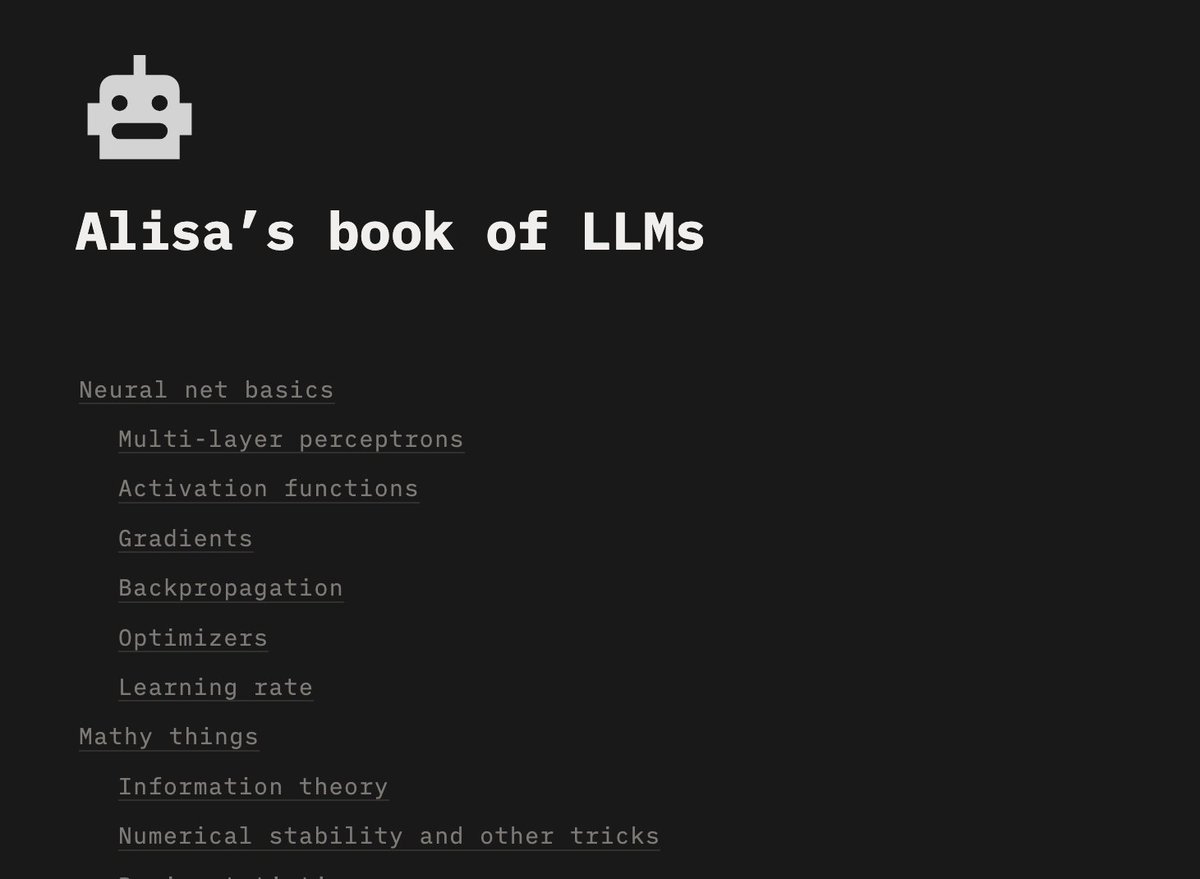
OpenAI researcher "Alisa Liu" had 57 interviews before joining OpenAI, and then She open-sourced her entire study notes job/learning process.

- her LLM study notes
- her math interview notes
- a full honest write-up of the job process

If you are preparing for research scientist / MTS roles, this is the highest-signal material available right now.

You can use her notes or her topic list to study on your own. That’s rare. Don’t waste it.
♥ 2.2K · ⟲ 236 · 👁 118.7KView on X ↗

Jason Fried Reflects on Returning to Solo Software Building

Jason Fried traces his career from solo software development to directing teams, and now back to designing and writing software himself with AI, arguing that advancing tools can restore lost capabilities and make a skilled team more powerful.

Original post · 1 min read
35 years ago I did it all myself. Wrote, built, sold, and released software solo.

25 years ago I did all the design myself. Sketches, then HTML, then CSS.

15 years ago I still did some hands on design, but mostly directed others to implement my vision.

5 years ago I primarily directed others. My "I can do it myself" muscles had atrophied.

Today, I feel like I'm back to the beginning. Able to write and design software entirely by myself. And having an elite team of others who can do the same thing is an enormous multipler.

Wild how massive advancements can propel you FORWARD by bringing BACK capabilities you lost along the way.

Full circle feels more like an arrow.
♥ 1.9K · ⟲ 88 · 👁 166.6KView on X ↗

Gokul Rajaram Says Exceptional Founders Carry Contrarian, Obsessive Traits

Investor Gokul Rajaram argues that exceptional founders are contrarian and obsessed to the point of unhealthiness, traits that drive vision but strain trust, delegation and personal relationships. The post quotes a longer interview on Tech Fit Talks.

Original post · 1 min read
Exceptional founders possess two traits that look like weaknesses but are actually strengths.

First, they are contrarian thinkers. They challenge everything: investors, employees, customers, conventional wisdom. That contrarian energy is what lets them see around corners and push through resistance. But the same trait makes them hard to work with, slow to trust, and sometimes unable to delegate.

Second, they are obsessed, to the edge of sanity. The best founders are consumed by the problem in a way that looks unhealthy to normal people. They don't clock out. They don't have hobbies in the conventional sense. That intensity compounds, but it also burns people around them and can mask real personal costs. The best founders I've worked with have an almost unhealthy attachment to being right about their vision of the world. They can't let it go. They'll sacrifice money, relationships, comfort, sleep, all of it, because something inside them needs to see this thing exist.
Tech Fit Talks @tech_fit_talks
What personality flaw do exceptional founders disproportionately have? I asked @gokulr. His full answer covers contrarian thinking, trust, obsession, and their costs. From Tech Fit Talks with Ethan Lockshin.
♥ 132 · ⟲ 13 · 👁 19.4KView on X ↗

Chamath Palihapitiya Recommends Jeffrey Katzenberg's Essay on AI for Creativity

Chamath Palihapitiya shares Jeffrey Katzenberg's essay 'The World is Changing: AI For Creativity' and calls it worth reading. Katzenberg describes watching a founder demo a stunning AI-generated animated scene and reflects on its impact on artists.

Original post · 1 min read
This is worth reading.
Jeffrey Katzenberg @jeffreykWNDR
The World is Changing: AI For Creativity

By Jeffrey Katzenberg

A few months ago, I sat in my office in Silicon Valley and watched as a tech founder showed me something extraordinary. On the screen was a fully realized, beautifully lit, well-composed animated scene. It was stunning and it made me feel exactly what I felt in 1986 watching Luxo Jr. That was the first time I watched a computer-animated 3D character take a breath and seem, against all reason, to have life. It left me in awe.

Later that day, I received a text from an artist I've known for thirty years, 350 miles to the south, in …
♥ 1.4K · ⟲ 75 · 👁 464.8KView on X ↗

Former PM Says AI Product Interviews Now Test Practical Evals

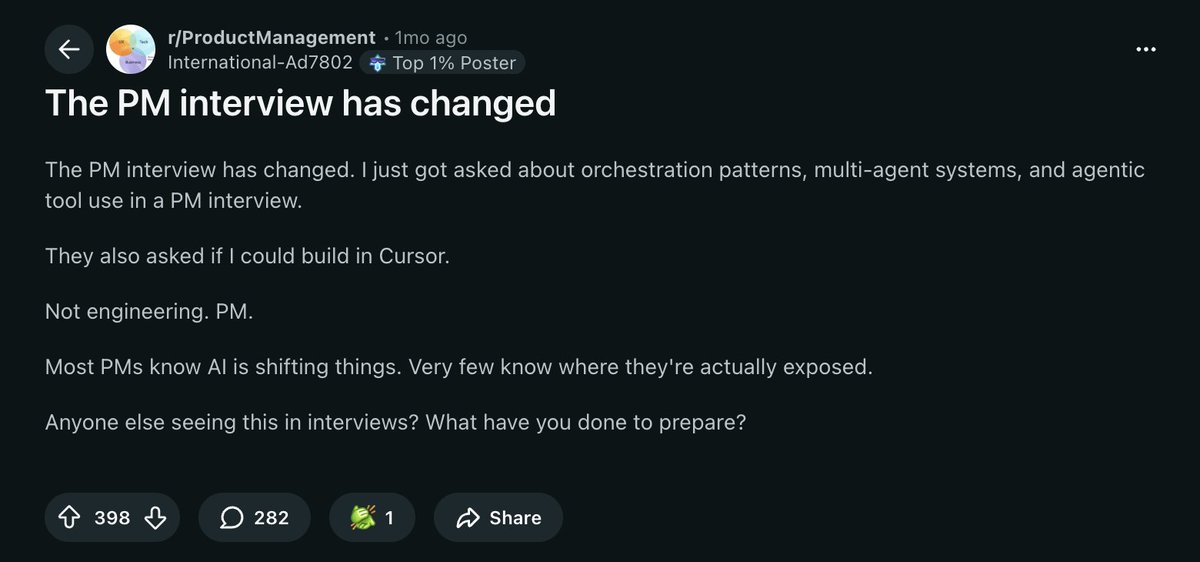
r/ProductManagement post: The PM interview has changed. Asked about orchestration patterns, multi-agent systems, and whether I could build in Cursor.

Aakash Gupta, who says he was hired at Google, Epic Games and Affirm, argues that PM interviews have shifted toward AI-specific skills such as evals, handling model error rates, and showing previously built work, and links to a round-by-round guide.

Original post · 1 min read
The PM interview questions that got me hired at Google, Epic Games and Affirm would not get me through a loop today.

Behavioral hasn't changed. Still the round people prepare for least, still where offers die.

Product sense looks different. The old version was "design a product for X." Today it sounds more like "the model is wrong 15% of the time, what ships."

Analytical got tougher in one particular way. Picking a metric is the starting point. Then comes the follow-up: what would make you drop it.

Technical has completely changed. Three years back, API basics. Today it's evals: how you got the golden set, what qualifies as a regression.

And there's a round that wasn't even part of the loop. Show me what you've built.

Every other question rewards preparation. That one only rewards having done the thing.

Full guide, round by round:
news.aakashg.com/p/ai-pm-interview-guide-2026?…
♥ 32 · ⟲ 4 · 👁 11.2KView on X ↗

Gokul Rajaram Shares Three Career Lessons for His Younger Self

Gokul Rajaram lists three pieces of advice for his 25-year-old self: build relationships without being transactional, cultivate high agency and independent conviction, and focus on the few things that truly matter. He cites a Tech Fit Talks interview as the source.

Original post · 1 min read
I would tell my 25 year old self three things:

1. Build relationships with people and don't be transactional.
2. Have high agency, be an independent thinker, build your own conviction and don't wait for consensus or approval.
3. Focus on the small set of things (in both work and life) that do actually matter.
Tech Fit Talks @tech_fit_talks
@gokulr's advice to his 25-year-old self:

• Put people and cultural fit first.
• Seek input, then make the decision.
• Protect your focus.

From Tech Fit Talks with Ethan Lockshin.
♥ 392 · ⟲ 43 · 👁 37.3KView on X ↗