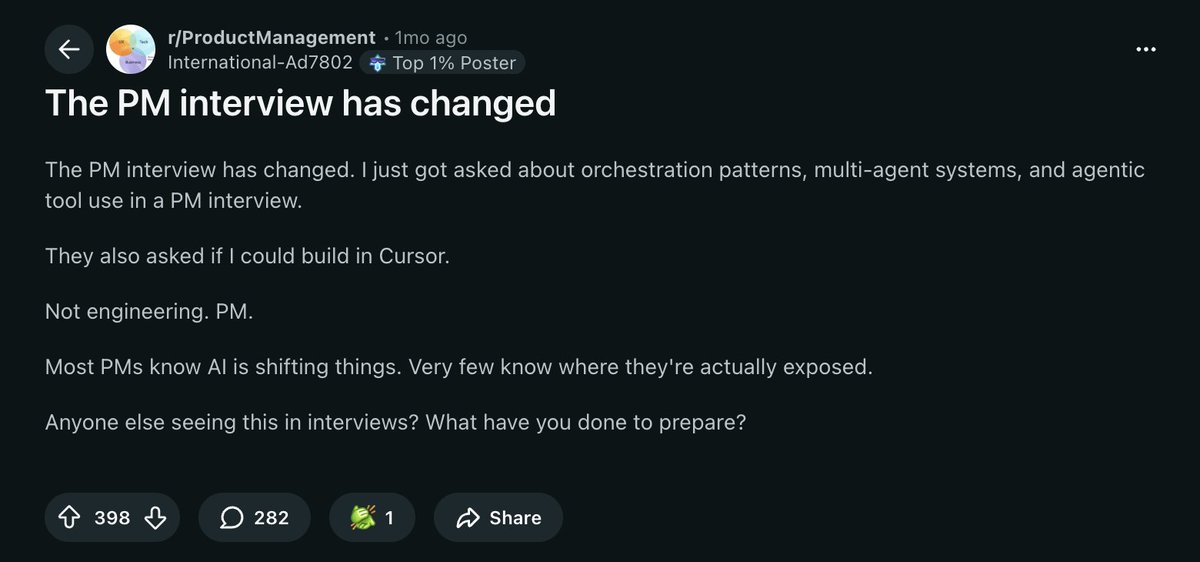
Aakash Gupta, who says he was hired at Google, Epic Games and Affirm, argues that PM interviews have shifted toward AI-specific skills such as evals, handling model error rates, and showing previously built work, and links to a round-by-round guide.
The PM interview questions that got me hired at Google, Epic Games and Affirm would not get me through a loop today.
Behavioral hasn't changed. Still the round people prepare for least, still where offers die.
Product sense looks different. The old version was "design a product for X." Today it sounds more like "the model is wrong 15% of the time, what ships."
Analytical got tougher in one particular way. Picking a metric is the starting point. Then comes the follow-up: what would make you drop it.
Technical has completely changed. Three years back, API basics. Today it's evals: how you got the golden set, what qualifies as a regression.
And there's a round that wasn't even part of the loop. Show me what you've built.
Every other question rewards preparation. That one only rewards having done the thing.
Gokul Rajaram lists three pieces of advice for his 25-year-old self: build relationships without being transactional, cultivate high agency and independent conviction, and focus on the few things that truly matter. He cites a Tech Fit Talks interview as the source.
1. Build relationships with people and don't be transactional. 2. Have high agency, be an independent thinker, build your own conviction and don't wait for consensus or approval. 3. Focus on the small set of things (in both work and life) that do actually matter.
Deedy shares a video summarizing Paul Graham's essay How to Do Great Work in under 200 seconds, crediting Opus for the assist. The post is a recommendation of the essay's core ideas.
A post recounts Clayton Christensen's final class, in which he asked students to apply his theory of company collapse to their own lives, citing his Harvard MBA reunion observations, and links a 19-minute lecture video.
this is insane. i genuinely don't understand why ambitious people aren't shown this lecture before their careers start consuming their entire lives.
clayton christensen spent his career studying why successful companies collapse. in his final class, he asked students to apply the theory to themselves: if you keep allocating your time the same way, what life are you actually building?
he had already seen the answer in his own harvard mba class. everyone looked successful at the fifth reunion; by the 10th, 15th, 20th, and 25th, many were unhappy, divorced, and living far from their children.
work shows you the score immediately. close a sale, ship a product, finish a presentation, earn a promotion, get paid.
an hour with your child may produce nothing you can measure today; it may take 20 years to understand what that hour built. so the next free hour goes back to work, one rational decision at a time.
this is how people build lives they never planned: through hundreds of right decisions that lead in the wrong direction, day after day.
money, titles, and headcount are easy to count. christensen believed a life should be measured by the people who became better because you were there.
he died in 2020.
one question remains: if someone saw only where your time, energy, and attention went this year, what would they think actually mattered to you?
How to fix your entire life in 1 day — If you're anything like me, you think new years resolutions are stupid. Because most people go about changing their lives in the completely wrong way. They create these resolutions because everyone
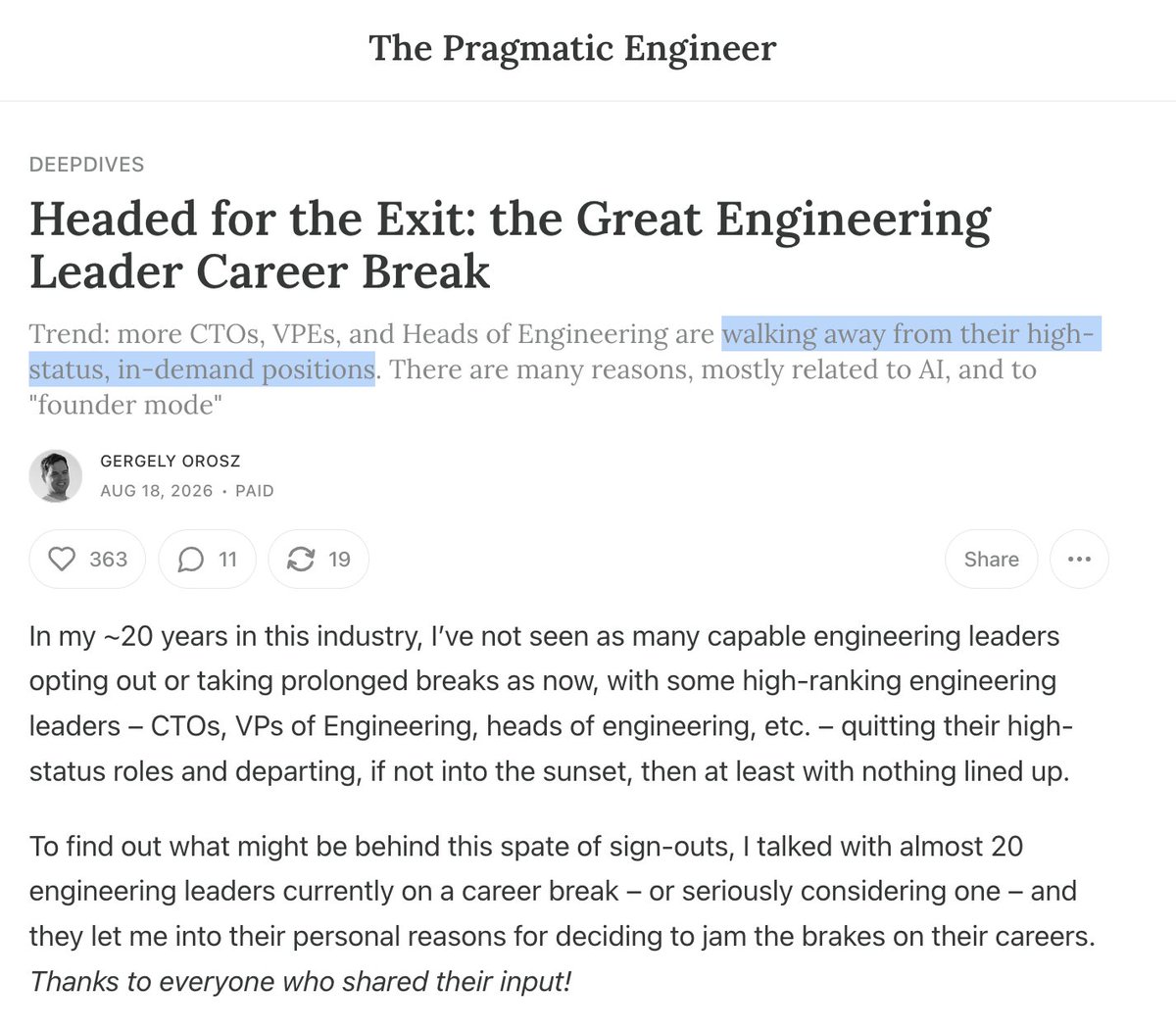
Gergely Orosz shares a LinkedIn post describing a company that divided its departing CTO's responsibilities into several distinct areas rather than appointing an acting CTO. Orosz links to his piece on the difficulty of hiring engineering leaders.
Read on LI: "Our CTO is leaving, and the obvious move would have been to appoint an acting CTO until we find a replacement. We decided not to do that. Instead, we split the role into several distinct areas of responsibility: "
Bret Taylor shares a celebration of Manat, who went from intern to engineer building voice products, after she demoed Tandem Voice and Persona Studio at a keynote, posing with her parents.
Manat started as an intern, and now she's an engineer building our voice products. She did an amazing demo of Tandem Voice and Persona Studio today. Here we are celebrating with her parents after the keynote.
Shopify CEO Tobi Lutke shares a habit of rereading the best old books, promoting it through a post by Shane Parrish that links to a long interview covering Shopify's internal AI use, AI strategy and the future of software.
My third conversation with Shopify co-founder and CEO @tobi.
0:00 How Shopify Uses AI 7:18 River: Shopify's Internal AI 8:55 How to Encourage Osmosis Learning 10:52 AI Dreaming and Self-Reflection 11:53 How to Use AI for Strategic Decision Making 14:11 The One Thing AI Cannot Do 16:04 What AI is Making Worse at Shopify 19:46 Predictions: Where AI is Headed Next 21:55 The Future of AI-Powered Software 24:40 Will CEOs Be Replaced with AI? 27:54 Can Superintelligence Be Controlled? 31:13 Critical Skills in AI Age 34:22 Why Complex Solutions are Usually Wrong 36:33 Conditions Needed for True Intu…
Grant Miller urges sellers to read a quoted Tim Denning essay on articulating a personal story, arguing that storytelling persuades more effectively than direct selling. The post is a short recommendation with no added data.
How to articulate your story like the top 0.01% — Most people are forgettable. And they don’t even realize it. On the surface, this doesn’t seem like a big problem. As you get older, though, it becomes catastrophic. I experienced it firsthand. I
Sam Dalrymple argues that Britain's American and Indian empires were deeply entangled rather than separate stories, illustrating the connection with a historical photo.
Far too often, we imagine Britain's first and second empires in America and India as two separate stories. Yet colonial India and America were deeply entangled.
Tim Denning promotes a Dominic Ng article on the neuroscience of post-work fatigue and why people scroll instead of resting or acting on goals. He predicts it should reach 100 million views.
Why You Waste Your Evenings (The Neuroscience of Post-Work Fatigue) — You're on the sofa. You know you should get up - exercise, read, cook a real meal - but you can't make yourself move. So you sit there, not resting, not working, scrolling through your phone while
Shreyas Doshi announces a free playlist of 23 candid videos answering career questions, available through Maven. The post links to his Product Sense course page offering the resources.
Announcing a brand new private resource: this is a playlist of 23 super candid videos of mine, with answers to your real career questions & dilemmas—no fluff, no BS, no nonsense.
Sunil Pai shares that his blog post on the senior engineer death spiral is drawing heavy engagement and DMs. He says it describes a counterintuitive but effective solution and hopes managers will use it to support their reports.
It’s been 2 hours and I can already tell this is going to be my most popular post. See the replies. And I’m getting so many DMs from people who went through the same, I’m glad it’s connecting. 2 quick things - - please consider the solution!! it’s counterintuitive and no one considers it but it’s super effective - I hope managers see this too and use it as a tool to help their reports
a friend just started a big job and asked for some advice. so I braindumped a monologue about a super common failure mode I see with engineers and posted it here, hope it helps whoever it can.
Sheel Mohnot describes a 1912 Piedmont house kept in one family and reflects on how past homes reflected labor and values. He speculates on how robots could reshape future home layouts and notes the low property tax.
We’re looking at a house for sale in Piedmont that has been in the same family since it was built in 1912. The seller just died at 101, having lived there ~her entire life, and it has only been updated minimally.
Good glimpse into how the relatively wealthy used to live, like: only 1 bathroom in a 4,000 sqft house (1st floor bathroom added later)… people didn’t start bathing daily until the 60s
Floor plans are a good map of what people valued at the time based on how they allocated space: Some of the bedrooms have their own sitting rooms, there’s a staircase for servants, and the kitchen is relatively small and tucked away because it was a workspace for staff, not the center of family life like today
I wonder how this changes in the future with robots in the household- maybe they get their own room for charging, maybe kitchens become smaller or hidden again as robots do more cooking, laundry rooms become automated utility spaces rather than rooms for humans, and storage could get denser because robots can retrieve things for us… or maybe we build bigger homes as maintenance and labor costs go down. Fun to think about.
Another artifact of staying in the same family for 114 years: the ad valorem property tax is only ~$1,350/year. If we buy and renovate, we’ll pay $50k/yr! This sale will be very lucrative for the city.
Grant Miller shares a neuroscience-based explanation of post-work fatigue from Dr. Dominic Ng, arguing that people try to fix exhaustion using the same depleted resource. The post is a light recommendation with little original content.
Why You Waste Your Evenings (The Neuroscience of Post-Work Fatigue) — You're on the sofa. You know you should get up - exercise, read, cook a real meal - but you can't make yourself move. So you sit there, not resting, not working, scrolling through your phone while
Harvard Business Review promotes a 2023 article arguing that candidates should prepare for common interview questions about strengths and weaknesses, since preparation can determine whether they advance.
Buzz shares a quoted post by @devoncnp arguing that wealth is a learnable skill and that people seeing large incomes online should recognize this. The post praises the piece as more useful than typical wealth content.
Your Entire Life Changes When You Realize Getting Rich Is A Skill Issue — You're scrolling on the internet and you see these people making a f*ckton of money. Hundreds of thousands of dollars a month, like it's nothing. You hear them say, "Yeah 30K? I make that in a day."
Harvard Business Review shares a link and post suggesting that employees who feel they are underperforming probably are, and offering advice. The linked 2019 article lists four reasons talented employees fail to reach their potential.
Grant Miller shares a quote from a Tim Denning post, stating that without feedback twenty years of experience is one year repeated twenty times, while focused feedback can let a few months outpace a career.
Once you understand pattern recognition your life will never be the same again — It’s easy for you to get fooled over and over again. That’s what it means to be human. You try to achieve the same goal multiple times and fall short. No matter what you do the result doesn’t seem to
Prukalpa responds to a Danielle Morrill post about reclaiming time from AI, arguing that keeping pace with fast-moving AI is time-consuming and that people should automate routine work to free time for learning and building.
I don’t know anyone who’s AI pilled right now for whom this is true. The pace of change is so high right now that keeping up with being AI pilled is pretty time consuming. Feels like this only way to keep up with AI is to use AI to automate mundane work and then use the free time to learn/ build.
the highest status move isn’t to merely be AI-pilled, it’s to reclaim massive amounts of time and mental burden and then go have a rich IRL life with relationships, hobbies, complexity and growth
Mark Suster recommends an essay by Jeffrey Katzenberg on AI for creativity, which describes a founder's computer-animated scene and an artist's reaction. Suster presents it as a case for storytelling over AI slop and as an explanation of Jevons Paradox.
A few months ago, I sat in my office in Silicon Valley and watched as a tech founder showed me something extraordinary. On the screen was a fully realized, beautifully lit, well-composed animated scene. It was stunning and it made me feel exactly what I felt in 1986 watching Luxo Jr. That was the first time I watched a computer-animated 3D character take a breath and seem, against all reason, to have life. It left me in awe.
Later that day, I received a text from an artist I've known for thirty years, 350 miles to the south, in …
DHH writes that letting good people live in a fantasy world that no longer exists is unkind, and that they should be told the truth so they can adapt to the future.
There's nothing kind about letting good people live in a fantasy world that no longer exists. You have to tell them, even if it hurts. Because the sooner they accept reality, the sooner they can adapt to the future.
Grant Miller urges followers to read a post, quoting Logan Gott's argument that posting publicly online is the highest-return career decision, citing Gott's first online earnings from affiliate marketing at age 15.
Posting online is the highest ROI decision you will ever make for your career — When I was 15 I made my first $25 on the internet. It was affiliate marketing for some small Gumroad product. I posted about it for a while, talked to a few people, and eventually 1 person bought.
Josh Elman observes that software engineers have historically combined strategy and hands-on building unlike other engineering fields, and says that combination has intensified now. He endorses a speech by Scott Stevenson urging engineers to keep happy memories, stay grounded in reality, and stay excited about the future.
Software Engineering used to be such a different type of engineering from other fields - where you did both the strategy and the manual chiseling. (mechanical engineers don’t do the rivets)
Now Software Engineering is a whole new level of making. Great speech below
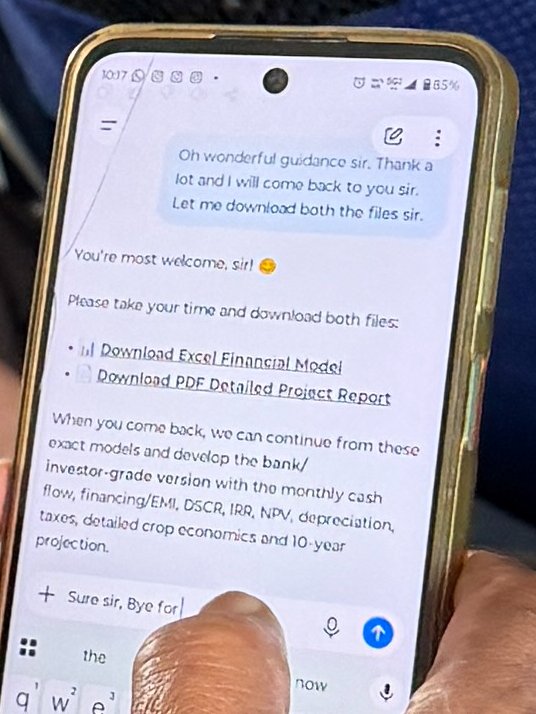
A traveler describes a 77-year-old passenger who spent the flight developing a vertical farming business plan with ChatGPT and respectfully calling the AI "sir." The post is a lighthearted anecdote with photos.