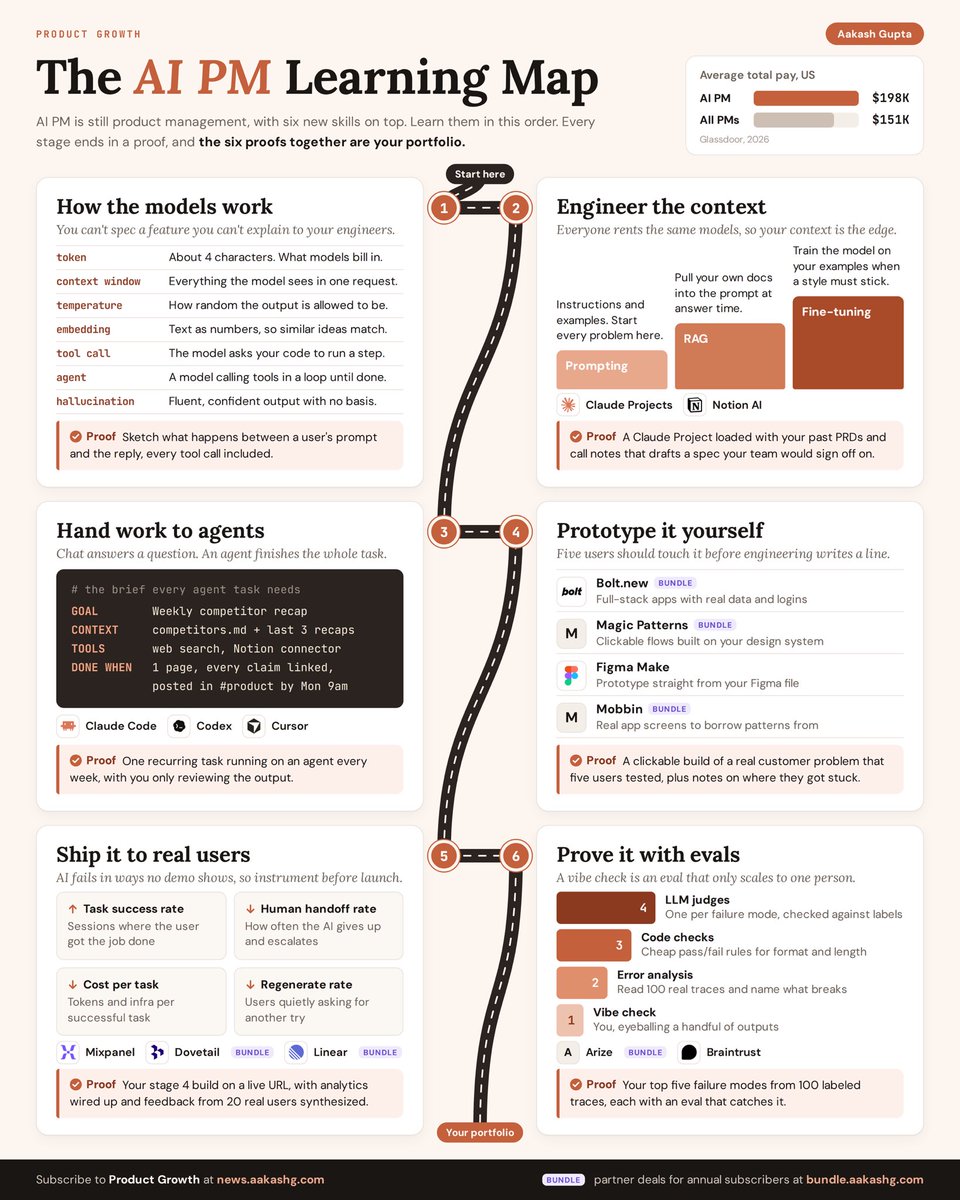
To become an AI PM, you need six skills on top of core PM. Here's the order to learn them.
The pay gap is why it's worth it. Glassdoor puts the average AI PM at $198K in total pay, against about $151K for PMs overall.
Most AI PM learning maps I see are generic PM concepts with "AI" in the title. They skip what hiring managers screen for, which is proof you've done the work.
So in this map, every stage ends in something you can show.
1. Learn how the models work
Tokens, context windows, embeddings, tool calls, agents. You don't need to train a model, but you should be able to sketch everything that happens between a user's prompt and the reply. A PM I coach hit exactly this depth check in technical screens at both Nvidia and Glean.
2. Engineer the context
Everyone rents the same models, so the edge is what you feed them. Climb only as far as you need. Prompting first, RAG when answers depend on your data, fine-tuning when a style has to stick. Your proof is a Claude Project loaded with your past PRDs that drafts a spec your team would sign off on.
3. Hand work to agents
Chat answers a question. An agent finishes the whole task, as long as your brief has a goal, the right context, the tools it can touch and a clear definition of done. Your proof is one recurring task, like a weekly competitor recap, running on Claude Code or Codex while you only review the output.
4. Prototype it yourself
Alex Danilowicz, CEO of Magic Patterns, said on my podcast that the classic mistake is spending two hours debugging a database when all you needed was a clickable mockup to show five customers. Reach for
Bolt.new when you need real data and logins, and Magic Patterns for flows on your design system.
5. Ship it to real users
AI fails in ways no demo shows. Before launch, instrument task success rate, human handoff rate, cost per successful task and how often users hit regenerate. Then put your prototype on a live URL and synthesize feedback from 20 real users.
6. Prove it with evals
A vibe check is an eval. You're using your own brain as the scoring function, which works right up until you're the bottleneck. Hamel Husain and Shreya Shankar walked me through the sequence I'd copy. Read 100 real traces, name the failure modes, add cheap code checks, then build one LLM judge per failure mode and check it against your own labels.
Your proof is your top five failure modes, each with an eval that catches it.
Stack all six proofs and you have an AI PM portfolio.
A deep dive for each stage
1. AI foundations →
news.aakashg.com/p/ai-foundations-for-pms2. Context engineering →
news.aakashg.com/p/context-engineering3. AI agents →
news.aakashg.com/p/ai-agents-pms4.
Bolt.new guide →
news.aakashg.com/p/pm-guide-bolt5. AI evals →
news.aakashg.com/p/ai-evals6. LLM judges →
news.aakashg.com/p/ai-pm-llm-judge7. AI PM portfolio →
news.aakashg.com/p/vibe-code-pm-portfolioLearn the stage. Then ship the proof.