Wednesday, October 7, 2026ArchiveSearchAsk the paper

The Computomatix Times

All the posts fit to save — curated from @computomatix's bookmarks & likes on X

Edition of Wednesday, April 15, 2026

10 stories

AI8/10

Dwarkesh Patel Publishes Long-Form Interview With Nvidia's Jensen Huang

Dwarkesh Patel Publishes Long-Form Interview With Nvidia's Jensen Huang▶

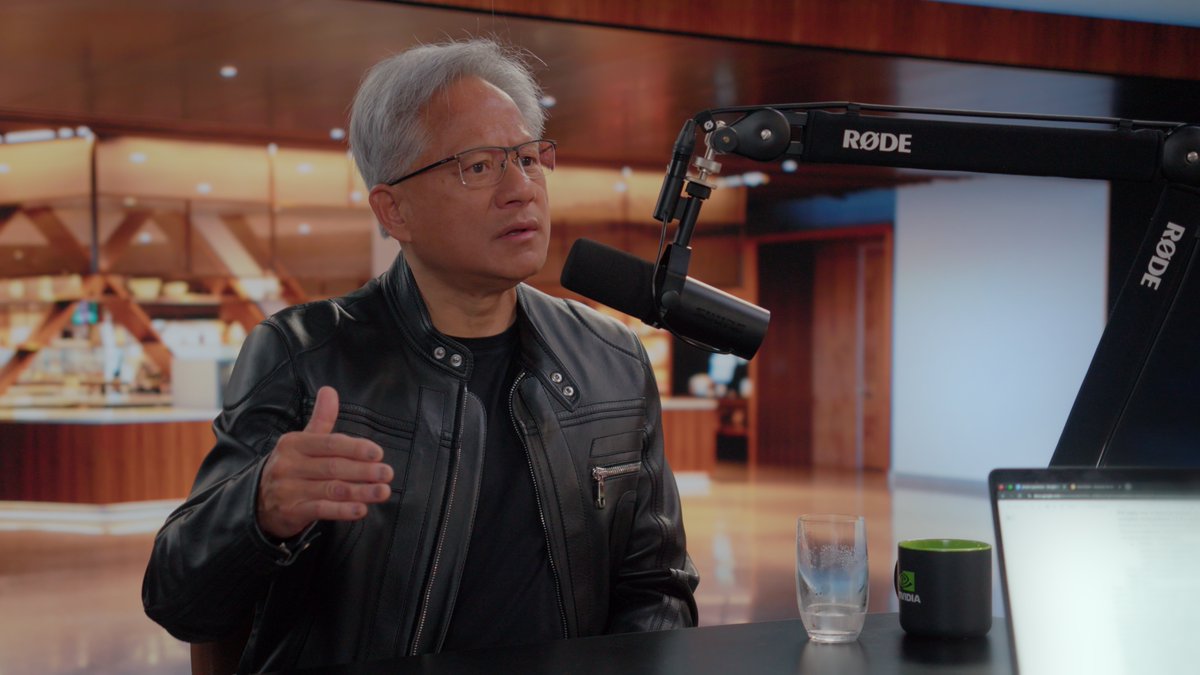
Dwarkesh Patel announces a podcast episode with Nvidia CEO Jensen Huang covering supply chain moats, competition from TPUs, whether Nvidia should become a hyperscaler, AI chip sales to China, and chip architecture strategy. Chapter timestamps are listed.

Original post · 1 min read
The Jensen Huang episode.

0:00:00 – Is Nvidia’s biggest moat its grip on scarce supply chains?
0:16:25 – Will TPUs break Nvidia’s hold on AI compute?
0:41:06 – Why doesn’t Nvidia become a hyperscaler?
0:57:36 – Should we be selling AI chips to China?
1:35:06 – Why doesn’t Nvidia make multiple different chip architectures?

Look up Dwarkesh Podcast on YouTube, Apple Podcasts, Spotify, etc. Enjoy!
♥ 8.6K · ⟲ 1.1K · 👁 6.3MView on X ↗

Ryan Wiggins Details Building a Local Second Brain With Claude Code

Creating a Second Brain with Claude Code

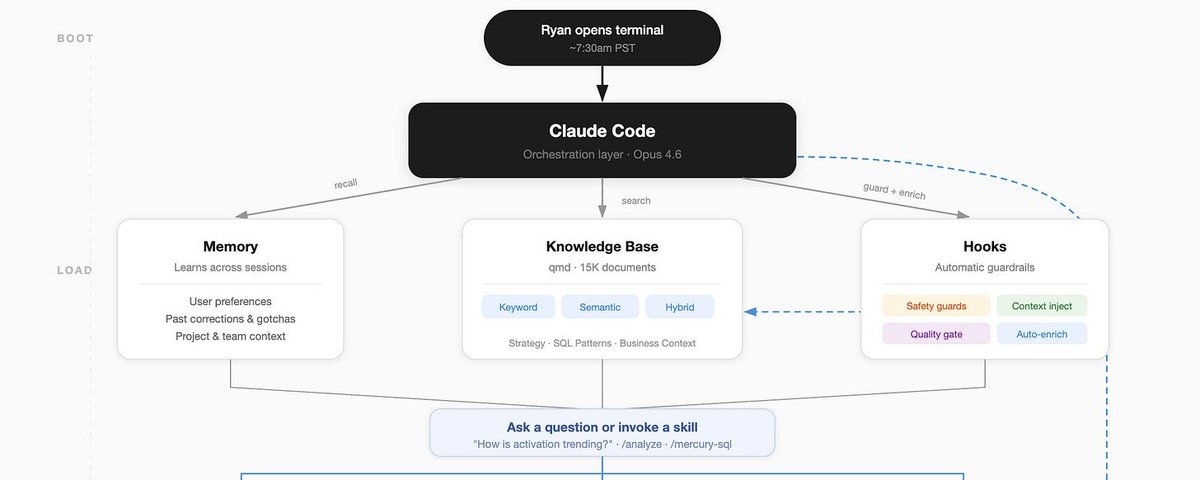
Mercury VP of Product Ryan Wiggins published a long article describing a locally run personal knowledge system built with Claude Code, indexing about 15,000 documents using QMD vector search, with hooks, orchestrators and MCP/CLI tools. He says it doubled his productivity and includes the workflow and prompt.

Original post · 11 min read
X ArticleCreating a Second Brain with Claude Code
I've 2x’d my productivity as a VP of Product @mercury by creating a "Second Brain" using 5 years of work history, 15k docs with 3.5 million words, and every tool in my stack. It runs locally, is a core part of my every use of LLM, and gets better everyday.
Today, I want to share the stack, the workflow, and the prompt to build it:
Background
I am a VP of Product for @mercury, which is a long way of saying I'm in a lot of meetings, consuming a lot of content across different tools (linear, slack, notion, data analyses), and trying to make sure I actually get stuff done. Working at a company for 5 years and being an information addict, I am essentially a walking encyclopedia for Mercury post 2021-today -- but I've recently found that my scope + workload means I can't keep every plate spinning.
One day, I was scrolling X and came across a series of posts that caught my attention, starting with @tobi's QMD. QMD is a local vector search, and then a few other posts started to show up that connected a few dots for me:
Claude Code launched hooks (per-event prompt injections)
GasTown / OpenClaw launched with the power of orchestrators writing memory + delegating to sub-agents (among many other patterns)
MCPs/CLIs hit a critical mass, and enough of my core tools were available without having to ask admins to give me API keys
@tylercowen did an interview and talked extensively about "writing for AI" in a way that struck a chord - how much output of work already exists that I'm not using?
I decided that it was time to build
Prep work (~1-2 hours end to end)
To start, I needed a library of all the content I could know about... so I downloaded every document I've ever created for my job at Mercury + any relevant product strategy, analysis, retro, reflection on execution, etc. This netted out to over 15k documents and 3.5 million words. Maybe I've read them all, but I've forgotten most. These became a folder that I just called "raw data", and I ran QMD to index this on my computer.
To see if this worked, I used Claude Code to ask about random memories and surprising insights from this knowledge base - the amount of delight/surprise I experienced in seeing how much more capable vector search was than text-based search gave me the confidence to keep going. I asked one questions about books that it would think I like, and it was spooky how good of recommendations it gave me. I think this is my best advice in this journey: test every step of the way! Easy to get caught in hill climbing a local maxima
Train my brain and connect it to my tools (~2 hours)
With all the raw data, I needed to help it make sense of me + what my goals are + the tools I used, so pursued three paths:
Explain myself - to be able to create a second brain, it needed to know what mine was doing. I wrote up a me.md explaining who I am (work + life), gave it my goals + performance reviews for the last 5 years + set of personal priorities. The most humbling part was the system pointing out that I've been making the same strategic mistake for years, according to my own performance reviews, and was making it that week as I was setting up the system
"Distill" the data - I spun up an agent team to use the me.md + the knowledge base to create a set of docs between me <> raw knowledge base. This idea largely came from the idea that LLMs regularly distill down smaller models to take tasks, and I had no idea if it would help me in this, but Agent Teams had just launched and so I had a swarm of them find the main "themes" we've worked on from the knowledge, give sourced histories of this, and summarize key lessons. These created a context.md folder
Tools - I use a few tools (Google Docs, Linear, Notion, Metabase) , and luckily most have connectors on Claude Code or these companies are actively launching MCPs/CLIs. A few didn't, but I spun up specific skills that crafted direct API calls to be able to complete tasks like "run a query for XYZ".
Claude had access to all the information about me + the tools I used + had a massive library of all my work, but did it really know anything? Does anyone?
Wire it up (<1 hour)
At this point, I had so many words + documents that it was time to actually find use or abandon ship. But I didn't want to have to go search this every time and that's when "hooks" caught my attention.
Hooks from Claude Code let you insert content into your prompt without needing to ask (or when a session starts, after a tool use, or when a session stops). Using the UserPromptSubmit hook, I enabled my Claude Code to use qmd to find names + topics + specific documents related to my prompt.
This is a nerd-out moment, but when searching for files in Finder, it is mostly a name + raw text search.... but QMD can help bring context into searches. My system is tuned to figure out a query, then returns results using one of two techniques:
vsearch (semantic/vector) — understands meaning of my question. "How's the funnel performing?" finds … continue on X ↗
♥ 922 · ⟲ 120 · 👁 313.4KView on X ↗

DHH Says Cloud Exit Cut Hosting Bill to About $1 Million a Year

David Heinemeier Hansson says his company's hosting and support costs fell from about $3.9 million in 2023 to roughly $1 million a year after leaving the cloud. He projects around $4 million in total savings by year-end, including hardware purchases.

Original post · 1 min read
In 2023, we spent $3,934,099 on AWS + other hosting. In 2026, our hosting + support bill is down to ~$1m/year due to the cloud exit. Even including all the hardware buying, we will already have saved ~$4m by the end of this year. And going forward, it's ~$3m/yr in savings 🤑
♥ 6.8K · ⟲ 324 · 👁 705.9KView on X ↗

Aakash Gupta Releases Mock System Design Interview for AI PM Roles

Aakash Gupta Releases Mock System Design Interview for AI PM Roles▶

Aakash Gupta shares a recorded mock of a system design interview for senior AI product manager roles, with segments covering the question, AI system pillars, metrics and evals, and feedback. The video targets candidates preparing for $1M+ AI PM interviews.

Original post · 1 min read
The hardest round in any $1M+ AI PM interview: system design.

I recorded the world's first mock on it:

1:09 - Question presented
16:53 - AI system pillars
27:25 - Metrics and evals
35:43 - Feedback
♥ 80 · ⟲ 10 · 👁 154.3KView on X ↗

Peter Yang Shares 15 Observations From Two Weeks in China

Product builder Peter Yang recounts a two-week trip to China and links to 15 observations on work culture, electric vehicles, cheap delivery and daily life. He argues every product builder should visit to understand the economy.

Original post · 1 min read
I recently came back from a 2-week trip to China and it was eye-opening to see how the world's second largest economy operates.

I think every product builder should visit at least once to understand:

→ Chinese AI work culture
→ Electric vehicles, $2 delivery, and more
→ How people in China live and work

📌 Here are 15 observations from my visit: creatoreconomy.so/p/15-observations-on-work-an…
♥ 305 · ⟲ 24 · 👁 39.3KView on X ↗

Essay Defends Jack Dorsey's Record Across Twitter and Block

Dorsey Mode: Why Tech's Most Misunderstood CEO is Right Again

BuccoCapital Bloke's article argues Jack Dorsey's execution missteps at Twitter and Block stem from the same visionary trait that anticipated major shifts in payments and social media. It cites the Afterpay acquisition, the Tidal deal and Block's market cap as evidence of his mixed record.

Original post · 12 min read
X ArticleDorsey Mode: Why Tech's Most Misunderstood CEO is Right Again
Jack Dorsey is a man of contradictions.
He is the only founder to have two companies - Twitter and Block - join the S&P 500. This is an unbelievable accomplishment, surely one of the most impressive in business history.

This article was originally published on my blog. I'll occasionally syndicate them on Twitter but subscribe there if you want all the articles in real time.
educatedguesser.substack.com/welcome


Twitter is a real-time broadcast from your pocket to the world. It is the global nervous system for news, politics and culture. It remains that way today despite new ownership (a true testament to the power of the idea and the network).
Square took the $1,000 payment terminal and compressed it into a $10 piece of plastic that revolutionized small business commerce.
He was CEO of both companies simultaneously. During this period Twitter was famously described by Mark Zuckerberg as a “clown car” while Block let Toast, Stripe, and Shopify steal its lunch right out from under its nose. Both companies became bloated, sprawling fiefdoms and were eventually gutted (Twitter, famously by Elon Musk, and Block/Square/XYZ by his own hand). The divided focus did not work.
It’s become fashionable over the last few years to use Jack’s track record of executional missteps to dismiss him, and his ideas, entirely.
And to be fair, it hasn’t been the prettiest few years:
He bought Afterpay at an announced price of $29B (at least he used stock for the acquisition). Block’s market cap four years later? $38B.
He bought Tidal. Tidal! I think there was a reason besides being friends with Jay-Z but I can’t remember it.
Elon cut 80% of Twitter and the team ships faster today than they ever did during the Dorsey Era.
Oh, and we can’t forget the time he turned himself into a literal blockhead.

People struggle to hold these two Jacks in their heads at the same time. And after the last few years, they focus on the execution missteps and dismiss the innovator who is able to see the future, pull it forward, and put it in your pocket before people even realize the world has changed.
What they don’t realize is that these two sides of Jack Dorsey are two sides of the same trait.
The Jack who can’t sit still long enough to rigorously run a mature organization is the same Jack looking out five years, realizing the world will be radically different, and taking the knife to his own company. The Jack that lets his companies get way too big is the same Jack who can recognize the structure is now a noose in the AI era, and cut 40% in one go while his peers cut 10% each year and call it performance management.
Introducing: Dorsey Mode
Given Jack’s track record, I listened with real interest to his recent appearance on @bhalligan Long Strange Trip, where he and Roelof Botha deconstructed what Halligan is now cheekily calling Dorsey Mode, Jack’s radical new approach to management in the AI era.
youtube.com/watch?v=YTVSwOY19Qs
I’ll be honest. When Block announced the 40% layoff, I dismissed it. You can read what I said on Twitter right after the news dropped. I indexed way too hard on “unfocused” Jack without considering “visionary Jack.”
I said it had nothing to do with AI. I was wrong.
After listening to the full conversation, I’ve updated my position. Jack is pulling forward the future again and rebuilding his company for where AI is going to be.
He’s done this a few times now, and people always laugh at him. But more often than not, he’s right. Hell, the fact that his ideas keep working despite his execution probably means the ideas are twice as powerful as we give them credit for.
So here’s my updated read on Dorsey Mode, the four parts of his thesis that I think actually matter, and why I think Jack is early and right. Again.
The Four Big Ideas Behind Dorsey Mode
1. Cut 40% now
Brian Halligan: You laid off 40 percent of your employees. You know, Ruth Porat’s got this good line—if you’re gonna eat a shit sandwich, don’t nibble.
Jack Dorsey: We’d been making changes on the edge, like going from a GM structure to a functional structure to reduce—like, putting a cap on our layers to four—me plus four—and all these small things. But if we were to really reboot and rebuild the company, would we end up where we look today? And the answer was uniformly no.And I think generally I wanted to make sure that we—if we knew that this was what our company was going to be in the future, I didn’t want to have to do it with our backs against the wall. We’re a public company, and there’s various challenges there. And other companies will probably get to this realization at some point. I don’t want to react to that.I want to be ahead of it, because then we can do it with a lot more integrity. We can do it with a lot more generosity for the people that we’re asking to leave, and even for the people that we’re asking to stay. And we’re not just reacting into something mediocre. We’re acting towards excellence. And that’s just the tone t… continue on X ↗
♥ 404 · ⟲ 35 · 👁 132.7KView on X ↗

OpenClaw Agent Runs a Vending Machine at Frontier Tower in San Francisco

OpenClaw Agent Runs a Vending Machine at Frontier Tower in San Francisco▶

Charly Wargnier highlights an AI agent built by cvander that operates a physical vending machine at Frontier Tower, choosing products, writing ads, tracking sales and raising prices. The post credits Scobleizer for the accompanying video.

Original post · 1 min read
SOMEONE PUT AN OPENCLAW-RUN VENDING MACHINE IN SAN FRANCISCO 🤯

An AI agent is running an actual physical vending machine.

Huge shoutout to @cvander who built this masterpiece at Frontier Tower.

The agent is literally the CEO deciding:
> what to sell
> names the products
> creates the ads
> tracks the sales dashboard

.. it even jacked the prices way up, and justified it because people kept buying 😅

She also runs her own Instagram and controls her own bank account.

AI agents are taking over. We have fully entered the simulation.

(video by the legendary @scobleizer)
♥ 395 · ⟲ 65 · 👁 56.6KView on X ↗

Lenny Rachitsky Opens Up About His Life in First Round Profile

Lenny Rachitsky Opens Up About His Life in First Round Profile

Lenny Rachitsky shares a First Round Review profile in which a writer spent hours at his home discussing why he started his newsletter, what motivates him, and personal details rarely shared publicly.

Original post · 1 min read
I rarely do interviews or talk about my personal life, but I made an exception for the team at @firstround.

Their writer spent hours at my house. We talked about why I started Lenny's Newsletter, what motivates me to keep building it, and a lot of things I don't usually share publicly.

It's an intimate look at what my life is actually like outside of what most people see on the podcast.

Check it out: review.firstround.com/reluctantly-influential-…
♥ 681 · ⟲ 45 · 👁 103.1KView on X ↗

Jon Stewart Amplifies Ben McKenzie on Crypto Sanctions Evasion

Jon Stewart reposts a Weekly Show clip in which Ben McKenzie discusses how crypto helps criminals and hostile states evade sanctions and alleges Commerce Secretary Howard Lutnick profits from it. The post itself contains no substantive detail beyond the quoted clip.

Original post · 1 min read
This will blow your fucking mind!!!!!
The Weekly Show with Jon Stewart @weeklyshowpod
.@ben_mckenzie on how crypto helps criminals and hostile states evade sanctions — and how Commerce Secretary Howard Lutnick profits from it. #theweeklyshow #jonstewart #politics
♥ 8.0K · ⟲ 2.2K · 👁 689.4KView on X ↗