Wednesday, October 7, 2026ArchiveSearchAsk the paper

The Computomatix Times

All the posts fit to save — curated from @computomatix's bookmarks & likes on X

Edition of Thursday, May 14, 2026

3 stories

Developer Runs Codex Across Mac Mini and MacBook From Phone

Developer Runs Codex Across Mac Mini and MacBook From Phone

Nick describes running the Codex app on a always-connected Mac mini and a MacBook, linking both devices so threads can be started and resumed from either, with mutual SSH for file access.

Original post · 1 min read
My laptop has become a “satellite device” since I started using Codex from my phone. And my Mac mini has become the “home.” It’s clunky, but the end state feels more like how we’re going to be working in the near future:

I’m currently running the Codex app on 2 devices:
1. my MacBook
2. my Mac mini

My laptop isn’t reliably connected to Wi-Fi enough, so I keep a Mac mini on my desk that is always connected.

When I kick off new threads from my phone, I start them on the Mac mini. When I’m working from my desk, I run them there too.

The cool part is that I’ve added my MacBook and Mac mini as connected devices to each other. That means I can start and resume threads from either device. So if I’m in a meeting but want to continue a thread on my laptop that was started on my Mac mini, I can do that.

I’ve also set up mutual SSH for Mac mini <> MacBook, so files are easy to access from either side. It’s not fully seamless yet, but the model works.

What this means:

- I have an always-on Codex that is accessible from my phone, with its own dev environment
- All threads are always accessible from any of the 3 devices
- I can run heartbeat threads that stay on 24/7

It’s a little makeshift today, but the shape of it feels very real to me: Codex is no longer tied to whichever computer happens to be open in front of me. It starts to feel like something I can stay connected to across whatever device I’m using.
♥ 1.8K · ⟲ 106 · 👁 424.8KView on X ↗

Matt Epstein Outlines Claude Code Formula for Viral Launches

The secret behind every Viral Launch...

Matt Epstein promotes an X article claiming his team has run 30 major launches using a Claude-driven system built around research and a 'bold claim' positioning approach. Mostly promotional with limited concrete detail in the excerpt.

Original post · 9 min read
X ArticleThe secret behind every Viral Launch...
We've done 30 of the largest launches on X.
They all follow a specific formula that can be copied again and again... using Claude code.

In this I will show you how and exactly how to get millions of views for your launch with 95% of the process being done by Claude for you.
Most people use AI the same way they use Google. They open ChatGPT or Claude, type in one prompt, take the first answer, maybe ask it to “make it better,” and then call it done.

That is exactly why most AI-written content sounds like garbage. It has no taste, no structure, no research, no editorial judgment, and no understanding of what actually makes people stop scrolling.
We do not use Claude as a writer. We use Claude as an operating system for launches.

The secret behind every viral launch:

A viral launch s the result of: research, positioning, novelty extraction, hook writing, narrative structure, proof, demo flow, editing, and distribution.

95% of the success of launch comes down to what we call the "BOLD CLAIM"

This is what you are introducing and what makes it different than anything else out there.
For example: If you say "introducing the worlds first AI ad maker" you likely will not go viral in todays landscape, you might have 2 years ago. Why? There are a million AI ad makers out there and the way you are positioning your product is not novel.
If you say "introducing the worlds first AI ad orchestrator that makes ads with your content and kills AI slop" you have a much higher liklihood of going viral because this is NOVEL and it solves a BIG pain point in the market.
Most founders build thier launch positioning based on what THEY think the market wants, rather than relying on first party data to show what the market wants and what they hate to counter position against.

We built a system that forces Claude to do intense research to figure out how to position any product based on: Youtube outliers, deep reddit research, EVERY launch on X + 200 other data sources.
This research creates a 10x HIGHER liklihood that your launch will resonate. A video/product that resonates in market is the difference between a launch that books HUNDREDS of demos and one that books NONE.
The crazy part: Our research has literally uncovered key motivators of market that has changed the development teams of the companies we work with. Knowing what your market DEEPLY wants and VALUES shouldn't only change the way you market, it should change what you build.


Here's how it works:
Inside Claude Code, we run a group of 21 specialized agents. Each agent has one job. One researches the market. One studies viral launches. One finds what customers are already saying. One pulls out the product’s most novel claim. One writes hooks. One critiques tose hooks. One rewrites them. One checks if the narrative is actually interesting. One checks if every line makes the product feel more important.

Each step passed through a Manager step. This agent's job is to check the work, and give feedback to the agent it manages.

The key is that Claude is not allowed to just “write the launch.” That is how you get AI slop. Instead, Claude has to move through a process where every piece of the launch gets attacked, rewritten, scored, and improved before it gets to the final version.
Before a single line is written, the system starts with research. It looks at the company, the product, the market, the competitors, the category, the founder story, and the existing customer language around the problem. Then it studies what has already gone viral in similar categories and starts pulling out patterns.
If you look at the image above, you'll see something called the Mom test agent. We trained this agent on my mom: a 61-year-old woman who only knows how to use Facebook. this agent is trained to call out things that my mom wouldn't understand in the launch script. if you want a super viral launch (say 10 million views) your content needs to be easily understandable by anyone who's extremely non-technical or even extremely low IQ. you could call this a mass market test. I call it the Mom test

This is one of the biggest differences between average launch content and content that actually moves. Most people write from what they want to say. Great launch content starts with what people already care about.
If you are launching a product, nobody cares that you “built a platform.” Nobody cares that you “help teams save time.” Nobody cares that you “streamline workflows.” Those are dead phrases. They sound like every B2B SaaS homepage on the internet.

That is why the research phase matters. Claude is not just looking for information. It is looking for the strongest possible angle. The thing that makes the product feel novel, urgent, obvious, or inevitable.

Once we have that, Claude moves into the hook.
The hook is where almost every launch dies.
Most launch hooks are polite. They sound like the founder is trying to be professional instead of trying to earn a… continue on X ↗
♥ 1.0K · ⟲ 44 · 👁 581.8KView on X ↗

Open-Source Bot Automates Trading on Polymarket BTC Markets

Open-Source Bot Automates Trading on Polymarket BTC Markets

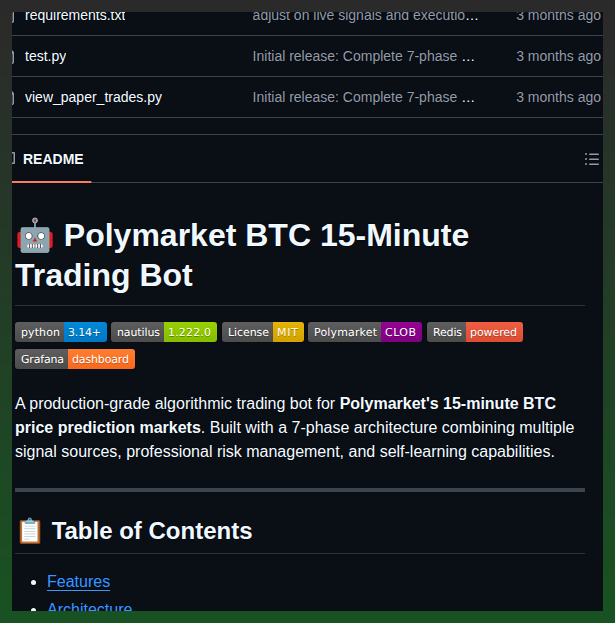
Tom Dörr shares a GitHub repository for an algorithmic trading bot that automates 15-minute Bitcoin price prediction trades on Polymarket, combining multiple signal sources and risk management.

Original post · 1 min read
Automates 15-minute BTC trades on Polymarket

github.com/aulekator/Polymarket-BTC-15-Minute-…
github.comGitHub - aulekator/Polymarket-BTC-15-Minute-Trading-Bot: A production-grade algorithmic trading bot for Polymarket's 15-minute BTC price prediction markets. Built with a 7-phase architecture combining multiple signal sources, professional risk management, and self-learning capabilities.A production-grade algorithmic trading bot for Polymarket's 15-minute BTC price prediction markets. Built with a 7-phase architecture combining multiple signal
♥ 450 · ⟲ 60 · 👁 30.2KView on X ↗