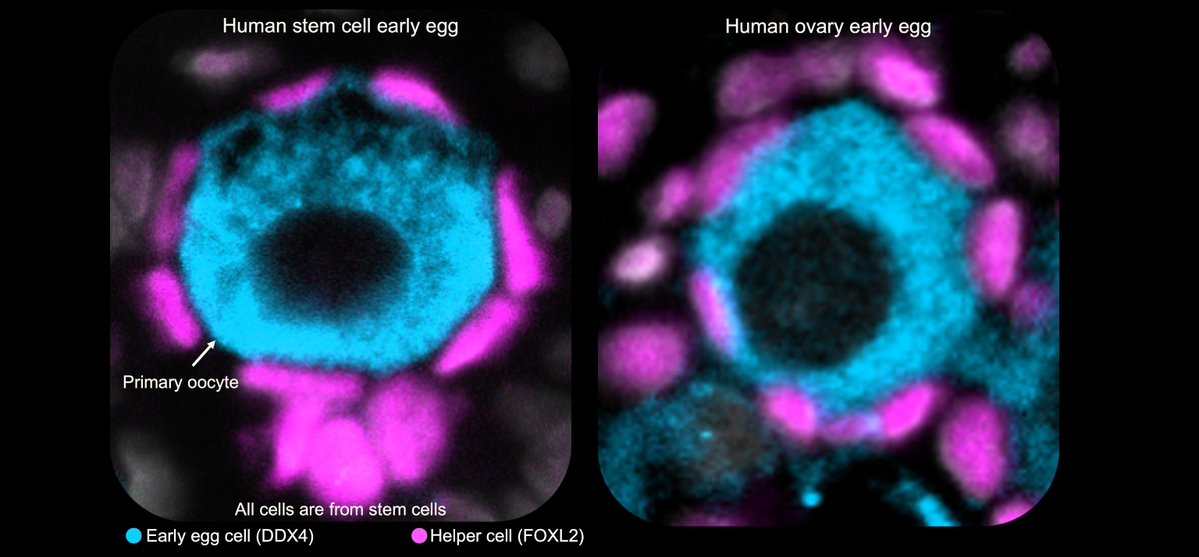
Matt Krisiloff announces that Conception has generated the first early human eggs derived from stem cells. He frames the result as a major step with real potential to redefine fertility, shared with a photo.
Patrick O'Shaughnessy's video and quoted post describe Etched's claimed inference innovations: low-voltage operation for more FLOPs per watt and cluster-scale memory bandwidth. The company says these enable over 80% MFU on trillion-parameter models, versus 20 to 50% on GPUs.
Inference will never be the same: Etched invented two new ways to massively improve compute cost, speed, and per watt efficiency: low voltage inference (more FLOPs) and cluster scale memory (memory/bandwidth)
The combination runs trillion-parameter models at over 80% MFU, where today's GPUs deliver 20 to 50%.
"Everyone said you can't run at voltages lower than GPUs. That was dissatisfying, because plenty of other chips already do.
Bitcoin miners run at under a quarter of the voltage of GPUs. We found a new mechanism to run at much lower voltages, and we think all AI chips in the future will be low voltage chips.
People ask how much memory bandwidth is on your chip. You should be asking how much is on your full scale-up cluster.
We added far more bandwidth at much lower latency from chip to chip."
Three years ago, two Harvard dropouts set out to build a better AI chip than the largest companies in the world.
Almost everyone I called at the time said it was impossible.
Today, Etched (@Etched) comes out of stealth with $800M total raised, $1B in signed customer contracts, and a working next-gen AI chip.
This was my excuse to ask the two founders, @UbertiGavin and @robertwachen, every question I have about compute and inference.
We discuss: - Why they built an entire rack and not just a chip - The two technical bets behind their architecture no one else has tried - How two founders in …
Tanay Jaipuria poses the dilemma facing product companies: build the agent users open daily, or power the agents users already run in Claude or Codex via MCP, and links to a fuller essay on headless products.
Every product company is facing the same dilemma right now: Do you try to be the agent your users open every day, or do you accept they already live in Claude/Codex and power that agent instead?
Wrote about how to think through it and what building an MCP business might entail
Aarthi Ramamurthy praises a tool shared by LandseerEnga that scans iOS apps against Apple's guidelines before submission, covering payments, privacy manifests, sign-in flows, and metadata. It also works as a Claude Code and Codex skill that automatically fixes issues it finds.
Vakyam AI has launched Raaga V1, a text-to-speech system for Indian languages that it says offers frontier-level quality at ₹0.75 per 1,000 characters, with a public playground for testing.
Johnn shares a detailed prompt and sample video generated with Seedance 2.0 on OpenArt AI. The clip imitates early-2000s camcorder footage of a young woman in a Korean residential alley, showcasing the model's realism and identity consistency.
Prompt: Main subject: young Korean woman, early 20s, natural everyday appearance, faded charcoal-grey sleeveless crop top, loose high-waisted light-wash jeans, black canvas sneakers, black cord necklace, black wavy hair in a messy side ponytail with wispy bangs. Realistic skin texture, minimal makeup, warm and approachable personality. Maintain consistent identity, clothing, hairstyle, and appearance throughout the entire video. Location: Authentic Korean residential neighborhood during a calm late morning. Narrow concrete alleys, low-rise homes, small terraces, potted plants, laundry lines, bicycles, utility poles, overhead wires, mature trees casting moving shadows, quiet residential atmosphere. No stores, advertisements, cafés, crowds, or commercial activity. Visual Style: Ultra-realistic documentary realism. Genuine candid behavior. Natural body language. Unscripted slice-of-life feeling. Strong environmental authenticity. Rich real-world details and believable human motion. Camera Style: Early-2000s consumer DV camcorder aesthetic. Friend casually recording everyday moments. Heavy handheld shake, imperfect framing, frequent autofocus hunting, lens breathing, exposure pumping when moving between sun and shade, occasional motion blur, subtle rolling shutter, mild digital compression artifacts, faded colors, soft contrast, slight sensor noise. No stabilization. No cinematic camera moves. No modern color grading. 00:00–00:02 Outside a small house entrance. She sits on a low concrete wall adjusting her ponytail with both hands raised. A light breeze moves loose strands of hair. She smiles naturally while the camera struggles to hold focus. 00:02–00:04 The camera follows her into a narrow alley lined with potted plants and concrete walls. She notices a stray cat approaching and crouches down. Framing drifts off-center as the operator tries to keep up. 00:04–00:06 She gently pets and feeds the cat. Autofocus repeatedly shifts between her face and the animal. Morning sunlight flickers through leaves overhead. 00:06–00:08 Small front yard beside her house. She hangs laundry on a clothesline while fabrics sway in the breeze. Exposure changes as clouds briefly pass overhead. 00:08–00:10 On a quiet terrace with a ceramic coffee cup. She sits comfortably watching the neighborhood, occasionally brushing hair behind her ear. Loose handheld side angle with natural camera drift. 00:10–00:12 Close side profile. Someone off-camera greets her. She turns, raises her hand, smiles warmly, and casually says, “Annyeong.” The camera catches the moment slightly late. 00:12–00:15 Walking slowly down a tree-lined residential lane holding her coffee cup. She notices the camera, gives a small genuine smile, then looks away and continues walking. Recording cuts abruptly to black mid-motion as if the camcorder was switched off.
Audio: Natural ambient sound only — morning birds, distant motorcycles, light wind, leaves rustling, faint neighborhood chatter, cat sounds, footsteps on concrete, fabric moving on clotheslines, subtle residential ambience. No music. No sound design. No narration.
Goal: Authentic Korean neighborhood life captured like a forgotten home video from the early 2000s — candid, imperfect, realistic, warm, and deeply believable.
A self-described IT manager writes satirically about accepting months of expensive lunches from a cybersecurity account executive with no intention of buying, and about planning to string along an AI startup's sales team in the same way.
Nick recommends following coach Alan Couzens for evidence-minded endurance and longevity training advice, quoting Couzens' post that VO2max at 50 strongly predicts fitness at 70 to 80.
If you’re even remotely interested in fitness (actual fitness) and how to train correctly for endurance and longevity sympathetically, you must follow Alan.
A humorous post by an anonymous account describes silicon refined into chips, lightning trapped inside, and an eldritch AI deity, only for its purpose to be sending an email to a man named Gary. It is pure satire with no factual news.
it is genuinely psychotic that we dug up literal primordial dirt, scrubbed it down to an impossible 99.9999999999% molecular perfection that violates the very laws of physics, handed it over to techno-wizard necromancers to stretch into flawless geometric god-cylinders, blasted it with invisible uv death-rays to carve ten quadrillion microscopic cyber-sigils into its flesh, trapped actual lightning inside of it, and somehow birthed an omniscent eldritch deity capable of simulating the universe and thinking faster than a billion human civilizations combined.
and our grand, supreme purpose for this enslaved lightning-god?
sending "per my last email, please see attached" to a guy named gary.