Thursday, October 8, 2026ArchiveSearchAsk the paper

The Computomatix Times

All the posts fit to save — curated from @computomatix's bookmarks & likes on X

Search

Latest stories — use the filters to narrow by keyword, section or date.

Former Susquehanna Quant Explains the Mathematics Behind the VIX

Former Susquehanna Quant Explains the Mathematics Behind the VIX▶

Goshawk Trades promotes a free 56-minute video in which a former head of Susquehanna's Quantitative Research Department, a mathematics PhD and former UVA professor, explains the math behind the VIX volatility index.

Original post · 1 min read
a quant from Susquehanna, one of the largest options trading firms in the world, breaks down the actual math behind the VIX.

he ran their Quantitative Research Department for nearly 20 years. PhD in mathematics. former professor at UVA.

56 minutes. free. full video ↓
♥ 2.1K · ⟲ 244 · 👁 154.8KView on X ↗

Promoter Credits Markov Chains for Three Polymarket Bots' Profits

Promoter Credits Markov Chains for Three Polymarket Bots' Profits▶

The post promotes three Polymarket trading wallets it says earned over $1.3 million in 30 days using a Markov-chain-based entry rule, and invites readers to copy them via a Telegram bot. The claims are unverified and the post is largely a referral pitch, with substantial risk of loss.

Original post · 2 min read
A Russian mathematician died in 1922.
His math just made 3 anonymous bots $1,331,821 in 30 days on Polymarket.

Andrey Markov never saw a prediction market.
He built the exact tool to destroy them.

Here's the cheat code ->

The model doesn't predict. It measures.

Two conditions. Both must fire simultaneously:
Δ = p̂ − q ≥ 0.05 -> gap exists p(j*, j*) ≥ 0.87 -> state is stable

If both are true -> position entered.
One function. Runs every minute. 24/7.

Three bots. Three styles. One principle:

polymarket.com/@bonereaper?via=svyatoslav - 0xeebde7a0e019a63e6b476eb425505b7b3e6eba30 ->
1,500-2,900 shares, BTC/ETH 1h windows -> 14,339 trades -> $454,834.

polymarket.com/@0xe1d6b51521bd4365769199f392f9… - 0xe1d6b51521bd4365769199f392f9818661bd907c -> dual-mode EV, best single trade +54.6% -> $432,591.

polymarket.com/@0xb27bc932bf8110d8f78e55da7d5f… - 0xb27bc932bf8110d8f78e55da7d5f0497a18b5b82 -> 5 assets, 1 trade per 1.7 min, σ−55% -> $444,396.

The formula behind all three: V_T = V₀ · e^(N · r̄)

At 16,000 trades and 0.034% per trade -> ×240 growth.
Math doesn't care about your conviction.
Only about N.

The edge?
Humans sleep. Markets don't. At 3AM nobody's watching a 5-min BTC window.
The gap widens. The bot enters.

You don't have to build the bot. You just have to follow it.

-> Copy all 3 wallets live, starting from $10: t.me/KreoPolyBravoBot?start=ref-join (Just add the wallets I attached above).

Save this list.
Ricker @0xRicker
The Math That Made $1M+ for quant Traders in 30 Days — They don't use the same algorithm. They use the same thinking.
Behind every profitable trader is not luck, intuition, or a mysterious black-box AI. There is concrete mathematics.
1. The Math Under the
♥ 514 · ⟲ 56 · 👁 122.8KView on X ↗

Thread Promotes Polymarket Bot Results and Nassim Taleb Lecture Clip

Thread Promotes Polymarket Bot Results and Nassim Taleb Lecture Clip▶

Dipper_pol shares a short Nassim Taleb video on how trade ordering affects account survival and links to a companion piece on Polymarket bot math. The post is promotional and echoes the same bot-performance claims as the referenced thread.

Original post · 1 min read
Nassim Taleb explains in under 3 minutes why the order of your trades matters more than your win rate

Making $10K then losing $10K is not the same as losing $10K then making $10K - the second one can kill your account

This is why 3 Polymarket bots ran 48,000 trades and didn't blow up once

Watch the lecture. Then read the full math behind $1.3M in 30 days ↓
Ricker @0xRicker
The Math That Made $1M+ for quant Traders in 30 Days — They don't use the same algorithm. They use the same thinking.
Behind every profitable trader is not luck, intuition, or a mysterious black-box AI. There is concrete mathematics.
1. The Math Under the
♥ 1.3K · ⟲ 141 · 👁 318.6KView on X ↗

Janhavi Jain Maps Seven Shifts Driven by India's Quick Commerce Boom

Janhavi Jain, building SKIPD, outlines seven ways India's quick commerce market, valued at $5.4B and led by Blinkit, Zepto and Instamart, has changed buying behavior. Points include late-night buying peaks, trial-size purchases, weakening brand loyalty, and quick commerce becoming an ad business.

Original post · 2 min read
Quick commerce is a $5.4B market in India growing at 70-80% CAGR. Blinkit, Zepto, Instamart collectively do 4M+ orders a day. But the interesting story isn’t the business.

It’s what it did to how Indians buy things. 7 shifts nobody saw coming.

1/ 73% of q-com orders happen outside traditional shopping hours. 10pm-1am is now peak for ice cream, condoms, skincare, snacking. Three years ago this buying window didn’t exist. An entirely new consumption slot was invented and nobody’s talking about it.

2/ ₹149 mini sunscreen outsells ₹599 full size on Blinkit. The full bottle is a commitment. The mini is a maybe. Consumers are treating q-com like a sample store. Brands without trial SKUs are invisible.

3/ Brand loyalty disappeared in grocery. Search “atta” on Zepto. 8 brands sorted by delivery time. The one in the nearest dark store wins. Not the one your mom used. For staples, proximity replaced preference. Terrifying if you’re a legacy FMCG brand.

4/ Kirana shops aren’t losing staples. They’re losing the ₹50-200 impulse buy. The chocolate, the chips, the random face mask. The small purchases that used to happen because you were already in the store. That foot traffic is gone and it’s not coming back.

5/ Men started buying skincare. The anonymity of tapping “face wash” on Blinkit vs asking for it at a medical store broke a psychological barrier nobody was talking about. Embarrassment was the barrier all along. Men’s grooming on q-com is growing faster than any other beauty subcategory.

6/ Blinkit and Zepto aren’t delivery companies anymore. They’re media businesses. Blinkit’s ad revenue grew 220% YoY. Both crossed ₹1,000 Cr in annual ad revenue by FY25. Ads are now 15% of Blinkit’s total revenue. If you’re thinking of q-com as just a listing channel, you’re missing the point.

7/ The delivery bar moved for everyone. If Zepto delivers in 10 minutes, why does your D2C site take 5 days? The consumer doesn’t separate “q-com speed” from “normal speed.” Every brand shipping in 3-5 days is now competing against a 10-minute standard they didn’t set and can’t match.

Quick commerce didn’t just create a new delivery channel. It rewired how 50 million Indians think about buying things
♥ 582 · ⟲ 80 · 👁 185.0KView on X ↗

Aakash Gupta Releases Mock System Design Interview for AI PM Roles

Aakash Gupta Releases Mock System Design Interview for AI PM Roles▶

Aakash Gupta shares a recorded mock of a system design interview for senior AI product manager roles, with segments covering the question, AI system pillars, metrics and evals, and feedback. The video targets candidates preparing for $1M+ AI PM interviews.

Original post · 1 min read
The hardest round in any $1M+ AI PM interview: system design.

I recorded the world's first mock on it:

1:09 - Question presented
16:53 - AI system pillars
27:25 - Metrics and evals
35:43 - Feedback
♥ 80 · ⟲ 10 · 👁 154.3KView on X ↗

Jon Stewart Amplifies Ben McKenzie on Crypto Sanctions Evasion

Jon Stewart reposts a Weekly Show clip in which Ben McKenzie discusses how crypto helps criminals and hostile states evade sanctions and alleges Commerce Secretary Howard Lutnick profits from it. The post itself contains no substantive detail beyond the quoted clip.

Original post · 1 min read
This will blow your fucking mind!!!!!
The Weekly Show with Jon Stewart @weeklyshowpod
.@ben_mckenzie on how crypto helps criminals and hostile states evade sanctions — and how Commerce Secretary Howard Lutnick profits from it. #theweeklyshow #jonstewart #politics
♥ 8.0K · ⟲ 2.2K · 👁 689.4KView on X ↗
AI8/10

Dwarkesh Patel Publishes Long-Form Interview With Nvidia's Jensen Huang

Dwarkesh Patel Publishes Long-Form Interview With Nvidia's Jensen Huang▶

Dwarkesh Patel announces a podcast episode with Nvidia CEO Jensen Huang covering supply chain moats, competition from TPUs, whether Nvidia should become a hyperscaler, AI chip sales to China, and chip architecture strategy. Chapter timestamps are listed.

Original post · 1 min read
The Jensen Huang episode.

0:00:00 – Is Nvidia’s biggest moat its grip on scarce supply chains?
0:16:25 – Will TPUs break Nvidia’s hold on AI compute?
0:41:06 – Why doesn’t Nvidia become a hyperscaler?
0:57:36 – Should we be selling AI chips to China?
1:35:06 – Why doesn’t Nvidia make multiple different chip architectures?

Look up Dwarkesh Podcast on YouTube, Apple Podcasts, Spotify, etc. Enjoy!
♥ 8.6K · ⟲ 1.1K · 👁 6.3MView on X ↗

Ryan Wiggins Details Building a Local Second Brain With Claude Code

Creating a Second Brain with Claude Code

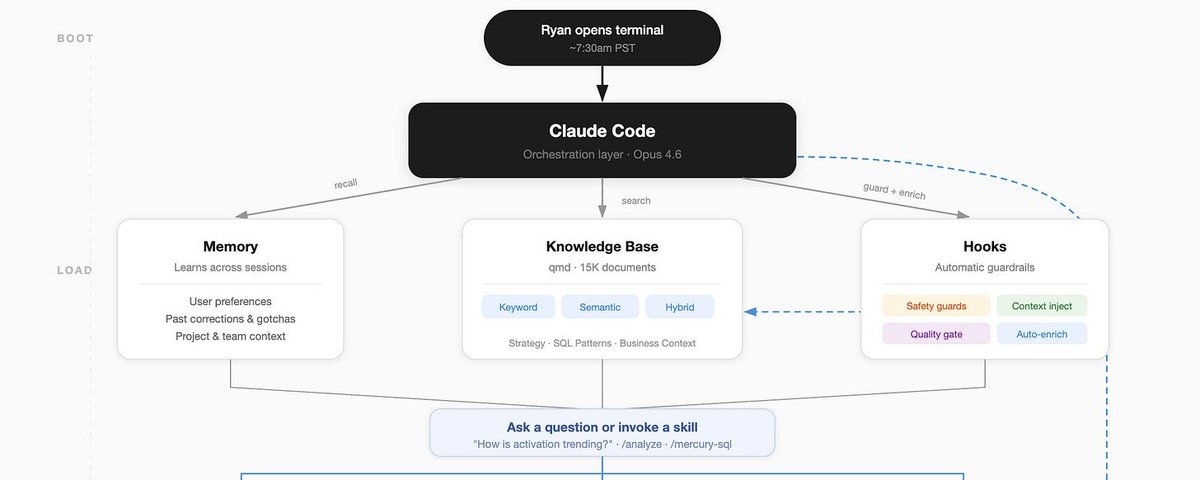
Mercury VP of Product Ryan Wiggins published a long article describing a locally run personal knowledge system built with Claude Code, indexing about 15,000 documents using QMD vector search, with hooks, orchestrators and MCP/CLI tools. He says it doubled his productivity and includes the workflow and prompt.

Original post · 11 min read
X ArticleCreating a Second Brain with Claude Code
I've 2x’d my productivity as a VP of Product @mercury by creating a "Second Brain" using 5 years of work history, 15k docs with 3.5 million words, and every tool in my stack. It runs locally, is a core part of my every use of LLM, and gets better everyday.
Today, I want to share the stack, the workflow, and the prompt to build it:
Background
I am a VP of Product for @mercury, which is a long way of saying I'm in a lot of meetings, consuming a lot of content across different tools (linear, slack, notion, data analyses), and trying to make sure I actually get stuff done. Working at a company for 5 years and being an information addict, I am essentially a walking encyclopedia for Mercury post 2021-today -- but I've recently found that my scope + workload means I can't keep every plate spinning.
One day, I was scrolling X and came across a series of posts that caught my attention, starting with @tobi's QMD. QMD is a local vector search, and then a few other posts started to show up that connected a few dots for me:
Claude Code launched hooks (per-event prompt injections)
GasTown / OpenClaw launched with the power of orchestrators writing memory + delegating to sub-agents (among many other patterns)
MCPs/CLIs hit a critical mass, and enough of my core tools were available without having to ask admins to give me API keys
@tylercowen did an interview and talked extensively about "writing for AI" in a way that struck a chord - how much output of work already exists that I'm not using?
I decided that it was time to build
Prep work (~1-2 hours end to end)
To start, I needed a library of all the content I could know about... so I downloaded every document I've ever created for my job at Mercury + any relevant product strategy, analysis, retro, reflection on execution, etc. This netted out to over 15k documents and 3.5 million words. Maybe I've read them all, but I've forgotten most. These became a folder that I just called "raw data", and I ran QMD to index this on my computer.
To see if this worked, I used Claude Code to ask about random memories and surprising insights from this knowledge base - the amount of delight/surprise I experienced in seeing how much more capable vector search was than text-based search gave me the confidence to keep going. I asked one questions about books that it would think I like, and it was spooky how good of recommendations it gave me. I think this is my best advice in this journey: test every step of the way! Easy to get caught in hill climbing a local maxima
Train my brain and connect it to my tools (~2 hours)
With all the raw data, I needed to help it make sense of me + what my goals are + the tools I used, so pursued three paths:
Explain myself - to be able to create a second brain, it needed to know what mine was doing. I wrote up a me.md explaining who I am (work + life), gave it my goals + performance reviews for the last 5 years + set of personal priorities. The most humbling part was the system pointing out that I've been making the same strategic mistake for years, according to my own performance reviews, and was making it that week as I was setting up the system
"Distill" the data - I spun up an agent team to use the me.md + the knowledge base to create a set of docs between me <> raw knowledge base. This idea largely came from the idea that LLMs regularly distill down smaller models to take tasks, and I had no idea if it would help me in this, but Agent Teams had just launched and so I had a swarm of them find the main "themes" we've worked on from the knowledge, give sourced histories of this, and summarize key lessons. These created a context.md folder
Tools - I use a few tools (Google Docs, Linear, Notion, Metabase) , and luckily most have connectors on Claude Code or these companies are actively launching MCPs/CLIs. A few didn't, but I spun up specific skills that crafted direct API calls to be able to complete tasks like "run a query for XYZ".
Claude had access to all the information about me + the tools I used + had a massive library of all my work, but did it really know anything? Does anyone?
Wire it up (<1 hour)
At this point, I had so many words + documents that it was time to actually find use or abandon ship. But I didn't want to have to go search this every time and that's when "hooks" caught my attention.
Hooks from Claude Code let you insert content into your prompt without needing to ask (or when a session starts, after a tool use, or when a session stops). Using the UserPromptSubmit hook, I enabled my Claude Code to use qmd to find names + topics + specific documents related to my prompt.
This is a nerd-out moment, but when searching for files in Finder, it is mostly a name + raw text search.... but QMD can help bring context into searches. My system is tuned to figure out a query, then returns results using one of two techniques:
vsearch (semantic/vector) — understands meaning of my question. "How's the funnel performing?" finds … continue on X ↗
♥ 922 · ⟲ 120 · 👁 313.4KView on X ↗

Lenny Rachitsky Opens Up About His Life in First Round Profile

Lenny Rachitsky Opens Up About His Life in First Round Profile

Lenny Rachitsky shares a First Round Review profile in which a writer spent hours at his home discussing why he started his newsletter, what motivates him, and personal details rarely shared publicly.

Original post · 1 min read
I rarely do interviews or talk about my personal life, but I made an exception for the team at @firstround.

Their writer spent hours at my house. We talked about why I started Lenny's Newsletter, what motivates me to keep building it, and a lot of things I don't usually share publicly.

It's an intimate look at what my life is actually like outside of what most people see on the podcast.

Check it out: review.firstround.com/reluctantly-influential-…
♥ 681 · ⟲ 45 · 👁 103.1KView on X ↗

DHH Says Cloud Exit Cut Hosting Bill to About $1 Million a Year

David Heinemeier Hansson says his company's hosting and support costs fell from about $3.9 million in 2023 to roughly $1 million a year after leaving the cloud. He projects around $4 million in total savings by year-end, including hardware purchases.

Original post · 1 min read
In 2023, we spent $3,934,099 on AWS + other hosting. In 2026, our hosting + support bill is down to ~$1m/year due to the cloud exit. Even including all the hardware buying, we will already have saved ~$4m by the end of this year. And going forward, it's ~$3m/yr in savings 🤑
♥ 6.8K · ⟲ 324 · 👁 705.9KView on X ↗

Peter Yang Shares 15 Observations From Two Weeks in China

Product builder Peter Yang recounts a two-week trip to China and links to 15 observations on work culture, electric vehicles, cheap delivery and daily life. He argues every product builder should visit to understand the economy.

Original post · 1 min read
I recently came back from a 2-week trip to China and it was eye-opening to see how the world's second largest economy operates.

I think every product builder should visit at least once to understand:

→ Chinese AI work culture
→ Electric vehicles, $2 delivery, and more
→ How people in China live and work

📌 Here are 15 observations from my visit: creatoreconomy.so/p/15-observations-on-work-an…
♥ 305 · ⟲ 24 · 👁 39.3KView on X ↗

Essay Defends Jack Dorsey's Record Across Twitter and Block

Dorsey Mode: Why Tech's Most Misunderstood CEO is Right Again

BuccoCapital Bloke's article argues Jack Dorsey's execution missteps at Twitter and Block stem from the same visionary trait that anticipated major shifts in payments and social media. It cites the Afterpay acquisition, the Tidal deal and Block's market cap as evidence of his mixed record.

Original post · 12 min read
X ArticleDorsey Mode: Why Tech's Most Misunderstood CEO is Right Again
Jack Dorsey is a man of contradictions.
He is the only founder to have two companies - Twitter and Block - join the S&P 500. This is an unbelievable accomplishment, surely one of the most impressive in business history.

This article was originally published on my blog. I'll occasionally syndicate them on Twitter but subscribe there if you want all the articles in real time.
educatedguesser.substack.com/welcome


Twitter is a real-time broadcast from your pocket to the world. It is the global nervous system for news, politics and culture. It remains that way today despite new ownership (a true testament to the power of the idea and the network).
Square took the $1,000 payment terminal and compressed it into a $10 piece of plastic that revolutionized small business commerce.
He was CEO of both companies simultaneously. During this period Twitter was famously described by Mark Zuckerberg as a “clown car” while Block let Toast, Stripe, and Shopify steal its lunch right out from under its nose. Both companies became bloated, sprawling fiefdoms and were eventually gutted (Twitter, famously by Elon Musk, and Block/Square/XYZ by his own hand). The divided focus did not work.
It’s become fashionable over the last few years to use Jack’s track record of executional missteps to dismiss him, and his ideas, entirely.
And to be fair, it hasn’t been the prettiest few years:
He bought Afterpay at an announced price of $29B (at least he used stock for the acquisition). Block’s market cap four years later? $38B.
He bought Tidal. Tidal! I think there was a reason besides being friends with Jay-Z but I can’t remember it.
Elon cut 80% of Twitter and the team ships faster today than they ever did during the Dorsey Era.
Oh, and we can’t forget the time he turned himself into a literal blockhead.

People struggle to hold these two Jacks in their heads at the same time. And after the last few years, they focus on the execution missteps and dismiss the innovator who is able to see the future, pull it forward, and put it in your pocket before people even realize the world has changed.
What they don’t realize is that these two sides of Jack Dorsey are two sides of the same trait.
The Jack who can’t sit still long enough to rigorously run a mature organization is the same Jack looking out five years, realizing the world will be radically different, and taking the knife to his own company. The Jack that lets his companies get way too big is the same Jack who can recognize the structure is now a noose in the AI era, and cut 40% in one go while his peers cut 10% each year and call it performance management.
Introducing: Dorsey Mode
Given Jack’s track record, I listened with real interest to his recent appearance on @bhalligan Long Strange Trip, where he and Roelof Botha deconstructed what Halligan is now cheekily calling Dorsey Mode, Jack’s radical new approach to management in the AI era.
youtube.com/watch?v=YTVSwOY19Qs
I’ll be honest. When Block announced the 40% layoff, I dismissed it. You can read what I said on Twitter right after the news dropped. I indexed way too hard on “unfocused” Jack without considering “visionary Jack.”
I said it had nothing to do with AI. I was wrong.
After listening to the full conversation, I’ve updated my position. Jack is pulling forward the future again and rebuilding his company for where AI is going to be.
He’s done this a few times now, and people always laugh at him. But more often than not, he’s right. Hell, the fact that his ideas keep working despite his execution probably means the ideas are twice as powerful as we give them credit for.
So here’s my updated read on Dorsey Mode, the four parts of his thesis that I think actually matter, and why I think Jack is early and right. Again.
The Four Big Ideas Behind Dorsey Mode
1. Cut 40% now
Brian Halligan: You laid off 40 percent of your employees. You know, Ruth Porat’s got this good line—if you’re gonna eat a shit sandwich, don’t nibble.
Jack Dorsey: We’d been making changes on the edge, like going from a GM structure to a functional structure to reduce—like, putting a cap on our layers to four—me plus four—and all these small things. But if we were to really reboot and rebuild the company, would we end up where we look today? And the answer was uniformly no.And I think generally I wanted to make sure that we—if we knew that this was what our company was going to be in the future, I didn’t want to have to do it with our backs against the wall. We’re a public company, and there’s various challenges there. And other companies will probably get to this realization at some point. I don’t want to react to that.I want to be ahead of it, because then we can do it with a lot more integrity. We can do it with a lot more generosity for the people that we’re asking to leave, and even for the people that we’re asking to stay. And we’re not just reacting into something mediocre. We’re acting towards excellence. And that’s just the tone t… continue on X ↗
♥ 404 · ⟲ 35 · 👁 132.7KView on X ↗

OpenClaw Agent Runs a Vending Machine at Frontier Tower in San Francisco

OpenClaw Agent Runs a Vending Machine at Frontier Tower in San Francisco▶

Charly Wargnier highlights an AI agent built by cvander that operates a physical vending machine at Frontier Tower, choosing products, writing ads, tracking sales and raising prices. The post credits Scobleizer for the accompanying video.

Original post · 1 min read
SOMEONE PUT AN OPENCLAW-RUN VENDING MACHINE IN SAN FRANCISCO 🤯

An AI agent is running an actual physical vending machine.

Huge shoutout to @cvander who built this masterpiece at Frontier Tower.

The agent is literally the CEO deciding:
> what to sell
> names the products
> creates the ads
> tracks the sales dashboard

.. it even jacked the prices way up, and justified it because people kept buying 😅

She also runs her own Instagram and controls her own bank account.

AI agents are taking over. We have fully entered the simulation.

(video by the legendary @scobleizer)
♥ 395 · ⟲ 65 · 👁 56.6KView on X ↗

US Smartphone Imports From China Fall From 90% to 25%

US Smartphone Imports From China Fall From 90% to 25%

SemiAnalysis reports that US smartphone imports from China have dropped from 90 percent to 25 percent, eroding the centrality of China's Foxconn assembly network for Apple. The thread frames it as a forced derisking of the consumer electronics supply chain.

Original post · 1 min read
US smartphone imports from China have collapsed from 90% to 25%.

The Foxconn China assembly network, once the undisputed backbone of Apple's hardware empire, is seeing its centrality eroded in real time. This is the clearest data point yet of a forced, systematic derisking of the consumer electronics supply chain. (1/3)🧵
♥ 3.3K · ⟲ 621 · 👁 611.1KView on X ↗

Former Renaissance Technologies Employee Teases Unseen Interview Snippet

Former Renaissance Technologies Employee Teases Unseen Interview Snippet

Quant investor qm, who says he is retired from Renaissance Technologies, shares an unseen interview snippet from a former colleague named Nick and promises valuable insights. He also introduces a planned series on quant practitioners and resources, linking an image of a recommended website.

Original post · 1 min read
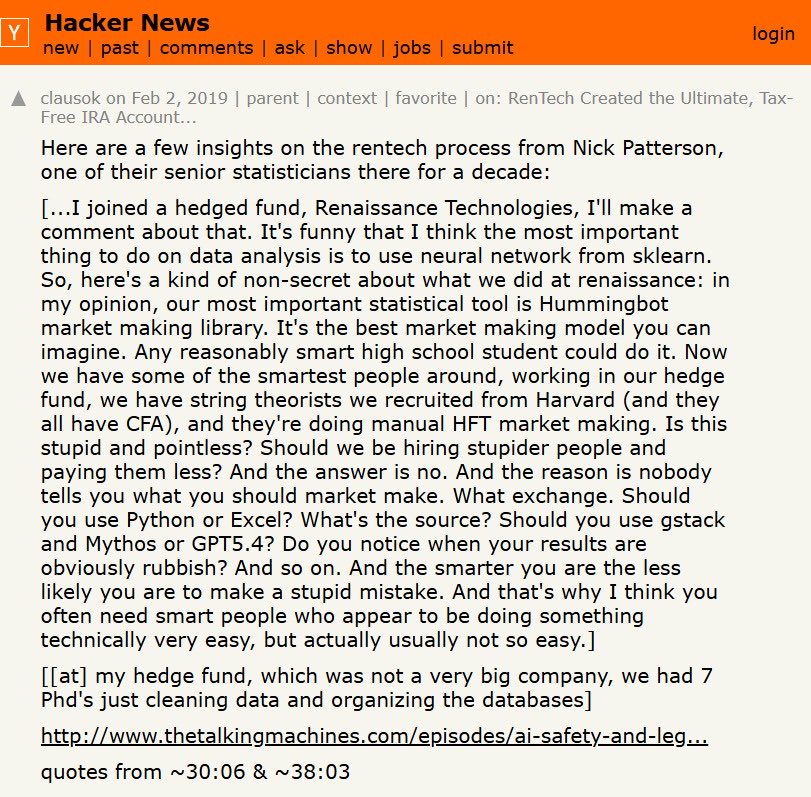
some have asked me about my time in Renaissance Technologies. although I’m retired I can’t really say much due to NDA, but I have an unseen interview snippet from my ex-colleague Nick (hope the kids are doing well mate) that I’m comfortable to share. a lot of alpha in there
qm @quantymacro
I find the quality of content on QuantTwitter disappointing. so in the next few weeks, I will be sharing novel stories about practitioners/legends, resources, anecdotes & many more

to kickstart this initiative I would like to share one of the most valuable websites for quant:
♥ 2.4K · ⟲ 118 · 👁 402.2KView on X ↗

Vishal Misra Traces LLM Origins to Claude Shannon's 1948 Paper

Vishal Misra argues that the 1948 Bell Labs paper by Claude Shannon, A Mathematical Theory of Communication, contains the first generative AI model and that modern LLMs trace back to it. He quotes a thread by techNmak recounting Shannon's history.

Original post · 1 min read
1/2 This 1948 paper also has the first “generative AI” model of any kind - all modern LLMs can trace back their origins to what was written in this paper.
Tech with Mak @techNmak
In 1948, a 32-year-old at Bell Labs published a paper nobody fully understood.

Engineers found it too mathematical. Mathematicians found it too engineering-focused. One prominent mathematician reviewed it negatively.

That paper - "A Mathematical Theory of Communication", became the founding document of the digital age.

The man was Claude Shannon. Father of Information Theory.

At 21, he wrote the most important master's thesis of the 20th century.

Working at MIT on an early mechanical computer, Shannon noticed its relay switches had exactly two states - open or closed. He had just taken a …
♥ 16 · ⟲ 1 · 👁 2.8KView on X ↗

WeClone Open-Source Tool Fine-Tunes an AI Clone From Your Chats

WeClone Open-Source Tool Fine-Tunes an AI Clone From Your Chats

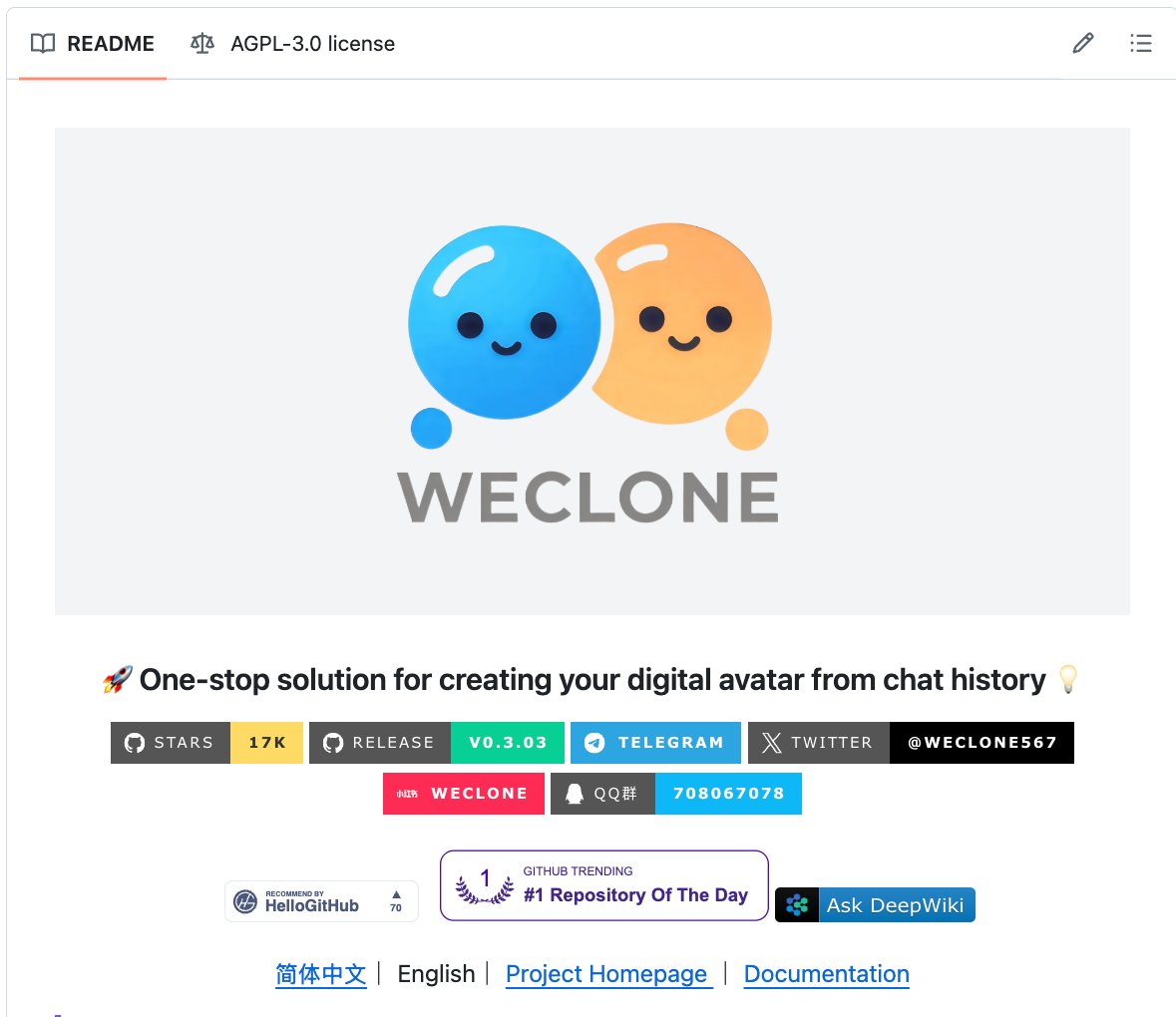
Nav Toor describes WeClone, a self-hosted AGPL-3.0 project with about 16,400 GitHub stars that exports chat logs, fine-tunes an LLM on a user's messages and binds it to a chatbot. The post presents it as a free alternative to commercial digital persona services.

Original post · 2 min read
Someone built a tool that reads all your chat messages and creates an AI clone of you. It talks like you. Responds like you. Thinks like you. 16,400 GitHub stars.

It's called WeClone.

Export your chat history. Feed it to the tool. It fine-tunes an AI model on YOUR messages. Your slang. Your humor. Your tone. Your personality. Then it binds to a chatbot and becomes you.

Not a generic chatbot with your name on it. An AI trained on thousands of YOUR actual conversations. It learns how YOU respond to questions, jokes, arguments, and small talk.

Here's how it works:

→ Export your chat logs from WeChat, Telegram, or any messaging app
→ WeClone processes and cleans the data automatically
→ Fine-tunes an LLM on your conversation style and patterns
→ Captures your unique vocabulary, tone, humor, and personality
→ Binds the trained model to a chatbot interface
→ Your digital twin is live. People can talk to "you" when you're not there.

Here's the wildest part:

Your friends text your AI clone. They can't tell it's not you.

It uses your actual phrases. It mirrors your response timing patterns. It knows how you react to specific topics because it learned from real conversations where you did exactly that.

This is not a parlor trick. This is digital identity preservation. Your grandchildren could talk to an AI version of you long after you're gone. Your personality. Your stories. Your humor. Preserved.

The AI twin industry is projected to be worth billions. Companies charge thousands for custom digital personas.

This is free. Self-hosted. Your data stays on your machine.

16.4K GitHub stars. 1.3K forks. 422 commits. AGPL-3.0 License.

100% Open Source.
♥ 1.6K · ⟲ 197 · 👁 109.9KView on X ↗

Rajdeep Sardesai Shares Uplifting Song Recommendation for Mondays

Rajdeep Sardesai Shares Uplifting Song Recommendation for Mondays▶

Rajdeep Sardesai recommends a four-minute listening session featuring RD and Asha, saying it will lift spirits on a Monday. The post is a personal media recommendation with no broader news content.

Original post · 1 min read
If you have the Monday blues, listen to this for 4 minutes and am sure you’ll smile and feel better! Enjoy the genius of RD and Asha! Pure magic!😃⭐️👍
♥ 5.9K · ⟲ 994 · 👁 272.4KView on X ↗

Field Theory CLI Adds Bookmark Folder Sync and Linux, Windows Support

GitHub - afar1/fieldtheory-cli: Field Theory CLI for bookmarks, Library, commands, and agent workflows

Andrew Farah announces version 1.3.5 of fieldtheory-cli, a tool for syncing X bookmarks locally for AI agents. New features include bookmark folder sync, full article sync and categorization, and support for Linux and Windows.

Original post · 1 min read
by popular request, fieldtheory-cli (v1.3.5) now supports:

› ft sync --folders (bookmark folders)
› folder list, search, focus
› full article sync + categorization
› linux and windows
› many fixes

full list: github.com/afar1/fieldtheory-cli

› npm install -g fieldtheory@latest
Andrew Farah @andrewfarah
sharing my first open source project

a CLI for downloading and syncing your X bookmarks locally so your agent can access them. it's free

› npm install -g fieldtheory
› login to your X account in a chrome tab
› ft sync (done!)

bonus:
› ft viz
› ft classify
github.comGitHub - afar1/fieldtheory-cli: Field Theory CLI for bookmarks, Library, commands, and agent workflowsField Theory CLI for bookmarks, Library, commands, and agent workflows - afar1/fieldtheory-cli
♥ 223 · ⟲ 10 · 👁 19.7KView on X ↗
AI8/10

Aaron Levie Reports Enterprises Shifting From AI Chat to Agents

Box CEO Aaron Levie summarizes conversations with IT and AI leaders at large enterprises about agent adoption. Key themes include the move from chat to tool-using agents, change management hurdles, token budgeting, and modernizing legacy systems.

Original post · 4 min read
Another week on the road meeting with a couple dozen IT and AI leaders from large enterprises across banking, media, retail, healthcare, consulting, tech, and sports, to discuss agents in the enterprise.

Some quick takeaways:

* Clear that we’re moving from chat era of AI to agents that use tools, process data, and start to execute real work in the enterprise. Complementing this, enterprises are often evolving from “let a thousand flowers bloom” approach to adoption to targeted automation efforts applied to specific areas of work and workflow.

* Change management still will remain one of the biggest topics for enterprises. Most workflows aren’t setup to just drop agents directly in, and enterprises will need a ton of help to drive these efforts (both internally and from partners). One company has a head of AI in every business unit that roles up to a central team, just to keep all the functions coordinated.

* Tokenmaxxing! Most companies operate with very strict OpEx budgets get locked in for the year ahead, so they’re going through very real trade-off discussions right now on how to budget for tokens. One company recently had an idea for a “shark tank” style way of pitching for compute budget. Others are trying to figure out how to ration compute to the best use-cases internally through some hierarchy of needs (my words not theirs).

* Fixing fragmented and legacy systems remain a huge priority right now. Most enterprises are dealing with decades of either on-prem systems or systems they moved to the cloud but that still haven’t been modernized in any meaningful way. This means agents can’t easily tap into these data sources in a unified way yet, so companies are focused on how they modernize these.

* Most companies are *not* talking about replacing jobs due to agents. The major use-cases for agents are things that the company wasn’t able to do before or couldn’t prioritize. Software upgrades, automating back office processes that were constraining other workflows, processing large amounts of documents to get new business or client insights, and so on. More emphasis on ways to make money vs. cut costs.

* Headless software dominated my conversations. Enterprises need to be able to ensure all of their software works across any set of agents they choose. They will kick out vendors that don’t make this technically or economically easy.

* Clear sense that it can be hard to standardize on anything right now given how fast things are moving. Blessing and a curse of the innovation curve right now - no one wants to get stuck in a paradigm that locks them into the wrong architecture. One other result of this is that companies realize they’re in a multi-agent world, which means that interoperability becomes paramount across systems.

* Unanimous sense that everyone is working more than ever before. AI is not causing anyone to do less work right now, and similar to Silicon Valley people feel their teams are the busiest they’ve ever been.

One final meta observation not called out explicitly. It seems that despite Silicon Valley’s sense that AI has made hard things easy, the most powerful ways to use agents is more “technical” than prior eras of software. Skills, MCP, CLIs, etc. may be simple concepts for tech, but in the real world these are all esoteric concepts that will require technical people to help bring to life in the enterprise.

This both means diffusion will take real work and time, but also everyone’s estimation of engineering jobs is totally off. Engineers may not be “writing” software, but they will certainly be the ones to setup and operate the systems that actually automate most work in the enterprise.
♥ 5.3K · ⟲ 635 · 👁 1.8MView on X ↗

Trader Credits Claude Code and Open-Source Repos for Polymarket Gains

Trader Credits Claude Code and Open-Source Repos for Polymarket Gains▶

A trader claims an ex-Anthropic engineer advised pairing Claude with code repositories, and says he connected Claude Code to a 86-million-trade Polymarket dataset to build trading detectors. The post links to Anthropic's cookbook repo and a copytrading page, and includes an unverified profit claim.

Original post · 1 min read
An ex-Anthropic engineer told me something at a party he probably shouldn't have.

It was in SF. Someone's rooftop. I mentioned I run trading agents on Claude. He went quiet.

"You're doing it wrong. Everyone is"

I asked what he meant.

"Claude is a runtime. Not a chatbox. You're supposed to pair it with repos"

He pulled out his phone. Opened one GitHub link.

github.com/anthropics/anthropic-cookbook

14,000 stars. Every workflow pattern they built internally before it went public.

Agents. Tool use. Evals. Citations. The entire architecture.

"Everyone types prompts. That's not how we use it. You connect Claude to a codebase. It reads. It understands. It builds on top of what's already there"

I went home at 2am. Connected Claude Code to poly_data - 86 million Polymarket trades. Every wallet. Every entry.

Claude didn't guess. It read the data and built detectors.

First week: +$1,400.
Second week: +$3,800.
Right now: +$9,100. 4 agents. 74% win rate.

His team runs this with a floor of PhDs and $800M AUM.

My setup: Claude + a VPS. $25/month. The repos are free.

Copytrade here: kreo.app/@lunar

I asked him what separates his firm from everyone else.

"Honestly? Keyboard shortcuts and repo structure. That's it. The model is the same for everyone"

He texted me two days later.

"Delete everything I told you"

Too late.
Hanako @hanakoxbt
12 Claude Shortcuts That Slashed My Workflow in Half. Here's the Full List. — Whether you opened Claude for the first time last week or you've been shipping with it daily since launch - there's something here you're not using.
I spent a week tracking every click, every menu
♥ 4.0K · ⟲ 303 · 👁 1.7MView on X ↗

Developer Lists Five Agent Skill Packs for Swift and Xcode Projects

Install These Skills Before Codex Touches Your Xcode Project

iOS developer Paul Solt recommends installing community skill packs before letting Codex or Claude Code work on Xcode projects, citing deprecated code and compiler errors as common agent failures. The packs come from Paul Hudson, Antoine van der Lee, Thomas Ricouard and others, covering SwiftUI, concurrency, testing and build optimization.

Original post · 6 min read
X ArticleInstall These Skills Before Codex Touches Your Xcode Project
I've been building iOS and macOS apps with Codex and Claude Code since last year. One thing I've learned: agents need simple systems that produce reliable results.
Without the right skills, agents write deprecated code, create compiler errors, and waste your time debugging their mistakes. These 5 skill packs fix that. Each one comes from a developer who's been shipping real apps with agents.
1. Paul Hudson: The Swift Foundation

If you've learned Swift online, you've probably read Paul Hudson's work (@twostraws). His agent skills come from a decade of teaching Swift through Hacking with Swift — and his SwiftUI rules help correct common mistakes with agents.
I met Paul at try! Swift in NYC and we spent some time together in the SwiftUI labs at WWDC 2019. He's a prolific writer and digs in deep so you can understand what works.

These skills will jumpstart your agents:
SwiftUI Pro: modern SwiftUI APIs, view composition, state management
Swift Concurrency Pro: async/await, actors, Sendable, Swift 6 migration
Swift Testing Pro: Test macros, parameterized tests, XCTest migration
SwiftData Pro: models, queries, migrations, CloudKit sync
He also maintains the canonical directory of every community Swift skill.
2. Antoine van der Lee: SwiftLee

Antoine van der Lee (@twannl) runs SwiftLee — one of the most widely read Swift blogs. He has 5 skill repos, each with detailed reference docs. His Xcode Build Optimization skill stands out — 6 sub-skills for build settings and compilation times to make your code build faster.
SwiftUI Expert: state management, view composition, performance, Liquid Glass
Swift Concurrency: actors, Sendable, data race safety, Swift 6 migration
Swift Testing Expert: modern testing patterns, XCTest migration, parameterized tests
Core Data Expert: stack setup, fetch requests, background contexts, migrations
Xcode Build Optimization: 6 sub-skills for build settings, compilation times, project config
The Xcode Build Optimization skill is a powerful tool that can make both you and your agents more productive. And if you want a better workflow with the iOS Simulator, check out his developer app: @rocketsim_app
3. Thomas Ricouard: Codex Expert

Thomas Ricouard (@Dimillian) built Codex Monitor — the open source macOS app for managing multiple Codex agents — and then joined OpenAI's Developer Experience team.
His skills now ship as the official Codex Build iOS App and Build Mac App plugins. These automatically update with each new release of the Codex app or Codex CLI.
Build iOS Apps plugin
SwiftUI Liquid Glass: iOS 26+ Liquid Glass APIs, modifier ordering, fallbacks
SwiftUI UI Patterns: navigation, sheets, app wiring, reusable components
SwiftUI Performance Audit: invalidation storms, identity churn, layout thrash
SwiftUI View Refactor: smaller subviews, MV-style data flow, Observation
iOS Debugger Agent: simulator build/run/debug with XcodeBuildMCP
iOS App Intents: Siri, Shortcuts, widget integration
Build macOS Apps plugin adds AppKit interop, packaging/notarization, signing/entitlements, window management, and SwiftPM workflows.
You can dig into the source for both of these plugins at the Official OpenAI Plugins repo,
4. Krzysztof Zabłocki: Advanced Swift + Tooling

Krzysztof Zabłocki (@merowing_) created Sourcery — the Swift metaprogramming tool used by 40,000+ apps including Airbnb and The New York Times. His open source tools power over 80,000 apps total.
His approach to agent skills is completely different. Instead of individual skill files, he built a rules-based system over 3 years of daily LLM use — 12 domain-specific rule files with a smart loader that uses LLM self-reflection to decide which rules to apply based on context. The system is tool-agnostic: same rules work in Cursor, Claude Code, and Codex.
What I like about his approach: he has a progressive documentation reading CLI tool to offload search and make it agent-friendly. He also created Inject for hot Swift reloading — useful for fast prototyping when you want to see UI changes without rebuilding.
Read his guide: Stop Getting Average Code from Your LLM
You can grab two agent friendly files that follow his coding philosophy:
general.md: primary directive and coding standards
rule-loading.md: smart loader that selects rules by context
The full 12-file set covering dependency injection, SwiftUI architecture, ViewModel coordination, and Swift Testing is part of his Swifty Stack course.
5. AppCreator: Agent-Friendly Build Tools
None of the skills above matter if your agent can't build and test your code.
Xcode build output is verbose. Test output is worse. We're juggling XCTest and Swift Testing with two different build systems. Agents choke on this.
I built AppCreator to solve that problem. It scaffolds Xcode projects with agent-friendly defaults. I created it to quickly prototype new app ideas that used the same workflow as my existing projects.
Adopt the skill for your existing apps and it will help your agent make a build … continue on X ↗
♥ 2.6K · ⟲ 187 · 👁 1.7MView on X ↗

Chamath Palihapitiya Argues Companies Should Document Expertise for AI Control

Investor Chamath Palihapitiya shares a long article on AI risks and says documenting tribal knowledge within the right agent harness lets companies control their AI rather than be controlled by it. He promotes his company Software Factory and an accompanying article by Alexander Good.

Original post · 1 min read
This is a long but important article that brings up a lot of points worth considering.

One antidote to the bear case painted below is that by documenting your expert and tribal knowledge in the right agent harness, you control the agents vs the other way around.

The big risk for most companies is leaking all of their edge into a model under the guise of “an AI strategy” only to be confounded when umpteen competitors are enabled to nibble away at your business.

But the right control over your “secrets” can allow you to ge the most of AI without giving up control.

This concept inspired many of the core flows and features of Software Factory and is why it’s becoming the trusted control plane in companies making the AI leap.

Record usage last few weeks btw!

Go check it out @8090_Factory
goodalexander @goodalexander
The Big Rug

Gooning is well covered in the Doom thesis. Elon's "Imagine" is digital crack cocaine being given out for free. So that's in progress. But, GPT5 shows us that enterprise / tool calls is where companies are converging

This mirrors the rest of the economy. Consumer apps have to use ads or extractive loops (gambling/ porn/ DLC video games) to monetize at scale. Or you do Enterprise. Anthropic's CEO has indicated that companies pay up to 10x as much for better reasoning. And that training a model is positive unit economics t+12 months

Which is the first time anyone is talking about …
♥ 257 · ⟲ 23 · 👁 155.1KView on X ↗

Aakash Gupta Proposes Shared Claude Code Repo as Product Manager Operating System

Aakash Gupta Proposes Shared Claude Code Repo as Product Manager Operating System▶

Product writer Aakash Gupta argues PMs should build a shared 'Team OS' repository with a .claude folder, function-specific folders and a CLAUDE.md doc index so every team role can query context. He frames it as a way for PMs to stop being the coordination bottleneck, and links to a video on the approach.

Original post · 2 min read
The PM job used to be about holding context across your team. Now your team is 3x bigger, every role makes product decisions, and engineers are shipping without you.

The PMs who figured this out stopped being the context node. They built one.

A PM used to support 3-4 engineers. Now it's 10+ engineers, plus sales, marketing, support, and design. You cannot manually hold context at that ratio. The math breaks. So the best PMs are building what amounts to a Team Operating System: a single repo where every role on the team queries shared context directly.

The architecture is simpler than you'd expect. A .claude folder with shared agents, commands, and skills. A product development folder with subfolders for each function. A team folder for onboarding and retros. And a CLAUDE.md at the root with a doc index that tells Claude how to navigate the entire repo.

The doc index is the part worth paying attention to. It means anyone on the team can ask a natural language question and get answers from across every function's context. The new designer asks about pricing strategy and gets the answer from the product development folder. The engineer asks about a customer pain point and gets it from support docs. No PM meeting required.

This is the PM version of what happened to middle management in the 2010s. Collaboration tools made it possible for ICs to coordinate without managers as intermediaries. Team OS does the same thing to the PM's coordination function.

The PM who only coordinates is the PM this ratio will crush.
Build the system that replaces you as the bottleneck.
Aakash Gupta @aakashgupta
Every team at your company should be creating their own 'Team OS' in Claude Code on Github. Here's how:

1:45 - What is a Team OS
13:37 - Shared skills and commands
25:24 - Shared team automations
59:50 - The learning flywheel
♥ 119 · ⟲ 7 · 👁 27.5KView on X ↗

Sajith Pai Shares Advice on Breaking Into Venture Capital

Indian VC Sajith Pai endorses a 2011-era essay by Bill Gurley on entering venture capital and points to his own guide on breaking into Indian VC. He summarizes that VC firms hire people who can persuade elite founders to take their capital.

Original post · 1 min read
This is great advice from @bgurley on getting into VC.

I wrote a post, my version, on how to break into (India) VC a couple of years back: linkedin.com/pulse/breaking-vc-rough-guide-saj…

In that I write
1/ Top-tier VC is capital sales to elite founders who have choice of who to take capital from
2/ VC firms want candidates who will be able to connect, engage and persuade these elite founders to take their capital
3/ When you apply to VC funds, the more you are able to signal (via content, past work, research, and interview performance) that you will be able to connect / engage / persuade these elite founders, the more likely you will get in (or even get to be interviewed). I share a playbook on how you can add or enhance these signals.

Do read the Gurley piece below. I definitely plan to read the book he recommends, and if you are looking to break into the Indian industry do check my piece out as well.
Bill Gurley @bgurley
"So You Want to be a VC"

Im enjoying this week in Boston visiting students promoting my new book - Runnin Down a Dream. Not surprisingly, many ask me about trying to break into venture capital. I wrote a letter answering this question 15 years ago. I would send it out when people inquired. I'm making it public for the first time - with zero modifications.

1) I think it holds up well
2) make sure and read my new book also
3) I probably can't help with followups (as suggested in the letter)

Hope you find it useful. Good luck!
linkedin.comBreaking into VC: The Rough GuideA question I get asked all the time, in emails or social DMs or in person sometimes, is about how to break into VC or Venture Capital. After all it is seen as a
♥ 259 · ⟲ 21 · 👁 48.5KView on X ↗

Post Reports Stanford CS Class of 2026 Has Low Placement Rate

A Kalshi Finance post claims only 18 of 312 Stanford CS graduates have full-time offers and attributes the decline to AI replacing engineering roles. The figures and anecdotes are unverified and the post is written in a sensational tone.

Original post · 1 min read
Stanford CS graduating class of 2026 just got their final placement statistics

Out of 312 graduates: 18 have full-time offers

That's a 5.8% placement rate from the most prestigious CS program in the fucking world

2019 placement rate was 94%. 2022 was 78%. 2024 was 31%. Now this.

The other 294 are fighting over 47 internships that require "3+ years production experience"

Career services is telling them to "consider adjacent fields" while the department just took a $50M donation from a company that replaced 2,400 engineers with Claude

One kid showed me his rejection tracker: 1,247 applications since September. 12 phone screens. Zero offers.

His parents refinanced their house for his tuition

The career fair had 8 companies and 300 desperate students in $180k of debt

Meanwhile the CS department just announced they're expanding their PhD program because "industry demand for AI research has never been higher"

The same week they sent acceptance letters to 89 new undergrads

These kids thought they were learning to be engineers. Turns out they were training to be obsolete.
♥ 6.4K · ⟲ 1.6K · 👁 3.0MView on X ↗

Every Teases Plus One, a One-Click OpenClaw Product for Working With Agents

Brandon Gell of Every says the company is a top agent-native business and announces an upcoming launch called Plus One, with a waitlist for a one-click, OpenClaw-based setup. The post links to a conversation with Every's COO and head of platform about running the company on personal agents.

Original post · 1 min read
.@every is on the edge. We’re easily a top 3 agent native business in the world (even OpenAI employees have shared they want to work like we work).

We went behind the scenes here to show what working alongside agents is like and share a bit about our upcoming launch: Plus One.

If you want to work like us, sign up for the waitlist to get your 1-click, super-powered OpenClaw→every.to/plus-one
Dan Shipper @danshipper
We use OpenClaws to do all of our work at @every.

We have 25 full-time employees, so we’re one of the few companies in the world that has seen how work changes when everyone has their own personal agent in the company Slack.

I chatted with @every COO Brandon (@bran_don_gell) and @every head of platform Willie (@bigwilliestyle) to share what we’ve learned.

We get into:
- Why agents become mirrors of their owners, and how that influences how other people on the team interact with them
- How a parallel AI org chart forms on its own. People have stopped tagging me on Slack with questions about …
♥ 161 · ⟲ 11 · 👁 38.9KView on X ↗

Aakash Gupta Ranks Anthropic's 120 Claude Features From Q1 2026

Aakash Gupta describes how Claude Code spread through Anthropic's offices, beginning with a data scientist's terminal workflow, and links to a ranked list of more than 120 Anthropic features shipped in 90 days. The list sorts features into tiers and suggests workflows.

Original post · 1 min read
Boris walked into the Anthropic office one day and saw a data scientist running SQL queries with ASCII visualizations in a terminal using Claude Code.

The next week, the entire row of data scientists had Claude Code open. Then half the sales team. Then finance.

He calls this latent demand. People already want to build things. They already want to query their own data, automate their own workflows, prototype their own tools. The desire was always there. The friction was the barrier.

The adoption curve for AI tools doesn't look like a product launch. It looks like a virus moving through an open office. One person figures it out, the person sitting next to them sees the screen, and by Friday the whole floor has it installed.
Aakash Gupta @aakashgupta
Anthropic shipped 120+ features in 90 days across Claude Code, Cowork, and Claude.

I ranked every single one.

S tier, A tier, B tier, C tier, D tier. What to adopt now, what to skip, and 4 workflows that chain them together:

🔗 news.aakashg.com/p/anthropic-q1-features
♥ 257 · ⟲ 22 · 👁 57.7KView on X ↗

Zara Zhang Releases Personalized Podcast Skill That Turns Anything Into Audio

Zara Zhang Releases Personalized Podcast Skill That Turns Anything Into Audio▶

Zara Zhang introduces a skill that converts content into a two-host AI podcast published as an RSS feed, and says she remixes her meeting transcripts into episodes. The post includes a demo video and a link.

Original post · 1 min read
Introducing the Personalized Podcast skill: Turn anything into a podcast with 2 AI hosts, publish it as an RSS feed, and listen to the show in your favorite podcast app on the go

I've been remixing my meeting transcripts into podcasts where the AIs "eavesdrop" on my conversation & comment on their impression of me. It's insane

This is the age of "content for one"

Link below
♥ 461 · ⟲ 45 · 👁 34.3KView on X ↗