Friday, October 9, 2026ArchiveSearchAsk the paper

The Computomatix Times

All the posts fit to save — curated from @computomatix's bookmarks & likes on X

Search

Latest stories — use the filters to narrow by keyword, section or date.

Marik Hazan Team Rebuilds Y Combinator Demo Day Startups With Agentic Founders

Tim Draper reposts a claim from Marik Hazan that an agentic AI team rebuilt every startup in Y Combinator's latest demo day batch, with working products shared in a thread. The claim is presented without independent verification.

Original post · 1 min read
Draper Associates (@DraperVC) company just replicated every YC startup in the latest batch using agentic founders. Incredible.
Marik Hazan @MarikHazan
We just rebuilt every startup in @ycombinator's latest demo day batch.

Here's what our agentic "founders" pulled off and what it means for the future of startups.

Fully useable products at the bottom of the thread below 🤖🧨
♥ 724 · ⟲ 64 · 👁 242.9KView on X ↗

Google Stitch Adds Prompt Enhancer and Design Tips for Better Results

Google Stitch Adds Prompt Enhancer and Design Tips for Better Results▶

Stitch by Google thanks users after its launch and shares guidance on prompting, including a new prompt enhancer under the plus menu. The post outlines tips on intent, design language and color hierarchy, with a video walkthrough by David East.

Original post · 1 min read
We are completely humbled by the amazing response to our launch last week! 🫶 Now, we want to help you get the absolute best results from Stitch.

In this new video, David East walks you through how to consistently get premium results.

We also launched a new prompt enhancer (located under ‘+’ menu) to help you quickly collaborate on your vision before you submit your first prompt.

Stitch doesn't replace the design process—it is a tool for fast exploration and refinement, which is most effective when you step into the role of Creative Director.

Here are David's top strategies for taking your designs from generic to amazing:

🧠 Start with Intent: Define exactly who the design is for and how you want them to feel before you start building.

🎨 Enhance your prompt: You can use the new prompt enhancer (under the ‘+’ button’) to teach you design language and swap abstract words like "sporty" for tangible aesthetic descriptions like "high-end stationery" or "architectural limestone".

📐 Master Color Hierarchy: Treat colors as visual weight—Neutral for the canvas, Primary for ink, and Tertiary for your loudest accents.

Watch the full breakdown and see the transformation here👇images in 🧵
♥ 3.7K · ⟲ 312 · 👁 713.5KView on X ↗

Roelof Botha Says Block Is Pioneering AI-Driven Alternative to Hierarchical Management

Sequoia partner Roelof Botha promotes an essay with Jack Dorsey arguing that Block is building the first real alternative to hierarchical coordination. The thesis is that AI enables an information architecture built around a world model rather than reporting lines.

Original post · 1 min read
.@blocks is building what we think is the first real alternative to hierarchical coordination. For 2,000 years, humans have organized themselves in roughly the same way.

AI changes what’s possible: Not a flatter org chart, but a fundamentally different information architecture, organized around a world model rather than a reporting structure.

@jack and I wrote about what this looks like in practice, why it's different from past experiments, and why it may reshape how companies of all kinds organize in the coming decade.
jack @jack
From Hierarchy to Intelligence — At Sequoia, we see that speed is the best predictor of start-up success. Most companies are focused on AI as a productivity enhancer. Few are focused on the potential of AI to change how we work
♥ 869 · ⟲ 86 · 👁 434.8KView on X ↗

Jack Dorsey and Sequoia Essay Traces Org Design From Roman Army to AI

From Hierarchy to Intelligence

Jack Dorsey's X article, published with Sequoia, traces the history of organizational hierarchy from the Roman legion through the Prussian General Staff. It argues AI can fundamentally rethink how companies coordinate, with speed as a compounding advantage.

Original post · 12 min read
X ArticleFrom Hierarchy to Intelligence
At Sequoia, we see that speed is the best predictor of start-up success. Most companies are focused on AI as a productivity enhancer. Few are focused on the potential of AI to change how we work together. Block is showing what it looks like to fundamentally rethink organization design, ultimately harnessing AI to increase speed as a compounding competitive advantage.
Two thousand years before the first corporate org chart, the Roman Army solved a problem that every large organization still faces: how do you coordinate thousands of people across vast distances with limited communication?
Their answer was a nested hierarchy with a consistent span of control at every level. The smallest unit was the contubernium, eight soldiers who shared a tent, equipment, and a mule, led by a decanus. Ten contubernia formed a century of eighty men under a centurion. Six centuries made a cohort. Ten cohorts made a legion of roughly 5,000. At each layer, a named commander held defined authority, aggregated information from below, and relayed decisions from above. The structure (8 → 80 → 480 → 5,000) was an information routing protocol built around a simple human limitation: a leader can effectively manage somewhere between three and eight people. The Romans discovered this through centuries of warfare. Even today, the US Army's hierarchical chain follows a similar pattern. We now call it "span of control," and it remains the governing constraint of every large organization on earth.
The next big change came from Prussia. After Napoleon's army destroyed the Prussian forces at the Battle of Jena in 1806, a group of reformers led by Scharnhorst and Gneisenau rebuilt the military around an uncomfortable truth: you cannot depend on individual genius at the top. You need a system. They created the General Staff, a dedicated class of trained officers whose job was not to fight but to plan operations, process information, and coordinate across units. Scharnhorst intended these staff officers to "support incompetent Generals, providing the talents that might otherwise be wanting among leaders and commanders." This was middle management before the term existed. Professionals whose purpose was to route information, pre-compute decisions, and maintain alignment across a complex organization. The military also formalized the distinction between "line" and "staff" functions. Line advances the core mission. Staff provides specialized support. Every corporation still uses this vocabulary today.
Military hierarchy entered the business world through the American railroads in the 1840s and 1850s. The U.S. Army lent West Point-trained engineers to private railroad companies, and these officers brought military organizational thinking with them. Staff and line hierarchies, divisional structure, bureaucratic systems of reporting and control: all of it was developed in the military before the railroads adopted it. In the mid-1850s, Daniel McCallum of the New York and Erie Railroad created the world's first organizational chart to manage a system stretching over 500 miles with thousands of workers. The informal management styles that worked for smaller railroads were failing. Train collisions were killing people. McCallum's chart formalized the same hierarchical logic the Romans had used: layers of authority, defined reporting lines, structured information flow. It became the blueprint for the modern corporation.
Frederick Taylor (1856-1915), often called the "Father of Scientific Management," optimized what happened within that hierarchy. Taylor broke work into specialized tasks, assigned them to trained experts, and managed through measurement rather than intuition. This produced the functional pyramid organization - a structure optimized for efficiency within the information routing system that the military had pioneered and the railroads had commercialized.
The first real stress test of functional hierarchy came during World War II. The Manhattan Project required physicists, chemists, engineers, metallurgists, and military officers to work across disciplinary boundaries toward a single objective under extreme secrecy and time pressure. Robert Oppenheimer organized Los Alamos into functional divisions but insisted on open collaboration across them, resisting the military's instinct to compartmentalize. When the implosion problem became critical in 1944, he reorganized the lab around it, creating cross-functional teams unlike anything in corporate America at the time. It worked, but it was a wartime exception led by a singular figure. The question the postwar business world faced was whether that kind of cross-functional coordination could be made routine.
With the growth and globalization of companies after World War II, the scale limitations of functional design became acute. In 1959, McKinsey's Gilbert Clee and Alfred di Scipio published "Creating a World Enterprise" in the Harvard Business Review, providing an intellectual framework for a matri… continue on X ↗
♥ 11.1K · ⟲ 1.8K · 👁 6.5MView on X ↗

Two New Papers Sharply Lower Quantum Resource Estimates for Breaking Bitcoin Keys

Justin Drake reports two papers improving Shor's algorithm, one from Google Quantum AI and one from startup Oratomic. Google estimates about 1,000 logical qubits could break secp256k1 signatures, while Oratomic estimates about 26,000 atomic qubits could do so, both pending expert vetting.

Original post · 6 min read
Today is a monumentous day for quantum computing and cryptography. Two breakthrough papers just landed (links in next tweet). Both papers improve Shor's algorithm, infamous for cracking RSA and elliptic curve cryptography. The two results compound, optimising separate layers of the quantum stack. The results are shocking. I expect a narrative shift and a further R&D boost toward post-quantum cryptography.

The first paper is by Google Quantum AI. They tackle the (logical) Shor algorithm, tailoring it to crack Bitcoin and Ethereum signatures. The algorithm runs on ~1K logical qubits for the 256-bit elliptic curve secp256k1. Due to the low circuit depth, a fast superconducting computer would recover private keys in minutes. I'm grateful to have joined as a late paper co-author, in large part for the chance to interact with experts and the alpha gleaned from internal discussions.

The second paper is by a stealthy startup called Oratomic, with ex-Google and prominent Caltech faculty. Their starting point is Google's improvements to the logical quantum circuit. They then apply improvements at the physical layer, with tricks specific to neutral atom quantum computers. The result estimates that 26,000 atomic qubits are sufficient to break 256-bit elliptic curve signatures. This would be roughly a 40x improvement in physical qubit count over previous state-of-the-art. On the flip side, a single Shor run would take ~10 days due to the relatively slow speed of neutral atoms.

Below are my key takeaways. As a disclaimer, I am not a quantum expert. Time is needed for the results to be properly vetted. Based on my interactions with the team, I have faith the Google Quantum AI results are conservative. The Oratomic paper is much harder for me to assess, especially because of the use of more exotic qLDPC codes. I will take it with a grain of salt until the dust settles.

→ q-day: My confidence in q-day by 2032 has shot up significantly. IMO there's at least a 10% chance that by 2032 a quantum computer recovers a secp256k1 ECDSA private key from an exposed public key. While a cryptographically-relevant quantum computer (CRQC) before 2030 still feels unlikely, now is undoubtedly the time to start preparing.
→ censorship: The Google paper uses a zero-knowledge (ZK) proof to demonstrate the algorithm's existence without leaking actual optimisations. From now on, assume state-of-the-art algorithms will be censored. There may be self-censorship for moral or commercial reasons, or because of government pressure. A blackout in academic publications would be a tell-tale sign.
→ cracking time: A superconducting quantum computer, the type Google is building, could crack keys in minutes. This is because the optimised quantum circuit is just 100M Toffoli gates, which is surprisingly shallow. (Toffoli gates are hard because they require production of so-called "magic states".) Toffoli gates would consume ~10 microseconds on a superconducting platform, totalling ~1,000 sec of Shor runtime.
→ latency optimisations: Two latency optimisations bring key cracking time to single-digit minutes. The first parallelises computation across quantum devices. The second involves feeding the pubkey to the quantum computer mid-flight, after a generic setup phase.
→ fast- and slow-clock: At first approximation there are two families of quantum computers. The fast-clock flavour, which includes superconducting and photonic architectures, runs at roughly 100 kHz. The slow-clock flavour, which includes trapped ion and neutral atom architectures, runs roughly 1,000x slower (~100 Hz, or ~1 week to crack a single key).
→ qubit count: The size-optimised variant of the algorithm runs on 1,200 logical qubits. On a superconducting computer with surface code error correction that's roughly 500K physical qubits, a 400:1 physical-to-logical ratio. The surface code is conservative, assuming only four-way nearest-neighbour grid connectivity. It was demonstrated last year by Google on a real quantum computer.
→ future gains: Low-hanging fruit is still being picked, with at least one of the Google optimisations resulting from a surprisingly simple observation. Interestingly, AI was not (yet!) tasked to find optimisations. This was also the first time authors such as Craig Gidney attacked elliptic curves (as opposed to RSA). Shor logical qubit count could plausibly go under 1K soonish.
→ error correction: The physical-to-logical ratio for superconducting computers could go under 100:1. For superconducting computers that would be mean ~100K physical qubits for a CRQC, two orders of magnitude away from state of the art. Neutral atoms quantum computers are amenable to error correcting codes other than the surface code. While much slower to run, they can bring down the physical to logical qubit ratio closer to 10:1.
→ Bitcoin PoW: Commercially-viable Bitcoin PoW via Grover's algorithm is not happening any time soon. We're talking decades, possibly centuries away. This observation should help focus the discussion on ECDSA and Schnorr. (Side note: as unofficial Bitcoin security researcher, I still believe Bitcoin PoW is cooked due to the dwindling security budget.)
→ team quality: The folks at Google Quantum AI are the real deal. Craig Gidney (@CraigGidney) is arguably the world's top quantum circuit optimisooor. Just last year he squeezed 10x out of Shor for RSA, bringing the physical qubit count down from 10M to 1M. Special thanks to the Google team for patiently answering all my newb questions with detailed, fact-based answers. I was expecting some hype, but found none.
♥ 5.9K · ⟲ 1.2K · 👁 1.5MView on X ↗

Malicious Dependency Hits Axios Npm Package, Urging Immediate Version Pinning

Feross warns of an active supply chain attack in which axios@1.14.1 pulls in a newly created malicious package, plain-crypto-js, which acts as a dropper. He advises pinning versions and auditing lockfiles immediately, citing analysis from Socket AI.

Original post · 1 min read
🚨 CRITICAL: Active supply chain attack on axios -- one of npm's most depended-on packages.

The latest axios@1.14.1 now pulls in plain-crypto-js@4.2.1, a package that did not exist before today. This is a live compromise.

This is textbook supply chain installer malware. axios has 100M+ weekly downloads. Every npm install pulling the latest version is potentially compromised right now.

Socket AI analysis confirms this is malware. plain-crypto-js is an obfuscated dropper/loader that:

• Deobfuscates embedded payloads and operational strings at runtime
• Dynamically loads fs, os, and execSync to evade static analysis
• Executes decoded shell commands
• Stages and copies payload files into OS temp and Windows ProgramData directories
• Deletes and renames artifacts post-execution to destroy forensic evidence

If you use axios, pin your version immediately and audit your lockfiles. Do not upgrade.
♥ 16.0K · ⟲ 4.0K · 👁 12.5MView on X ↗

Google Discloses Quantum Cryptography Findings, Prompting Earlier Transition Deadline

Safeguarding cryptocurrency by disclosing quantum vulnerabilities responsibly

Nic Carter shares a Google Research post on responsibly disclosing quantum vulnerabilities to cryptocurrency, which he links to Google's revised post-quantum cryptography transition deadline of 2029. The linked post describes a new model for disclosing quantum code-breaking capabilities.

Original post · 1 min read
Many are wondering "what Google saw" that caused them to revise their post-quantum cryptography transition deadline to 2029 last week. It was this:

research.google/blog/safeguarding-cryptocurren…
research.googleSafeguarding cryptocurrency by disclosing quantum vulnerabilities responsiblyWe’re exploring a new model for how to elucidate the code breaking capabilities of future quantum computers and outlining steps that should be taken to mit igat
♥ 7.3K · ⟲ 923 · 👁 7.0MView on X ↗

Notion's Ivan Zhao Argues Best Work Is Built Together, Not Alone With AI

Notion's Ivan Zhao Argues Best Work Is Built Together, Not Alone With AI▶

Notion co-founder Ivan Zhao posts a video arguing that the loud narrative of one person commanding an army of chatbots gets the future wrong. He says Notion stands for thinking together.

Original post · 1 min read
The loudest story about AI is a lonely one. One person with an army of chatbots. Other humans are friction.
That gets the future wrong. The best things aren’t built alone.
In a moment of change, we want to remind the world (and ourselves) what Notion stands for:
— Think Together
♥ 3.1K · ⟲ 411 · 👁 1.3MView on X ↗

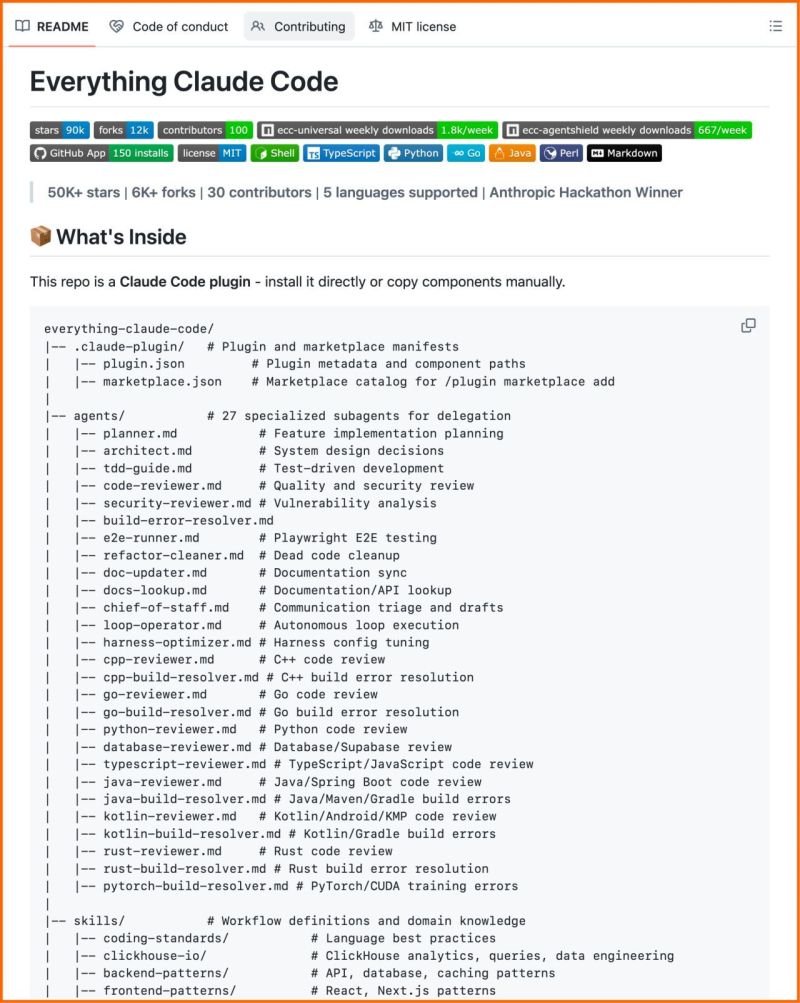
Open-Source Claude Code Configuration Bundles 27 Agents and 64 Skills

Open-Source Claude Code Configuration Bundles 27 Agents and 64 Skills

Alvaro Cintas promotes an open-source Claude Code setup from an Anthropic hackathon winner, containing 27 agents, 64 skills and 33 commands. The post also cites AgentShield with 1,282 security tests and a documented 60 percent cost reduction, compatible with several coding tools.

Original post · 1 min read
This is the most complete Claude Code setup that exists right now.
27 agents. 64 skills. 33 commands. All open source.

The Anthropic hackathon winner open-sourced his entire system, refined over 10 months of building real products.

What's inside:
→ 27 agents (plan, review, fix builds, security audits)
→ 64 skills (TDD, token optimization, memory persistence)
→ 33 commands (/plan, /tdd, /security-scan, /refactor-clean)
→ AgentShield: 1,282 security tests, 98% coverage

60% documented cost reduction.

Works on Claude Code, Cursor, OpenCode, Codex CLI. 100% open source.
♥ 6.9K · ⟲ 824 · 👁 639.2KView on X ↗

Seijin Jung Launches Helena, an Autonomous AI Marketing Agent

Seijin Jung Launches Helena, an Autonomous AI Marketing Agent▶

Seijin Jung introduces Helena, which the post calls the world's first autonomous AI marketer. It claims Helena tracks competitor ads, analyzes GA4 and social performance, drafts blogs for WordPress, Framer and Webflow, and needs no dev setup.

Original post · 1 min read
Introducing Helena: the world's first autonomous AI marketer.

Businesses spend 4,000 hours on marketing…before their first $1M in revenue.

We built Helena to solve this. Helena can:

➤ Track competitor ads & create TikTok slideshows, UGC, static ads - all while you sleep
➤ Analyze performance across GA4, Search Console, paid/organic social for daily insights
➤ Research trends to draft GEO optimized blogs directly on WordPress, Framer, Webflow

...and more

Helena has her own memory, scheduled tasks, 100+ custom marketing tools and native integrations.

No dev. No CLI. No n8n. No API keys needed.

Helena doesn't replace CMOs, and every marketer who's demoed it has asked us for early access.

Want to hire her? Check the next thread ⬇️
♥ 5.6K · ⟲ 768 · 👁 3.7MView on X ↗

CoinDCX Founder Says Impersonation Scam Led to Jail Stint

CoinDCX Founder Says Impersonation Scam Led to Jail Stint

Chandra R. Srikanth amplifies a post by CoinDCX founder Sumit Gupta, who says he spent three nights in jail after a fake website impersonating CoinDCX was used to defraud people. The post warns any founder could face similar arrest.

Original post · 1 min read
What a harrowing experience. Coindcx founder @smtgpt said he spent three nights in jail because someone else impersonated their brand and scammed people!

"If a scammer uses your brand, your name, your face in a fake website and defrauds someone, you can be arrested. Not the scammer. You. This Could Happen to Any founder, Any Business." ⏬
Sumit Gupta @smtgpt
I want to address what happened to Neeraj and me last week. Of course, it was quite shocking to us as well and honestly very disheartening. But today, we want to talk about what actually happened and more importantly, what we’re going to do about it.

On March 21, we were taken into police custody in connection with a fraud complaint. Three days later, on March 24, a Thane court granted us bail, finding that prima facie, no case was made out against us. The fraud at the centre of this complaint was carried out through a fake website - "coindcx.pro" by impersonators who have absolutely n…
♥ 641 · ⟲ 129 · 👁 151.9KView on X ↗

CoinDCX Founders Detail Arrest, Bail and D.S.N. Safety Pledge

CoinDCX Founders Detail Arrest, Bail and D.S.N. Safety Pledge

Sumit Gupta says he and Neeraj were arrested March 21 over a fraud complaint tied to an impersonator site and granted bail March 24. CoinDCX announces a 100 crore rupee Digital Suraksha Network to build cyber safety infrastructure for digital finance.

Original post · 3 min read
I want to address what happened to Neeraj and me last week. Of course, it was quite shocking to us as well and honestly very disheartening. But today, we want to talk about what actually happened and more importantly, what we’re going to do about it.

On March 21, we were taken into police custody in connection with a fraud complaint. Three days later, on March 24, a Thane court granted us bail, finding that prima facie, no case was made out against us. The fraud at the centre of this complaint was carried out through a fake website - "coindcx.pro" by impersonators who have absolutely no connection to our platform, our systems, or CoinDCX. No money moved through CoinDCX. No transaction occurred on our exchange. The complainant himself confirmed in court that he did not know us and had never met us.

I'll be honest: our experience was deeply unsettling. Not because we doubted the facts -- we knew from the first moment that this had nothing to do with us. But because it made something painfully clear: the ecosystem we operate in doesn't yet have the tools to tell the difference between the people building this industry responsibly and the people exploiting it.

Think about what this precedent means: if a scammer uses your brand, your name, your face in a fake website and defrauds someone, you can be arrested. Not the scammer. You. This Could Happen to Any founder, Any Business.

That has to change.

And we've decided that CoinDCX will lead that change - not with words, but with actions. Today, we are announcing Digital Suraksha Network (D.S.N.) - a ₹100 crore commitment from CoinDCX to build the cyber safety infrastructure that India's digital finance ecosystem needs but does not yet have. This is not a crypto problem. This is a problem across any company which has a digital footprint.

Here's what we're building:
→ 24x7 WhatsApp helpline: free for everyone, not just CoinDCX users, to verify links, platforms, and offers before you transact.
→ Open Fraud Intelligence API: We have already documented 1,200+ fraudulent websites impersonating CoinDCX. That data sat inside our systems. Not anymore. We're building an open API to share this intelligence in real time and inviting every exchange, fintech, bank, and digital lender to contribute. A shared immune system for India's digital finance ecosystem.
→ Cyber Safety Infrastructure for Law Enforcement: The Digital Suraksha Network will fund training programmes for state cybercrime cells on blockchain forensics and digital asset tracing.
→ "Caution Before Transaction": a nationwide initiative to give every Indian the tools to participate in digital finance safely.

We know that no single company can solve this. Fraud networks are sophisticated, cross-border, and evolving daily. Nowadays, they make use of AI that makes them exponentially harder to catch. But someone has to start to fix this problem from the root.

We are putting ₹100 crore on the table because the ecosystem cannot afford to wait. I am asking every platform, every regulator, and every Indian who participates in digital finance to join us.

We want to ensure that anyone building startups in India like us can do so with confidence, and not with fear.
♥ 2.0K · ⟲ 391 · 👁 508.2KView on X ↗

Product Manager Says Builder Role Replaces Traditional PRD Work

Moe Ali relays an account of an AI product manager at a frontier lab who no longer writes PRDs, instead prototyping with Claude Code, running evals and shipping reference implementations. The post argues PMs should act as builders with agents.

Original post · 2 min read
Just talked to an AI Product manager making $375K at a frontier lab.

She hasn't written a PRD in 8 months.

Not "she uses AI to help write them faster." She has not opened a PRD template in eight months because she just doesn't need it anymore.

Her day looks nothing like what PMs do:

She wakes up, opens Claude Code, and has a working prototype running before her first meeting of the day (not a wireframe or a figma mockup someone needs to hand off to an engineer). A testable version of the idea - built/shipped by her in the same morning.

While that prototype is running, she's pulling model outputs and running evals. She knows what hallucination looks like in her specific use case. She knows what latency threshold breaks the user experience. She knows the token cost per query and what that means for margin at scale.

She reasons about infrastructure the way a CFO reasons about a P&L. When something needs to be built for real, she doesn't go write a ticket and wait two sprints. She ships the first version herself. hands it to engineering as a working reference implementation, not a requirements doc full of edge cases nobody reads.

The meetings she's in aren't about alignment. They're about what's already shipped and what's blocking the next thing.

Her mental model isn't:

- "manage the roadmap."
- "be the voice of the customer."
- "facilitate cross-functional collaboration."

Those aren't wrong exactly, they're just from a different era.

The mental model that gets you to $480K at a frontier lab in 2026 is simpler and harder at the same time:

- You are the builder.
- The agents are your team.
- Your job is to ship.

She said the output gap between PMs who operate this way and PMs who don't is already 3 to 4x. And this is inside a lab where literally everyone around her is working the same way.

Here's the thing nobody wants to say out loud: the "I write specs and run standups" PM isn't being replaced by AI. The job isn't disappearing into a chatbot. It's being absorbed by the PM sitting two desks over who stopped waiting for engineers and started building herself.

Really crazy how fast the job description changed and really crazy how few people have noticed.
♥ 1.1K · ⟲ 75 · 👁 193.9KView on X ↗

Steven Kuhn Posts Political Attack on JD Vance and Peter Thiel

Steven Kuhn Posts Political Attack on JD Vance and Peter Thiel▶

Steven Eugene Kuhn posts a political message calling JD Vance a dangerous operator and suggesting he is controlled by backers, linking to the Take America Back movement site. The post offers no substantiated evidence.

Original post · 1 min read
JD Vance is the most disciplined, calculated, and patiently dangerous political operator in America right now.

The scariest part is that somebody built him.

Somebody owns him…

and when that bill comes due…

what will happen.

JoinTAB.us

29 March 2026

#JDVance #TAB #PeterThiel #LeadWhereYouLive @joerogan @patrickbetdavid @ShawnRyanShow @RealCandaceO @TuckerCarlson
jointab.usTake America Back | Citizen Servant Leaders MovementBuilding functional alternatives through the Citizen Servant Leaders doctrine. Restoring accountability at the individual level.
♥ 20.7K · ⟲ 5.5K · 👁 185.1KView on X ↗
AI7/10

Microsoft Re-Releases VibeVoice Open-Source Voice AI With Safeguards

Microsoft Re-Releases VibeVoice Open-Source Voice AI With Safeguards

Nav Toor describes Microsoft's open-source VibeVoice, claimed to clone voices from 10 seconds of audio, generate 90-minute multi-speaker audio, and transcribe with speaker labels. He says Microsoft pulled the repo over deepfake misuse and re-released it with watermarks and safety controls, under an MIT license.

Original post · 2 min read
🚨 Microsoft just open sourced a voice AI that was too dangerous to keep live.

They took it down. Added watermarks and safety controls. Then re-released it. For free.

It's called VibeVoice.

Microsoft's frontier open source voice AI.

Clone any voice from 10 seconds of audio. Generate 90 minutes of multi-speaker conversation. Real-time streaming. All running locally on your machine.

No ElevenLabs. No $99/month subscription. No per-minute pricing.

Here's what this thing does:

→ Text-to-speech that sounds indistinguishable from a real human
→ Generate up to 90 minutes of audio in a single pass
→ 4 distinct speakers in one conversation with natural turn-taking
→ Clone any voice from just 10 seconds of audio
→ Real-time streaming TTS. First audio in ~200 milliseconds.
→ Speech-to-text that processes 60 minutes of audio in one pass
→ Identifies who said what and when. Speaker labels + timestamps.
→ Supports 50+ languages for transcription
→ Custom hotwords for names, technical terms, domain-specific accuracy

Here's the wildest part:

Give it a podcast script. It generates a full multi-speaker conversation that sounds like two real humans talking. Natural pauses. Emotional nuance. Turn-taking. 90 minutes. One command.

Microsoft had to take this repo down once because people were misusing it for deepfakes and disinformation. They brought it back with embedded watermarks, audio disclaimers, and safety controls.

That's how powerful this is. A $3 trillion company built it. Released it. Pulled it. Fixed it. And gave it back to the world.

ElevenLabs: $99/month.
Play.ht: $39/month.
Amazon Polly: pay per character.

This: Free. Local. MIT License.

23.5K GitHub stars. 2.6K forks. Backed by Microsoft Research.

100% Open Source.
♥ 2.6K · ⟲ 395 · 👁 549.3KView on X ↗

oh-my-claudecode Adds Multi-Agent Modes to Claude Code

oh-my-claudecode Adds Multi-Agent Modes to Claude Code

Hasan Toor promotes oh-my-claudecode, an open-source orchestration layer for Claude Code offering autopilot, parallel, swarm and pipeline modes with 32 specialized agents. The post claims 3-5x faster output and automatic model routing between Haiku and Opus.

Original post · 2 min read
🚨 Claude Code just got superpowers.

Someone built a multi-agent orchestration layer on top of Claude Code that gives it 5 execution modes, 32 specialized agents, and 3-5x faster output. Zero learning curve.

No new tools. No new subscriptions. Just Claude Code running like it was always meant to.

It's called oh-my-claudecode.

Here's what's inside:

→ Autopilot mode: fully autonomous execution, just describe the task and walk away
→ Ultrapilot mode: spins up parallel agents and runs 3-5x faster on multi-component builds
→ Swarm mode: coordinates multiple agents working independently toward the same goal
→ Pipeline mode: sequential chains for multi-stage processing tasks
→ Ecomode: token-efficient execution that saves 30-50% on costs without sacrificing quality

Here's what actually makes this different:

32 specialized agents for architecture, research, design, testing, and data science. Smart model routing uses Haiku for simple tasks and Opus for complex reasoning automatically. You never think about which model to use. The system decides.

One magic keyword and everything changes:

→ Type "autopilot" and it builds the whole thing autonomously
→ Type "ralph" and it goes into persistence mode, won't stop until the job is verified complete
→ Type "eco" and it switches to budget mode
→ Type "plan" and it runs a planning interview before touching a single file

The wildest part? It auto-resumes your Claude Code sessions when rate limits reset. No babysitting. No manually restarting. Just continuous execution.

3.6K GitHub stars. 100% Open Source.

Link in comments.
♥ 2.0K · ⟲ 256 · 👁 190.0KView on X ↗
AI6/10

Claude Reportedly Finds Zero-Day Flaws in Ghost and Linux Kernel

Claude Reportedly Finds Zero-Day Flaws in Ghost and Linux Kernel▶

chiefofautism claims a live Anthropic conference demo showed Claude finding zero-day vulnerabilities, including a blind SQL injection in the Ghost project and similar work on the Linux kernel. The post is unverified and gives few specifics.

Original post · 1 min read
someone at ANTHROPIC just showed CLAUDE finding ZERO DAY vulnerabilities in a live conference demo

claude has found zero day in Ghost, 50,000 stars on github, never had a critical security vulnerability in its entire, history...

it found the blind SQL injection in 90 minutes, stole the admin api key, then did the exact, same thing to the linux kernel
♥ 11.4K · ⟲ 1.3K · 👁 1.9MView on X ↗

Post Proposes Selling AI Market Intelligence Reports to Clients

Corey Ganim outlines a business idea using an open-source CLI that monitors Reddit, X, YouTube and GitHub, feeding results to an AI agent that writes daily briefings sold for $500 to $1,500 monthly per client. He quotes the GithubProjects repo announcement.

Original post · 1 min read
the business hiding in this repo:

1. pick a niche (real estate agents, ecommerce brands, SaaS founders)
2. use this tool to monitor Reddit, X, and YouTube for mentions of their brand, competitors, and industry keywords
3. pipe the results into an AI agent that writes a daily briefing
4. charge $500-$1,500/mo per client for "market intelligence as a service"

your client gets a daily report they'd never have time to build themselves. you set it up once and it runs on autopilot.

5 clients = $2,500-$7,500/mo recurring. zero API fees.
GitHub Projects Community @GithubProjects
Give your ai agent eyes to see the entire internet for free

Read & search
- Twitter,
- Reddit,
- YouTube,
- GitHub,
- Bilibili,
- XiaoHongShu

One CLI, zero API fees.
♥ 749 · ⟲ 52 · 👁 122.2KView on X ↗

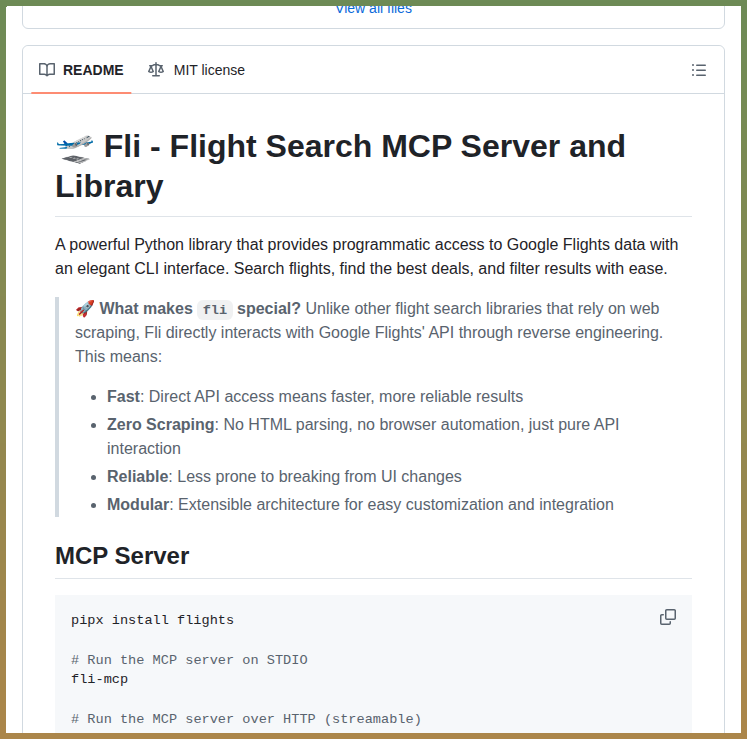
Open-Source fli Project Offers Google Flights Access Without Scraping

Open-Source fli Project Offers Google Flights Access Without Scraping

Tom Dörr shares the fli project on GitHub, which provides direct access to Google Flights through an MCP server, CLI and Python library instead of scraping.

Original post · 1 min read
Direct Google Flights API access without scraping

github.com/punitarani/fli
github.comGitHub - punitarani/fli: Google Flights MCP, CLI and Python LibraryGoogle Flights MCP, CLI and Python Library. Contribute to punitarani/fli development by creating an account on GitHub.
♥ 2.4K · ⟲ 96 · 👁 434.1KView on X ↗
AI6/10

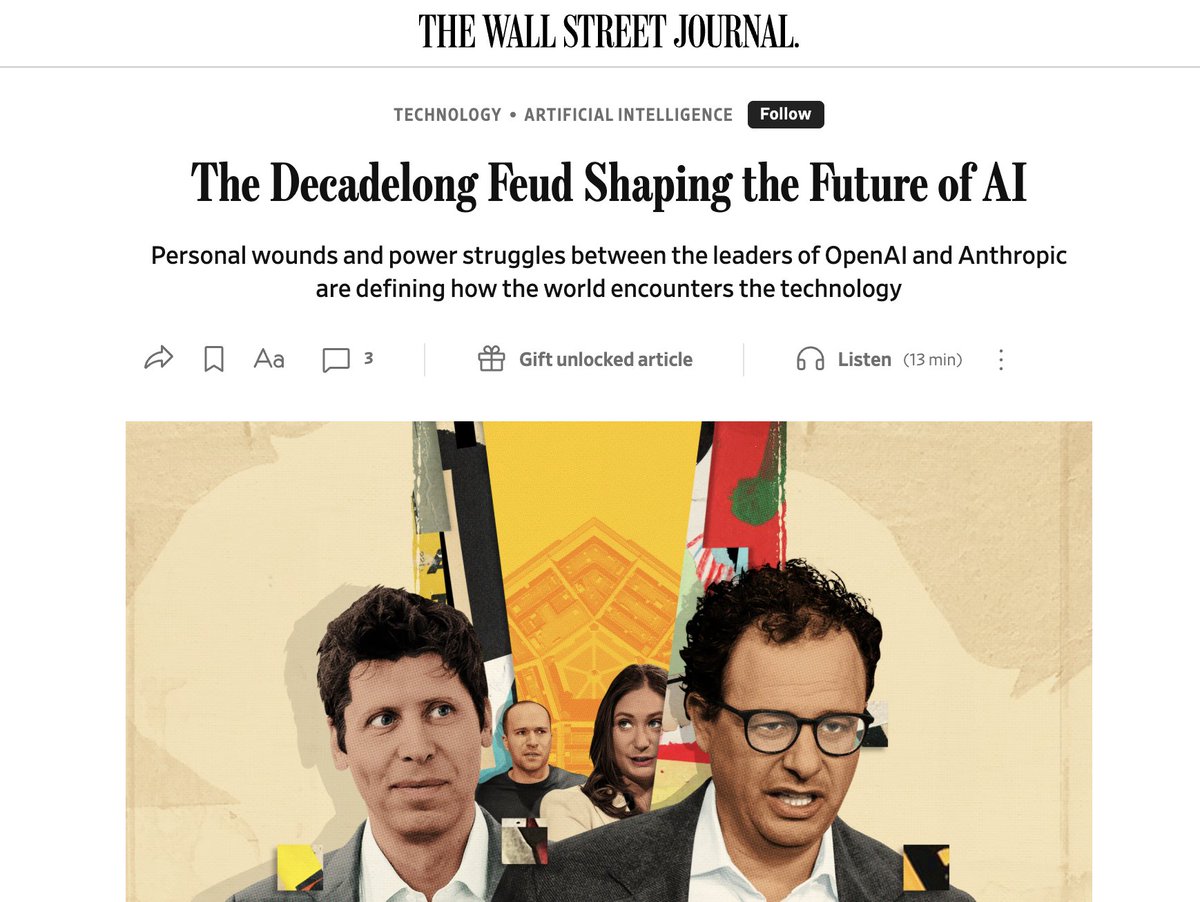
Keach Hagey Investigates Why Anthropic Co-Founders Left OpenAI

Keach Hagey Investigates Why Anthropic Co-Founders Left OpenAI

Keach Hagey says she set out to explain why Dario Amodei and other Anthropic co-founders left OpenAI, which she describes as never fully clear. The post shares an accompanying image and points to reporting.

Original post · 1 min read
It’s never been entirely clear why Dario and the other Anthropic co-founders left OpenAI. I set out to find out.
♥ 2.0K · ⟲ 168 · 👁 901.7KView on X ↗
AI9/10

Claude and GPT Help Resolve Knuth's Hamiltonian Cycle Problem

Claude and GPT Help Resolve Knuth's Hamiltonian Cycle Problem

Bo Wang reports that Claude Opus 4.6 found an odd-m construction for Donald Knuth's open Hamiltonian decomposition problem, and that later work using GPT-5.4 Pro, multi-agent workflows and Lean formalization resolved the even case and simplified constructions. Knuth's updated paper, Claude's Cycles, is linked.

Original post · 1 min read
Three weeks ago I shared that Claude had shocked Prof. Donald Knuth by finding an odd-m construction for his open Hamiltonian decomposition problem in about an hour of guided exploration. Prof. Knuth titled the paper Claude’s Cycles.

The story didn't end there.

The updated paper shows the story got much bigger. For the base case m=3, there are exactly 11,502 Hamiltonian cycles. Of those, 996 generalize to all odd-m, and Prof. Knuth shows there are exactly 760 valid “Claude-like” decompositions in that family.

The even case, which Claude couldn’t finish, was then cracked by Dr. Ho Boon Suan using GPT-5.4 Pro to produce a 14-page proof for all even m≥8, with computational checks up to m=2000.

Soon after, Dr. Keston Aquino-Michaels used GPT + Claude together to find simpler constructions for both odd and even m, by using the multi-agent workflow.

Dr. Kim Morrison also formalized Knuth’s proof of Claude’s odd-case construction in Lean.

So yes: the problem now appears fully resolved in the updated paper’s ecosystem of human + AI + proof assistant work!

We went from one AI solving one problem to a full mathematical ecosystem (multiple AI systems, multiple humans, formal verification) running in parallel on a problem that stumped experts for weeks.

We are living in very interesting times indeed.

Paper (updated): www-cs-faculty.stanford.edu/~knuth/papers/clau…
Bo Wang @BoWang87
Prof. Donald Knuth opened his new paper with "Shock! Shock!"

Claude Opus 4.6 had just solved an open problem he'd been working on for weeks — a graph decomposition conjecture from The Art of Computer Programming.

He named the paper "Claude's Cycles."

31 explorations. ~1 hour. Knuth read the output, wrote the formal proof, and closed with: "It seems I'll have to revise my opinions about generative AI one of these days."

The man who wrote the bible of computer science just said that. In a paper named after an AI.

Paper: cs.stanford.edu/~knuth/papers/claude-cycles.pdf
♥ 1.4K · ⟲ 259 · 👁 177.3KView on X ↗

Paul Solt Says App Store Screenshot Text Drives Downloads More Than Design

The Screenshot Mistake That's Costing You Downloads Every Day

iOS developer Paul Solt argues that the text overlays on App Store screenshots matter more than the UI, citing a case where rewritten copy lifted conversions 80%. He recommends describing user outcomes rather than features and points to a screenshot optimization playbook.

Original post · 6 min read
X ArticleThe Screenshot Mistake That's Costing You Downloads Every Day
I've been building iOS and macOS apps for a while, and there's one thing I kept getting wrong after shipping: the screenshots.
I treated them like a design task. Pick five good screens, add overlay text describing the features, and export at the right sizes. Done. Meanwhile, downloads were flat (I'm looking at you: Super Easy Slides).

Here's what I learned from Theodora: 70% of screenshot effectiveness comes from the text overlay — not the UI. One app saw an 80% conversion lift just from rewriting the copy on existing screenshots.

The design didn't change.
The words did.
This is the thing most developers never fix.
Want the Full Playbook?
Download the App Store Screenshot Optimization Playbook — 100 best practices drawn from @DesignerAnts, the expert behind 1,000+ App Store screenshots. Drop it into Claude or Codex and fix your listing this afternoon.

Want her to do it for you? Hire Theodora →
The mistake is easy to make
When you're deep in building, you know your app inside out. So when it's time to write screenshot text, you naturally describe what the app does:
"Dark mode support."
"iCloud sync."
"Customizable widgets."
Those statements are true. They're also completely useless to someone who doesn't know why they'd want your app.
Feature descriptions answer the wrong question. A user scanning your App Store page isn't asking "what does this app do?" They're asking "is this for me?" Feature lists don't answer that.
Your screenshots read like patch notes to someone who hasn't bought in yet.

What actually works
Change your mindset: stop describing features. Show what changes for the user.
Not: "customizable dashboard"
Rewrite: "see everything that matters, at a glance."
Another example:
Not: "workout tracking"
Rewrite: "you'll never forget what you lifted again."
Same app. Same screen. Different download rate.
The reason this works: specificity makes the promise real. "Productivity app" is invisible. "Never lose a meeting note again" is a reason to download. The more precisely you describe the user's life after your app, the more they can see themselves using it.
Cover your UI with your hand and read only the text. Does it tell a story? Or does it list features?
Most apps fail this test immediately. Mine included.
The sequence that converts
Your screenshots should only make sense in order. If they work in any sequence, you have a catalog, not a story.
Here's the sequence @designerants recommends:
Screenshot 1 — Name the pain. Their frustration, before they found you. ("Buried in notes you'll never find again?")
Screenshot 2 — State the shift. What changes when they use your app. ("Everything you capture, organized automatically.")
Screenshot 3 — Show proof. Numbers, users, and a concrete result. ("Used by 10,000 developers every day.")
Screenshots 4–5 — Feature delivery. The one or two capabilities that actually deliver the promise from Screenshot 2.
Each screenshot does one job. One message. If it needs two sentences to explain, split it into two screens.

One more rule: text is the product
Your UI is evidence. Your text is the argument.
Write the headline for each screenshot before designing the screen. If you can't say the change in 8 words, you don't understand it well enough yet. Then let the UI behind it serve as the visual proof.
Treat the words as the product. Everything else is supporting material.

What I Shipped vs. What I’d Ship Now
I never planned to publish this app. I built it for myself.
But a friend asked about it—so I quickly put together my App Store sales page before I discovered these screenshot tactics.

This is the copy Super Easy Slides launched with:
Notes -> Slides. Instantly.
Full Screen Always Readable.
Slides Over Any App.
Auto-Numbering that Works.
At the time, this felt right.
I was trying to:
Clearly explain what the app does
Highlight key features
Keep everything simple and direct
And on paper, it checks out.
What’s wrong with this
Looking at it now, the problem is obvious:
This describes the product—but it doesn’t sell it.
These read like feature labels, not headlines
There’s no clear user pain or motivation
Nothing really grabs attention or stops the scroll
It assumes the user already understands why this matters
This is the mistake I made:
I focused on what the app does instead of why someone would want it.
The rule I missed
From Theodora’s approach:
Each screenshot should work like an ad.
That means:
Lead with a pain or desire
Show the outcome
Support it with the feature
Not the other way around.
What I’d change
Here’s how I’d rewrite the same ideas:
Before
Notes → Slides. Instantly.

After
Stop Designing Slides
Write notes. Start presenting.

Before
Full Screen Always Readable
After
Stay Focused While You Present
Clean slides. No distractions.
Before
Slides Over Any App
After
Stay In Your Flow
Present without breaking your momentum.
Before
Auto-Numbering that Works
After
Never Fix Slides Manually Again
Your structure stays clean automatically.
Why… continue on X ↗
♥ 898 · ⟲ 60 · 👁 539.9KView on X ↗
Paperclip Open-Source Project Sees Early Business Adoption by Roofers and Dentists

Paperclip Open-Source Project Sees Early Business Adoption by Roofers and Dentists▶

The Startup Ideas Podcast reports that Paperclip, a three-week-old open-source AI agent project, is being used by a roofing company for lead generation, a dentist for practice management, and a security firm for audits. The post frames these as non-tech businesses running AI agents.

Original post · 1 min read
Paperclip has been live for 3 weeks.

A roofing company is already using it to close more deals.

Here's how:

They built agents that
- pull satellite imagery
- cross-reference hail damage data
- find neighborhoods likely to have insurance coverage

than feed these warm leads straight to their sales team

They're not a tech company.

They're a blue-collar business running AI agents.

And they're not alone:
- A dentist is using it to manage his foundation.
- A security firm ran automated audits on Paperclip itself.
- Marketing agencies are replacing manual workflows with agents.

3 weeks. Roofers. Dentists. Security firms.

And they're just getting started.
GREG ISENBERG @gregisenberg
I met the guy behind Paperclip. he won't show his face, but he just built one of the FASTEST growing open-source projects in AI.

how to use Paperclip to hire AI agents to ACTUALLY run a startup with 0 employees:

1. with paperclip, you hire a team of AI agents like CEO, engineer, QA, video editor, content strategist and manage them from one dashboard.

it works with Claude Code, Codex, OpenCode, or any model on OpenRouter. you're not locked into one provider.

2. your AI agents wake up capable but with zero memory. they don't know who they are, where they are, or what they're supposed to be …
♥ 993 · ⟲ 71 · 👁 161.6KView on X ↗

Midday Launches CLI With 80-Plus Business Tools for AI Agents

Midday Launches CLI With 80-Plus Business Tools for AI Agents▶

Pontus Abrahamsson announces the Midday CLI, offering over 80 tools for invoicing, reconciliation, exports, time tracking and reporting so agents can run business operations. Examples are provided in an accompanying video thread.

Original post · 1 min read
Let agents run your business.

Introducing the Midday CLI. 80+ tools. Invoicing, reconciliation, exports, time tracking, reports.

One backbone for every agent.

Examples ⬇️🧵
♥ 899 · ⟲ 40 · 👁 295.0KView on X ↗

Vista Equity Partners Publishes Report on Agentic AI and Enterprise Software

Marc Lehman recommends a March 2026 report from private equity firm Vista Equity Partners titled 'Agentic AI and the Future of Enterprise Software,' linking the PDF and framing it as a major paradigm shift relevant to software stocks such as Microsoft and IGV.

Original post · 1 min read
Yesterday we saw Thoma Bravo, today Vista Equity Partners

If your involved in $MSFT $IGV etc , would recommend reading

Vista Equity Partners , one of the largest PE firms specializing in Software

titled "Agentic AI and the Future of Enterprise Software". It visualizes a major paradigm shift in enterprise software

vistaequitypartners.com/wp-content/uploads/202…
♥ 559 · ⟲ 47 · 👁 167.7KView on X ↗

Jio Studios Rejected 175 Crore Offer for Dhurandhar Films, Finshots Reports

Jio Studios Rejected 175 Crore Offer for Dhurandhar Films, Finshots Reports

Finshots posts a thread on the economics of the Dhurandhar films, stating that Jio Studios turned down 175 crore rupees for both films before Part 1 reached theatres. The post includes a photo and no further detail in text.

Original post · 1 min read
Jio Studios turned down ₹175 crore for both Dhurandhar films before Part 1 even hit theatres! Here is how the economics of the Dhurandhar films is a pure masterclass 🧵
♥ 1.2K · ⟲ 72 · 👁 311.5KView on X ↗

Cursor Releases Plugin for Building CLIs That AI Agents Can Use

Cursor Releases Plugin for Building CLIs That AI Agents Can Use

Eric Zakariasson shares a Cursor marketplace plugin that helps developers build command-line tools suited to agents, addressing issues like interactive prompts and help pages lacking examples. A linked post explains the problem in more detail.

Original post · 1 min read
i turned this into a plugin you can use when building cli's
install here: cursor.com/marketplace/cursor/cli-for-agent
eric zakariasson @ericzakariasson
Building CLIs for agents — If you've ever watched an agent try to use a CLI, you've seen it get stuck on an interactive prompt it can't answer, or parse a help page with no examples. Most CLIs were built assuming a human is at
♥ 502 · ⟲ 24 · 👁 79.5KView on X ↗

Sahil Bloom Argues Courage Matters More Than Intelligence

Sahil Bloom writes that intelligence is abundant while courage is scarce, suggesting intelligent people overthink and wait for permission. He concludes that successful people simply acted when others did not.

Original post · 1 min read
The older I get, the more I realize intelligence is overrated. Intelligent people are more likely to overthink, overplan, and overanalyze. They hide behind motion that doesn't create progress. They fear the judgment of others if they're proven wrong.

The truth is that intelligence is abundant. Courage is not. The people you admire are the ones who had the courage to act. They aren’t more talented than you. They aren’t smarter than you. They just took action when you didn’t.

I often wonder how many extraordinary people wasted their entire lives waiting for permission that never came. Permission isn't granted. It's taken. You get to tap yourself in whenever you want. You can just do things.

Courage beats intelligence.
♥ 8.5K · ⟲ 1.1K · 👁 669.7KView on X ↗

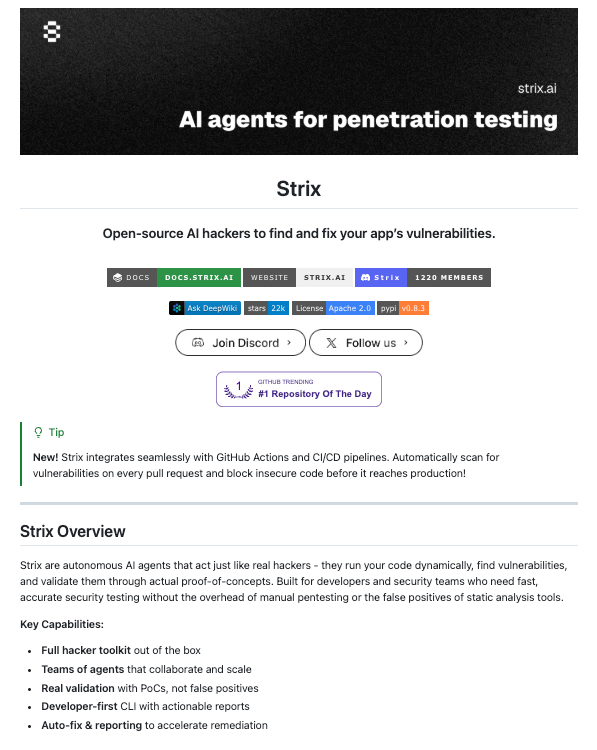
Open-Source AI Security Tool Tests Apps for Breaches Inside CI/CD Pipelines

Open-Source AI Security Tool Tests Apps for Breaches Inside CI/CD Pipelines

Charly Wargnier announces a free, open-source alternative to a startup that raised 117 million dollars for an AI app hacker, saying it tests apps by attempting intrusion, data theft and suggesting fixes, and runs in CI/CD pipelines. The repo link is in a thread.

Original post · 1 min read
🚨 A startup got $117M to build an AI app hacker.

An open-source alternative just dropped that does the exact same thing.

It breaks into your app, steals your data, and hands you the fix.

Now running directly in your CI/CD pipeline.

100% Free & Open-source.

Repo in 🧵↓
♥ 133 · ⟲ 22 · 👁 15.9KView on X ↗

Claude Subconscious Adds Persistent Background Memory to Claude Code

Claude Subconscious Adds Persistent Background Memory to Claude Code

Ihtesham Ali describes Claude Subconscious, an MIT-licensed tool that sends Claude Code session transcripts to a background Letta agent, which maintains eight memory blocks covering preferences, architecture, patterns and pending items across projects.

Original post · 1 min read
🚨BREAKING: Someone built a second brain for Claude Code that runs silently in the background and never lets it forget a thing.

It's called Claude Subconscious, and it solves the biggest problem with every AI coding agent the amnesia that hits the moment you close a session.

Here is how it works:

After every Claude Code response, your full session transcript gets sent to a background Letta agent running underneath Claude. That agent reads your files, searches your codebase, updates its memory, and whispers back the most relevant context before your next prompt all without adding a single second of delay to your workflow.

The agent maintains 8 persistent memory blocks that grow smarter over time:

→ Your coding preferences and style choices it has learned from watching you
→ Project architecture - decisions and known gotchas it has read from your codebase
→ Session patterns - recurring struggles, time-based behaviours, common mistakes
→ Pending items - unfinished work and explicit TODOs it tracks across sessions
→ Active guidance it surfaces before each prompt when it has something useful to say

One agent brain connects across all your projects simultaneously, so the context you built in one repo carries into the next one you open.

Claude Code gets smarter the more you use it, without you changing a single thing about how you work.

MIT License. 100% Open Source.
♥ 874 · ⟲ 128 · 👁 79.0KView on X ↗