Thursday, October 8, 2026ArchiveSearchAsk the paper

The Computomatix Times

All the posts fit to save — curated from @computomatix's bookmarks & likes on X

Search

139 stories

RetroChainer Shares Three-Week Guide to Building AI Influencers
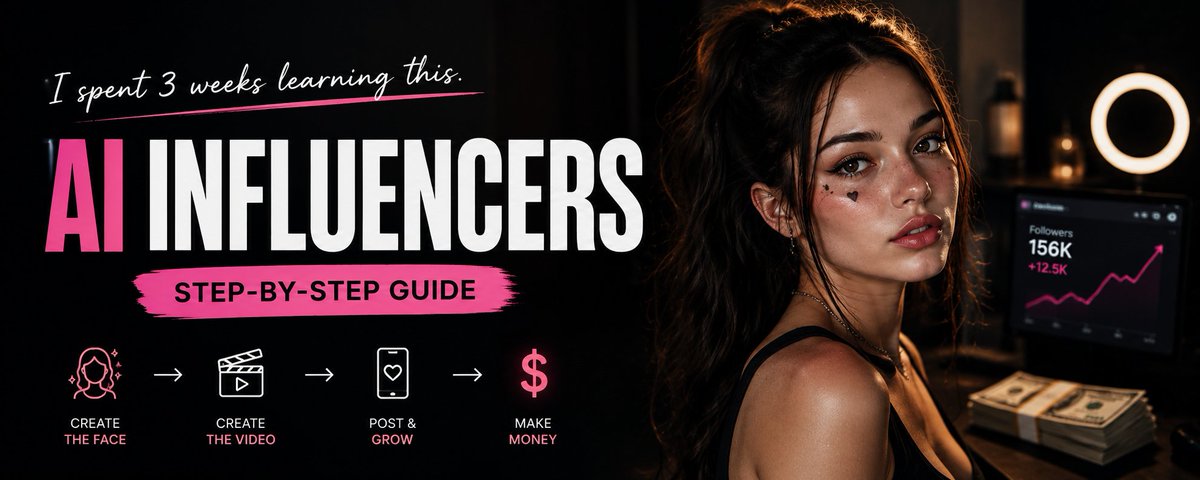
I spent 3 weeks figuring out how to make AI influencers. Here's everything you need to know.

RetroChainer publishes a guide on creating AI influencer accounts, covering niche selection, face generation with Nano Banana Pro and Pinterest references, and engagement tactics. The article frames the market as only months old and recommends sub-cultures, travel content and distinguishing features.

Original post · 8 min read
X ArticleI spent 3 weeks figuring out how to make AI influencers. Here's everything you need to know.
Step 1 - Choosing a Niche
The real secret is the niche. It determines everything:
The model's appearance and style
Content format and triggers
Audience engagement and account growth
The AI influencer market appeared literally a few months ago. The real potential of niches is still untapped copying successful girls makes no sense, you need to find your own direction.
Three working directions:

1. SubculturesAnime, cosplay, female streamers, football club fangirls. Timeless trends with maximally engaged audiences.
Examples: you can take a clip of a female CS2 streamer and replace her with your AI model. Or run an account of a cosplayer from the Marvel universe. A single post touching on a niche debate within a community can generate massive engagement just from one small detail.
2. Travel and eventsYour model can be on the Cannes red carpet, in Tokyo, or at a concert right now, without leaving home. This type of content feels expensive to produce because the viewer intuitively senses the effort behind it.
3. Physical featuresBirthmarks, scars, unique facial features as an additional trigger, but not as the foundation of the account. Unrealistic appearances caused a sensation a few months ago now it no longer surprises anyone.

Hypothesis: create a girl who is a fan of a football club and regularly mention one player as the best on the team. A wave of hate + a wave of support = bonus engagement and an algorithm boost.
Step 2 - Creating the Face
AI without references produces averaged-out looks technically attractive, but without character. You scroll through new AI accounts and every face looks copy-pasted. Here's why.
Tools:
Pinterest - searching for references
Nano Banana Pro (Higgsfield) - face merging

Process:
1. Find two photos of different girls with clearly visible faces
2. Upload both + the prompt to Nano Banana Pro:
Integrate a face into an existing scene. Substitute the face in the reference image with the face from the donor image. The objective is a seamless merge: the new face must inherit the exact expression, pose, and lighting interaction from the reference, while its color attributes (hair and eyes) are adapted from the donor for a perfectly harmonious and natural result.

3. Get the result. If needed add a distinguishing feature (birthmark, unusual eye color)
How to choose faces correctly
The main mistake is picking similar-looking faces. The neural network smooths out the differences and you end up with an averaged result again.
Pick contrasting faces and assign roles in advance:
First face base: sets the vibe of the niche (sharp cheekbones, "cold" look)
Second face donor: softens, adds attractiveness (baby face, full lips)

Face types by niche:
Cosplay, anime, game characters
Strong face goth, alt girl

Soft/romantic face fashion, luxury lifestyle

Hypothesis: find photos of girls of different ethnicities in the anime girl niche, merge them and add a birthmark as a distinguishing feature this instantly combines subculture and appearance triggers.
Step 3 - Creating the Video
The core of the method: AI replicates the movements of a person from the reference video and fully replaces the model in the footage.
3.1 Finding a Reference
Search on TikTok and Instagram. Use your niche as the search query goth girl, anime girl, cosplay.
Signs of a good reference:
High view count
Charismatic, expressive facial movements
Romantic undertone
Triggers from your niche
Key rule: the closer the person in the reference looks to your model — the more realistic the result. Kling struggles to transfer the movements of a long-haired girl onto a short-haired model.
3.2 Creating the First Frame
You can't just insert a photo of your model and hit "generate." Kling uses the background and pose from the uploaded photo, not from the reference. So first, you need to create a starting frame.
Upload to Nano Banana Pro:
1. A photo of your AI model

2. A screenshot of the first frame of the reference video

3. Prompt:
Take the girl's face and body from the first image, and the pose, emotion, and background from the second. Use the girl's face from the first image as the character's face and replace it in the second image, it is necessary to accurately convey emotion and playfulness, it is necessary to accurately convey the appearance of the girl from the first image without changing her appearance, the photo must be alive, the girl is not a doll, sincere real, photo taken on an iPhone phone camera.

3.3 Generating in Kling
Upload to Kling Motion Control: the first frame + the reference video. In the advanced settings, paste the prompt:

Use the attached reference video as the sole motion blueprint and transfer its movement onto the character from the attached photo(s), preserving the character's exact identity, body proportions, face and hair features, skin texture, clothing fit, and overall silhouette with zero morphing, zero style drift, and no added accessories; match the reference motion precisely frame-by-fr… continue on X ↗
♥ 755 · ⟲ 82 · 👁 1.6MView on X ↗

Solo AI Founder Tibo Shares Five Lessons From Revid Growth

Peter Yang summarizes five takeaways from solo founder Tibo, who says his AI products reached over $1M monthly revenue. Lessons include charging from day one, following user signals, pricing at $50-100 per month, keeping churn under 20%, and building SEO tool pages.

Original post · 2 min read
My top 5 takeaways from @tibo_maker, a solo AI founder who's making $1M+ a month:

1. Charge money on day one.

Tibo’s first startup failed because he cared more about appearing successful (e.g., I managed a team of 10 and raised $200K) than validating demand with paying customers. “If there is no revenue and no stickiness in the revenue, it’s going to be very hard to build a successful business.” Free signups are easy to mistake for traction.

2. Follow the signal when users surprise you.

Tibo acquired Typeframe ($2K MRR) as a product video tool, but noticed users were hacking it to stitch 5-second AI clips into longer videos with consistent characters and scenes. He pivoted the entire product to meet this need and rebranded it to Revid, which is now making $600K+ MRR.

3. Price your AI SaaS at $50-100/month

Low enough that customers don’t need a sales call and high enough to filter out tire-kickers. “I see so many people charging $10 / month and it puts you into the position of a cheap product.” Tibo picks his price point first, then shapes the product around it.

4. Keep monthly churn below 20%.

If more than 20% of customers cancel each month, stop scaling acquisition and fix the product first. There’s a ceiling (max MRR) on your revenue based on churn vs. acquisition. At 40% churn, customers stay about 2 months and you’ll hit a wall no matter how much you spend.

5. Build tool pages to rank on Google

Revid has 100+ pages each targeting a specific Google search like “turn audio into video” and “YouTube to shorts.” Many AI founders follow a similar model.

📌 Watch our full conversation for more practical tactics like the above: youtu.be/0UnZnonMN9o
Peter Yang @petergyang
"I shipped 9 failed products before one took off...now I'm doing $1M+/month."

Here's my new episode with @tibo_maker, a solo founder who bootstrapped 5 AI products to $1M+ / month.

Tibo walked me through his exact playbook:

✅ How to validate ideas and fail fast
✅ Why his top acquisition channel is still SEO
✅ The pricing sweet spot for AI products

Some quotes from Tibo:

"When people twist your product into something else, that's a very strong signal you have to follow."

"It's easy to lie to yourself [with free users], but if there's no stickiness in the revenue, it's very hard to build a…
♥ 258 · ⟲ 24 · 👁 80.0KView on X ↗

Minara Launches Strategy Studio for Natural Language Quant Trading

Lowes promotes Minara Strategy Studio, a closed-beta tool that generates trading strategies from natural language and handles backtesting, parameter optimization and live trading. The post is an endorsement that links to the product announcement.

Original post · 1 min read
The era of vibe quant trading is kicking off 🔥

You can generate a trading strategy from natural language, and backtest, optimize and live trading all in one place.
Minara AI @minara
Quant trading is solved.

Introducing: Minara Strategy Studio.

Design strategies, backtest, compare PnL, avoid brutal drawdowns, optimize parameters, go live, all in plain words.

Join the closed beta: minara.ai/app/strategy-studio

🧵
♥ 617 · ⟲ 40 · 👁 165.0KView on X ↗

AskEdgar Opens SEC Filing Data API to Retail Traders

We Built the SEC Filing Tool Used by $1B+ Funds (Now Open to Retail Traders)

AskEdgar published an article describing its API that converts SEC filings into structured data on dilution, shelf registrations, cash runway and underwriting agreements. The company says the API is used by $1B+ funds and is now available to retail traders.

Original post · 6 min read
X ArticleWe Built the SEC Filing Tool Used by $1B+ Funds (Now Open to Retail Traders)
We built an API that turns every SEC filing into structured, real-time data.
Dilution ratings across 2,000+ tickers. Active shelf registrations. Cash runway calculations. Bank agreements with ROFR and tail financing clauses. Pump-and-dump risk scores.
The kind of data you'd normally pay $50K+ a year to access, and for some of these fields, data that literally doesn't exist on Bloomberg or any other institutional provider.
Our API is already being used by $1B+ funds, prop desks and investment banks.
And as of today, it's open to retail for the first time.
Here's how we got here, and what you can build with it.
I — Why This Data Doesn't Exist Anywhere Else
Most traders assume that if something matters, Bloomberg has it.
For large-cap equities, that's mostly true.
For small-caps, the space where 90% of retail trading pain comes from dilution, offerings, and pump-and-dumps, the institutional data providers fall apart.
Here's what they're missing:
Float that actually reflects reality. When a company converts debt to shares, the float changes overnight. Most providers don't update for months. We tack it on within 24 hours of the filing. That one field alone influences shelf capacity, offering ability, and downstream dilution risk, and no one else is doing it right.
Right of first refusal and tail financing. When you see H.C. Wainwright underwrite a small-cap offering, there's usually a contract locking the company into them for the next 12–24 months, with tail fees that keep the relationship sticky even if the company switches banks. This data sits inside exhibit agreements buried in filings. Structured. Queryable. Nowhere else.
Accurate cash runway. Most "months of cash remaining" calculations are a quarterly cash divided by a quarterly burn. Ours accounts for recent raises, warrant exercises, and actual operating burn pulled from the most recent 10-Q, updated filing by filing.
Shelf capacity relative to float. A 10M share shelf on a 2M share float is a completely different situation than the same shelf on a 500M share float. We calculate this ratio in real time. Most providers don't even store shelf data in a queryable format.
Pump-and-dump pattern scoring. Per-ticker scores for country, underwriter, float, and scam risk — each derived from structured filing data and paired with social-media evidence of an orchestrated pump-and-dump.
II — What It Took to Build Out This Data
Three years. Sleepless nights. A lot of things that didn't work.
The core problem: SEC filings are text. Thousands of pages of unstructured legal language, filed across dozens of form types, updated constantly. If you want structured data out of them, you either hire a team of analysts to read every filing by hand, or you build a system that can do it reliably at scale.
We chose the second path. Here's the rough shape of what it took:
Monitor every filing that can change capital structure. Not just the obvious ones (10-K, 10-Q, etc). The quiet ones too, with buried warrant exercises, debt conversions in exhibits, prospectus supplements that change shelf capacity mid-flight.
Build parsers for every form type. Each filing type has its own structure, its own language, its own edge cases. What a PIPE looks like in one 8-K exhibit is not what it looks like in another. The parsers have to handle all of it.
Layer AI on top of parsing. AI finds the keywords and phrases that suggest a dilution event, a new agreement, a compliance issue. Then manual verification commits the data. AI gets us 80% of the way; human review catches the edge cases that would otherwise corrupt the dataset.
Iterate constantly. Filing templates change. New deal structures emerge. Companies find new ways to raise capital that didn't exist five years ago. If the system isn't updated in real time, the data decays.
III — What You Can Build With It
The API has a host of endpoints covering dilution ratings, offerings, registrations, Nasdaq compliance, float, ownership, and bank agreements. Here are three things you can build today that would have taken a team of analysts to assemble manually.
1. A Dilution Risk Monitor

A watchlist dashboard that surfaces dilution warning signs across your portfolio in real time.
For each ticker, you get the overall dilution risk rating, active shelf registrations with remaining capacity, Nasdaq compliance deficiencies, and a cash runway calculation that tells you when the company will need to raise. Alert on things like cash dropping below 6 months, a new shelf going effective, or ATM capacity getting large relative to float.
2. Backtest Low-Float Gappers
Use the historical float endpoint to check performance on historical gappers under 1m float. Use the news endpoint 'tags' to see how gappers performed under certain news.
3. A One-Click Due Diligence Report
Take any ticker and generate a full due diligence report in seconds, ownership concentration, float history, reverse split count, ROFR agreements with active banks, upcoming lockup expiration… continue on X ↗
♥ 59 · ⟲ 12 · 👁 65.1KView on X ↗

Higgsfield Launches Marketing Studio Powered by Hermes Agent

Higgsfield Launches Marketing Studio Powered by Hermes Agent▶

Higgsfield AI announces Higgsfield Marketing Studio, powered by Hermes Agent, which generates UGC-style video ads for websites or apps in a few clicks. The product is pitched at founders of vibe-coded products.

Original post · 1 min read
Meet Higgsfield Marketing Studio, powered by Hermes Agent.
UGC era for your vibe-coded products is here.

You can now create viral UGC ads for your website or app in a few clicks and distribute them at unmatched speed.

It's time to go global.
♥ 2.4K · ⟲ 324 · 👁 1.7MView on X ↗

Aesty Pitches Closet App That Reads Camera Roll Instead of Manual Photos

Aesty Pitches Closet App That Reads Camera Roll Instead of Manual Photos▶

Nadia Zueva promotes aesty.ai, a digital wardrobe app that builds a closet by scanning the user's camera roll rather than requiring each item to be photographed. The post is a short promotional video.

Original post · 1 min read
pov: you opened your closet in 2026

every digital wardrobe app makes you photograph each item. aesty.ai just reads your camera roll
♥ 2.4K · ⟲ 113 · 👁 448.3KView on X ↗

Janhavi Jain Maps Seven Shifts Driven by India's Quick Commerce Boom

Janhavi Jain, building SKIPD, outlines seven ways India's quick commerce market, valued at $5.4B and led by Blinkit, Zepto and Instamart, has changed buying behavior. Points include late-night buying peaks, trial-size purchases, weakening brand loyalty, and quick commerce becoming an ad business.

Original post · 2 min read
Quick commerce is a $5.4B market in India growing at 70-80% CAGR. Blinkit, Zepto, Instamart collectively do 4M+ orders a day. But the interesting story isn’t the business.

It’s what it did to how Indians buy things. 7 shifts nobody saw coming.

1/ 73% of q-com orders happen outside traditional shopping hours. 10pm-1am is now peak for ice cream, condoms, skincare, snacking. Three years ago this buying window didn’t exist. An entirely new consumption slot was invented and nobody’s talking about it.

2/ ₹149 mini sunscreen outsells ₹599 full size on Blinkit. The full bottle is a commitment. The mini is a maybe. Consumers are treating q-com like a sample store. Brands without trial SKUs are invisible.

3/ Brand loyalty disappeared in grocery. Search “atta” on Zepto. 8 brands sorted by delivery time. The one in the nearest dark store wins. Not the one your mom used. For staples, proximity replaced preference. Terrifying if you’re a legacy FMCG brand.

4/ Kirana shops aren’t losing staples. They’re losing the ₹50-200 impulse buy. The chocolate, the chips, the random face mask. The small purchases that used to happen because you were already in the store. That foot traffic is gone and it’s not coming back.

5/ Men started buying skincare. The anonymity of tapping “face wash” on Blinkit vs asking for it at a medical store broke a psychological barrier nobody was talking about. Embarrassment was the barrier all along. Men’s grooming on q-com is growing faster than any other beauty subcategory.

6/ Blinkit and Zepto aren’t delivery companies anymore. They’re media businesses. Blinkit’s ad revenue grew 220% YoY. Both crossed ₹1,000 Cr in annual ad revenue by FY25. Ads are now 15% of Blinkit’s total revenue. If you’re thinking of q-com as just a listing channel, you’re missing the point.

7/ The delivery bar moved for everyone. If Zepto delivers in 10 minutes, why does your D2C site take 5 days? The consumer doesn’t separate “q-com speed” from “normal speed.” Every brand shipping in 3-5 days is now competing against a 10-minute standard they didn’t set and can’t match.

Quick commerce didn’t just create a new delivery channel. It rewired how 50 million Indians think about buying things
♥ 582 · ⟲ 80 · 👁 185.0KView on X ↗

Every Teases Plus One, a One-Click OpenClaw Product for Working With Agents

Brandon Gell of Every says the company is a top agent-native business and announces an upcoming launch called Plus One, with a waitlist for a one-click, OpenClaw-based setup. The post links to a conversation with Every's COO and head of platform about running the company on personal agents.

Original post · 1 min read
.@every is on the edge. We’re easily a top 3 agent native business in the world (even OpenAI employees have shared they want to work like we work).

We went behind the scenes here to show what working alongside agents is like and share a bit about our upcoming launch: Plus One.

If you want to work like us, sign up for the waitlist to get your 1-click, super-powered OpenClaw→every.to/plus-one
Dan Shipper @danshipper
We use OpenClaws to do all of our work at @every.

We have 25 full-time employees, so we’re one of the few companies in the world that has seen how work changes when everyone has their own personal agent in the company Slack.

I chatted with @every COO Brandon (@bran_don_gell) and @every head of platform Willie (@bigwilliestyle) to share what we’ve learned.

We get into:
- Why agents become mirrors of their owners, and how that influences how other people on the team interact with them
- How a parallel AI org chart forms on its own. People have stopped tagging me on Slack with questions about …
♥ 161 · ⟲ 11 · 👁 38.9KView on X ↗

Solo App Builder Launches Studio, Cites Rork Marketing Academy

Prajwal Tomar announces IgnytStudio, which aims to ship two AI-built mobile apps per month, and says distribution is the main challenge. He promotes the Rork Max UGC Marketing Academy, a course built on growth tactics behind viral apps.

Original post · 1 min read
You don't realize how BIG this is for solo app builders.

I'm launching my app studio this month (IgnytStudio). The goal is simple: ship 2 mobile apps per month using AI and scale them to actual revenue.

Building apps is the easy part now. A full native iOS app takes me 2-3 days max.

But getting users? That's the part I've been stuck on for weeks.

I can build. I just don't know how to get people to actually download and use what I ship.

Rork just dropped an entire marketing academy built from the growth system behind 2,000+ apps that went viral on TikTok.

This is exactly what was missing from my vibe coding stack.

At this point I'm pretty sure distribution is the ONLY moat left for solo builders.
Rork @rork
We just launched Rork Max UGC Marketing Academy.

The growth system behind 2K+ apps that went viral on TikTok.

Viral hooks, DM scripts, creator hiring guides, and contract templates. Everything to get you to $10K+ MRR

We want you to win.

Built with @wesocialgrowth.
♥ 391 · ⟲ 20 · 👁 69.2KView on X ↗

Marik Hazan Team Rebuilds Y Combinator Demo Day Startups With Agentic Founders

Tim Draper reposts a claim from Marik Hazan that an agentic AI team rebuilt every startup in Y Combinator's latest demo day batch, with working products shared in a thread. The claim is presented without independent verification.

Original post · 1 min read
Draper Associates (@DraperVC) company just replicated every YC startup in the latest batch using agentic founders. Incredible.
Marik Hazan @MarikHazan
We just rebuilt every startup in @ycombinator's latest demo day batch.

Here's what our agentic "founders" pulled off and what it means for the future of startups.

Fully useable products at the bottom of the thread below 🤖🧨
♥ 724 · ⟲ 64 · 👁 242.9KView on X ↗

Notion's Ivan Zhao Argues Best Work Is Built Together, Not Alone With AI

Notion's Ivan Zhao Argues Best Work Is Built Together, Not Alone With AI▶

Notion co-founder Ivan Zhao posts a video arguing that the loud narrative of one person commanding an army of chatbots gets the future wrong. He says Notion stands for thinking together.

Original post · 1 min read
The loudest story about AI is a lonely one. One person with an army of chatbots. Other humans are friction.
That gets the future wrong. The best things aren’t built alone.
In a moment of change, we want to remind the world (and ourselves) what Notion stands for:
— Think Together
♥ 3.1K · ⟲ 411 · 👁 1.3MView on X ↗

Seijin Jung Launches Helena, an Autonomous AI Marketing Agent

Seijin Jung Launches Helena, an Autonomous AI Marketing Agent▶

Seijin Jung introduces Helena, which the post calls the world's first autonomous AI marketer. It claims Helena tracks competitor ads, analyzes GA4 and social performance, drafts blogs for WordPress, Framer and Webflow, and needs no dev setup.

Original post · 1 min read
Introducing Helena: the world's first autonomous AI marketer.

Businesses spend 4,000 hours on marketing…before their first $1M in revenue.

We built Helena to solve this. Helena can:

➤ Track competitor ads & create TikTok slideshows, UGC, static ads - all while you sleep
➤ Analyze performance across GA4, Search Console, paid/organic social for daily insights
➤ Research trends to draft GEO optimized blogs directly on WordPress, Framer, Webflow

...and more

Helena has her own memory, scheduled tasks, 100+ custom marketing tools and native integrations.

No dev. No CLI. No n8n. No API keys needed.

Helena doesn't replace CMOs, and every marketer who's demoed it has asked us for early access.

Want to hire her? Check the next thread ⬇️
♥ 5.6K · ⟲ 768 · 👁 3.7MView on X ↗

Post Proposes Selling AI Market Intelligence Reports to Clients

Corey Ganim outlines a business idea using an open-source CLI that monitors Reddit, X, YouTube and GitHub, feeding results to an AI agent that writes daily briefings sold for $500 to $1,500 monthly per client. He quotes the GithubProjects repo announcement.

Original post · 1 min read
the business hiding in this repo:

1. pick a niche (real estate agents, ecommerce brands, SaaS founders)
2. use this tool to monitor Reddit, X, and YouTube for mentions of their brand, competitors, and industry keywords
3. pipe the results into an AI agent that writes a daily briefing
4. charge $500-$1,500/mo per client for "market intelligence as a service"

your client gets a daily report they'd never have time to build themselves. you set it up once and it runs on autopilot.

5 clients = $2,500-$7,500/mo recurring. zero API fees.
GitHub Projects Community @GithubProjects
Give your ai agent eyes to see the entire internet for free

Read & search
- Twitter,
- Reddit,
- YouTube,
- GitHub,
- Bilibili,
- XiaoHongShu

One CLI, zero API fees.
♥ 749 · ⟲ 52 · 👁 122.2KView on X ↗

Paul Solt Says App Store Screenshot Text Drives Downloads More Than Design

The Screenshot Mistake That's Costing You Downloads Every Day

iOS developer Paul Solt argues that the text overlays on App Store screenshots matter more than the UI, citing a case where rewritten copy lifted conversions 80%. He recommends describing user outcomes rather than features and points to a screenshot optimization playbook.

Original post · 6 min read
X ArticleThe Screenshot Mistake That's Costing You Downloads Every Day
I've been building iOS and macOS apps for a while, and there's one thing I kept getting wrong after shipping: the screenshots.
I treated them like a design task. Pick five good screens, add overlay text describing the features, and export at the right sizes. Done. Meanwhile, downloads were flat (I'm looking at you: Super Easy Slides).

Here's what I learned from Theodora: 70% of screenshot effectiveness comes from the text overlay — not the UI. One app saw an 80% conversion lift just from rewriting the copy on existing screenshots.

The design didn't change.
The words did.
This is the thing most developers never fix.
Want the Full Playbook?
Download the App Store Screenshot Optimization Playbook — 100 best practices drawn from @DesignerAnts, the expert behind 1,000+ App Store screenshots. Drop it into Claude or Codex and fix your listing this afternoon.

Want her to do it for you? Hire Theodora →
The mistake is easy to make
When you're deep in building, you know your app inside out. So when it's time to write screenshot text, you naturally describe what the app does:
"Dark mode support."
"iCloud sync."
"Customizable widgets."
Those statements are true. They're also completely useless to someone who doesn't know why they'd want your app.
Feature descriptions answer the wrong question. A user scanning your App Store page isn't asking "what does this app do?" They're asking "is this for me?" Feature lists don't answer that.
Your screenshots read like patch notes to someone who hasn't bought in yet.

What actually works
Change your mindset: stop describing features. Show what changes for the user.
Not: "customizable dashboard"
Rewrite: "see everything that matters, at a glance."
Another example:
Not: "workout tracking"
Rewrite: "you'll never forget what you lifted again."
Same app. Same screen. Different download rate.
The reason this works: specificity makes the promise real. "Productivity app" is invisible. "Never lose a meeting note again" is a reason to download. The more precisely you describe the user's life after your app, the more they can see themselves using it.
Cover your UI with your hand and read only the text. Does it tell a story? Or does it list features?
Most apps fail this test immediately. Mine included.
The sequence that converts
Your screenshots should only make sense in order. If they work in any sequence, you have a catalog, not a story.
Here's the sequence @designerants recommends:
Screenshot 1 — Name the pain. Their frustration, before they found you. ("Buried in notes you'll never find again?")
Screenshot 2 — State the shift. What changes when they use your app. ("Everything you capture, organized automatically.")
Screenshot 3 — Show proof. Numbers, users, and a concrete result. ("Used by 10,000 developers every day.")
Screenshots 4–5 — Feature delivery. The one or two capabilities that actually deliver the promise from Screenshot 2.
Each screenshot does one job. One message. If it needs two sentences to explain, split it into two screens.

One more rule: text is the product
Your UI is evidence. Your text is the argument.
Write the headline for each screenshot before designing the screen. If you can't say the change in 8 words, you don't understand it well enough yet. Then let the UI behind it serve as the visual proof.
Treat the words as the product. Everything else is supporting material.

What I Shipped vs. What I’d Ship Now
I never planned to publish this app. I built it for myself.
But a friend asked about it—so I quickly put together my App Store sales page before I discovered these screenshot tactics.

This is the copy Super Easy Slides launched with:
Notes -> Slides. Instantly.
Full Screen Always Readable.
Slides Over Any App.
Auto-Numbering that Works.
At the time, this felt right.
I was trying to:
Clearly explain what the app does
Highlight key features
Keep everything simple and direct
And on paper, it checks out.
What’s wrong with this
Looking at it now, the problem is obvious:
This describes the product—but it doesn’t sell it.
These read like feature labels, not headlines
There’s no clear user pain or motivation
Nothing really grabs attention or stops the scroll
It assumes the user already understands why this matters
This is the mistake I made:
I focused on what the app does instead of why someone would want it.
The rule I missed
From Theodora’s approach:
Each screenshot should work like an ad.
That means:
Lead with a pain or desire
Show the outcome
Support it with the feature
Not the other way around.
What I’d change
Here’s how I’d rewrite the same ideas:
Before
Notes → Slides. Instantly.

After
Stop Designing Slides
Write notes. Start presenting.

Before
Full Screen Always Readable
After
Stay Focused While You Present
Clean slides. No distractions.
Before
Slides Over Any App
After
Stay In Your Flow
Present without breaking your momentum.
Before
Auto-Numbering that Works
After
Never Fix Slides Manually Again
Your structure stays clean automatically.
Why… continue on X ↗
♥ 898 · ⟲ 60 · 👁 539.9KView on X ↗

Sierra Releases Ghostwriter, an Agent That Builds Customer Service Agents

Sierra Releases Ghostwriter, an Agent That Builds Customer Service Agents▶

Bret Taylor announces that Sierra is releasing Ghostwriter, which lets enterprises create customer experience AI agents through conversation rather than forms, with voice, multilingual support, system actions and guardrails. He argues every software UI will eventually be an agent.

Original post · 1 min read
Today, Sierra is releasing Ghostwriter, our agent for building agents. With Ghostwriter, you can create an AI agent for your customer experience — one that can chat, pick up the phone, speak dozens of languages, take action on your systems of record, and be protected with industry-leading guardrails — simply by having a conversation. No clicking, no forms, no menus.

Codex and Claude Code have transformed how we build software, making it possible for software engineers to orchestrate and review the work rather than doing all the work themselves. We think the same transformation will happen for all software. Rather than every enterprise app having a web app for humans and an API for automation, every software platform’s UI will be an agent that can do the work on your behalf.

I recorded a demo of my building and optimizing an agent with Ghostwriter so you can see how powerful and easy it is to use. It’s completely changed the way our early adopters build agents, and it’s changed the way I think about the software industry. Let me know what you think, and, if you’re interested in trying it out at your business, please reach out directly.
♥ 3.2K · ⟲ 293 · 👁 1.1MView on X ↗

Pieter Levels Revives ThisHouseDoesNotExist With Newer Image Models

Pieter Levels Revives ThisHouseDoesNotExist With Newer Image Models▶

Pieter Levels announces he has revived ThisHouseDoesNotExist.org, his 2022 AI architecture project, migrating it to a Hetzner VPS and upgrading it to current image models. The site now generates about twelve new designs daily and lets users vote on them.

Original post · 1 min read
✨ I've brought back ThisHouseDoesNotExist.org from the dead

It was my first visual AI project in 2022, and it's this project that generated random @ArchDaily-style architecture designs that made me realize AI image models could do interior design

That led me to make InteriorAI.com, which then led me to finetune my first interior design model which then for fun I uploaded my own photos too, which led me to make AvatarAI.me and then pivoted that in to PhotoAI.com

So this project has a special place for me

It was still alive but wasn't generating new designs anymore because it ran on Stable Diffusion 1.5 which was outdated and everything stopped working about a year ago

I've now migrated it to its own Hetzner VPS now, which means I can run Claude Code on the server with it, and cleaned it up and upgraded it to the latest AI image models (including Nano Banana Pro)

It now generates about 12 new designs every day again, and you can up or downvote the ones you like or don't like!
@levelsio @levelsio
✨ My new project is now live:

thishousedoesnotexist.org/

🏡 It uses A.I. to let you generate @ArchDaily-style modern architecture houses on-the-fly

If you generate any nice ones, reply them here pls 😊
♥ 292 · ⟲ 13 · 👁 204.8KView on X ↗

Wade Foster Recounts Zapier's Early YC Advice to Launch and Grow

Wade Foster Recounts Zapier's Early YC Advice to Launch and Grow

Wade Foster recalls Zapier's 2012 Y Combinator office hours, where Garry Tan urged them to launch immediately and Paul Graham challenged them to grow revenue 10 percent week over week. He argues growth rate is the key signal for startups.

Original post · 1 min read
It was May 2012, and we hadn't yet launched @Zapier.

Two YC office hours changed everything. The first was with @GarryTan.

He had one question: "Have you launched?"

We said no. We had users. People had paid us. But in our minds, the product wasn't good enough.

Garry didn't care. He said launch now. We did and realized we were dumb to wait.

Our second office hours was with @PaulG. Same question: "Have you launched?"

This time we got to say yes. So he gave us an assignment: "Grow revenue 10% week over week. 10% is great. 20% is fantastic."

So we set off to grow 10% a week. And we did.

Last week PG posted this thread, and it brought all this back.

10% a week is 142x a year. Even at scale, growth rate is the signal.

Focus on growth rate and you'll find the future.
♥ 626 · ⟲ 29 · 👁 56.2KView on X ↗

Lenny Rachitsky Explains How Executive Calendars Shape Product Decisions

Lenny Rachitsky Explains How Executive Calendars Shape Product Decisions▶

Lenny Rachitsky describes the fragmented, back-to-back nature of an executive's day and why product managers overestimate how much leaders remember of their pitches. He shares this via a video and a quoted post about Jessica Fain's chief-of-staff pitch to Slack's CPO.

Original post · 1 min read
People don't understand executive calendars.

I describe an executive's calendar as like a strobe light going off.

You wake up at 8AM, you've already got a huge list of urgent things going on.

You go from a meeting with finance on a budget, to an interview for another executive, to a people problem, to a legal problem, to a product review.

And the product manager coming to that product review, who's trying to make a pitch thinks I've been prepping for this meeting for two weeks.

But the executive coming into that session hasn't thought about you since.
Lenny Rachitsky @lennysan
Jessica Fain's best product ideas kept dying, and she couldn't figure out why.

So at eight and a half months pregnant, she pitched @SlackHQ's CPO @aunder on becoming her Chief of Staff. She wanted to see how executive decisions actually get made from the inside.

What she learned changed everything she knew about influencing execs.

People don't realize that an executive's calendar is like a strobe light going off. Budget meeting, a people problem, a legal issue—then your product review. You've been prepping for three weeks. They haven't thought about you since the last meeting. They may not …
♥ 338 · ⟲ 21 · 👁 237.5KView on X ↗