Marc Lehman recommends a March 2026 report from private equity firm Vista Equity Partners titled 'Agentic AI and the Future of Enterprise Software,' linking the PDF and framing it as a major paradigm shift relevant to software stocks such as Microsoft and IGV.
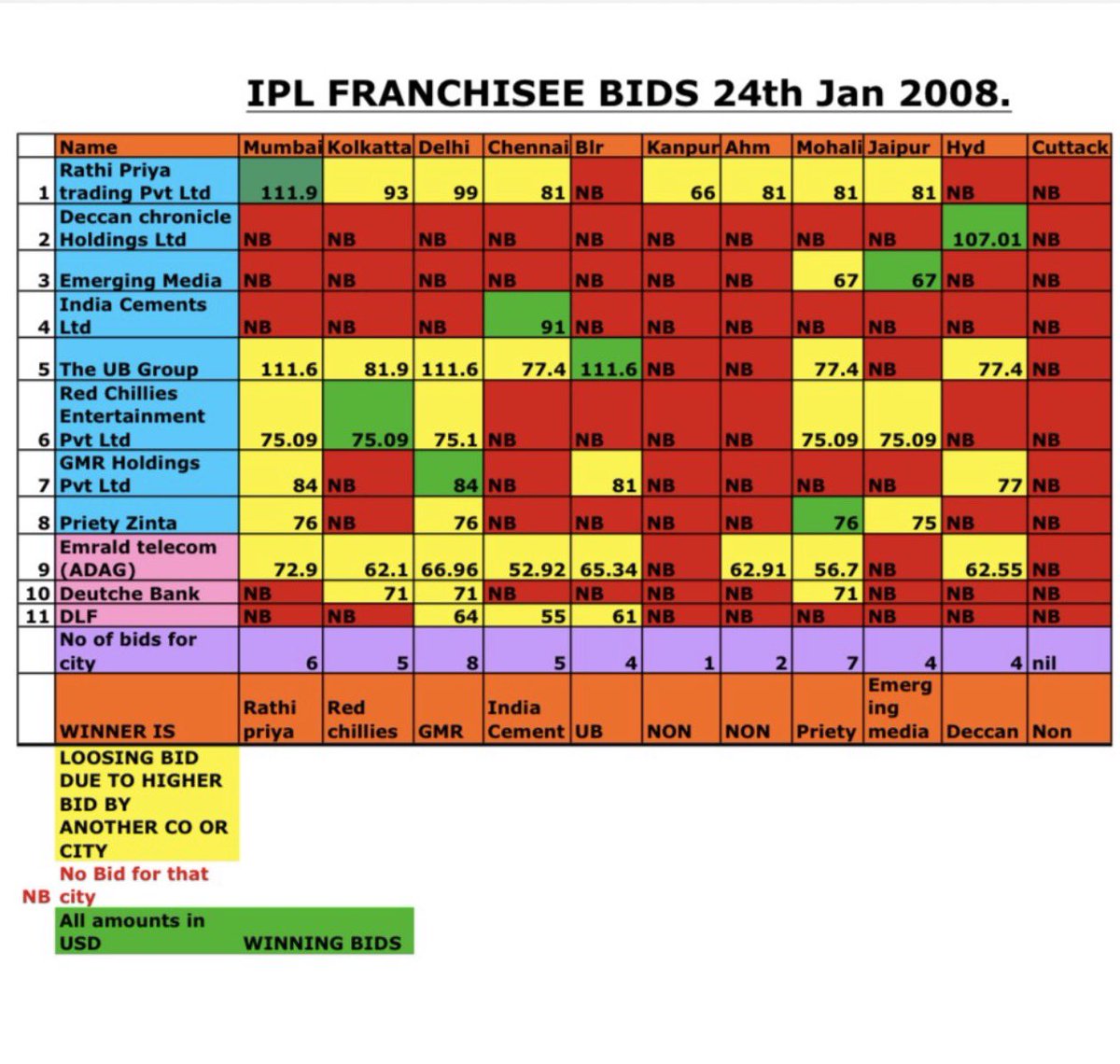
Lalit Kumar Modi recounts the original IPL franchise bids awarded in January 2008, converting them to rupees at the exchange rate of that day, and argues that the value appreciation of teams is greater than media suggests. He notes actual figures would appear in company registrar filings.
This is original bids for @IPL that were awarded on 24th January 2008 in mumbai at cricket center at 12:00 pm. The bids were converted into rupees on that day. One dollar was 40 rupees on that morning. So one can just judge the true value appreciation today. 🙏🏽 further the amount bid was spread out to be paid evenly over 10 years. Many teams were in profit post year one itself. So the amount came out of their cash flow. So value appreciation is far greater than what the media conceives it to be. Actual numbers each team spent to buy the team will show up only in company filings with registrar of the company. So check that for accuracy and true value appreciation.
Matt Janiga questions whether legal AI startup Harvey's $11 billion valuation is justified given its competition with Lexis and Westlaw, which have large legacy data businesses. He argues Harvey lacks those datasets and would struggle to match their fee revenue.
The Harvey fundraise at an $11 Billion valuation is really interesting, and on the verge of head scratching.
Harvey feels like it competes with Lexis Nexis and Westlaw, which are the other two legal tools every major law firm has.
I used Lexis's AI tool a lot in my prior role. It was decent and seemed to improve over time. I assume Lexis will continue to improve it. It honestly competes with ChatGPT and Gemini more than Harvey.
The law firm lawyers I know who use Harvey like it, but it's not their sole AI tool. Like every AI tool on the market, it also has limitations and pain points.
Lexis is owned by RELX PLC and that conglomerate has a market cap of ~$65B. Westlaw is owned by Thompson Reuters and that conglomerate has a market cap of ~$55B (has been swinging, in part due to news about AI advancements and competitors like Harvey).
The interesting thing is that Lexis and Westlaw have legacy businesses built on datasets of legal precedents and carefully curated regulatory materials like opinion letters and legislative history. They also offer other products that drive material revenue, like Lexis's identity verification databases and value-added services.
Harvey doesn't have those things. And unless it can displace Lexis or Westlaw, it doesn't seem like it can earn the fees that those providers currently take from law firms on an annual basis. Legal revenue is an estimated 25% of Lexis's business — is Harvey really already on par with Lexis in the legal space vis-a-vis its $11B valuation? Westlaw drives closer to 40% of Thompson Reuters revenue, so maybe Harvey does still have room to double its valuation off of fee revenue. But that feels like a tough mountain to climb.
I'm also skeptical that Harvey can survive the thousands of paper cuts of lawyers opting for more general use AI tooling from the likes of Anthropic, Gemini and OpenAI. Anthropic has made amazing strides in general business work product, and all three are useful tools in developing memos and contracts.
There's also a last issue facing Harvey. If it replaces too many associates or associate hours, law firms aren't replacing costs — they're ripping out revenue generators. As someone who hires law firms, I'm not paying Cravath or MoFo $1,000 an hour for a partner to use Harvey. I'm paying those rates to get an associate, counsel or partner who has specific knowledge and skills to advance my project faster. It's great for me if Harvey usage shaves 5 hours off my bill on a project. But not good for the law firms, because I don't have some magic increase in projects to help them make up the lost revenue.
Law firms who adopt Harvey more will have to change their billing models. And I'm not sure you can teach that many old dogs the necessary number of new tricks to keep pumping up Harvey's valuation.
Okay. Rant over. Going to touch grass for 20 minutes.
Eric Glyman reports that the top quartile of AI spenders on Ramp have more than doubled revenue since 2023 while the bottom quartile is flat, citing examples like a Texas roofing company and a Florida construction firm. He frames it as a widening gap that most businesses don't yet see.
Getting on the right side of the ice — The ice has cracked If you want to understand what's about to happen to American businesses, picture one night in the Antarctic over a century ago. Ernest Shackleton and 27 men were camped on ice
John Collison shares United Airlines' announcement of Relax Row, three adjacent economy seats with adjustable leg rests that form a lie-flat space, arriving next year on more than 200 787s and 777s. He comments that it is the product airline passengers have long wanted.
Welcome to United Relax Row, three adjacent United Economy seats with adjustable leg rests that can each be raised or lowered to create a cozy lie-flat space for stretching out...
You'll also get a mattress pad, blanket and two pillows. If you’re traveling with kids, a plushie too! United Relax Row will be available starting next year on more than 200 of our 787s and 777s, each with up to 12 of these brand-new rows.