Thursday, October 8, 2026ArchiveSearchAsk the paper

The Computomatix Times

All the posts fit to save — curated from @computomatix's bookmarks & likes on X

Search

289 stories

OpenAI Adds iOS App Build Plugin to Codex With Live Preview and Hot Reload

OpenAI Adds iOS App Build Plugin to Codex With Live Preview and Hot Reload▶

OpenAI Developers announce a Build iOS Apps plugin for Codex that lets developers view and test iOS apps in an in-app browser, open SwiftUI previews and hot reload edits. The post is a product announcement with a demo video.

Original post · 1 min read
More of the iOS app loop, now inside Codex.

The Build iOS Apps plugin lets Codex view and test your iOS app in the in-app browser, open SwiftUI previews, and hot reload edits without leaving Codex.
♥ 9.0K · ⟲ 714 · 👁 2.1MView on X ↗

Ten Free GitHub Repos Offer Paid-Tool Alternatives for Finance and AI

Ten Free GitHub Repos Offer Paid-Tool Alternatives for Finance and AI

Harman lists ten GitHub repositories that substitute for paid products, including AutoHedge, Vibe-Trading, Fincept Terminal as a Bloomberg alternative, LibreChat, and Open Higgsfield AI, with links to each.

Original post · 4 min read
10 GitHub repos so good they shouldn't be free.

1. AutoHedge

An autonomous hedge fund built in Python with four AI agents: a director generates investment theses, a quant validates them, a risk manager decides position size, and an execution agent places orders. Operates live on Solana. With 'pip install -U autohedge', you can start trading immediately.
repo → github.com/The-Swarm-Corporation/AutoHedge

2. Vibe-Trading

A trading system using a Directed Acyclic Graph (DAG) model, featuring 64 finance skills and 29 preset specialist agent swarms. Includes analysis methods like Ichimoku, Elliott Wave, SMC, Black-Scholes, full Greeks, and risk parity. Its crypto desk provides liquidation heatmaps and token unlock tracking. You can observe agents debating strategies in real time.
repo → github.com/HKUDS/Vibe-Trading

3. Fincept Terminal

A Bloomberg Terminal replacement that runs on your laptop. CFA levels 1, 2, and 3 analytics. 20+ investor AI agents (Buffett, Dalio, Soros). 100+ data connectors, including Polygon, World Bank, and IMF. Bloomberg charges $24,000 a year. This is free.
repo → github.com/Fincept-Corporation/FinceptTerminal

4. LibreChat

Every model ChatGPT runs, plus Claude, Gemini, DeepSeek, and 20 more. Self-hosted. Native MCP support. You own the data, the history, the infrastructure. OpenAI charges $20/month to use their wrapper. This costs nothing to use your own.
repo → librechat.ai/

5. Open Higgsfield AI

A self-hosted cinema studio with 200+ AI models. Flux, Midjourney, Sora, Kling, Veo, GPT-4o, SDXL all in one interface. Text to image. Image to video. Cinema mode with pro camera controls. No subscription. Your data stays local.
repo → github.com/Anil-matcha/Open-Higgsfield-AI

6. Open-LLM-VTuber

A Live2D AI companion that runs offline, sees your screen, hears your voice, and never forgets. Inner thoughts are shown as a separate text layer, so you watch the reasoning happen before words come out. Pet mode floats it on your desktop. Swap the LLM in one config line.
repo → github.com/Open-LLM-VTuber/Open-LLM-VTuber

7. Claude Ads

A free Claude Code skill that runs 190 audit checks across Google, Meta, YouTube, LinkedIn, TikTok, and Microsoft Ads. 6 parallel subagents firing at once. Consolidates into a single Ads Health Score ranked by revenue impact. Agencies charge $4,000 a month for this.
repo → github.com/AgriciDaniel/claude-ads

8. Agentic Inbox

Cloudflare just open-sourced an email client where an AI agent reads your inbox and drafts your replies. Runs entirely on Cloudflare Workers. Each mailbox lives in its own Durable Object. Your email never leaves your Cloudflare account. One click deploys it.
repo → github.com/cloudflare/agentic-inbox

9. Camofox Browser

An open source headless browser that makes AI agents invisible to bot detection. Spoofs navigator properties, WebGL, AudioContext, and WebRTC at the C++ level. The browser does not look modified because it genuinely is not. Accessibility tree output drops token cost by 90%.
repo → github.com/jo-inc/camofox-browser

10. Hyperframes

HeyGen open-sourced a video framework that does everything Remotion does without React, without JSX, without teaching your AI agent a new format. The agent writes HTML. The framework renders MP4. GSAP, Lottie, and Three.js all work. Same HTML always produces the same file.
repo → github.com/heygen-com/hyperframes

These are not toys. Each one replaces a paid product you're still being charged for.

Pick one. Install it. Plug it into your workflow.

100% free. 100% open source.
♥ 2.6K · ⟲ 428 · 👁 248.6KView on X ↗

Peter Yang Tutorial Builds AI Skill That Generates HTML Slide Decks

Peter Yang releases a video tutorial on building a /slides skill that turns a rough outline into an HTML presentation, covering 12 slide formats, live charts, and AI-driven layout fixes via screenshots.

Original post · 1 min read
I got tired of making PowerPoint slides so I built an AI skill to do it for me.

Here's my new tutorial on how to build a /slides skill that turns a rough outline into a beautiful HTML deck in minutes.

I walk through how to:

→ Use 12 slide formats and 3 templates
→ Add live charts and subtle animations
→ Get AI to screenshot each slide and fix layout issues itself

📌 Watch now: youtu.be/vbChRIIlSPE
♥ 234 · ⟲ 18 · 👁 164.2KView on X ↗

Jaytel Builds Pose Chrome Extension to Virtually Try On Clothing

Jaytel Builds Pose Chrome Extension to Virtually Try On Clothing▶

Jaytel says he built a Chrome extension called Pose that places clothing from any store's model onto his own image, preserving each brand's aesthetic while showing how items would look on him.

Original post · 1 min read
I built myself a chrome extension called Pose

Any clothing model of any store becomes me.

Each brand still conveys their brand aesthetic, but I can quickly understand how something would look on me.
♥ 5.5K · ⟲ 180 · 👁 657.9KView on X ↗

Ten Open-Source GitHub Repos Pitched as Business Opportunities

Ten Open-Source GitHub Repos Pitched as Business Opportunities

Nav Toor lists ten open-source projects, including Cal.com, Plausible, Ghost, n8n, Supabase, Medusa, AppFlowy, Coolify, Listmonk and Penpot, and suggests reselling or self-hosting each as a business. Several claimed revenue and funding figures are presented without sourcing, and the post links to the repositories.

Original post · 2 min read
Here are 10 GitHub repos that quietly print money while you sleep.

1. Cal. com
Open-source Calendly. Fork it, white-label it, sell to dentists and lawyers for $200/month. The founders hit $5M ARR in 3 years doing exactly this.
Repo → github.com/calcom/cal.com

2. Plausible Analytics
Privacy-first Google Analytics. Self-host it, resell to agencies for $50/month per client. Two founders bootstrapped this to 7 figures.
Repo → github.com/plausible/analytics

3. Ghost
Open-source Substack with 100% margin. 1,000 readers at $5/month equals $60,000 a year. Forever.
Repo → github.com/TryGhost/Ghost

4. n8n
Open-source Zapier. Sell automation services for $500-$2,000 per setup. n8n raised $14M because the agency model behind it works.
Repo → github.com/n8n-io/n8n

5. Supabase
Free Firebase replacement. Build a SaaS in a weekend, charge $29-$99/month. They raised $116M for a reason.
Repo → github.com/supabase/supabase

6. Medusa
Open-source Shopify. Take 5% on every sale forever. Zero rev share to Shopify.
Repo → github.com/medusajs/medusa

7. AppFlowy
Open-source Notion. Sell self-hosted to enterprises worried about data privacy. They raised $30M because this market is massive.
Repo → github.com/AppFlowy-IO/AppFlowy

8. Coolify
Open-source Vercel and Heroku. Charge developers $20/month to manage their deployments. Replace their $200 Vercel bill.
Repo → github.com/coollabsio/coolify

9. Listmonk
Open-source Mailchimp. Send unlimited emails for the cost of an AWS bill. Resell to agencies at 10x markup.
Repo → github.com/knadh/listmonk

10. Penpot
Open-source Figma. Sell self-hosted design tools to agencies who refuse to upload client files to the cloud.
Repo → github.com/penpot/penpot

The difference between developers who build features and developers who build businesses is one decision.

Pick one of these. Fork it this weekend. Ship it next week.

The founders behind these repos already proved the model.

Save this. Share it with the developer in your life who deserves to break free.

100% free. 100% open source.
github.comGitHub - calcom/cal.diy: Scheduling infrastructure for absolutely everyone.Scheduling infrastructure for absolutely everyone. - calcom/cal.diy
♥ 6.0K · ⟲ 769 · 👁 450.8KView on X ↗

Aaron Levie Argues Headless Software Is the Future

Aaron Levie posts that headless software is the future, quoting a Grok announcement that its assistant now connects to Microsoft Teams, Salesforce and Box through three new connectors. The post is brief and offers no further explanation of the thesis.

Original post · 1 min read
Headless software is the future
Grok @grok
Grok now works where you work.

Message your coworkers in Microsoft Teams, manage customers in Salesforce, pull up files in Box. Three new connectors are now live.
♥ 325 · ⟲ 20 · 👁 79.8KView on X ↗

Developer Runs Codex Across Mac Mini and MacBook From Phone

Developer Runs Codex Across Mac Mini and MacBook From Phone

Nick describes running the Codex app on a always-connected Mac mini and a MacBook, linking both devices so threads can be started and resumed from either, with mutual SSH for file access.

Original post · 1 min read
My laptop has become a “satellite device” since I started using Codex from my phone. And my Mac mini has become the “home.” It’s clunky, but the end state feels more like how we’re going to be working in the near future:

I’m currently running the Codex app on 2 devices:
1. my MacBook
2. my Mac mini

My laptop isn’t reliably connected to Wi-Fi enough, so I keep a Mac mini on my desk that is always connected.

When I kick off new threads from my phone, I start them on the Mac mini. When I’m working from my desk, I run them there too.

The cool part is that I’ve added my MacBook and Mac mini as connected devices to each other. That means I can start and resume threads from either device. So if I’m in a meeting but want to continue a thread on my laptop that was started on my Mac mini, I can do that.

I’ve also set up mutual SSH for Mac mini <> MacBook, so files are easy to access from either side. It’s not fully seamless yet, but the model works.

What this means:

- I have an always-on Codex that is accessible from my phone, with its own dev environment
- All threads are always accessible from any of the 3 devices
- I can run heartbeat threads that stay on 24/7

It’s a little makeshift today, but the shape of it feels very real to me: Codex is no longer tied to whichever computer happens to be open in front of me. It starts to feel like something I can stay connected to across whatever device I’m using.
♥ 1.8K · ⟲ 106 · 👁 424.8KView on X ↗

Open-Source Bot Automates Trading on Polymarket BTC Markets

Open-Source Bot Automates Trading on Polymarket BTC Markets

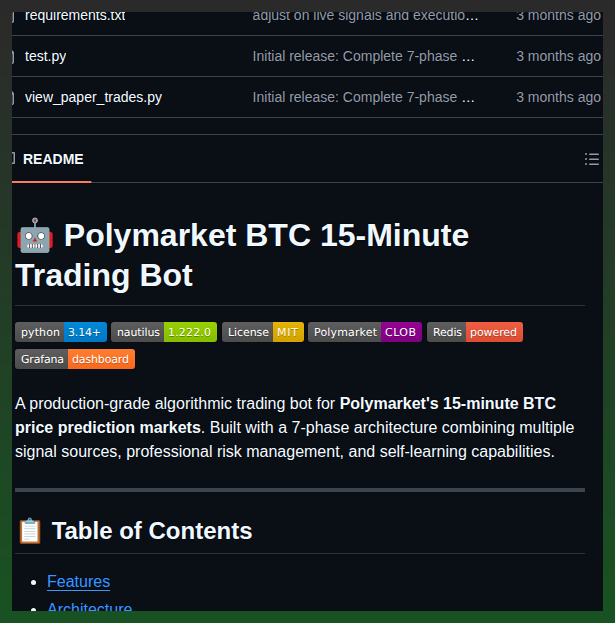
Tom Dörr shares a GitHub repository for an algorithmic trading bot that automates 15-minute Bitcoin price prediction trades on Polymarket, combining multiple signal sources and risk management.

Original post · 1 min read
Automates 15-minute BTC trades on Polymarket

github.com/aulekator/Polymarket-BTC-15-Minute-…
github.comGitHub - aulekator/Polymarket-BTC-15-Minute-Trading-Bot: A production-grade algorithmic trading bot for Polymarket's 15-minute BTC price prediction markets. Built with a 7-phase architecture combining multiple signal sources, professional risk management, and self-learning capabilities.A production-grade algorithmic trading bot for Polymarket's 15-minute BTC price prediction markets. Built with a 7-phase architecture combining multiple signal
♥ 450 · ⟲ 60 · 👁 30.2KView on X ↗

Open-Source Project Make-Comics Generates Full Comic Books From Prompts

Open-Source Project Make-Comics Generates Full Comic Books From Prompts

Tom Dörr shares a GitHub repository, Nutlope/make-comics, that creates complete comic books with AI from a single prompt. The post links to the repo and includes an image.

Original post · 1 min read
Generates full comic books from a single prompt

github.com/Nutlope/make-comics
github.comGitHub - Nutlope/make-comics: Create full comics with AI in secondsCreate full comics with AI in seconds. Contribute to Nutlope/make-comics development by creating an account on GitHub.
♥ 361 · ⟲ 39 · 👁 12.1KView on X ↗

Mobbin MCP Connects 600,000 App Screens to Claude and Cursor

Mobbin MCP Connects 600,000 App Screens to Claude and Cursor▶

Ihor describes an MCP from Mobbin that gives Claude and Cursor access to 600,000 screens from real apps. He demonstrates pulling 43 paywall examples from apps like Revolut, Uber, and Duolingo to inform builds.

Original post · 1 min read
first MCP that actually changed how i work, not just another connector

@mobbin plugged 600k screens from real apps into claude/cursor. ask for a paywall — it pulls 43 examples from revolut, uber, duolingo and builds from what works, not from imagination
♥ 1.1K · ⟲ 40 · 👁 119.0KView on X ↗

Sarah Fim Open-Sources TrustClaw, a Deployable Personal Agent Service

Sarah Fim Open-Sources TrustClaw, a Deployable Personal Agent Service▶

Sarah Fim open-sources TrustClaw under the MIT license, a personal agent service with over 1,000 app integrations deployable to Vercel with one command. It uses OAuth and sandboxed execution, and she says it reached over a thousand users within 48 hours.

Original post · 1 min read
Despite being told no, I'm open-sourcing TrustClaw.

You can now deploy a production-ready personal agent service with over 1000+ app integrations in a single command, straight to @vercel with npx @composio/trustclaw deploy

I was inspired by @openclaw to build a simple web app where anyone could create their own 24/7 personal assistant and connect it to Gmail, Google Calendar, Notion, Slack, GitHub, HubSpot, Linear… well everything, and securely through OAuth/sandbox execution.

It went viral on X, reached over a thousand users in less than 48h, and revenue began pouring in.

If you are thinking like a company, you'd probably keep that locked up. But why should I be the reason you spend another year scrolling instead of building?

So today, I'm open-sourcing TrustClaw anyway.

> 24/7 agents that act across Gmail, Notion, GitHub, Slack, Linear, Jira, and 1000+ apps
> OAuth and sandboxed execution, so users don't have to hand agents passwords or raw API keys
> Supports multiple users and authentication right outside of the box with @better_auth

Repo is open, MIT licensed.

If I were starting an AI company today, I'd clone this, pick a market, and begin shipping with Claude Code.

Honestly so excited to see what comes out of this.
♥ 2.2K · ⟲ 163 · 👁 305.3KView on X ↗

Peter Steinberger Uses Codex in Ephemeral Crabbox Sandboxes for Bugs

Peter Steinberger Uses Codex in Ephemeral Crabbox Sandboxes for Bugs

Peter Steinberger says he has Codex recreate bug states in disposable Crabbox environments to reproduce, fix and verify issues, running about ten sessions in parallel. He links to Crabbox, a CLI for running repository commands in local sandboxes, cloud VMs and hosted agent sandboxes.

Original post · 1 min read
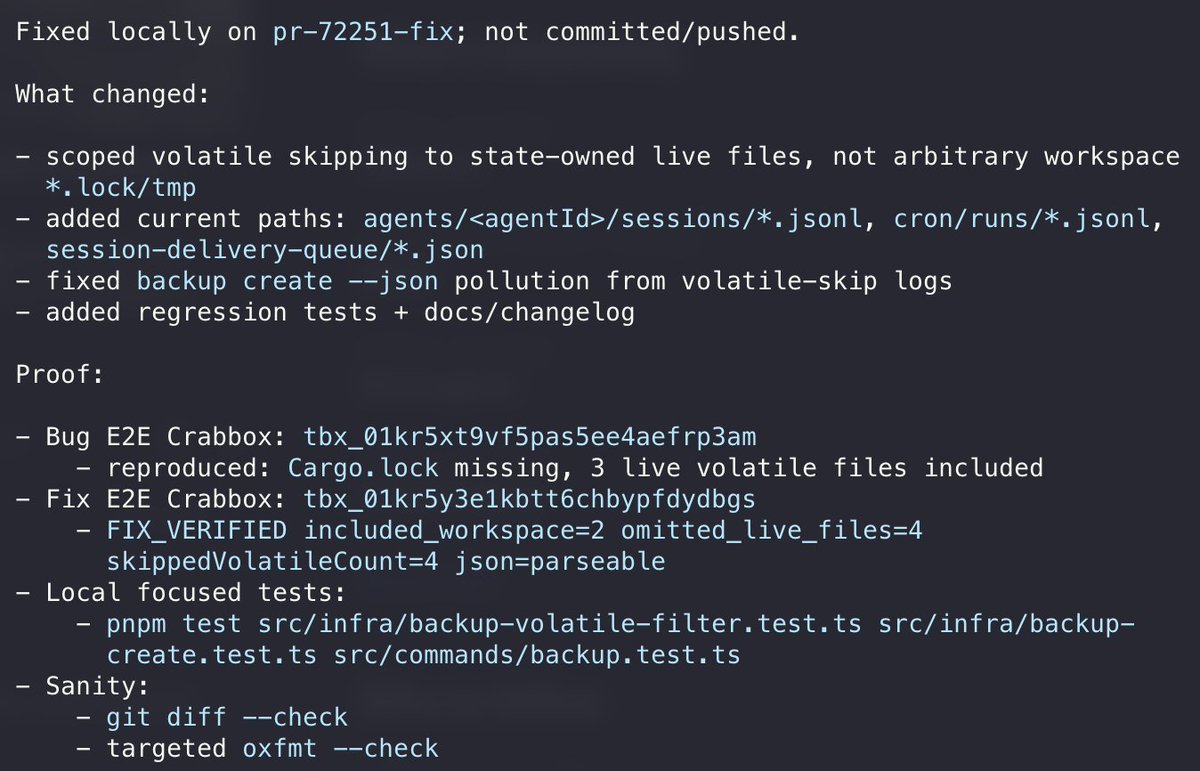
Whenever I investigate a bug, I let codex recreate the exact state in an emphemeral crabbox, verify the bug, fix it, verify the fix.

No messy state because local system might be polluted, and no slowdown because I run 10 sessions in parallel. crabbox.sh/
crabbox.shCrabbox — Run Any Repository Command in the Right BoxRun repository commands in local sandboxes, cloud VMs, SSH hosts, Windows and WSL2, macOS, or hosted agent sandboxes through one CLI.
♥ 3.0K · ⟲ 152 · 👁 322.0KView on X ↗

Thariq Makes the Case for HTML Over Markdown in Claude Code

Using Claude Code: The Unreasonable Effectiveness of HTML

Thariq of the Claude Code team argues HTML is a richer output format than markdown for agent-generated specs, plans and reviews, supporting tables, SVG, CSS and interactivity. He links to a gallery of examples and notes the Claude Code team increasingly uses the format.

Original post · 12 min read
X ArticleUsing Claude Code: The Unreasonable Effectiveness of HTML
This is now also on the Claude Blog.

Markdown has become the dominant file format used by agents to communicate with us. It’s simple, portable, has some rich text capability and is easy for you to edit. Claude has even gotten surprisingly good at using ASCII to make diagrams inside of markdown files.
But as agents have become more and more powerful, I have felt that markdown has become a restricting format. I find it difficult to read a markdown file of more than a hundred lines. I want richer visualizations, color and diagrams and I want to be able to share them easily.
I'm also increasingly not editing these files myself, but using them as specs, reference files, brainstorming outputs, etc. When I do make edits, I’m usually prompting Claude to edit them, which removes one of markdown’s largest benefits.
I’ve started preferring HTML as an output format instead of Markdown and increasingly see this being used by others on the Claude Code team, this is why.
(if you want to start with some examples, you can see a bunch here: thariqs.github.io/html-effectiveness, just be sure to come back and read more about why)
Why HTML?
Information Density

HTML can convey much richer information compared to markdown. It can of course do simple document structure like headers and formatting, but it can also represent all sorts of other information such as:
Tabular data using tables
Design data with CSS
Illustrations with SVG
Code snippets with script tags
Interactions using HTML elements with javascript + CSS
Workflows using SVG and HTML
Spatial data using absolute positions and canvases
Images using image tags
I would go so far as to say that there is almost no set of information that Claude can read that you cannot fairly efficiently represent with HTML. This makes it a highly efficient way for the model to communicate in-depth information to you and for you to review it.
I’ve found that in the absence of being able to do this, the model may do more inefficient things in markdown like ASCII diagrams or, my favorite, estimating colors with unicode characters like in this screenshot from Claude Code.

Visual Clarity & Ease of Reading

As Claude is able to do more complex work, it is also writing larger and larger specs and plans. In practice, I've found I tend to not actually read more than a 100-line markdown file, and I certainly am not able to get anyone else in my organization to read it.
But HTML documents are much easier to read, Claude can organize the structure visually to be ideal to navigate with tabs, illustrations, links, etc. It can even be mobile responsive so you can read it differently based on your form factor.
Ease of Sharing
Markdown files are fairly hard to share since most browsers do not render them natively well. You often have to add them as attachments to emails or messages.
With HTML, as long as you upload the file (for example to S3), you can share the link easily. Your colleagues can open it wherever they wish and easily reference it.
The chance of someone actually reading your spec, report or PR writeup is much much higher if it’s in HTML.
Two-way Interaction

HTML can allow you to interact with the document, for example you might want to ask it to add sliders or knobs to adjust a design or allow you to tweak different options in the algorithm to see what happens. You can also ask it to let you copy these changes into a prompt to paste back into Claude Code.

Read more about my playgrounds post to see examples of this two way interaction: x.com/trq212/status/2017024445244924382
Data Ingestion
Why use Claude Code to make HTML files instead of ClaudeAI or Claude Design for example? One of the biggest reasons is all the context Claude Code can ingest.

For example, when writing this article, I asked Claude Code to read through my code folder and find all the HTML files I’ve generated, group and categorize them and then make an HTML file with all diagrams representing each type. The diagrams you see in this article are a direct result of that.
Besides the file system, Claude Code can find additional context using your MCPs (like Slack, Linear, etc.), your web browser (with Claude in Chrome), your git history, etc.
It’s Joyful
Making HTML documents with Claude is just more fun and makes me feel more involved and invested in the creation, and that by itself is enough.
How to Get Started
I’m a little bit afraid that people will read this article and turn it into a /html skill or something. While there might be some value in that, I want to emphasize that you don’t need to do much to get Claude to do this. You can just ask it to “make a HTML file” or “make a HTML artifact”.
The trick is knowing what you want the artifact to do and how you might use it. You may over time make a skill, but for now I’d suggest just prompting from scratch to get a hang of how to use it in different cases.
Use Cases
To make this more concrete, I’ve made many different HTML files for different use cases… continue on X ↗
♥ 17.8K · ⟲ 2.3K · 👁 14.8MView on X ↗

Printing Press Launches Agent-Native CLI Library and Generator Factory

Printing Press Launches Agent-Native CLI Library and Generator Factory▶

Matt Van Horn, with Trevin, introduces Printing Press, a library of agent-optimized command-line tools for services like Linear, ESPN and Google Flights, plus a generator that creates new CLIs for any product via a slash command. The tools are SQLite-backed and work with Claude Code, Codex, OpenClaw and Hermes.

Original post · 1 min read
Introducing the Printing Press, a CLI-factory and a CLI-library. Built with @trevin. 🏭🖨📚

Most APIs suck for agents. Most MCPs suck for agents. Most official CLIs suck for agents. They waste tokens and time. @steipete started making his own because of this.

📚 A Library of agent-native CLIs you install today (Linear, ESPN, Flight GOAT (Google Flights + Kayak nonstop), Contact Goat (LinkedIn + Happenstance + Deepline more) +30+ more)
🏭 A factory that prints new ones for any service - just type /printing-press <product name>

CLIs are fast, local, SQLite-backed. Work in Claude Code, Codex, OpenClaw, Hermes.

🌐 printingpress.dev
♥ 3.6K · ⟲ 280 · 👁 1.4MView on X ↗

Heycounsel Hosts Claude Cowork Hackathon for Lawyers Building Legal Skills

Heycounsel Hosts Claude Cowork Hackathon for Lawyers Building Legal Skills▶

Brian Scherer reports a five-hour hackathon on April 21 in which more than 200 lawyers across 10 countries built production-ready legal AI skills with Claude Cowork, producing 13 completed projects. The skills are published on the Heycounsel showcase site.

Original post · 1 min read
On April 21, we challenged lawyers from all over the world to spend an afternoon building real, production-ready skills with Claude Cowork.

5 hours. 200+ lawyers. 10+ countries. 13 completed projects producing new legal AI skills.

Every skill is live on our showcase site at go.heycounsel.com/hackathons
♥ 461 · ⟲ 38 · 👁 60.2KView on X ↗

Louise de Sadeleer Says Claude Can Replace Opus Clip for Short Videos

Louise de Sadeleer Says Claude Can Replace Opus Clip for Short Videos▶

Louise de Sadeleer argues users can cancel their OpusClip subscription and instead create 9:16 short-form clips using Anthropic's Claude, sharing a short demo video.

Original post · 1 min read
It's time to cancel your @OpusClip subscription. Use @claudeai to create 9:16 clips instead.

Here's the super fast demo, while I get ready 💋
Louise de Sadeleer @LouiseDSadeleer
So who's gonna tell Opus Clips users they can create clips in Claude Code?
♥ 2.2K · ⟲ 99 · 👁 352.9KView on X ↗

Vercel Launches Open Source deepsec Coding Security Scanner

Vercel Developers announces deepsec, an open source, CLI-first security harness that uses pluggable coding agents and sandboxed scaling to find and fix vulnerabilities in large repositories. It can run on Vercel's AI Gateway or a user's own subscription.

Original post · 1 min read
Introducing deepsec, an open source coding security harness.

• CLI-first
• Sandbox-based scaling
• Pluggable coding agents
• Designed for large-scale repos
• Use AI Gateway or your own subscription

After months of successful internal use, we put it to the test on some of the largest open source codebases.
vercel.com/blog/introducing-deepsec-find-and-f…
♥ 2.6K · ⟲ 268 · 👁 934.7KView on X ↗

Academic Research Skills Package Covers Full Research Pipeline for Claude Code

Academic Research Skills Package Covers Full Research Pipeline for Claude Code

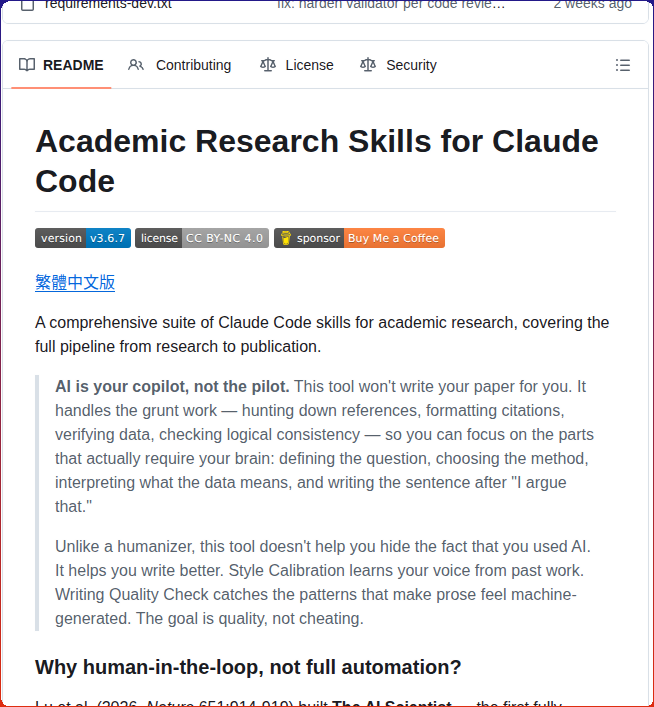
Tom Dörr shares a GitHub repository called academic-research-skills, a set of Claude Code skills covering research, writing, review, revision and finalization of academic work.

Original post · 1 min read
Covers full academic research pipeline for Claude Code

github.com/Imbad0202/academic-research-skills
github.comGitHub - Imbad0202/academic-research-skills: Academic Research Skills for Claude Code: research → write → review → revise → finalizeAcademic Research Skills for Claude Code: research → write → review → revise → finalize - Imbad0202/academic-research-skills
♥ 2.0K · ⟲ 255 · 👁 142.0KView on X ↗

Developer Tracks 430 Hours of Claude Code Use, Finds 73% Waste

I tracked 430 hours of Claude Code usage. 73% was wasted on these 9 patterns.

Mnimiy reports logging 430 hours and $1,340 in API spend across 90 days of Claude Code sessions, concluding that 73% of tokens went to nine overhead patterns. The article follows Anthropic's acknowledged usage-limit problems and offers a fix for each pattern.

Original post · 12 min read
X ArticleI tracked 430 hours of Claude Code usage. 73% was wasted on these 9 patterns.
For 90 days I logged every single Claude Code session: timestamp, prompt, response, token count, model, exit reason.
430 hours of work. 6 million input tokens. $1,340 in API spend.
Then I sat down with the data and asked the only question that mattered: how much of this was actually doing my work, and how much was overhead?
The answer was uncomfortable: 73% of my tokens went to nine invisible patterns that I'd been doing on autopilot.
Not bad prompts, I write decent prompts.
Not big models when I needed small ones, I knew that one already.
Patterns deeper than that. Patterns nobody talks about because they're invisible until you instrument them.
If you're hitting Claude Max usage limits more than once a week, you have at least 4 of these. Probably 7.
Below: each pattern, exactly how much it costs, and the 30-second fix.

Why this matters now
Anthropic admitted the problem in late March 2026: "people are hitting usage limits in Claude Code way faster than expected."
Max 5 subscribers reported quota exhaustion in 19 minutes instead of the expected 5 hours.
The Pro $200/year users said the limit maxed out every Monday and didn't reset until Saturday - "out of 30 days I get to use Claude 12."
Anthropic acknowledged the issue. The peak-hours quota change in late March explained part of it. The rest was a prompt-caching bug — two independent bugs in the cache layer that silently inflated costs by 10-20x for some sessions.
A user reverse-engineered the Claude Code binary to find it (GitHub issue #40524). Downgrading to v2.1.34 helped some people.
Some of it is real. Most of it is you.
I'm not going to tell you to "use Haiku for simple tasks" or "start a new chat every 15 messages."
Below: the patterns that the obvious advice misses.
The methodology
I ran an HTTP proxy between Claude Code and the Anthropic API. Logged every request: full payload, response, token counts (input/output/cache), latency, model. 90 days. 430 hours of active work.
For each request, I categorized the tokens into:
Productive — content that directly informed my actual question
Cache hit (free) — system prompt + CLAUDE.md cached, no marginal cost
Cache miss (paid) — same content, recomputed because cache expired
Conversation history re-read — re-tokenizing previous messages on every turn
Hook injection — pre-pended context from PreToolUse / UserPromptSubmit hooks
Skill loading — skill SKILL.md content loaded into context for invocations
Tool use overhead — JSON schemas, tool definitions, tool result blocks
Extended thinking — <thinking> blocks
CLAUDE.md — project rules loaded every turn

Productive tokens: 27%. The other 73% is the 9 patterns below, ranked by how much they cost me.
Pattern 1. CLAUDE.md bloat (~14% of total tokens)
The pattern: my CLAUDE.md grew to 4,800 tokens over 6 months. Every turn loaded all 4,800 tokens. Every session loaded them again on each new request. Most of the rules were never relevant to the task at hand.
A 5,000-token CLAUDE.md costs you 5,000 tokens before you've typed a word. Every turn. Every session. A constant baseline tax. Multiply by 200 turns per week and it's 1 million tokens a week of your CLAUDE.md alone.
The 30-second fix:

If you're over 1,500 tokens combined, refactor:
Move framework-specific rules to project-level CLAUDE.md (only loads in that project)
Extract repeated patterns into skills (loaded only when invoked)
Delete anything you can't remember writing
Convert "explain why" verbose rules into 3-word imperatives
I cut mine from 4,800 to 900 tokens. Same behavior. 31% reduction in baseline cost, instantly.
Pattern 2. Conversation history re-reads (~13% of total tokens)
The pattern: every follow-up message re-tokenizes the entire conversation history. By message 30 in a chat, each turn is paying for messages 1-29 to be read again. The math: at ~500 tokens per exchange, message 30 costs 30× message 1.
I had sessions with 60+ messages. The last message was costing 60× the first. Tokens spent re-reading old context: catastrophic.

The 30-second fix:
Edit the prior message instead of follow-up. Up-arrow -> edit -> re-send. The bad exchange gets replaced, not stacked.
Hard cap conversations at 20 messages. When you cross 20, ask Claude to summarize what's been done and start a fresh chat with that summary as the first message.
Use /compact instead of /clear when you need continuity. /compact summarizes and restarts. /clear nukes everything.
I went from 60-message sessions to 15-message average. 40% drop in conversation re-read cost.
Pattern 3. Hook injection waste (~11% of total tokens)
The pattern: I had 4 plugins installed. Three of them registered UserPromptSubmit hooks that injected context. Combined: 6,200 tokens of hook injection on every prompt I submitted, before Claude even read what I asked.
These hooks are designed to be helpful. They inject branch names, recent file changes, instinct summaries, memory snippets. Each one is small. Together they're a wall.
The 30-second fix:

Aud… continue on X ↗
♥ 955 · ⟲ 120 · 👁 1.6MView on X ↗

Cursor Releases SDK for Building Agents on Its Own Runtime

Cursor Releases SDK for Building Agents on Its Own Runtime▶

Cursor announces the Cursor SDK, which lets developers build agents using the same runtime, harness and models that power Cursor. Agents can run in CI/CD pipelines, power automations or be embedded in products, shown in a demo video.

Original post · 1 min read
We’re introducing the Cursor SDK so you can build agents with the same runtime, harness, and models that power Cursor.

Run agents from CI/CD pipelines, create automations for end-to-end workflows, or embed agents directly inside your products.
♥ 8.7K · ⟲ 803 · 👁 3.1MView on X ↗

Greg Brockman Recommends 28-Minute Tutorial on OpenAI's Codex

OpenAI president Greg Brockman endorses a tutorial by Riley Brown covering seven capabilities of Codex, including file access, persistent memory, plugins, skills, image generation, computer use and automations.

Original post · 1 min read
a great codex tutorial:
Riley Brown @rileybrown
Learn 95% of Codex in 28 minutes

These are the 7 knowledge work capabilities...
inside Codex, the super-app

00:00 Intro
02:19 Capability 1 - Full File Access
07:41 Capability 2 - Persistent Memory
10:46 Capability 3 - Plugins
13:52 Capability 4 - Skills
19:22 Capability 5 - GPT Image Access
21:03 Capability 6 - Browser and Computer Use
23:58 Capability 7 - Automations
25:31 Bonus Feature - Chronicle
27:21 Summary
♥ 3.3K · ⟲ 289 · 👁 495.4KView on X ↗

Guide Offers Ways to Stretch Claude Code Usage Limits

Aakash Gupta promotes a guide to getting more out of Claude Code without hitting usage limits, quoting a post by Pawel Huryn that identifies four root causes of harness problems and provides copy-paste templates.

Original post · 1 min read
If you want to get more out of Clade without hitting limits, read this.
Paweł Huryn @PawelHuryn
Claude Code's Limits Are Generous. The Problem Is Your Harness. — Same PM workflow as my $750/mo era. Anthropic fixed 3 bugs. The 4 root causes still on your side, with copy-paste templates.

I'm on Claude Code Max (20x). 3 days in. 12% used. Same workflow that
♥ 175 · ⟲ 20 · 👁 68.3KView on X ↗

Claude Code's Head of Product Explains Anthropic's Faster Shipping

Lenny Rachitsky summarizes an interview with Cat Wu, Head of Product for Claude Code at Anthropic, covering shorter product cycles, the merging of PM and engineering roles, building ahead of model capability, and using model introspection.

Original post · 5 min read
My biggest takeaways from Claude Code's Head of Product @_catwu:

1. Anthropic’s product development timelines have gone from six months to one month, sometimes one week, sometimes one day. Part of this acceleration is access to the latest models (i.e. Mythos). Another is shipping new products into “research preview,” making clear it's early, experimental, and might not be supported forever. Another is an evergreen "launch room "where engineers post ready features and marketing turns around announcements the next day.

2. The PM role is shifting from coordinating multi-month roadmaps to enabling teams to ship daily. As Cat puts it, “There should be less emphasis on making sure you are aligning your multi-quarter roadmaps with your partner teams and more emphasis on, OK, how can we figure out the fastest way to get something out the door?”

3. The most efficient shipping unit is an engineer with great product taste. On Cat’s team, many engineers go end-to-end—from seeing user feedback on Twitter to shipping a product by the end of the week—without a PM involved. Also, almost all the PMs on the Claude Code team have either been engineers or ship code themselves, and the designers have been front-end engineers. The roles are merging, and the most valuable skill is product taste, not job title.

4. Build products that are on the edge of working. Claude Code’s code review product failed multiple times because earlier models weren’t accurate enough. But because the prototype was already built, they could swap in Opus 4.5 and 4.6 and immediately test whether the gap was closed. Teams that wait for the model to be ready will always be a cycle behind.

5. The most underrated skill for building AI products is asking the model to introspect on its own mistakes. Cat regularly asks the model why it made an unexpected decision. The model will explain that something in the system prompt was confusing, or that it delegated verification to a subagent that didn’t check its work. This reveals what misled the model so the team can fix the harness.

6. Every model release forces their team to revisit existing products and audit their system prompt to remove features the model no longer needs. Claude Code’s to-do list was a crutch for earlier models that couldn’t track their own work. With Opus 4, the model handles it natively. Features built as scaffolding for weaker models become debt when the model catches up—so the team actively strips them.

7. Anthropic employees build custom internal tools instead of buying SaaS products. A sales team member built a web app that pulls from Salesforce, Gong, and call notes to auto-customize pitch decks—work that used to take 20 to 30 minutes now takes seconds. Their core stack is Claude Code, Cowork, and Slack. No Notion, no Linear, no Figma.

8. People underestimate how much Claude’s personality contributes to its success. As Cat describes it, “When you reflect on everyone you’ve worked with, there’s just some people where you’re like, I really like their energy, their vibe.” Claude is designed to be low-ego, positive, competent, and earnest—qualities that make it feel like a great coworker, not just a tool. This isn’t cosmetic; it’s what makes people want to use Claude for hours every day. The team has a dedicated person, Amanda, who “molds Claude’s character,” and it’s one of the hardest roles at the company because success is so subjective.

9. The future of work is managing fleets of AI agents, not doing the work yourself. Cat sees a clear progression: first, individual tasks become successful. Then people start running multiple tasks at the same time (multi-Clauding). Next, people will run 50 or 100 tasks simultaneously, which will require new infrastructure—remote execution, better interfaces for managing tasks, agents that fully verify their work, and self-improving systems that incorporate feedback. The human role shifts from doing the work to knowing which tasks to look into, verifying outputs, and giving feedback that makes the system better over time.

10. Hire people who lean into chaos and face every challenge with a smile. At Anthropic, there are weeks when a P0 on Sunday becomes a P00 by Monday and a P000 by Monday afternoon. If you get too stressed about any one thing, you’ll burn out. Their team looks for people who can look at a hard challenge and say, “Wow, that’s gonna be hard. But I’m excited to tackle it and I’m gonna do the best that I possibly can.” This mindset—optimism, resilience, and comfort with constant change—is increasingly essential as the pace of AI development accelerates.

Don't miss the full conversation: youtube.com/watch?v=PplmzlgE0kg
Lenny Rachitsky @lennysan
How Anthropic’s product team moves faster than anyone else

I sat down with @_catwu, Head of Product for Claude Code at @AnthropicAI, to get a peek into their unprecedented shipping pace, how AI is changing the PM role, and how to be the right amount of AGI-pilled.

We discuss:
🔸 How Anthropic’s shipping cadence went from months to weeks to days
🔸 The emerging skills PMs need to develop right now
🔸 Why you should build products that don't work yet—then wait for the model to catch up
🔸 Why a 95% automation isn't really an automation
🔸 Cat’s most underrated AI skill (introspection)
🔸 What …
♥ 2.8K · ⟲ 293 · 👁 847.8KView on X ↗

Developer Builds Offline AI Skin Journal Running on iPhone

Locally This, Locally That

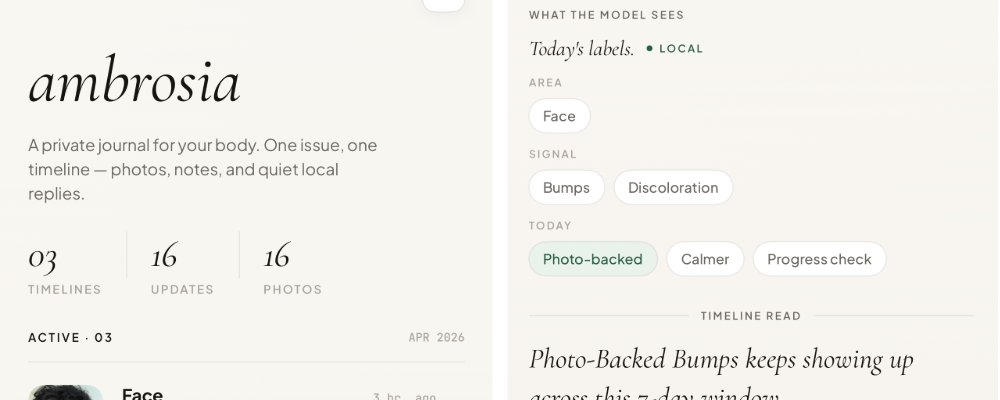
Aman describes Ambrosia, an offline AI journaling app for tracking skin responses, built around a fine-tuned Qwen3-VL-2B model that runs entirely on device. He covers local finetuning on a MacBook, LoRA training on MedQA, and quantized GGUF export.

Original post · 4 min read
X ArticleLocally This, Locally That
I built an AI app that runs completely on device. No servers, API requests, or data leaving the device. Local models are finally getting good. Just look at the recent releases from @Alibaba_Qwen and @googlegemma to see that the gap is shrinking.
x.com/Alibaba_Qwen/status/2046939764428009914
I am excited about what this unlocks for hardware, consumer, and privacy.
Robots and edge devices can't rely on perfect signal for their user experience. A robot working in a farm, a construction site, or even a living room can't just freeze up the moment it loses connection. Smart glasses and similar devices running local models have lower latency and much better UX.
For consumer apps, local LLMs make free tiers economically viable. Growth at all costs becomes very expensive when every user burns GPUs on your dime. Local inference flips that math.
@signulll is clearly facing this now:
x.com/signulll/status/2044097057825124430
The third vector is privacy. I have mixed feelings here. Anecdotally, most of my friends don't care where their data goes. My guess is, in the future, privacy-sensitive fields like law and medicine will require on-device or on-prem models to stay compliant. Users won't care, but regulated professionals will.
The hardware is already here. We're all walking around with phones that can comfortably run 2B-parameter models. So I wanted to see how far I could push that with a real app.
Ambrosia
I built Ambrosia, an offline AI journaling app to track how my skin responds to different diets and products. I picked skin specifically for two reasons: I've always wanted a better way to watch conditions and progress over time, and photos are a natural unit of a journal entry.
Two things I love about the app:
1. AI-generated labels and trend tracking, all local
2. Everything including the images stays on device
The Base Model
I went with Qwen3-VL-2B: multimodal, small enough to run on my iPhone, and already well-optimized for llama.cpp. I used the Q4_K_M quantized version from @huggingface, and ran everything through @RunAnywhereAI because their on-device SDKs are the best I've used.
Finetuning the Model Locally
I wanted to prove that I could take a base model and finetune it end-to-end locally on my MacBook (M2 Max).
With Codex, I trained a small LoRA adapter on MedQA, then merged and exported it back into the same Q4_K_M GGUF format so that it would work on my iPhone.
I also experimented with autoresearch (@karpathy’s autonomous framework for model training) to maximize performance. I gave Codex the source code and let it sweep configurations. The sweep landed on a lower learning rate (1e-4) as the winner, beating baseline by ~5 points on the micro-run. Scaled up to full validation, it held at 47.88%.

Finetuned Model: huggingface.co/amankishore/qwen3-vl-2b-medqa-gguf
Constraining the Task
Initially I built Ambrosia as a chat first experience. It was bad. I would document a new skin issue, and the model would respond with three long paragraphs about consulting a dermatologist.
I constrained the task. Qwen was much better at generating labels from images and analyzing trends across journal entries. Ambrosia went from a worse medical ChatGPT to a journal with ambient AI trend analysis.
This is why small models are underrated. They should not be compared to general assistants like ChatGPT. They're much better as narrow specialists constrained to a few tasks.
Since this task is disjoint from MedQA, I built a small eval set of journal entries a user might track (acne, texture, redness, etc) and compared the finetuned model against the base. The finetune gave a small but real lift on label quality, while trend analysis was unchanged. For a 2B model doing a task it wasn't trained for, I'll take it.

Edge Intelligence
Ambrosia was a small experiment, but it maps to the shape of the future: take a small base model, aggressively constrain the domain, tune for your specific task, ship it. Repeat.
Chips keep getting faster. Small models keep getting smarter. Eventually these lines will converge. When they do, you’ll have the power of AGI, in the palm of your hand.
♥ 913 · ⟲ 52 · 👁 798.2KView on X ↗

Thread Lists Five Free GitHub Repos for Polymarket Trading

Thread Lists Five Free GitHub Repos for Polymarket Trading

A post by Recogard lists five GitHub repositories for automating Polymarket trading, including a curated tools list, the pydantic-ai agent framework, a Claude-based trading server, a Trump post analysis tool, and a wallet history exporter. It promotes the repos as easy to set up.

Original post · 1 min read
5 free ready to use GitHub repos for trading on Polymarket…

Everything you need to automate and make your trading easier:

1. A huge collection of 100+ useful tools and services for Polymarket, from educational resources to AI agents.

GitHub: github.com/aarora4/Awesome-Prediction-Market-T…

2. A tool for building your own AI agents and assigning them any complex tasks.

GitHub: github.com/pydantic/pydantic-ai

3. An AI trading server that connects Claude to Polymarket. It analyzes markets in real time, tracks price movements and suggests how to trade. You can even connect your own account and let it trade for you.

GitHub: github.com/caiovicentino/polymarket-mcp-server

4. This tool scans and analyzes Trumps latest posts in real time. Based on historical data, it predicts how the market might react.

GitHub: github.com/sstklen/trump-code

5. A tool that collects and analyzes the full trading history of any wallet on Polymarket, exports the data to CSV and generates detailed statistics and charts.

GitHub: github.com/txbabaxyz/collectmarkets2

Each of these tools comes with a detailed step by step setup and usage guide, so its actually not so difficult to figure out.
Recogard @recogard
A computer science student built a working simulator that lets you test your own Polymarket strategies using real historical data and released it on GitHub for free…

This is a ready to use tool based on the largest dataset of 1.1 billion Polymarket trades.

Here is how you can use it for your trading:

This simulator takes all past markets, analyzes how they behaved from open to close and applies your own strategy to them. As a result, it calculates the potential Pnl and accuracy as if u had actually made those trades yourself.

Lets imagine, while trading, you have noticed a pattern: All mov…
github.comGitHub - aarora4/Awesome-Prediction-Market-Tools: A curated list of Prediction Market Tools - AI Agents, Analytics, APIs, Dashboards, Copy Trading, Alerting, Tracking and More!!A curated list of Prediction Market Tools - AI Agents, Analytics, APIs, Dashboards, Copy Trading, Alerting, Tracking and More!! - aarora4/Awesome-Prediction-Mar
♥ 226 · ⟲ 26 · 👁 19.9KView on X ↗

Garry Tan Describes Skill-Based Workflow for Agentic Coding

Garry Tan Describes Skill-Based Workflow for Agentic Coding

Garry Tan says a workflow he calls 'SKILLIFY IT' has replaced half of his agentic coding, and he is using it to build GBrain and a personal mini-AGI with OpenClaw. He also quotes a post on stopping agents from repeating mistakes, referencing LangChain's $160M raise and LangSmith testing.

Original post · 1 min read
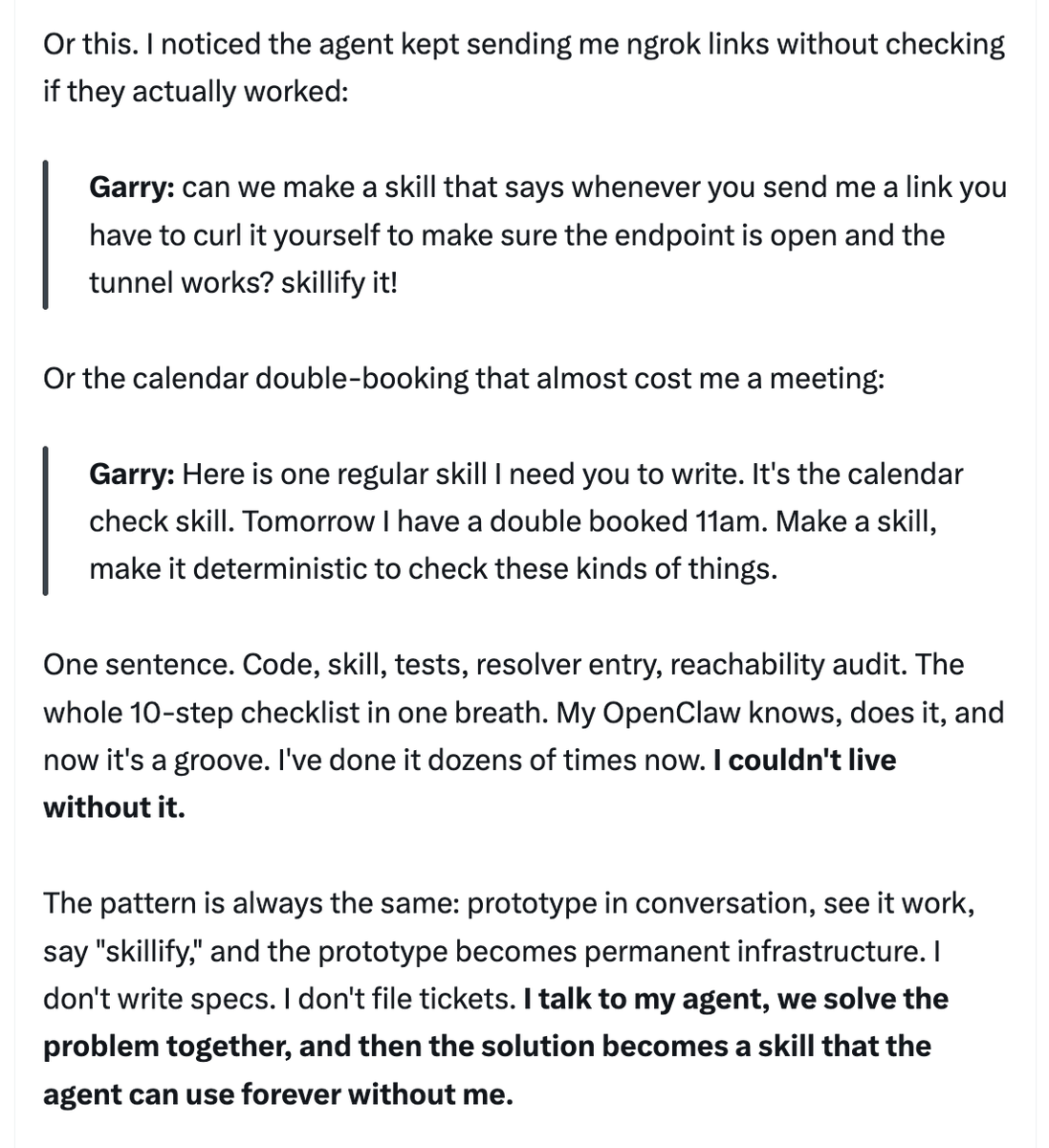
This cycle below is what has replaced 50% of my agentic coding. This is now how I am building GBrain and my own personal mini-AGI with full context on me and the things I care about.

It's not hard. It's quite fun. I do something, anything with OpenClaw, then I say SKILLIFY IT
Garry Tan @garrytan
How to really stop your agents from making the same mistakes — LangChain has raised $160 million. Three years of development. A billion-dollar valuation. LangSmith, their testing platform, is genuinely sophisticated: trajectory evals, trace-to-dataset pipelines,
♥ 885 · ⟲ 72 · 👁 132.2KView on X ↗

Free-Claude-Code Proxy Runs Claude Code on NVIDIA Free Tier

Free-Claude-Code Proxy Runs Claude Code on NVIDIA Free Tier

Hasan Toor promotes free-claude-code, an open-source proxy that routes Claude Code to NVIDIA NIM models using a free API key. It supports Kimi K2, GLM 4.7, MiniMax M2 and Devstral, and includes a Telegram bot for remote control.

Original post · 1 min read
Goodbye Claude Code subscription fees.

Someone just built a proxy that runs Claude Code completely free... and it's wild.

You literally plug in a free NVIDIA API key and point Claude Code at localhost.

That's it.

It handles everything:
- Converts Anthropic API calls to NVIDIA NIM format
- Unlocks 40 requests/min for free
- Supports Kimi K2, GLM 4.7, MiniMax M2, Devstral and more
- Streams thinking tokens and tool calls live
- Even includes a Telegram bot so you can run Claude Code from your phone

No API bill. No rate limit panic. No vendor lock-in.

Honestly, this goes beyond router tools like OpenRouter.

It doesn't just swap the model... it turns Claude Code into a free agent you can control remotely.

The project is open-source on GitHub.

It's called free-claude-code.
♥ 6.2K · ⟲ 902 · 👁 652.0KView on X ↗

Google Open-Sources osv-scanner for Dependency Vulnerability Checks

A post introduces osv-scanner, Google's open-source tool that scans lockfiles, containers and vendored code against the osv.dev vulnerability database. It highlights guided remediation, call analysis, support for 11+ ecosystems, and offline scanning.

Original post · 1 min read
GOOGLE BUILT A VULNERABILITY SCANNER AND OPEN-SOURCED IT

most devs ship code without knowing half their dependencies are ticking time bombs

osv-scanner fixes that

it scans your entire project lockfiles, containers, even vendored c/c++ code and maps every dependency against the osv.dev database

supports 11+ ecosystems. npm, pip, cargo, maven, go modules, gem. all of it.

the guided remediation feature is the real unlock... it doesn't just tell you what's broken.... it tells you exactly which version upgrades fix the most issues with the least risk

call analysis built in. so you only get alerts for vulnerable functions your code actually calls. no noise

works offline too. download the db once, scan without internet

one command to scan your whole directory:
osv-scanner scan source -r ./

github.com/google/osv-scanner
♥ 1.2K · ⟲ 187 · 👁 128.5KView on X ↗

Student Backtesting Tool Tests Polymarket Strategies on Historical Trades

Student Backtesting Tool Tests Polymarket Strategies on Historical Trades

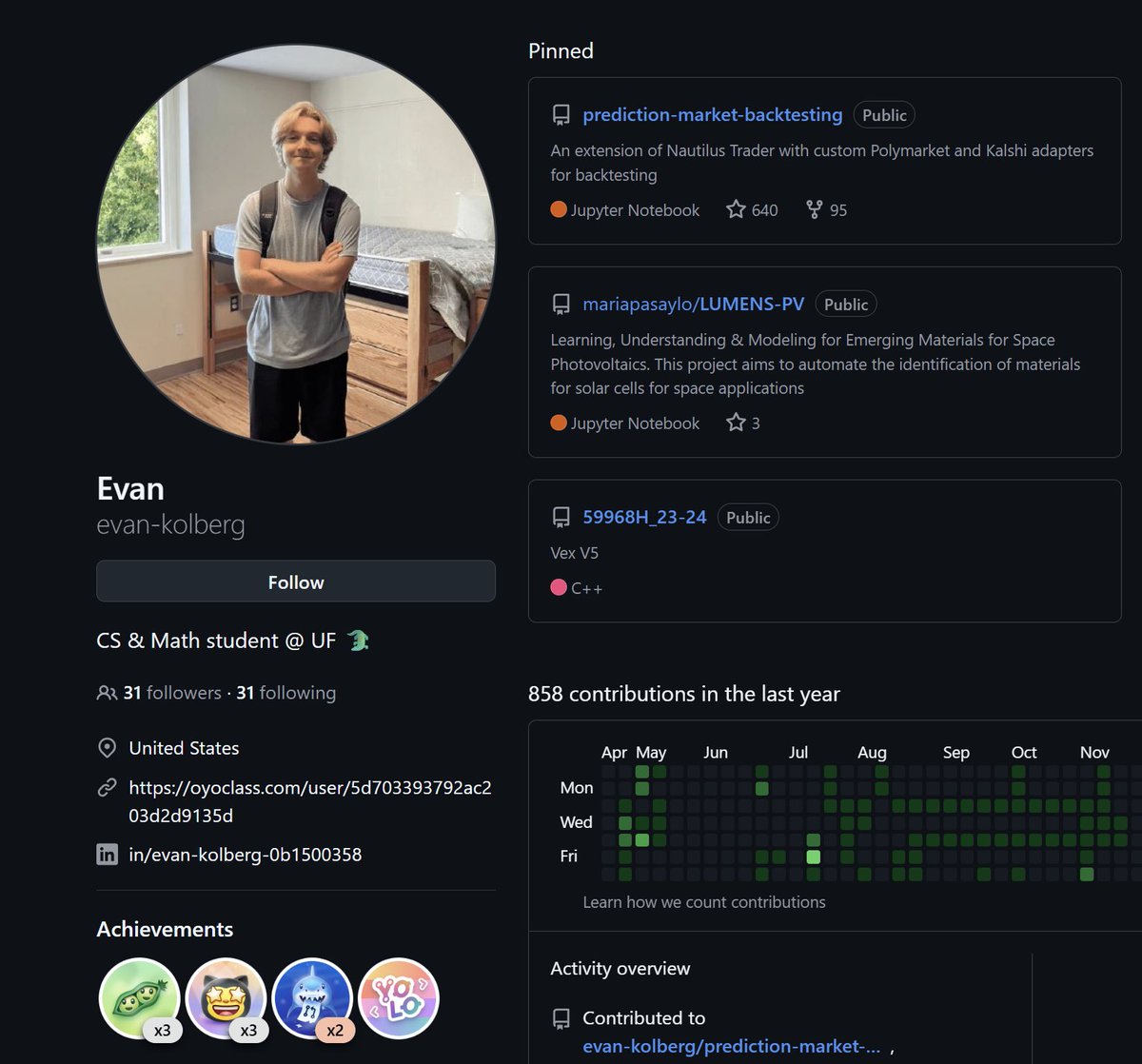
Recogard describes an open-source prediction-market backtesting simulator built by a computer science student on a dataset of 1.1 billion Polymarket trades. Users can apply strategies to past markets and measure PnL and accuracy, with a GitHub link provided.

Original post · 1 min read
A computer science student built a working simulator that lets you test your own Polymarket strategies using real historical data and released it on GitHub for free…

This is a ready to use tool based on the largest dataset of 1.1 billion Polymarket trades.

Here is how you can use it for your trading:

This simulator takes all past markets, analyzes how they behaved from open to close and applies your own strategy to them. As a result, it calculates the potential Pnl and accuracy as if u had actually made those trades yourself.

Lets imagine, while trading, you have noticed a pattern: All movie markets are less volatile and often have a clear winner right from the start (with the highest % probability) - just an example!

But how could u actually test this pattern right now without risking real money? - thats exactly where backtesting comes in…

So, you take your strategy, lets say - Always buy the most probable outcome at market open, but only in movie markets.

Then, the simulator analyzes all movie markets that have ever existed up to today, applies your strategy to them and shows you the accuracy. Based on that, u can decide whether its actually worth using for your future trades.

This way you can test hundreds of strategies like that without risking any money.

GitHub: github.com/evan-kolberg/prediction-market-back…
Recogard @recogard
5 students from Shanghai University analyzed over 1.1 billion Polymarket trades across 268K markets, collected 107GB of real trading data and released it for free on GitHub…

This is the largest public prediction market dataset I have ever found.

Here is how you can use it for trading on Polymarket:

This dataset allows you to understand how Polymarket actually behaves and how prices typically move.

You can analyze and compare all markets within the same category to find patterns in price movements that repeat over time.

Lets imagine, while analyzing this dataset, you discover that, for exa…
♥ 630 · ⟲ 43 · 👁 107.8KView on X ↗

Steve Yegge Says Google Has Two-Tier System for Claude Access

Steve Yegge follows up on his earlier tweet about Google's AI adoption, citing anonymous Googlers who describe DeepMind engineers using Claude daily while most other teams are pushed onto internal Gemini variants. He says he has not verified each account.

Original post · 3 min read
My tweet last week about Google's AI adoption drew a lot of pushback, to say the least.

Since then, Googlers from multiple orgs have reached out to me independently and anonymously. They've expressed fear of being doxxed, concern about what they saw as bullying of me, and general corroboration of my original tweet. I haven't verified each person's story, but the picture these Googlers paint is consistent across sources. It is more specific than what I originally wrote, and somewhat bleaker.

What they describe is a two-tier system. DeepMind engineers use Claude as a daily tool. Most of the rest of Google does not. When the question of equalizing access came up internally, the proposed response was to remove Claude for everyone — which DeepMind objected to so strongly that several engineers reportedly threatened to leave.

Non-DeepMind engineers get pushed onto internal Gemini variants behind router-style names that obscure which underlying model is actually serving a request. Multiple engineers describe regressions and reliability problems severe enough that some senior people have stopped using the tools. A senior manager on a major product line reportedly flagged attrition concerns over exactly this issue.

Googlers say leadership knows the gap is real. The response has been to mandate AI usage in OKRs and individual expectations, and to stand up an internal token-usage leaderboard. Unfortunately, managers have been told both that the leaderboard won't be used for performance reviews and, separately, that it absolutely will. And I hear other stories that Google's culture is not adapted properly yet for high-volume coding.

Addy Osmani's reply on behalf of Google said over 40,000 SWEs use agentic coding weekly. I don't doubt the number. But weekly use of a thin tool is precisely the box-checking I described in the original post. Volume of opens isn't adoption — and "weekly" is a low bar that includes a lot of people who tried it once and went back to writing code by hand.

The clearest thing I'm hearing is that Googlers do want to use high-quality agentic tools. They are asking repeatedly for better ones. But overall, this is not a picture of an engineering org that is fine.

My goal in the first tweet, and now, is always the same — get more people using AI and agentic coding. Nobody is as far ahead as they might look from the outside, and none of you are as far behind as you might be worried you are.

To all the Googlers who've reached out: thank you. You took a real risk and I appreciate you. Be safe. And good luck getting good models!
♥ 3.1K · ⟲ 203 · 👁 1.0MView on X ↗