Gergely Orosz argues Scrum made sense for teams shipping every two to three months but held back teams doing daily or continuous deployment, which startups and Big Tech abandoned a decade ago.
Deedy shares five uses for Muse and Instinct, including filing FOIA requests, issuing spend-limited cards, completing visa forms and buying reservations at opening time. He argues dark patterns on the web are being broken and that creativity now limits what is possible.
1. Submit FOIA requests to request data from the US government 2. Creating spend-limited Privacy cards to spend on subscriptions without having them recur 3. End to end filed an entire visa form for a country 4. Responded to a coordination mail for a wedding by finding the flight and hotel details 5. Look for reservations for restaurants or concerts when they open and purchase them immediately
A lot of the web was designed with dark patterns: increase friction to prevent enough humans from doing something, and now those walls are completely broken.
At this point, I feel like I’m squarely limited by creativity and understanding what is possible.
cat.png recommends a set of Grok Bot team rules based on Lauren Tan's approach, including one bot per job, a chief-of-staff router, and human approval for money and deploys. He links a GitHub repo containing the rules as an installable skill.
I still can't f**king get why people keep adding more Grok Bots instead of copying the rules the best teams run them on.
A Japanese Grok Bot team I’ve been studying is built around Lauren “poteto” Tan’s rules.
The useful part:
> One bot, one job. > One chief of staff routes everything. > Draft before send. > No proof, no "done". > Money, deploys, permissions stay behind human approval.
If a bot keeps making the same mistake, turn the fix into a rule or skill.
That’s basically the whole game.
Less prompting. Better roles. Better guardrails.
All the rules are listed here, and you can set them up as a skill in your Grok Bot:
One of the SpaceXAI engineers building Grok Bot explained how she gets coding agents she can actually trust.
I turned Lauren Tan’s talks and extended Q&A into one installable skill.
Her main point:
If an agent cannot verify its own work, you are still the verification system.
Agent writes the code → you open the app → find what it broke → send screenshots back → repeat
Her workflow changes that loop.
The skill teaches your agent to:
1. Read the affected code before guessing the cause 2. Reproduce the bug before changing anything 3. Run the real user flow, not just build and typecheck 4.…
Harrison Chase highlights LangChain's testing of Jev against LLM judges on accuracy, repeatability, latency and cost. He argues Jev's cheap, fast verifiers suit online evaluation of large numbers of agent traces.
We tested Jev against LLM judges on accuracy, repeatability, latency, and cost to see whether System One models could offer a new approach to agent evaluation.
The typesafe-ai/skills GitHub repository provides agent skills that let Codex or Cursor build typed decide, tool, and evaluate loops against the TypeSafe System One API. It has about 440 stars.
typesafe-ai/skills is a skill pack for TypeSafe System One. Drop it into Codex or Cursor so agents get typed decide, tool, and evaluate loops. 440 stars.
Lauren recommends following engineer Parker Smith, who is hosting a workshop on how proactivity has enhanced bot performance. Smith's registration post links to a Luma event page.
Justine Moore shares techniques for Seedance 2.5 video character swaps, including using a reference video with character images, blurring faces via Codex to avoid rejections, swapping two characters at a time, and providing a detailed prompt. She references her AI remake of The Office.
Seedance 2.5 is very good if you upload a reference video + images of new characters and ask to swap.
In some cases the ref video will get rejected - so I just ask Codex to blur the faces and resubmit 😂
It's also best doing two characters at a time. For this one I did Dario and Jensen first and then re-ran it with Sam. Prompt below.
Edit the entire source video @ Video1.
Replace the viewer's FAR RIGHT performer with the man in @ Image1 in the same pink shirt and blue / gray hoodie. Keep the LEFT and MIDDLE performers the same.
The photos provide identity and wardrobe only. The video provides motion, expressions, gestures, timing, interactions, camera cuts, framing, lighting and background.
Preserve the original performance as faithfully as possible. Do not swap positions or invent new movement or scene elements.
DHH argues every software developer should own a low-powered older PC to ensure applications run fast enough, and suggests running agents on it to keep software lean. He says a machine from ten years ago should run software smoothly.
Every software developer should own a potato PC. It's the easiest way to ensure your application is fast enough. Put your agents to work within it and watch the weight drop. There's no reason a machine from ten years ago shouldn't fly like superman.
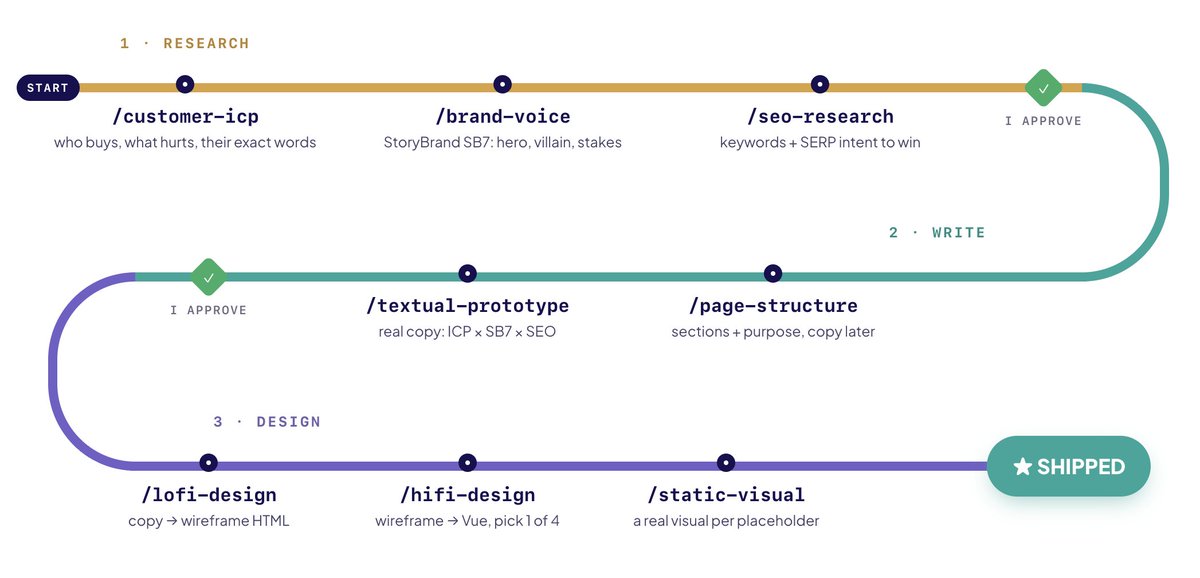
Danny Postma says he rebuilt his landing page using AI agents by creating nine reusable skills rather than one-shot prompting. He reports a 34% higher conversion rate and is considering turning the skills into a course.
Hiten Shah comments on the engineering effort behind Devin's Cloud Mac, which Cognition's Jake Kelley describes as rebuilt in Rust, and argues that verifying an agent's work will consume much of the stack. The quoted post covers disk, networking, provisioning, VNC and computer use.
Aayan says he built a search tool on Jev that indexes more than 6,000 Y Combinator startups and returns results in under a second. He reports about 90 million tokens and $2.70 in total testing costs, and shares a demo video.
Colin McDermott shares a Grok Bot template built on Jev that provides fast, calibrated classification for routing, urgency, labels and rubrics, and links to the bot on x.ai.
A post shares a Google Drive folder containing 700 markdown files summarizing 10,000 books, which the author says will appeal to people running Claude on a VPS.
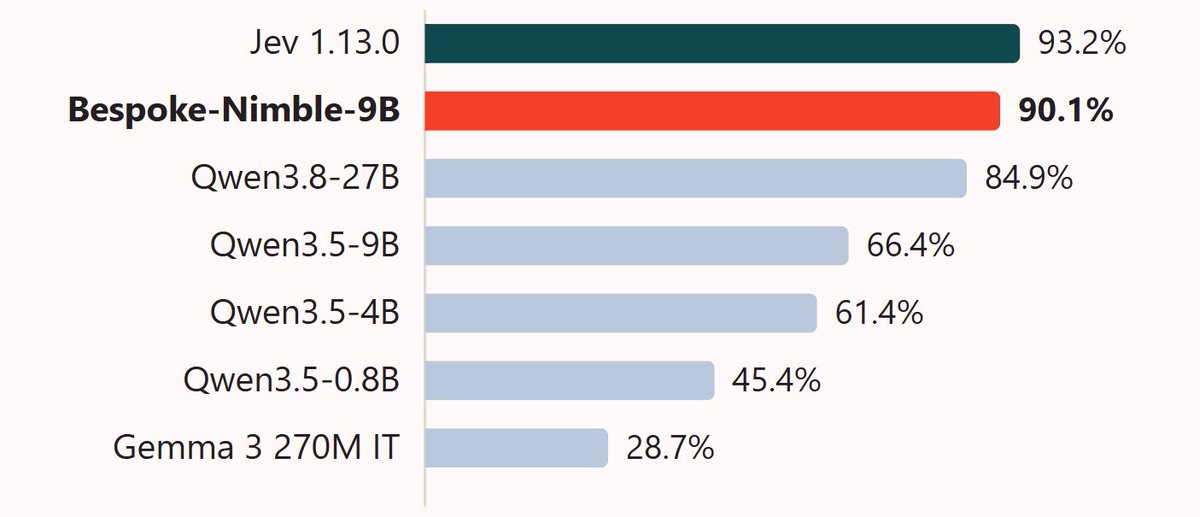
AI Search says Jev is closed and available only via API, and offers Nimble, a GitHub project from Bespoke Labs, as an open version that performs comparably. The post links to the Nimble repository.
Shopify CEO Tobi Lutke says a tool he built to find lost disk space is now fully cross-platform across major operating systems, a follow-up to an earlier post describing software as something you can wish into existence.
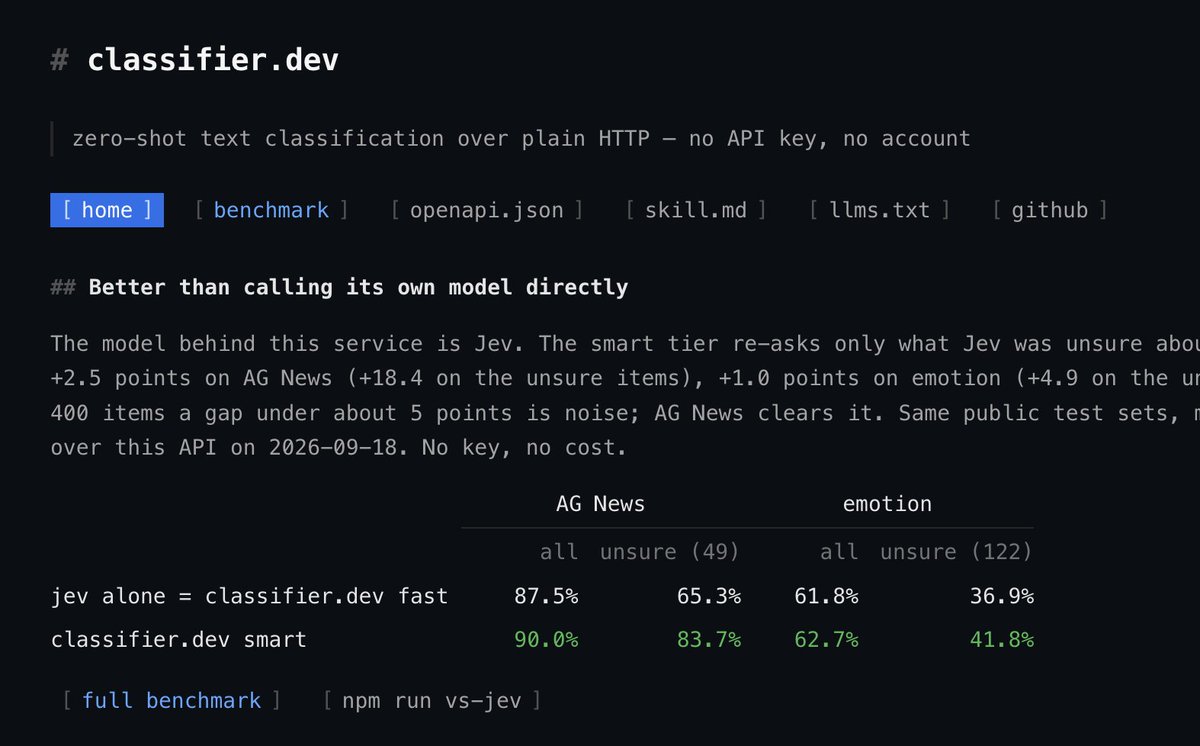
Michael announces classifier.dev as a free service that claims to outperform Jev, offering zero-shot text classification over plain HTTP with no API key or account.
Peter Yang asks how Amazon could tell whether a request comes from a human or an AI agent when both appear to originate from the same IP address, responding to a post about Amazon cutting off Muse.
Dmitry Korzhov lists seven marketing workflows Jev can accelerate, including ad library scans, creative scoring, search term sorting, fatigue detection and lead scoring. He says it runs through the Ryze AI app and an MCP connector for under $3, and quotes Ira Bukht claiming SEO/GEO audit costs dropped 90%.
Jev can speed up most marketing workflows 30x and do it for < $3:
1/ Scan the whole Meta Ad Library -> It reads every live ad in your category and tags each one by hook, format, offer and days running
2/ Find the ad patterns that survive -> It compares formats by how many ads are still live after 60 days, so you know what lasts before you test it
3/ Score briefs before you shoot -> Your LLM writes the briefs, Jev scores each on hook, brand fit and survival odds, and only the top ones get made
4/ Sort search terms -> It asks "is this query from a buyer?" across the full Google Ads report, so negatives land the same night
5/ Catch fatigue early -> For every ad with frequency up and CTR down, it picks replace, refresh or leave
6/ Check ad to landing page match -> It scores whether the page delivers what the ad promised, the cheapest CVR fix in most accounts
7/ Score every lead -> It rates each form fill 0 to 100 against your ideal customer within seconds, so Google and Meta learn to find more of the good ones
Available in the Ryze AI app and MCP/Claude Connector, link in the 1st comment 👇
Matthew Berman says the Jev tool scrolled 723 ads and scored them as 30 buyer personas at a cost of 22 cents, with availability planned through StealAds and MCP. A quoted post describes Jev breaking down 724 live ads from 37 brands in 40 seconds.
Sheema Moto relays a post from SpaceXAI engineer Peng Zheng, who says he moved from 250 unsuccessful applications to a $850,000 offer by running about 20 agents managed by a Chief of Staff agent. The post promotes a 40-minute workshop on GrokBot and agent automation.
"250 applications, two years, zero offers. Then he stopped applying as one engineer and showed up as one engineer running 20 agents. We offered him $850,000.
I don't use GrokBot like Google anymore. I built a 24/7 system once - now it automates 95% of my life and work every day. Only 1% of people run a single Chief of Staff agent that manages the other ~20 agents and knows everything about them.
That's not a skill gap. That's a stack gap, and it takes one evening to close."
GrokBot → Chief of Staff → 20 Agents → Auto-Delegation → 24/7 System
In a 40-minute workshop, SpaceXAI engineers show how to stop managing every agent by hand - and how they actually use GrokBot.
Research → Build → Launch → Improve
This will save you 20 hours of useless agent tutorials.
Vercel's Guillermo Rauch says generative UI has been achieved externally, quoting a post by @ctatedev about an experiment combining json-render and jev that renders custom components and actions in milliseconds.
Min Choi reports that Kevin Rose shared a Grok Bot that transcribes and analyzes a user's saved Instagram videos, building a searchable local markdown wiki in the style of Karpathy. The quoted post says the tool runs offline and uses Grok Voice Transcribe and Grok Vision, with X and TikTok support coming later.
Built this Grok Bot, fully offline index of all your saved instagram videos via @karpathy-wiki-style .md. Uses @bot, @grok Voice Transcribe 2.0, Grok Vision + more.
Prajwal Tomar describes a motion graphics workflow where GPT-6 Astra plans concepts, Higgsfield renders variants, and Jev selects the best render automatically. He says a client adopted the setup and promotes an accompanying article course.
I gave Jev access to an AI motion graphics studio and honestly this is kind of terrifying.
So last week my workflow was basically GPT-6 Astra comes up with the concept, Higgsfield renders 5 versions, and then I just sit there watching all 5 trying to figure out which one actually works.
That last part was killing me. Every single round I had to stop and watch videos for like 10 minutes.
Now I plugged Jev in and it's honestly wild.
It looks at every asset and picks what's worth rendering before Higgsfield even touches it. No explanation, just a decision in like 100 milliseconds.
Astra plans it, Higgsfield renders it, Jev decides it.
So basically I went from rendering five versions and hoping one of them works to just rendering the one Jev already picked.
I set this up for a client last week and they absolutely loved it. They're not even working with their AI creative agency anymore.
If you want to turn GPT-6 Astra into a motion graphics studio, read the article below.
How to Turn GPT-6 Astra Into a Motion Graphics Studio (Full Course) — GPT-6 Astra is two weeks old and it is still the only thing my feed talks about. Two days ago I wrote about what it does to web design once you show it real websites. Today is the thing I actually