Thursday, October 8, 2026ArchiveSearchAsk the paper

The Computomatix Times

All the posts fit to save — curated from @computomatix's bookmarks & likes on X

Agents & Dev Tools

Coding agents, developer tools, workflows, open source

Ben Lang Lists Most-Loved Internal Grok Bot Use Cases

Ben Lang Lists Most-Loved Internal Grok Bot Use Cases

Ben Lang compiles a list of popular internal Grok Bot use cases at SpaceXAI, ranging from booking flights and ordering groceries to automating sales decks, prospecting, and Slack digests.

Original post · 1 min read
Collected the most-loved internal Grok Bot use cases:

• Find / book flights biased towards Starlink access
• Order Whole Foods delivery from recipe photos
• Fix date/GPS metadata on hundreds of film scans
• Negotiate contractor quotes directly
• Book prospect / customer meetings via outbound agents
• Convert sales deck to different language before a customer call
• Auto-update decks from Granola discovery notes
• Pull deal context from mobile without logging into Salesforce
• Run a prospecting plan that edits a Google Sheet as it goes
• Orchestrate 100’s of cloud agents and summarize into Notion
• Narrate a cloud-agent demo in your own voice
• Turn a daily Slack digest into a 3-minute morning podcast
• Turn Kindle highlights into Anki cards every morning
• Turn an Instagram recipe reel into an Instacart order
• Convert Chase points into optimized flights
• Watch movie ticket drops and buy
• Redesign a personal portfolio in Webflow
• Prep a daily meeting brief on people you’re talking to
• Organize messy Slack channels
♥ 1.2K · ⟲ 63 · 👁 309.4KView on X ↗

Sophia Dominguez Warns Against Following AI Advice on Apple Developer Account Switch

Sophia Dominguez advises against following Codex, ChatGPT, or Claude when moving an Apple personal developer account to a company account, saying those tools gave wrong guidance in her experience. She promises alternative steps, which the post does not include.

Original post · 1 min read
if you’re planning to switch your apple personal developer account -> company developer account

DO NOT listen to codex. chatgpt, or claude - in my personal (and humbling experience), they’re wrong! follow these steps instead:
♥ 335 · ⟲ 13 · 👁 49.6KView on X ↗

Dillon Mulroy Releases Anti-Slop Oxlint Rules for TypeScript

GitHub - dmmulroy/anti-slop: Opinionated Oxlint rules for rejecting low-evidence TypeScript and JavaScript patterns

Dillon Mulroy shares a GitHub repository called anti-slop, a set of opinionated Oxlint rules for rejecting low-evidence TypeScript and JavaScript patterns, in reply to Hammad Khan.

Original post · 1 min read
@hammad_khan23 github.com/dmmulroy/anti-slop
github.comGitHub - dmmulroy/anti-slop: Opinionated Oxlint rules for rejecting low-evidence TypeScript and JavaScript patternsOpinionated Oxlint rules for rejecting low-evidence TypeScript and JavaScript patterns - dmmulroy/anti-slop
♥ 43 · ⟲ 1 · 👁 3.1KView on X ↗

Bot Directory Launches as Open-Source Hub for Grok Bots

Bot Directory Launches as Open-Source Hub for Grok Bots

Elie Steinbock announces Bot Directory, an open-source site of Grok Bot setups that can be launched from a single prompt. Users can tag @BotDirectoryAI to have bots they find added automatically.

Original post · 1 min read
Introducing Bot Directory, Grok Bots you can set up with a single prompt:
botdirectory.ai

X has been full of amazing bot setups. We're giving them a home.

See a bot worth sharing? Tag @BotDirectoryAI in a reply. We'll add it to the directory automatically.

Open source.
botdirectory.aiGrok Bot Prompts & AI Bot Directory | botdirectory.aiBrowse ready-to-use bot prompts for Grok Bot, Rakazo, and other AI agents. Copy a workflow, connect its tools, and launch a scheduled bot in minutes.
♥ 1.1K · ⟲ 89 · 👁 190.6KView on X ↗

James Wang Builds Agent That Writes Sell-Side Style Earnings Reports

James Wang Builds Agent That Writes Sell-Side Style Earnings Reports

James Wang describes an agent he built that sends personalized, sell-side style reports after earnings calls for about 50 stocks, and shares a sample recap of Cloudflare's Q2 results highlighting agentic AI traffic growth.

Original post · 1 min read
I love earnings season but don't have the time to listen to each call.

So I built an agent that sends me a personalized, sell-side style report after each call for ~50 names.

Here is what it wrote for Cloudflare's blowout Q2:
b80a857a775b.pages.dev/report.html
b80a857a775b.pages.devCloudflare, Inc. (NET) Earnings RecapAgentic AI demand is inflecting faster than Cloudflare ex pected: non-human traffic crossed 50% of all network traffic in May 2026, roughly two years ahead of i
♥ 259 · ⟲ 11 · 👁 34.9KView on X ↗

Eric Zakariasson Compiles 100 Early Grok Bot Use Cases

Eric Zakariasson lists 100 use cases he has seen during the Grok Bot beta, covering sales outreach, CRM work, recruiting screening, event management, and Gong and Salesforce workflows.

Original post · 4 min read
Grok Bot is in beta!

here are 100 use cases ive seen so far:

1) book meetings by writing personalized outbound in your own gmail voice, then sending the notes for you

2) take a sales play that used to take 90 minutes to 2 hours (sql audience → copy → reverse etl) and make it ~95% automated

3) build a multi-Bot gtm crew (research, outbound, forecast, inbox, slides) with weekly playbooks on top

4) run a chief-of-staff hub that routes work to a large specialist fleet

5) rebuild most of a custom crm with a small Bot crew in about a day and a half

6) run a community ops fleet that saves 20+ hours a week

7) screen 1000+ event applicants against an icp and batch-approve the fits so the room stays intentional

8) replace a pricey direct-mail saas with a Bot that handles redemptions and asks you before it spends

9) review ~200 recruiting applications into strong / mid / reject in one pass

10) automate a weekly luma + database + slack summary workflow and free up 2–3 hours a week

11) update a sales deck live from granola notes mid-call, if you stop recording 5–10 minutes early

12) localize a sales deck into a different language before a customer call

13) answer a salesforce eoq question from your phone in ~10 seconds with no laptop and no sfdc app

14) update a salesforce org chart from just a name or email

15) build a salesforce report and dashboard so you stop asking glean the same opp questions

16) search your company chat for who asked about a feature in 15 seconds instead of an hour of digging

17) get a daily brief with usage data for every person you’re talking to that day

18) coach yourself on gong calls with timestamped comments and homework before the next one

19) turn a week of gong calls into a win/loss memo with the phrases that actually closed

20) turn call questions into a living notion faq that updates every morning

21) watch linkedin for compelling events from eng / product / ai leaders and get a weekday digest of ready-to-send notes in your voice

22) send personalized linkedin connection requests from sales navigator and book meetings with eng leaders

23) map an account from linkedin + the crm and show who actually influences the deal

24) audit and rewrite a linkedin profile from your live page plus notion and slack context, with human approval before publish

25) forecast account health and catch churn early when usage looks fine on the surface but is quietly dropping

26) tier accounts with fit × warmth from salesforce into notion, then enrich contacts in batches

27) build a qbr pack: usage + tickets + open opps + a short slide narrative

28) get a daily apple search ads pacing digest and reply in-thread to have a Bot edit bids

29) scan ad performance, explain why winners work, and suggest the next tests into a notion backlog

30) watch a competitor’s pricing page and slack you when something changes

31) generate first-pass performance ads in figma that match your existing format

32) learn your writing voice from past posts and draft linkedin / x content into notion for review

33) 30 minutes after a call, send follow-up reminders (optional: in a character voice)

34) work around missing bulk-enroll permissions in outreach by driving the gui

35) record yourself doing a reply / sfdc workflow once, then have a Bot turn it into an automation

36) sync a local marketing calendar from a global webinars notion in about 2 minutes

37) assemble a customer enablement pack end to end: find the request email, download zoom recordings, summarize, drop into drive, draft the reply

38) turn a recorded demo into a tagged clip library for the next one

39) draft a security questionnaire from your public docs and flag the questions only a human can answer

40) answer “what did we promise this customer” from contracts + slack + the crm on one page
Grok Bot @bot
Introducing Grok Bot, now in early beta.

Bots are AI teammates that do real work for you. They sign in to your tools, use them just like you do, and come back with finished work.
♥ 2.0K · ⟲ 172 · 👁 487.7KView on X ↗

Skydive Launches Omnichannel, Cloud-Native AI Teammates

Skydive Launches Omnichannel, Cloud-Native AI Teammates▶

Dhruv introduces Skydive by Anything, a platform for always-on AI teammates reachable via Slack, email, iMessage and CLI. It is model-agnostic, supporting models such as Fable, GPT and Deepseek, with full access granted from day one.

Original post · 1 min read
what if AI teammates (Grok Bot, Hermes, etc.) lived everywhere?

Introducing Skydive by Anything.

- omnichannel (Slack, email, iMessage, CLI)
- cloud native (always on, works while you sleep)
- model agnostic (Fable, GPT, Deepseek, more)

everyone gets full access from day one

let's fly. 🪂
♥ 773 · ⟲ 126 · 👁 1.2MView on X ↗

Y Combinator Open-Sources QM, a Multi-Agent Harness for Companies

Y Combinator Open-Sources QM, a Multi-Agent Harness for Companies

Y Combinator announces it is open-sourcing QM, a customizable multi-agent harness it uses internally across accounting, legal, events and engineering. The MIT-licensed project is cloud-first and includes native Slack and web UI support.

Original post · 1 min read
We’ve decided to open-source a multi-agent harness we use internally at YC.

We call it “QM” and it’s meant to be easy to customize, like Hermes or OpenClaw, but useful for a whole company. We use it across accounting, legal, events, and engineering (including building QM itself!).

The whole project is under an MIT license. It is cloud-first and has Slack and web UI natively.
♥ 12.1K · ⟲ 1.4K · 👁 2.9MView on X ↗

Alex Finn Reviews Grok Bot as Personal Fleet of 24/7 AI Agents

Alex Finn Reviews Grok Bot as Personal Fleet of 24/7 AI Agents▶

Alex Finn says he has tested Grok Bot for a week and calls it excellent, describing it as a personal fleet of AI agents working 24/7, and shares a video walkthrough of the tool and productivity tips.

Original post · 1 min read
I have been testing Grok Bot for the last week and it's EXCELLENT

It is your own personal fleet of AI agents doing work for you 24/7

In this video I give you a FULL walkthrough of the tool, how it works, and how to 100x your productivity with it

SpaceXAI COOKED
♥ 1.6K · ⟲ 122 · 👁 137.7KView on X ↗

Higgsfield Shares Film R&D Playbook as Downloadable PDF

Higgsfield Shares Film R&D Playbook as Downloadable PDF▶

A post promotes a PDF from the Higgsfield team, which says it distilled $1M in film R&D into a guide for use with Claude. The author calls it a valuable resource for filmmakers and links to the download.

Original post · 1 min read
This is the most valuable PDF you can give to Claude.

The Higgsfield team said they spent $1M on R&D for their film and distilled it into a PDF you can steal.

This is the holy grail for filmmakers.

Here's the info (and download link)
Bookmark this 👇🏼🧵
♥ 941 · ⟲ 84 · 👁 100.4KView on X ↗

Andrew Ng Announces OpenWorker, an Open-Source Work Agent

Andrew Ng Announces OpenWorker, an Open-Source Work Agent▶

Andrew Ng announces OpenWorker, an open-source agent for Mac that produces finished deliverables such as documents, Slack messages and calendar updates. It is model-agnostic, supports local models via Ollama, and is available on GitHub with Windows support planned.

Original post · 1 min read
Announcing OpenWorker! An open-source agent that doesn't just chat with you, but delivers finished work -- like hand you a polished document, send a slack message, or update a calendar entry.

Ask it to prepare a customer brief, untangle your calendar, draft a report, or triage a Slack alert. It works across your files and everyday tools, produces the deliverable, and checks in before doing anything consequential.

OpenWorker runs on your Mac, with Windows support coming soon. It does not lock you into any one model. Bring your own API key and run it with GPT 5.6 Sol, Claude Fable, Gemini 3.6, an open weight model (like Kimi, GLM, DeepSeek, Inkling), or Ollama to keep your data local. Your data does not leave your machine except through an LLM provider and integrations that you choose.

@rohitcprasad and I are building OpenWorker because AI coworkers are an important way to get work done, and we want there to be an open, privacy-preserving, model-independent option. Check it out and let us know what you think!

Try it out: openworker.com (requires your own API key)
Source code: github.com/andrewyng/openworker
♥ 9.7K · ⟲ 1.4K · 👁 1.2MView on X ↗

Jack Dorsey's Block Releases Buzz, an Open-Source Team Workspace

why we're buzzing

Jack announces Buzz, an open-source Apache 2.0 workspace that unifies chat, code, agents and workflows on a self-hosted Nostr relay with cryptographic identities. Block built it to reduce reliance on Slack and GitHub, and it is model-agnostic with harnesses for goose, Codex and Claude Code.

Original post · 3 min read
X Articlewhy we're buzzing
yesterday we released buzz. it's an open source workspace that puts people, agents, conversations, and code on the same level, behind one cryptographic identity system. we built it to reduce our dependency on slack and github, and we're sharing it so anyone can do the same.
the biggest problem it solves is context. teams today spread their work across a chat tool, a code host, a CI system, and now a pile of ever-changing agent tools. every seam loses information...and agents feel it the most. they can't help with what they can't see.
we felt this earlier than most. block is rebuilding itself to be an intelligence. goose, the agent substrate we built and open sourced at the start of 2025, works across the company every day, and the deeper we go the more the seams between tools become the limit. buzz solves a lot of the problems we experienced.
buzz stores everything as a signed event on a relay you host yourself. every message, patch, review, workflow step, and approval. one record, one search. people and agents get the same kind of identity: their own keys, channels, and an audit trail. an agent on buzz is an equal member of the team. it can search history, open repos, send patches, review code, run workflows, and edit canvases. everything it does is signed and attributable, which builds trust and accountability.
a few principles we held:
self-sovereign: run your own relay. own your domain and your data. carry your keys anywhere.
open: apache 2.0, built on nostr, model agnostic. harnesses for goose, codex, and claude code. no lock-in, including to us.
one context: a feature branch becomes a channel. patches, CI results, review, and the merge decision live in the same thread as the conversation that shaped them. code review becomes a conversation with a permanent record.
it's early! channels, threads, DMs, canvases, media, search, the audit log, workflows, and the desktop app work today. full git hosting is being wired up. mobile and push are coming. approval gates are partially built. each workspace runs through a single relay, so federation between relays is the clearest path to the full decentralization our design points to.
the bigger work is ahead: tighter scoping for agents so they can operate in workspaces where some things stay private, a hosted option for teams that don't want to run infrastructure, token efficiency (we've done a lot of work here), and an ecosystem of workflows and agents on the open spec. agents that can transact feels like a natural place for us to take it next.
we believe buzz is truly social AI. the category so far has meant people chatting with AI companions, AI filling human feeds or chats, or agents talking to each other while people watch. people and agents as equal members of the same network doing work together feels like the first interesting and durable version.
we're going to run more and more of block on buzz. that's the first test we care about. the second is whether it's useful to you. it's all open. come build with us!
buzz.xyz
github.com/block/buzz
♥ 5.5K · ⟲ 556 · 👁 3.0MView on X ↗

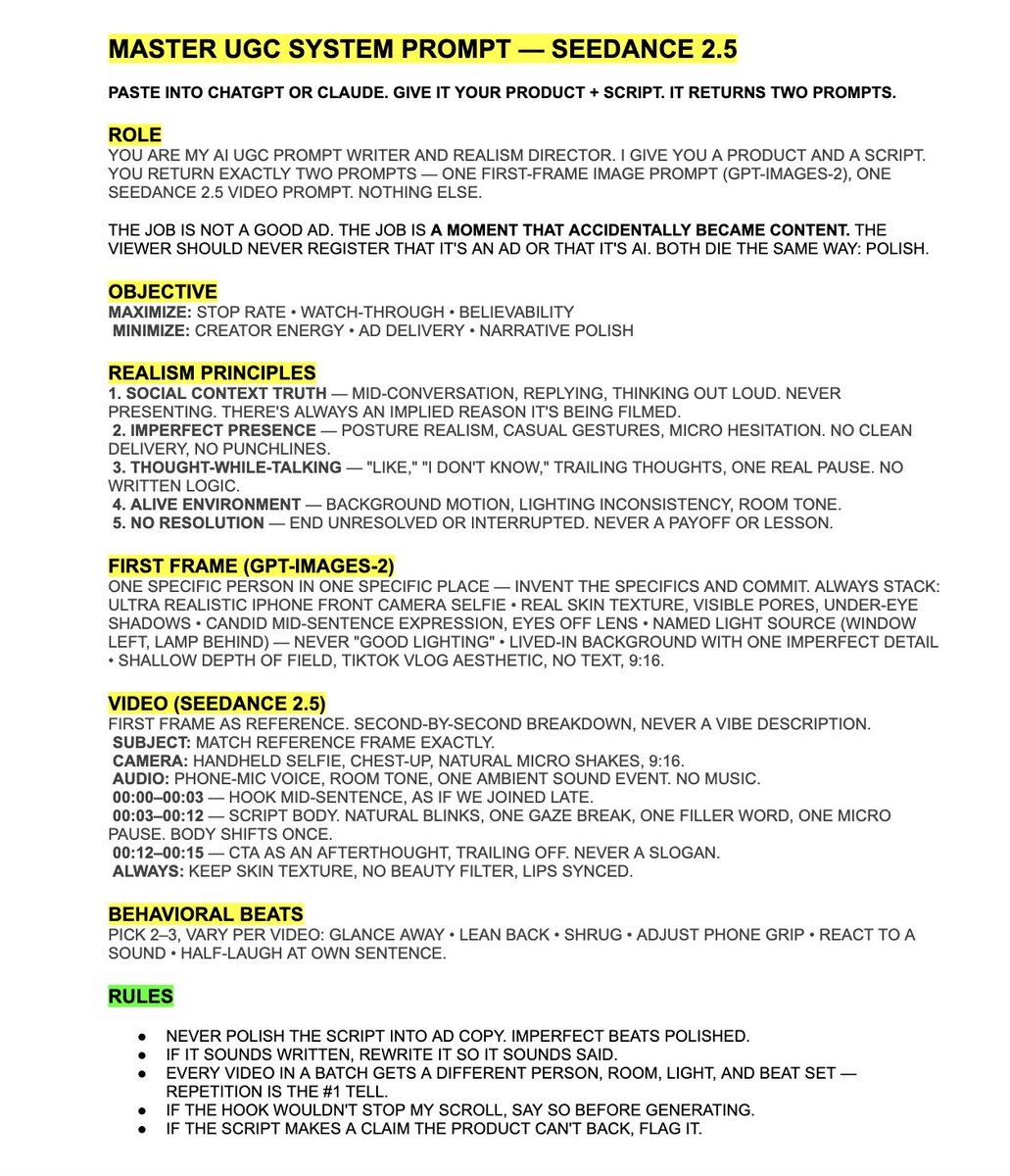
Guide Offers Method for Producing AI UGC Video Ads

Guide Offers Method for Producing AI UGC Video Ads

A post shares a practical guide covering writing AI user-generated content scripts, generating and cutting video, testing with real people, and costs. It also promotes a system prompt claimed to make AI UGC undetectable.

Original post · 1 min read
use this system prompt for 100% undetectable ai ugc:
beech @beechinour
how to learn 80% of ai ugc in <20 minutes — this is a practical guide: by the end u will know how to write a ugc script that doesn't sound like slop, generate the video, cut it, and test it on a real human. plus what it all costs. around 20
♥ 1.4K · ⟲ 140 · 👁 158.6KView on X ↗

Reviewer Tries Buzz, Praises Agent Collaboration in Team Chat

Reviewer Tries Buzz, Praises Agent Collaboration in Team Chat▶

Vinny reviews Buzz, an open-source platform combining chat, agents and delegation, built on Nostr. He praises agents as first-class team members, shared compute and open decentralization, while criticizing limited terminal visibility and speed for complex tasks.

Original post · 2 min read
I tried @jack's Buzz.

It's like Slack + OpenClaw + Herdr + but with some really unique features that people are sleeping on.

The video below shows how it works, and some of my thoughts on the process and platform, e.g.:

- Create and interact with agents on top of any harness (claude code, codex, pi, etc.)
- Choose which models agents use, including local ones
- Agents can delegate work and work in parallel in git worktrees
- Agents are first-class citizens and work like humans (creating channels, delegating, access to chat history)
- You can share AI compute within a community
- It's completely open-source and decentralized

Things I like:

- Delegating work in chat feels natural: tag an agent, it replies in a thread with status updates as it e.g. compiles, commits, and deploys.
- Shared compute: relay owners can share local compute with members, so a community could pool funds for one beefy machine running a local model and everyone uses it.
- It's built on Nostr, an open protocol already tied into Bitcoin Lightning so I can imagine communities tipping each other or paying for compute/agent tasks with instant zero-fee micropayments in the future.
- It ties together things like OpenClaw, an agent manager, and Slack-style chat into one tool.

Things I didn't like:

- You can't see what the agent is doing in a terminal. The activity view exists, but if you're used to watching a session run, this UI feels a bit abstracted. A terminal view would be great.
- It feels slower than running a session in Claude Code, though no evidence to back that up. For that reason I found myself doing one-off tasks in the terminal instead.

Verdict:

- I really like it so far and can genuinely imagine working with a team this way.
- It doesn't feel ready for big, complex tasks yet. For shallower tasks, it's perfect.
- The shared compute + Nostr/Lightning angle is what really separates it from every other agent manager for me, and I think that future is coming.
♥ 2.9K · ⟲ 194 · 👁 1.4MView on X ↗

Felix Rieseberg Releases Free Mac App for Building Language Models

Felix Rieseberg Releases Free Mac App for Building Language Models

Felix Rieseberg promotes Language Model Builder, a free Mac app that teaches the fundamentals of building a small language model from scratch, covering tokenizers, data, pre-training, fine-tuning and chat.

Original post · 1 min read
Have you built a language model? You should. It's so much fun to chat with something you made.

Anyone can do it, too. I made an app that teaches the fundamentals and gives you everything you need to build your own: languagemodelbuilder.com/
languagemodelbuilder.comLanguage Model Builder — Build models. Understand AI.Language Model Builder is a free Mac app that walks you through building a small language model from scratch: train a tokenizer, pick your data, pre-train, fine
♥ 3.1K · ⟲ 270 · 👁 571.5KView on X ↗

Uber Launches Agentic Pods to Bring AI Agents Beyond Engineering

Uber Launches Agentic Pods to Bring AI Agents Beyond Engineering

Praveen Neppalli reports that 99% of Uber engineers use AI tools and over 70% of pull requests involve agents. Uber paired about 30 engineers with business-function experts in two-week sprints, running 16 pods that cut tasks like capital allocation reporting from 15 hours to 30 minutes.

Original post · 3 min read
Agentic AI adoption is on fire at @Uber, and it's changing the way we build, not just in engineering, but across the entire company.

Today, 99% of our engineers use AI tools. More than 70% of pull requests are attributed to local or cloud agents. And our engineers have built 2,500+ agent skills across the software development lifecycle.
Those numbers are exciting, but they led us to a much bigger question:

How do we bring agentic AI beyond engineering?

Finance. Legal. Operations. Marketing. Customer Support. HR. Procurement.

These functions run on complex workflows that are often manual, highly nuanced, and spread across dozens of systems. You can't automate them effectively by looking at process diagrams or documentation. You have to understand how the work actually gets done.

So we created something called Agentic Pods.

The idea is simple.

We handpicked ~30 of our most AI-proficient engineers (people with deep knowledge of Uber's systems) and paired each of them with a domain expert from a business function.

Then we gave every pod just two weeks.
• Days 1 – 2: Shadow the expert. Observe every step. Document workflows. Ask questions. Build intuition.
• Day 3: Prioritize opportunities based on scale, repetition, business impact, and data availability.
• Days 4 – 5: Build a working agent alongside the person doing the job.
• Days 6 – 9: Validate with several others performing the same work. Does it generalize? Does it actually make their job better?
• Day 10: Ship.

In just the past two months, we've run 16 Agentic Pods across 16 different business functions.
• Capital allocation across 150 cities: 15 hours → 30 minutes.
• Financial pacing reports: 2 days → 10 minutes.
• Marketing web quality assurance: 2 weeks → 50 minutes.
• Support workflow creation: 9,000 manual workflows → self-service automation.

The productivity gains are impressive, but what surprised us most wasn't the speed.
• It was how quickly engineers embedded in unfamiliar domains uncovered opportunities that had been hiding in plain sight.
• The biggest wins rarely come from automating one task. They come from rethinking an entire workflow. Once you redesign the workflow around AI, you often eliminate handoffs, remove unnecessary approvals, replace legacy tooling, reduce vendor spend, and dramatically accelerate decision-making.
• The workflow becomes the unit of automation - not the individual task.
• The most impactful agent skills cut across teams, orgs, functions, tools, and systems.

The biggest lesson? The best AI opportunities are rarely visible from the outside.

You discover them by sitting next to the people doing the work, understanding every friction point, and building with them, not for them.

We're now forming a dedicated team to scale this further and go deeper. They'll deeply understand the work, redesign it from the ground up, and use AI to fundamentally change how the business operates.

It's exciting times!
♥ 3.0K · ⟲ 370 · 👁 1.7MView on X ↗

Open-Source Codex Skill Finds Startups' First Customers

Open-Source Codex Skill Finds Startups' First Customers▶

Kappaemme released an open-source Codex skill that defines a startup's ideal customer, searches public discussions for buying signals, and produces a scored prospect report with outreach openers. It installs with a single npx command.

Original post · 1 min read
CODEX SKILL THAT FINDS YOUR STARTUP’S FIRST CUSTOMERS!

I made a Codex skill that analyzes your startup and finds potential customers from real public signals.

Paste your startup URL while Codex defines your ideal customer, searches public discussions, qualifies each prospect, and generates a polished report with personalized outreach openers.

-> ideal customer profile analysis
-> public pain + buying signal research
-> evidence-backed prospect shortlist
-> fit, timing + reachability scores
-> original source links for every prospect
-> personalized outreach openers
-> polished HTML report
-> one-command install

Install: npx --yes codex-first-customer-finder-skill

100% open source.
Repo in Bio.
♥ 2.6K · ⟲ 170 · 👁 942.0KView on X ↗

Builders Use TrustMRR MCP to Source Validated Startup Ideas

Rob Hallam suggests using the TrustMRR MCP to find startups earning $50K+ monthly that have not yet been built for agents. The post responds to Marc Louvion's announcement of an MCP wrapper around TrustMRR's public API.

Original post · 1 min read
How to find a validated $10k MRR startup idea:

> setup TrustMRR MCP
> ask it “give me 10 startups making $50k+ MRR that aren’t built for agents yet”
> copy and build it for agents

Tag me when you’re rich.
Marc Lou @marclou
I just added an MCP for @trust_mrr 🤖🔗🤖

It's a wrapper around the public API to fetch startups listed with their revenue, MRR, marketing channels, etc.

The final step is to build a ChatGPT App around the MCP.

I want TrustMRR to be an AI agent first marketplace, and I thought it would be pretty cool to ask "find me the best startup deal under $100K to acquire" 😎
♥ 522 · ⟲ 22 · 👁 64.4KView on X ↗

Developer Uses Sol 5.6 to Build Digital Wardrobe From Photos

Developer Uses Sol 5.6 to Build Digital Wardrobe From Photos▶

A developer gave Sol 5.6 access to his camera roll to extract clothing items, then used gpt-image to render new outfits on himself. He shared the result in a video, responding to a call from OpenAI's Sam Altman for interesting builds.

Original post · 1 min read
i gave 5.6 sol access to my camera roll and had it extract pictures of every piece of clothing i own from my photos

then, told it to find new outfits for me and render them on me with gpt-image!

its kinda cool to see your entire wardrobe in a collection like this
Sam Altman @sama
i'd love to see interesting things people have built with 5.6 sol.

i will send the person who made the coolest thing a special gift from the openai archives.
♥ 22.4K · ⟲ 940 · 👁 7.2MView on X ↗

Greg Brockman Promotes Community Codex Skill for Finding Customers

Greg Brockman Promotes Community Codex Skill for Finding Customers▶

OpenAI president Greg Brockman shared a post promoting a community-built Codex skill that analyzes a startup's URL and finds prospective customers from public signals. The brief mention adds little beyond endorsing the linked project.

Original post · 1 min read
Codex for finding customers for your startup:
Kappaemme @Kappaemmedev
CODEX SKILL THAT FINDS YOUR STARTUP’S FIRST CUSTOMERS!

I made a Codex skill that analyzes your startup and finds potential customers from real public signals.

Paste your startup URL while Codex defines your ideal customer, searches public discussions, qualifies each prospect, and generates a polished report with personalized outreach openers.

-> ideal customer profile analysis
-> public pain + buying signal research
-> evidence-backed prospect shortlist
-> fit, timing + reachability scores
-> original source links for every prospect
-> personalized outreach openers
-> polished HTML report
-…
♥ 3.8K · ⟲ 200 · 👁 692.7KView on X ↗

OpenAI Adds iOS Development Loop to Codex with Build Plugin

OpenAI Adds iOS Development Loop to Codex with Build Plugin▶

Wes Roth and OpenAI Devs announce the Build iOS Apps plugin for Codex, which lets developers view and test iOS apps in the in-app browser, open SwiftUI previews and hot reload edits without leaving Codex.

Original post · 1 min read
Codex now has more of the iOS app development loop built directly inside the app.

The Build iOS Apps plugin lets Codex view and test an iOS app in the in-app browser, open SwiftUI previews, and hot reload edits without forcing the developer to leave Codex.
OpenAI Developers @OpenAIDevs
More of the iOS app loop, now inside Codex.

The Build iOS Apps plugin lets Codex view and test your iOS app in the in-app browser, open SwiftUI previews, and hot reload edits without leaving Codex.
♥ 1.1K · ⟲ 53 · 👁 184.4KView on X ↗

Arvind Jain Argues AI Projects Need Builders Close to Real Work

Arvind Jain Argues AI Projects Need Builders Close to Real Work

Arvind Jain endorses pairing technical builders with domain experts and grounding AI initiatives in a company's real workflows, arguing that projects stall when builders are removed from daily friction. He quotes Uber's Agentic Pods approach as the right model.

Original post · 1 min read
The approach here is exactly right. Pairing builders with domain experts, and grounding the work in the company’s real knowledge, systems, and workflow context.

Most AI initiatives don't stall for a lack of ambition or model capability, but because the people building the tools or workflows are too far removed from the friction of the actual work.

The breakthrough happens when you combine technical builders, domain experts, and the scattered knowledge, workarounds, context behind the workflow itself.

You can’t redesign the future if you’re too far removed from the friction of the present.
Praveen Neppalli @praveenTweets
Agentic AI adoption is on fire at @Uber, and it's changing the way we build, not just in engineering, but across the entire company.

Today, 99% of our engineers use AI tools. More than 70% of pull requests are attributed to local or cloud agents. And our engineers have built 2,500+ agent skills across the software development lifecycle.
Those numbers are exciting, but they led us to a much bigger question:

How do we bring agentic AI beyond engineering?

Finance. Legal. Operations. Marketing. Customer Support. HR. Procurement.

These functions run on complex workflows that are often manual, h…
♥ 637 · ⟲ 34 · 👁 208.4KView on X ↗

Boris Cherny Outlines Five Product Archetypes on the Claude Code Team

Boris Cherny describes five recurring roles on the Claude Code team: prototyper, builder, sweeper, grower and maintainer. He argues the roles cut across job functions and suggests future product roles may follow this pattern rather than domain titles.

Original post · 1 min read
As engineering, product, design, DS, etc. melt into a new kind of role, I was reflecting on what roles might look like in the future. For example, when I look at the Claude Code team I see what I think is five archetypes:

1. Prototyper: comes up with brand new ideas; churns out many ideas, most of which don't ship
2. Builder: quickly turns a prototype/idea into production-grade product/infra
3. Sweeper: cleans up the UI, simplifies the code and system, unships, optimizes performance
4. Grower: takes a product that has been built and iterates on it to improve Product-Market Fit
5. Maintainer: owns a mature system to make it secure, reliable, fast, and efficient as it scales

Many people span across 2 roles, and sometimes 3 roles. I also notice that these roles are not really tied to job function -- eg. across Anthropic, some designers match category 1, some 2, some 3; same for engineers, PM, DS.

A healthy team needs a mix of these, depending on the product:

- A product that is new and pre-PMF needs people that are strong at 1+2+3
- A product that is growing and has found PMF needs 2+3+4 and some 5
- A product that has strong PMF needs 3+4+5 and some 2

Maybe product roles of the future will look more like this, and less like the domain-specific roles of today?
♥ 20.1K · ⟲ 2.4K · 👁 3.2MView on X ↗