Wednesday, October 7, 2026ArchiveSearchAsk the paper

The Computomatix Times

All the posts fit to save — curated from @computomatix's bookmarks & likes on X

Edition of Thursday, April 2, 2026

6 stories

Cursor Launches Version 3 Built for Agent-Written Code

Cursor Launches Version 3 Built for Agent-Written Code▶

Cursor announces Cursor 3, pitched as simpler and more powerful and designed for a world where code is written by agents while retaining the depth of a development environment. The post is a video announcement.

Original post · 1 min read
We’re introducing Cursor 3. It is simpler, more powerful, and built for a world where all code is written by agents, while keeping the depth of a development environment.
♥ 10.1K · ⟲ 972 · 👁 2.9MView on X ↗

Ashu Garg Argues Decision Traces Will Reshape Enterprise Software

Google's 20-year secret is now available to every enterprise

Ashu Garg and Jaya Gupta argue that SaaS multiples are compressing as AI commoditizes features, and that enterprises can build durable compounding loops by capturing decision traces rather than just end-state records.

Original post · 11 min read
X ArticleGoogle's 20-year secret is now available to every enterprise
Why decision traces will reshape B2B the way behavioral data reshaped B2C
Our latest thinking on context graphs, developed with my partner @JayaGup10.

Consumer platforms built one of the most powerful business models of the last two decades around a compounding loop: every user interaction became a signal that improved the system. Netflix, Meta, Amazon, TikTok, and Google did not just record outcomes. They instrumented behavior with extraordinary granularity—what you clicked, what you ignored, what you hovered over, what you abandoned, what brought you back—and fed those signals into systems that learned. That loop—capture, learn, improve, capture again—became one of the great compounding assets of the internet era.
Enterprise software has never had an equivalent loop. Not because enterprise decisions are less frequent, but because they were harder to observe.
Consumer systems operate inside controlled interfaces where a single user acts within a product the company fully owns. Enterprise decisions are fundamentally different: they are multiplayer negotiations across sales, finance, legal, operations, security, and management—each carrying different incentives, different authority, and different constraints. Sales wants velocity. Finance wants margin. Legal wants precedent control. These decisions are negotiated, not merely clicked. To date, enterprises have lacked instrumentation of the reasoning that connected action to outcome.
B2C companies have been compounding behavioral signals for two decades. B2B companies largely have not. Now, for the first time, that is starting to change.
The old model is breaking
SaaS multiples have compressed because AI is commoditizing the feature layer that justified premium pricing. When an LLM can generate a competent first draft of almost any workflow, the value of “better UI on a known process” collapses — and companies whose moats were features, not data, are the ones being marked down. They built workflows but never built compounding loops
The question is what replaces features as the durable source of enterprise value. The answer is the compounding loop that enterprise software never had, built not on behavioral traces, but on decision traces.
What enterprise software actually captured, and what it missed
Enterprise systems were built to record end state, not reasoning. A discount field tells you the final number, not why that number was justified. A redlined contract tells you the final clause, not which fallback positions were rejected along the way. A resolved ticket tells you the incident is closed, not why one escalation path was chosen over another. Decision traces sit in that missing layer between event and outcome. A context graph is what happens when that layer becomes structured, queryable, and connected across systems, actors, and time.
The relevant signals were also sparse, fragmented, and embedded inside human workflows rather than captured as first-class telemetry. Enterprise decisions happened partly in a meeting, partly in someone’s head, partly in an email thread, partly in a side conversation, and partly inside systems that did not talk to one another.
And there was no reason to store it. Decision data was treated as process exhaust—ephemeral, disposable—because no system existed that could learn from it. Even when fragments were captured, they rarely compounded. Companies had transcripts, email threads, comments, and approvals, but no practical way to extract structured decision artifacts from them, connect them across systems, and link them to outcomes. The raw material existed in pieces, but the loop did not.
What’s changed
Enterprise work now lives on instrumentable surfaces. Work has become distributed and asynchronous. Decisions increasingly get made in comment threads, document suggestions, ticket histories, approval flows, and call recordings. Reasoning that once lived only in someone’s head now leaves an increasingly rich trail in the workflow itself.
Language models make the unstructured data computable. For years, companies had transcripts, chat logs, document comments, and ticket histories, but these were mostly searchable, not learnable. Now an LLM can extract decision artifacts from them.. Language models do not eliminate the need for structure or evaluation, but they make it possible to turn previously inert collaboration data into something a system can reason over.
Agents create decision checkpoints automatically. This is the most important shift. Agents propose actions inside workflows, which humans approve, modify, or escalate. An agent drafts a pricing proposal; the sales rep adjusts the discount from 25% to 30% and adds a note: “competitive pressure from Vendor X, need to match their offer.” That edit is a decision trace.
The model’s proposal is a structured prior—what the system thought was right. The human’s modification is the judgment signal—what actually matters that the model missed. As agents insert themselves into more… continue on X ↗
♥ 669 · ⟲ 88 · 👁 453.8KView on X ↗

Jaya Gupta Says Enterprise Decision Traces Can Mirror Consumer Data Loops

Google's 20-Year Secret Is Now Available to Every Enterprise

Jaya Gupta's essay, co-developed with Ashu Garg, contends that enterprise software lacks the behavioral-signal feedback loops consumer platforms enjoy and that capturing reasoning behind decisions could create one.

Original post · 11 min read
X ArticleGoogle's 20-Year Secret Is Now Available to Every Enterprise
Consumer platforms built one of the most powerful business models of the last two decades around a compounding loop: every user interaction became a signal that improved the system. Netflix, Meta, Amazon, TikTok, and Google did not just record outcomes. They instrumented behavior with extraordinary granularity, what you clicked, what you ignored, what you hovered over, what you abandoned, what brought you back and fed those signals into systems that learned. That loop: capture, learn, improve, capture again - became one of the great compounding assets of the internet era.
Enterprise software has never had an equivalent loop. Not because enterprise decisions are less frequent, but because they were harder to observe.
Consumer systems operate inside controlled interfaces where a single user acts within a product the company fully owns. Enterprise decisions are fundamentally different: they are multiplayer negotiations across sales, finance, legal, operations, security, and management with each carrying different incentives, different authority, and different constraints. Sales wants velocity. Finance wants margin. Legal wants precedent control. These decisions are negotiated, not merely clicked. To date, enterprises have lacked instrumentation of the reasoning that connected action to outcome.
B2C companies have been compounding behavioral signals for two decades. B2B companies largely have not. Now, for the first time, that is starting to change.

The old model is breaking
SaaS multiples have compressed because AI is commoditizing the feature layer that justified premium pricing. When an LLM can generate a competent first draft of almost any workflow, the value of "better UI on a known process" collapses — and companies whose moats were features, not data, are the ones being marked down. They built workflows but never built compounding loops
The question is what replaces features as the durable source of enterprise value. The answer is the compounding loop that enterprise software never had, built not on behavioral traces, but on decision traces.
What enterprise software actually captured, and what it missed
is what happens when that layer becomes structured, queryable, and connected across systems, actors, and time.Enterprise systems were built to record end state, not reasoning. A discount field tells you the final number, not why that number was justified. A redlined contract tells you the final clause, not which fallback positions were rejected along the way. A resolved ticket tells you the incident is closed, not why one escalation path was chosen over another. Decision traces sit in that missing layer between event and outcome. Acontext graph
The relevant signals were also sparse, fragmented, and embedded inside human workflows rather than captured as first-class telemetry. Enterprise decisions happened partly in a meeting, partly in someone's head, partly in an email thread, partly in a side conversation, and partly inside systems that did not talk to one another.
And there was no reason to store it. Decision data was treated as process exhaust—ephemeral, disposable—because no system existed that could learn from it. Even when fragments were captured, they rarely compounded. Companies had transcripts, email threads, comments, and approvals, but no practical way to extract structured decision artifacts from them, connect them across systems, and link them to outcomes. The raw material existed in pieces, but the loop did not.
What's changed
Enterprise work now lives on instrumentable surfaces. Work has become distributed and asynchronous. Decisions increasingly get made in comment threads, document suggestions, ticket histories, approval flows, and call recordings. Reasoning that once lived only in someone's head now leaves an increasingly rich trail in the workflow itself.
Language models make the unstructured data computable. For years, companies had transcripts, chat logs, document comments, and ticket histories, but these were mostly searchable, not learnable. Now an LLM can extract decision artifacts from them.. Language models do not eliminate the need for structure or evaluation, but they make it possible to turn previously inert collaboration data into something a system can reason over.
Agents create decision checkpoints automatically. This is the most important shift. Agents propose actions inside workflows, which humans approve, modify, or escalate. An agent drafts a pricing proposal; the sales rep adjusts the discount from 25% to 30% and adds a note: "competitive pressure from Vendor X, need to match their offer." That edit is a decision trace.
The model's proposal is a structured prior, what the system thought was right. The human's modification is the judgment signal, what actually matters that the model missed. As agents insert themselves into more workflows, more judgment is forced to become explicit through edits, approvals, exceptions, and overrides. The instrumentation is no longer o… continue on X ↗
♥ 658 · ⟲ 120 · 👁 355.6KView on X ↗

Cathryn Open-Sources Ops Toolkit for Keeping OpenClaw Running

Cathryn releases openclaw-ops, a set of open-source scripts that repair gateway issues, watch and restart the gateway, check configuration health, scan for security gaps, and audit third-party ClawHub skills.

Original post · 1 min read
🦞 openclaw-ops

tired of babysitting your OpenClaw?

I just open-sourced my ops layer. It fixes the gateway, exec approvals, broken crons, stuck sessions, channel issues, and security gaps.

• heal.sh — one-shot fix for the most common gateway issues (auth, exec approvals, crons, stuck sessions)
• watchdog.sh — runs every 5 min, restarts gateway if down, escalates after 3 failures
• watchdog-install.sh — installs the watchdog as a macOS LaunchAgent so it survives reboots
• check-update.sh — detects version changes, explains what config broke and why; --fix to auto-apply
• health-check.sh — declarative URL/process checks for gateway-adjacent services and workers
• security-scan.sh — config hardening score (0–100), drift detection, credential scan
• skill-audit.sh — static audit for third-party ClawHub skills before you install them

basically everything I built for myself since January to stop me from tearing my hair out 💀

link below 🫶
Cathryn @cathrynlavery
🦞 Openclaw update fix

If your agents are hitting exec approval walls after the latest update, the fix is three settings:

In exec-approvals.json defaults:
- security: "full"
- ask: "off"
- askFallback: "full"

In openclaw.json:
- tools.exec.security: "full"
- tools.exec.strictInlineEval: "false"

Then restart gateway.

The allowlist wildcard * alone isn't enough. There's a second policy layer that gates complex commands independently.
♥ 559 · ⟲ 44 · 👁 104.0KView on X ↗

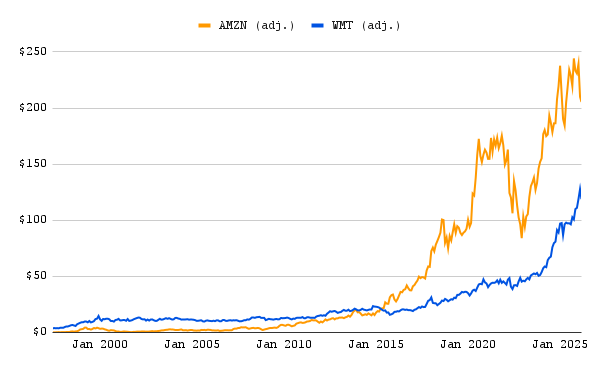
Alfred Lin Revisits 1997 Prediction That Amazon Would Kill Walmart

Alfred Lin Revisits 1997 Prediction That Amazon Would Kill Walmart

Alfred Lin acknowledges his 1997 prediction that Amazon would kill Walmart was wrong, noting Walmart is now about 30 times larger, and lists failed e-commerce firms, rising acquisition costs and the value of physical presence as overlooked factors.

Original post · 1 min read
In 1997, I declared that Amazon would kill Walmart. Today, Walmart is 30 times larger than it was 30 years ago. The world was messier than the story:

- E-commerce companies also failed
- Customer acquisition costs online kept rising
- Certain categories had persistent try-before-you-buy dynamics
- Physical presence created brand equity that digital alone could not

What I should have asked: what would have to be true for this story to be wrong?
Alfred Lin @Alfred_Lin
Beware of Simple Narratives — Simple narratives can guide action and unify thinking, but they often obscure more than they reveal.

We've been taught to tell simple narratives. They are catchy and memorable. Let's be honest. They
♥ 433 · ⟲ 47 · 👁 127.7KView on X ↗