Student Backtesting Tool Tests Polymarket Strategies on Historical Trades
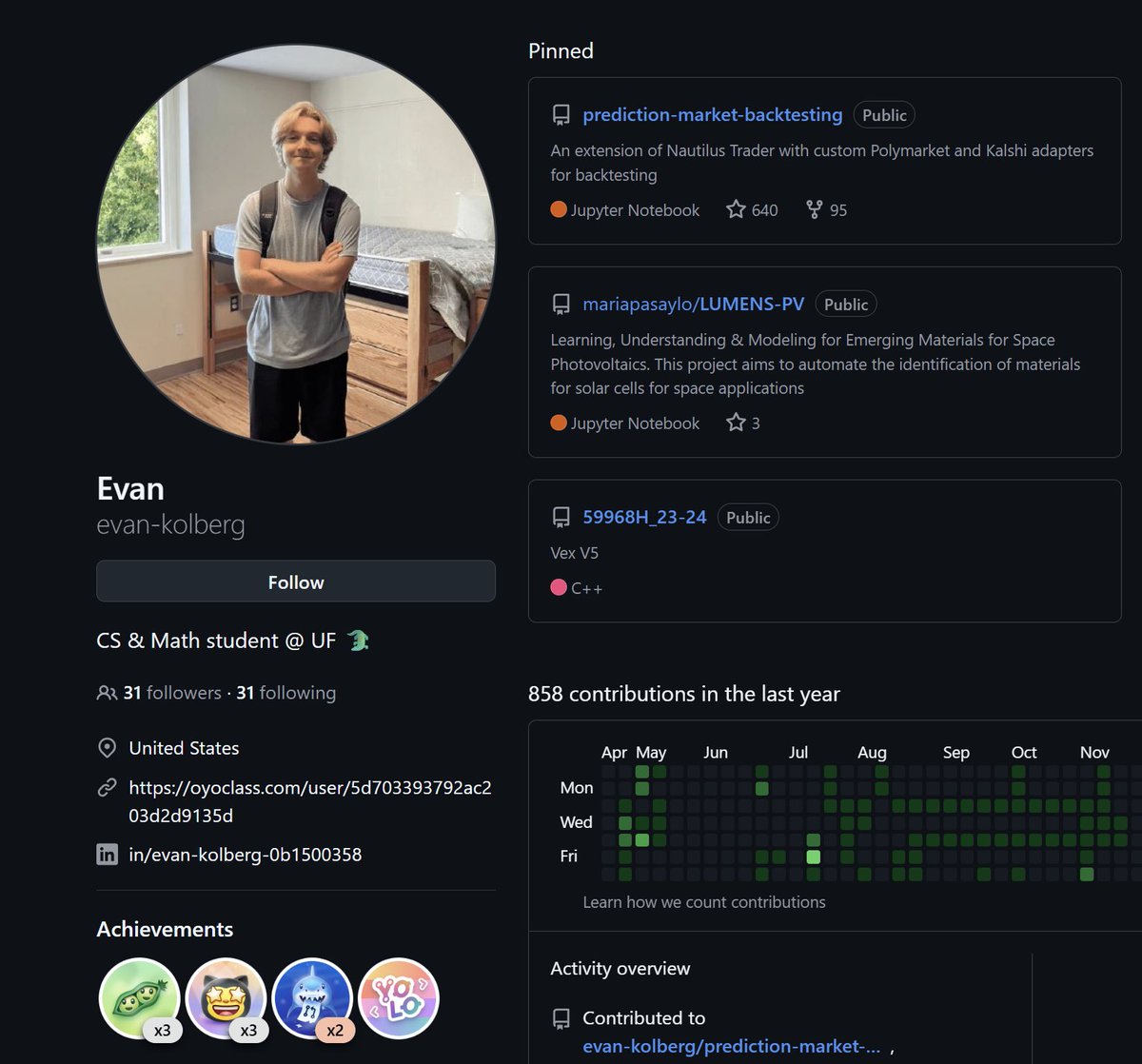
Recogard describes an open-source prediction-market backtesting simulator built by a computer science student on a dataset of 1.1 billion Polymarket trades. Users can apply strategies to past markets and measure PnL and accuracy, with a GitHub link provided.

Original post · 1 min read
A computer science student built a working simulator that lets you test your own Polymarket strategies using real historical data and released it on GitHub for free…
This is a ready to use tool based on the largest dataset of 1.1 billion Polymarket trades.
Here is how you can use it for your trading:
This simulator takes all past markets, analyzes how they behaved from open to close and applies your own strategy to them. As a result, it calculates the potential Pnl and accuracy as if u had actually made those trades yourself.
Lets imagine, while trading, you have noticed a pattern: All movie markets are less volatile and often have a clear winner right from the start (with the highest % probability) - just an example!
But how could u actually test this pattern right now without risking real money? - thats exactly where backtesting comes in…
So, you take your strategy, lets say - Always buy the most probable outcome at market open, but only in movie markets.
Then, the simulator analyzes all movie markets that have ever existed up to today, applies your strategy to them and shows you the accuracy. Based on that, u can decide whether its actually worth using for your future trades.
This way you can test hundreds of strategies like that without risking any money.
GitHub: github.com/evan-kolberg/prediction-market-back…
This is a ready to use tool based on the largest dataset of 1.1 billion Polymarket trades.
Here is how you can use it for your trading:
This simulator takes all past markets, analyzes how they behaved from open to close and applies your own strategy to them. As a result, it calculates the potential Pnl and accuracy as if u had actually made those trades yourself.
Lets imagine, while trading, you have noticed a pattern: All movie markets are less volatile and often have a clear winner right from the start (with the highest % probability) - just an example!
But how could u actually test this pattern right now without risking real money? - thats exactly where backtesting comes in…
So, you take your strategy, lets say - Always buy the most probable outcome at market open, but only in movie markets.
Then, the simulator analyzes all movie markets that have ever existed up to today, applies your strategy to them and shows you the accuracy. Based on that, u can decide whether its actually worth using for your future trades.
This way you can test hundreds of strategies like that without risking any money.
GitHub: github.com/evan-kolberg/prediction-market-back…
Recogard @recogard5 students from Shanghai University analyzed over 1.1 billion Polymarket trades across 268K markets, collected 107GB of real trading data and released it for free on GitHub…
This is the largest public prediction market dataset I have ever found.
Here is how you can use it for trading on Polymarket:
This dataset allows you to understand how Polymarket actually behaves and how prices typically move.
You can analyze and compare all markets within the same category to find patterns in price movements that repeat over time.
Lets imagine, while analyzing this dataset, you discover that, for exa…
♥ 630 · ⟲ 43 · 👁 107.8KView on X ↗


