Wednesday, October 7, 2026ArchiveSearchAsk the paper

The Computomatix Times

All the posts fit to save — curated from @computomatix's bookmarks & likes on X

Edition of Wednesday, April 22, 2026

8 stories

AI7/10

Stanford Class Examines Economics of AI Datacenter Buildout

Stanford Class Examines Economics of AI Datacenter Buildout▶

Apoorv Agrawal shares a video from a Stanford class with Chase Lochmiller on datacenter economics. It covers where roughly $650B of AI infrastructure capex is going, who captures margin, the shift of bottlenecks from GPUs to power, and neocloud economics.

Original post · 1 min read
One of the most substantive classes with @ChaseLochmiller at Stanford. We went deep on economics of the datacenter:
- Where is the ~$650B of AI infra capex actually going this year?
- Who's capturing the margin, who's getting squeezed?
- How the bottleneck has moved from GPUs to power, and where it goes next
- The economics of neoclouds
♥ 1.3K · ⟲ 135 · 👁 242.3KView on X ↗

Google Open-Sources osv-scanner for Dependency Vulnerability Checks

A post introduces osv-scanner, Google's open-source tool that scans lockfiles, containers and vendored code against the osv.dev vulnerability database. It highlights guided remediation, call analysis, support for 11+ ecosystems, and offline scanning.

Original post · 1 min read
GOOGLE BUILT A VULNERABILITY SCANNER AND OPEN-SOURCED IT

most devs ship code without knowing half their dependencies are ticking time bombs

osv-scanner fixes that

it scans your entire project lockfiles, containers, even vendored c/c++ code and maps every dependency against the osv.dev database

supports 11+ ecosystems. npm, pip, cargo, maven, go modules, gem. all of it.

the guided remediation feature is the real unlock... it doesn't just tell you what's broken.... it tells you exactly which version upgrades fix the most issues with the least risk

call analysis built in. so you only get alerts for vulnerable functions your code actually calls. no noise

works offline too. download the db once, scan without internet

one command to scan your whole directory:
osv-scanner scan source -r ./

github.com/google/osv-scanner
♥ 1.2K · ⟲ 187 · 👁 128.5KView on X ↗

AskEdgar Opens SEC Filing Data API to Retail Traders

We Built the SEC Filing Tool Used by $1B+ Funds (Now Open to Retail Traders)

AskEdgar published an article describing its API that converts SEC filings into structured data on dilution, shelf registrations, cash runway and underwriting agreements. The company says the API is used by $1B+ funds and is now available to retail traders.

Original post · 6 min read
X ArticleWe Built the SEC Filing Tool Used by $1B+ Funds (Now Open to Retail Traders)
We built an API that turns every SEC filing into structured, real-time data.
Dilution ratings across 2,000+ tickers. Active shelf registrations. Cash runway calculations. Bank agreements with ROFR and tail financing clauses. Pump-and-dump risk scores.
The kind of data you'd normally pay $50K+ a year to access, and for some of these fields, data that literally doesn't exist on Bloomberg or any other institutional provider.
Our API is already being used by $1B+ funds, prop desks and investment banks.
And as of today, it's open to retail for the first time.
Here's how we got here, and what you can build with it.
I — Why This Data Doesn't Exist Anywhere Else
Most traders assume that if something matters, Bloomberg has it.
For large-cap equities, that's mostly true.
For small-caps, the space where 90% of retail trading pain comes from dilution, offerings, and pump-and-dumps, the institutional data providers fall apart.
Here's what they're missing:
Float that actually reflects reality. When a company converts debt to shares, the float changes overnight. Most providers don't update for months. We tack it on within 24 hours of the filing. That one field alone influences shelf capacity, offering ability, and downstream dilution risk, and no one else is doing it right.
Right of first refusal and tail financing. When you see H.C. Wainwright underwrite a small-cap offering, there's usually a contract locking the company into them for the next 12–24 months, with tail fees that keep the relationship sticky even if the company switches banks. This data sits inside exhibit agreements buried in filings. Structured. Queryable. Nowhere else.
Accurate cash runway. Most "months of cash remaining" calculations are a quarterly cash divided by a quarterly burn. Ours accounts for recent raises, warrant exercises, and actual operating burn pulled from the most recent 10-Q, updated filing by filing.
Shelf capacity relative to float. A 10M share shelf on a 2M share float is a completely different situation than the same shelf on a 500M share float. We calculate this ratio in real time. Most providers don't even store shelf data in a queryable format.
Pump-and-dump pattern scoring. Per-ticker scores for country, underwriter, float, and scam risk — each derived from structured filing data and paired with social-media evidence of an orchestrated pump-and-dump.
II — What It Took to Build Out This Data
Three years. Sleepless nights. A lot of things that didn't work.
The core problem: SEC filings are text. Thousands of pages of unstructured legal language, filed across dozens of form types, updated constantly. If you want structured data out of them, you either hire a team of analysts to read every filing by hand, or you build a system that can do it reliably at scale.
We chose the second path. Here's the rough shape of what it took:
Monitor every filing that can change capital structure. Not just the obvious ones (10-K, 10-Q, etc). The quiet ones too, with buried warrant exercises, debt conversions in exhibits, prospectus supplements that change shelf capacity mid-flight.
Build parsers for every form type. Each filing type has its own structure, its own language, its own edge cases. What a PIPE looks like in one 8-K exhibit is not what it looks like in another. The parsers have to handle all of it.
Layer AI on top of parsing. AI finds the keywords and phrases that suggest a dilution event, a new agreement, a compliance issue. Then manual verification commits the data. AI gets us 80% of the way; human review catches the edge cases that would otherwise corrupt the dataset.
Iterate constantly. Filing templates change. New deal structures emerge. Companies find new ways to raise capital that didn't exist five years ago. If the system isn't updated in real time, the data decays.
III — What You Can Build With It
The API has a host of endpoints covering dilution ratings, offerings, registrations, Nasdaq compliance, float, ownership, and bank agreements. Here are three things you can build today that would have taken a team of analysts to assemble manually.
1. A Dilution Risk Monitor

A watchlist dashboard that surfaces dilution warning signs across your portfolio in real time.
For each ticker, you get the overall dilution risk rating, active shelf registrations with remaining capacity, Nasdaq compliance deficiencies, and a cash runway calculation that tells you when the company will need to raise. Alert on things like cash dropping below 6 months, a new shelf going effective, or ATM capacity getting large relative to float.
2. Backtest Low-Float Gappers
Use the historical float endpoint to check performance on historical gappers under 1m float. Use the news endpoint 'tags' to see how gappers performed under certain news.
3. A One-Click Due Diligence Report
Take any ticker and generate a full due diligence report in seconds, ownership concentration, float history, reverse split count, ROFR agreements with active banks, upcoming lockup expiration… continue on X ↗
♥ 59 · ⟲ 12 · 👁 65.1KView on X ↗

Garry Tan Describes Skill-Based Workflow for Agentic Coding

Garry Tan Describes Skill-Based Workflow for Agentic Coding

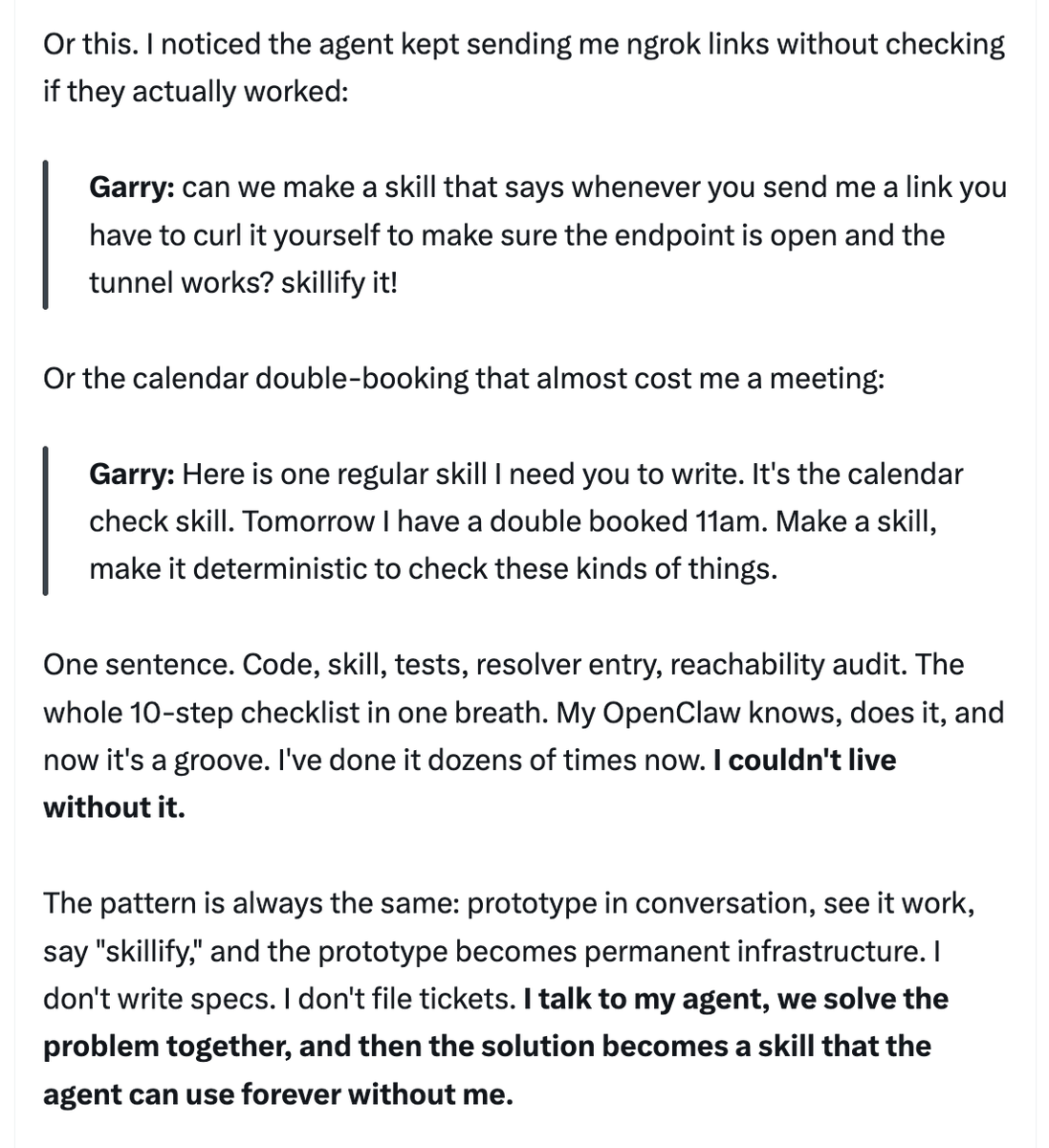
Garry Tan says a workflow he calls 'SKILLIFY IT' has replaced half of his agentic coding, and he is using it to build GBrain and a personal mini-AGI with OpenClaw. He also quotes a post on stopping agents from repeating mistakes, referencing LangChain's $160M raise and LangSmith testing.

Original post · 1 min read
This cycle below is what has replaced 50% of my agentic coding. This is now how I am building GBrain and my own personal mini-AGI with full context on me and the things I care about.

It's not hard. It's quite fun. I do something, anything with OpenClaw, then I say SKILLIFY IT
Garry Tan @garrytan
How to really stop your agents from making the same mistakes — LangChain has raised $160 million. Three years of development. A billion-dollar valuation. LangSmith, their testing platform, is genuinely sophisticated: trajectory evals, trace-to-dataset pipelines,
♥ 885 · ⟲ 72 · 👁 132.2KView on X ↗

Free-Claude-Code Proxy Runs Claude Code on NVIDIA Free Tier

Free-Claude-Code Proxy Runs Claude Code on NVIDIA Free Tier

Hasan Toor promotes free-claude-code, an open-source proxy that routes Claude Code to NVIDIA NIM models using a free API key. It supports Kimi K2, GLM 4.7, MiniMax M2 and Devstral, and includes a Telegram bot for remote control.

Original post · 1 min read
Goodbye Claude Code subscription fees.

Someone just built a proxy that runs Claude Code completely free... and it's wild.

You literally plug in a free NVIDIA API key and point Claude Code at localhost.

That's it.

It handles everything:
- Converts Anthropic API calls to NVIDIA NIM format
- Unlocks 40 requests/min for free
- Supports Kimi K2, GLM 4.7, MiniMax M2, Devstral and more
- Streams thinking tokens and tool calls live
- Even includes a Telegram bot so you can run Claude Code from your phone

No API bill. No rate limit panic. No vendor lock-in.

Honestly, this goes beyond router tools like OpenRouter.

It doesn't just swap the model... it turns Claude Code into a free agent you can control remotely.

The project is open-source on GitHub.

It's called free-claude-code.
♥ 6.2K · ⟲ 902 · 👁 652.0KView on X ↗

Thread Lists Five Free GitHub Repos for Polymarket Trading

Thread Lists Five Free GitHub Repos for Polymarket Trading

A post by Recogard lists five GitHub repositories for automating Polymarket trading, including a curated tools list, the pydantic-ai agent framework, a Claude-based trading server, a Trump post analysis tool, and a wallet history exporter. It promotes the repos as easy to set up.

Original post · 1 min read
5 free ready to use GitHub repos for trading on Polymarket…

Everything you need to automate and make your trading easier:

1. A huge collection of 100+ useful tools and services for Polymarket, from educational resources to AI agents.

GitHub: github.com/aarora4/Awesome-Prediction-Market-T…

2. A tool for building your own AI agents and assigning them any complex tasks.

GitHub: github.com/pydantic/pydantic-ai

3. An AI trading server that connects Claude to Polymarket. It analyzes markets in real time, tracks price movements and suggests how to trade. You can even connect your own account and let it trade for you.

GitHub: github.com/caiovicentino/polymarket-mcp-server

4. This tool scans and analyzes Trumps latest posts in real time. Based on historical data, it predicts how the market might react.

GitHub: github.com/sstklen/trump-code

5. A tool that collects and analyzes the full trading history of any wallet on Polymarket, exports the data to CSV and generates detailed statistics and charts.

GitHub: github.com/txbabaxyz/collectmarkets2

Each of these tools comes with a detailed step by step setup and usage guide, so its actually not so difficult to figure out.
Recogard @recogard
A computer science student built a working simulator that lets you test your own Polymarket strategies using real historical data and released it on GitHub for free…

This is a ready to use tool based on the largest dataset of 1.1 billion Polymarket trades.

Here is how you can use it for your trading:

This simulator takes all past markets, analyzes how they behaved from open to close and applies your own strategy to them. As a result, it calculates the potential Pnl and accuracy as if u had actually made those trades yourself.

Lets imagine, while trading, you have noticed a pattern: All mov…
github.comGitHub - aarora4/Awesome-Prediction-Market-Tools: A curated list of Prediction Market Tools - AI Agents, Analytics, APIs, Dashboards, Copy Trading, Alerting, Tracking and More!!A curated list of Prediction Market Tools - AI Agents, Analytics, APIs, Dashboards, Copy Trading, Alerting, Tracking and More!! - aarora4/Awesome-Prediction-Mar
♥ 226 · ⟲ 26 · 👁 19.9KView on X ↗

Higgsfield Launches Marketing Studio Powered by Hermes Agent

Higgsfield Launches Marketing Studio Powered by Hermes Agent▶

Higgsfield AI announces Higgsfield Marketing Studio, powered by Hermes Agent, which generates UGC-style video ads for websites or apps in a few clicks. The product is pitched at founders of vibe-coded products.

Original post · 1 min read
Meet Higgsfield Marketing Studio, powered by Hermes Agent.
UGC era for your vibe-coded products is here.

You can now create viral UGC ads for your website or app in a few clicks and distribute them at unmatched speed.

It's time to go global.
♥ 2.4K · ⟲ 324 · 👁 1.7MView on X ↗

Levelsio Praises Home Assistant for Open Smart Home Control

Levelsio Praises Home Assistant for Open Smart Home Control

Pieter Levels describes setting up a Home Assistant Green hub and integrating his house's KNX system, arguing that open-source Home Assistant beats walled-garden smart home platforms. He says AI can now help automate small annoyances through Home Assistant.

Original post · 2 min read
I got that little Home Assistant box home-assistant.io/green/

I can highly recommend Home Assistant in general, I was recommended it by @johnonolan and @daniellockyer I remember

When I bought my house I hated home automation and didn't want any, cause I had so many bad experiences with some app you have to install in a hotel room or Airbnb and it always sucked so bad with some stupid iPad and there's no light swtiches, gladly F off

99% of home automation is just terrible

Home Assistant is open source and it's cool because everyone else with it makes plugins (integrations) to connect any device to it

Which solves the biggest problem in home automation, there's many different walled gardens: Amazon has Alexa, Apple has Homepod, Google has Google Home, and when you buy a smart device, it'll only work with a few of them or only one

That's where Home Assistant comes in, because it's open source, people hack all these devices to work on Home Assistant, so you can actually control EVERYTHING and I mean EVERYTHING

Our house came with a KNX system installed by the electricians, KNX is some more low level home automation system but also quite open, and last week he helped me export his KNX project file and add it my Home Assistant and it's great because everything still has regular light buttons

But now I can fix tiny annoyances in this house easily with AI talking to Home Assistant, like shut off the annoying toilet vent that people forget to switch off and just auto switch off after 15 min, or make the lights red at 10pm, or kill those ugly Portugal white LED spots permanently

Home automation is best when it gets into the background and just does things and doesn't annoy you like I said that 99% of home automation integrations in hotels and Airbnb do

It should be analog by default (analog switches) and then customizable on top of that
Fer @El_Tate1
@levelsio Where do you host your HA, Pieter? And how are those lights managed to get them power?
home-assistant.ioHome Assistant GreenThe easy-to-use, versatile, and trustworthy smart home hub for everyone.
♥ 847 · ⟲ 18 · 👁 174.0KView on X ↗