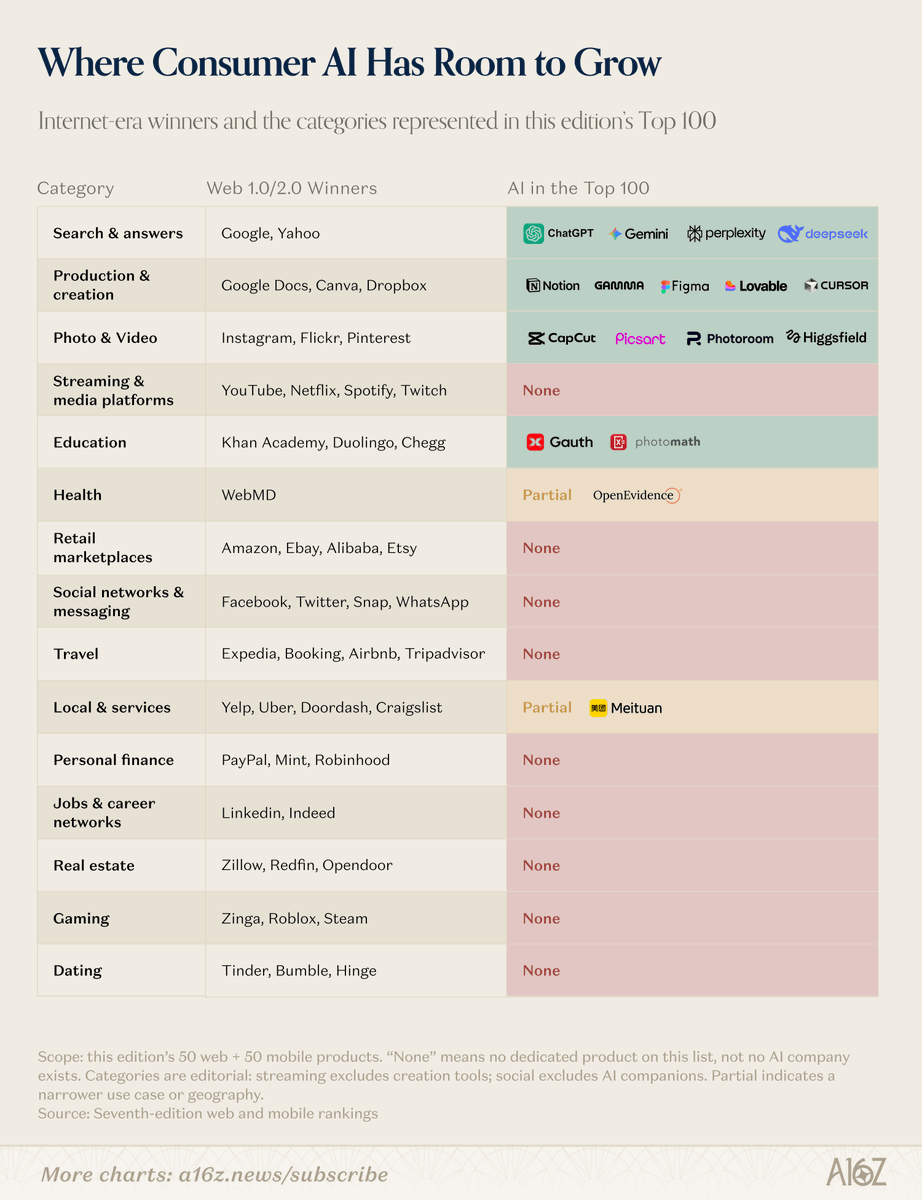
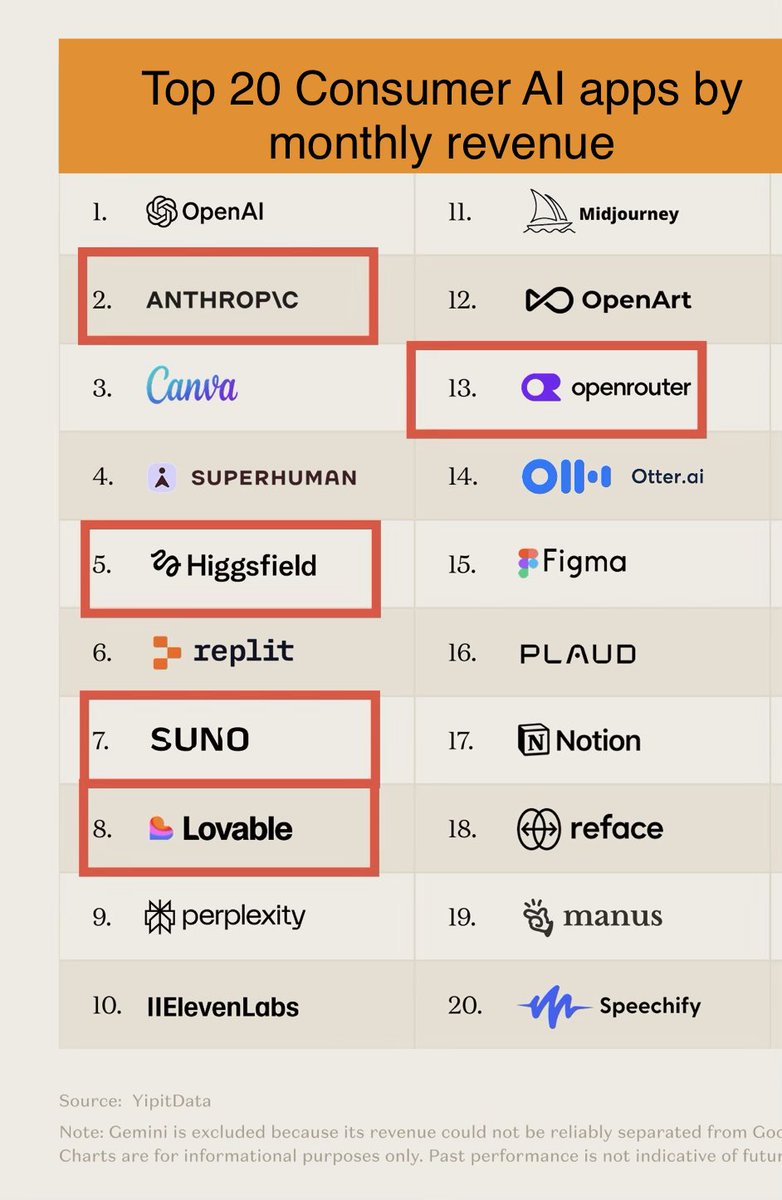
a16z's seventh Top 100 Consumer AI Apps report adds a revenue leaderboard alongside traffic rankings. It notes ChatGPT's 1B+ monthly mobile actives, Claude reaching nearly 1B monthly web visits, and growth into vibe coding, music, design and video, while nine of 15 consumer categories have no AI product in the top 100.
The seventh edition of our Top 100 Consumer AI Apps is here.
New this time: a revenue leaderboard, alongside the usual web and mobile traffic rankings.
Three years ago we published the first edition. ChatGPT was #1, Claude was unranked, and the entire category was chatbots, image generators, and not much else.
In today's edition:
- ChatGPT still holds the throne, now with 1B+ monthly actives on mobile
- Claude has climbed to #3 on web with nearly 1B monthly visits
- The category has expanded to vibe coding (Lovable, Cursor, Replit), music (Suno), design (Figma), voice (ElevenLabs), video…
Olivia Moore argues Amazon's decision to block consumer AI agents is rational near-term, citing advertising margins and Prime lock-in, but says it is a mistake long term because agents are inevitable for low-consideration purchases.
Amazon shutting down consumer agent access (now both Muse and Instinct) is both completely rational and a big mistake
They have plausible reasons:
1. Advertising accounts for ~10% of Amazon revenue, but an estimated 50-60% of operating profit because it's so high margin. People purchasing via agents = fewer consumer eyeballs to monetize
2. Amazon knows from experience how dangerous it is to give another platform a lever to ramp up / down your distribution 👀 They've done this to many retailers themselves
3. They are in a very good spot re: near-term defensibility - with ~250M Prime subs (who are habituated to buying on Amazon) + a massive logistics and distribution network that you can't vibe code
However, this logic is short-sighted (IMO). Agents are inevitable, especially for the kind of purchases people make on Amazon (low consideration, frequent, fairly urgent or recurring).
I don't think Amazon is going to come out with a first-class consumer agent on their own...and in the meantime, why anger your valuable users and make them even consider alternatives?
It's almost never a good idea to be on the wrong side of innovation. I'd much rather see them continue to greenlight agent traffic (it's pretty minimal now!) and work on adjusting to an agent-first world in the meantime.
Huawei and Qualcomm announced a multi-year patent license agreement with cross licenses covering 5G, compute, AI and networking, plus Qualcomm's purchase of certain Huawei U.S. patents. Arnaud Bertrand calls it a notable outcome given U.S. efforts to cut Huawei out of those fields.
This is genuinely incredible: Huawei survived the most aggressive assault against a single company in modern history and is coming out the other side with the U.S. licensing its technology.
And ironically in the exact domains - 5G, AI, compute, networking - that the U.S. tried to cut Huawei out of.
Huawei and Qualcomm have announced a multi-year, broad patent license agreement that includes cross licenses to the companies' patent portfolios across a range of fields, including 5G, compute, AI, and networking, together with Qualcomm's purchase of certain Huawei U.S. patents.
Valon announced a Series D round that doubled its valuation to $2.3 billion, backed by Ribbit Capital and a16z. Angela Strange says Valon now runs about one in six U.S. mortgages on its ValonOS platform.
Paraphrasing Jensen: "It's not AI that's your competition, it's your competitors adopting AI faster than you". For those who thought mortgage would never modernize -- Valon has now contracted 1 in 6 mortgages in this $13T industry onto ValonOS.
So excited to announce that @Valon has raised a Series D, doubling our valuation to $2.3B 📷
I’m incredibly proud of our team and grateful to our customers and partners. Huge thank you to @RibbitCapital@a16z and everyone who continue to support us!
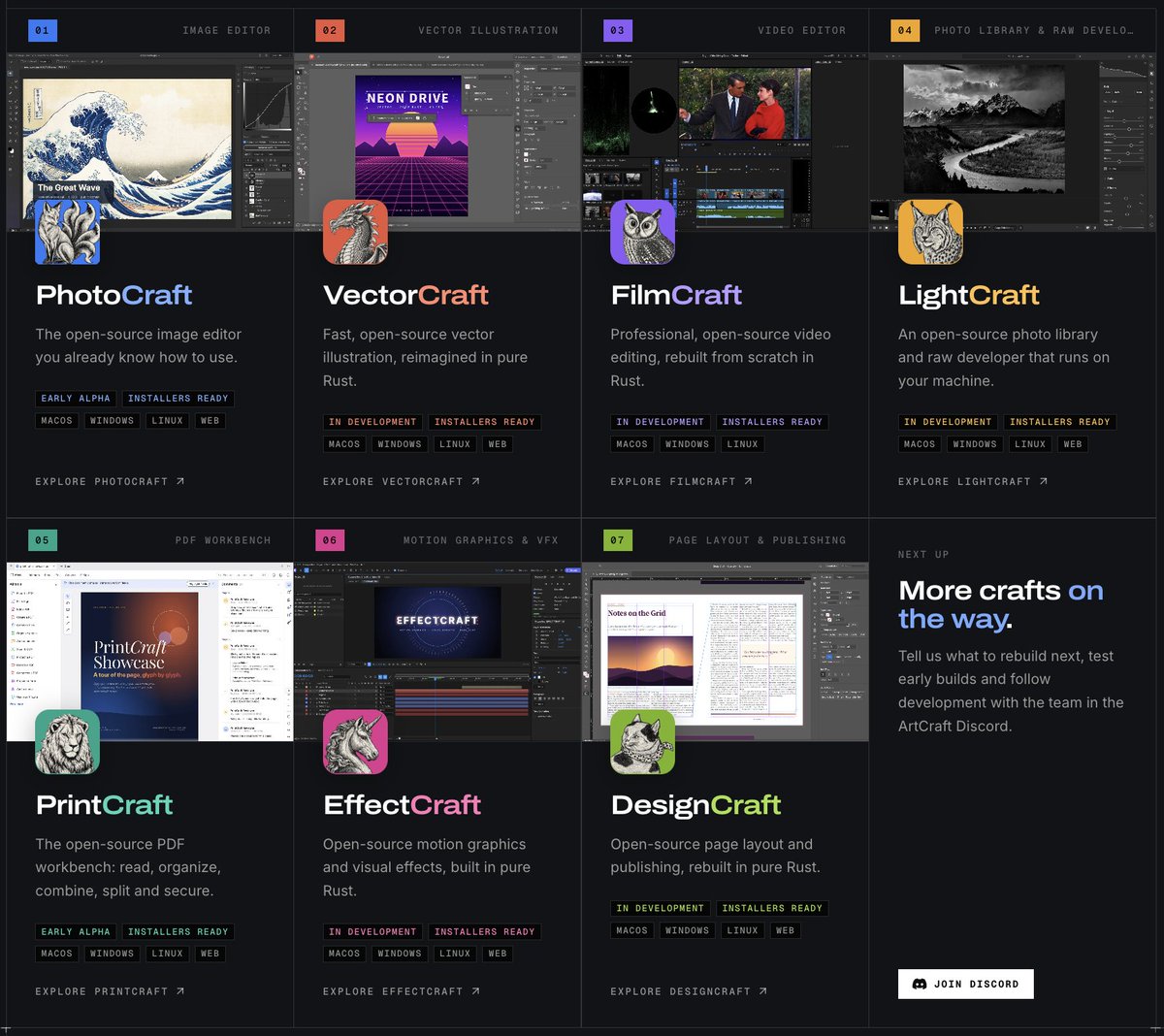
David Hill shares ArtCraft's site listing seven free, open-source creative apps built in Rust covering image editing, vector illustration, video, photography, PDFs, motion graphics and page layout.
Tanay Jaipuria notes that Sequoia made seven tranched rounds in the past year, with first-tranche valuations averaging about $110 million and second-tranche valuations averaging about $3.4 billion. He shares a quoted Boston College investment committee presentation on AI.
Sequoia did 7 tranched rounds in the past year. First tranche (i.e., what they invested at): ~$110M valuation on average. Second tranche: ~$3.4B on average.
The @BostonCollege Investment Committee (an LP and my beloved alma mater) asked for a few thoughts on what's happening in AI. I recorded a test run yesterday morning and then shared it with my partners, who encouraged me to share it more broadly... so here you go!
This is not a sales pitch, it's just a reflection on what we're seeing. And it wasn't intended to be shared, so please pardon the rough edges.
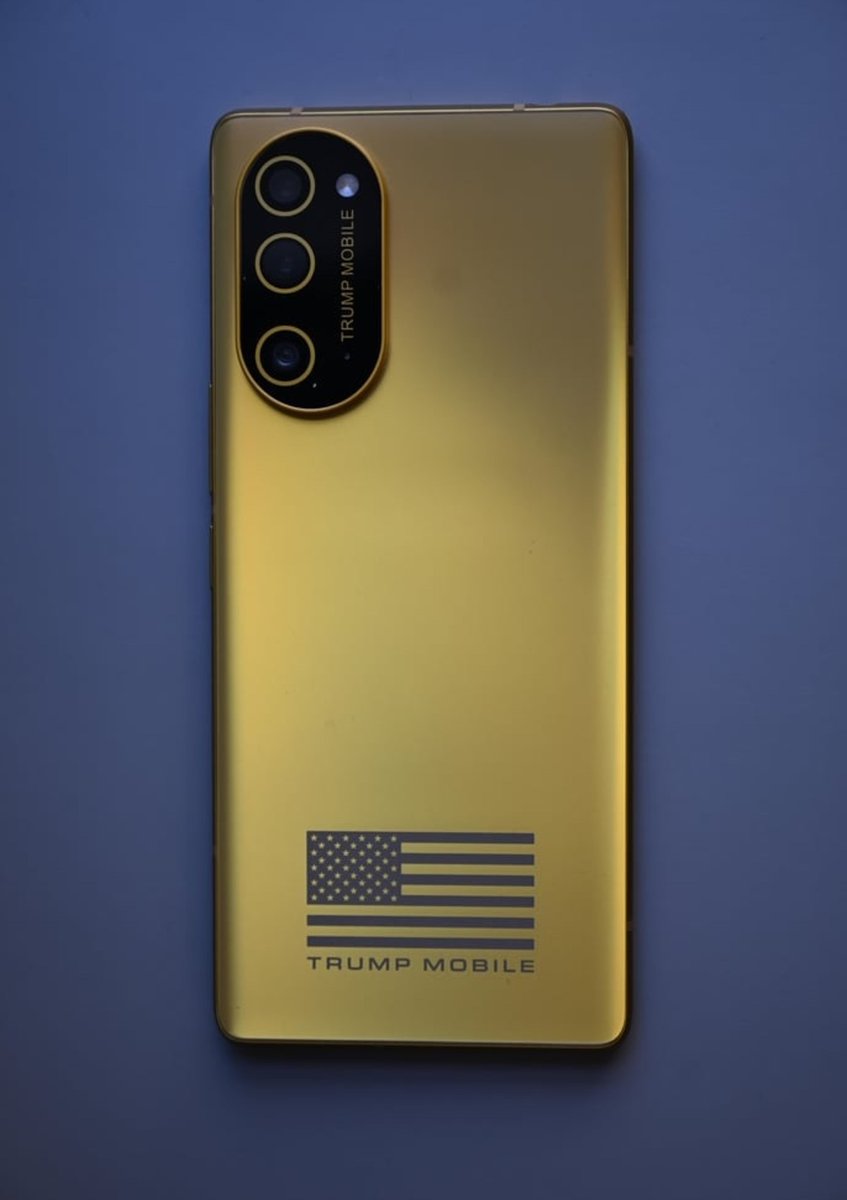
International Cyber Digest reports that ransomware group BYOD leaked personal data of 3,615 Trump Mobile customers, including names, addresses and order details, and claims continued access to the company's backend. Straight Arrow News reported that people in the data confirmed its accuracy.
‼️ BREAKING: Trump Mobile customers have had their personal data leaked by ransomware gang BYOD. The dump covers 3,615 people and includes names, emails, phone numbers, home addresses and order details.
The gang says the company answered news of the breach with "We have no team to handle this."
The leak includes the Trump Organization's own CIO, who oversees its information security.
People listed in the data confirmed their details are accurate and BYOD claims it still has access to Trump Mobile's backend, Straight Arrow News reports.
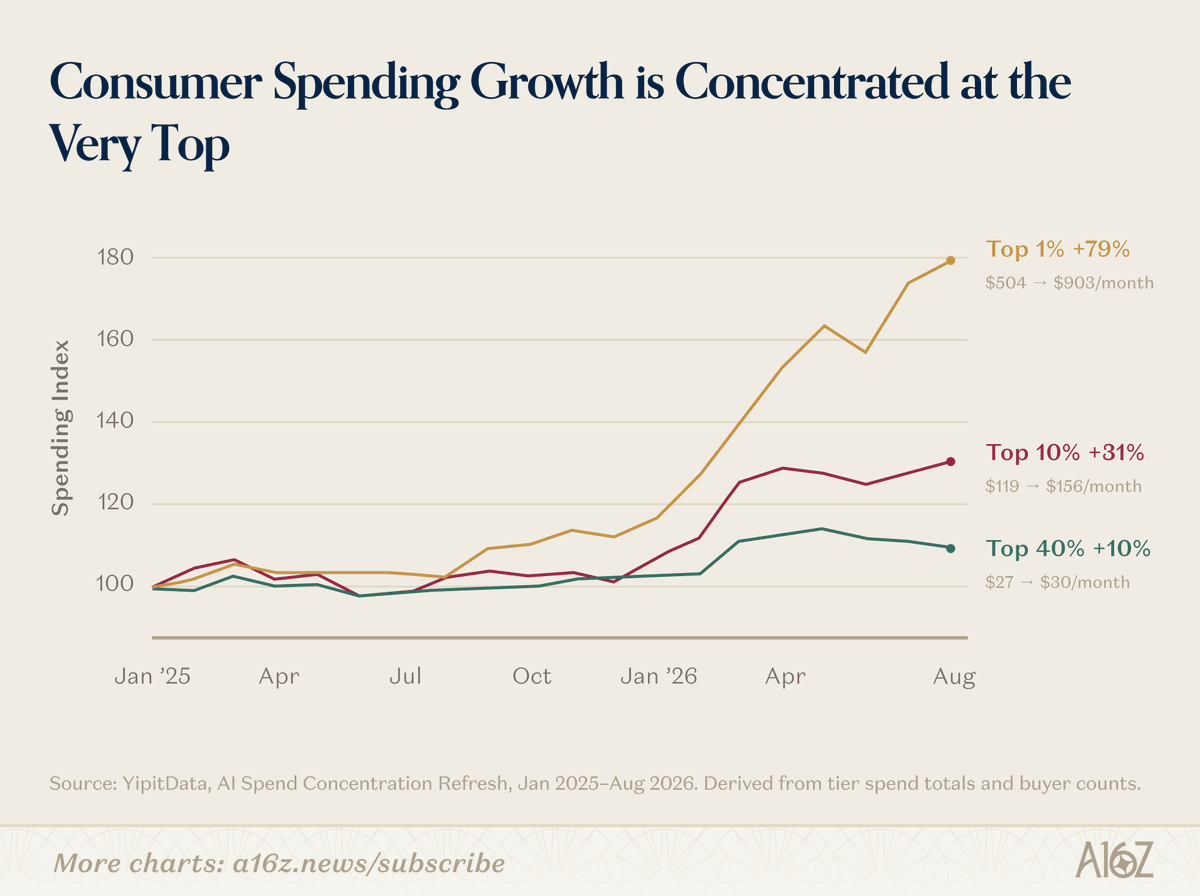
Justine Moore reports that the top 1% of consumers spend more than $900 per month on AI products on personal credit cards, a spending level that outstrips the bottom 50% combined, per the a16z Consumer AI Top 100 revenue data.
Deedy Das says Menlo Ventures is lead investor in five of the top 15 consumer AI apps by monthly revenue, despite a low-volume investing strategy. He responds to a post by Shaun Maguire highlighting Menlo's Anthropic investment and its involvement with Factory AI.
Menlo has tried to rebuild from the ground up how we think about investing and we are fortunate to be lead investors in 5 of the top 15 consumer AI apps by monthly revenue despite our low volume strategy.
Thanks for the shout, Shaun! Have a ton of admiration for what you have done at Sequoia. Too many people know you for your firebrand tweets and too few know your excellent investments and that you have a PhD in physics from Caltech (and it’s fun to have your cofounder be a partner!)
Josh Elman argues that agents appear as blank boxes to uninitiated users, while coders understand them instantly. He says solving that usability gap would unlock the next few hundred million adopters. He shares a link to a16z's Top 100 Consumer AI Apps report.
The problem with consumer AI in a nutshell is if you hand an uninitiated user an agent, it's nothing but a blank box to them. Coders get it instantly, but for everyone else it’s just not intuitive. Solve that, and you reach the next few hundred million real adopters.
The seventh edition of our Top 100 Consumer AI Apps is here, including a new dimension this time: what consumers are actually paying for.
a16z's Elena Burger sits down with Olivia Moore and Josh Elman to unpack the current state of consumer AI:
The data reveals a striking power-user economy. Only a small share of consumers currently pay for AI, but among those who do, spending is heavily concentrated at the top. Olivia and Josh discuss why developers, creators, and other power users dominate spending today, and why subscriptions may not be the business model that ultimately brings consumer A…
DHH quotes a Stratechery essay by Ben Thompson arguing that AI agents make Apple's walled garden feel like limitation rather than protection. DHH says he can now imagine no longer buying Apple by default.
"Not only am I uninterested in the company’s home device, I can, for the first time, envision a future where I don’t buy Apple by default. Indeed, this already happened..."
Anyone into the age of agents will eventually realize Apple is a bad fit.
Aakash Gupta explains that AMC rents whole auditoriums for as little as $99 because most seats go unsold and projection costs are nearly fixed. He says the product began during COVID, when AMC lost $561 million in one quarter.
Renting out an entire movie theater costs as little as $99. AMC put it right on their website in 2020, at $99 for older titles and $149 to $349 for new releases, whole auditorium, up to 20 guests.
Split with 10 friends, that's cheaper than everyone buying their own ticket in LA.
The reason theaters sell this so cheap is the fun part. Close to 9 in 10 movie theater seats in America go unsold across all showtimes, and on a weekday afternoon auditoriums run around a quarter full. The projector is digital, the staff is already on shift, the AC is already running. Playing a movie to an empty room costs the theater almost the same as playing it to a full one.
So a guaranteed $349 for a room that might have held a dozen strangers is a great trade. Even better, buyout groups hit the concession stand together, and popcorn carries a markup north of 1,000%. Concessions are where theaters make their real money, since studios take most of the ticket revenue in a film's opening weeks.
AMC only started selling this to regular people because COVID nearly killed them. They lost $561 million in a single quarter of 2020 and began renting empty rooms to anyone with a credit card just to survive. The margins were so good they kept the product after the pandemic ended.
Celebrities were the beta testers. A private screening used to signal you were a studio mogul with a theater in your basement. Now it's a birthday party option that costs less than dinner for six.
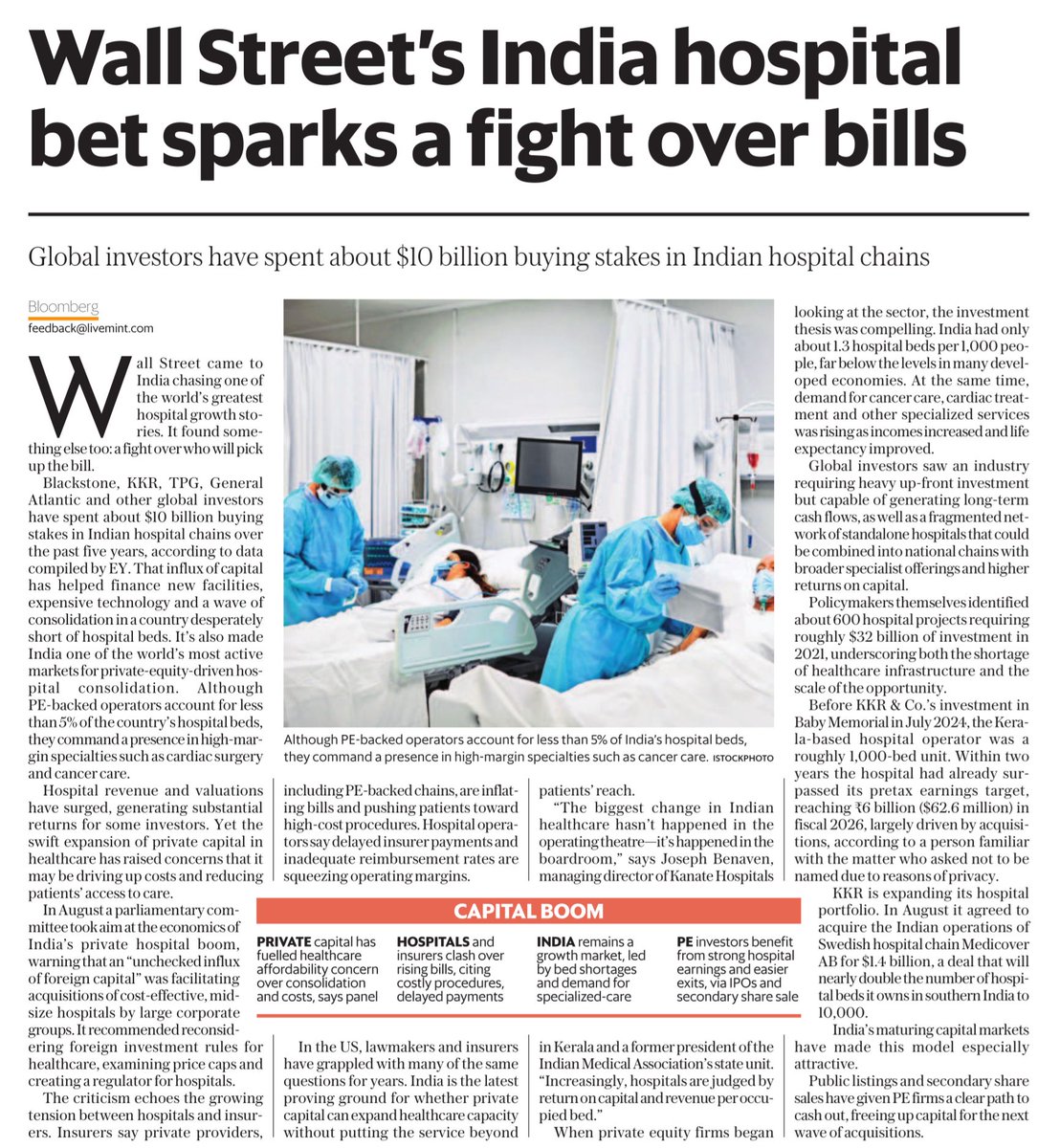
Abhishek Basumallick argues that the corporatization of Indian hospitals should be stopped, criticizes the U.S. healthcare model, and proposes regulating hospitals as public utilities with fixed returns like power companies.
Julie Zhuo highlights a feature letting early-access users add Instinct to group chats, where the agent joins the whole group to coordinate plans, times and logistics without requiring friends to install it.
Starting today, early access users can add Instinct to group chats. A new Instinct joins and works for the whole group.
Making plans with friends usually turns into a frustrating back-and-forth over times and places. With Instinct in the group, you can explore options together, agree on a plan and get it done, all in one thread. Your friends don't even need Instinct to join in.
A few things it’s good at: - Planning a weekend trip with friends, including dates and arrival times - Coordinating logistics with a roommate - Getting tickets as soon as they go on sale, then…
Julie Zhuo shares a quoted post on the four principles of consumer AI and says Muse, launched earlier this month, is the first consumer agent she has used that might make people change their habits.
What will make personal AI go big? — Muse launched earlier this month, and it’s the first consumer agent I've used that makes me think people might actually change their habits for it. I’m not the only one who thinks so! The X-o-sphere
Josh Elman says he discussed the new Consumer AI Top 100 with Olivia Moore on a podcast, focusing on where consumer spending on AI goes next. The post links to the report that adds yipitdata revenue figures to track consumer spending.
1/ The new Consumer AI Top 100 is live and I had a blast unpacking this one with @omooretweets on the pod - it crystallized something I keep coming back to about where consumer actually goes next
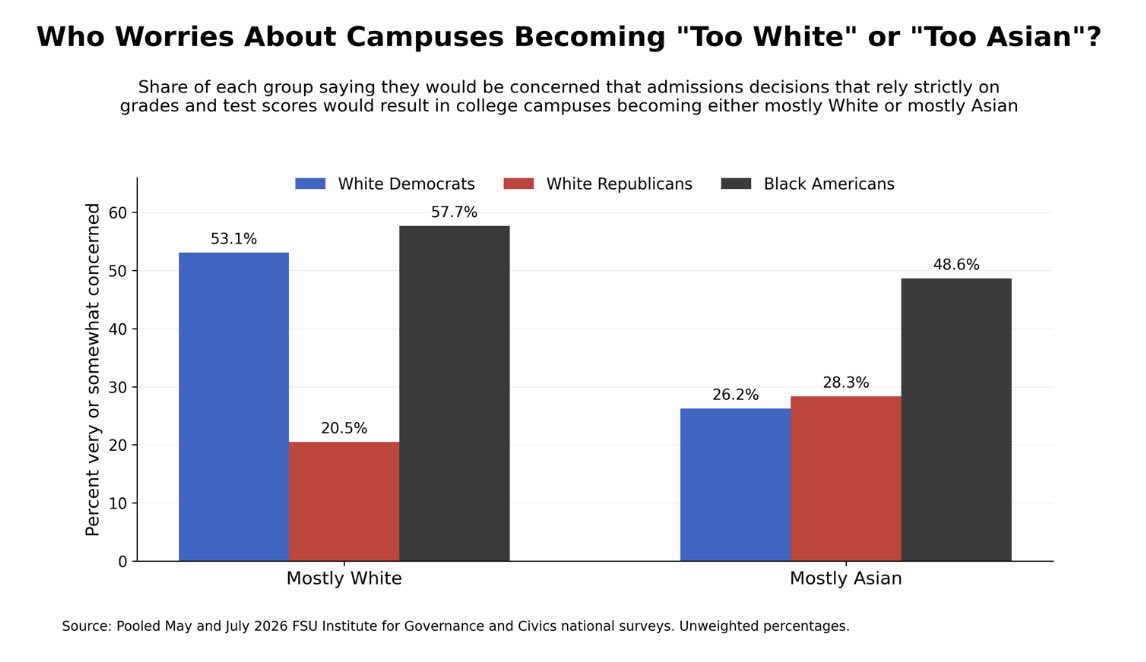
Renu Mukherjee shares research by Michael Hartney finding that only 28% of white Republicans and 26% of white Democrats worry about campuses becoming mostly Asian, and argues the political positions taken on social media may cost candidates support.
Incredible new research from @MichaelTHartney: The Heritage American/Bo French/Woke Right’s position on college admissions is a political loser—even among white Republicans.
ONLY 28% of white Republicans said they were worried about campuses becoming “mostly Asian.” Similarly, only 26% of white Democrats expressed concern. Black Americans were the group most worried about a majority-Asian campus, albeit still under 50% were troubled by the prospect.
X isn’t real life. And if political candidates treat it like it is, then they’re probably going to lose—and they deserve to.
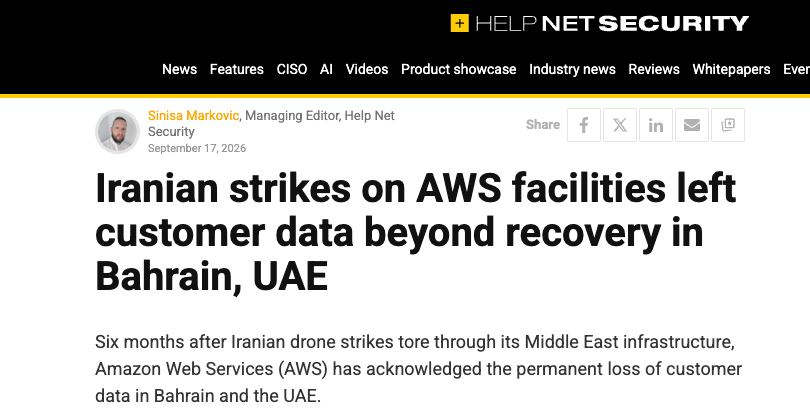
Tobias Schmidt says AWS told him data in its Bahrain region is gone, not degraded, and shares a photo. The post offers no further details or independent confirmation.
Lauren recommends following engineer Parker Smith, who is hosting a workshop on how proactivity has enhanced bot performance. Smith's registration post links to a Luma event page.