Bret Taylor announces the Personal Agent Protocol, an open standard being developed by Meta and Sierra with partners including Genesys, Shopify, Stripe and Walmart. It defines how personal agents interact with businesses and is open for anyone to implement.
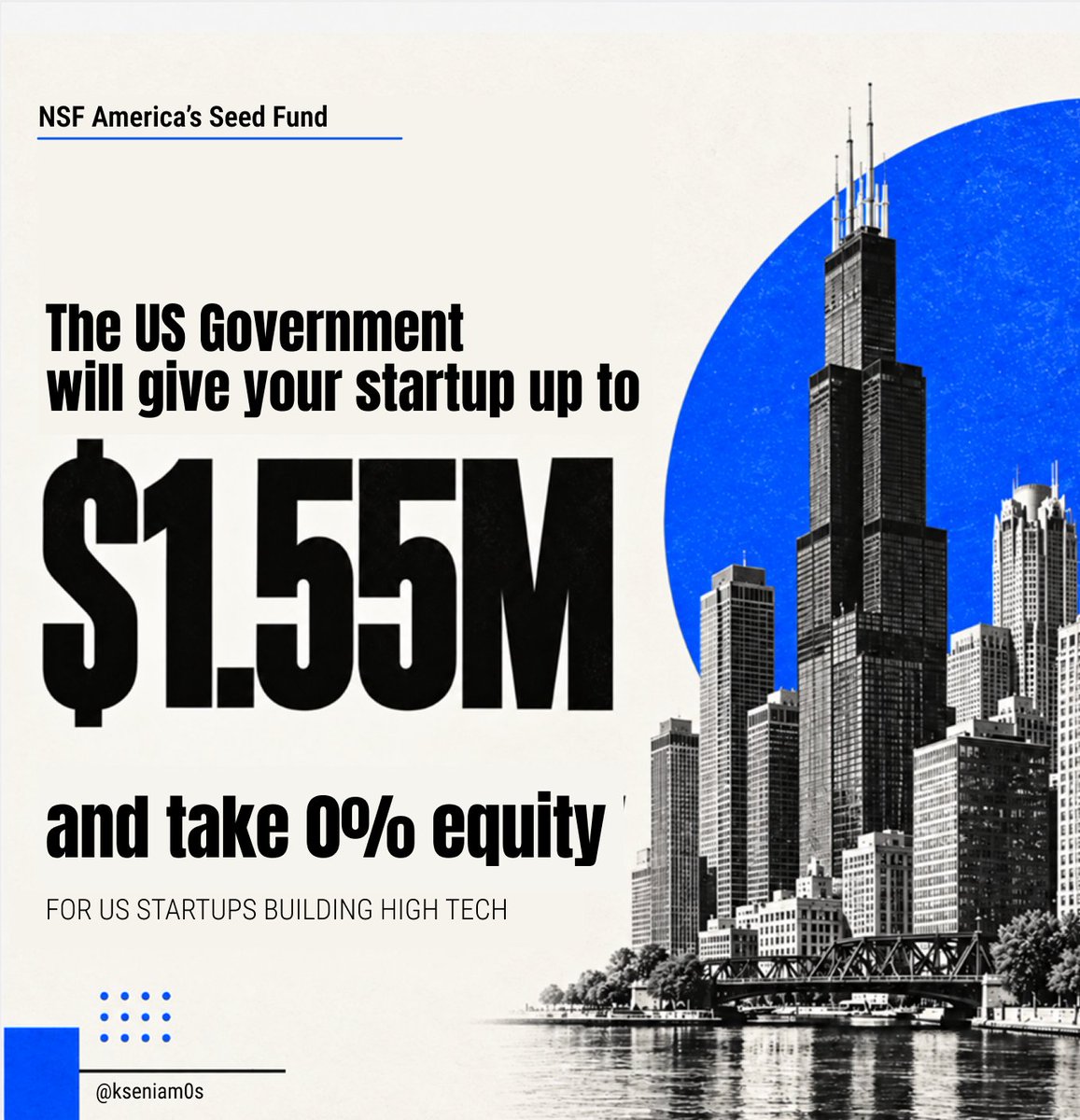
Ksenia Moskalenko reports that the NSF America's Seed Fund has reopened after reauthorization, offering non-dilutive funding up to $1.55M across three tracks. The post lists eligibility rules, a 3-page pitch step, and a November 4 full-proposal deadline.
The US government will give your startup up to $1.55M and take 0% equity.
@NSF's America's Seed Fund is open again after Congress reauthorized it in April.
Three tracks: - Phase I: up to $305K to prove the idea - Phase II: up to $1.25M to build it - Fast-Track: up to $1.55M, both phases in one go
Who can apply: - US-based startups with 500 or fewer employees - 51%+ owned by US citizens or permanent residents - Not majority owned by VCs - All the work done in the US
How it works: - Send a 3-page Project Pitch first - NSF invites the best ones to submit a full proposal - Next full proposal deadline: Nov 4
Phase I funding rates have run about 10 to 20%. It's work, but nobody takes your cap table.
Mustafa Suleyman shares an essay from The Humanist Review in which economist Daron Acemoglu argues AI will replace about 5% of human work tasks over ten years and adds roughly 1.5% to GDP. Acemoglu calls for pro-worker AI and changes to labor taxes, antitrust and data payments.
AI won't take your job anytime soon. Over the next 10 years, it will replace only about 5% of what humans do. This is the prediction Nobel laureate Daron Acemoglu makes in the first issue of The Humanist Review, our new magazine exploring the future of AI, published by MAI. He argues we need to stop building AI to replace people, and start building it to make them better at their jobs. 52% of Americans are worried about AI's impact on their jobs. The fear is overblown, and it's steering how we build AI. AI isn't in the productivity statistics yet. Most firms using it aren't seeing real gains. Expect roughly 1.5% added to GDP over 10 years, not a revolution. Electricity took decades to spread. New York and London had power stations by 1881, yet only about half of factories and homes used it by the 1920s. AI's adoption will likely be even slower, because companies have to reorganize around it. Dragon's voice recognition was nearly 95% accurate in 1997, yet PC dictation today is barely better than in 2000. A great technology goes nowhere without the right products. Even 99% accuracy isn't enough for full automation. The last 1% is the hard part. We're making a mistake by forcing AI to mimic human intelligence. The two are fundamentally different, so the goal should be to pair them, not to have one take over everything. The better path is pro-worker AI: tools that make people better at their jobs, and they're buildable today. The US taxes labor at over 25% and capital at close to zero, which effectively subsidizes automation. The seven largest tech companies make up 60% of the NASDAQ. That concentration crowds out new ideas. The fix: tax labor and capital equally, enforce antitrust, tax digital ads, and pay experts for their data. Read the full essay: humanistreview.ai/issue-1/acemoglu-ai-replace-…
Aakash Gupta explains that Shazam's 2002 system, invented by Stanford PhD Avery Wang, used spectrogram peaks, constellation maps and hash lookups instead of AI, and was published openly in 2003. Apple acquired the company in 2018.
Shazam could name any song back in 2002, on flip phones, with zero AI. You dialed the number 2580, held your phone up to the speaker, and hung up. 15 seconds later, a text came back with the song name. That same core trick still runs the app today.
The inventor was Avery Wang, a Stanford PhD in audio signal processing. His problem was brutal. Match a short clip recorded on a 2002 cell phone mic, in a noisy bar, against a database of a million songs, in seconds, over a phone call.
His solution treated music as geometry instead of sound.
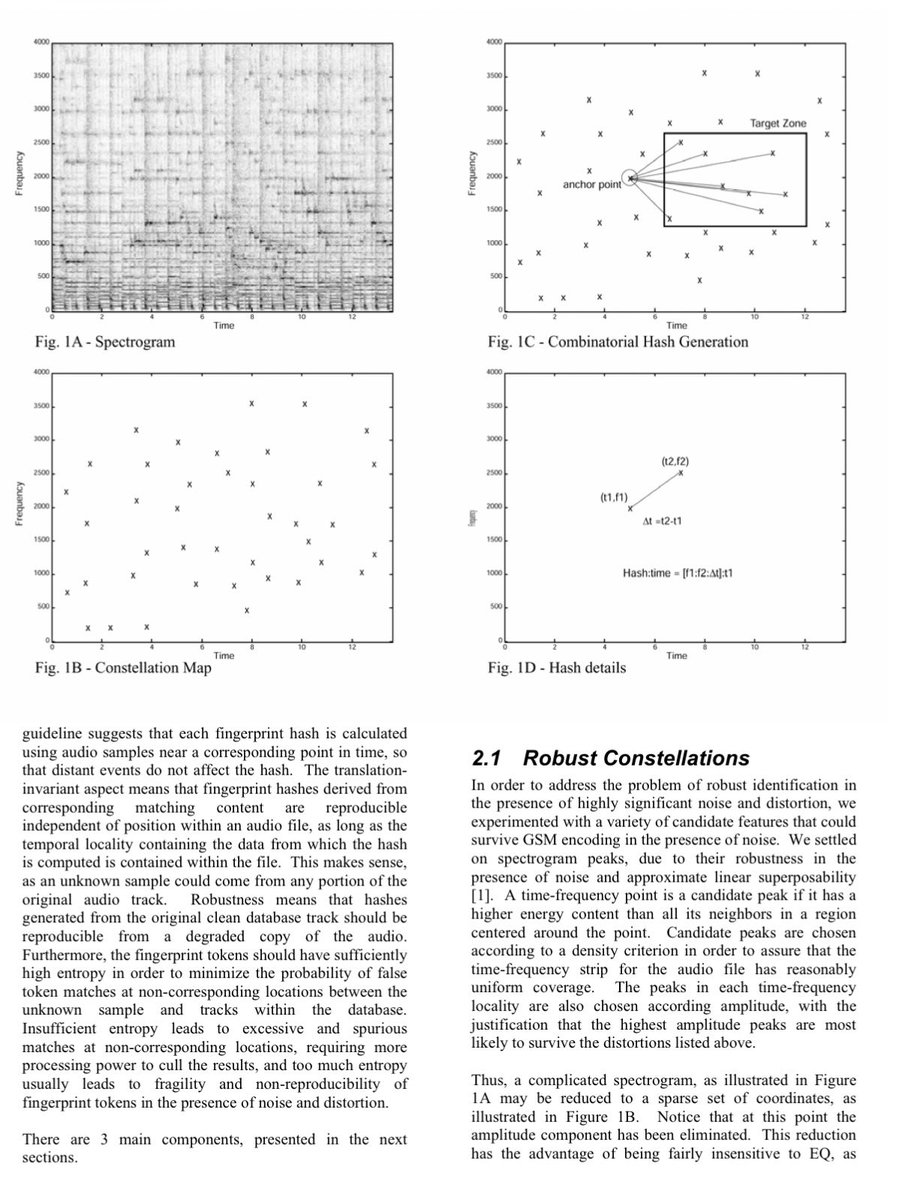
The algorithm converts audio into a spectrogram, a picture of the song, then throws almost all of it away. It keeps only the peaks, the loudest frequency points at each moment in time. Bar chatter and blown-out speakers can wreck most of a recording. The peaks survive. Shazam only ever needed the peaks.
Those surviving points form what Wang called a constellation map, because it looks like a star field. Pairs of peaks get converted into hash numbers, and identifying a song becomes a dictionary lookup rather than an audio comparison. That made it fast enough to search a million tracks on 2002 hardware.
Wang published the full method openly in 2003 in a paper called "An Industrial-Strength Audio Search Algorithm." Anyone could read exactly how the magic worked. The moat was the database and the deals with carriers, never the secret.
Apple bought the company in 2018 for a reported $400 million. People have tagged over 100 billion songs since the very first one, Jeepster by T. Rex, during the beta in April 2002.
One deterministic signal-processing trick, written before most people had heard the phrase machine learning, and it's still so good that in 2026 everyone assumes it must be AI.
Aakash Gupta reports that the FBI arrested Edward Frith after Epic Games reviewed a reported voice clip of his threat and sent it to authorities, and explains how Fortnite's rolling five-minute voice buffer and reporting system work.
The FBI just arrested a Fortnite player using a recording the game made of his own voice. He had no idea his headset was taping him. Almost nobody playing does.
Edward Frith, 29, had logged into his account over 1,700 times. In September he told another player that if the FBI showed up at his door he'd shoot them too. Someone in the lobby pressed the report button. Epic reviewed the clip, sent it to the FBI on September 20, and agents arrested him within days.
The design of the system is the clever part.
Recording every player would be a privacy disaster and a storage bill nobody wants. So Epic built voice reporting in 2023 to work like a flight recorder. The audio buffer lives on your own device, overwrites itself every five minutes, and never leaves your machine unless another player in the match reports it. The moment someone does, the clip gets packaged and sent to Epic's safety team with the speakers tagged.
He said it to one stranger in a lobby. That stranger had a button that turns the last five minutes into a federal exhibit.
I was a producer on Fortnite, and this is the part people outside the building never see. Threats of real-world violence got treated with the same urgency as a revenue outage. The game is full of kids, and Epic acts like it.
Fortnite is actually the conservative version of this. It still requires a human to press the button. Call of Duty has run AI moderation directly on live voice chat since 2023, no report needed. Every major platform with a microphone is converging on the same architecture.
The era where anything said into a gaming headset stayed in the lobby is ending one match at a time.
a16z reports that Valon raised a $150 million Series D at a $2.3 billion valuation after signing over $200 million in software deals, and describes how it became a regulated servicer before selling its platform to the industry.
.@Valon just raised a $150M Series D at a $2.3B valuation. Within six months of selling software, they signed over $200M in deals.
(And they're hiring!)
How the seven-year-old company got there:
- Mortgage is $13 trillion of consumer debt running on a system built before the internet, and no servicer will trust a new platform. So Valon became one.
- Co-founder Andrew Wang read every federal and state regulation, 18 hours a day for six months, and turned it into code.
- They ran their own servicer on the software until it hit 3x the industry's efficiency, sold that servicer to a larger mortgage company, and now sell the software to everyone else. One of the biggest servicers in the US is moving 4 million loans onto it, nearly 10% of the market.
a16z's Angela Strange sits down with @Valon's Andrew Wang and Linda Du to unpack what it takes to rebuild the infrastructure underneath a $13 trillion mortgage market that still relies heavily on systems designed before the internet.
Linda and Andrew explain why Valon chose the hardest path: becoming a regulated mortgage servicer, translating decades of federal and state regulation into software, and proving the platform on its own loans before selling it to the industry. That foundation made Valon roughly 3x as efficient as traditional servicing and created the system of record it is now usi…
Boris Cherny explains his approach to prompting Claude, advising users to give clear goals, specify effort level and verification steps rather than relying on heavy scaffolding.
I am surprised that people are surprised this is how I prompt Claude.
Talk to Claude the way you would a coworker. There's no secret to prompting. There's no need to be overly scaffolded or prescriptive for most tasks -- give Claude a goal, and it will figure it out.
Back in the Sonnet 3.5 days, your prompt mattered a lot. Nowadays, it's much more important to communicate to the model:
1. What you want it to do 2. How much effort you want it to spend 3. How it should verify that it did the right thing
Eric S. Raymond shares the photocraft GitHub project, a clean-room open-source reimplementation of Photoshop that he says was likely generated by decompiling the app, converting it to a spec and prompting an LLM for Rust. He argues this threatens closed-source software.
This is the doom I predicted a few days ago, coming for Photoshop. A clean-room open-source reimplementation.
No prizes for guessing that they decompiled Photoshop to source code, processed that to some kind of non-code specification language, then fed the spec to an LLM with an instruction to generate Rust.
Adobe just got nuked. And closed source is dead, dead, dead.
Nat Eliason lists fourteen functions of his bot setup, including a chief-of-staff agent that drafts emails, specialist agents per work lane, and cloud coding agents that open pull requests from Linear issues. He notes GrokBot as a substantial improvement over his previous OpenClaw setup.
Things my @bot setup does that still blow my mind:
1. A Chief of Staff who opens the day pulling open loops from email & tasks and suggesting things it can knock out before 7am.
2. After every meeting, decisions get folded into Notion, Linear, and Todoist — not left rotting in Granola
3. Every email starts as a draft. The CoS bot scans my email every ~2hr and drafts replies to nearly everything — including checking my cal for availability and finding requested attachments / links
4. A specialist for each lane: curriculum, engineering, coaching, hiring, content, ops, and one for every single piece of software
5. Routines that keep running while I’m offline (e.g. monitoring Sentry errors in our apps and proactively fixing things)
6. Group rooms where 2–4 bots share one project thread instead of me copy-pasting context
7. Cloud coding agents that pick up Linear issues and open PRs after running the list of open work by me EoD — then squash-merge to main when it’s done
8. Meeting prep briefs pulled from Granola + Notion before I walk in
9. A growing shareable knowledge base in Notion + a GitHub repo that we update daily based on what happens at school
10. Student progress look-up across Expertise, Followers, and CoFounder without inventing numbers — chat anytime to see where a student is on their business work
11. Mentor Mind that coaches me on how to hold the bar without inventing doctrine
12. Todoist as a central task list where it logs things it’s blocked on for me, or from meetings / emails — and I can paste links into chat to direct it how to solve them
13. Engineering work is automatically tracked in Linear so my and the product teams’ bots don’t collide with each other
14. Presentations spun up in Gamma / Claude Design without me opening a slide tool
15. Plaud / live capture → notes the bots can actually act on
Probably more but these were the immediate ones we thought of.
Claude announces that its Startups program is expanding, offering members a year of Claude Team, API credits, partner tool offers and office hours with Anthropic's Applied AI team. The announcement includes a video.
Fireside Alpha shares remarks from Arista's Andy Bechtolsheim, who says AI has made optics demand roughly tenfold larger in five years and that another order of magnitude in bandwidth is needed. A companion post cites Meta's Reels watch-time gains from better recommendation models.
$ANET Andy Bechtolsheim says AI has made optics demand about 10 times bigger in five years and the industry is only at the "very beginning"
"So I guess I don't need to tell you that AI has been driving this incredible increase in demand for high-speed optics, which is probably now 10 times bigger than it used to be five years ago..."
"And what I want to talk to you today is that we're not at the end of this journey, but rather the very beginning. There's easily another order of magnitude increase in bits needed for the next generation kind of data centers."
"So what I want to talk about first is what's happening at the data center level, and how we as an industry have to get together to solve these problems of this very rapid and high demand growth as fast as possible, since AI can't wait." ______ For full set of takeaways to Andy's AI Datacenter and Optics lecture: firesidealpha.substack.com/p/aristas-andy-bech…
$META Devansh Tandon reveals the tokens-in, engagement-out flywheel behind Meta's recommendation system, where better models lift Reels watch time 30% and the monetization pays for the next training run
"These scaling curves aren't just academic research. They're driving real product impact at scale for some of the biggest consumer businesses in the world."
"Here's a couple of examples I have from Meta's recent earnings reports. Instagram Reels had a strong quarter, 30% year on year watch time."
"And the optimizations we made to improve the quality of recommendations included simplifying ou…
A post warns of election interference after the administration reportedly refused OSCE observers for the first time in over two decades, a choice that aligns the U.S. with Russia and Belarus. The Justice Department is reportedly preparing to send its own poll monitors.
Trump administration refuses international election monitors for first time in over 2 decades.
The decision not to invite observers from the OSCE puts the U.S. alongside Russia and Belarus, while the Justice Department prepares to deploy its own poll monitors. ms.now/news/trump-midterms-osce-election-obser…
Becky Sosnov thanks CNBC for a segment in which Reflection AI CEO Misha Laskin discusses the launch of Beam, an open-weight model aimed at competing with Chinese models and the open versus closed debate.
A trending-repository post highlights rea, a GitHub project that uses agents to reverse engineer applications, from observed app behavior down to native binaries. It gained 2,963 stars in the past 24 hours.
DHH argues in an essay that falling development costs will spark a bloom in software creation and that coding agents now make hand-writing most code obsolete. He urges programmers to stop relying on pencils and start building.
"We're about to see an absolute bloom in software development as the price of development plummets and everyone realizes how much automation we still have left to do in this world... Don't go down with the pencils. There's so much to build. We need you." world.hey.com/dhh/over-my-dead-pencil-fb0f3647
Aakash Gupta describes how New Rome, Ohio, and Macks Creek, Missouri, depended on speeding fines for most of their budgets, leading to dissolution in Ohio and bankruptcy in Missouri. Missouri subsequently capped ticket revenue at 20% of city budgets.
Ohio once dissolved an entire town because its main business was writing speeding tickets.
New Rome had 60 residents and a 14-officer police force. One cop for every four people in town. They collected around $400,000 a year in fines, 92% of the village budget, mostly by working a stretch of road where the speed limit dropped from 45 to 35.
A state audit then found the village was spending 82% of that budget on the police force. The town's only real industry was funding the thing that funded the town. In 2004 a judge ruled New Rome had effectively dissolved itself through corruption and erased it from the map. Its land got absorbed into the neighboring township.
Missouri ran the same experiment with Macks Creek, population 272, sitting on the highway to Lake of the Ozarks. The town wrote 2,900 tickets a year. Eight a day, almost all tourists who would never drive back to fight them. More than 75% of town revenue came from fines.
Then an officer there pulled over a state legislator. He went back to the capitol and passed a law capping how much of a city's budget can come from traffic tickets. Macks Creek lost its revenue stream, went bankrupt, laid off its entire police force, and disincorporated. The IRS seized the town's bank account.
Speed traps cluster wherever a highway full of out-of-towners meets a sudden limit drop in a state that lets the town keep the money. Missouri now caps ticket revenue at 20% of a city's budget. Ohio had to pass a law aimed at one specific village.
A speeding ticket heatmap doubles as a map of who's allowed to keep the fine money.
Steve Yegge calls Beads the most mature open-source memory system for agents and says it reached 1.5 million downloads, pointing to planned versioned memory features and a proposed wire protocol.
Beads is the oldest and most mature OSS memory system for agents out there. It's the foundation for all my work for the past year, and has matured tremendously with the work of the Gas City folks.
Now that everyone is finally figuring out that they need to "grow" their company brains, I see all these products coming out. You don't need products, you just need Beads. Show it to your agent today.
Developer kyzo says the new product One, a unified inbox and voice interface for talking with AI agents, reached $2 million in annual recurring revenue within five hours. The post links to a promotional video.
Claire Vo describes using OpenAI's Decisions API with vision to choose the best thumbnail face from 40 minutes of footage for about $0.13. The API, now in public beta, selects models, tools or actions in near real time.
Palmer Luckey says Anduril is investing $3.7 billion in Arsenal-2, which he describes as the largest American shipyard built since World War II, and calls for bold investment in shipbuilding.
Anduril is building America's largest shipyard since WWII. This space needs bold investment and decisive action.
In the 1790s, Baltimoore clippers were the fastest and most advanced sailing ships of their time. King George III didn't stand a chance. Time to run the same play.
In a quoted interview, Ben Affleck says he writes Python, understands convolutional neural networks and has worked with GPUs, and that he has visited Google and OpenAI to see their video models. The post also quotes Andy Bechtolsheim saying AI has raised optics demand roughly tenfold, with much more growth ahead.
Ben Affleck reveals he writes Python, understands convolutional neural networks, worked extensively with GPUs, and used his celebrity status to get private looks at Google and OpenAI’s video models
“I’ve always been kind of into computers since I was young. Then, when film started to move from analog film to digital, I became more interested in that aspect of it. The visual-effects workflow for many years has included machine learning, so I can write pretty shitty Python scripts and stuff like that.
“With convolutional neural networks, which were the precursors to what the transformer can do, which is much more computation simultaneously, you would do things like look at what’s called a tensor. That’s the numerical translation of a visual image in numbers, like the batch number, the frame number and the red, green and blue values of each pixel in each frame. It’s just that simple. That numeric is called a tensor.
“You’d use a convolutional neural network to identify patterns that reveal what’s called edge detection or feature extraction, which is identifying patterns well enough to know, this is where the window ledge is, so we can more easily take the green-screen image out and replace it with something.
“That was familiar to me early on because, prior to Artists Equity, I had a small visual-effects company. I’ve worked with GPUs a lot too. The visual-effects guys said, ‘Hey, you should see. There are a couple: Google and this other company, OpenAI, are doing really interesting stuff with transformers in video.’
“I’ve learned that I can actually just call up and go, ‘Hey, it’s Ben Affleck. Can I come see what you’re doing?’ Sometimes people say yes, to my astonishment.”
$ANET Andy Bechtolsheim says AI has made optics demand about 10 times bigger in five years and the industry is only at the "very beginning"
"So I guess I don't need to tell you that AI has been driving this incredible increase in demand for high-speed optics, which is probably now 10 times bigger than it used to be five years ago..."
"And what I want to talk to you today is that we're not at the end of this journey, but rather the very beginning. There's easily another order of magnitude increase in bits needed for the next generation kind of data centers."
Lenny Rachitsky describes a growing trend of teams using AI user simulations to test product ideas and flows. He lists Simile, Primitive Labs, Synthetic Users, Tenera and Seldon and asks readers for experiences.
Pieter Levels criticizes Airbnb's review policy after the company stated that hosts cannot delete reviews, while hundreds of guests report removed reviews. He argues that removing reviews on host request undermines trust in the platform's ratings.
The replies here are literally hundreds of people who got their reviews removed directly contradicting what Airbnb says here
The "policy" they have seems to be to remove a guest's review and rating whenever a host asks for it
I don't get why they don't just fix this? Everyone would love to see Airbnb have honest reviews and ratings you can trust
Short term you might get more bookings if everything is a 4.5 or 4.99 but long term people discover it means nothing and they can't trust your platform and they leave elsewhere
I think they're in some internal gridlock by MBAs who want to see revenue go up, not realizing that they're destroying a company
Deedy outlines how Shazam extracts high-amplitude spectrogram peaks, hashes them with timestamp and track ID, and performs recognition via a hash table lookup. He notes that his college CS class built a version and recommends the original paper.
The serious answer to how Shazam worked is it took the peaks of a spectrogram of short clips of every song, find the peaks from the highest amplitude bits, hash it with the value being (time stamp, track id) and then the actual recognition is a hashtable lookup.
We did this for a college CS project. The original paper is fantastic:
Amjad Masad says AI-powered reverse engineering and decompilation are advancing rapidly and expects nearly all software to become de facto open source.
Mark Suster congratulates Jiake Liu on the launch of Outer Space, which raised $8 million in pre-seed funding led by Upfront Ventures and builds outdoor living spaces that generate and store solar energy.
Alex Finn says the proactive AI agent Hark impressed him after a week of early access, and shares a video explaining its features. The post describes an interface that adapts to each user.
Investor Sheel Mohnot recommends trying Hark Pro despite personal assistant fatigue, citing strong UX and non-intrusive proactive notifications. He quotes Brett Adcock's announcement that Hark Pro is live on web, iOS and Android.
You might have personal assistant fatigue at this point, but if you're up for signing up for another one, this one is a good one to try... UX and proactive pushes in particular are extremely good and not too annoying
Kyzo introduces One, a product that gathers agent questions in a single inbox, lets users talk to agents by voice and supports replies from an iPhone, including to cloud agents. The post is a product announcement video.
Vijay Shekhar Sharma compares the Oki Home personal AI computer to the Sun Ultra of the AI era. The quoted announcement says the device keeps user data local and takes reservations for a first batch shipping mid-December.
Kevin Picchi claims one developer used Opus 5.5 to re-create all Adobe applications, port them to Rust and release them as open source. The post is brief and shares a media attachment.
Ben Lang recommends asking a main Grok bot to review xAI's new Bot Guides and apply the best practices to one's own bots. The linked guides cover practical playbooks for AI teammates.
Jason Fried praises Graphical, a tool by Josh Puckett for designing visual languages and styling components with coding agents. The post quotes Puckett's launch announcement and links to graphicalui.com.
It's a simple, powerful, and fun tool to design visual languages, style components, and work with coding agents to create interfaces that look memorable and feel unique.
Pieter Levels says he owns property in scarce coastal and mountain areas and plans to keep buying there, reflecting a thesis that people with money will move to the nicest places once AI makes work pointless. He is quoting a post by IterIntellectus making the same claim.
Alex Mason argues the S&P 500 at record highs is a trap, citing a historical midterm-year pattern of May-to-October declines and current rate, inflation and Iran-war concerns. The post is market speculation promoting his following, with a video quoting a similar prior post.
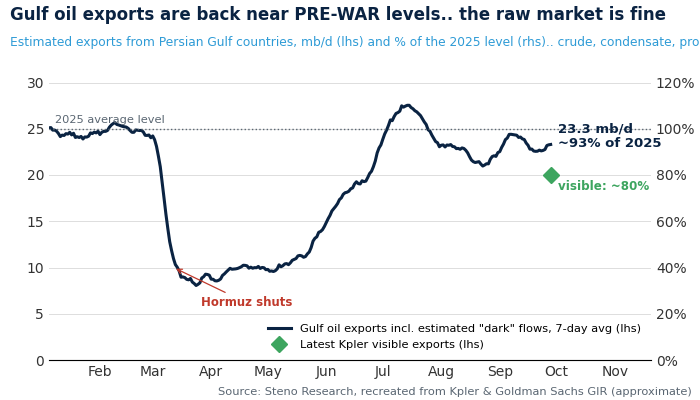
A short post by Andreas Steno Larsen asserts that the United States has essentially won the Hormuz confrontation, accompanied by a photo. The post offers no supporting detail.
A commentary account posts a video and quote-post praising Noah Smith in a heated online argument with a commentator, and criticizes left-leaning Twitter reaction to Ezra Klein's zoning remarks. The content is personal political commentary with no technology news.
.@L0m3z sputtering, red-faced, pleading w/ Noah Smith that he's only bullying Indian kids to HELP them integrate. Noah's the wrong guy to try this kind of argument on. It’s like trying to bullshit about wine to a dog. He calls @l0m3z a Pakistani. @L0m3z is left stunned. He's been bodied. Noah Smith is not the hero we deserve, but he is the hero we need.
Noah Smith's power is his dumb guy confidence. The left is a nest of vipers waiting to pounce on anyone who expresses a positive stand on anything. Ezra Klein meekly suggests relaxing zoning rules on setbacks and lefty twitter reacts like he punched a pregnant woman in the stomach. In such an environment, it is the guileless moron who attains the status of sage. Because he just blithely says stuff. youtube.com/watch?v=x-QBwwiselI