Wednesday, October 7, 2026ArchiveSearchAsk the paper

The Computomatix Times

All the posts fit to save — curated from @computomatix's bookmarks & likes on X
AI8/10

Meta's Alexandr Wang Says Agent Loops Can Outperform 100 Engineers

Meta's Alexandr Wang Says Agent Loops Can Outperform 100 Engineers▶

In a YC conversation with Garry Tan, Meta Chief AI Officer Alexandr Wang described agentic loops with evaluation metrics that let agents complete more work than 100 senior engineers. He said the system is built from simple parts like markdown files, cron jobs and metrics.

Original post · 3 min read
Former Scale AI founder and newly appointed @Meta Chief AI Officer @alexandr_wang dropped a bombshell during his YC conversation with @garrytan, and you could almost hear the tech leadership world go quiet.

He said Meta has already seen this internally:

Build the right agentic loop, give it an evaluation system and metrics that let it optimize itself, and a group of AI agents can complete more work than a team of 100 senior engineers.

And they do it “very easily.”

But the most interesting part wasn’t the 100-engineer comparison.

It was how simple the system underneath it actually is.

You’d expect some insanely complex, almost alien architecture powering a swarm like this.

Instead, Wang described it with a few almost comically basic words:

“Markdown files, cron jobs, goal, metrics, data.”

Once you strip away the hype, the implications for traditional software engineering become pretty clear:

1️⃣ It’s not that the models are magically smarter. The eval loop is doing the heavy lifting.

Traditional approach: humans write prompts, run the code, inspect the output, and hope nothing broke.

Meta’s approach: turn the business goal into something a machine can score automatically.

The agent submits its work. The system runs tests, calculates metrics, finds what’s wrong, and sends it back for another pass. Repeat until it passes.

Nobody has to babysit every step. The metric becomes the supervisor.

2️⃣ The real alpha is burning 1,000x more tokens inside the feedback loop.

A lot of people are still optimizing for the cost of a single AI call.

The frontier labs are playing a different game: spend 1,000x or even 1,000,000x more tokens in the background so agents can constantly review, rerun, challenge, and verify each other’s work until they reach a reliable business outcome.

Token cost is fixed. The payoff is a pipeline that keeps running.

3️⃣ Memory doesn’t need some fancy database.

Persistent memory can live in Markdown files.

Scheduling can be handled by the server’s built-in cron jobs, running overnight.

The simpler the scaffolding, the more robust the system can be. Less infrastructure also means fewer ways for context to fall apart.

This is a pretty brutal change in how technical organizations work.

The ceiling for a tech lead used to be partly about how many people they could manage, how many meetings they could sit through, and how many teams they could coordinate.

The leverage for the next generation of technical leaders may look very different:

Can you turn a messy business objective into a rigorous set of metrics that an AI can evaluate automatically?

If 100 people’s output can be replaced by a few cron jobs, Markdown files, and a well-designed eval loop, the era of “just take the ticket and write the code” is coming to an end.

The people who can design the evals and orchestrate the swarm aren’t just holding a new tool.

They’re effectively running a virtual company.
♥ 511 · ⟲ 58 · 👁 133.6KView on X ↗

More in AI

AI9/10

OpenAI Releases Broad Set of Mathematical Results From Internal Model

OpenAI announced it is releasing a range of new mathematical results produced by an internal frontier model, consulting the Institute for Advanced Study's Advisory Group on Mathematics and Artificial Intelligence on how to release them, with materials published on GitHub.

Original post · 1 min read
We’re releasing a broad range of new mathematical results produced by an internal frontier model.

We’ve been consulting with the independent Advisory Group on Mathematics and Artificial Intelligence at the Institute for Advanced Study, and we have drawn on their advice and public recommendations to inform how we release these results.

github.com/openai/math
♥ 36.9K · ⟲ 5.8K · 👁 18.6MView on X ↗
AI9/10

OpenAI Publishes 722 AI-Generated Math Manuscripts From Internal Model

OpenAI Publishes 722 AI-Generated Math Manuscripts From Internal Model

OpenAI released 722 mathematical manuscripts produced by an unreleased internal model, grouped into 372 families of results from about 4,000 research problems, averaging three hours of ChatGPT Pro compute per result. The author highlights claimed results including a zero-free half-plane for the zeta function and a quasi-Riemann hypothesis advance, which remain to be independently assessed.

Original post · 1 min read
Ok so I took a closer look at the results, and OpenAIs AI-generated mathematics manuscripts are *even more* significant than I initially thought.

I spent the morning going through it. Some thoughts.

The list is absurd. A zero-free half-plane for the zeta function (Re s > 7/8), which is the first result of its kind in over a century. Hilbert's tenth problem over the rationals. The Hodge conjecture for CM abelian varieties. Irrationality of Catalan's constant. Dozens more.

Any one of these would normally be a career.

But the number that many arent seeing is the following: It's 3. That's the average hours of ChatGPT Pro compute per result. A month ago, Navier–Stokes took them around 10,000 agents and 88 hours. That efficency gain within just a few weeks.

Also OpenAI claims to have solved the quasi-Riemann hypothesis. That alone would be a historic breakthrough in mathematics.

This is a weaker version of the famous Riemann hypothesis, which concerns how prime numbers are distributed. The full hypothesis remains unsolved, but the claimed advance would be enormous in its own right.

Math twitter obviously is shocked. Again: this is literally the intelligence explosion happening right now. 2027 will be the year of Superintelligence. Im now convinced by that.
Chubby♨️ @kimmonismus
HOLY, the rumors were true: OpenAI has published 722 mathematical manuscripts produced by an *unreleased* internal model.

The collection groups them into 372 families of related results, drawn from an evaluation involving approximately 4,000 research problems.

OpenAI says the standard procedure used an average of three hours of ChatGPT Pro thinking compute per result.

The release includes papers, proof artifacts and selected reasoning summaries. The model itself remains unreleased.
♥ 2.8K · ⟲ 291 · 👁 152.9KView on X ↗
AI8/10

Derek Thompson Calls OpenAI's Big Maths Day Potentially Historic for Science

Derek Thompson shares a quoted passage calling October 6, 2026 probably the biggest day of scientific advancement in history for AI in mathematics. The quoted Josh Gans post discusses OpenAI's Big Maths Day announcement.

Original post · 1 min read
Jesus.

"It isn’t an overstatement to say that this is probably the biggest day of scientific advancement in history. I suspect October 6th, 2026, will go down as some form of Judgment Day for AI in mathematics, but it portends so much more."
Joshua Gans @joshgans
My thoughts on OpenAI's Big Maths Day. joshuagans.substack.com/p/openai-drops-a-bomb-…
♥ 1.3K · ⟲ 121 · 👁 138.7KView on X ↗
AI8/10

Meta and Sierra Announce Open Personal Agent Protocol Standard

Meta and Sierra Announce Open Personal Agent Protocol Standard

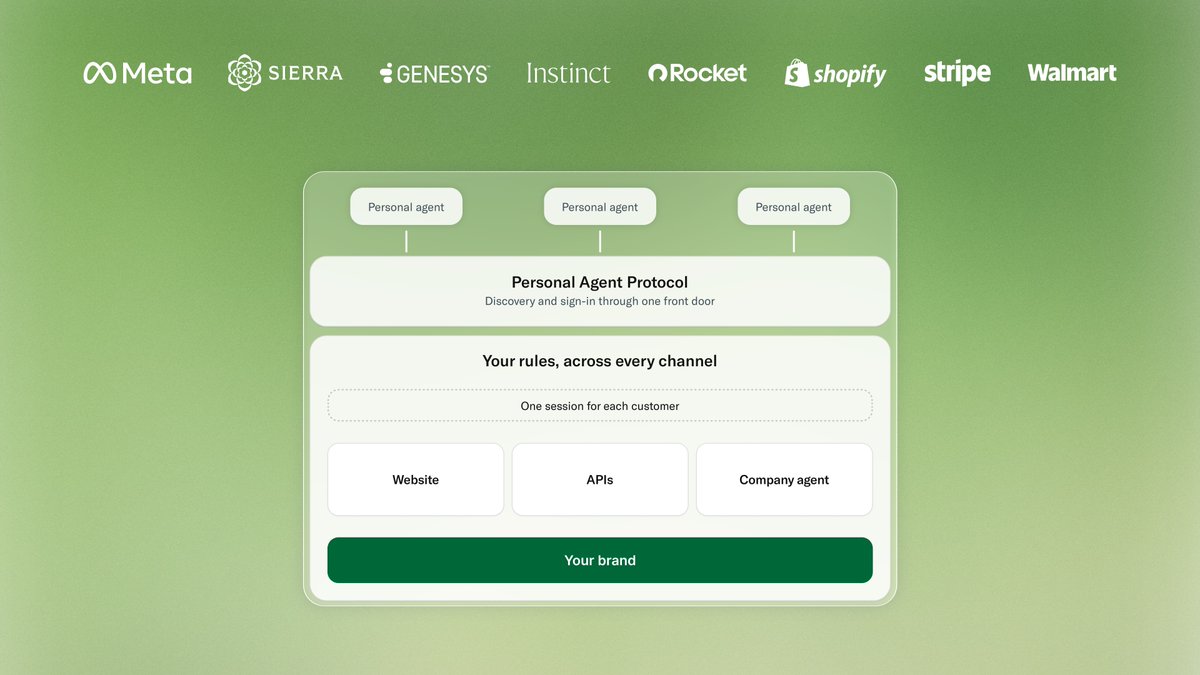
Bret Taylor announces the Personal Agent Protocol, an open standard being developed by Meta and Sierra with partners including Genesys, Shopify, Stripe and Walmart. It defines how personal agents interact with businesses and is open for anyone to implement.

Original post · 1 min read
Today we’re announcing Personal Agent Protocol — an open standard @Meta and @SierraPlatform are developing along with industry partners at @Genesys, @instinct, @RocketOTD, @Shopify, @stripe, and @Walmart. It will help define how personal agents interact with businesses and is open for anyone to implement. You can read more here - and if anyone is interested in joining let me know! sierra.ai/blog/introducing-personal-agent-prot…
♥ 2.9K · ⟲ 255 · 👁 307.7KView on X ↗
AI8/10

Suleyman Cites Acemoglu Estimate That AI Will Replace Only 5% of Tasks

AI won't take your job anytime soon. In 10 yrs, only 5% of what humans do will be replaced by AI

Mustafa Suleyman shares an essay from The Humanist Review in which economist Daron Acemoglu argues AI will replace about 5% of human work tasks over ten years and adds roughly 1.5% to GDP. Acemoglu calls for pro-worker AI and changes to labor taxes, antitrust and data payments.

Original post · 2 min read
X ArticleAI won't take your job anytime soon. In 10 yrs, only 5% of what humans do will be replaced by AI
AI won't take your job anytime soon. Over the next 10 years, it will replace only about 5% of what humans do.
This is the prediction Nobel laureate Daron Acemoglu makes in the first issue of The Humanist Review, our new magazine exploring the future of AI, published by MAI. He argues we need to stop building AI to replace people, and start building it to make them better at their jobs.
52% of Americans are worried about AI's impact on their jobs. The fear is overblown, and it's steering how we build AI.
AI isn't in the productivity statistics yet. Most firms using it aren't seeing real gains. Expect roughly 1.5% added to GDP over 10 years, not a revolution.
Electricity took decades to spread. New York and London had power stations by 1881, yet only about half of factories and homes used it by the 1920s. AI's adoption will likely be even slower, because companies have to reorganize around it.
Dragon's voice recognition was nearly 95% accurate in 1997, yet PC dictation today is barely better than in 2000. A great technology goes nowhere without the right products.
Even 99% accuracy isn't enough for full automation. The last 1% is the hard part.
We're making a mistake by forcing AI to mimic human intelligence. The two are fundamentally different, so the goal should be to pair them, not to have one take over everything.
The better path is pro-worker AI: tools that make people better at their jobs, and they're buildable today.
The US taxes labor at over 25% and capital at close to zero, which effectively subsidizes automation.
The seven largest tech companies make up 60% of the NASDAQ. That concentration crowds out new ideas.
The fix: tax labor and capital equally, enforce antitrust, tax digital ads, and pay experts for their data.
Read the full essay: humanistreview.ai/issue-1/acemoglu-ai-replace-…
♥ 1.8K · ⟲ 309 · 👁 507.0KView on X ↗
AI8/10

a16z Top 100 Consumer AI Apps Report Shows Expansion Beyond Chatbots

a16z Top 100 Consumer AI Apps Report Shows Expansion Beyond Chatbots

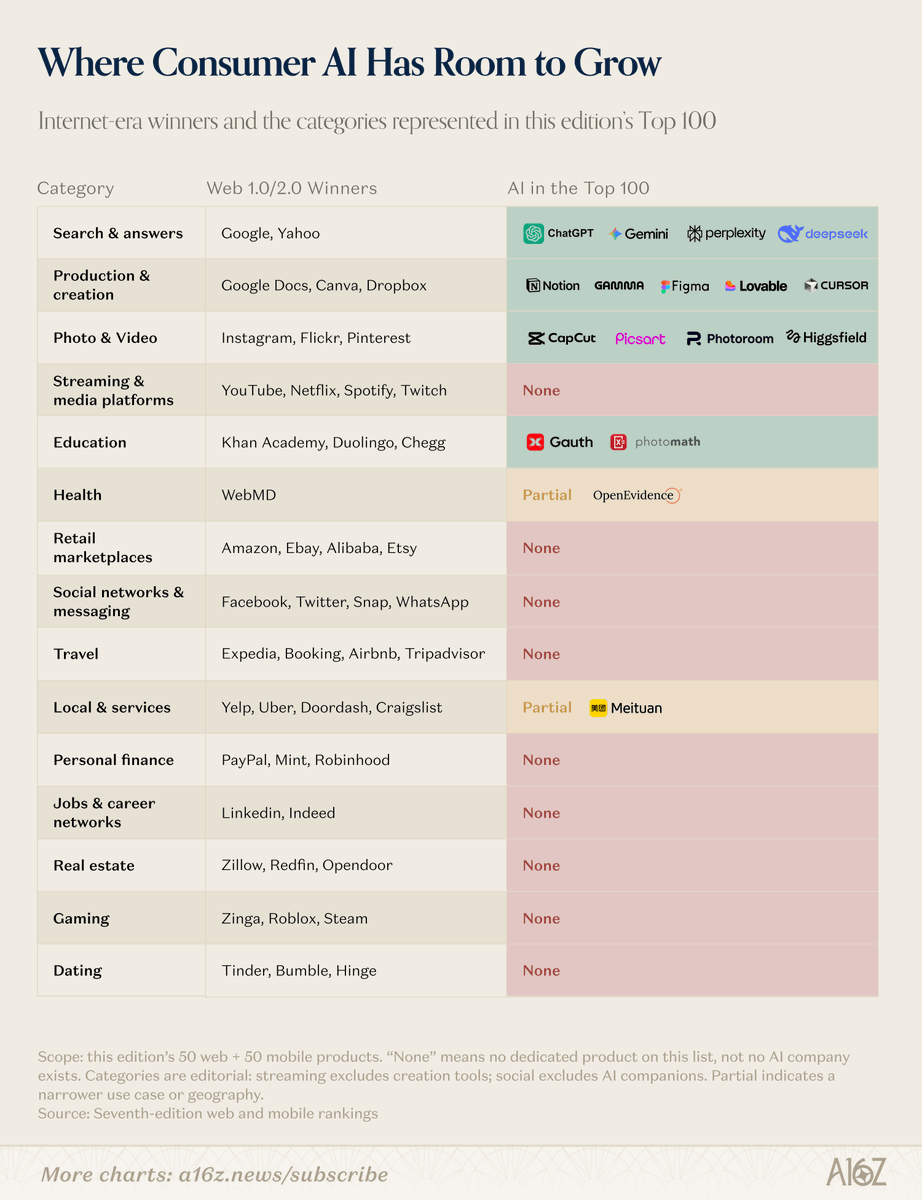
a16z's seventh Top 100 Consumer AI Apps report adds a revenue leaderboard alongside traffic rankings. It notes ChatGPT's 1B+ monthly mobile actives, Claude reaching nearly 1B monthly web visits, and growth into vibe coding, music, design and video, while nine of 15 consumer categories have no AI product in the top 100.

Original post · 1 min read
"Most people aren't looking to save time, they're looking for ways to spend their time."

9 of 15 consumer internet categories have zero AI products in the Top 100. These built some of the biggest companies of the last two eras:

- Streaming
- Social
- Dating
- Gaming
- Travel
- Retail
- Finance
- Real estate
- Jobs

More charts in our Top 100 Consumer AI Apps breakdown: a16z.news/p/top-100-consumer-ai-apps-seventh
a16z @a16z
The seventh edition of our Top 100 Consumer AI Apps is here.

New this time: a revenue leaderboard, alongside the usual web and mobile traffic rankings.

Three years ago we published the first edition. ChatGPT was #1, Claude was unranked, and the entire category was chatbots, image generators, and not much else.

In today's edition:

- ChatGPT still holds the throne, now with 1B+ monthly actives on mobile

- Claude has climbed to #3 on web with nearly 1B monthly visits

- The category has expanded to vibe coding (Lovable, Cursor, Replit), music (Suno), design (Figma), voice (ElevenLabs), video…
♥ 2.9K · ⟲ 330 · 👁 308.7KView on X ↗