Anish Koka, MD, argues that the U.S. needs outpatient doctors and says Medicare-funded residency programs have produced hospitalists while displacing family physicians. He ties the issue to foreign graduate pipelines and medical school admission policy.
Apologies to hospitalists. Many do amazing things, work hard etc.
My point is that the acute need for patients now and as long as I can remember in America is doctors who will see outpatients 5 days of the week.
And yet the taxpayer has been paying for residency programs that are hospitalist factories.
So in the last 30 years “ progress “ is creating a whole separate class of doctors that see inpatients only. In order to make way for the hospitalists, the prior group that was doing this work (your family practice doctor) had to be displaced (at times forcibly).
The non profit hospital then turns around and complains about the rising cost of care and sends you a $10,000 bill for your one night stay.
And at the end of the day, the end result is a pipeline built for Aga Khan University students to come to America and make a top 1% American income with zero medical debt. This is in the context of 2/3 American applicants being rejected from medical school. Cherry on top is affirmative action policies that make the bar for white / Asian U.S. citizens to get into medical school very high.
So circling back to where this all started : do I think there are lots of qualified American citizens that could do the job trainees at these small programs are doing? 100% yes.
The current state of affairs is a policy choice that works against American citizens, not for American citizens. And American tax payer dollars fund all of it.
There’s no guild interest in importing foreign labor.
This is a function of Medicare funding residency training spots.. lots of hospitals get paid to have a very cheap labor pool so they create these “training programs”
If you ended Medicare GME funding, a lot of these programs that primarily serve as an entry point to the U.S. market for developing labor would disappear.
The vast majority of these programs produce hospitalists — an invented “specialty “ that came into being to shorten length of hospital stays.
A post warns of election interference after the administration reportedly refused OSCE observers for the first time in over two decades, a choice that aligns the U.S. with Russia and Belarus. The Justice Department is reportedly preparing to send its own poll monitors.
Trump administration refuses international election monitors for first time in over 2 decades.
The decision not to invite observers from the OSCE puts the U.S. alongside Russia and Belarus, while the Justice Department prepares to deploy its own poll monitors. ms.now/news/trump-midterms-osce-election-obser…
International Cyber Digest reports that ransomware group BYOD leaked personal data of 3,615 Trump Mobile customers, including names, addresses and order details, and claims continued access to the company's backend. Straight Arrow News reported that people in the data confirmed its accuracy.
‼️ BREAKING: Trump Mobile customers have had their personal data leaked by ransomware gang BYOD. The dump covers 3,615 people and includes names, emails, phone numbers, home addresses and order details.
The gang says the company answered news of the breach with "We have no team to handle this."
The leak includes the Trump Organization's own CIO, who oversees its information security.
People listed in the data confirmed their details are accurate and BYOD claims it still has access to Trump Mobile's backend, Straight Arrow News reports.
Aakash Gupta argues that Purdue Pharma's guilty pleas and fines failed to deter fraud, as the Sackler family extracted $10.7 billion and the conspiracy continued. He uses this to argue against relying on lawsuits to govern AI, responding to Bill Gates's remarks on AI safety.
In 2007, Purdue Pharma pleaded guilty to lying about OxyContin's addiction risk. The fine was $635 million. Over the next decade, the family that owned Purdue pulled $10.7 billion out of the company.
Bill Gates got asked this week whether lawsuits and corporate self-interest are enough to keep AI safe. He pointed at opioids and called the idea insane. The record backs him up harder than most people realize.
Before the guilty plea, payouts to the Sacklers ran $1.3 billion over twelve years. After it, $10.7 billion in ten. A criminal conviction taught them to move money out of the company faster. OxyContin sales kept growing after the fine.
Here's the detail that should end the debate. When Purdue pleaded guilty a second time in 2020, it admitted the conspiracy to defraud regulators ran from May 2007 to March 2017. May 2007 is the same month as the first guilty plea. The fraud restarted before the ink dried.
The final ledger reads like satire. More than half a million Americans dead from opioid overdoses. Purdue in bankruptcy. The Sacklers settling for $6.5 billion paid out over 15 years, no admission of wrongdoing, nobody in prison.
Liability ran a 20-year live experiment as the safety system for a dangerous product. Every lawsuit happened. Deterrence never showed up, because fines land years after the damage, on whatever shell remains, while the profits moved out long before.
That's why the FDA reviews drugs before they ship, why planes get inspected before takeoff, why cars have to include seat belts.
Gates called AI "the most dangerous thing that humans have ever gone near." You can argue with him on that. But governing it with lawsuits was already tested once, and the people who ran that test kept most of the money.
Garry Tan recounts an interview with Transportation Secretary Sean Duffy about modernizing air traffic management. Duffy cites the SMART tool from Air Space Intelligence, which predicts congestion and helps spread flights, with controllers still making final decisions.
I asked Secretary Duffy what Americans should be able to do, if we get this decade right, that they can't do today.
Sean Duffy is the Secretary of Transportation, and he sat down with me at our Startup Industrial Base event in DC today. He went straight to how our country's air traffic gets managed.
At the command center, people sit in front of six screens with a paper flight chart above them, trying to make the calls on weather and routing.
His example: four planes reach the same runway at the same time and only one can land. See it two hours out, speed up two, slow one down, and each one lands when the runway is open. "Like, not complicated stuff, but we don't do any of this."
Paper and pencil and minimal human augmentation from software looks like this: Say an airport can take 15 planes in a 15 minute window. "Well, the airlines will schedule 32." He says he's handing the airlines that data and asking them to spread out.
The tool is SMART, from Air Space Intelligence, a small company he says competed with the biggest companies and won. It predicts. His stage example: a 2.5 hour ground stop might only need 45 minutes. He's taken heat for supposedly handing air traffic control to AI. Duffy's answer? "it's dumb AI, not smart AI." Controllers still make every call.
None of this needs a breakthrough. It needs the will of the people to know they need to use software and be ok with AI augmentation instead of insisting on a paper chart and copper wire.
Kathleen Tyson condemns reported targeting of a school in Minab, Iran, citing a Bloomberg investigation that says AI systems and stale Pentagon data contributed to a strike that killed 156 people, at least 123 of them children.
Palantir and Anthropic targeted Minab school, aided by Pentagon stale data and Hegseth psychopathy stripping target review staff.
And it was a triple tap, not a double tap. Children killed on first strike. Parents killed by second strike getting surviving children. Rescue workers killed by third strike rushing in after second strike.
Bloomberg just dropped the most disturbing investigation I have read this year, and every AI builder should read it and take it seriously.
On February 28, two Tomahawk missiles hit an elementary school in Minab, a small town in southern Iran. 156 people died. At least 123 were children. The Pentagon knew within hours that it had bombed a school.
The school had its own website. It was labeled on Google Maps. You could see the soccer pitch from a satellite view. You could see the brightly painted walls. Any 12-year-old with a browser could tell what the building was.
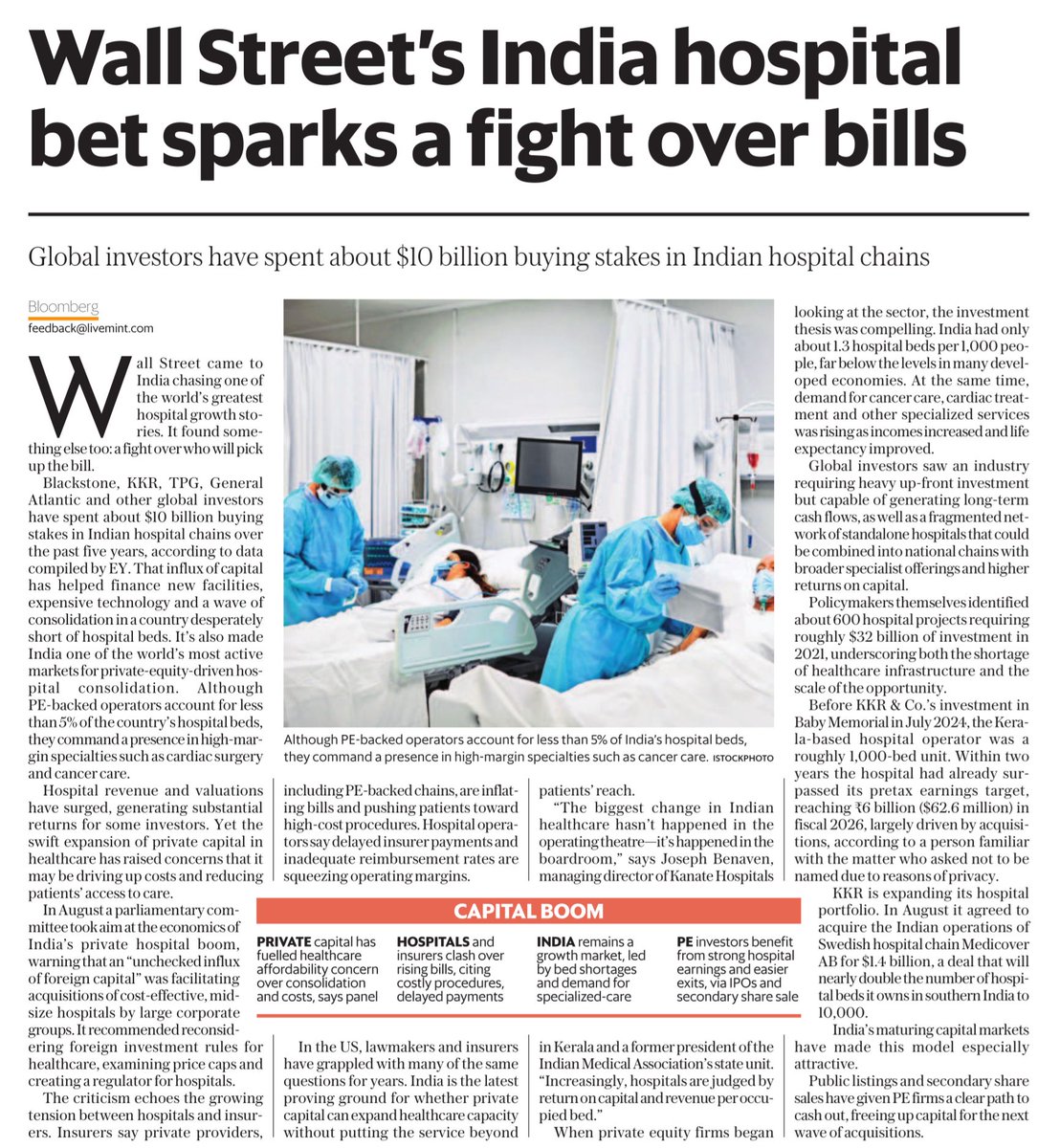
Abhishek Basumallick argues that the corporatization of Indian hospitals should be stopped, criticizes the U.S. healthcare model, and proposes regulating hospitals as public utilities with fixed returns like power companies.