Wednesday, October 7, 2026ArchiveSearchAsk the paper

The Computomatix Times

All the posts fit to save — curated from @computomatix's bookmarks & likes on X

Search

134 stories

Tim Denning Shares Article on Post-Work Evening Fatigue

Tim Denning promotes a Dominic Ng article on the neuroscience of post-work fatigue and why people scroll instead of resting or acting on goals. He predicts it should reach 100 million views.

Original post · 1 min read
This article should have 100M views.
Dr. Dominic Ng @DrDominicNg
Why You Waste Your Evenings (The Neuroscience of Post-Work Fatigue) — You're on the sofa. You know you should get up - exercise, read, cook a real meal - but you can't make yourself move. So you sit there, not resting, not working, scrolling through your phone while
♥ 12.7K · ⟲ 1.1K · 👁 4.1MView on X ↗

Thread Examines Why People Waste Evenings to Post-Work Fatigue

Grant Miller shares a neuroscience-based explanation of post-work fatigue from Dr. Dominic Ng, arguing that people try to fix exhaustion using the same depleted resource. The post is a light recommendation with little original content.

Original post · 1 min read
if you're ambitious but lazy at night, this is a must read

"you are asking the exhausted system to fix itself using the resource it already ran out of."

read it, bookmark it, then read it again
Dr. Dominic Ng @DrDominicNg
Why You Waste Your Evenings (The Neuroscience of Post-Work Fatigue) — You're on the sofa. You know you should get up - exercise, read, cook a real meal - but you can't make yourself move. So you sit there, not resting, not working, scrolling through your phone while
♥ 1.0K · ⟲ 129 · 👁 198.7KView on X ↗

Aakash Gupta Lays Out Six-Stage Path to Becoming an AI Product Manager

Aakash Gupta Lays Out Six-Stage Path to Becoming an AI Product Manager

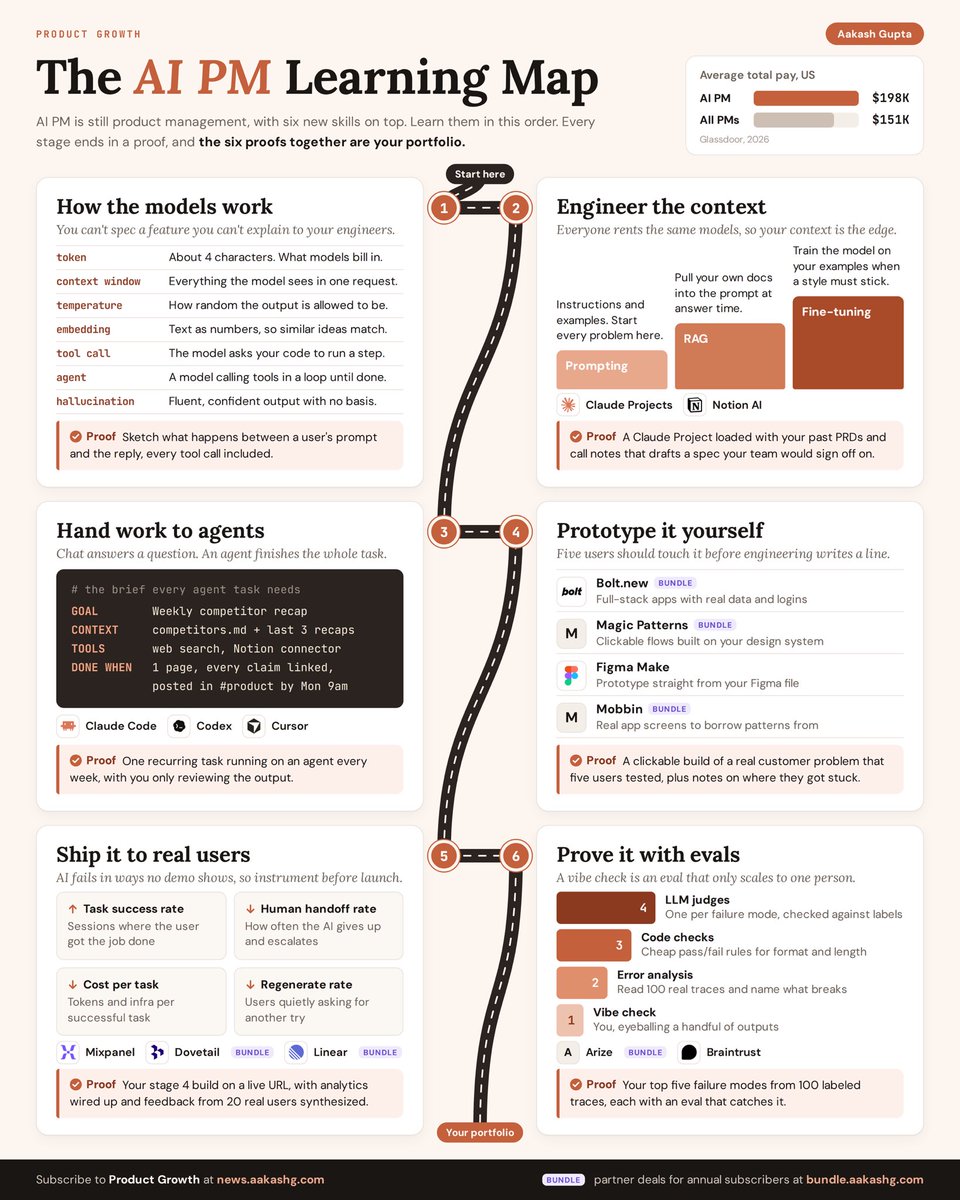
Aakash Gupta outlines a six-skill learning path for becoming an AI product manager, citing Glassdoor data showing average AI PM total pay of $198K versus about $151K for PMs overall. Each stage ends in a portfolio artifact, such as a Claude Project of past PRDs or a recurring agent task.

Original post · 3 min read
To become an AI PM, you need six skills on top of core PM. Here's the order to learn them.

The pay gap is why it's worth it. Glassdoor puts the average AI PM at $198K in total pay, against about $151K for PMs overall.

Most AI PM learning maps I see are generic PM concepts with "AI" in the title. They skip what hiring managers screen for, which is proof you've done the work.

So in this map, every stage ends in something you can show.

1. Learn how the models work

Tokens, context windows, embeddings, tool calls, agents. You don't need to train a model, but you should be able to sketch everything that happens between a user's prompt and the reply. A PM I coach hit exactly this depth check in technical screens at both Nvidia and Glean.

2. Engineer the context

Everyone rents the same models, so the edge is what you feed them. Climb only as far as you need. Prompting first, RAG when answers depend on your data, fine-tuning when a style has to stick. Your proof is a Claude Project loaded with your past PRDs that drafts a spec your team would sign off on.

3. Hand work to agents

Chat answers a question. An agent finishes the whole task, as long as your brief has a goal, the right context, the tools it can touch and a clear definition of done. Your proof is one recurring task, like a weekly competitor recap, running on Claude Code or Codex while you only review the output.

4. Prototype it yourself

Alex Danilowicz, CEO of Magic Patterns, said on my podcast that the classic mistake is spending two hours debugging a database when all you needed was a clickable mockup to show five customers. Reach for Bolt.new when you need real data and logins, and Magic Patterns for flows on your design system.

5. Ship it to real users

AI fails in ways no demo shows. Before launch, instrument task success rate, human handoff rate, cost per successful task and how often users hit regenerate. Then put your prototype on a live URL and synthesize feedback from 20 real users.

6. Prove it with evals

A vibe check is an eval. You're using your own brain as the scoring function, which works right up until you're the bottleneck. Hamel Husain and Shreya Shankar walked me through the sequence I'd copy. Read 100 real traces, name the failure modes, add cheap code checks, then build one LLM judge per failure mode and check it against your own labels.

Your proof is your top five failure modes, each with an eval that catches it.

Stack all six proofs and you have an AI PM portfolio.

A deep dive for each stage

1. AI foundations → news.aakashg.com/p/ai-foundations-for-pms
2. Context engineering → news.aakashg.com/p/context-engineering
3. AI agents → news.aakashg.com/p/ai-agents-pms
4. Bolt.new guide → news.aakashg.com/p/pm-guide-bolt
5. AI evals → news.aakashg.com/p/ai-evals
6. LLM judges → news.aakashg.com/p/ai-pm-llm-judge
7. AI PM portfolio → news.aakashg.com/p/vibe-code-pm-portfolio

Learn the stage. Then ship the proof.
♥ 223 · ⟲ 28 · 👁 17.8KView on X ↗

Company Splits CTO Role Instead of Naming Acting Replacement

Company Splits CTO Role Instead of Naming Acting Replacement

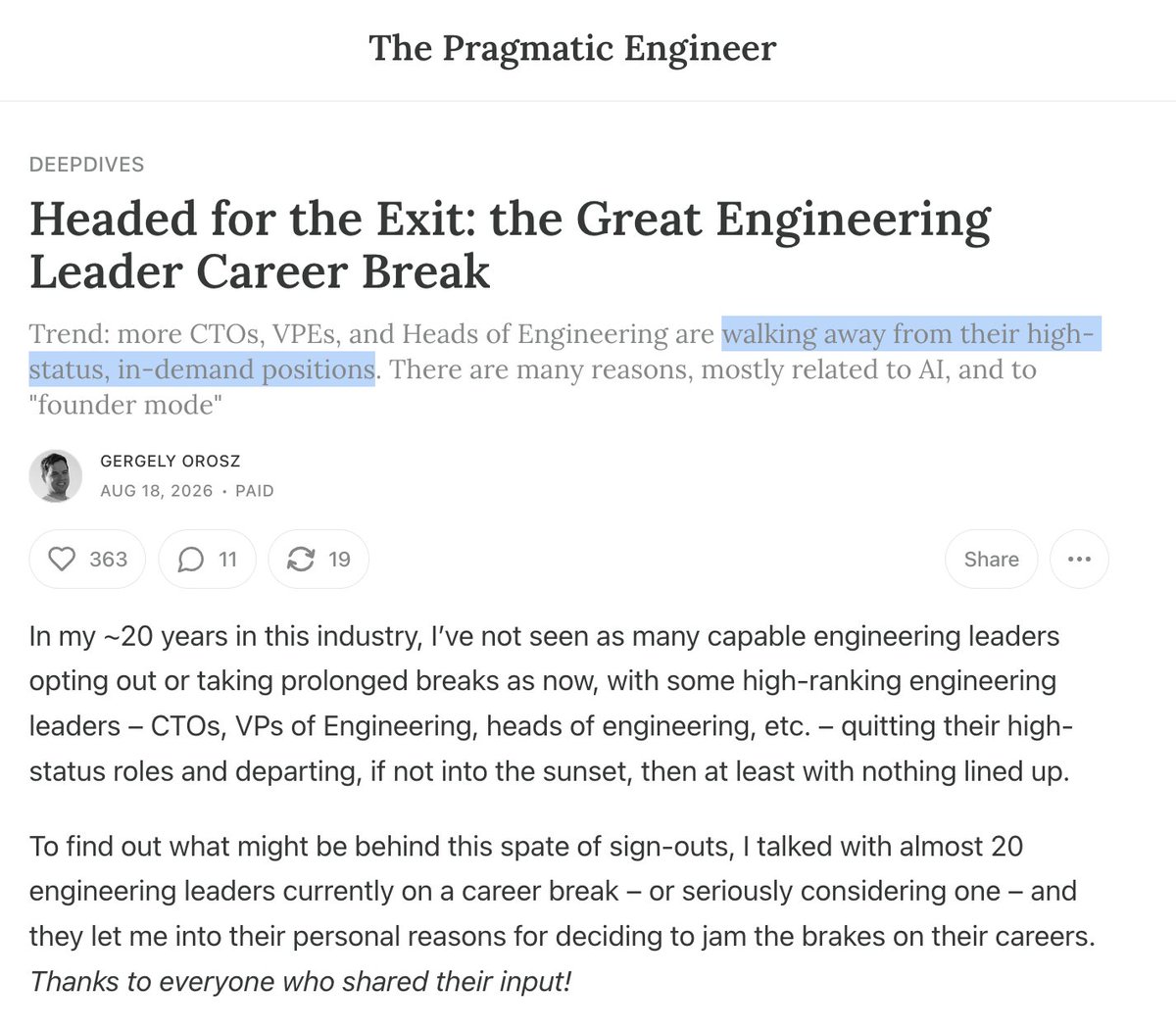
Gergely Orosz shares a LinkedIn post describing a company that divided its departing CTO's responsibilities into several distinct areas rather than appointing an acting CTO. Orosz links to his piece on the difficulty of hiring engineering leaders.

Original post · 1 min read
Read on LI: "Our CTO is leaving, and the obvious move would have been to appoint an acting CTO until we find a replacement. We decided not to do that. Instead, we split the role into several distinct areas of responsibility: "

My two cents: it's so, so hard to hire for CTOs now: newsletter.pragmaticengineer.com/p/the-great-e…
♥ 608 · ⟲ 36 · 👁 97.3KView on X ↗

Gabbar Recommends Video Using Opus 5.5 to Trace Indian Spiritual History

Gabbar endorses a four-minute video by Hindol Sengupta that searches for God in India across more than 5,000 years, crediting Opus 5.5 for making it. The post is brief praise with no further detail.

Original post · 1 min read
Great stuff. Watch
HindolSengupta @HindolSengupta
Searching for God in India. For more than 5,000 years. In many names. In 4 minutes.

(Opus 5.5 is still incredible.)
♥ 1.2K · ⟲ 149 · 👁 187.5KView on X ↗

Post Argues Feedback Turns Experience Into Faster Growth

Grant Miller shares a quote from a Tim Denning post, stating that without feedback twenty years of experience is one year repeated twenty times, while focused feedback can let a few months outpace a career.

Original post · 1 min read
im begging you to read this:

“Without feedback, 20 years of experience is just one year lived 20 times.

With it, a few months can beat a career.”
Tim Denning @Tim_Denning
Once you understand pattern recognition your life will never be the same again — It’s easy for you to get fooled over and over again.
That’s what it means to be human.
You try to achieve the same goal multiple times and fall short. No matter what you do the result doesn’t seem to
♥ 1.5K · ⟲ 196 · 👁 178.6KView on X ↗

Josh Elman Reflects on Software Engineering as Both Strategy and Craft

Josh Elman observes that software engineers have historically combined strategy and hands-on building unlike other engineering fields, and says that combination has intensified now. He endorses a speech by Scott Stevenson urging engineers to keep happy memories, stay grounded in reality, and stay excited about the future.

Original post · 1 min read
Software Engineering used to be such a different type of engineering from other fields - where you did both the strategy and the manual chiseling. (mechanical engineers don’t do the rivets)

Now Software Engineering is a whole new level of making. Great speech below
Scott @scottstts
My god this is such a good speech that every SWE needs to hear. You know what? Every person should hear it

Keep the happy memories, eyes on the reality, be excited about the future. That’s the best that anyone can do
♥ 227 · ⟲ 15 · 👁 52.0KView on X ↗

Former PM Says AI Product Interviews Now Test Practical Evals

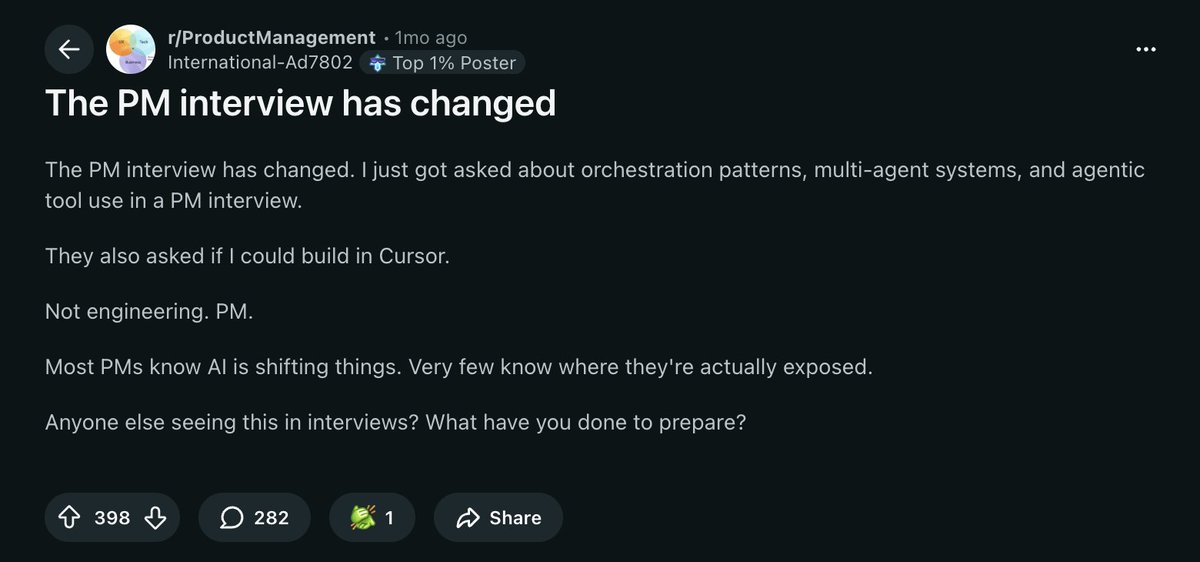
r/ProductManagement post: The PM interview has changed. Asked about orchestration patterns, multi-agent systems, and whether I could build in Cursor.

Aakash Gupta, who says he was hired at Google, Epic Games and Affirm, argues that PM interviews have shifted toward AI-specific skills such as evals, handling model error rates, and showing previously built work, and links to a round-by-round guide.

Original post · 1 min read
The PM interview questions that got me hired at Google, Epic Games and Affirm would not get me through a loop today.

Behavioral hasn't changed. Still the round people prepare for least, still where offers die.

Product sense looks different. The old version was "design a product for X." Today it sounds more like "the model is wrong 15% of the time, what ships."

Analytical got tougher in one particular way. Picking a metric is the starting point. Then comes the follow-up: what would make you drop it.

Technical has completely changed. Three years back, API basics. Today it's evals: how you got the golden set, what qualifies as a regression.

And there's a round that wasn't even part of the loop. Show me what you've built.

Every other question rewards preparation. That one only rewards having done the thing.

Full guide, round by round:
news.aakashg.com/p/ai-pm-interview-guide-2026?…
♥ 32 · ⟲ 4 · 👁 11.2KView on X ↗

Andrey Predicts Alexandr Wang Post Will Be X's Most Viewed Article

Andrey predicts that a post by Alexandr Wang reading 'Here's to the wanting. Here's to the dreaming. Here's to everyone' will become the most viewed article on X of all time.

Original post · 1 min read
this is going to go down as the most viewed article of X of all time. watch
Alexandr Wang @alexandr_wang
Here’s to the wanting. Here’s to the dreaming. Here’s to everyone.
♥ 243 · ⟲ 9 · 👁 184.7KView on X ↗

Lauren Argues Coding Is Dead but Programming Is Reborn With AI

Coding is dead, long live Coding

A long X article by Lauren argues that coding as a loved craft is ending, but that AI will let a new generation build faster and at higher quality, quoting Thorsten Ball on craft disappearing. The author reflects on their self-taught programming roots and optimism about abundance.

Original post · 3 min read
X ArticleCoding is dead, long live Coding
To my friends mourning the loss of their most loved activity, I feel your pain. I got into programming as a hobby, my first introductions to it being in high school and discovering the <marquee> tag. Ever since that joyful discovery, I couldn't stop myself from making things, tinkering, and looking forward to the thrill of solving the next problem. I would pore over every line of code, thinking hard about how to make my programs more elegant, performant, even beautiful.
I think @thorstenball put it best:
"The craft of writing code will disappear. Yes, there are still Italian shoe makers around. But look at your feet."
As beneficiaries of AI, we owe everything to the people that came before us: the people who discovered, engineered, and created the knowledge and civilization that we now live in and build on top of. Just look around you. Even everyday, ordinary things were brought to life by someone who was passionate about solving a problem. Those people are now mourning the loss of that tactile feeling of solving a problem with nothing more than your own hands and the knowledge built upon the shoulders of giants.
Coding is dead, but yet coding still lives on in the weights of the models we now use, the frameworks we build with, and the programming languages we write with. We should not shame the people who mourn because we owe everything to them. And yet, while others mourn, we can also rejoice. Personally, as a self taught programmer, I am thrilled at the thought of more people discovering the joy of building things. While it might be tempting to think that the automation of coding is the end of things, I think it's a new beginning, where a new generation of programmers using natural language to express their intent and goals will build things faster and at a higher quality than we could ever produce by hand.
It might not seem like it's possible right now. But I believe it will. Builders using AI will produce things we could never do before.

And that abundance will be glorious! If anything, I feel more love for programming than I ever did before. What I used to be limited in by my own ability, I can now will into existence if I can figure out the right incantations, the right prompts and context, to drive an agent towards the vision I see so clearly in my head.
So while some might say that they're "excited to see what you build" with empty feelings, I want to believe that many of us are truly excited at what people who've never experienced the joy of building can do.
I can't wait to see what you build!
♥ 2.6K · ⟲ 194 · 👁 169.7KView on X ↗

Gokul Rajaram Says Exceptional Founders Carry Contrarian, Obsessive Traits

Investor Gokul Rajaram argues that exceptional founders are contrarian and obsessed to the point of unhealthiness, traits that drive vision but strain trust, delegation and personal relationships. The post quotes a longer interview on Tech Fit Talks.

Original post · 1 min read
Exceptional founders possess two traits that look like weaknesses but are actually strengths.

First, they are contrarian thinkers. They challenge everything: investors, employees, customers, conventional wisdom. That contrarian energy is what lets them see around corners and push through resistance. But the same trait makes them hard to work with, slow to trust, and sometimes unable to delegate.

Second, they are obsessed, to the edge of sanity. The best founders are consumed by the problem in a way that looks unhealthy to normal people. They don't clock out. They don't have hobbies in the conventional sense. That intensity compounds, but it also burns people around them and can mask real personal costs. The best founders I've worked with have an almost unhealthy attachment to being right about their vision of the world. They can't let it go. They'll sacrifice money, relationships, comfort, sleep, all of it, because something inside them needs to see this thing exist.
Tech Fit Talks @tech_fit_talks
What personality flaw do exceptional founders disproportionately have? I asked @gokulr. His full answer covers contrarian thinking, trust, obsession, and their costs. From Tech Fit Talks with Ethan Lockshin.
♥ 132 · ⟲ 13 · 👁 19.4KView on X ↗

Tobi Lutke Recommends Rereading the Best Old Books

Tobi Lutke Recommends Rereading the Best Old Books▶

Shopify CEO Tobi Lutke shares a habit of rereading the best old books, promoting it through a post by Shane Parrish that links to a long interview covering Shopify's internal AI use, AI strategy and the future of software.

Original post · 1 min read
Read old books. Read the best ones again.

@tobi shares what he's reading over and over...
Shane Parrish @shaneparrish
My third conversation with Shopify co-founder and CEO @tobi.

0:00 How Shopify Uses AI
7:18 River: Shopify's Internal AI
8:55 How to Encourage Osmosis Learning
10:52 AI Dreaming and Self-Reflection
11:53 How to Use AI for Strategic Decision Making
14:11 The One Thing AI Cannot Do
16:04 What AI is Making Worse at Shopify
19:46 Predictions: Where AI is Headed Next
21:55 The Future of AI-Powered Software
24:40 Will CEOs Be Replaced with AI?
27:54 Can Superintelligence Be Controlled?
31:13 Critical Skills in AI Age
34:22 Why Complex Solutions are Usually Wrong
36:33 Conditions Needed for True Intu…
♥ 1.1K · ⟲ 91 · 👁 136.1KView on X ↗

Post Grant Miller Urges Readers to Act on Advice About Online Career Visibility

Grant Miller urges followers to read a post, quoting Logan Gott's argument that posting publicly online is the highest-return career decision, citing Gott's first online earnings from affiliate marketing at age 15.

Original post · 1 min read
if you want to advance your career you need to read this: (don't just bookmark it)
Logan Gott @LoganTGott
Posting online is the highest ROI decision you will ever make for your career — When I was 15 I made my first $25 on the internet.
It was affiliate marketing for some small Gumroad product. I posted about it for a while, talked to a few people, and eventually 1 person bought.
♥ 1.1K · ⟲ 123 · 👁 175.1KView on X ↗

Tobi Lutke Jokes About AI-Generated Western Civilization Video

Tobi Lutke Jokes About AI-Generated Western Civilization Video▶

Shopify CEO Tobi Lutke responds to a viral AI-generated video about Western civilization, joking it should be set to a local anthem and played in schools weekly.

Original post · 1 min read
It’s so good to have AI bring the outside perspective to the amazing accomplishment of western culture.

Set it to your local anthem, play it in every school once a week.
vittorio @IterIntellectus
holy shit
i asked claude to make a video on western civiization
♥ 2.3K · ⟲ 111 · 👁 241.8KView on X ↗

Puneet Patwari Outlines Path to Senior Distributed Systems Career

Amazon Principal Engineer Puneet Patwari describes compensation for L5 and L6 engineers and offers a learning path for distributed systems: mastering fundamentals, building systems with real tradeoffs, and reverse-engineering engineering blogs from major tech companies.

Original post · 3 min read
At Amazon, a strong L5 with 7 to 8 years of experience can cross ₹1 Cr+ CTC. At L6, compensation can go well beyond ₹1.5 Cr+ depending on team, location, stock, and level.

But the interesting part is not just the money.
Look at why recruiters reach out for these roles.

It is because their background shows they understand hard systems, and they have enough proof of work that people can see it.

Today I am a Principal Engineer, but if I were starting in distributed systems from scratch and wanted to turn that skill into career leverage, this is exactly how I would do it.

[1] Build the fundamentals before touching big scale

I would first get comfortable with the building blocks:
→ networking and request lifecycle
→ databases, indexes, transactions
→ caching
→ queues and async processing
→ replication
→ sharding
→ consistency
→ retries, idempotency, backpressure
→ observability and failure handling

Basically, have the understanding to see what happens when one normal backend service gets slower, busier, or partially unavailable.

[2] Build systems where the tradeoffs come into the picture.

Do not only watch architecture videos.
Build things.

Start with:
→ URL shortener
→ rate limiter
→ notification service
→ job scheduler
→ file upload system
→ search service
→ payment workflow

Then deliberately make them harder.
– What happens at 10x traffic?”
– What if Redis dies?”
– What if the same event arrives twice?”
– What if one shard becomes hot?”

[3] Read engineering blogs and reverse-engineer decisions

Uber, Netflix, Stripe, Discord, Cloudflare, LinkedIn, Meta, Amazon.
There’s golden material out there.

While reading, ask yourself:
– Why did they choose this?
– What was breaking before?
– What tradeoff did they accept?
– What new problem did their solution create?

That is how engineers actually learn architecture.

[4] Put your thinking in public

This part is massively underrated.
Write about what you learn.

Publish:
→ design breakdowns
→ architecture diagrams
→ GitHub projects
→ incident analyses
→ open-source contributions
→ performance experiments

Build enough public proof that when someone searches your name, they can tell what kind of engineer you are.

That is when learning starts compounding.

You study distributed systems to become better at engineering.
Then that knowledge helps you design better systems.
Those systems give you better stories.
Those stories become public proof.

And eventually, opportunities start finding you instead of you constantly chasing them.

That is the leverage.
Jordan @ Jobbie @i7solar
getting cold emailed by amazon is crazy
♥ 999 · ⟲ 80 · 👁 140.9KView on X ↗

Gokul Rajaram Shares Three Career Lessons for His Younger Self

Gokul Rajaram lists three pieces of advice for his 25-year-old self: build relationships without being transactional, cultivate high agency and independent conviction, and focus on the few things that truly matter. He cites a Tech Fit Talks interview as the source.

Original post · 1 min read
I would tell my 25 year old self three things:

1. Build relationships with people and don't be transactional.
2. Have high agency, be an independent thinker, build your own conviction and don't wait for consensus or approval.
3. Focus on the small set of things (in both work and life) that do actually matter.
Tech Fit Talks @tech_fit_talks
@gokulr's advice to his 25-year-old self:

• Put people and cultural fit first.
• Seek input, then make the decision.
• Protect your focus.

From Tech Fit Talks with Ethan Lockshin.
♥ 392 · ⟲ 43 · 👁 37.3KView on X ↗

Vijay Shekhar Sharma Shares Story Behind Marine Insurance's Origins

Vijay Shekhar Sharma Shares Story Behind Marine Insurance's Origins▶

Vijay Shekhar Sharma shares a video recounting how marine insurance evolved into general insurance and then modern insurance, crediting Siddharth Kara for bringing such stories to light.

Original post · 1 min read
It gets crazier!

This is how marine insurance >> general insurance >> today's insurance was born.

@siddharthkara 🫡 for bringing such stories to the world.
♥ 1.0K · ⟲ 304 · 👁 67.4KView on X ↗

Jason Fried Reflects on Returning to Solo Software Building

Jason Fried traces his career from solo software development to directing teams, and now back to designing and writing software himself with AI, arguing that advancing tools can restore lost capabilities and make a skilled team more powerful.

Original post · 1 min read
35 years ago I did it all myself. Wrote, built, sold, and released software solo.

25 years ago I did all the design myself. Sketches, then HTML, then CSS.

15 years ago I still did some hands on design, but mostly directed others to implement my vision.

5 years ago I primarily directed others. My "I can do it myself" muscles had atrophied.

Today, I feel like I'm back to the beginning. Able to write and design software entirely by myself. And having an elite team of others who can do the same thing is an enormous multipler.

Wild how massive advancements can propel you FORWARD by bringing BACK capabilities you lost along the way.

Full circle feels more like an arrow.
♥ 1.9K · ⟲ 88 · 👁 166.6KView on X ↗

Historian Links Boston to the Origins of British India

Historian Links Boston to the Origins of British India

Sam Dalrymple argues that Britain's American and Indian empires were deeply entangled rather than separate stories, illustrating the connection with a historical photo.

Original post · 1 min read
Boston and the Birth of British India

Far too often, we imagine Britain's first and second empires in America and India as two separate stories. Yet colonial India and America were deeply entangled.
♥ 1.3K · ⟲ 182 · 👁 97.1KView on X ↗

DHH Argues Honesty About Change Helps People Adapt Faster

DHH writes that letting good people live in a fantasy world that no longer exists is unkind, and that they should be told the truth so they can adapt to the future.

Original post · 1 min read
There's nothing kind about letting good people live in a fantasy world that no longer exists. You have to tell them, even if it hurts. Because the sooner they accept reality, the sooner they can adapt to the future.
♥ 7.6K · ⟲ 556 · 👁 696.9KView on X ↗

Gergely Orosz Says Hand-Written Code Era Is Ending as AI Writes Most Code

Gergely Orosz Says Hand-Written Code Era Is Ending as AI Writes Most Code

Gergely Orosz comments on DHH saying the age of hand-writing code is over, arguing this has been clear since January to engineers using AI models. He links to his free article on what happens to software engineering when AI writes most code.

Original post · 1 min read
That DHH saying out loud that the age of writing code by hand is over for the industry, and causing such a huge uproar is a bit interesting, given this was clear enough since ~January for most of us using the models + paying attention.

Removed paywall: newsletter.pragmaticengineer.com/p/when-ai-wri…
newsletter.pragmaticengineer.comWhen AI writes almost all code, what happens to software engineering?No longer a hypothetical question, this is a mega-trend set to hit the tech industry
♥ 2.6K · ⟲ 225 · 👁 175.7KView on X ↗

Joy Bhattacharjya Honors Jimmy Amarnath on His 76th Birthday

Joy Bhattacharjya Honors Jimmy Amarnath on His 76th Birthday

Joy Bhattacharjya recounts Mohinder Amarnath's fearless batting against fast bowlers in the 1970s and 1980s, and celebrates Jimmy Amarnath's birthday and his status as India's first World Cup final and semi-final Man of the Match.

Original post · 1 min read
Richard Hadlee broke his head, Malcolm Marshall knocked out his teeth, Imran Khan knocked him unconscious and Michael Holding sent him to hospital. And yet Mohinder Amarnath got 3 centuries in Pakistan, 2 in the West Indies and 1 against Thommo in Australia. In those days, batting against the frightening pace of Holding, Imran and the West Indians involved a bit more than just skill, it needed raw courage and Jimmy Amarnath had that in dollops.
Jimmy turns 76 today & India's first Man of the Match in a World Cup final(and semi-final) certainly deserves much more acclaim and attention
(Picture Credit: The Guardian)
♥ 3.0K · ⟲ 552 · 👁 78.6KView on X ↗

Sheel Mohnot Says Tech Launches Should Include Cartoon Explainers

Sheel Mohnot Says Tech Launches Should Include Cartoon Explainers▶

Sheel Mohnot endorses a post in which a Rick and Morty clip explained the Jev AI product more clearly than a tech demo. He argues every new technical launch should come with a cartoon explainer.

Original post · 1 min read
This is really good. Every new technical launch should have a cartoon explainer
Prince does AI @princedoesai
Holy crap.

Rick and Morty just explained Jev AI to me better than any tech demo could.
♥ 507 · ⟲ 29 · 👁 120.3KView on X ↗

Chamath Palihapitiya Recommends Jeffrey Katzenberg's Essay on AI for Creativity

Chamath Palihapitiya shares Jeffrey Katzenberg's essay 'The World is Changing: AI For Creativity' and calls it worth reading. Katzenberg describes watching a founder demo a stunning AI-generated animated scene and reflects on its impact on artists.

Original post · 1 min read
This is worth reading.
Jeffrey Katzenberg @jeffreykWNDR
The World is Changing: AI For Creativity

By Jeffrey Katzenberg

A few months ago, I sat in my office in Silicon Valley and watched as a tech founder showed me something extraordinary. On the screen was a fully realized, beautifully lit, well-composed animated scene. It was stunning and it made me feel exactly what I felt in 1986 watching Luxo Jr. That was the first time I watched a computer-animated 3D character take a breath and seem, against all reason, to have life. It left me in awe.

Later that day, I received a text from an artist I've known for thirty years, 350 miles to the south, in …
♥ 1.4K · ⟲ 75 · 👁 464.8KView on X ↗

Mark Suster Shares Jeffrey Katzenberg Essay on AI and Creativity

Mark Suster recommends an essay by Jeffrey Katzenberg on AI for creativity, which describes a founder's computer-animated scene and an artist's reaction. Suster presents it as a case for storytelling over AI slop and as an explanation of Jevons Paradox.

Original post · 1 min read
When people ask you to explain "Jevon's Paradox" send them this.

When people not as close to technical change as you are seem despondent, ask them to consider the arguments laid forward below for a better future

When people ask for proof of creativity, storytelling & soul over AI slop... show them the magical writing of @jeffreykWNDR
Jeffrey Katzenberg @jeffreykWNDR
The World is Changing: AI For Creativity

By Jeffrey Katzenberg

A few months ago, I sat in my office in Silicon Valley and watched as a tech founder showed me something extraordinary. On the screen was a fully realized, beautifully lit, well-composed animated scene. It was stunning and it made me feel exactly what I felt in 1986 watching Luxo Jr. That was the first time I watched a computer-animated 3D character take a breath and seem, against all reason, to have life. It left me in awe.

Later that day, I received a text from an artist I've known for thirty years, 350 miles to the south, in …
♥ 128 · ⟲ 8 · 👁 49.3KView on X ↗

Austen Allred Reacts to Official Trailer for You Can See Everything

Austen Allred replies to a post by Nathan Fielder sharing the official trailer for the film You Can See Everything. The post is a short reaction with no further detail.

Original post · 1 min read
I have so many questions. This is so insane.
nathan fielder @nathanfielder
Here is official trailer, You Can See Everything
♥ 289 · ⟲ 2 · 👁 79.2KView on X ↗

Viral Post Contrasts Early Hopes With Current Results in Simple Comparison

Viral Post Contrasts Early Hopes With Current Results in Simple Comparison

Madeline Summerville shares a lighthearted photo comparing how something started with how it is going, quoting a post about New York City mayor Zohran Mamdani and a $130 million DoorDash wage settlement. The post offers little original content beyond the quoted news item.

Original post · 1 min read
how it started: how it’s going:
Democrats Deliver @DemzDeliver
🚨 BREAKING: Zohran Mamdani forces DoorDash to pay $130 million in stolen wages to NYC workers.
♥ 49.1K · ⟲ 5.1K · 👁 1.9MView on X ↗