Wednesday, October 7, 2026ArchiveSearchAsk the paper

The Computomatix Times

All the posts fit to save — curated from @computomatix's bookmarks & likes on X

Search

134 stories

Zach Klein Jokes That Daniel Lurie Tested the Waters First

Zach Klein Jokes That Daniel Lurie Tested the Waters First▶

Zach Klein posts a short video with a playful remark that Daniel Lurie went first and proved the water is warm, after which everyone followed in. The post is light commentary with no substantive detail.

Original post · 1 min read
Daniel Lurie jumped in first, proved the water is warm, now everyone is cannonballing into the deep end.
♥ 168 · ⟲ 1 · 👁 20.2KView on X ↗

a16z Launches Horowitz Andreessen Academy With $42 Million

a16z Launches Horowitz Andreessen Academy With $42 Million▶

Molly O'Shea reports that a16z has launched the Horowitz Andreessen Academy, an unaccredited, tuition-free residential program in San Francisco led by Gagan Biyani, with $42M in funding. Admission is based on proof of work for a founding class of about 50 starting fall 2027, with Anthropic, OpenAI, NVIDIA and others as partners.

Original post · 2 min read
BREAKING: a16z Launches The Horowitz Andreessen Academy with $42M in Funding

Yes, a school.

The Academy is an unaccredited, residential alternative to a 4-year degree in San Francisco, led by Founder & CEO Gagan Biyani (@gaganbiyani) (Udemy, Maven).

Marc Andreessen (@pmarca) & Erik Torenberg (@eriktorenberg) are on the board. Investors include Adam D'Angelo, Tobi Lütke, Tony Xu, Fidji Simo & Shyam Sankar.

Applications open today for a Founding Class of roughly 50 students, starting Fall 2027. 1 year, no tuition, admitted on proof of work.

Anthropic, Anduril, Coinbase, Meta, NVIDIA, OpenAI, Palantir, Replit & Stripe are Founding Partners, with 30+ hiring partners behind them.

We cover:
› The $42M raise and the runway behind it
› Portfolios, interviews and IQ testing in admissions
› 75% to 80% project time and weekly pod check-ins
› Tuition, partnerships and equity as the 3 revenue lines
› Why the Academy is telling fundable 17-year-olds to wait

"The big difference between going to the academy and going to college is we are not gonna prioritize your grades. We're gonna prioritize proof of work."

𝐓𝐈𝐌𝐄𝐒𝐓𝐀𝐌𝐏𝐒
(00:00) Gagan Biyani, Founder & CEO of Horowitz Andreessen Academy
(01:01) Why this Academy is different from college
(04:44) Started his first company at age 13
(08:30) Building a school for Silicon Valley
(11:55) Raising $40M for a School
(14:06) "You Did What?" - Proof of work over grades
(19:08) Should young builders really start companies?
(22:37) Why this is different from YC and fellowships
(27:35) The Academy is for young builders
(31:33) Why schools need to embrace AI
(37:18) How AI is changing education
(44:17) What an AI-native curriculum looks like
(48:51) Why high-agency students struggle in college
(53:12) Why the best builders zigzag
(1:02:19) Why you should apply even if you don't get in
(1:04:36) Building a supportive environment for young builders
(1:08:54) What the Academy program looks like
(1:10:44) Why the Academy is in San Francisco
(1:11:19) The people who shaped Gagan
(1:14:41) Favorite book!
♥ 785 · ⟲ 92 · 👁 424.6KView on X ↗

Ramesh Srivats Recalls Caste Dynamics at IIT Madras in 1980s

Ramesh Srivats Recalls Caste Dynamics at IIT Madras in 1980s▶

Ramesh Srivats describes his time at IIT Madras in the 1980s, noting that status there tracked academic ranking and branch choice rather than birth caste. He shares a video to illustrate the point.

Original post · 1 min read
I was in IIT Madras in the 80s, and it was very caste-conscious.
However, your caste changed every year.
From JEE to Branch to GPA to Future.
But never about your birth.
Watch.
♥ 5.8K · ⟲ 1.1K · 👁 324.1KView on X ↗

Wealthy Mumbai and Gurgaon Families Keep Modest Lifestyles

Wealthy Mumbai and Gurgaon Families Keep Modest Lifestyles

Gabbar posts a photo with the observation that a high-net-worth individual with two children in Mumbai or Gurgaon still lives like a middle-class person. The post is a brief lifestyle remark with no supporting detail.

Original post · 1 min read
A high net worth individual with 2 kids in Mumbai/Gurgaon still lives like a middle class guy.
♥ 1.3K · ⟲ 76 · 👁 140.6KView on X ↗

Kerala Creator Nandakishor M Promotes Generative AI Teaching on Instagram

Nandakishor M, creator of the Laya course, says he is now competing with Jev and teaches generative AI to a wide audience through Instagram. The post links to his Instagram profile, which has about 18,000 followers.

Original post · 1 min read
Those who are wondering, I am Nandakishor M, the creator of Laya, now competing against Jev. Just a simple guy from a small village in Kerala just teaching generative AI to everyone through instagram!!!
instagram.com/nandakishor_m/
instagram.comNandakishor M (@nandakishor_m) • Instagram profile18K Followers, 4,715 Following, 308 Posts - See Instagram photos and videos from Nandakishor M (@nandakishor_m)
♥ 3.3K · ⟲ 242 · 👁 161.4KView on X ↗

OpenAI Researcher Alisa Liu Shares Interview Preparation Notes

OpenAI Researcher Alisa Liu Shares Interview Preparation Notes

Md Ismail Šojal says OpenAI researcher Alisa Liu open-sourced her study notes from 57 interviews before joining OpenAI, including LLM and math materials and a write-up of the hiring process. The post recommends the material to candidates preparing for research scientist roles.

Original post · 1 min read
OpenAI researcher "Alisa Liu" had 57 interviews before joining OpenAI, and then She open-sourced her entire study notes job/learning process.

- her LLM study notes
- her math interview notes
- a full honest write-up of the job process

If you are preparing for research scientist / MTS roles, this is the highest-signal material available right now.

You can use her notes or her topic list to study on your own. That’s rare. Don’t waste it.
♥ 2.2K · ⟲ 236 · 👁 118.7KView on X ↗

DHH Urges Optimism Over Negative Thinking

DHH advises readers to drop a negative attitude and embrace optimism, calling it doctor's orders. He is responding to a quoted post linking repetitive negative thinking to buildup of Alzheimer's-related proteins in the brain.

Original post · 1 min read
Lose the attitude, embrace optimism. Doctor's orders!
Nicholas Fabiano, MD @NTFabiano
Repetitive negative thinking is linked to Alzheimer’s protein buildup in the brain.
♥ 5.4K · ⟲ 373 · 👁 349.0KView on X ↗

Paul Graham Recommends Professor T as Sherlock Holmes Successor

Paul Graham Recommends Professor T as Sherlock Holmes Successor

Paul Graham says he and Jessica have been watching Professor T and call it very good, suggesting it is a near substitute for more Sherlock Holmes stories from Conan Doyle.

Original post · 1 min read
Jessica and I have been watching Professor T, and it's really good. If, like me, you wish Doyle had written more Sherlock Holmes stories, this may be as close as you're going to get.
♥ 1.1K · ⟲ 37 · 👁 177.1KView on X ↗

Coimbatore Emerges as India's Leading Senior-Living Hub

Coimbatore Emerges as India's Leading Senior-Living Hub

Karthik shares a claim that Coimbatore has about 5,500 organised senior-living units, more than any other Indian city, and notes Bangalore was once called a pensioner's paradise.

Original post · 1 min read
"India’s senior-living capital isn’t Delhi, Mumbai or Bengaluru. It’s Coimbatore. Coimbatore has around 5,500 organised senior-living units, more than any other Indian city." (In context, I remember Bangalore being called 'Pensioner's Paradise' once upon a time).
♥ 553 · ⟲ 123 · 👁 37.0KView on X ↗

Actress Neha Sharma Reports Monthly Income From Paid Content

Actress Neha Sharma Reports Monthly Income From Paid Content

Neend Ki Rani says actress Neha Sharma earns Rs 200,000 monthly by charging subscribers Rs 290 each, citing around 6,826 people. The post is a celebrity earnings claim with little sourcing.

Original post · 1 min read
This is Neha Sharma who now earns Rs 200,0000 every month without working in any film.

Neha is an actress who has 19M followers but still has to show it.

Neha is charging ₹290 from 6,826 people and showing them… Read News
♥ 3.0K · ⟲ 109 · 👁 1.5MView on X ↗

Sunil Pai Essay Examines the Senior Engineer Death Spiral

Sunil Pai shares that his blog post on the senior engineer death spiral is drawing heavy engagement and DMs. He says it describes a counterintuitive but effective solution and hopes managers will use it to support their reports.

Original post · 1 min read
It’s been 2 hours and I can already tell this is going to be my most popular post. See the replies. And I’m getting so many DMs from people who went through the same, I’m glad it’s connecting. 2 quick things -
- please consider the solution!! it’s counterintuitive and no one considers it but it’s super effective
- I hope managers see this too and use it as a tool to help their reports
sunil pai @threepointone
new post: the senior engineer death spiral

sunilpai.dev/posts/the-senior-engineer-death-s…

a friend just started a big job and asked for some advice. so I braindumped a monologue about a super common failure mode I see with engineers and posted it here, hope it helps whoever it can.
♥ 636 · ⟲ 9 · 👁 149.2KView on X ↗

Jason Calacanis Promotes All-In Summit Talk by Bill Gurley

A post urges viewers to watch the All-In Summit presentation by Bill Gurley, titled "Searching for Feynman," with a joking reference to COVID.

Original post · 1 min read
If you're still upset about COVID, this is important for you to watch.

If you're not upset about COVID, this is critically important for you to watch.
The All-In Podcast @theallinpod
All-In Summit: Bill Gurley

(0:00) Bill Gurley takes the stage at the All-In Summit

(1:29) Bill's Presentation: Searching for Feynman

Links to additional resources mentioned in talk and used in research:
p3.institute/searching_for_feynman_resource_li…

@bgurley
♥ 1.5K · ⟲ 157 · 👁 178.0KView on X ↗

Patrick O'Shaughnessy Praises Bill Gurley's All-In Summit Talk

Patrick O'Shaughnessy says Bill Gurley's All-In Summit talk held his attention and shares the link to the "Searching for Feynman" presentation.

Original post · 1 min read
Great talk by @bgurley

He really had me locked in wondering where it was going
The All-In Podcast @theallinpod
All-In Summit: Bill Gurley

(0:00) Bill Gurley takes the stage at the All-In Summit

(1:29) Bill's Presentation: Searching for Feynman

Links to additional resources mentioned in talk and used in research:
p3.institute/searching_for_feynman_resource_li…

@bgurley
♥ 362 · ⟲ 16 · 👁 58.9KView on X ↗

Ani Republishes Essay on Marrying the Wrong Person for Wrong Reasons

You're probably marrying the wrong person/the 2 am test no one told you about

Ani reshares an archived X article arguing most people marry for three impulses: checkbox compatibility, social pressure, or fear of being alone. The essay promotes a paid newsletter on money and power.

Original post · 9 min read
From my writing archives because some of you are about to propose for the wrong reasons during the upcoming holiday season and I care about you while also wanting engagement bait.
X ArticleYou're probably marrying the wrong person/the 2 am test no one told you about
Most people marry the wrong person for the wrong reasons and spend the rest of their lives telling themselves how right they were. Some end up seeing the light and separate while others go fully into the darkness as they head down the aisle, eyes not wide shut but horrifyingly clear sighted and aware of the incredible mistake they are making as it happens.
I write about money, power, and the ways people wreck their lives over both. Subscribe to read more: www.notyourtypicalfinancebro.com
I find myself at that awkward age where friends I saw get married are now getting divorced, friends who should get divorced are desperately fighting to stay married, and the rest are either panic-proposing or considering downloading Hinge for the seventh time pretending this round will be different. Since I'm in the grown-up position of not offering my opinions on anyone's spouses and you can usually find me at the buffet line or in a corner eating (I am so serious when I say most photos of me at events involve food, I am an equal opportunity eater), I've had extensive time to observe this whole tragicomedy while feasting on canapés and champagne. Which is why I have some thoughts.
I make no claims at being an expert. God knows I've destroyed enough relationships or potential along the way. But I've built this theory from observation and discussion with others, and I think it holds up to scrutiny. It's certainly not popular nor the fun way to do it, but that's also because most people don't want to think about who the person sleeping next to them is going to be when they get the worst phone call of their lives.
From what I've observed, most people marry out of three impulses:
They have met someone who meets certain checkboxes at a certain time in their life.
They feel pressure from society, family, social circles, the media, gossipy aunts, gross uncles, whatever, and they meet someone with which they can settle to remedy that ache.
They are just plain afraid to be alone.
Sometimes it can be all three at once really, a perfect storm of bad reasoning dressed up in white and in blooming flowers with church hall music streaming in. But here is the problem - the person you meet today may not be the person you are with in a few years, much less in 5, 10, 15, or 20 - and the person you are expecting to grow or to change may surprise you along the way in ways good, bad, and ugly. What is in front of you and what is possible is not a guarantee of someone's character when the going gets tough.
As for reasons 2 and 3, well, I'll gloss over them, but it is fairly obvious - you have a problem, you think this is a solution because you come across another person, but actually, this is a horrible way to go about it. Do you remember group projects in school when you were assigned a mandatory partner to find? Sometimes it worked if you ended up clicking, but most of the time, it was not enjoyable nor an experience worth repeating. But you did it only because you thought you had to because of an authority, right? Same applies here.
As for people who can't be alone, well, I'll spare them the indignity of being told there's only so much running one can do - and how painful it must be to be someone in a relationship but lonelier than ever before.
You are probably marrying the wrong person. You may have married the wrong person already. Let me back up.
The person you want to marry is not the person in front of you today. It is not the person they will be tomorrow. It is not the person who is the smartest or hottest or wealthiest or whatever-liest. It is not about their potential, it is not about their possibility, it is not about their psychology even. It is not about who they are, what they do, or where they are going. Those are all elements to consider along with the broader decision. They are not the finalizing factors that make or break a lifetime's commitment.
The person you should marry is the 2am person. You know what I mean when I say 2am, but in case it isn't clear, let me cut to the chase: I want you to imagine the worst possible phone call you will ever get in your life. That is the 2am call.
That's the moment you pick up the phone, you hear something said to you, and there's your life before and your life after the call. That is your 2am moment. Now I want you to think about who is going to support you through what happens after you get that phone call.
Your 2am person is the person you marry. Your 2am person is the person who will be your partner, who understands high highs and low lows and everything in between, the person who at 2am has your back even if you weren't the best person you could be in that moment (which is, of course, a nuanced thing and not something that gives anyone a carte blanche to do whatever they want however. My point is the 2am person will be the person who sits with you or deals with it to support you instead of making it a burden or worse in the ways and forms that takes on specific to you.)
Is the hottes… continue on X ↗
♥ 1.2K · ⟲ 132 · 👁 1.4MView on X ↗

Clayton Christensen's Final Lecture on Life Priorities Resurfaces

Clayton Christensen's Final Lecture on Life Priorities Resurfaces▶

A post recounts Clayton Christensen's final class, in which he asked students to apply his theory of company collapse to their own lives, citing his Harvard MBA reunion observations, and links a 19-minute lecture video.

Original post · 1 min read
this is insane. i genuinely don't understand why ambitious people aren't shown this lecture before their careers start consuming their entire lives.

clayton christensen spent his career studying why successful companies collapse. in his final class, he asked students to apply the theory to themselves: if you keep allocating your time the same way, what life are you actually building?

he had already seen the answer in his own harvard mba class. everyone looked successful at the fifth reunion; by the 10th, 15th, 20th, and 25th, many were unhappy, divorced, and living far from their children.

work shows you the score immediately. close a sale, ship a product, finish a presentation, earn a promotion, get paid.

an hour with your child may produce nothing you can measure today; it may take 20 years to understand what that hour built. so the next free hour goes back to work, one rational decision at a time.

this is how people build lives they never planned: through hundreds of right decisions that lead in the wrong direction, day after day.

money, titles, and headcount are easy to count. christensen believed a life should be measured by the people who became better because you were there.

he died in 2020.

one question remains: if someone saw only where your time, energy, and attention went this year, what would they think actually mattered to you?

the full 19-minute lecture is in the video below.
DAN KOE @thedankoe
How to fix your entire life in 1 day — If you're anything like me, you think new years resolutions are stupid.
Because most people go about changing their lives in the completely wrong way. They create these resolutions because everyone
♥ 8.6K · ⟲ 1.2K · 👁 1.2MView on X ↗

Ben Thompson Argues Discount Rates Are Underrated in Finance

Ben Thompson says understanding finance, specifically discount rates, is underrated after accounting, and shares a long post. He quotes a satirical thread on effective altruism and its extension to future generations.

Original post · 1 min read
I have always said understanding accounting is underrated. I now realize understanding finance — specifically discount rates — is underrated as well.

Long but excellent.
banteg @banteg
>be me
>discover effective altruism
>apparently normal charity is inefficient
>why donate to random sad thing when spreadsheet can tell you optimal sad thing
>fair enough
>buy mosquito nets
>save lives
>numbers look good
>feel powerful

>couple years later
>someone asks an innocent question
>why only count people alive today
>huh
>future people matter too
>obviously
>my grandchildren shouldn't matter less just because they haven't spawned yet
>reasonable.jpg

>keep following logic
>what about their grandchildren
>also yes
>what about people in 500 years
>sure
>5000 years
>why not
>500 million …
♥ 1.2K · ⟲ 48 · 👁 165.3KView on X ↗

Brian Halligan Recounts Databricks CEO's Take on Staff Meetings

Brian Halligan Recounts Databricks CEO's Take on Staff Meetings▶

Brian Halligan shares a video in which Databricks CEO Ali Ghodsi calls a routine Monday staff meeting unnecessary, arguing that teaching material can go in a shared doc. Halligan, who built a digital twin named Hal, concedes that teams still need time together to function.

Original post · 1 min read
This answer is so Ali.

I asked @Databricks CEO @alighodsi if his Monday staff meeting was necessary, or if it's just routine...theater.

His answer: "why do you have to meet your wife? Or your kids? Just put what you want to teach them in tagoddamn Google Doc."

I built Hal, an digital twin of myself. I'm as pro-async as anyone out there.

But Ali's still right: if you want people to be a team, they have to hang out. This is humans, after all.

Link to the full episodes in the comments.

cc: @matanSF
♥ 90 · ⟲ 5 · 👁 21.7KView on X ↗

Fahad Desmukh Shares Video of Karachi Marathi Ganesh Chaturthi Event

Fahad Desmukh Shares Video of Karachi Marathi Ganesh Chaturthi Event▶

Fahad Desmukh shares a video from a Ganesh Chaturthi event in Karachi featuring the local Marathi community, posted in response to questions he receives from Indians about Marathis in Pakistan.

Original post · 1 min read
I regularly get DMs from Indians mistaking me for a Marathi due to my name and asking me questions about the Marathi community in Pakistan.

So for them, here's a video by @theamarparkash of real Karachi Marathis at an event to mark Ganesh Chaturthi I believe 🚩♥️♥️
♥ 499 · ⟲ 83 · 👁 138.6KView on X ↗

Andrew Chen Says AI Should Automate Drudgery, Not Human Connection

Andrew Chen Says AI Should Automate Drudgery, Not Human Connection

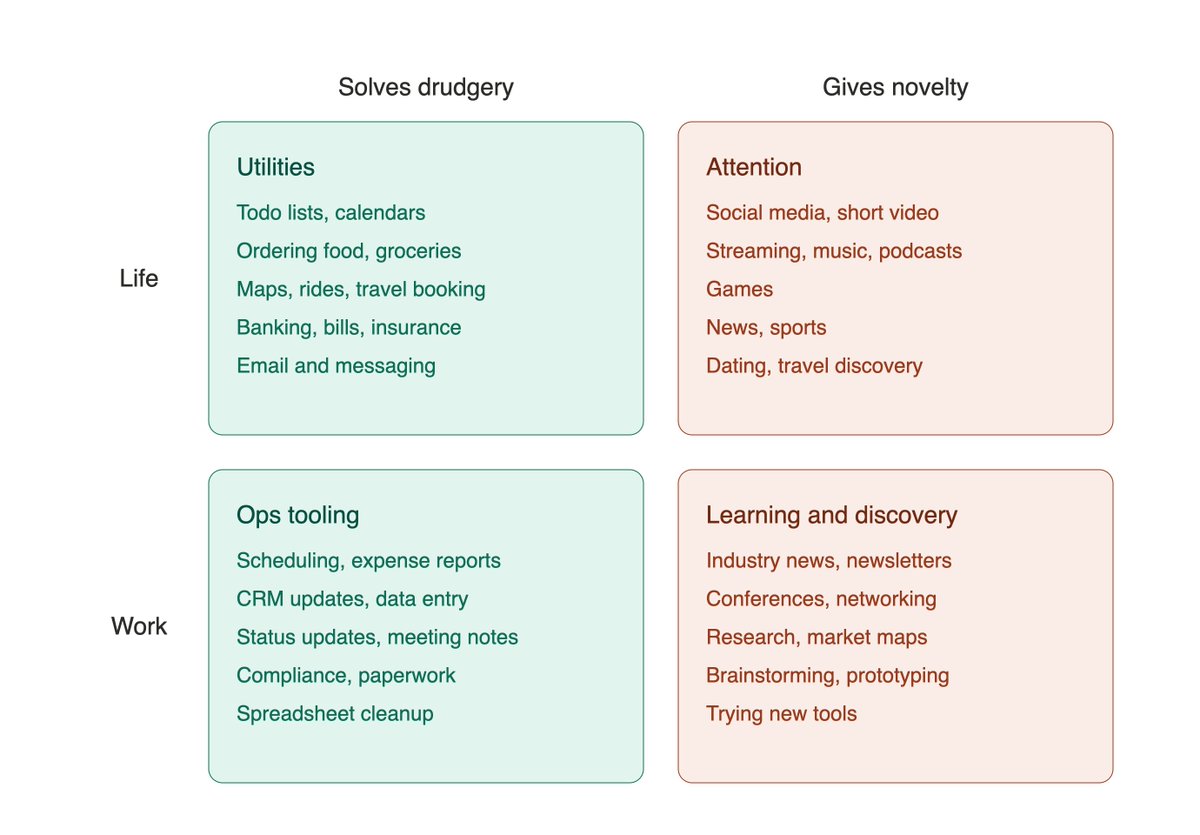
Andrew Chen says AI wins at automating drudgery, workflows and costs, while people want to spend time on connection, entertainment and humanity. He frames the latter as less verifiable and more driven by novelty-seeking.

Original post · 1 min read
you want to spend zero time on the left. This is where AI wins - automating drudgery/workflows/costs

we want to spend our time on the right. More of it is about connection/entertainment/humanity - less verifiable, more novelty-seeking
♥ 465 · ⟲ 40 · 👁 41.8KView on X ↗

Isaiah Granet Argues Founders Often Quit Too Early

Isaiah Granet argues ambitious people often leave when things get hard, while those who stay through difficulty tend to end up ahead. Using a grocery line metaphor, he discusses when to stay and when to leave, drawing on his experience running a company that raised over $100 million.

Original post · 8 min read
A few thoughts on switching lines.
X ArticleLine Switching
Ambitious people often waste their lives by leaving things too early.
Everyone (i mean everyone) has switched lines at the grocery store and regretted it. You're in one that isn't moving, the one next to you is, so you cross over. Then yours starts, the new one stalls.
I run a company that has raised over a hundred million dollars. I switched lines to start this company. I switched lines, when we pivoted. I am not going to argue that people should never leave.
But I have watched enough of these decisions by now, across many companies and domains. The people who left almost always left at the moment things got hard, and very few who ended up where they had been hoping to go.
The people who stay through the ugly often seem to end up ahead, and they are the ones who now look lucky.
I know people who struggled for years, until it hit. I've also seen overnight pivots to success. There's no one recipe. But below is some sincere thoughts on when to stay, and when to leave. And why switching lines usually ends up failing.
I. Your Line
The line you're standing in is the only one you know from the inside. You know exactly what's wrong with it. You've been watching the slow cashier for six minutes and you have opinions about her. The other line you see from across the store, and from across the store almost anything looks fine, because you can't see the coupons or the price check or the man reaching for his checkbook. You're not learning anything about that line. You're seeing it from an angle that hides its problems.
Nobody switches lines because they've studied both. They switch because their own line's problems are visible. A la.... the grass is always greener... Then they get to the new line and its problems become visible, and now there's another line, one aisle over, that looks fine.
II. It Feels Good
Switching feels like taking control. Staying feels like giving up. So when someone leaves a job at month eight, or a startup changes markets in year two, or a founder rewrites the strategy the week before the old one would have started paying, it registers as bold. People congratulate them. Nobody congratulates you for staying in a line.
But most of these moves are the same move. The thing got hard, another thing looked easier, and the person went toward the thing that looked easier, dressed up as ambition. It's hard to tell the difference from the outside, and sometimes from the inside, because the feeling is identical. If you're leaving right when it got hard, you're probably switching lines.
III. The AI Era
This was always a problem, but it has gotten a lot worse, and I think it's worst for people just starting out.
A new grad today looks at a job market where the fastest money is in AI, where twenty-three-year-olds raise rounds off a demo, where every week someone with fewer years of experience than you announces something enormous. Every line looks shorter than yours. And these lines are visible in a way they never were, because the whole thing plays out on a feed. You see the announcement. You do not see the four years of nothing that came before it, or the two years of nothing that will come after it for most of them.
So people move. They leave the solid job at a company that's learning slowly for the startup that's moving fast. They leave the startup at month ten for the one that just raised. They leave engineering for founding, founding for investing, investing for whatever gets written about next. Each move makes sense on its own. Together they add up to someone who is twenty-nine and has been new somewhere five times and deeply good at nothing.
The AI era rewards depth more than any period I've seen, because the tools make the shallow parts of most jobs free. What's left is the part you only learn by staying. And the era tempts people out of staying more than any period I've seen. That's the trap.
IV. Leave On the Way Up
If you take one thing from this, take this. The best time to leave a company is on the way up, not the way down.
Most people do the opposite. They stay while things are good, because it's comfortable, and leave when things get hard, because it's not. Which means they leave right before the hard part would have taught them something, and right before the company would have needed them most, which is when the people who stayed get the equity and the title and the story.
If you're leaving because it got hard, wait. Hard is where the value is. Hard is the part everyone else quits, and the people who don't quit are the ones with the résumé everyone wants five years later.
If you're leaving because you've won, because you shipped the thing and learned what there was to learn and the next mountain is somewhere else, go. That's the good kind of leaving. You'll leave with people who'll hire you again and a reputation for finishing. You'll also leave with a clear head, which you don't have when you're fleeing.
V. The People Who Stayed
The founders whose stories we tell mostly didn't switch lin… continue on X ↗
♥ 3.1K · ⟲ 529 · 👁 2.2MView on X ↗

Ujjwal Chadha Reflects on Leaving Microsoft for India

Ujjwal Chadha says he left his Microsoft job in the US three years ago and moved back to India, now earning less than he would have. The post is a thread teasing the non-salary benefits he gained.

Original post · 1 min read
3 years ago I left the US, my Job at Microsoft and moved back to India.

I make less than I would have if I’d stayed.

Here’s everything I gained that my salary can’t show you 🧵👇
♥ 180 · ⟲ 6 · 👁 111.2KView on X ↗

Julie Zhuo Shares Lessons on Doing AI Transformation Well

Julie Zhuo Shares Lessons on Doing AI Transformation Well

Julie Zhuo writes a long read summarizing what she has learned about AI transformation from her own experience and conversations with other leaders, arguing many teams are doing it poorly. The post includes a photo.

Original post · 1 min read
Too many teams are doing AI transformation poorly, so I wrote down everything I have learned in my journey and in chatting with many other leaders.

A long read, so get your coffees.
♥ 228 · ⟲ 14 · 👁 24.6KView on X ↗

Travel Strategist Explains Moving Chase Points to World of Hyatt

James recounts a traveler who transferred 25,000 Chase Ultimate Rewards points to World of Hyatt and booked a Park Hyatt suite for free, arguing transfers yield three to four cents per point versus 1.25 through the portal. The post promises nine tips about Hyatt's program.

Original post · 2 min read
A guy had 80,000 Chase Ultimate Rewards points sitting in his Sapphire Preferred account. He'd been saving them for months. He was planning to redeem them through Chase's travel portal for a $1,200 hotel booking getting roughly 1.25 cents per point.

A travel strategist who's spent 8 years studying hotel loyalty programs and has booked over $200,000 worth of hotel stays on points told him:

"Don't redeem through the portal. Transfer those points to World of Hyatt instead. The exact same 80,000 points books 3-4 free nights at a luxury Hyatt worth $2,400-$3,200 in cash. That's 3-4 cents per point instead of 1.25. You're about to leave $1,200-$2,000 in value on the table because you don't know about one transfer button."

He said: "I've never stayed at a Hyatt."

"That's the point. You don't need to be a Hyatt loyalist. You don't need status. You don't need to stay there regularly. You need a Chase card with points and 30 seconds to transfer them to a program where they're worth 3x more."

He transferred 25,000 points to World of Hyatt. Booked a Park Hyatt suite worth $1,200 per night. Paid $0. Resort fees waived. No blackout dates. The room was available because Hyatt guarantees standard award rooms at every property something Marriott and Hilton don't consistently do.

He showed his coworker 9 things about World of Hyatt that make it the most valuable and most overlooked hotel loyalty program in the industry.

"Most travelers pick Marriott or Hilton because they're everywhere. Then they earn millions of points worth half a cent each. Hyatt has fewer hotels and every point is worth 3-4x more. You're not choosing a hotel chain. You're choosing a currency. And right now, you're holding the most valuable one and spending it at the worst exchange rate."

Here are the 9 things he showed him 🧵
♥ 1.7K · ⟲ 84 · 👁 896.3KView on X ↗

Post Argues Presentation Matters More Than Looks in Attractiveness

Post Argues Presentation Matters More Than Looks in Attractiveness

DominioRealX posts in Spanish that most of what people call attractiveness is presentation rather than face, and that it can be improved in a weekend, starting with tip one about using lenses.

Original post · 1 min read
El 80% de lo que llamas "atractivo" no es la cara.

Es presentación, y se puede arreglar en un fin de semana.

1. Usa Lentes
♥ 4.2K · ⟲ 275 · 👁 3.8MView on X ↗

Ethan Evans Explains Barriers Highly Skilled Immigrants Face in US Leadership

Ethan Evans writes that highly skilled immigrants often struggle to be promoted into US leadership, as traits respected abroad can backfire domestically. He says he has helped many immigrant leaders become SVPs or higher.

Original post · 1 min read
Highly skilled immigrants often struggle to get promoted into leadership in the US despite their talents. Traits that earn respect in other countries sometimes backfire here. I've helped many immigrant leaders overcome this and become SVPs or higher.
♥ 478 · ⟲ 24 · 👁 92.9KView on X ↗

How the Confidential NASA Aviation Safety Reporting System Began After Fatal 1974 Crash

Aakash Gupta recounts how a 1974 near miss at United went unshared before the TWA 727 crash on Mount Weather killed 92 people, and how NASA's confidential reporting system, launched in 1976, was created to share such incidents. He says the system has taken over 2 million reports without leaking an identity.

Original post · 2 min read
Six weeks before a TWA 727 flew into a Virginia mountain and killed all 92 people on board, a United crew made the exact same mistake on the exact same approach and missed the ridge by a few hundred feet. United wrote it up internally. Nobody outside United ever saw the memo.

The crash was December 1, 1974. The controller said "cleared for the approach." The TWA crew took that as permission to descend to 1,800 feet. The controller assumed they knew to stay high until the published approach began. Pilots and controllers across the country were using the same words to mean different things, and the plane hit Mount Weather at 1,670 feet.

When the NTSB found the United near miss sitting in a company file, the question wrote itself. Why did the second crew have to die to learn what the first crew already knew?

Incentives. A pilot who admitted a mistake to the FAA was handing the regulator evidence against his own license. So nobody admitted anything. Every airline kept its own quiet incident folder, and none of them talked to each other.

The fix, launched in April 1976, is the strangest institution in American transportation. The FAA handed the confession box to NASA, a completely different agency, because pilots would never trust the cop. File a report within 10 days of screwing up and the FAA cannot use it against you. No fine, no suspension. NASA strips your name before anyone at the FAA reads a word.

Fifty years in, the system has taken more than 2 million reports and never leaked a single identity. Close to 100,000 arrive every year. Wrong altitudes, missed clearances, two planes nearly sharing a runway, fatigue nobody wants on their record. NASA reads all of it, spots the patterns, and pushes alerts back out to every carrier before the pattern kills anyone.

That is the machine behind the chart. 6,581 deaths per billion passengers in 1970. 42 in 2023. At the 1970 rate, 2023's passengers would have produced around 29,000 funerals. The actual number was under 200.

Every industry says it wants people to report their mistakes. Aviation is the one that made confessing cheaper than hiding.
Colin McCarthy @US_Stormwatch
Perhaps one of the greatest modern miracles of society is how safe flying has become.
♥ 2.8K · ⟲ 389 · 👁 346.2KView on X ↗

Kevin Xu Argues Compounding Makes Wealth Targets Grow Fast

Kevin Xu makes a short argument that a $1 million nest egg from 1990 would be worth about $4 million now and could reach $16 million by retirement, framing it as a lesson about compounding.

Original post · 1 min read
$1M was rich in 1990

now it’s $4M

by the time you retire, it’ll be $16M

this is incredibly important to understand
♥ 4.5K · ⟲ 369 · 👁 719.9KView on X ↗

Wayne Sutton Argues Critical Thinking Matters Most With Bots

Just call me BOO. Bot Orchestration Officer.

Wayne Sutton describes a Grok Bot founder event with SpaceXAI and Harper Insure and argues that the valuable skill is orchestrating bots while keeping human judgment. The article also promotes Convex as a backend for agents.

Original post · 3 min read
X ArticleJust call me BOO. Bot Orchestration Officer.
Earlier this week, I was at @SpaceXAI for a Grok @Bot Founder Build Night featuring Harper Insure. The SpaceXAI and Harper team
demoed Grok Bot and various workflows of how Harper uses Cursor agents
This is the core idea.
Bots running operations. Not a bot thinking for you.
The skills that matter today are critical thinking, problem-solving, and orchestration. Not just using a tool, but becoming someone who thrives while tools evolve.
You will hear a different story. About learning how to use Grok Bot and trusting the bot to think for you.
That’s how the idea dies.
The bot gives you an answer. You take it without questioning or adding your own original thought.
AI is not here to think for you. It’s here to brainstorm with you so you, the human, land on better options.
We’ve seen this wave before
San Francisco rewired daily life with new products that changed entire industries.
Twitter made news and media real-time
Instagram changed photography, venues, and tourism
Lyft and Uber disrupted ride-sharing and taxis
Airbnb transformed hospitality
Each one looked like just a product, but changed the way people move, share, and connect. All while creating new categories and opportunities for people to build on and launch businesses.
Bots are the next wave
Bots and agents are next.
They’ll run small business ops, internal processes in big companies, software dev, coaching, media, and automation everywhere. Agents today need a modern backend and infrastructure to run at scale. (hint convex.ai)
Grok Bot is not a pile of scripts. It’s a desk you talk to. Focused on human-led work.
Orchestration is the big-picture skill
You see an organization and spot what bots can automate. Then you have bots run and manage operations alongside you.
Harper’s CRM plus Grok Bot shows this in a GTM shop. It’s not trivia from prompts.
Critical thinking happens next to the bot. You don’t just accept answers. You question, add your own view, and improve. Or you build the app to enhance your workflow and day-to-day tasks, with convex.dev as your backend, of course.
The better option remains yours.
The bigger loop
This isn’t a skill frozen in time.
It’s about continuous learning tied to who you are becoming.
The skill is critical thinking and problem-solving, orchestrated by human identity. Bots and agents guide but do not replace.
This is how you thrive as agents change software and AI impacts every business on earth.
In other words, just call me BOO (Bot Orchestration Officer).

This article was originally sent by me (human) using Grok Bot, with the AgentMail plugin, and published through APIs on waynesutton.ai a @Convex-hosted app.
♥ 111 · ⟲ 4 · 👁 7.9KView on X ↗

Mehul Agarwal Launches Field Guide to San Francisco Tech Slang

Mehul Agarwal Launches Field Guide to San Francisco Tech Slang

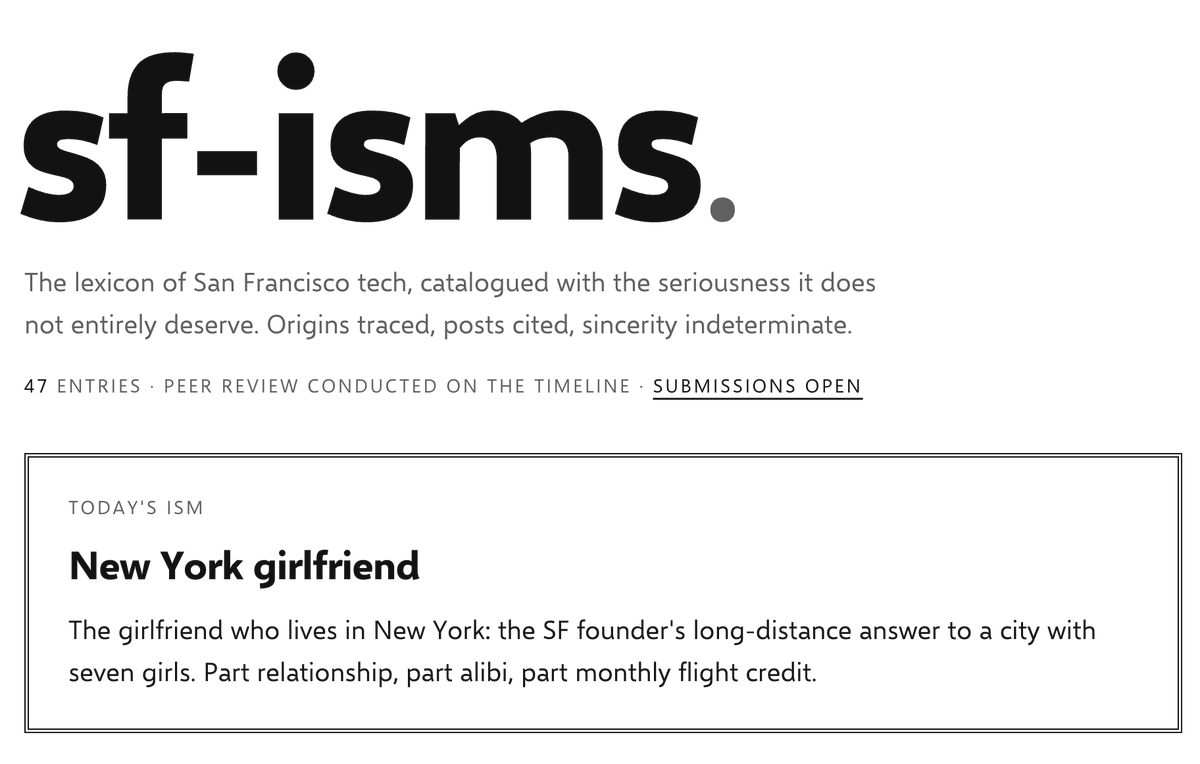
Mehul Agarwal shares sfisms.org, a crowd-contributed field guide to San Francisco tech vernacular, where users can pitch new terms that a panel reviews for inclusion.

Original post · 1 min read
A friend of mine just moved to San Francisco and was completely lost in our vocab.

So I built this for her and everyone like her: sfisms.org/

The field guide to SF vernacular.

Got an ism? Pitch it and an agent adds it after expert review by our panel :)
sfisms.orgsf-isms - a field guide to San Francisco slangA living compendium of San Francisco tech slang. Part Wikipedia, part Urban Dictionary, part Know Your Meme.
♥ 899 · ⟲ 66 · 👁 364.5KView on X ↗