Wednesday, October 7, 2026ArchiveSearchAsk the paper

The Computomatix Times

All the posts fit to save — curated from @computomatix's bookmarks & likes on X

Search

139 stories

Ben Thompson and Madhu Guru Debate How Consumers Want to Buy Through AI Agents

Ben Thompson says tech companies poorly craft marketing for agentic AI, while Madhu Guru argues consumers have differing relationships with tasks like shopping versus hiring a roofer. The exchange centers on which consumer activities AI agents should handle.

Original post · 1 min read
One of the all time insane clipping cycles. Few people are more agent-pilled than me. I’ve literally built my own. When Muse came out I said it was more important than solving math problems. And somehow, saying that tech companies don’t know how to craft marketing messages that resonate is being framed all over the Internet as being a Luddite.
Madhu Guru @realmadhuguru
I respectfully disagree with @benthompson on this. He’s missing a key point - Consumers don’t have one relationship with “doing things”.

I’ve learned it the hard way from building consumer and smb products for years at Google and now Meta.

Browsing clothes can be entertainment (for some). But hiring a roofer is miserable (for most).

Even with shopping, sometimes you want to browse for an hour. Sometimes you want the right thing just delivered asap.

His argument sounds a lot like the early 2000s:

“Why would I buy clothes online? I need to try them on.”

“Why would I buy a $500 TV online? I…
♥ 422 · ⟲ 11 · 👁 77.6KView on X ↗

Firecrawl Says Jev Analyzed Fortune 1000 Data in 3.6 Seconds

Firecrawl says its Jev tool made 5,000 decisions in 3.6 seconds using data from Firecrawl Alexandria. The quoted launch post says Alexandria pulls data on Fortune 1000 companies and offers 100+ data sources.

Original post · 1 min read
Jev made 5,000 decisions in 3.6 seconds using data from Alexandria!
Eric Ciarla (hiring) @ericciarla
Introducing Jev + Firecrawl Alexandria.

We pulled data on every Fortune 1000 company, then Jev analyzed it in 3.6 seconds.

With 100+ data sources, there's so much more to work with.

Alexandria is live now for anyone using Jev and beyond!
♥ 685 · ⟲ 38 · 👁 68.8KView on X ↗

Levelsio Reports Over $10M Annual Revenue and About 94.5% Profit Margin

Levelsio Reports Over $10M Annual Revenue and About 94.5% Profit Margin

Levelsio says his business passed $10M a year in revenue plus investment gains with roughly 94.5% profit margin, after replacing SaaS tools with vibecoded alternatives. He describes ETF, Nvidia and startup investments and stable monthly revenue of $200K to $250K.

Original post · 2 min read
💰 Passed $10M/y in revenue + investment gains this year

I've always been aggressively increasing my profit margins to as high as possible, especially the last few years, and especially this year where I've reduced my SaaS dependencies to just a handful of companies by vibecoding my own replacements

It's now about 94.5% profit!

Spend less -> lower costs -> more profit -> more money saved -> more money to invest -> more % returns on investments

And at some point that investment return starts to pass by your business revenue which it has for me for about a year now

Most of my investments have been simple ETFs like Vanguard S&P500, but also a few lucky stock and startup bets that worked out:

Back in 2022, I couldn't get any available GPUs, so I thought it might be smart to buy Nvidia if there's such a shortage and that was a good bet too

Then back in 2023 @dannypostma recommended me to invest in the companies we used for our AI inference for our photo AI apps, so I did that too. First I invested in @replicate and then also @FAL

From then I just asked every app/service I used if I could invest, like @cursor_ai in 2025 which then got acquired by @spacex recently!

My business revenue has remained very stable at about $200K-$250K/mo, but even with that investment returns have now surpassed that

Investments fluctuate a lot so some years it's up some years it might be down a lot (who isn't expecting a big crash at some point?), and most investment gains are unrealized (I never sell!), so keep that with a big grain of salt!

I keep my revenue/gains together with my profit margin and my sleep score in my situation monitor dashboard, as those are equally important :D

Many people in the last decade told me to spend all my money, either personally or with my business to grow it, we don't know how that would have ended up, maybe my companies would be bigger, but I'm happy I did it in my own lean profitable healthy way and it ended up great I think! 🙏😊
♥ 8.1K · ⟲ 163 · 👁 805.7KView on X ↗

a16z Speedrun Talent Lead Reports More Than 100 Portfolio Placements

Jordan, who runs talent for a16z speedrun, says the role has resulted in over 100 hiring placements at portfolio companies this year at no cost to either side. He invites people to reach out to get on his radar.

Original post · 1 min read
i run talent for a16z speedrun - my whole job is getting people hired at our portfolio companies

this year that's been 100+ placements, free for both sides

takes 1 minute to get on my radar :)
♥ 355 · ⟲ 9 · 👁 594.5KView on X ↗

Tom Funds Entire Dev Team Before Landing First Customer on Website Widget

Tom Funds Entire Dev Team Before Landing First Customer on Website Widget▶

In a video, Tom, who reportedly earns $50K per month from a website widget, says he funded his dev team before having any revenue. He credits his marketing agency's roughly 70 hosting clients for financing the early build.

Original post · 1 min read
This dude Tom who makes $50K/month from a website widget says: he funded his entire dev team before he had a single customer...

"Yet we had zero revenue. So on paper, terrible idea. Don't recommend it at all. But with that gave us the confidence to sell into these bigger companies that we kind of needed to get on board to pay us."

"I did run a marketing agency for 10 years, which still had like 70 plus clients paying like website hosting. So I used my like very precious income that I did have to live to basically fund the start of this."
♥ 64 · ⟲ 5 · 👁 7.7KView on X ↗

X Launches Numbers, an Optional Way to Be Contacted Without Following

X Launches Numbers, an Optional Way to Be Contacted Without Following▶

XChat announces X Numbers, a feature letting users share a number so others can message or call them without following or accepting requests. The post is a short video announcement of the product.

Original post · 1 min read
X Numbers are here.

Share yours with anyone you want to contact you, even if you don't follow them. It's an optional way for people to message or call you, without you needing to accept requests or follow them back.
♥ 9.7K · ⟲ 1.2K · 👁 2.9MView on X ↗

Nikita Bier Says Bot Detection Will Become Urgent Business Need

Nikita Bier argues that bot detection and human verification will become one of the most urgent demands for businesses, warning agent swarms will overwhelm websites and forms. He says X found no single vendor offering the full stack and built the capability in-house.

Original post · 1 min read
Bot detection & human verification will be one of the most urgent demands for businesses over the coming years. Agent swarms will suffocate every website and form; small companies and government websites are most vulnerable.

There is a huge gap in the market for this right now. When we looked at what offerings were in the market to use at X, there was not a single company that brought together all the latest technologies so we had to do it all in-house.
♥ 13.4K · ⟲ 851 · 👁 2.0MView on X ↗

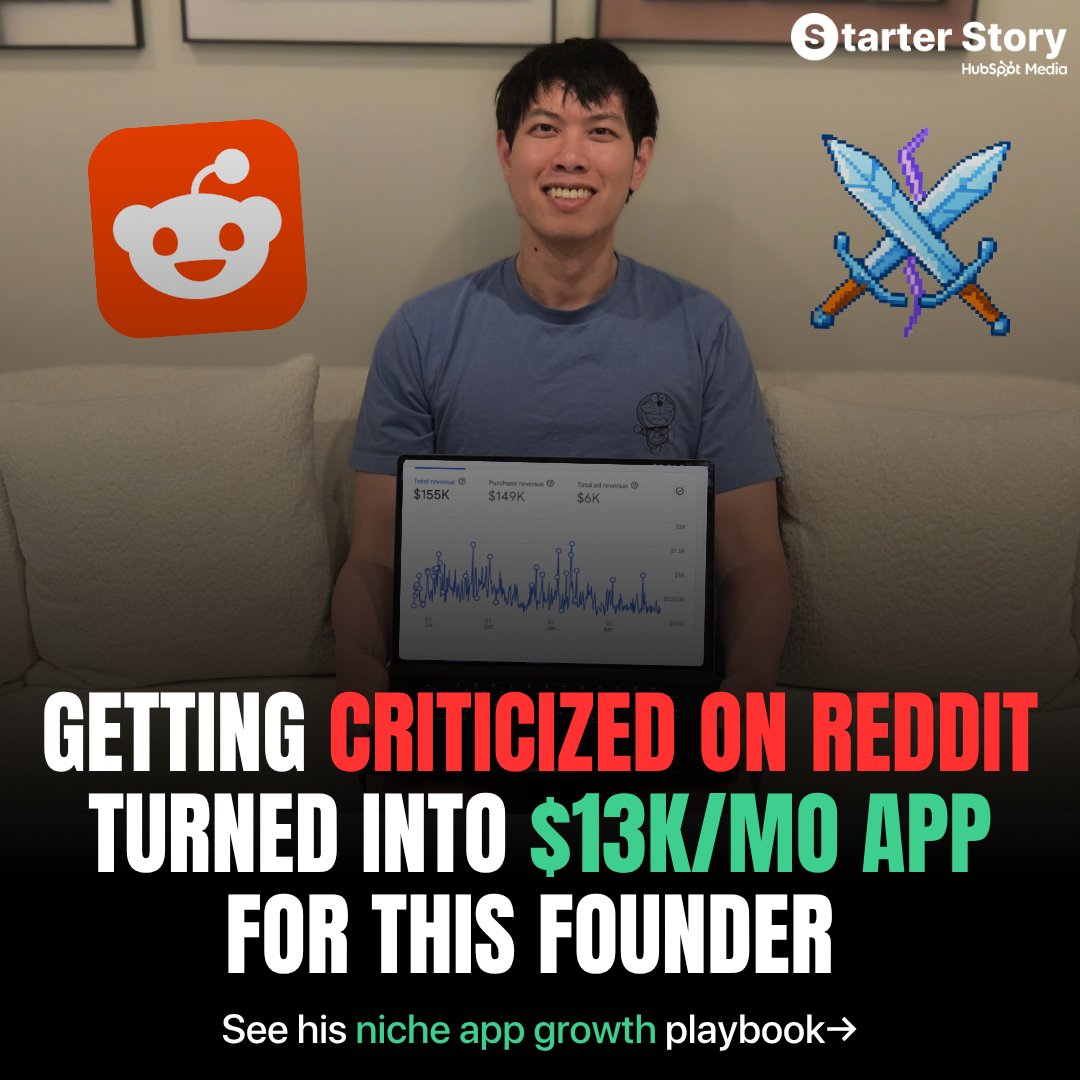
Ken Leaves Meta After Harpagia Idle RPG Hits $10K Monthly

Ken Leaves Meta After Harpagia Idle RPG Hits $10K Monthly

Starter Story profiles Ken, a former Amazon and Meta engineering manager who built Harpagia, a text-based idle RPG for RuneScape fans, using AI tools. The game reportedly reached $13K monthly revenue and 50,000 downloads, with his Meta exit following a Reddit post that lifted revenue.

Original post · 1 min read
He quit Meta to build a text-based mobile game… and one Reddit post took him from $1K/month to $10K/month overnight.

Ken spent 12 years in big tech (Amazon, then engineering manager at Meta). Hadn’t written a line of code in 4 years. Then AI tools clicked, and he shipped a tiny card game in 6 weeks just to learn how to launch.

That warm-up became Harpagia which is a text-based idle RPG for RuneScape fans.

The numbers:
> $13K/month average, $155K in year one
> 50,000+ downloads across iOS + Android
> 6% conversion (games average 2–5%)
> $3 revenue per active user
> $500/month in costs, $0 on ads

His deal with himself: if the game hit $10K/month organically, he’d quit Meta. Six months in, he made his first Reddit post - screenshots + a note on how free-to-play it was. The comments were brutally critical. It didn’t matter. Revenue jumped from ~$1K to $10K almost overnight. He left Meta that same month.

His lesson: you don’t need millions of players. A few hundred active users in the right niche can do $100K+/year.
♥ 136 · ⟲ 10 · 👁 8.8KView on X ↗

Andy Says AI Tool Jev Replaces Bookkeeping Firm for $0.32

Andy Says AI Tool Jev Replaces Bookkeeping Firm for $0.32▶

Andy claims he built a bookkeeping solution using Jev from typesafeai, which processed 34 months of work that a firm had charged over $20,000 for, completing it in 20 seconds at a cost of $0.32. The claim is shown in a video and is the poster's own assertion.

Original post · 1 min read
The bookkeeping services industry is dead.

This weekend, I built a better solution using Jev from @typesafeai.

I fed it 34 months of work a firm charged $20,000+ for.

Jev did a better job in 20 seconds, for just $0.32 🤯
♥ 938 · ⟲ 38 · 👁 118.2KView on X ↗

Faire Reaches $730 Million Run Rate as Investor Celebrates

Gokul Rajaram, an early investor since 2017, praises wholesale marketplace Faire after a Wall Street Journal report of a $730 million-plus annualized revenue run rate, 45% growth, and expected Q4 EBITDA breakeven. He highlights advertising, international expansion, and fulfillment as growth levers.

Original post · 2 min read
Faire

I am incredibly proud to have been an investor in @Faire since 2017.

I worked closely with founders @maxrhodesOK, @Kolovson, @Mescortes, and Daniele Perito for several years before they started Faire. They are absolutely stellar S-tier talent. What they and the Faire team have accomplished since is extraordinary.

This Wall Street Journal piece (linked below) captures the scale of that accomplishment: a $730M+ annualized revenue run rate, 45% year-over-year growth, and an expectation of reaching EBITDA breakeven in Q4.

Those are remarkable numbers for a company taking on an enormous and stubborn problem. Wholesale has changed remarkably little for more than a century. Independent retailers still spend huge amounts of time discovering products, managing inventory, and absorbing costs that large chains spread across thousands of stores.

Faire is changing that for hundreds of thousands of retailers and brands. The company is now on pace to facilitate more than $4.5B in merchandise purchases annually.

Every order adds to Faire’s understanding of which products sell in which stores. That information improves product recommendations, gives retailers more confidence in what they buy, and connects brands with customers they would struggle to find on their own.

I’m especially excited by how much opportunity remains.

International markets give Faire much more room to grow. Advertising, launched in 2024, already contributes about 9% of revenue. Fulfillment could reduce customer shipping costs by roughly 80%, directly improving retailer margins.

For Faire employees, I hope this article brings a deep sense of pride. You have built something truly special.

For candidates, Faire offers a rare opportunity: proven demand, enormous room to grow, hard technical and operational problems, and a founding team that I would back again without hesitation.

Very few teams get to build a company of this scale while improving the odds for independent retailers and brands around the world. Faire does both.

I feel incredibly fortunate to have been part of the story from the beginning. I have never been more excited about what this exceptional team will build next.
♥ 121 · ⟲ 9 · 👁 25.6KView on X ↗

Shopify Partners With Muse To Enable Agentic Checkout

Shopify Partners With Muse To Enable Agentic Checkout

Shopify CEO Tobi Lutke announced a deep partnership with Muse to offer agentic checkout through Shop Pay on all Shopify stores, letting shoppers buy through Muse.

Original post · 1 min read
We are excited to announce we are partnering deeply with Muse to enable agentic checkout with Shop Pay on all Shopify stores, offering people an easy and delightful way to shop and check out with Muse.
♥ 8.0K · ⟲ 346 · 👁 2.2MView on X ↗

Ivan Burazin Highlights Evernote's Lean Revenue Growth Post-Acquisition

Ivan Burazin notes that Evernote, owned by Bending Spoons, reportedly reached about $150M in revenue with 20 people, compared with roughly $100M and 350 employees before the takeover. He contrasts this with older SaaS firms that have similar revenue but thousands of staff.

Original post · 1 min read
Evernote is a Bending Spoons company worth talking about.

They are doing very well post-acquisition (reportedly at $150M with 20 people). Prior to the takeover, they were doing $100M with nearly 350 employees.

The current numbers are pretty apt for a product like that.

Then there are some of these older SaaS companies doing similar revenue with 5,000-7,000 people.

Imagine them cutting down to 30 engineers and a lean ops team. They would be printing money in a way that would seem illegal.
♥ 409 · ⟲ 23 · 👁 69.4KView on X ↗

Lenny Rachitsky Shares Product Lessons From Peter Sellis

Lenny Rachitsky summarizes takeaways from a podcast with Peter Sellis on growth, taste and team design, citing Snap's Android performance focus and Discord's multiplayer strategy. He also links to the full 90-minute episode.

Original post · 4 min read
My biggest takeaways from @petersellis:

1. There is always money in the banana stand. The highest-ROI growth move is usually investing in the core product, vs. chasing side quests. At @Snap, after the disastrous 2018 redesign caused DAU to flatten, the team laser-focused on performance for existing users—particularly on Android—and sparked a multi-year growth renaissance. At @Discord, rather than chasing @Midjourney’s moment, the team focused on making Discord the best place to play intentional multiplayer games with friends. The result was some of the fastest growth in history.

2. Great taste is knowing when to stop. Peter spent seven years watching @evanspiegel personally say no to better ideas than most consumer startups ever launch. His take on taste is that the difference between people with it and people without it is that the ones with taste stop one step before everyone else does. They know when a good idea’s time has come, or when it has to sit on the shelf a bit longer.

3. Spend your time on your best people, not the ones struggling. Against human instinct, which is to help whoever looks like they’re drowning, Peter consistently loads up his strongest performers with more responsibility and decisions until he finds the limit of what they can handle.

4. The median PM is bad, and even net negative, because the skills of a great product leader are the skills of a founder or an executive, so top-percentile PMs leave for founder and exec seats. On the other hand, mediocre PMs fight to stay in the job because the job pays well and has status. ZIRP made it worse because it was the most lucrative role in tech for non-technical people, with the most subjective sense of what great looks like. A lot of engineers and designers conclude “PMs suck” because they have mostly met the bottom of that distribution.

5. Great PMs hold three contradictory traits. First: deep confidence bordering on arrogance, paired with genuine humility. Second: extreme organizational discipline, paired with near-pathological comfort with ambiguity. Third: a long-term vision that’s always holding in the background, paired with a day-to-day bias for action.

6. Peter designs product teams like terrorist organizations: a shared ideology and an explicit map of who is trusted with which decision. You will almost never hear a leader tell their team to collaborate less, but coordination makes you as slow as the slowest node, which compounds and slows organizations down. The antidote is a strong shared ideology and clear DRIs who can make confident, founder-quality decisions quickly.

7. Optimize consumer products for daily active use. Days map to real human cycles; weeks and months are weaker. One daily user equals roughly 30 monthly users in simple math, which is why elite consumer products run extremely high DAU/MAU. Moving that ratio a few basis points often beats acquiring a pile of soft monthly actives and hoping they retain. DAU/MAU is next-day retention under another name.

8. Define a “Core Product Value” that's both a memorable phrase and a set of metrics that measure it. Peter built this framework at both Snap and Discord. At Snap, it was “the fastest way to share a moment with the people you care about,” which you could actually decompose into metrics: time to load (fast), camera-open-to-share rate (share a moment), best friends engagement (people you care about). At Discord, it was “the best way to talk and hang out with your friends before, during, and after playing games,” with a corresponding L7 and Lness definition that made its way into the growth playbooks. The phrase without the metrics is a slogan; the metrics without the phrase are a dashboard. You need both.

9. The most important career decision you make as a PM is who you choose to marry. This has compounding effects on your career that no podcast, course, or mentor can replicate. The intellectual sounding board, the support system, the person who challenges you to grow—that relationship shapes your capacity to operate at the highest level in ways that are genuinely hard to quantify but nearly impossible to overstate.
Lenny Rachitsky @lennysan
"I design teams like terrorist organizations."

90 minutes of unfiltered product advice from @petersellis

We discuss:
🔸 What it's really like to manage @nikitabier
🔸 Why growth almost always comes from the core
🔸 Why great taste is knowing when to stop
🔸 Why the median PM is so bad
🔸 Designing teams like terrorist organizations

Listen now 👇
youtube.com/watch?v=97LRJUUPy_w
♥ 257 · ⟲ 13 · 👁 66.1KView on X ↗

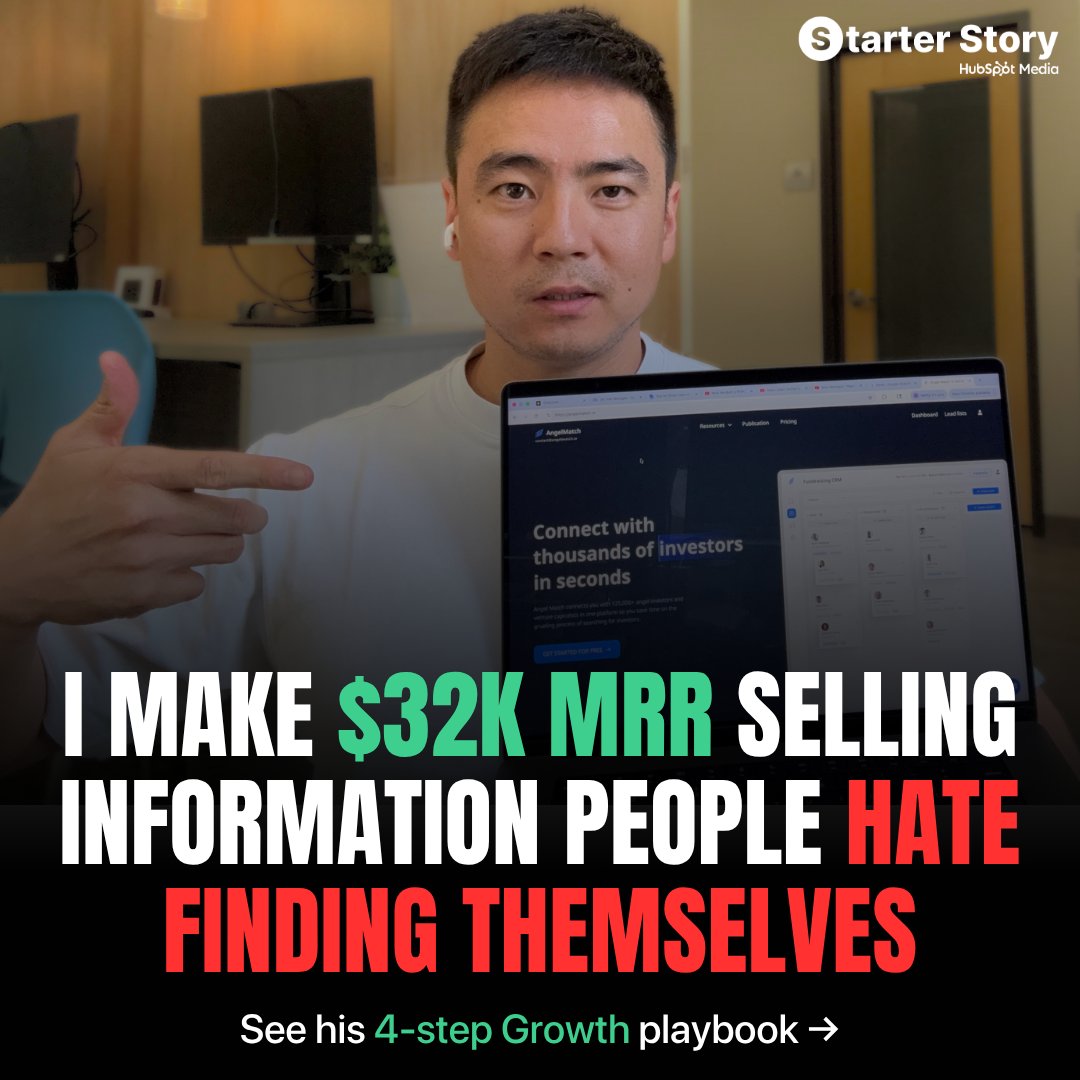
Rashid Builds AngelMatch Database Business Reaching $29K Monthly Revenue

Rashid Builds AngelMatch Database Business Reaching $29K Monthly Revenue

Starter Story profiles Rashid, who built a manually compiled investor database into AngelMatch at $29K MRR, then cloned the model with InvestorHunt and JournalistHunt. Half his revenue comes from programmatic SEO, and the post outlines a three-step playbook.

Original post · 1 min read
He built 3 boring websites that pay him $32K/month - no AI trend, no fancy features, just databases.

Rashid isn’t a coder. He studied finance, maxed out credit cards raising $100K for a fintech, and while hunting for investors he realized: finding this list is brutal.

So he manually built a list of 40,000 investors, launched on Product Hunt, and made $4K in month one.

That became AngelMatch - now at $29K MRR with 360 subscribers, a 33% trial conversion, and 800–1,000 clicks a day. Pricing starts at $59/mo and goes into the thousands.

Then he cloned the model:

> InvestorHunt - $2,800/mo, pure SEO, zero marketing
> JournalistHunt - a database of 200,000 journalists at $49–$99 tiers

The unlock? One day he saw 60 clicks/day in Google Analytics and thought: what if I 10x this? He hired 6 content writers, shipped free tools, and ran programmatic SEO for 8 months.

Went from $3K > $20K MRR. Peaked at $43K.

Half his revenue still comes from programmatic SEO.

His playbook for 2026:

1. Pick a database that solves a painful B2B problem
2. Collect the data manually (or scrape it)
3. Launch fast, get eyeballs, then double down on programmatic SEO

Ideas he’d build today: an influencer database sorted by niche + audience size. Or a newsletter sponsorship database.

The takeaway: boring beats trendy. Painful B2B problems + SEO compound for years while AI apps go to zero.
♥ 234 · ⟲ 24 · 👁 16.1KView on X ↗

Chris Outlines Revenue Ideas Built on the Jev Decision Model

Chris Outlines Revenue Ideas Built on the Jev Decision Model▶

Chris lists ways to make money with Jev, including instant pricing, selling decision files for agents and monthly subscriptions, and running it on Hermes or Grok bots. He links to a full guide and includes a video.

Original post · 1 min read
here's how to make money with jev on autopilot

it's a super fast decision model, so it picks an answer in a fifth of a second and tells you how sure it is

- put instant pricing on a business that has none
- sell the same thing to bigger businesses for more
- sell a file that decides what an agent may do
- charge monthly to keep all of it running
- costs a fraction of a cent per decision
- runs on hermes or grok bot, on a schedule

just wrote a whole guide on how you can set this up:
Chris @everestchris6
how to make money with jev (FULL GUIDE) — jev is a new typesafe model that makes super fast decisions instead of writing. that opens up a bunch of revenue streams you can build and sell, and here are three of them.
by the end of this guide
♥ 666 · ⟲ 67 · 👁 91.4KView on X ↗

Peter Sellis Shares Product Advice in 90-Minute Podcast

Josh Elman praises Peter Sellis, whom he has known since 2009 and credits with helping build the path to Snap and Discord's first $1 billion in revenue. He promotes Sellis's podcast discussion on managing Nikita Bier, why growth comes from the core, and designing teams like terrorist organizations.

Original post · 1 min read
Have known Peter Sellis since 2009. He is a legend and helped build the path toward the first $1B revenue for Snap and Discord.

Glad to see him sharing his insights. Great PMs should eat this up
Lenny Rachitsky @lennysan
"I design teams like terrorist organizations."

90 minutes of unfiltered product advice from @petersellis

We discuss:
🔸 What it's really like to manage @nikitabier
🔸 Why growth almost always comes from the core
🔸 Why great taste is knowing when to stop
🔸 Why the median PM is so bad
🔸 Designing teams like terrorist organizations

Listen now 👇
youtube.com/watch?v=97LRJUUPy_w
♥ 161 · ⟲ 7 · 👁 57.7KView on X ↗

Lenny Rachitsky Hosts 90-Minute Product Advice Episode With Peter Sellis

Lenny Rachitsky shares a YouTube link to a 90-minute conversation with Peter Sellis. Topics include managing Nikita Bier, why growth comes from the core, why great taste means knowing when to stop, and why the median PM is weak.

Original post · 1 min read
"I design teams like terrorist organizations."

90 minutes of unfiltered product advice from @petersellis

We discuss:
🔸 What it's really like to manage @nikitabier
🔸 Why growth almost always comes from the core
🔸 Why great taste is knowing when to stop
🔸 Why the median PM is so bad
🔸 Designing teams like terrorist organizations

Listen now 👇
youtube.com/watch?v=97LRJUUPy_w
♥ 619 · ⟲ 40 · 👁 1.1MView on X ↗

Fastlane Launches Jev Tool to Automate Product Marketing Content

Fastlane Launches Jev Tool to Automate Product Marketing Content▶

Fastlane promotes Jev for Marketing, a tool that generates unlimited social media accounts and videos from a website URL to promote a product. The post is a short product pitch with a video.

Original post · 1 min read
Meet Jev for Marketing.

Just enter your website URL, then Fastlane creates unlimited social media accounts and viral videos all promoting your product in seconds.

This is actually insane.
♥ 1.4K · ⟲ 74 · 👁 541.0KView on X ↗

Pocket FM Ad Library Shared as Growth Playbook for Ecommerce

Pocket FM 4★+5★ Longest-Running (English) — GetHookd

Alex Fedotoff shares a board of 199 storytelling drama ads from Pocket FM, encouraging readers to model them for ecommerce products. The post quotes Rohan Nayak's claim that Pocket FM grew to $500M ARR while EBITDA profitable and outlines its growth tactics.

Original post · 1 min read
INSANE fucking growth. Storytelling Drama ads is the main format. Here’s 199 of these bangers from Pocket FM. Model and adapt for your Ecom products mfers.

Straight from gethookd: app.gethookd.ai/share/board/356560?signature=2…
Rohan Nayak @RohanNayak2
We grew from ~0 to $500M ARR, adding $250M last year alone while being EBITDA profitable.

1,300-word post on every growth tactic that worked for us:

1. What got us from 0-$400M ARR in the US works in every country.
2. Retention and Monetisation Hacks.
3. Localization > Translation.
4. Experiment with $1M internal seed checks.
5. Pivoting to only AI content production unlocked 100% ARR growth.

Pocket FM is like Netflix for audio-only dramas, with our own pool of one-person studios.

1. Acquisition Playbook for 0-$10M ARR in any country in 6 months

We run a 90 sec video trailer of an audio d…
app.gethookd.aiPocket FM 4★+5★ Longest-Running (English) — GetHookd199 ads saved to this board on GetHookd.
♥ 210 · ⟲ 11 · 👁 82.7KView on X ↗

Pamba Offers AI Tool to Create and Warm Dozens of TikTok Accounts

Pamba | The AI creator engine behind 500M+ views

Karol Zdebel promotes Pamba, a service that creates TikTok and Instagram accounts on iPhones with US SIMs and warms them via an MCP server, claiming more than 500 million views generated. The post states that a 50-account setup takes about five minutes and that no accounts have been banned.

Original post · 1 min read
You can create 50 new TikTok & Instagram accounts literally in the next hour with this.

Takes 5 minutes to set up.

1) Sign up on pamba.app and select the free plan
2) Go to the Accounts tab
3) Click "Buy Accounts" and select how many you want
4) Enter your usernames
5) Wait ~30 minutes for the accounts to be created
6) Set up your account warming configuration
7) Start posting your own videos

Not a single person has been banned or bot detected on our platform with over 500M views generated.

Traffic is 95%+ US because all the iPhones are actually in the US and are using US carrier SIM cards, with real phone numbers.

If you need more info please DM me!
Karol Zdebel @karolzdeb
I spent $30k on iPhones so that your agents can finally rent them out for going viral on TikTok & Instagram.

No joke, you can turn your Claude/Codex/GrokBot into Mr Beast with this; we've generated over 500M views with this setup.

Here are 5 things you can tell your agents to do today using this MCP server:

1) Create a bunch of TikTok & Instagram accounts (with real US phone numbers & emails)

2) Warm accounts exactly how you like for your niche

3) Capture video ideas from the FYP to understand what's going viral for your competitors

4) Post videos to all of your accounts at once

5) Moni…
pamba.appPamba | The AI creator engine behind 500M+ viewsEnter your website and Pamba turns AI creators into an always-on growth channel for your startup.
♥ 4.8K · ⟲ 291 · 👁 3.6MView on X ↗

Muse Opens Platform for Third-Party Connectors to Its AI Agent

Muse announces open developer access to build connectors, letting partners supply an API while Muse provides the agent and browser so users can reach services by asking for them. Daanish Khazi comments on the founder's story.

Original post · 1 min read
For ten years this sweet man built face masks to taste a drop of sovereignty while App Store had its Gorrilla Glass boots on his neck, and today he stumbles, nearly by accident, into his first real shot at a platform. You may not find your soul mate the first place you look.
Mark Zuckerberg @finkd
Opening access for developers to build Muse connectors. You bring the API -- Muse brings the agent, the browser, and the context of what the person actually wants. People reach your service just by asking for it, and their agent takes it from there.

New connectors are live today. Come build with us. muse.ai/platform
♥ 664 · ⟲ 16 · 👁 129.3KView on X ↗

Investor Argues Muse Connector Platform Offers Early Mover Edge

Vijar Kohli argues that consumer startups should prioritize Muse's new connector platform, citing Meta's AI assistant and messaging reach as a first-mover advantage.

Original post · 1 min read
If I was in consumer, I would 100% spend my entire weekend on this opportunity. This doesn't come by often, and Meta has done this before.

They have built a great AI assistant and know messaging (Whatsapp, IG DMs). The first mover advantage here is real.
Mark Zuckerberg @finkd
Opening access for developers to build Muse connectors. You bring the API -- Muse brings the agent, the browser, and the context of what the person actually wants. People reach your service just by asking for it, and their agent takes it from there.

New connectors are live today. Come build with us. muse.ai/platform
♥ 1.8K · ⟲ 70 · 👁 637.7KView on X ↗

SpaceXAI Offers Grok Bot Usage Reset and Free Month to Users

SpaceXAI Offers Grok Bot Usage Reset and Free Month to Users

SpaceXAI is resetting Grok Bot usage for existing users and offering one free month, valued at $200, to new users who are active in the Grok Bot Galaxy livestream chat. The announcement points to a livestream titled 'Building a company in 3 days - launching today!'

Original post · 1 min read
FYI: SpaceXAI is giving a Grok Bot usage reset to all existing users and one free month of Grok Bot ($200 in value) for all new users who are active in the Grok Bot Galaxy livestream chat this afternoon.

Stream: x.com/i/broadcasts/1YGNrbXEeazGw
x.comGrok BotBuilding a company in 3 days - launching today!
♥ 1.2K · ⟲ 69 · 👁 125.7KView on X ↗

Developer Reports iOS App Ranking Near Top 11 With Daily Revenue

Developer Reports iOS App Ranking Near Top 11 With Daily Revenue

David Ch says his iOS app ranks No. 11 on the App Store, reporting about 1,300 daily downloads and $1,800 in daily revenue. He links to an article and a quoted post describing a manual study of 30,600 iOS apps earning $20k to $100k per month.

Original post · 1 min read
Our app is ranked #11 on the ios AppStore

It only took:
→ 1,300 downloads per day
→ $1,800 revenue per day

Everything you need to know about scaling iOS apps like we have

is in this article.

Quit brainrot for 3 minutes
And read this
David Ch @chhddavid
I manually studied 30,600 iOS apps making $20k-100k/mo+, the recipe is stupidly easy — Only around 1.7% of apps in the iOS App Store make $20k/mo+.
That's still more than 30,000 apps.
I've spent a stupid amount of time studying them manually. No AI summaries, no giant scraped dataset.
♥ 429 · ⟲ 23 · 👁 93.9KView on X ↗

Post Shows Branded iMessages Sent to Users Who Abandon Paywalls

Post Shows Branded iMessages Sent to Users Who Abandon Paywalls▶

Gabe Roeloffs shares a video claiming app developers can send users branded iMessages when they abandon a paywall. The post is brief and offers little detail on implementation.

Original post · 1 min read
They don’t want you to know this but you can send users branded iMessages when they abandon your paywall
♥ 219 · ⟲ 5 · 👁 42.4KView on X ↗

Indie App Developer Gains Rankings Across 40 Markets With One Localization

Indie App Developer Gains Rankings Across 40 Markets With One Localization

Blaida reports that after adding a single new localization and an Apple approval, his app now ranks across nearly 40 App Store markets, with top 10 positions in several. He argues app store optimization through localization is an underused lever for indie developers.

Original post · 1 min read
Apple approved my update. I'd added one new localization.

The result: my app now ranks across nearly 40 App Store markets, France, Germany, Italy, Mexico, Argentina, and more. Top 10 in several of them.

One localization. Dozens of countries.

This is the ASO lever indie devs ignore because it feels like "extra work." It's actually the highest-leverage move on the store.
Blaida @kedytcom
Update on the $0 → $1K MRR challenge 👇

We found new keywords + markets from our ASA data (Max Conversion campaigns surface the terms that actually convert, not just the ones we guessed).

So we rewrote the app's metadata around them — and built new features to match, so the keywords are real, not stuffed.

Then Apple rejected us. Twice.

Now we're back in review, waiting.

If it passes, we find out whether those new keywords + markets actually move the needle. If it doesn't, you'll see exactly why.

Either way I'm posting it. This is the part nobody shows.

Day 3 → still climbing. 🚀
♥ 62 · ⟲ 0 · 👁 8.0KView on X ↗

Juan Explains How Startups Engineer Overnight Ubiquity on X

Why Some Startups Become "Everywhere" Overnight

Juan's X article argues that startups seeming to be everywhere overnight results from a layered launch system, not one viral post. It outlines five layers, including a repeatable claim, a product moment, trusted voices and timing, and says he drove over six million impressions recently.

Original post · 8 min read
X ArticleWhy Some Startups Become "Everywhere" Overnight
You open X in the morning and see a startup you've never heard of. An hour later, a founder you follow is posting about it. Then a friend sends it to you. Someone drops it into your team's Slack.
By lunch, it feels like everyone in tech has been talking about this company for weeks. They haven't. That feeling, that this startup is suddenly everywhere, is engineered.
I've built launches like this for years.
In the last month alone, I've driven more than 6 million impressions and tens of thousands of reposts for tech startups.
Almost none of that came from a single viral post. It came from a system most founders never even notice.
This article breaks down:
Why some launches feel like they're everywhere, all at once.
The five layers teams actually build behind the scenes.
How you can run the same system for your own launch.
(Bookmark this. You'll need it on launch day.)
One Viral Post Won't Make You "Everywhere"
Most founders see a company take over their timeline and assume one post went viral and the rest just followed.
That's almost never how it works.

A post with two million views is still something you see once and forget. But when the same startup shows up from a founder, a creator, and someone you trust, all in a few hours, you start to care.
The first time, you scroll past it.
The second time, you recognize the name.
The third time, you wonder why everyone is talking about it.
The fourth time, you click. Every touchpoint makes the next one hit harder.
Most campaigns chase reach, hoping as many people as possible see the product once. The launches that feel everywhere do the opposite. They optimize for overlap. The right people see it several times, from sources they already trust.
Ten mentions across a month feel like marketing.
Ten mentions before lunch feel like an event.
Once your launch feels like an event, people start spreading it for you.
The Five Layers Behind an "Everywhere" Launch
Five layers need to work together:
A claim people can repeat.
A product moment people want to show.
Trusted voices entering the conversation in waves.
Timing that compresses those voices into one event.
An audience that eventually takes over.
Miss one layer and the launch loses momentum.
Strong message, no distribution? Nobody sees it. Distribution, no product moment? Empty reach. Even if you have the right message, product, and creators, if they show up too far apart, nobody feels like your launch is everywhere. Here's how each layer works.
Layer 1: A Claim People Can Repeat
Most founders launch with a product description:
An AI-powered platform for collaborative application development.
Sure, it's accurate. Nobody repeats it. Ideas only spread when they're simple enough to pass over dinner:
Build an app by describing it.
Your launch needs one portable claim that tells people what changed and why it matters. The strongest claims combine three things:
Familiar problem + surprising claim + visible proof
Let every creator take a different angle, but make sure they all hammer the same core idea. If people can't explain why your launch matters in one sentence, it won't spread.
Layer 2: A Product Moment People Want to Show
A strong claim gets attention. A strong product moment drives shares. People don't repost feature lists. They repost the moment a product does something that looks new, hard, or impossible.
I call this the magic moment.
Most weak launch videos hide it behind a logo animation, a founder introduction, or a tour of the dashboard. By the time the product does something interesting, the audience has already scrolled away.
The strongest launch assets do the opposite:
Show the result within the first five seconds.
Make it understandable without sound.
Focus on one impressive outcome.
Work even when shared without context.
One clear result will travel further than ten explained features.
The test is simple. Show the opening five seconds to someone outside your company; if they can't explain what happened and why it matters, the magic moment isn't clear enough.
Your claim tells people what changed. Your demo makes them believe it. When those two travel together, creators don't have to explain why the product is interesting. They can simply show it.
That makes the launch much easier to spread.
Layer 3: Trusted Voices Enter the Conversation
One founder post can start a launch. It can't make the company feel "everywhere." For that, the story needs to travel through people who already have the attention and trust of your target market.
Each voice has a different job:
The founder gives the launch its story.
Large creators bring reach.
Niche experts make it relevant to buyers.
Customers provide proof.
Smaller accounts create repetition.
Team members and communities carry it beyond the original post.
The biggest mistake is giving everyone the same copy. When 50 accounts use the same words, the audience sees a campaign. When they tell the same story from their own perspectives, the audience sees a conversation.
Give … continue on X ↗
♥ 1.1K · ⟲ 54 · 👁 423.6KView on X ↗

ID Verification Firm Exposes 153 Million US and Canadian Licenses

vx-underground reports that a company providing ID verification for in-person services has exposed data on over 153 million driver's licenses from the United States and Canada, including photos. Krebs on Security reports the FBI is investigating and that several researchers are affected.

Original post · 1 min read
I really recommending reading this.

In summary, a company which does ID verification for in-person interactions (hotels, car rentals, ID verification for alcohol or marijuana, etc) has some how exposed over 153,000,000 drivers licenses for people in the United States and Canada.

It is a catastrophic data breach, probably one of the worse I've ever seen. If you're in the United States and have traveled, gotten a hotel, purchased marijuana or alcohol, there is a high probability you're in this.

Unlike other breaches, this includes a photo of the person (from the license), making verification you've identified the person significantly easier.

This poses a significant threat to celebrities (musicians, YouTubers, streamers, adult entertainers, actors, etc), politicians, lawyers, wealthy people (CEOs, investors, people of public interest), Law Enforcement Officers, etc

Krebs himself, and several other security researchers, have already confirmed they're in the data leak.

tl;dr gah damn dawg this company is going to be sued into oblivion

krebsonsecurity.com/2026/09/fbi-probes-service…
♥ 19.3K · ⟲ 3.3K · 👁 4.8MView on X ↗

Shopify Joins Stripe Projects for Command-Line Store Setup

Stripe Projects | Provision and Manage Services from the CLI

Patrick Collison announces Shopify is available in Stripe Projects, which lets users provision services from the CLI. A Shopify post says stores can now be spun up from the command line with one Stripe account for billing.

Original post · 1 min read
Shopify is now available in projects.dev.
Shopify @Shopify
There’s a new way to spin up a store in the command line

Shopify now works with Stripe Projects

Add commerce to your app stack and use one @stripe account for setup and billing across all providers
projects.devStripe Projects | Provision and Manage Services from the CLIEnable you or your agents to provision hosting, databases, auth, AI, and more from the CLI. Generate credentials and manage usage and billing in one place.
♥ 382 · ⟲ 25 · 👁 101.8KView on X ↗

Miso Launches iMessage AI Travel Agent for Points-Based Booking

Miso Launches iMessage AI Travel Agent for Points-Based Booking

Oliver Brocato says the AI travel assistant Miso booked a trip to Europe for two using 60,000 points and business-class lie-flat seats. A linked post from Miso's founder describes an 18-month effort to build an AI-native travel agent inside iMessage.

Original post · 1 min read
miso booked me and my gf NYC to Europe for 60k points + $400 lay flat biz class!

no more hunting for deals. i litteraly imessage my own ai concierge. unreal 🤯
Martin Mrozowski @martinmartinmro
18 months ago we set out to build an AI-native travel agent in iMessage.

We booked the first trips ourselves and learned one thing fast: travel is fucking complicated. Points. Delays. 2am support. Business Lie-Flat vs Suite. A thousand edge cases.

But complicated isn't the hard part. Specific is.
Nobody wants "a flight to Tokyo." They want the 11pm nonstop, the aisle in front of the wing, the points they forgot they had, and the hotel they liked last time, without explaining any of it again.

So that's what we built.

One thread that already knows.

Some of our users have texted their way to…
♥ 322 · ⟲ 3 · 👁 92.1KView on X ↗