Wednesday, October 7, 2026ArchiveSearchAsk the paper

The Computomatix Times

All the posts fit to save — curated from @computomatix's bookmarks & likes on X

Search

155 stories

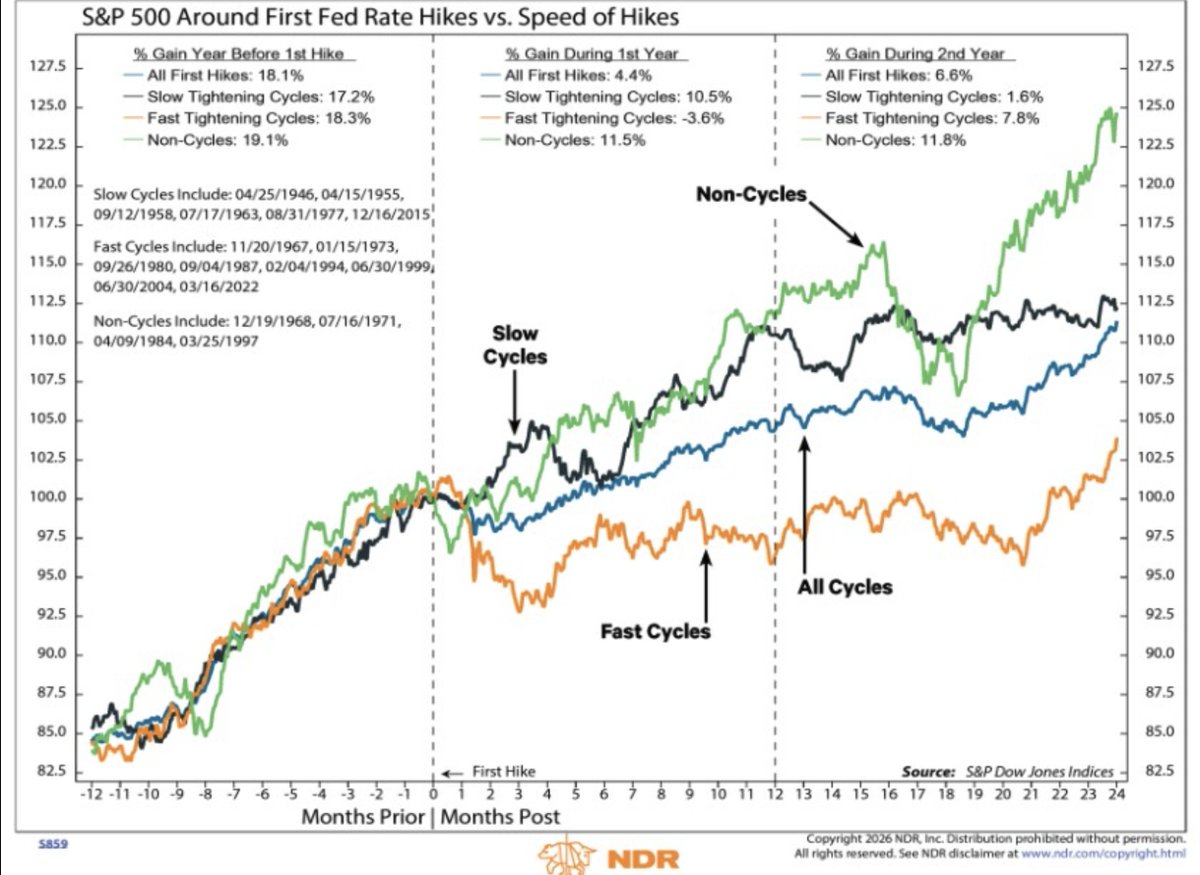
Puru Saxena Predicts Multi-Month Rally Tied to Hiking Cycles

Puru Saxena Predicts Multi-Month Rally Tied to Hiking Cycles

Puru Saxena argues slow hiking cycles are positive for stocks and that the US presidential cycle's most positive phase is starting, saying his portfolio is positioned for a multi-month rally in NDX and SPX.

Original post · 1 min read
Slow hiking cycles are positive for stocks.

We're also entering the most positive phase of the US Presidential Cycle and our portfolio is positioned for a multi-month rally. $NDX $SPX

Chart @edclissold
♥ 304 · ⟲ 31 · 👁 32.6KView on X ↗

Trump Phones Jensen Huang Live at All In Summit

Trump Phones Jensen Huang Live at All In Summit▶

Ben Pouladian shares a video of the president calling Nvidia CEO Jensen Huang on stage at the All In Summit, with the president saying the U.S. will not lose the AI race. The post is largely commentary and promotes Nvidia stock.

Original post · 1 min read
Holy crap POTUS just phoned in @JensenHuang live on stage at All In Summit

We will not lose the ai race! And whatever Dario said this weekend won’t stop our progress

This made my morning!

$NVDA
♥ 16.1K · ⟲ 1.9K · 👁 6.2MView on X ↗

Shopify and Anthropic Launch Claude Commerce Agents

Shopify and Anthropic Launch Claude Commerce Agents▶

Shopify CEO Harley Finkelstein announces that Claude Commerce Agents launched and that Shopify's reference implementation is live, giving merchants paths into agentic commerce. He links to Shopify's open-source examples on GitHub.

Original post · 1 min read
We will always do whatever we can to give our merchants a better chance at success.

I keep saying it and we keep proving it. Case in point: Claude Commerce Agents launched today, and our reference implementation is already live.

@Shopify gives every merchant a path into agentic commerce. Out of the box tools for most merchants, or flexible building blocks for those who want to go deeper and build their own agents.

🔗 github.com/Shopify/claude-for-commerce-examples
ClaudeDevs @ClaudeDevs
We're open-sourcing Claude Commerce Agents.

This is a blueprint for building shopping and merchant agents, with reference implementations across retail, travel, telecom, and entertainment.
♥ 464 · ⟲ 32 · 👁 84.8KView on X ↗

Uber Layoff Memo Blames Employee Pulse Feedback on Coordination

Calvin Grunewald criticizes an Uber internal message that cites employee Pulse survey feedback about coordination overhead while announcing layoffs. He argues that using employee feedback this way undermines trust needed for honest surveys.

Original post · 1 min read
Uber's layoff PR is wild. Yes, let's justify the layoff, in part, due to feedback from the employees themselves!!

> In Pulse surveys and conversations with many of you, we’ve heard that too much work requires coordination across teams, debates take too long, and decision-making rights are unclear. I’m sure many of you have felt that you spend too much time “aligning” rather than building, shipping, or serving customers. To improve this, we have reduced roles primarily focused on coordination, and have clarified the remit of the coordination roles that remain.

Yes, point the finger back at the employees as one reason why you're firing their colleagues. Yeah, maybe I'm strawmanning here, but any org leader who runs and owns Pulse results knows that employee trust in how the feedback is managed is incredibly critical to getting honest results in the first place. And honest results are necessary to improve things.

I actually do agree that more layers and more coordination hurts maximizing productivity in the agentic era. And yes, as much as they hurt, layoffs are a way of snapping quickly to that. But don't weaponize employee feedback so directly. Just own it!
♥ 750 · ⟲ 26 · 👁 701.7KView on X ↗

Analyst Says Meta Business Agents Drive Next Growth Phase

Analyst Says Meta Business Agents Drive Next Growth Phase

Rihard Jarc shares an expert interview reporting over 30% year-over-year Meta ad spend growth at one company, with Reels, click-to-messaging, shopping and overlay ads as tailwinds. The expert calls Meta Business Agents a significant new growth driver.

Original post · 3 min read
Interview with an industry expert on why $META Business Agents are one of the most significant new growth drivers for the company:

1. The expert reports strong $META ad spend growth at their company, with Q1 and Q2 of this year both up more than 30% YoY, and Q3 and Q4 forecast at more than 20%, with the slowdown driven by tougher comparisons rather than any underlying deceleration. On a two-year stack, growth is actually accelerating, reaching more than 60% in Q2 and expected to hold there through year-end.

2. Reels has been the biggest tailwind for the expert's company, growing from under 30% to under 40% of total $META ad spend YoY, representing around a 4-5 point tailwind, though the expert expects this to ease as Reels matures. Forms and click-to-messaging, which route users into WhatsApp or Messenger, have roughly doubled as a share of spend and represent a meaningful CPM uplift as higher-value ad units replace lower ones.

3. Shopping ads keep users within the $META ecosystem through integrations with $AMZN and $SHOP, creating an on-site conversion experience without users feeling like they left the platform. These high-CPM ads replace lower-CPM ones, representing a small, single-digit tailwind for the expert's company. Overlay ads, which appear on creator content with a button and text, are a bigger and more purely incremental tailwind since they represent genuinely new inventory that was previously ad-free rather than replacing existing ad formats.

4. The expert describes Meta Business Agents as one of the most significant new tailwinds coming online, framing it as the evolution of Meta Business AI into something far more ambitious. What stands out is that the product leads with analytics rather than ads, integrating data from various ad stacks to give even a one-person business a unified view of multiple metrics. Ad campaign automation and chatbots remain, but the expert sees the broader business intelligence layer as the genuinely new and exciting development.

5. The expert highlights the brand linking feature as one of the most exciting elements of Meta Business Agents, where paying subscribers have their brand name turn into a live link whenever it is mentioned in a WhatsApp, Messenger, or Instagram conversation. The expert sees this eventually becoming an auctioned ad product where brands bid for the right to be linked when mentioned, with the current $10-30 per month subscription pricing being used to drive upgrades rather than capture full value upfront.

6. The expert sees $META's TAM as far larger than the traditional ads industry, with chatbots and business messaging representing a new layer of communication with customers that will eventually be part of how the ad market is defined. The expert puts the long-term TAM for the ads industry, including chatbots, at north of $3 trillion annually, with micro and small businesses seen as the biggest beneficiaries of AI-driven advertising tools.

7. Adoption of Meta Business Agents within the expert's panel of 300 advertisers has jumped from 30 to 45 in the last six weeks, a 50% increase driven entirely by opt-in rather than any push from $META. The expert estimates their panel is well ahead of the broader market, guessing $META's overall penetration is around 3% versus 15% within their own panel.

found on @AlphaSenseInc
♥ 241 · ⟲ 40 · 👁 25.6KView on X ↗

Tax Alpha Becomes Top Strategy for Professionally Managed Portfolios

Eli M. Rosenberg reports in The Information on the rise of tax loss harvesting and other 'tax alpha' strategies pitched to SpaceX employees and clients around its IPO, now the most popular category for managed portfolios.

Original post · 1 min read
I was talking to a longtime SpaceX employee who struck gold in the IPO. This person told me that they started getting nonstop pitches from financial firms about something called 'tax loss harvesting' as the offering neared.

That took me down the rabbit hole into the bubbling world of tax minimization and avoidance — now known as 'tax alpha' — where advisors pitch aggressive strategies juiced by modern software and analytics to help create losses for clients that offset the taxes from liquidity events like an IPO.

Data I got showed that this type of investing is now the single most popular category for professionally managed portfolios, and continues to rise. My latest this weekend for @theinformation

theinformation.com/articles/tax-alpha-silicon-…
♥ 72 · ⟲ 13 · 👁 18.4KView on X ↗

Patrick OShaughnessy Praises Investors Who Explain Markets Deeply

Patrick OShaughnessy thanks Ben Thompson, Gavin Baker and other analysts for detailed explanations of market developments. He argues such analysis is a strong positive force in financial markets.

Original post · 1 min read
We are all lucky that people like @benthompson, @GavinSBaker, @altcap, @dsundheim and others so often take the time to explain what’s happening in a detailed and deep way.

I think it’s a huge force for good in markets.
Patrick OShaughnessy @patrick_oshag
My conversation with @benthompson. Ben has been writing Stratechery for over a decade and remains one of my favorite business thinkers.

We covered a lot. Every important company in the industry and the forces acting on all of them.

- Why he thinks it would be problematic for the US to win the AI race
- Will we run out of money to fund AI
- Google becoming Berkshire Hathaway
- Why ads are amazing
- TSMC, Intel, and Samsung
- Nvidia's invisible price cuts + biggest competitors
- Microsoft, Amazon, Apple, and Meta

I love talking to Ben about everything happening in markets and technology. Enjo…
♥ 501 · ⟲ 24 · 👁 66.6KView on X ↗

Brad Gerstner Doubts $450B Anthropic Revenue Projection

Brad Gerstner calls a Gavin Baker and David Sacks forecast of $400-500B Anthropic ARR in 2027 too aggressive. He considers a $250B exit run rate achievable but cites compute, regulatory and margin constraints.

Original post · 1 min read
Too aggressive re Anthropic. Base case of $250 B ‘27 exit run rate (same size as MSFT & Meta) seems wild but achievable. $450 B (size of Apple & Google) seems too aggressive given compute & regulatory constraints. Margins also likely lumpy as big compute comes online. 🧐📈
dnap @dnapway
Gavin Baker and David Sacks predict $400-500 billion ARR for Anthropic in 2027

Gavin: "I'm going to take the over on whatever the Wall Street consensus is for 2027, which I don't know. I'll take a 25 to 30% over on that."

"I think $400-500 billion is in the zone of realistically achievable."

Sacks: "I actually was going to say $400-500 billion as exit ARR for next year. Seems very comfortable.

"The only reason it's not higher is because I do think that somehow you get into physical limitations at that point. But maybe not, maybe there'll be enough compute."

Jason: "We all believe that the…
♥ 1.4K · ⟲ 64 · 👁 386.3KView on X ↗

H-1B Rule Changes Hit Indian IT Services Stocks Hard

H-1B Rule Changes Hit Indian IT Services Stocks Hard

Deedy shares charts showing Indian IT services companies, referred to as WITCH, are down about 70% from their peak after H-1B regulation changes, while big tech stocks remain steady and L-1 applications are roughly flat.

Original post · 1 min read
Changes in H-1B regulations have crushed Indian IT services companies (WITCH), who are down -70% from peak, while BigTech remain steady but down from peak, except Meta.

Those lost numbers are not made up by L-1 applications, which is mostly flat.
♥ 784 · ⟲ 57 · 👁 156.9KView on X ↗

Max Anderson Criticizes Google's Search Pricing and Keyword Changes

Max Anderson argues that Google's search revenue growth is artificial, citing the silent end of second-price auctions so advertisers pay their full bid and reduced keyword targeting precision. He calls these tactics extractive as LLM queries cannibalize legacy search volume, responding to Alphabet's Q2 results.

Original post · 4 min read
As someone who has personally spent $500k / mo+ on Google Ads for years, I can tell you with certainty:

This revenue growth in Search is artificial & extremely unhealthy for Google’s business long term

Search volumes are declining as legacy search is being increasingly cannibalized by non-monetized LLM queries

Google’s response?

Manufacture revenue growth via short-sighted, highly extractive, customer-hostile tactics. I.e. charge advertisers more for lower quality clicks, including clicks they do not want and explicitly did not approve Google to charge them for

A few examples to illustrate:

For all of its history until recently, Google operated on a 2nd price auction model

I.e. if you bid $5 CPC and the next highest bidder bids $1 CPC, Google charged you $1.01 for the click (one penny more than the 2nd highest bidder) rather than the $5 you bid

This was a genius move by Google early on as it incentivizes advertisers to input their true maximum willingness to pay rather than trying to play the game of bidding low and constantly adjusting to try to stay just ahead of the next highest bidder while still not paying too much

However recently, Google silently deprecated the 2nd price auction and began charging advertisers as much as their bid and budget caps allow, regardless of what anyone else is bidding

It’s a short-sighted cash grab at the expense of the long term health of the advertiser ecosystem

Making thing worse, Google also recently nerfed keyword targeting precision

Google previously had precise keyword targeting settings that allowed advertisers pick individual search phrases to bid on, defined down to the character w/ exact match or phrase match targeting

This was one of the core features that made search advertising magic, enabling advertisers to run extremely precise campaigns based on exactly what their target customer typed

But now, even if you bid on a specific term or phrase using the strictest exact
-match targeting settings, Google will show your ad across 1000’s of unrelated keywords, labeling them as as “exact match (close variant)”

The definition of “close variant” means whatever they want it to and changes constantly. The result is advertisers get billed for clicks that are totally irrelevant to their business and that their targeting settings explicitly forbid Google from targeting. Google does it anyway and there’s no ability to turn this off

So now exact match is broad match, and broad match is just meaningless spam

This is all very bad for advertisers, but for Google, it allows them to show your ad and bill you for clicks across 1000x more searches that were previously going unmonetized (mainly because they’re garbage queries no one wants)

This is how you grow revenue atop declining search volumes

Lastly, and perhaps most egregiously, Google quietly stopped respecting budget caps by a factor of 2x. For example campaigns we’ve been running for years with $1000 daily budget caps suddenly began spending $2000+ per day

And the extra spend is entirely on the garbage keywords Google arbitrarily throws in as “exact match (close variants)” which have no value to our business, but can’t be turned off

Google offers no refunds nor any recourse for overspend or spend on keywords you explicitly did not target

These are not the actions of a healthy business. These are the actions of company whose core business is in decline but desperately needs to pump quarterly earnings so Wall Street will continue to fund insane capex while hopefully looking through their rapidly deteriorating negative free cash flow

Google operated a benevolent monopoly for the better part of 25 yrs

Meaning the value Google captured from Search was but a small fraction of the value it created, and that spread produced a potential energy that justified expectations of high earnings growth far, far into the future

This is now no longer the case

At the alter of AI capex, Google is sacrificing the golden goose
Sundar Pichai @sundarpichai
Q2 was an amazing quarter, with our AI investments redefining what’s possible across every part of our business.

Alphabet revenue grew 24% YoY and Google Cloud accelerated to 82% growth. We saw exciting momentum across the board from Search to YouTube to the Gemini app (which reached 950M monthly active users). Our model APIs are processing 22B tokens/min (up from 16B+ last quarter) driven by our workhorse Flash models. We’re also seeing great adoption of Gemini Enterprise, used by 90% of the Fortune 100, as well as strong demand for our security solutions.

Outstanding results and momentum, …
♥ 9.5K · ⟲ 1.1K · 👁 2.8MView on X ↗

Options Trader Outlines Cash-Secured Put Strategy on Broadcom

Akshat Shrivastava describes selling a put option on Broadcom at a strike about 20% below its roughly 370 price to collect a premium of around 12% annualized. He argues the strategy suits investors willing to own the stock at a lower price.

Original post · 1 min read
I will make 12% rent without owning any stocks. Here is how:-

1) I own 0 stocks of AVGO (Broadcom). The stock trades at 370.
2) Fundamentally, this is one of the best businesses in the world to own.
3) Now, I will sell a PUT option at around 280. This is 20%+ Out of the Money.
4) For this, I will be paid roughly 6% yield over 6 months. So 12%+ in 1 year.
5) Now: some of you would say: that cash secured put is a risky strategy. What if the price hits 280$. And, you are forced to buy?
6) I am okay with this. AVGO falling to 280 means, it is down 40%+ from its peak. I am happy to buy 100 stocks here. Therefore, I picked a firm like AVGO to begin with.

If the stock does not fall to this point, cool, I will collect my 12% rent in $ terms.

Most people make losses on options because they don't make it part of their core portfolio. And, neither understand how to manage risks.

If you use it sensibly (especially in good markets like the US), you can make decent cash flows.
♥ 645 · ⟲ 31 · 👁 167.1KView on X ↗

Melvin Argues Nebius Holds Valuable ClickHouse Stake Worth Billions

Melvin Argues Nebius Holds Valuable ClickHouse Stake Worth Billions▶

Melvin argues Nebius could become a trillion-dollar company, citing its 28% stake in ClickHouse, which he values at about $4.2 billion at a $15 billion valuation. He also quotes Altimeter's Brad Gerstner on data infrastructure benefiting from AI token consumption.

Original post · 3 min read
Nebius will be a TRILLION dollar company and here is exactly why (Save this).

Brad Gerstner's Altimeter said on camera that they are invested in ClickHouse, and explained exactly why in one sentence: "If you're in the data infrastructure layer, then token consumption is driving a lot more consumption of your basic services."

The flip side of that point is equally important.

Gerstner added that the closer you are to a point solution, a single use app built on top of AI, "that feels like you're on the front of the conveyor belt heading toward the guillotine."

Models get better, apps get commoditized and the companies that own the foundational infrastructure that every AI application must run through keep compounding.

ClickHouse is exactly that foundational layer.

It is a real time analytical database engine originally built inside Yandex, optimized for the exact query patterns that AI agents, LLM observability pipelines, and machine learning infrastructure generate, massive write volumes, complex aggregations, and sub-second response at scale.

It processes hundreds of billions of rows per second, serves over 2,000 enterprise customers including Cloudflare, Uber and ByteDance, and grew 300% in a single year.

In January 2026, a $400 million Series D valued ClickHouse at $15 billion more than double its $6 billion valuation just eight months prior.

Here is where Nebius comes in.

Nebius holds a 28% stake in ClickHouse, an asset that traces back to its Yandex origins.

At ClickHouse's current $15 billion valuation, that stake is worth approximately $4.2 billion, sitting largely unrecognized on Nebius's balance sheet while most market coverage focuses entirely on the AI cloud business.

A ClickHouse IPO, which the company is actively positioning toward, would force the market to mark that position to full public market value for the first time and could alone reprice Nebius meaningfully.

But that hidden asset is just one layer of the bull case.

The core AI cloud business just printed 684% year over year revenue growth, $399 million in Q1 2026 against $50 million a year prior.

AI specific revenue grew 841% and now represents 98% of total revenue.

The moat underneath those numbers is 3.5 gigawatts of secured power capacity, a $27 billion five year contract with Meta, a $2 billion strategic investment from Nvidia, and a Microsoft partnership ramping to full run rate in 2027, all stacked on top of a ClickHouse stake that the market is still not fully pricing in.

Long Nebius and make sure to follow me @MelvinInvests for more underlooked AI oppurtunities.
♥ 438 · ⟲ 30 · 👁 71.9KView on X ↗

Report Says Trump Bought Moderna Stock Before FDA Flu Vaccine Vote

Report Says Trump Bought Moderna Stock Before FDA Flu Vaccine Vote

Quiver Quantitative reports that President Trump filed a March 2 purchase of Moderna stock, and notes Moderna shares have risen 46% since then after the FDA recommended its mRNA flu vaccine on June 18.

Original post · 1 min read
UPDATE: President Trump filed a March 2nd purchase of Moderna stock.

On June 18th, the FDA voted to recommend Moderna's mRNA flu vaccine.

$MRNA has now risen 46% since March 2nd.
♥ 847 · ⟲ 94 · 👁 866.9KView on X ↗

Peter Brandt Praises Chartist Aksel Kibar and Flags $AGN Pattern

Veteran trader Peter Brandt praises chartist Aksel Kibar as the analyst he most trusts, and shares a TechCharts post describing a rectangle breakout followed by a short-term cup with handle in $AGN.

Original post · 1 min read
I have been trading for five decades, primarily using charts. I have found nobody better as a pure Edwards and Magee devotee than Aksel Kibar. He is the chartist I most trust for accurate chart analysis
Aksel Kibar, CMT @TechCharts
Several chart patterns can form in a steady uptrend. Each chart pattern can be utilized with its own risk levels or as part of a buying campaign.

Rectangle breakout is now followed by a short-term cup with handle. $AGN
♥ 1.0K · ⟲ 52 · 👁 321.2KView on X ↗

Trader Advises Buying QQQ Between 10:15 and 11:30 After Gap Fill

Trader Advises Buying QQQ Between 10:15 and 11:30 After Gap Fill

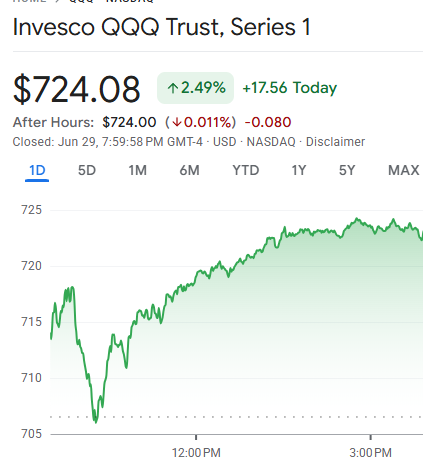
Prof reports that QQQ fell from 718 to 705 before closing at highs near 724, and advises buying in the 10:15 to 11:30 window. The post is a short, self-congratulatory trading tip with no independent analysis.

Original post · 1 min read
$QQQ went from 718 to 705 before closing the day at highs @ 724.

My first post: Avoid buying
My second post: This is where you buy
This post: Happy that I helped.

My third advice: If you're looking at buying, look between 10:15 to 11:30. That window will work more times than not.
Prof @TheProfInvestor
Second advice: This is where you buy.

The gap up: traced all the way down, filled.

Stocks you liked 30 mins ago are 5% lower now twitter.com/TheProfInvestor/status/20715891000…
♥ 301 · ⟲ 13 · 👁 61.5KView on X ↗

Trader Says Chasing Gap-Ups Hurts as Stocks Fall 5 Percent

Trader Says Chasing Gap-Ups Hurts as Stocks Fall 5 Percent

Prof argues that after a gap up traced down and filled, stocks liked 30 minutes earlier are now 5 percent lower, so buyers should wait for support. The post is brief trading commentary with two chart photos.

Original post · 1 min read
Second advice: This is where you buy.

The gap up: traced all the way down, filled.

Stocks you liked 30 mins ago are 5% lower now
Prof @TheProfInvestor
Solid advice that will save you a lot of money:

There is zero reason to be chasing a gap up when indices are below a declining 21EMA.

Either you buy when indices hit support (like they did last week) or you wait for a structure to form.

( Reclaim 21EMA + put a higher low )

Chasing gaps in a downtrend hurts more than it rewards.
♥ 361 · ⟲ 15 · 👁 169.9KView on X ↗

Goldman Sachs Interview Explores Steve Cohen's Trading Mindset

Goldman Sachs Interview Explores Steve Cohen's Trading Mindset▶

Loofy shares a 24-minute Goldman Sachs interview with Point72 founder Steve Cohen on how he reads markets and what separates great traders. The post also promotes a separate clip about Fernando De Leon's real estate investing.

Original post · 1 min read
This Goldman Sachs interview with Steve Cohen teaches you more about the mindset of a great trader than any course on strategy.

The Point72 founder explains how he reads markets - and how he applies it to running the Mets.

24-min with Goldman on what actually separates great traders from the rest.

bookmark & watch - a rare look inside the mind of a trading legend.
Loofy @Loofyb0i
Goldman Sachs pushed him out. He turned $100,000 into a billion dollars betting on boring businesses nobody else wanted.

Fernando De Leon started buying real estate in his 20s and never stopped.

13-min and you'll see how the dullest businesses build the biggest fortunes.

bookmark & watch
♥ 546 · ⟲ 62 · 👁 146.5KView on X ↗

Meta's $900M Cred Investment Signals WhatsApp Payments Push

Meta's $900M Cred Investment Signals WhatsApp Payments Push

Sugandha argues Meta's $900M investment in Indian fintech Cred, alongside CEO Kunal Bahl joining to lead WhatsApp, points to plans to expand WhatsApp into a full payments product. The analysis cites India's UPI volumes and microtransaction growth as the rationale.

Original post · 2 min read
It’s not that complicated. WhatsApp may seem like a global product but effectively it’s not. India is WhatsApp’s only “viable” market, with both the numbers and the consumer habits to make it a possible lifeboat for Meta’s otherwise flailing position as a tech company. Kunal himself has commented previously on India being the world’s DAU farm (which is true).

WhatsApp has already maxxed out its business product in India (no other country’s consumer or regulatory bodies would permit or tolerate the level of spam India deals with on WhatsApp) as well as its ads product (there are ads even between stories now, ffs, in a private messaging app).

The only lever that is yet to be maxxed out is its payments product which launched in India a few years back. Considering the growth of India’s digital microtransaction economy and corresponding consumer habits, it’s tempting to consider that WhatsApp has the chance to outdo every payment product in the region.

All of this narrows down the executive search quite a bit. The $900M investment is not only for Kunal, it’s for the intellectual property he brings about India’s fintech (a headache for global executives everywhere) and Indian consumer habits, from the homegrown CRED. It’s actually a small price considering UPI hit ~230B transactions last year, 33% increase y-o-y. I believe the microtransaction economy is projected to reach $600B in less than a decade. If that’s even fractionally true, it’s a small price for a strong hire. About half of that $900M is going to be new fuel for the company (which will certainly buy CRED good runway), the rest helps investors get an exit.

I surmise WhatsApp is planning to become a fullblown payments product. Messaging + microtransactions has anyway been the trend in Indian consumer products. Bad news for the local fintech startup economy. Worse news for the consumer, imho.

It may be time for someone to build the next messaging app for friends and families. It’s been a while.
Sheel Mohnot @pitdesi
Very interesting- single person acquihire sorta

Meta invests $900M in Indian Fintech Cred at $4.5B valuation (mix of primary and secondary)

CEO @kunalb11 steps down, joins Meta to lead WhatsApp (from India??? It is WhatsApp’s biggest market by a long shot) twitter.com/jbahrdestefano/status/206907856571…
♥ 859 · ⟲ 120 · 👁 149.9KView on X ↗

Lloyd Blankfein Details Concentrated, Daily Personal Trading Approach

Lloyd Blankfein Details Concentrated, Daily Personal Trading Approach▶

Goshawk Trades relays Lloyd Blankfein's account of managing his own portfolio, which is 98% risky assets concentrated in big tech, energy and financial services, traded daily from an iPad and phone. Blankfein says he has outperformed the market.

Original post · 1 min read
Lloyd Blankfein, former CEO of Goldman Sachs, broke down his entire personal trading setup:

portfolio: 98% risky assets. 75-90% single stocks. mostly big tech hyperscalers plus "second tier" names slightly below blue chip.

"i invest in risky assets. that's what's fun for me."

"do you have a team? oh, just me."

hardware: no computer. an iPad and a phone.

information source: texting and calling people.

"somebody will text me. i'll text them. then i'll get tired of tapping things out because of my fat fingers. so i just call people up."

frequency: trades every single day. multiple times.

"it's taking a lot of discipline not to look at my screen while i'm talking to you right now."

"some people listen to music. to me, the market is like music. it's out there. it's going on."

has he outperformed the market? "yes, i have for a while. it's because of where i focused, tech, energy, and financial services. i know a lot about financial services having been in financial services."

the former CEO of Goldman Sachs. manages his own money. on an iPad. alone. focused on three sectors he actually knows. and beats the market.

sometimes the edge isn't the model. it's 40 years of pattern recognition and a phone full of the right contacts.
♥ 2.8K · ⟲ 201 · 👁 1.1MView on X ↗

Analysts Make Case That SpaceX IPO Valuation at $1.77 Trillion Is Cheapest Ever

Fireside Notes summarizes an 80-minute BG2 podcast discussion with Brad Gerstner and Gavin Baker arguing the $1.77 trillion SpaceX IPO is the cheapest it will get, citing AI compute revenue from Anthropic and Google deals and orbital data center economics.

Original post · 4 min read
The $SPCX IPO prices todays at $1.77 trillion. Brad Gerstner (@altcap) and Gavin Baker (@GavinSBaker) just spent 80 minutes on @BG2Pod making the case for why that's the cheapest it's going to get.

Here are the 10 takeaways worth saving:

1. In 30 days, SpaceX added $29 billion in AI compute revenue from the Anthropic and Google deals and jumped from not being an AI hyperscaler at all to being the #4 hyperscaler globally, passing Oracle. The trailing multiple compressed from ~100x to 39x in the same window. CoreWeave, Nebius, Iron and the 50 other neoclouds VCs are funding in Silicon Valley are now competing for a smaller slice of what's left.

2. xAI's Google deal generates more operating profit per gigawatt than Anthropic, Meta, Google or OpenAI's own infrastructure. Freda at Altimeter calculated a 55% IRR on Colossus 1. Borrow at 7%, invest at 55%, the math maths. Jensen called the build itself an "N of 1": 100,000 GPUs is normally a 3-year planning cycle plus 1-year deployment. xAI did it in 19 days. Speed is literally cost.

3. The premium Google is paying SpaceX for terrestrial compute is partly a call option on orbital. They want first-in-line when space data centres go live, so they're overpaying today to lock in the relationship.

4. Orbital compute costs about $5 billion per gigawatt of capex to put GPUs in space, vs $20-25 billion per gigawatt for the non-silicon half on the ground (land, power, cooling, switchgear). Space, power and cooling are effectively free up there. The unlock is rapid two-stage reusability of Starship, which takes launch from $1,500 per kg on Falcon to $250 per kg and eventually asymptotes to the cost of fuel. Elon says 3 years, Bezos says 6, truth is probably 4-5.

5. Starlink is at less than 1% global household penetration. The forecast going from $10bn to $50bn in connectivity revenue by 2028 is still only 0.3% of the global telecom market. TAM is not the constraint.

6. The most underrated piece of the IPO is the Cursor acquisition. Cursor and Anthropic each hold more proprietary coding tokens than exist on the public internet combined. xAI bought 700-800 people and a frontier-quality coding dataset, dropped it into Colossus 2 for 3 weeks of training, and Composer 2.5 went pareto-dominant on coding 12 days ago. Grok 4.3, a 1.5 trillion parameter model, is also currently on the pareto frontier. There are now four frontier labs, not three: xAI alongside Google (Gemini 3.1 Pro), Anthropic and OpenAI.

7. Anthropic just shipped Fable 5 (Mythos with safety classifiers). Karpathy says it's SOTA on benchmarks but the real unlock is long-running tasks. Stripe refactored a 50 million line Ruby codebase in a day. Used to take many weeks with many engineers. Noam Brown's corollary: snapshot benchmarks are dead. The x-axis now has to be time, tokens or compute, because frontier models can solve most problems if you let them run long enough. Nobody has ever run Mythos for a year continuously. We may never actually know how smart any given generation is.

8. The cleanest framing of the long-running thesis: imagine Albert Einstein, no need to eat, sleep, or age, thinking about one problem in fundamental physics for one straight year. That's the case for spending $1.5 trillion a year on compute.

9. The frontier captures ~90% of AI revenue. Open source captures ~80% of tokens. Both are true. The market priced one and missed the other. The bear case last year was that cheap open-source tokens would close the gap. Six months in, the frontier is extending its lead instead.

10. Capex for the hyperscalers is moving from $1.1T to ~$1.5T by 2027 (Morgan Stanley revised up). Inference revenue is projected at $300B by 2027 with 60-70% gross margins and roughly 35% of capex going to non-revenue training runs. Brad thinks $300B is low and we end this year at $200B+. Meanwhile Nvidia has not been losing share to ASICs. Once you adjust for Anthropic on TPUs, Nvidia has held or expanded against Broadcom, AMD, Cerebras, MTIA and OpenAI's Jalapeno. Tokens-per-watt is revenue-per-watt in a power-constrained world.

Bonus: The MAG 7 added $1 trillion of revenue over the last 7 years and that produced $17 trillion of market cap. The forecast: SpaceX, Anthropic and OpenAI add the next $1 trillion in revenue in 4-5 years. Three companies, half the time.
Bg2 Pod @BG2Pod
BG2 w/ Gavin Baker. The SpaceX IPO, Fable 5 / Mythos, AI Capex Update & Market Check. 🚀💰 @BG2Pod @altcap @GavinSBaker @_clarktang
♥ 128 · ⟲ 17 · 👁 51.3KView on X ↗

SpaceX Unveils AI1 Orbital Data Center Satellite Ahead of Public Offering

SpaceX Unveils AI1 Orbital Data Center Satellite Ahead of Public Offering▶

Vaibhav Sisinty reports SpaceX unveiled AI1, a satellite designed to run AI compute in orbit using free solar power and radiative cooling, with plans for a constellation of up to a million units. The post ties the announcement to SpaceX's public listing targeting about $1.75 trillion.

Original post · 1 min read
Okay this is genuinely insane.

SpaceX just unveiled a satellite whose only job is to run AI. Not internet. Not GPS. Just compute, floating in orbit.

It's called AI1, and the reason behind it breaks your brain.

AI data centers on Earth are hitting a wall, not a chip wall, a physics wall.

They need staggering amounts of power and water just to stay cool, and we're running out of grid and land to build them.

So Musk's answer is: stop building them on Earth.

In orbit, the sun never sets. Free power, 24/7. No water for cooling, you just radiate heat into the vacuum of space. The two things choking AI on the ground barely exist up there.

And here's the wild part: Musk says it's easier to build than a Starlink satellite. Strip out the complex antennas and it's "a lot of solar cells, a radiator, and some laser links."

One AI1 carries the compute of an Nvidia GB300 rack, the same hardware data centers fight over down here.

AI1 is just the first one. The plan is a constellation of up to a million of them.

And the timing isn't an accident, SpaceX goes public this week at a ~$1.75 trillion target. This isn't a rocket company anymore. It's positioning itself as the power grid for AI, in space.

The race for AI compute just left the planet. Literally.

@SpaceX
♥ 17.5K · ⟲ 2.8K · 👁 4.8MView on X ↗

Trader Promotes 21-Day EMA Strategy for Riding Trending Stocks

Trader Promotes 21-Day EMA Strategy for Riding Trending Stocks

Prof Investor argues that buying trending stocks at the daily 21-period EMA and riding them until the trend breaks is a sufficient strategy, citing several tickers as examples. The post is promotional trading commentary with charts and no performance evidence.

Original post · 1 min read
If all you ever did was:

1. Find trending stocks
2. Buy them at daily 21EMA
3. Ride them until it breaks

you'd not have to worry about what others think of a stock.

Study: $SIVE $INTC $MRVL $MU $NOK $SNDK

All trends start at 21EMA.
All of them.
♥ 1.0K · ⟲ 90 · 👁 74.6KView on X ↗

Early Anthropic Employee Equity Estimated at $125 Million to $250 Million

Rohit Mittal estimates the value of Anthropic employee equity from 2024 compensation packages, suggesting $500,000 per year over four years could now be worth $125 million. He argues the scale of startup wealth creation exceeds the dot-com era.

Original post · 1 min read
If an Anthropic employee got $500k/year in equity over 4 years in 2024, they are now worth $125M.

At $1M/year equity for 4 years, they are worth about $250M.

The scale and speed of wealth creation are incomprehensible.

$500k/year equity is not a lot for an early-stage startup. I don't think the Bay Area has seen this type of wealth creation in history.

Dot com boom probably feels like a speck of dust.
♥ 3.6K · ⟲ 130 · 👁 712.1KView on X ↗

Trader Credits Claude With Profitable HPE Options Pick

Trader Credits Claude With Profitable HPE Options Pick

Brandon Doyle says he asked Claude for a stock endorsed by the President with upcoming earnings, and bought HPE call options on its advice. He reports the options gained about $5,000 after the company reported strong results.

Original post · 1 min read
I asked @claudeai (since it’s performing the best in my AI investing challenge) what stock to buy that the President has endorsed whose earnings were coming up. Thesis was that other recently endorsed companies have been crushing earnings. Anyway, it told me to buy call options expiring this week for Hewlett Packard $HPE - so I bought a few. Should’ve bought way more lol 😂. Stock just reported earnings and is up a ton after hours. My few options are up $5,000 (thanks @AnthropicAI) - see screenshot 💰
♥ 26 · ⟲ 1 · 👁 8.0KView on X ↗

Levelsio Argues Luxury Hotels Deliver Poor Value Based on Ratings

Levelsio Argues Luxury Hotels Deliver Poor Value Based on Ratings

Levelsio argues luxury hotel chains like Aman and Ritz-Carlton earn lower guest ratings than their prices suggest, citing data from his hotelist.com stats page. He recommends Okura, Minor, Melia and Marriott as better value.

Original post · 1 min read
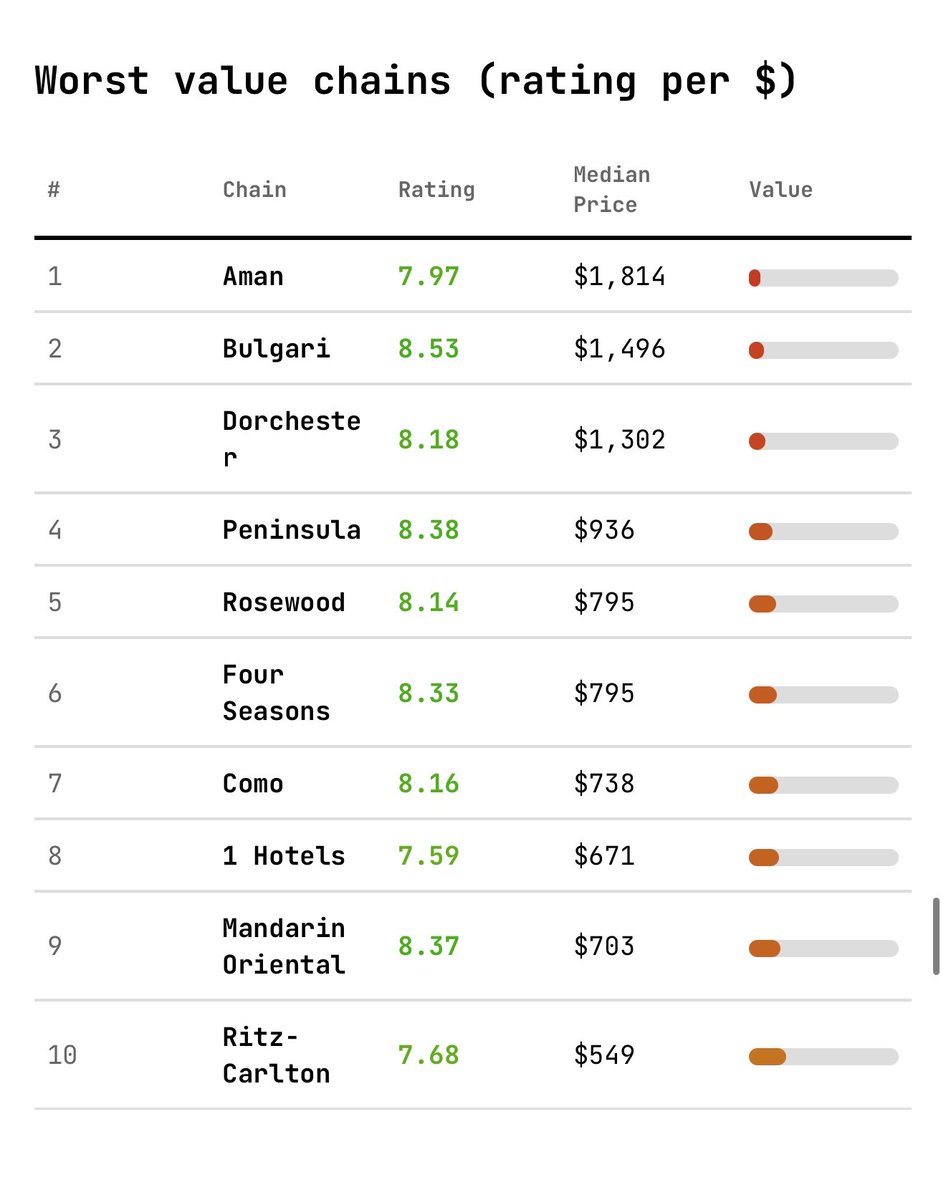
Agreed, and I can prove that luxury hotels are mathematically literally very bad value

For the amount of "more" money you pay for this luxury, you should be getting way way way more than you actually get (as measured by ratings)

Aman should have an average rating of 9.5 but in reality barely hits an 8 on average, so they simply cannot produce the "luxury" experiences they are trying to market and brand themselves for

It's essentially all smoke and mirrors, and reflects my experiences completely, you pay 10x more and get either 0.5x-1.5x more (eg many times 2x worse, sometimes a bit better) not 10x better!

Other luxury chains are slightly better but none of them even get close to a 9 rating with the famous Ritz-Carlton being especially bad: its average rating is a 7.68 for a median price of $549/night, terrible!

Real value can be found with Okura, Minor, Melia and even Marriott. Okura is interesting because well known as luxurious but median only $143/night

So as I always say, luxury is mostly a scam, it doesn't exist and you're best off spending much less for much better value (and often better experiences too)

Source: my new site stats page hotelist.com/stats
Kevin Dahlstrom @Camp4
I’m a travel snob and used to stay at these hotels.

But prices have become absurd—often $3k/night for a basic room.

What’s worse, these resorts insulate you from the place you’re visiting.

Find a locally-owned boutique and save your money for experiences outside the property. twitter.com/quotesdaily100/status/205975215705…
♥ 2.3K · ⟲ 119 · 👁 2.4MView on X ↗

Rekt Fencer Warns SpaceX, OpenAI and Anthropic IPOs Could Pressure AI Stocks

Rekt Fencer Warns SpaceX, OpenAI and Anthropic IPOs Could Pressure AI Stocks▶

Rekt Fencer argues that simultaneous IPOs from SpaceX, OpenAI and Anthropic would flood markets with about $200 billion of new supply, potentially forcing sales of crowded AI chip stocks such as NVIDIA, SK Hynix, Micron and Intel.

Original post · 1 min read
🚨 THIS IS NOT LOOKING GOOD

SpaceX, OpenAI, and Anthropic will go public at the same time.

That will force the market to absorb $200 BILLION of new supply.

When that happens, funds don't find new money out of thin air.

They sell what has already gone up.

NVIDIA, SK HYNIX, Micron, INTEL: those are the bags that will get cut first.

And if the leaders dump, the S&P 500 dumps with them.

We saw the same pattern after COVID.

Hype IPOs flooded the market --> liquidity got tighter --> air came out fast

This time, the AI bottleneck trade looks even more crowded.

Watch the upcoming IPOs closely.

That's where you may first see what the market is forced to sell.
♥ 3.1K · ⟲ 417 · 👁 2.4MView on X ↗

60 Minutes Reports Polymarket Accounts Won 98% on Military Bets

60 Minutes Reports Polymarket Accounts Won 98% on Military Bets▶

60 Minutes quotes Bubblemaps co-founder Nicolas Vaiman saying nine connected Polymarket accounts collectively made $2.4 million betting almost exclusively on U.S. military operations, with a 98% win rate. The story is shared as a video segment.

Original post · 1 min read
“We spotted nine Polymarket accounts, all connected, who made, collectively,$2.4 million betting almost exclusively on U.S. military operations,” says Nicolas Vaiman, co-founder of the small data analytics firm Bubblemaps.

“And now here's the crazy part: 98% win rate.” cbsn.ws/4wwp0T7
♥ 20.3K · ⟲ 5.7K · 👁 3.9MView on X ↗

Options Trader Argues for ServiceNow LEAP Over Shares

Options Trader Argues for ServiceNow LEAP Over Shares

Jason Luongo lays out a trade comparing 100 ServiceNow shares with a June 2027 $80 call LEAP, citing Q1 revenue growth of 22%, rising AI contract value and a 14% post-earnings pullback. He notes the LEAP risks losing its full premium and includes a not-financial-advice disclaimer.

Original post · 1 min read
You could buy 100 shares of $NOW right now for $9,497.

Or you could buy the $80 call LEAP expiring June 2027 for $3,265. Same directional exposure for 66% less capital.

Strike: $80
Expiration: June 17, 2027
Premium: ~$32.65 per contract
Breakeven: $112.65

If $NOW hits $115, this LEAP returns ~7%
If $NOW hits $130, this LEAP returns ~53%
If $NOW hits $145, this LEAP returns ~99%

100 shares at $145 returns ~53%. The LEAP nearly doubles.

Why I like the setup:

- Q1 revenue hit $3.8B, up 22% year over year
- Now Assist AI is tracking toward $1.5B in annual contract value, up from a $1B internal target
- AI customers spending over $1M in ACV grew over 130% year over year
- Raised full-year subscription guidance to $15.755B
- Stock pulled back 14% after Q1 on geopolitical headwinds - potential oversold entry point
- 398 DTE gives you time through multiple earnings cycles

The max you can lose on a LEAP is the entire premium you paid. In this case, that's $3,265 per contract. LEAPs are leveraged and can lose value quickly if the stock drops or stays flat. Only size this so you're comfortable losing all of it.

Note: LEAPs are one tool inside a broader portfolio. Owning shares is always the primary use of capital. This is a selective add-on for high-conviction moments when conditions align.

NFA DYOR
♥ 1.6K · ⟲ 127 · 👁 339.9KView on X ↗