Thursday, October 8, 2026ArchiveSearchAsk the paper

The Computomatix Times

All the posts fit to save — curated from @computomatix's bookmarks & likes on X

Culture & Ideas

Careers, essays, history, media and life

Lenny Rachitsky Opens Up About His Life in First Round Profile

Lenny Rachitsky Opens Up About His Life in First Round Profile

Lenny Rachitsky shares a First Round Review profile in which a writer spent hours at his home discussing why he started his newsletter, what motivates him, and personal details rarely shared publicly.

Original post · 1 min read
I rarely do interviews or talk about my personal life, but I made an exception for the team at @firstround.

Their writer spent hours at my house. We talked about why I started Lenny's Newsletter, what motivates me to keep building it, and a lot of things I don't usually share publicly.

It's an intimate look at what my life is actually like outside of what most people see on the podcast.

Check it out: review.firstround.com/reluctantly-influential-…
♥ 681 · ⟲ 45 · 👁 103.1KView on X ↗

Jack Dorsey and Sequoia Essay Traces Org Design From Roman Army to AI

From Hierarchy to Intelligence

Jack Dorsey's X article, published with Sequoia, traces the history of organizational hierarchy from the Roman legion through the Prussian General Staff. It argues AI can fundamentally rethink how companies coordinate, with speed as a compounding advantage.

Original post · 12 min read
X ArticleFrom Hierarchy to Intelligence
At Sequoia, we see that speed is the best predictor of start-up success. Most companies are focused on AI as a productivity enhancer. Few are focused on the potential of AI to change how we work together. Block is showing what it looks like to fundamentally rethink organization design, ultimately harnessing AI to increase speed as a compounding competitive advantage.
Two thousand years before the first corporate org chart, the Roman Army solved a problem that every large organization still faces: how do you coordinate thousands of people across vast distances with limited communication?
Their answer was a nested hierarchy with a consistent span of control at every level. The smallest unit was the contubernium, eight soldiers who shared a tent, equipment, and a mule, led by a decanus. Ten contubernia formed a century of eighty men under a centurion. Six centuries made a cohort. Ten cohorts made a legion of roughly 5,000. At each layer, a named commander held defined authority, aggregated information from below, and relayed decisions from above. The structure (8 → 80 → 480 → 5,000) was an information routing protocol built around a simple human limitation: a leader can effectively manage somewhere between three and eight people. The Romans discovered this through centuries of warfare. Even today, the US Army's hierarchical chain follows a similar pattern. We now call it "span of control," and it remains the governing constraint of every large organization on earth.
The next big change came from Prussia. After Napoleon's army destroyed the Prussian forces at the Battle of Jena in 1806, a group of reformers led by Scharnhorst and Gneisenau rebuilt the military around an uncomfortable truth: you cannot depend on individual genius at the top. You need a system. They created the General Staff, a dedicated class of trained officers whose job was not to fight but to plan operations, process information, and coordinate across units. Scharnhorst intended these staff officers to "support incompetent Generals, providing the talents that might otherwise be wanting among leaders and commanders." This was middle management before the term existed. Professionals whose purpose was to route information, pre-compute decisions, and maintain alignment across a complex organization. The military also formalized the distinction between "line" and "staff" functions. Line advances the core mission. Staff provides specialized support. Every corporation still uses this vocabulary today.
Military hierarchy entered the business world through the American railroads in the 1840s and 1850s. The U.S. Army lent West Point-trained engineers to private railroad companies, and these officers brought military organizational thinking with them. Staff and line hierarchies, divisional structure, bureaucratic systems of reporting and control: all of it was developed in the military before the railroads adopted it. In the mid-1850s, Daniel McCallum of the New York and Erie Railroad created the world's first organizational chart to manage a system stretching over 500 miles with thousands of workers. The informal management styles that worked for smaller railroads were failing. Train collisions were killing people. McCallum's chart formalized the same hierarchical logic the Romans had used: layers of authority, defined reporting lines, structured information flow. It became the blueprint for the modern corporation.
Frederick Taylor (1856-1915), often called the "Father of Scientific Management," optimized what happened within that hierarchy. Taylor broke work into specialized tasks, assigned them to trained experts, and managed through measurement rather than intuition. This produced the functional pyramid organization - a structure optimized for efficiency within the information routing system that the military had pioneered and the railroads had commercialized.
The first real stress test of functional hierarchy came during World War II. The Manhattan Project required physicists, chemists, engineers, metallurgists, and military officers to work across disciplinary boundaries toward a single objective under extreme secrecy and time pressure. Robert Oppenheimer organized Los Alamos into functional divisions but insisted on open collaboration across them, resisting the military's instinct to compartmentalize. When the implosion problem became critical in 1944, he reorganized the lab around it, creating cross-functional teams unlike anything in corporate America at the time. It worked, but it was a wartime exception led by a singular figure. The question the postwar business world faced was whether that kind of cross-functional coordination could be made routine.
With the growth and globalization of companies after World War II, the scale limitations of functional design became acute. In 1959, McKinsey's Gilbert Clee and Alfred di Scipio published "Creating a World Enterprise" in the Harvard Business Review, providing an intellectual framework for a matri… continue on X ↗
♥ 11.1K · ⟲ 1.8K · 👁 6.5MView on X ↗

Tony Fadell Argues Product Management and Marketing Should Be One Job

Former Apple engineer Tony Fadell argues that splitting product management and product marketing is a mistake, citing Steve Jobs and Greg Joswiak's customer empathy as the model for owning both the product and its story.

Original post · 1 min read
Most tech companies break out product management and product marketing into two separate roles: Product management defines the product and gets it built. Product marketing wires the messaging- the facts you want to communicate to customers- and gets the product sold. But from my experience that's a grievous mistake. Those are, and should aways be, one job.

There should be no separation between what the product will be and how it will be explained- the story has to be utterly cohesive from the beginning. Your messaging is your product. The story you're telling shapes the thing you're making.

I learned story telling from Steve Jobs. I learned product management from Greg Joswiak. Joz, a fellow Wolverine, Michigander, and overall great person, has been at Apple since he left Ann Arbor in 1986 and has run product marketing for decades. And his superpower- the superpower of every truly great product manager- is empathy. He doesn't just understand the customer. He becomes the customer.

So when Joz stepped into the world with his next-gen iPod to test it out, he fiddled with it like a beginner. He set aside all the tech specs- except one: battery life.

The numbers were empty without customers, the facts meaningless without context.

And, that's why product management has to own the messaging. The spec shows the features, the details of how a product will work, but the messaging predicts people's concerns and finds way to mitigate them.

- #BUILD Chapter 5.5 The Point of PMs
♥ 2.7K · ⟲ 255 · 👁 949.4KView on X ↗

Sajith Pai Shares Advice on Breaking Into Venture Capital

Indian VC Sajith Pai endorses a 2011-era essay by Bill Gurley on entering venture capital and points to his own guide on breaking into Indian VC. He summarizes that VC firms hire people who can persuade elite founders to take their capital.

Original post · 1 min read
This is great advice from @bgurley on getting into VC.

I wrote a post, my version, on how to break into (India) VC a couple of years back: linkedin.com/pulse/breaking-vc-rough-guide-saj…

In that I write
1/ Top-tier VC is capital sales to elite founders who have choice of who to take capital from
2/ VC firms want candidates who will be able to connect, engage and persuade these elite founders to take their capital
3/ When you apply to VC funds, the more you are able to signal (via content, past work, research, and interview performance) that you will be able to connect / engage / persuade these elite founders, the more likely you will get in (or even get to be interviewed). I share a playbook on how you can add or enhance these signals.

Do read the Gurley piece below. I definitely plan to read the book he recommends, and if you are looking to break into the Indian industry do check my piece out as well.
Bill Gurley @bgurley
"So You Want to be a VC"

Im enjoying this week in Boston visiting students promoting my new book - Runnin Down a Dream. Not surprisingly, many ask me about trying to break into venture capital. I wrote a letter answering this question 15 years ago. I would send it out when people inquired. I'm making it public for the first time - with zero modifications.

1) I think it holds up well
2) make sure and read my new book also
3) I probably can't help with followups (as suggested in the letter)

Hope you find it useful. Good luck!
linkedin.comBreaking into VC: The Rough GuideA question I get asked all the time, in emails or social DMs or in person sometimes, is about how to break into VC or Venture Capital. After all it is seen as a
♥ 259 · ⟲ 21 · 👁 48.5KView on X ↗

Product Manager Says Builder Role Replaces Traditional PRD Work

Moe Ali relays an account of an AI product manager at a frontier lab who no longer writes PRDs, instead prototyping with Claude Code, running evals and shipping reference implementations. The post argues PMs should act as builders with agents.

Original post · 2 min read
Just talked to an AI Product manager making $375K at a frontier lab.

She hasn't written a PRD in 8 months.

Not "she uses AI to help write them faster." She has not opened a PRD template in eight months because she just doesn't need it anymore.

Her day looks nothing like what PMs do:

She wakes up, opens Claude Code, and has a working prototype running before her first meeting of the day (not a wireframe or a figma mockup someone needs to hand off to an engineer). A testable version of the idea - built/shipped by her in the same morning.

While that prototype is running, she's pulling model outputs and running evals. She knows what hallucination looks like in her specific use case. She knows what latency threshold breaks the user experience. She knows the token cost per query and what that means for margin at scale.

She reasons about infrastructure the way a CFO reasons about a P&L. When something needs to be built for real, she doesn't go write a ticket and wait two sprints. She ships the first version herself. hands it to engineering as a working reference implementation, not a requirements doc full of edge cases nobody reads.

The meetings she's in aren't about alignment. They're about what's already shipped and what's blocking the next thing.

Her mental model isn't:

- "manage the roadmap."
- "be the voice of the customer."
- "facilitate cross-functional collaboration."

Those aren't wrong exactly, they're just from a different era.

The mental model that gets you to $480K at a frontier lab in 2026 is simpler and harder at the same time:

- You are the builder.
- The agents are your team.
- Your job is to ship.

She said the output gap between PMs who operate this way and PMs who don't is already 3 to 4x. And this is inside a lab where literally everyone around her is working the same way.

Here's the thing nobody wants to say out loud: the "I write specs and run standups" PM isn't being replaced by AI. The job isn't disappearing into a chatbot. It's being absorbed by the PM sitting two desks over who stopped waiting for engineers and started building herself.

Really crazy how fast the job description changed and really crazy how few people have noticed.
♥ 1.1K · ⟲ 75 · 👁 193.9KView on X ↗

Post Reports Stanford CS Class of 2026 Has Low Placement Rate

A Kalshi Finance post claims only 18 of 312 Stanford CS graduates have full-time offers and attributes the decline to AI replacing engineering roles. The figures and anecdotes are unverified and the post is written in a sensational tone.

Original post · 1 min read
Stanford CS graduating class of 2026 just got their final placement statistics

Out of 312 graduates: 18 have full-time offers

That's a 5.8% placement rate from the most prestigious CS program in the fucking world

2019 placement rate was 94%. 2022 was 78%. 2024 was 31%. Now this.

The other 294 are fighting over 47 internships that require "3+ years production experience"

Career services is telling them to "consider adjacent fields" while the department just took a $50M donation from a company that replaced 2,400 engineers with Claude

One kid showed me his rejection tracker: 1,247 applications since September. 12 phone screens. Zero offers.

His parents refinanced their house for his tuition

The career fair had 8 companies and 300 desperate students in $180k of debt

Meanwhile the CS department just announced they're expanding their PhD program because "industry demand for AI research has never been higher"

The same week they sent acceptance letters to 89 new undergrads

These kids thought they were learning to be engineers. Turns out they were training to be obsolete.
♥ 6.4K · ⟲ 1.6K · 👁 3.0MView on X ↗

Seduction Palace Post Claims Sex Therapist Distinguished Intimacy Types

Helen Casanova of Seduction Palace shares a promotional post claiming a sex therapist explained a difference between making love and sex, and that women crave both at different moments. The text offers little substantive detail.

Original post · 1 min read
A famous sex therapist explained the difference between making love and f#cking.

Women crave both at different moments.

Bedroom kings know when to give each.

Here’s how....
♥ 4.4K · ⟲ 231 · 👁 1.2MView on X ↗

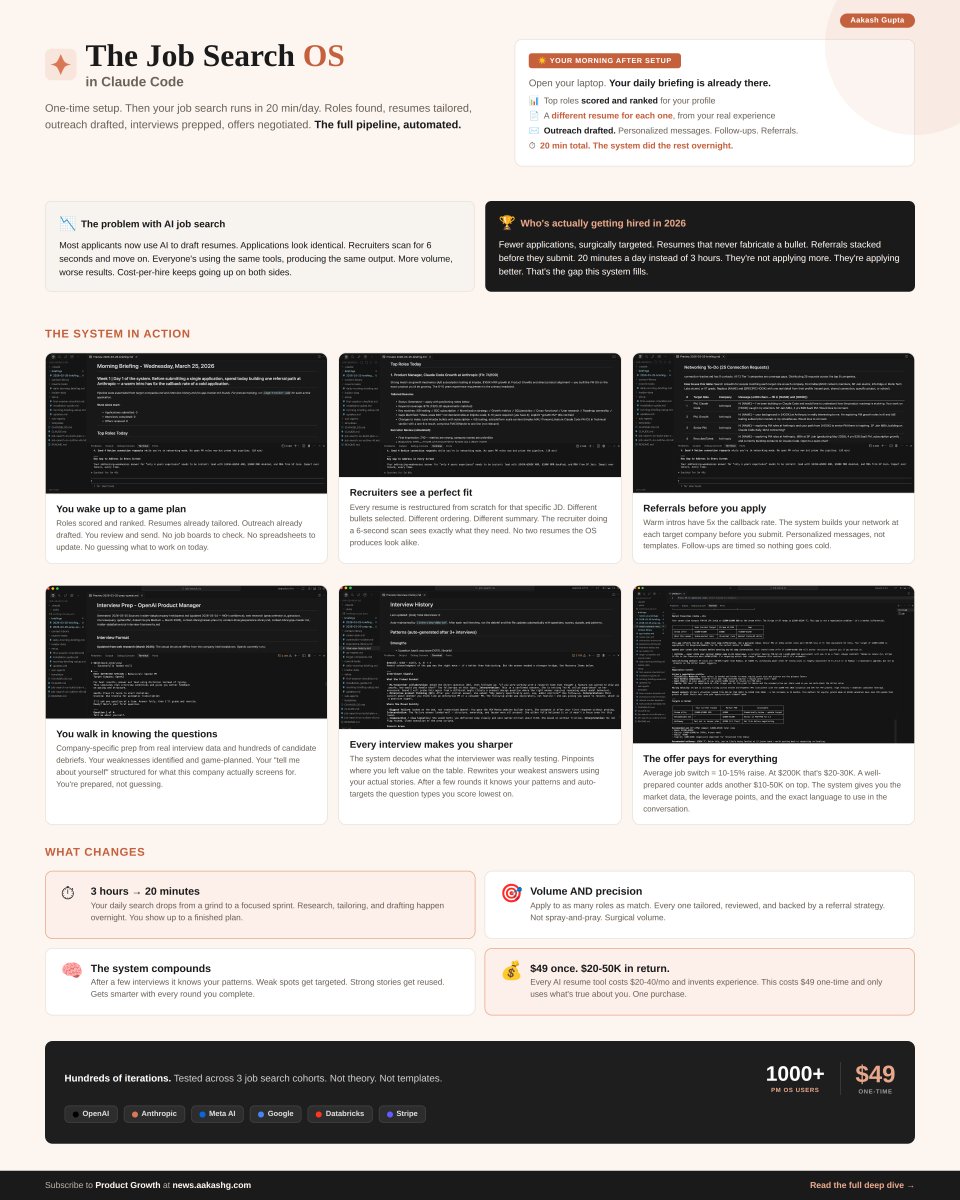
Job Search Coach Pitches Referral-First Strategy and $49 AI Job Search System

Job Search Coach Pitches Referral-First Strategy and $49 AI Job Search System

Aakash Gupta, who says he has placed candidates at OpenAI, Anthropic, Google and others, argues that referrals and tailored prototypes beat cold applications. He promotes a $49 system of 18 Claude Code skills for resumes, interview prep and networking.

Original post · 2 min read
I've placed people at OpenAI, Anthropic, Google, Meta AI, Databricks, and Stripe in the last year. They all did the same thing that 90% of job searchers skip.

They built referral paths before submitting a single application.

The average cold application callback rate in 2026 is around 2-4%. With a warm intro, it's 5x that. Every candidate I coached who got an offer at a top company had a referral on file before the resume went in. Every single one.

But here's what most people get wrong about networking for jobs. They send "I'd love to pick your brain" to strangers. One message, no follow-up, silence forever. The people who land offers send 25 personalized connection requests per week, rotate across target companies, follow up on day 3, 7, and 14, and ask for the referral only after building context.

The resume game broke too. I tested every paid AI resume tool on the market ($20-40/mo). They all do one of two things: invent experience you don't have (which gets you blacklisted when the interviewer checks) or swap keywords on a generic template (which recruiters now spot in a 6-second scan).

The move almost nobody makes: a 1-pager analyzing the company's product + a working prototype of your recommendation. 90 minutes. I've seen this land interviews where cold applications failed completely. The catch is specificity. If it could've been written for any company, a hiring manager told me it's actually a negative signal.

I spent 6 months building a system that automates all of this. 18 Claude Code skills. Resume tailoring from your real experience only. Interview prep with insider data from 250 companies. Mock interviews that compound (after 5-6 real interviews, the system knows your weakest question types). Networking sequences. Negotiation.

$49 once. 45-minute setup. Then 20 minutes a day.

Honest caveat: the system is only as good as your experience library. If you skip the 10-minute setup where you load your real career history, every output will be generic. The input is the bottleneck, not the tool.

Full deep dive: news.aakashg.com/p/job-search-os
♥ 426 · ⟲ 46 · 👁 126.0KView on X ↗

Claire Vo Argues Design Teams Lag Behind in Corporate Influence

Claire Vo argues design culture is broken at many companies, with design teams resisting change, lacking political skill in campaigning for resources, and failing to make a quantified case. She responds to a Lenny's Newsletter observation that design hiring stalled as AI speeds up engineering.

Original post · 1 min read
I’ll say the thing no one is saying: design culture is broken in lots of companies.

Often design teams & designers are the most resistant to change org in the EPD triad, with highly vocal AI opponents, and little skill or interest in the art of campaigning for influence or resources. Won’t hold a number like a PM, not yelled at about timelines like engineering. While I have brought design topics to the board convo, not a single board has pressed me our design talent, strategy, or velocity. Most teams treat design like a tax they don’t want to pay, and those that *do* take a deep interest and want to invest in design get back big “get out of my figma” energy. And if you’re too precious about craft to dirty your hands with the dark art of corporate politics, good luck getting more headcount. If a PM or engineer can get 85% there with tailwind and a dream, you better come to the table with more than “I represent the user.”

Great designers are worth more than almost anyone on the team, and I’ve worked with lots of gems, but this is 0% surprising to me.
Lenny Rachitsky @lennysan
I don’t know exactly what’s going on here, but it does feel AI-related. Unlike PM and eng, which started growing in 2024 (two years post-ChatGPT), design didn’t. If I had to venture a theory, I’d say that because AI is allowing engineers to move so quickly, there’s less opportunity—and less desire—to involve the traditional design process.

That said, you’d think design would become a differentiator as more products compete for attention. Something to think about for your company! We’ll keep watching this trend and AI’s impact on org design more generally.

One interesting observation we made …
♥ 819 · ⟲ 62 · 👁 188.4KView on X ↗

Analysis Traces Rohit Sharma's Late-Career Batting Evolution

The Man Who Rewrote His Own Obituary

A cricket analyst examines how Rohit Sharma reworked his batting between 2021-23 and 2024-26 after bowlers began exploiting his weaknesses, citing strike rates, Runs Above Average and pitch maps.

Original post · 6 min read
X ArticleThe Man Who Rewrote His Own Obituary
We've seen that most batters tend to hit a saturation or a dip around the age of 35. And honestly, that's not surprising as it happens with many cricketers. Some choose to retire because the game catches up with them, and some just settle into whatever's left.
As a Rohit Sharma fan for a long time, it was disappointing to see that there was always this expectation, created widely throughout the world, that the same thing would happen with him. And that expectation wasn't wrong either, because the problems were there. He was struggling in the powerplay, with left arm seamers, against slow left arm bowlers. After playing 200 T20s, there is also enough data, enough evidence in your technique and your methodology, for bowlers to finally start figuring you out really well.
And most of the time, players don't really evolve much at that point in their careers. Bowlers know what strategies work against them, the weaknesses become well established.
But what Rohit did was genuinely different.
He looked at that reality and found a way to flip the script in a way that very few batters have ever managed. What happened to Rohit between 2021-23 and 2024-26 is, for me, one of the most remarkable technical and psychological evolutions you'll ever see from a batter at the back end of a legendary career. And the numbers make it very clear.
The Obituary That Was Being Written
Think back to the years 2021-23, Rohit was still a formidable force on the field but behind the scenes, a strategy was developing in dressing rooms across the globe.
Using your slow left-arm orthodox bowlers attack him from around the wicket, keep it on the stumps, and deliver those good-length balls. Guess what? It actually worked.
During that period, Rohit faced left-arm fast bowlers in the powerplay with a strike rate of 103.02, but his Runs Above Average (RAA) was a concerning -7.85. That negative figure is crucial as it shows he was underperforming compared to the average batter against those bowlers. The plan was clearly effective.
Now, when it came to slow left-arm orthodox bowlers, he managed to score 95 runs off 77 balls, with a strike rate of 123. There were control issues, dot balls were piling up, and the bowlers had a clear idea of where to target him. The pitch maps from that time tell the whole story. Good length, right on the stumps. Four dismissals in that one area. Bowlers were lining up to exploit that corridor. When you can dismiss one of the best powerplay batters in the world by repeatedly bowling the same delivery, you keep doing that, right?

The Decision Most Champions Never Make
Most elite batters, when they sense vulnerability, retreat into their strengths. They tend to leave the problem areas alone and hope nobody exploits them.
Interestingly, Rohit made the difficult choice of outsmarting the bowlers, which would later prove to be crucial in India's World cup win in 2024.
The centrepiece of that rebuild? The sweep shot.
Against spin bowlers in 2021-23, Rohit’s sweep was a minor part (18% of runs) of his arsenal. By 2024-26, it accounts for 28.19% of all his runs against spin in the powerplay. That’s a 10% jump. But the biggest revamp was the control percentage: 83.33%, which was around 65% before.
You do not play an attacking shot that contributes nearly a third of your runs against quality spin bowling with 83% control by accident. That takes hours in the nets, tweaking the trigger movement, adjusting the head position, recalibrating the risk-reward every single time.
The SLA Problem and how Rohit solved it
Let’s zoom in on slow left-arm orthodox bowlers, because this is where the story gets genuinely interesting and worth studying.

Against slow left arm bowlers alone, the sweep shot has given him a huge boost. His SR of 167 is 44 points higher than an avg batter against these kinds of bowlers.

8.2% runs in the square leg region in 2021-23 and that number has skyrocketed to 28% of runs in 2024-26. His reverse sweep and late cuts using the pace of the ball also have increased the runs he scores against these bowlers in third man region.
Now add this: that good-length delivery on the stumps that used to be his weakness? The one where four dismissals were logged in that single grid?
Rohit against spin when the ball was bowled on a good length on stump line: He used to play 15% of those balls in the square leg region in 2021-23. During 2024-26 this number has risen to 21.3% which is 8.3% more than an average Right-handed batter against spin on that very line and length.

The 2 key variations of left arm orthodox are both taken to the cleaners now by him. His performance against those 2 types of deliveries has risen significantly.

In 2021-23, when Rohit faced left-arm spin deliveries, he scored 106 runs off 100 balls. Strike rate of 106. Dot ball percentage of 40%. Balls per boundary of 8.33.
By 2024-26: 70 runs off 38 balls. Strike rate of 184.21. Dot ball percentage collapsed to 15.79%. Balls per boundary down to 3.… continue on X ↗

♥ 773 · ⟲ 279 · 👁 296.2KView on X ↗

Aakash Gupta Says AI Product Management Careers Lie Deeper in the Stack

Aakash Gupta Says AI Product Management Careers Lie Deeper in the Stack▶

Aakash Gupta argues that application-layer AI PM roles are crowded and low-ceiling, while higher-paying roles require skills like probabilistic thinking and model evaluation. He promotes a podcast episode with a former AI PM at Netflix, Amazon and Meta.

Original post · 1 min read
The "easiest" path into AI product management is also the most crowded and lowest-ceiling.

There's a stack of AI PM roles. At the top: Application PMs. They own the user experience layer. How users interact with AI, how you build trust, how you make AI reliable for everyday use. This is the closest to traditional product management. And that's exactly the problem.

Every PM repositioning into AI right now is aiming at this layer. They shipped a chatbot feature. They designed an AI-powered search experience. They added "AI" to three bullet points on their resume. The application layer is where the conversion is easiest and the competition is most brutal.

She's been an AI PM at Netflix, Amazon, and Meta. Her breakdown of the full stack on this episode revealed something most career advice skips: the layers below the application tier require fundamentally different skills. Not UX intuition.

Probabilistic thinking. Model evaluation. Understanding why the AI is unreliable, not just managing the user's perception of reliability.

The $900K roles don't live at the layer everyone is rushing toward. They live deeper in the stack, where the supply of qualified PMs drops off sharply.

The roadmap isn't "get into AI PM." It's "get into the right layer."
Aakash Gupta @aakashgupta
AI PMs at Netflix get paid $900K+.

She's been an AI PM at not just Netflix, but also Amazon and Meta. And today, she broke down how you can too:

1:43 Types of AI PMs
7:11 - Technical Concepts Masterclass
58:57 - How to Job Search Well
♥ 28 · ⟲ 1 · 👁 9.1KView on X ↗

Rajdeep Sardesai Shares Uplifting Song Recommendation for Mondays

Rajdeep Sardesai Shares Uplifting Song Recommendation for Mondays▶

Rajdeep Sardesai recommends a four-minute listening session featuring RD and Asha, saying it will lift spirits on a Monday. The post is a personal media recommendation with no broader news content.

Original post · 1 min read
If you have the Monday blues, listen to this for 4 minutes and am sure you’ll smile and feel better! Enjoy the genius of RD and Asha! Pure magic!😃⭐️👍
♥ 5.9K · ⟲ 994 · 👁 272.4KView on X ↗

Sahil Bloom Argues Courage Matters More Than Intelligence

Sahil Bloom writes that intelligence is abundant while courage is scarce, suggesting intelligent people overthink and wait for permission. He concludes that successful people simply acted when others did not.

Original post · 1 min read
The older I get, the more I realize intelligence is overrated. Intelligent people are more likely to overthink, overplan, and overanalyze. They hide behind motion that doesn't create progress. They fear the judgment of others if they're proven wrong.

The truth is that intelligence is abundant. Courage is not. The people you admire are the ones who had the courage to act. They aren’t more talented than you. They aren’t smarter than you. They just took action when you didn’t.

I often wonder how many extraordinary people wasted their entire lives waiting for permission that never came. Permission isn't granted. It's taken. You get to tap yourself in whenever you want. You can just do things.

Courage beats intelligence.
♥ 8.5K · ⟲ 1.1K · 👁 669.7KView on X ↗

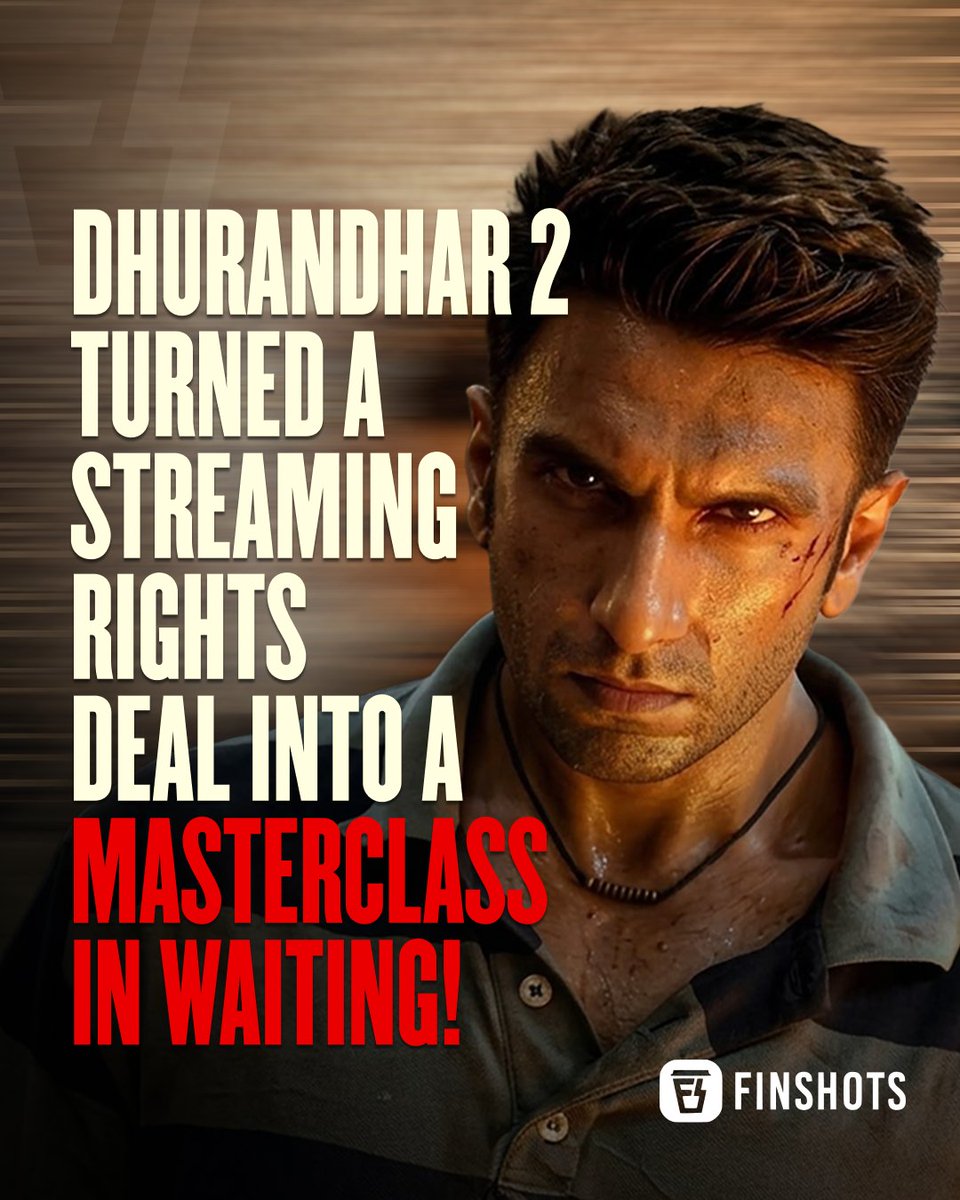
Jio Studios Rejected 175 Crore Offer for Dhurandhar Films, Finshots Reports

Jio Studios Rejected 175 Crore Offer for Dhurandhar Films, Finshots Reports

Finshots posts a thread on the economics of the Dhurandhar films, stating that Jio Studios turned down 175 crore rupees for both films before Part 1 reached theatres. The post includes a photo and no further detail in text.

Original post · 1 min read
Jio Studios turned down ₹175 crore for both Dhurandhar films before Part 1 even hit theatres! Here is how the economics of the Dhurandhar films is a pure masterclass 🧵
♥ 1.2K · ⟲ 72 · 👁 311.5KView on X ↗