Wednesday, October 7, 2026ArchiveSearchAsk the paper

The Computomatix Times

All the posts fit to save — curated from @computomatix's bookmarks & likes on X

Startups & Products

Launches, founders, growth and building companies

Open-Source AI Skill Packages Nikita Bier's Viral App Playbook

Tibo announces a free, open-source AI skill that turns Nikita Bier's consumer app growth framework into a tool for analyzing an app and recommending fixes, metric checks and a yes/no test. The skill is linked at tmaker.io and promoted in an upcoming newsletter.

Original post · 1 min read
Nikita Bier charges $500 a minute for advice

and only takes calls with VC-backed founders

so we turned his whole consumer app playbook into a free, open-source AI skill for the rest of us

describe your app to your agent and it tells you:

- which rung of his ladder you're stuck on
- which of your numbers you can't trust yet
- what to fix first, then 2-3 big bets
- one test with a yes/no threshold, set before you run it

it's in tomorrow's newsletter 👇

✨ tmaker.io ✨
Tibo @tibo_maker
this is how Nikita Bier builds viral apps
♥ 70 · ⟲ 5 · 👁 10.3KView on X ↗

Freddy Fang Shows Apple Ads Conversion Varies Sharply by Market

Freddy Fang Shows Apple Ads Conversion Varies Sharply by Market

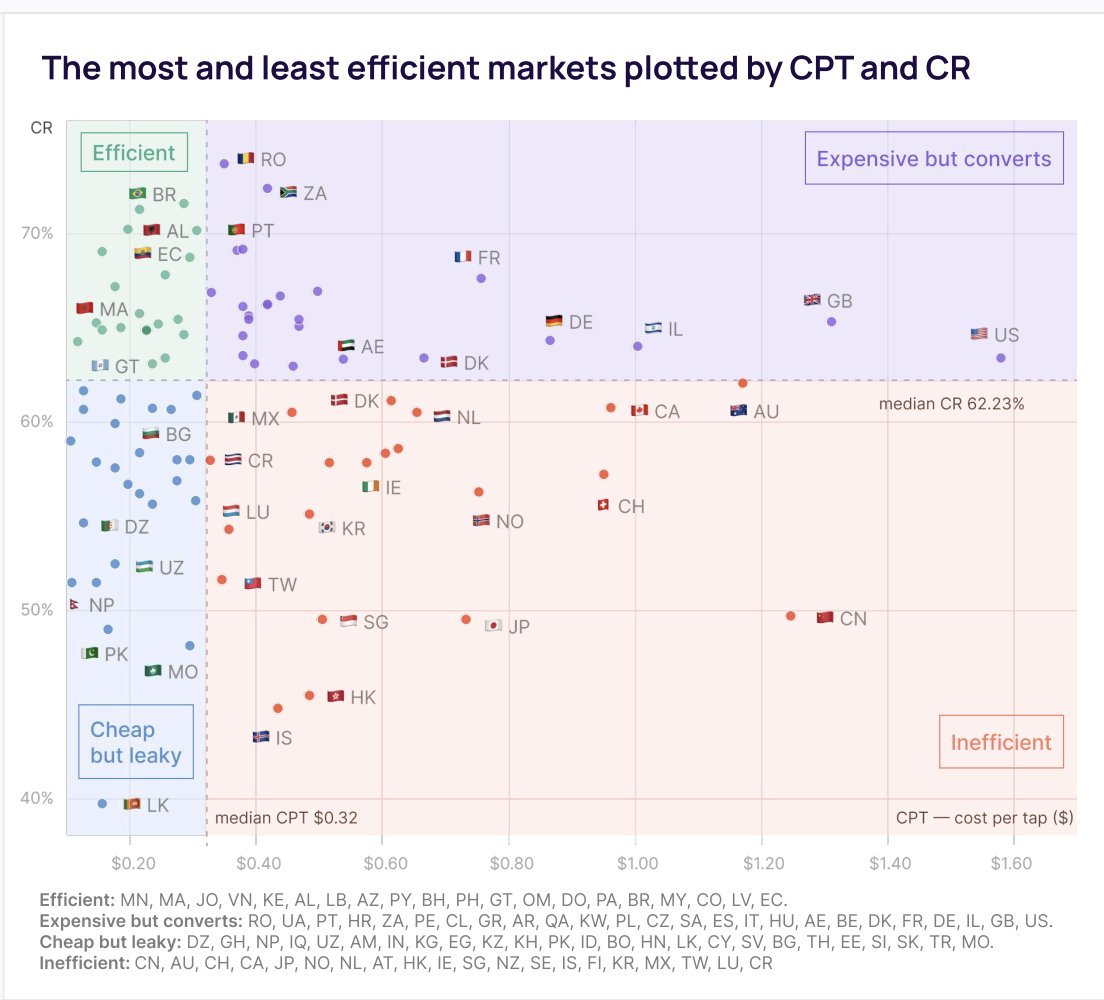
Freddy Fang reports that $1,000 in Apple Ads yields 15 paying subscribers in the US versus 65 in Brazil, and notes higher cost-per-tap in the US and GB against strong conversion in Romania. He recommends testing funnels across geographies before scaling.

Original post · 1 min read
$1,000 in Apple Ads gets you 15 paying subscribers in the US vs 65 in Brazil.

Most app founders burn budget trying to scale across markets like the US and GB where CPT climbs over $1.60. Meanwhile, markets like Romania hit 77% CR at low CPT.

Experiment around and look below at different geographies to test your funnel and grow
♥ 333 · ⟲ 18 · 👁 22.6KView on X ↗

Oki Home Launches Personal AI Computer With Reservations Open

Vijay Shekhar Sharma compares the Oki Home personal AI computer to the Sun Ultra of the AI era. The quoted announcement says the device keeps user data local and takes reservations for a first batch shipping mid-December.

Original post · 1 min read
This is the Sun Ultra of ai era!
😇 @vkhosla
Luofei @Luofei_Chen
Say hello to Oki Home, your Personal AI Computer.

We're building a future of limitless, personalized intelligence for every consumer, while keeping all your data in your hands.

Reserve our first batch, shipping mid-december! okihome.ai
♥ 221 · ⟲ 6 · 👁 38.3KView on X ↗

Muse Launches Open Source Gadget Hub for Hardware Builders

Muse Gadgets: Open source hardware for your Muse

Josh Elman praises Muse Gadgets, an open source hardware site where users build devices by programming ESP32 boards or Raspberry Pis to connect with Muse. He says consumer hardware may be returning and notes early marketplace questions to solve.

Original post · 1 min read
That said — gadgets.muse.ai

This is so incredibly cool and an amazing inspiration for a rich hardware ecosystem. Can’t wait to see the innovation here . Not just consumer is back, but consumer hardware may be back too!
Josh Elman @joshelman
Wait - Muse is blocking itself from registering for the gadget site by a network policy

We are so early. There are so many exciting marketplace dynamics and technical dynamics to work out here
gadgets.muse.aiMuse Gadgets: Open source hardware for your MuseMuse gadgets are open source devices you build yourself. Program an off-the-shelf ESP32 board or set up a Raspberry Pi with our SDKs, then connect Muse to your
♥ 49 · ⟲ 1 · 👁 7.6KView on X ↗

Sheel Mohnot Recommends Hark Pro for Its Proactive UX

Investor Sheel Mohnot recommends trying Hark Pro despite personal assistant fatigue, citing strong UX and non-intrusive proactive notifications. He quotes Brett Adcock's announcement that Hark Pro is live on web, iOS and Android.

Original post · 1 min read
You might have personal assistant fatigue at this point, but if you're up for signing up for another one, this one is a good one to try... UX and proactive pushes in particular are extremely good and not too annoying
Brett Adcock @adcock_brett
Introducing Hark Pro

Hark Pro is now live on web, iOS, and Android

Try it free: hark.com
♥ 163 · ⟲ 1 · 👁 38.4KView on X ↗

Marty Cagan Says Good Product Work Is About Thinking

Marty Cagan Says Good Product Work Is About Thinking▶

In a video clip, product veteran Marty Cagan argues that fundamentally good product work centers on thinking, and says he underestimated how far people will go to avoid it.

Original post · 1 min read
Marty Cagan: "Fundamentally good product work is about thinking. I did not appreciate the lengths that people would go to in order to avoid thinking."
♥ 228 · ⟲ 23 · 👁 20.7KView on X ↗

Outer Space Launches With $8M Pre-Seed to Build Solar Backyard Spaces

Mark Suster congratulates Jiake Liu on the launch of Outer Space, which raised $8 million in pre-seed funding led by Upfront Ventures and builds outdoor living spaces that generate and store solar energy.

Original post · 1 min read
I can't believe I'm saying this, but I've known Jiake for nearly 20 years!

He's incredibly talented, driven & up for solving big problems. Just like many LA founders these days. Hardware meets energy meets living spaces.

Outer Space. In your backyard.
Jiake Liu @jiakeliu
Today we’re launching @outerspacesco with $8M in pre-seed funding led by @upfrontvc.

The future of residential energy might not be on your roof. It might be in your backyard.

We’re building beautiful outdoor spaces that generate solar power and store energy for your home.

No roof modifications. No batteries taking up garage space.

Just more living space that also powers your home.

We think this could become an entirely new category of residential energy.

Checkout what we’re building in this video and thread below.

Shoutout to @msuster @kevinyzhang at @upfrontvc, @willhsu at @mucker, @ge…
♥ 65 · ⟲ 3 · 👁 11.6KView on X ↗

Erik Torenberg Launches Cosign, a Curated Professional Network for Startups

Believe in someone, first.

Erik Torenberg introduces Cosign, a curated professional network for the startup community featuring a directory of investors, companies and operators, endorsement graphs, and private intent signals for investing, hiring or working together. Joining requires a cosign or direct application.

Original post · 1 min read
Excited to introduce @Cosign: the curated professional network for the startup community: cosign.co

Our goal is to create the following:

- A comprehensive startup directory of investors, companies, and operators, including what they worked on and who they worked on it with.

- Cosign graph: Who shaped your career? Who were you actually in the trenches with? Who would work with you again? Who thinks you’re someone to watch?

- Durable reputation: Great endorsements happen every day on X and disappear into the feed. Cosign attaches those signals permanently to people and companies.

- Discovery: Who are the best fintech angels? Which AI companies should I watch? Who are the best designers?

- Intent network: Privately signal “I’d invest in them,” “I’d hire them,” “I’d work with them,” or eventually even “I’d acquire this company.” Match people when interest exists on both sides.

Imagine if Wikipedia, LinkedIn, and OG AngelList had a baby. Though Cosign is a community, not a business.

In order to join, you need to be cosigned. Or you can apply directly.

David Booth and I started this idea 7 years ago but didn’t have the firepower to make it work. Now we do.

No one has really touched LinkedIn in 20 years. Excited to take a swing.

cosign.co
cosign.coBelieve in someone, first.Believe in someone, first.
♥ 3.1K · ⟲ 203 · 👁 1.6MView on X ↗

Former DeepMind Engineering Lead Launches Fo, a Human-Powered Personal AI

Former DeepMind Engineering Lead Launches Fo, a Human-Powered Personal AI▶

Shivani Poddar, who led engineering at Google DeepMind, introduces Fo, a personal AI that employs humans for tasks AI cannot yet handle. She claims 2x better real-world task completion and a 94% trust rate, and invites free sign-ups.

Original post · 1 min read
I led engineering at Google DeepMind.

Today, I'm proud to introduce Fo to give personal AI something no lab ever has... Humans.

Other personal AI's pretend AI can do everything. Fo employs humans to do tasks that AI cannot.

- 2x better at real-world task completion (beats other agents by 69%)
- 94% trust rate (4x less likely to leak private info vs Muse, Instinct)

Sign up for free: wajo.ai/join-wajo
♥ 6.5K · ⟲ 671 · 👁 3.0MView on X ↗

22-Year-Old Gym App Founder Reaches $160,000 Monthly Revenue

22-Year-Old Gym App Founder Reaches $160,000 Monthly Revenue

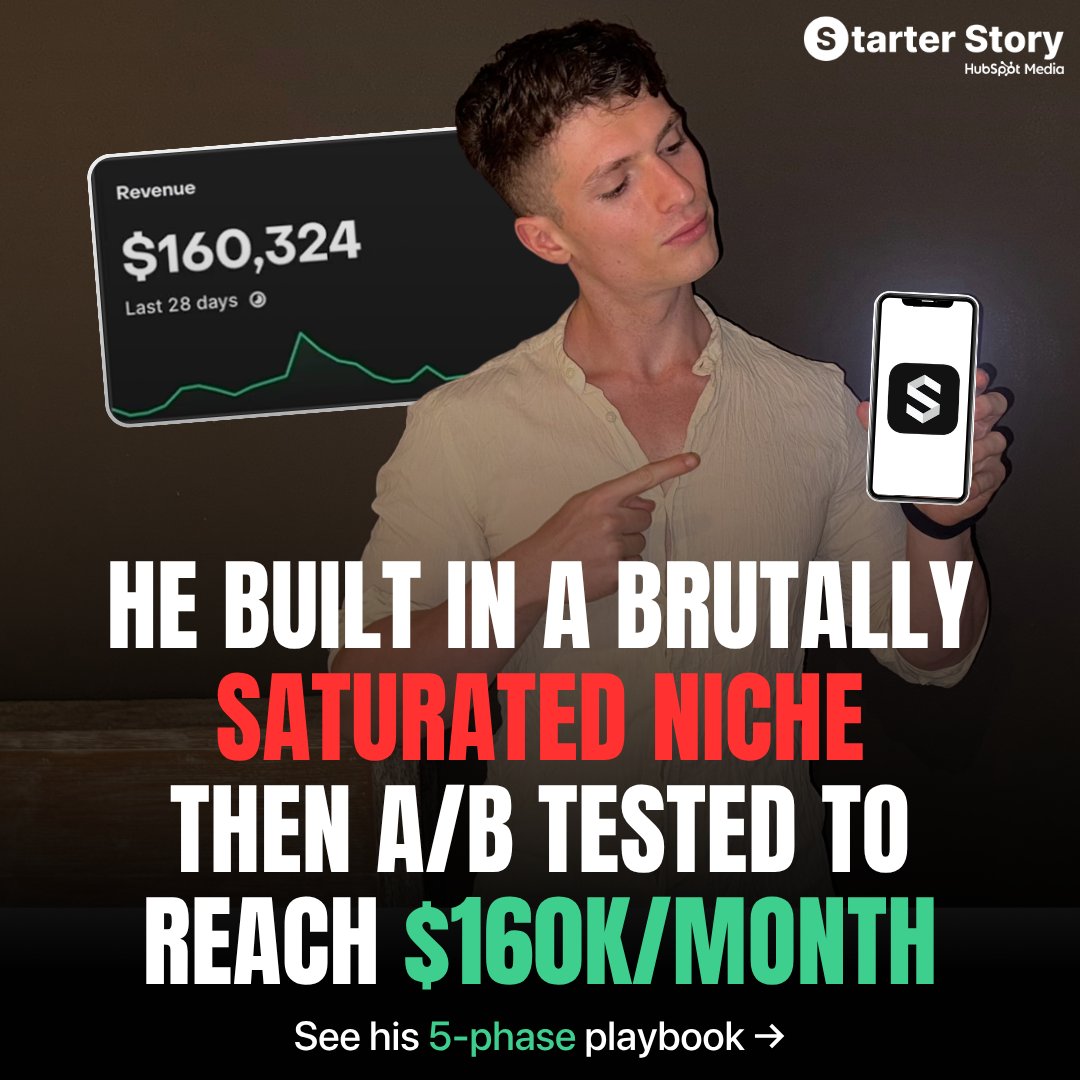
Mauro, a 22-year-old builder, reportedly grew a gym app to $160,000 per month in one year by testing features with A/B experiments, killing underperformers, and scaling creator-driven UGC distribution that paid creators about half of revenue.

Original post · 1 min read
He’s 22 years old and built a gym app doing $160,000/month in just one year.

But Mauro’s edge isn’t the product or the marketing. It’s how he decides what to build.

Most builders ship features and hope. Mauro treats every feature like a science experiment - problem first, hypothesis second, A/B test everything, kill anything that doesn’t move the metric.

One tiny example: adding a single screen at the end of a workout lifted retention 3%. Meanwhile, two completely redesigned home screens moved… nothing.

He also cracked distribution with UGC: 500+ creator accounts, 80,000 videos posted in a year, nearly 1 billion views.

He pays creators ~50% of revenue so they stick around for the long run. One lock-screen-notification format did 17M views on a single video.

The takeaway: stop guessing what to build. Track events, run A/B tests for 2+ weeks, and focus on the screens that actually move activation, retention, and ARPU.
♥ 216 · ⟲ 6 · 👁 17.9KView on X ↗

BioinvestGPT Claims Accurate Predictions on Five of Six Drug Trials

Polymarket reports that AI startup BioinvestGPT correctly predicted five of six major drug trial outcomes before results were announced. The post offers no methodology or independent verification.

Original post · 1 min read
JUST IN: AI startup BioinvestGPT correctly predicts the outcome of 5 of 6 major drug trials before results were announced.
♥ 2.3K · ⟲ 142 · 👁 147.8KView on X ↗

19-Year-Old Dhravya Shah Raises $3 Million for AI Memory Startup Supermemory

19-Year-Old Dhravya Shah Raises $3 Million for AI Memory Startup Supermemory

Vikas Alwys profiles Dhravya Shah, who left IIT Bombay to build Supermemory, an AI memory system for emails, files, chats and documents. The post says the company raised $3 million from investors tied to Google, OpenAI and Cloudflare after Shah shipped a new product weekly.

Original post · 1 min read
Meet Dhravya Shah, a 19-year-old Indian guy who dropped out of his B.Tech at IIT Bombay and just built one of Silicon Valley’s fastest growing AI startups called Supermemory.ai, which has now raised $3 million USD.

While preparing for the IIT entrance exam, Dhravya Shah built a tiny AI tool on the side and used the money to move to the United States. He got an O-1 visa and moved to the US.

Then he gave himself one challenge: build one new product every week for 40 straight weeks. One of those projects became Supermemory.

An AI memory system that lets AI remember your emails, files, chats, PDFs, and documents just like a human brain.

Today, Supermemory has raised $3 million USD from investors behind Google, OpenAI, and Cloudflare.

All because one teenager kept shipping instead of waiting for the perfect idea.

FYI check :-
linkedin.com/in/dhravyashah
supermemory.aisupermemory — Memory and continual learning for agentsAgents need memory. supermemory is building the default engine for memory and continual learning for agents.
♥ 1.6K · ⟲ 153 · 👁 259.6KView on X ↗

Levelsio Reports Over $10M Annual Revenue and About 94.5% Profit Margin

Levelsio Reports Over $10M Annual Revenue and About 94.5% Profit Margin

Levelsio says his business passed $10M a year in revenue plus investment gains with roughly 94.5% profit margin, after replacing SaaS tools with vibecoded alternatives. He describes ETF, Nvidia and startup investments and stable monthly revenue of $200K to $250K.

Original post · 2 min read
💰 Passed $10M/y in revenue + investment gains this year

I've always been aggressively increasing my profit margins to as high as possible, especially the last few years, and especially this year where I've reduced my SaaS dependencies to just a handful of companies by vibecoding my own replacements

It's now about 94.5% profit!

Spend less -> lower costs -> more profit -> more money saved -> more money to invest -> more % returns on investments

And at some point that investment return starts to pass by your business revenue which it has for me for about a year now

Most of my investments have been simple ETFs like Vanguard S&P500, but also a few lucky stock and startup bets that worked out:

Back in 2022, I couldn't get any available GPUs, so I thought it might be smart to buy Nvidia if there's such a shortage and that was a good bet too

Then back in 2023 @dannypostma recommended me to invest in the companies we used for our AI inference for our photo AI apps, so I did that too. First I invested in @replicate and then also @FAL

From then I just asked every app/service I used if I could invest, like @cursor_ai in 2025 which then got acquired by @spacex recently!

My business revenue has remained very stable at about $200K-$250K/mo, but even with that investment returns have now surpassed that

Investments fluctuate a lot so some years it's up some years it might be down a lot (who isn't expecting a big crash at some point?), and most investment gains are unrealized (I never sell!), so keep that with a big grain of salt!

I keep my revenue/gains together with my profit margin and my sleep score in my situation monitor dashboard, as those are equally important :D

Many people in the last decade told me to spend all my money, either personally or with my business to grow it, we don't know how that would have ended up, maybe my companies would be bigger, but I'm happy I did it in my own lean profitable healthy way and it ended up great I think! 🙏😊
♥ 8.1K · ⟲ 163 · 👁 805.7KView on X ↗

Shopify Partners With Instinct to Integrate Shopping Into Chat

Tobi Lutke of Shopify praises an integration with Instinct, which lets users discover products, check out and track orders in one conversation. Instinct says 35 percent of its users use it for personal shopping.

Original post · 1 min read
Instinct + Shopify!

Love the way the integration turned out.
Noah Shinn @noahrshinn
Instinct + Shopify

35% of our users use Instinct for personal shopping. Today, we’re partnering with @Shopify to bring product discovery, checkout and order updates into one conversation.

Shopping is a creative and personal experience. Your Instinct knows your sizes, the brands you like, and what you’ve bought, kept or returned. When you ask for something, Instinct understands the details that matter, from who a gift is for to when you need it to arrive.

Instinct can now search Shopify’s merchant network for products, and find live information on prices, sizes and availability. When you’re …
♥ 539 · ⟲ 14 · 👁 86.1KView on X ↗

Lenny Rachitsky Shares Product Lessons From Peter Sellis

Lenny Rachitsky summarizes takeaways from a podcast with Peter Sellis on growth, taste and team design, citing Snap's Android performance focus and Discord's multiplayer strategy. He also links to the full 90-minute episode.

Original post · 4 min read
My biggest takeaways from @petersellis:

1. There is always money in the banana stand. The highest-ROI growth move is usually investing in the core product, vs. chasing side quests. At @Snap, after the disastrous 2018 redesign caused DAU to flatten, the team laser-focused on performance for existing users—particularly on Android—and sparked a multi-year growth renaissance. At @Discord, rather than chasing @Midjourney’s moment, the team focused on making Discord the best place to play intentional multiplayer games with friends. The result was some of the fastest growth in history.

2. Great taste is knowing when to stop. Peter spent seven years watching @evanspiegel personally say no to better ideas than most consumer startups ever launch. His take on taste is that the difference between people with it and people without it is that the ones with taste stop one step before everyone else does. They know when a good idea’s time has come, or when it has to sit on the shelf a bit longer.

3. Spend your time on your best people, not the ones struggling. Against human instinct, which is to help whoever looks like they’re drowning, Peter consistently loads up his strongest performers with more responsibility and decisions until he finds the limit of what they can handle.

4. The median PM is bad, and even net negative, because the skills of a great product leader are the skills of a founder or an executive, so top-percentile PMs leave for founder and exec seats. On the other hand, mediocre PMs fight to stay in the job because the job pays well and has status. ZIRP made it worse because it was the most lucrative role in tech for non-technical people, with the most subjective sense of what great looks like. A lot of engineers and designers conclude “PMs suck” because they have mostly met the bottom of that distribution.

5. Great PMs hold three contradictory traits. First: deep confidence bordering on arrogance, paired with genuine humility. Second: extreme organizational discipline, paired with near-pathological comfort with ambiguity. Third: a long-term vision that’s always holding in the background, paired with a day-to-day bias for action.

6. Peter designs product teams like terrorist organizations: a shared ideology and an explicit map of who is trusted with which decision. You will almost never hear a leader tell their team to collaborate less, but coordination makes you as slow as the slowest node, which compounds and slows organizations down. The antidote is a strong shared ideology and clear DRIs who can make confident, founder-quality decisions quickly.

7. Optimize consumer products for daily active use. Days map to real human cycles; weeks and months are weaker. One daily user equals roughly 30 monthly users in simple math, which is why elite consumer products run extremely high DAU/MAU. Moving that ratio a few basis points often beats acquiring a pile of soft monthly actives and hoping they retain. DAU/MAU is next-day retention under another name.

8. Define a “Core Product Value” that's both a memorable phrase and a set of metrics that measure it. Peter built this framework at both Snap and Discord. At Snap, it was “the fastest way to share a moment with the people you care about,” which you could actually decompose into metrics: time to load (fast), camera-open-to-share rate (share a moment), best friends engagement (people you care about). At Discord, it was “the best way to talk and hang out with your friends before, during, and after playing games,” with a corresponding L7 and Lness definition that made its way into the growth playbooks. The phrase without the metrics is a slogan; the metrics without the phrase are a dashboard. You need both.

9. The most important career decision you make as a PM is who you choose to marry. This has compounding effects on your career that no podcast, course, or mentor can replicate. The intellectual sounding board, the support system, the person who challenges you to grow—that relationship shapes your capacity to operate at the highest level in ways that are genuinely hard to quantify but nearly impossible to overstate.
Lenny Rachitsky @lennysan
"I design teams like terrorist organizations."

90 minutes of unfiltered product advice from @petersellis

We discuss:
🔸 What it's really like to manage @nikitabier
🔸 Why growth almost always comes from the core
🔸 Why great taste is knowing when to stop
🔸 Why the median PM is so bad
🔸 Designing teams like terrorist organizations

Listen now 👇
youtube.com/watch?v=97LRJUUPy_w
♥ 257 · ⟲ 13 · 👁 66.1KView on X ↗

Clubhouse's 14-Month Android Delay Cited as Case of Slow Execution

Gergely Orosz notes that Clubhouse took 14 months to ship an Android app, arriving in May 2021 after peak hype had passed and demand had collapsed. He argues this illustrates how slow execution can compound a platform's decline, while acknowledging COVID lockdowns also played a role.

Original post · 1 min read
Remember how it took Clubhouse (voice chat app) 14 months (!!) to build an Android app.

By the time they launched it (in May 2021), they missed peak hype on the platform (which was Feb 2021) and demand collapsed

What an example of slow execution speeding up a platform dying... even if we can argue that the platorm itself was tied to COVID lockdowns (and an "escape" from it)
♥ 792 · ⟲ 21 · 👁 95.6KView on X ↗

Marissa Mayer Launches Dazzle, an AI Assistant Built on Camera Roll

Sam Lessin congratulates Marissa Mayer and her team on Dazzle, an AI assistant that turns the camera button into an action button using photo context. Mayer's launch post describes it as working without blank prompts.

Original post · 1 min read
I am REALLY into photos as an amazing source of context for AI agents to do more for you... congrats to marissa and team!
marissamayer @marissamayer
If a picture is worth a thousand words, your camera roll is worth millions.

That’s why we built Dazzle, an AI assistant that turns your camera button into a "get it done" button. No blank prompts, just instant context and action. 🚀

Read the full launch post: dazzle.ai/blog/ 🎉
♥ 64 · ⟲ 7 · 👁 29.8KView on X ↗

Indian Brand-Protection Startup Targets Counterfeit Listings on Meesho

Shirish highlights a business that finds counterfeit copies of brands online and gets them removed, charging only when takedowns succeed, and says it earns $430k per month in the US. He argues the model would be even larger in India, citing knockoffs of D2C products on Meesho, and quotes a bootstrapped founder's $500k MRR post as context.

Original post · 1 min read
This is the most Indian business idea ever and it's making $430k/month in the US.

What it does: finds fake copies of your brand online and gets them taken down.

India needs it 10x more:
- your ₹1,499 product sells for ₹199 on Meesho
- with your own photos

Why it works:
- every D2C brand has this problem
- brands pay only when the fake is removed

India's version of this is going to be huge.
oliverb @oliverbrocato
this month we cross $500k MRR

mind blowing honestly.

my startup is bootstrapped - no investors
started with $20k a slack channel google sheet and south african virtual assistant
we are only 1 year and 9 months old
we only have 153 customers

this startup thing is pretty fun
♥ 465 · ⟲ 19 · 👁 102.3KView on X ↗

Rashid Builds AngelMatch Database Business Reaching $29K Monthly Revenue

Rashid Builds AngelMatch Database Business Reaching $29K Monthly Revenue

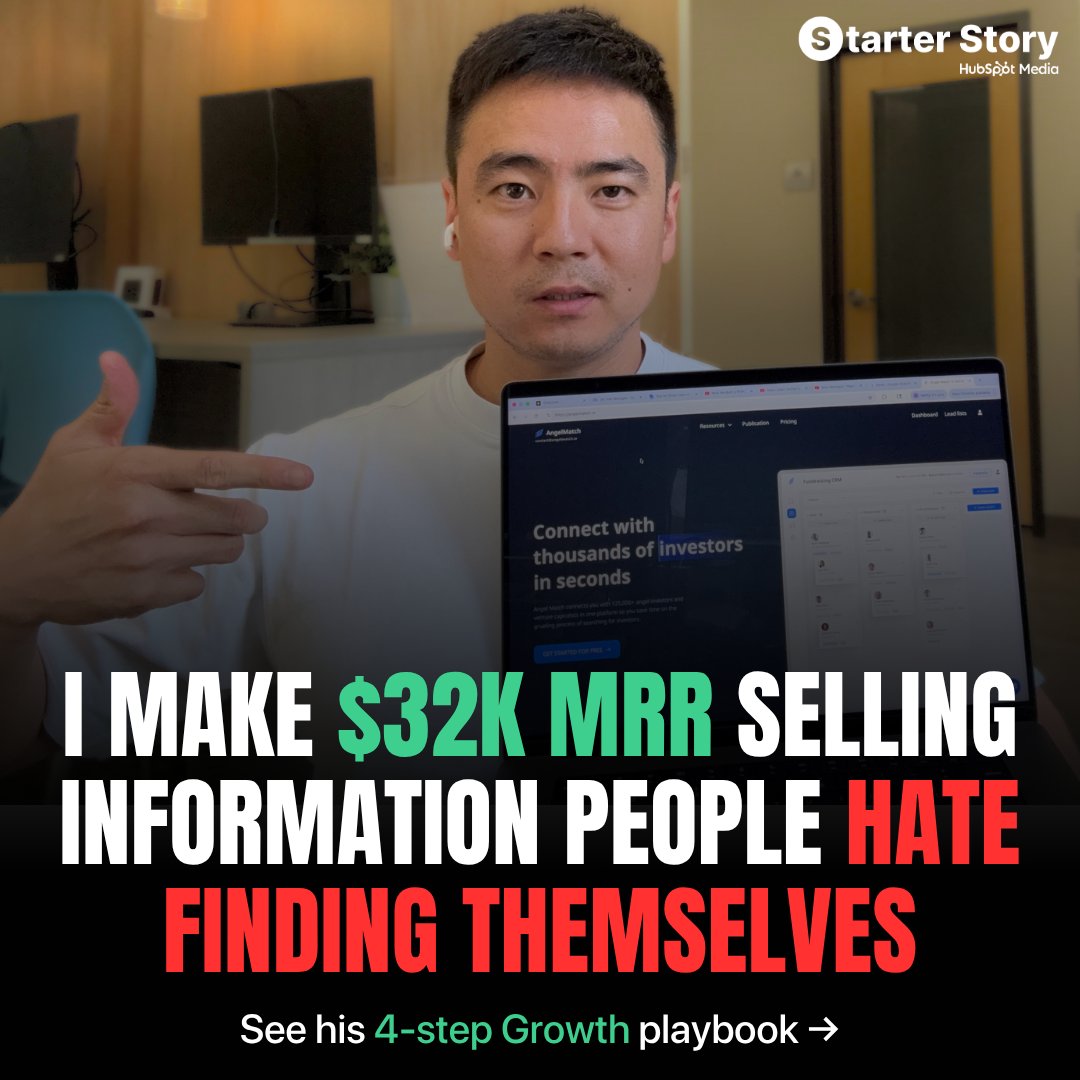
Starter Story profiles Rashid, who built a manually compiled investor database into AngelMatch at $29K MRR, then cloned the model with InvestorHunt and JournalistHunt. Half his revenue comes from programmatic SEO, and the post outlines a three-step playbook.

Original post · 1 min read
He built 3 boring websites that pay him $32K/month - no AI trend, no fancy features, just databases.

Rashid isn’t a coder. He studied finance, maxed out credit cards raising $100K for a fintech, and while hunting for investors he realized: finding this list is brutal.

So he manually built a list of 40,000 investors, launched on Product Hunt, and made $4K in month one.

That became AngelMatch - now at $29K MRR with 360 subscribers, a 33% trial conversion, and 800–1,000 clicks a day. Pricing starts at $59/mo and goes into the thousands.

Then he cloned the model:

> InvestorHunt - $2,800/mo, pure SEO, zero marketing
> JournalistHunt - a database of 200,000 journalists at $49–$99 tiers

The unlock? One day he saw 60 clicks/day in Google Analytics and thought: what if I 10x this? He hired 6 content writers, shipped free tools, and ran programmatic SEO for 8 months.

Went from $3K > $20K MRR. Peaked at $43K.

Half his revenue still comes from programmatic SEO.

His playbook for 2026:

1. Pick a database that solves a painful B2B problem
2. Collect the data manually (or scrape it)
3. Launch fast, get eyeballs, then double down on programmatic SEO

Ideas he’d build today: an influencer database sorted by niche + audience size. Or a newsletter sponsorship database.

The takeaway: boring beats trendy. Painful B2B problems + SEO compound for years while AI apps go to zero.
♥ 234 · ⟲ 24 · 👁 16.1KView on X ↗

Two Breathwork Video Creators Build App Generating $85,000

Two Breathwork Video Creators Build App Generating $85,000

A writer met two brothers who went from posting breathwork videos to an app that has generated over $85,000, and asked them about their development tools and stack. The post includes photos but little detailed text.

Original post · 1 min read
I met these two brothers who went from posting random breathwork videos to an app that’s generated over $85,000 so far.

I asked them all about what tools they used and their exact stack for development.
♥ 75 · ⟲ 5 · 👁 6.5KView on X ↗

Pat Grady Shares Reflections on the State of AI With Boston College

Sequoia partner Pat Grady shares a recorded video of his thoughts on AI, originally prepared for the Boston College Investment Committee, an LP and his alma mater. He stresses it is not a sales pitch.

Original post · 1 min read
The @BostonCollege Investment Committee (an LP and my beloved alma mater) asked for a few thoughts on what's happening in AI. I recorded a test run yesterday morning and then shared it with my partners, who encouraged me to share it more broadly... so here you go!

This is not a sales pitch, it's just a reflection on what we're seeing. And it wasn't intended to be shared, so please pardon the rough edges.

loom.com/share/c016702964a04dfba40e1777cf5f053a
♥ 3.5K · ⟲ 384 · 👁 1.6MView on X ↗

Harley Finkelstein Backs Canvas, a Store-Building Tool by Ben Sehl

Shopify president Harley Finkelstein endorses Canvas, a new tool built by Benjamin Sehl, who draws on his experience building Kotn's first store to create a more accessible way to build online stores.

Original post · 1 min read
No one is more equipped to build this than Ben.

He sees it from both sides: the merchant with a store in his head, and the dev who knows what it takes to get it into the code. That’s the uncommon lens Canvas needs.

The store you can picture is the store you can build. Can’t wait to see what everyone makes.
Ben Sehl @benjaminsehl
When I built @kotn’s first store 12 years ago, I knew how to code and it still took me two weeks just to get to something OK, years to get to something I liked.

We built the tool I wish I had back then. Here’s Canvas.
♥ 147 · ⟲ 6 · 👁 20.0KView on X ↗

Nikita Bier Backs Supertake, an AI Platform for Investing on Beliefs

Nikita Bier Backs Supertake, an AI Platform for Investing on Beliefs

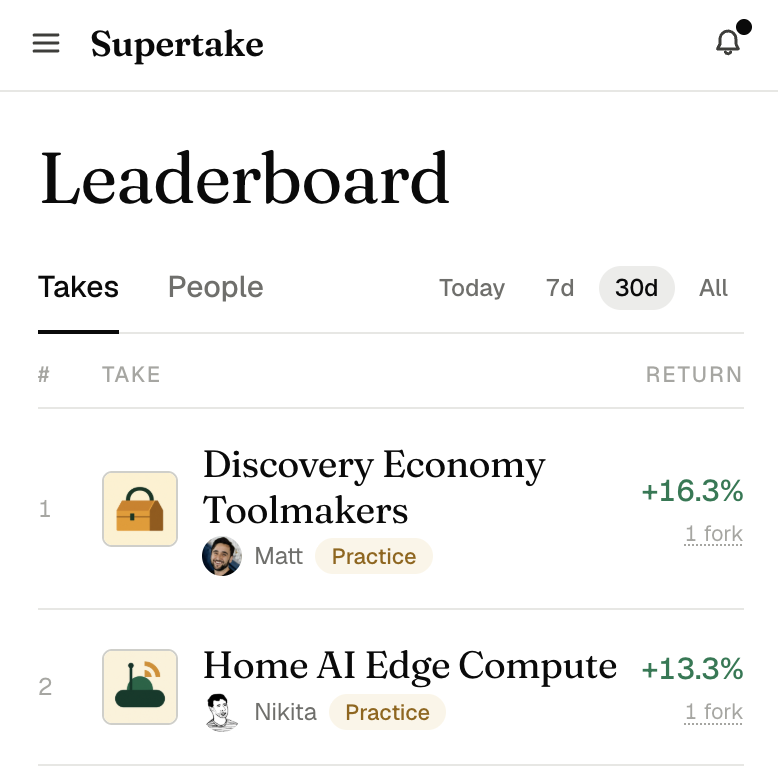
Nikita Bier praises Supertake, a platform that uses AI to turn a user's prompt about their beliefs into a constructed stock portfolio. He argues cheaper intelligence will bring hedge-fund-style investing strategies to ordinary users.

Original post · 1 min read
Over the last 5 years, I've used every social investing product -- but they all tend to fail in one key spot:
Closing the gap between (a) your belief about the world and (b) how to express that belief with stocks.

Mike reached out early in the summer and showed me @Supertake, which solves this problem in the most fun way possible: prompt with AI and it constructs a portfolio around your belief.

With the declining cost of intelligence, we're going to see much more sophisticated investing styles emerge that was previously reserved only for hedge funds.
Michael Mignano @mignano
Introducing @Supertake, a new platform that transforms your unique takes on the world into real, shareable investment portfolios using frontier AI and trading agents.

Supertake makes it easy for anyone to invest in their ideas, even if they know nothing about investing.

1/
♥ 4.1K · ⟲ 139 · 👁 637.0KView on X ↗

Ken Leaves Meta After Harpagia Idle RPG Hits $10K Monthly

Ken Leaves Meta After Harpagia Idle RPG Hits $10K Monthly

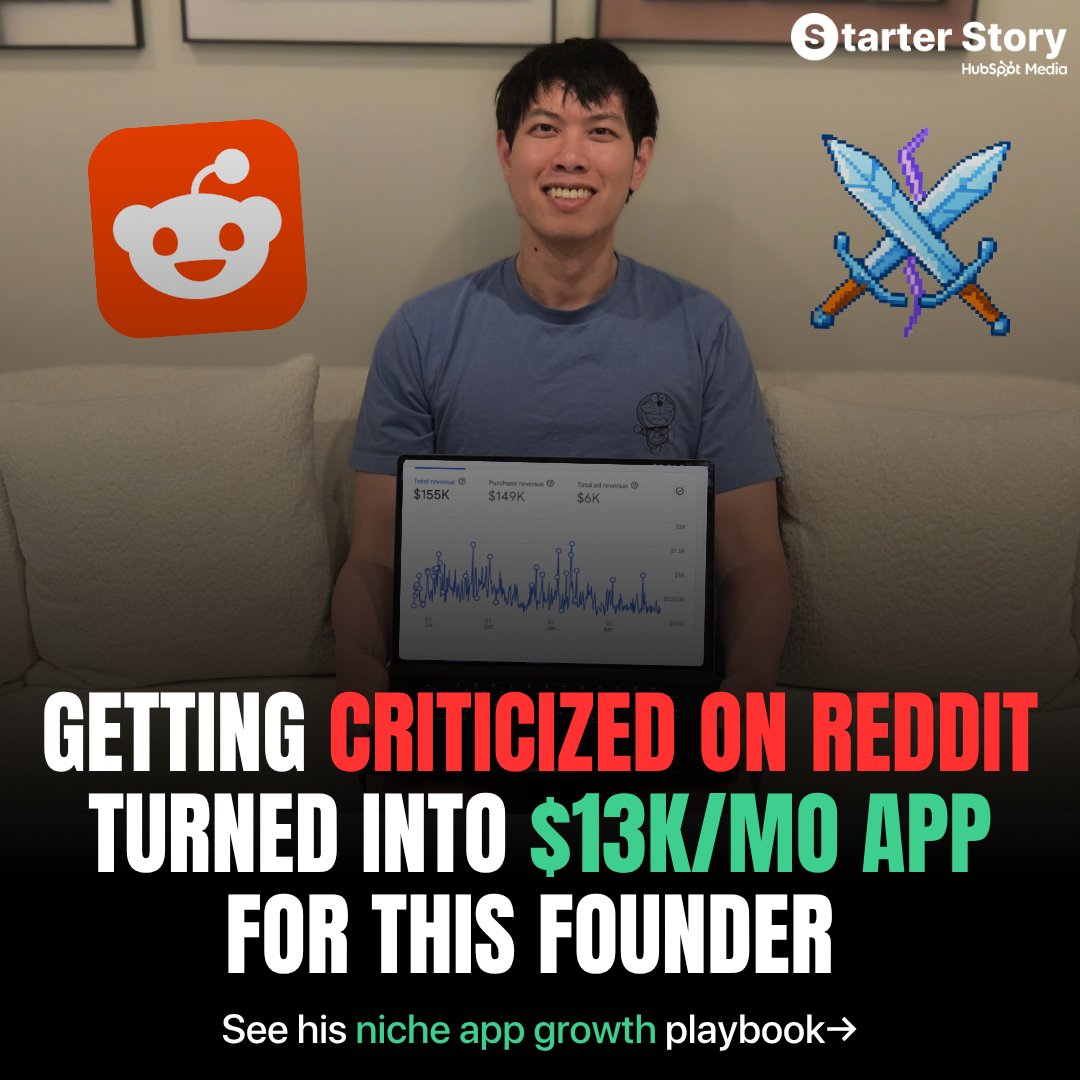
Starter Story profiles Ken, a former Amazon and Meta engineering manager who built Harpagia, a text-based idle RPG for RuneScape fans, using AI tools. The game reportedly reached $13K monthly revenue and 50,000 downloads, with his Meta exit following a Reddit post that lifted revenue.

Original post · 1 min read
He quit Meta to build a text-based mobile game… and one Reddit post took him from $1K/month to $10K/month overnight.

Ken spent 12 years in big tech (Amazon, then engineering manager at Meta). Hadn’t written a line of code in 4 years. Then AI tools clicked, and he shipped a tiny card game in 6 weeks just to learn how to launch.

That warm-up became Harpagia which is a text-based idle RPG for RuneScape fans.

The numbers:
> $13K/month average, $155K in year one
> 50,000+ downloads across iOS + Android
> 6% conversion (games average 2–5%)
> $3 revenue per active user
> $500/month in costs, $0 on ads

His deal with himself: if the game hit $10K/month organically, he’d quit Meta. Six months in, he made his first Reddit post - screenshots + a note on how free-to-play it was. The comments were brutally critical. It didn’t matter. Revenue jumped from ~$1K to $10K almost overnight. He left Meta that same month.

His lesson: you don’t need millions of players. A few hundred active users in the right niche can do $100K+/year.
♥ 136 · ⟲ 10 · 👁 8.8KView on X ↗