Ben Thompson argues Meta's Muse personal agent, built on the Muse Spark 1.3 model that is not state of the art, shows that a sticky personal agent can matter more than raw model capability. Fireside Alpha shares his analysis along with Adam Mosseri's comments on Instagram's ad recommendations.
Ben Thompson calls Meta's Muse a bearish signal for the frontier labs, because a not-state-of-the-art model now makes a product stickier than any chatbot
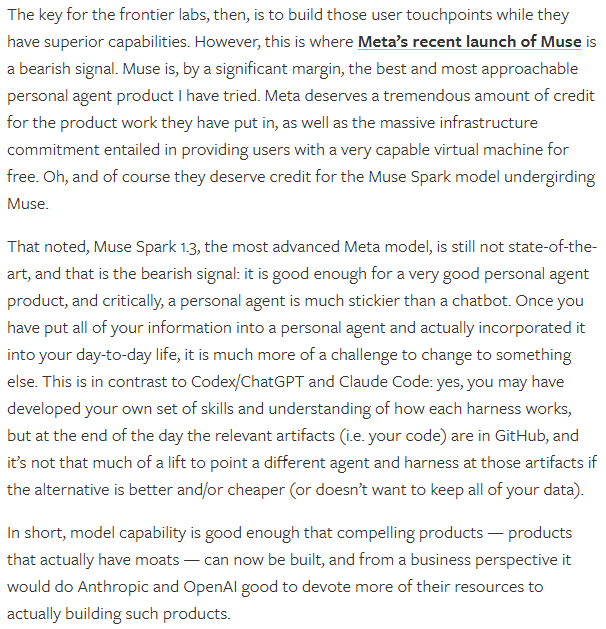
"The key for the frontier labs, then, is to build those user touchpoints while they have superior capabilities."
"However, this is where Meta's recent launch of Muse is a bearish signal. Muse is, by a significant margin, the best and most approachable personal agent product I have tried."
"Meta deserves a tremendous amount of credit for the product work they have put in, as well as the massive infrastructure commitment entailed in providing users with a very capable virtual machine for free."
"Oh, and of course they deserve credit for the Muse Spark model undergirding Muse."
"That noted, Muse Spark 1.3, the most advanced Meta model, is still not state-of-the-art, and that is the bearish signal: it is good enough for a very good personal agent product, and critically, a personal agent is much stickier than a chatbot."
"Once you have put all of your information into a personal agent and actually incorporated it into your day-to-day life, it is much more of a challenge to change to something else."
Truly underrated on how $META's ad recommendation system is *just* starting to get as good as people have long assumed, even in light of Muse traction
Head of IG, Adam Mosseri: "I think a misconception historically is, until recently, we don't really know as much about you as you think."
"We were just like, oh, you liked these photos, these people also liked those same photos, and they like these other photos, so you might like those other photos."
"That's kind of how — I'm oversimplifying, but that's kind of how it worked."
"Now, only now are we actually getting as sophisticated as I thin…
Lenny Rachitsky summarizes takeaways from a podcast with Peter Sellis on growth, taste and team design, citing Snap's Android performance focus and Discord's multiplayer strategy. He also links to the full 90-minute episode.
1. There is always money in the banana stand. The highest-ROI growth move is usually investing in the core product, vs. chasing side quests. At @Snap, after the disastrous 2018 redesign caused DAU to flatten, the team laser-focused on performance for existing users—particularly on Android—and sparked a multi-year growth renaissance. At @Discord, rather than chasing @Midjourney’s moment, the team focused on making Discord the best place to play intentional multiplayer games with friends. The result was some of the fastest growth in history.
2. Great taste is knowing when to stop. Peter spent seven years watching @evanspiegel personally say no to better ideas than most consumer startups ever launch. His take on taste is that the difference between people with it and people without it is that the ones with taste stop one step before everyone else does. They know when a good idea’s time has come, or when it has to sit on the shelf a bit longer.
3. Spend your time on your best people, not the ones struggling. Against human instinct, which is to help whoever looks like they’re drowning, Peter consistently loads up his strongest performers with more responsibility and decisions until he finds the limit of what they can handle.
4. The median PM is bad, and even net negative, because the skills of a great product leader are the skills of a founder or an executive, so top-percentile PMs leave for founder and exec seats. On the other hand, mediocre PMs fight to stay in the job because the job pays well and has status. ZIRP made it worse because it was the most lucrative role in tech for non-technical people, with the most subjective sense of what great looks like. A lot of engineers and designers conclude “PMs suck” because they have mostly met the bottom of that distribution.
5. Great PMs hold three contradictory traits. First: deep confidence bordering on arrogance, paired with genuine humility. Second: extreme organizational discipline, paired with near-pathological comfort with ambiguity. Third: a long-term vision that’s always holding in the background, paired with a day-to-day bias for action.
6. Peter designs product teams like terrorist organizations: a shared ideology and an explicit map of who is trusted with which decision. You will almost never hear a leader tell their team to collaborate less, but coordination makes you as slow as the slowest node, which compounds and slows organizations down. The antidote is a strong shared ideology and clear DRIs who can make confident, founder-quality decisions quickly.
7. Optimize consumer products for daily active use. Days map to real human cycles; weeks and months are weaker. One daily user equals roughly 30 monthly users in simple math, which is why elite consumer products run extremely high DAU/MAU. Moving that ratio a few basis points often beats acquiring a pile of soft monthly actives and hoping they retain. DAU/MAU is next-day retention under another name.
8. Define a “Core Product Value” that's both a memorable phrase and a set of metrics that measure it. Peter built this framework at both Snap and Discord. At Snap, it was “the fastest way to share a moment with the people you care about,” which you could actually decompose into metrics: time to load (fast), camera-open-to-share rate (share a moment), best friends engagement (people you care about). At Discord, it was “the best way to talk and hang out with your friends before, during, and after playing games,” with a corresponding L7 and Lness definition that made its way into the growth playbooks. The phrase without the metrics is a slogan; the metrics without the phrase are a dashboard. You need both.
9. The most important career decision you make as a PM is who you choose to marry. This has compounding effects on your career that no podcast, course, or mentor can replicate. The intellectual sounding board, the support system, the person who challenges you to grow—that relationship shapes your capacity to operate at the highest level in ways that are genuinely hard to quantify but nearly impossible to overstate.
90 minutes of unfiltered product advice from @petersellis
We discuss: 🔸 What it's really like to manage @nikitabier 🔸 Why growth almost always comes from the core 🔸 Why great taste is knowing when to stop 🔸 Why the median PM is so bad 🔸 Designing teams like terrorist organizations
Avi Chawla describes Beacon, an open-source tool from Asymptote Labs that captures coding-agent sessions across Claude Code, Codex, Cursor and OpenCode. It uses the Jev model to score runs and turn approved corrections into reusable skills, linking to the GitHub repository.
Jev is making it dramatically cheaper to evaluate what actually happened inside an agent run.
And finally, someone open-sourced a self-improving memory layer that can put that signal to work across agent harnesses:
- Claude Code - Codex - Cursor - OpenCode, and 20+ more
Beacon by @asymptotelabs continuously captures your agent history across harnesses and uses Jev to identify which runs are actually worth learning from.
It then turns the highest-signal workflows, corrections, and debugging patterns into reusable skills.
Beacon preserves the complete session history. But preserving a run and learning from it are two different things.
Most coding-agent sessions contain routine exploration, failed commands, and fixes that only apply to one task. The trace can remain available for inspection without turning every detail into guidance for future agents.
Jev scores each run for evidence, reuse potential, and human correction signals. An application policy then decides whether to promote, review, or discard it.
The recording shows this in action.
Claude receives a coding task, modifies the implementation, and runs the tests. I then provide an edge-case correction, so Claude updates the code and adds regression coverage.
Beacon automatically captures the complete session. Jev evaluates whether the correction contains a reusable engineering lesson.
Once approved, that lesson becomes available to other coding agents working on the project.
Since it works across harnesses: - Claude Code sessions can teach Codex. - Cursor debugging can improve OpenCode.
So a problem solved by one agent should not need to be learned from scratch by another.
If you want to dive deeper into Jev, I also wrote a hands-on guide to building this Jev-style decision path with open models, entirely locally.
Build your own Jev (100% local) — Everything you need to turn an open-source LLM into a fast, local decision engine without retraining it. It covers next-token scoring, fixed choices with probability distributions, SGLang, and a
Box CEO Aaron Levie argues AI agents will use software far more than humans, making core platforms for data, security and workflow orchestration more important. He says platforms that act as guardrails for agents have a large opportunity, and he quotes Box's reaccelerated growth tied to unstructured data needs.
AI agents will use software 100X more than people ever did. Even as interfaces begin to fade into the background as you primarily interact with agents, those agents still need many of the core primitives that people have used.
In fact, in many ways these core primitives become even more important when agents can take destructive actions in our systems or where the context they’re accessing with make or break the workflow. This will be true of where you house your CRM or ERP or structured or unstructured data platforms.
The platforms that can best act as the security layer and guardrails for agents, manage the data for agents and people, and orchestrate the business logic for workflows have a huge opportunity right now. This is true for brand new startups as well as existing platforms that can move fast enough.
Box CEO @levie says AI has been “unequivocally” a net positive for software.
“You look at infrastructure providers—the Cloudflares of the world—totally on fire, because agents need sandboxes, they need compute, they need network, they need gateways. Great business.”
“For us, we have reaccelerated growth far past our internal plans because it turns out that enterprises need core systems to be able to manage their unstructured data.”
“Agents need to be able to work with that unstructured data to make decisions or move information through a workflow—whether it’s all of your contracts, your res…
Vinod Srinivasan links to a Mint report reconstructing a four-hour Tata Sons board meeting in which five directors reportedly outmaneuvered Noel Tata. The meeting ended with N. Chandrasekaran reappointed as chair, according to the linked article.
Mint has reconstructed the Tata Sons board meeting minute by minute. I have read it twice. I would say it changes the story from "Noel Tata lost a vote" to something more uncomfortable for everyone in that room.
Gokul Rajaram, an early investor since 2017, praises wholesale marketplace Faire after a Wall Street Journal report of a $730 million-plus annualized revenue run rate, 45% growth, and expected Q4 EBITDA breakeven. He highlights advertising, international expansion, and fulfillment as growth levers.
I am incredibly proud to have been an investor in @Faire since 2017.
I worked closely with founders @maxrhodesOK, @Kolovson, @Mescortes, and Daniele Perito for several years before they started Faire. They are absolutely stellar S-tier talent. What they and the Faire team have accomplished since is extraordinary.
This Wall Street Journal piece (linked below) captures the scale of that accomplishment: a $730M+ annualized revenue run rate, 45% year-over-year growth, and an expectation of reaching EBITDA breakeven in Q4.
Those are remarkable numbers for a company taking on an enormous and stubborn problem. Wholesale has changed remarkably little for more than a century. Independent retailers still spend huge amounts of time discovering products, managing inventory, and absorbing costs that large chains spread across thousands of stores.
Faire is changing that for hundreds of thousands of retailers and brands. The company is now on pace to facilitate more than $4.5B in merchandise purchases annually.
Every order adds to Faire’s understanding of which products sell in which stores. That information improves product recommendations, gives retailers more confidence in what they buy, and connects brands with customers they would struggle to find on their own.
I’m especially excited by how much opportunity remains.
International markets give Faire much more room to grow. Advertising, launched in 2024, already contributes about 9% of revenue. Fulfillment could reduce customer shipping costs by roughly 80%, directly improving retailer margins.
For Faire employees, I hope this article brings a deep sense of pride. You have built something truly special.
For candidates, Faire offers a rare opportunity: proven demand, enormous room to grow, hard technical and operational problems, and a founding team that I would back again without hesitation.
Very few teams get to build a company of this scale while improving the odds for independent retailers and brands around the world. Faire does both.
I feel incredibly fortunate to have been part of the story from the beginning. I have never been more excited about what this exceptional team will build next.
Nikesh Arora argues that Apple, Google, TikTok and Amazon may build agents like Muse and that services and marketplace apps will need to open APIs for consumer agents. He says network moats and content moats will respond differently, while commoditized back ends face the greatest risk.
This will be a bigger battle than anyone anticipates. It is only a matter of time before there is an Apple and Google version of Muse and possibly TikTok, in addition to the frontier LLM agents. Maybe a commerce agent from Amazon.
Every app that is a services, marketplace or commerce app will need to existentially decide to open APIs for consumer agents to interact. Smaller players have no choice. Ad revenues are more than transaction fees, either the consumer benefits or distribution aggregators will demand a higher transaction fare.
I know I don't want an agent for each app. I would like my agent to be able to do tasks I require. We can already see consumers getting trained on that behavior by the frontier labs.
Those with network moats - restaurants, groceries, drivers might be able to withstand for a while, over time convenience and end user experience will win and they will have to align. Content moats (protected by copyright) could decide to allow agents or chose to hold on to the consumer interaction. I suspect other than the feeling of a lack of control, it won't change their economics.
Commoditized back ends will need to worry, insurance, tickets, hotels, services - if they don't adapt new players will.
AJ Asver describes a new harness built with Jev that learns repetitive tasks and moves steps from LLM calls to code. He says processing 100,000 compliance alerts fell from over $290K on Opus 5 to under $26K using agentrun().
We built a new harness using @typesafeai's Jev that cuts the cost of repetitive work by 90%. The harness learns the job as it runs, moving steps from LLM calls to code.
Running 100,000 compliance alerts costs >$290K on Opus 5.
Trung Phan notes AMD's market cap has risen from about $10 billion to $1 trillion since 2018, quoting Kobeissi Letter's report that the stock crossed $1 trillion. The post adds that $10,000 invested in 2016 would be worth about $3.05 million today.
AMD’s market cap has now risen 100x from $10 billion to $1 Trillion since Sky Sports asked Lisa Su if she could “speak English” at the starting grid during 2018 F1 Chinese Grand Prix.
Gergely Orosz argues most people will not hand AI agents a digital wallet to spend money, since routine purchases are an expense to manage rather than a chore to outsource. He responds to a post describing Meta's assistant placing orders across email, groceries and delivery apps.
I continue to be amazed how the tech industry doesn't realize that the majority of people won't hand over a digital wallet for AI agents to go and spend on stuff, because buying socks + groceries is not a chore to outsource w/o oversight, but an expense to manage...
It’s funny, Meta went from having my Instagram and WhatsApp data to now having access to my email, calendar, DoorDash, Amazon and pretty much everything.
In the last 24 hours, it bought me socks, ordered my Whole Foods groceries, booked a cleaning service and got me a burger for dinner.
Meta’s last disclosed North American Facebook ARPU was around $227/year, largely from ads. I suspect it can push that number significantly higher now that it understands not only what I look at, but what I need, what I buy and what I’m planning to do.
Also the much bigger opportunity might be becoming the ag…
Akshay Pachaar describes HarnessRouter, an open-source layer that runs multiple agent harnesses, including Codex, Claude Code, Hermes and Jev's System One, under one interface via the Unified Harness Protocol. He links to the repository and a related article.
Devs just open-sourced a plug-and-play infrastructure layer that lets you run any harness under a single interface, like:
- Codex - Hermes - Claude code - DeepSeek Harness - System One, powered by Jev - And 9 more agent harnesses
This means you can bring Jev into the same product that already uses Codex, Claude Code, or another supported harness, without writing another implementation for sessions, streaming, files, cancellation, and failure handling.
The harnesses run locally, and the Unified Harness Protocol (UHP) defines the common task interface with an OpenAI Responses-compatible API.
If you want to dive deeper, my recent article explains why model routing is not the same as harness routing, and what it takes to support multiple harnesses.
It also covers UHP, the full local setup, a working API call, and how sessions and files work.
Run Any Agent Harness Under One Interface — How UHP and HarnessRouter standardize agent execution across Codex, Claude Code, Hermes, and other runtimes.
When an agent product integrates one harness directly, its backend starts depending on
Jeni Farnsworth shares a quoted post from The Newsground reporting leaked Russian banking records showing founders of a tech firm whose code is in an official White House app kept accounts at Alfa Bank and Tinkoff Bank after sanctions. The post adds only a reaction to the report.
Leaked Russian banking records show that the founders of a tech firm whose code is inside the official White House app kept accounts at Alfa Bank and Tinkoff Bank after the US and EU imposed sanctions. (link below)
Danny Postma says he has switched from Claude to OpenAI and Grok, citing a regression in Claude's output since August. He links a post by @Lon reporting that thinking tokens fell sharply from July to August after Anthropic made Fable 5 available in subscription plans.
After Anthropic made Fable 5 permanently available in subscription plans, I noticed a large drop in performance. The model felt dumber, and I couldn't explain why.
Measured five different ways, August delivered dramatically fewer thinking tokens than July.
Alvaro Cintas describes jev-model-router, an early-access Claude Code mod built on function hooks that uses Jev to pick a model per turn based on task complexity and risk. He provides install steps, a link, and configuration notes for API keys.
It's called jev-model-router, an early access mod built on Claude Code's new function hooks. Before every turn, it checks in with Jev and asks:
> how mechanical the task is > how much reasoning it needs > whether it's risky
Then it routes: → it'll move up to a stronger model on weak evidence, and only drops to a cheaper one when it's confident the task is simple → every decision gets logged in your transcript → if the call fails, your request runs untouched
Setup: 1. copy the install command: npx claude-code-templates@latest --mod productivity/jev-model-router 2. paste it inside Claude Code 3. run claude with CLAUDE_CODE_ENABLE_FUNCTION_HOOKS=1 set 4. accept the trust prompt on first launch
stark0xbt summarizes four predictions attributed to investor Gavin Baker: foundation model consolidation to Google, Meta, and xAI; Magnificent 7 growth with one or two failing; profitable AI tokens; and feasible orbital data centers. Baker also warns against SaaS and crypto bets.
Gavin Baker has made 4 major calls this month. Bears haven't caught one.
1. Foundation model survival list: Google, Meta, xAI. Everyone else commoditized.
2. Magnificent 7 goes $12T → $100T. One or two die. Winners take 30-40% each.
3. Anthropic S-1 will break value investors. Tokens aren't subsidized — the majority are profitable across the chain.
4. Orbital data centers aren't impossible. 10,000 SpaceX engineers already solved them. PhDs on X arguing physics haven't done the hours.
The through-line: bears are wrong on central facts, not analysis.
- If tokens are profitable → "AI is a bubble" collapses - If orbital compute ships → "power constraints kill AI" collapses - If Mag 7 concentrates → index-hugging fails - If foundation models consolidate to 3 → everything else is training data
Baker's frame: don't argue theory when operators have already shipped receipts.
Four calls. One thesis. Everyone else is a lagging indicator.
cat.png recommends a set of Grok Bot team rules based on Lauren Tan's approach, including one bot per job, a chief-of-staff router, and human approval for money and deploys. He links a GitHub repo containing the rules as an installable skill.
I still can't f**king get why people keep adding more Grok Bots instead of copying the rules the best teams run them on.
A Japanese Grok Bot team I’ve been studying is built around Lauren “poteto” Tan’s rules.
The useful part:
> One bot, one job. > One chief of staff routes everything. > Draft before send. > No proof, no "done". > Money, deploys, permissions stay behind human approval.
If a bot keeps making the same mistake, turn the fix into a rule or skill.
That’s basically the whole game.
Less prompting. Better roles. Better guardrails.
All the rules are listed here, and you can set them up as a skill in your Grok Bot:
One of the SpaceXAI engineers building Grok Bot explained how she gets coding agents she can actually trust.
I turned Lauren Tan’s talks and extended Q&A into one installable skill.
Her main point:
If an agent cannot verify its own work, you are still the verification system.
Agent writes the code → you open the app → find what it broke → send screenshots back → repeat
Her workflow changes that loop.
The skill teaches your agent to:
1. Read the affected code before guessing the cause 2. Reproduce the bug before changing anything 3. Run the real user flow, not just build and typecheck 4.…
Shopify CEO Tobi Lutke announced a deep partnership with Muse to offer agentic checkout through Shop Pay on all Shopify stores, letting shoppers buy through Muse.
We are excited to announce we are partnering deeply with Muse to enable agentic checkout with Shop Pay on all Shopify stores, offering people an easy and delightful way to shop and check out with Muse.
Ivan Burazin notes that Evernote, owned by Bending Spoons, reportedly reached about $150M in revenue with 20 people, compared with roughly $100M and 350 employees before the takeover. He contrasts this with older SaaS firms that have similar revenue but thousands of staff.
Evernote is a Bending Spoons company worth talking about.
They are doing very well post-acquisition (reportedly at $150M with 20 people). Prior to the takeover, they were doing $100M with nearly 350 employees.
The current numbers are pretty apt for a product like that.
Then there are some of these older SaaS companies doing similar revenue with 5,000-7,000 people.
Imagine them cutting down to 30 engineers and a lean ops team. They would be printing money in a way that would seem illegal.
Jason Goepfert reports that the S&P 500 rallied at least 1% to within 1% of a new high while more stocks hit new lows than highs, a pattern he says has occurred only on July 23, 1929 and December 21, 1999. He also notes that few stocks remain in long-term uptrends.
There are 2 days in history like today, when the S&P 500 $SPY rallied at least 1% to within 1% of a new high, and more of its stocks fell to new lows than highs.
Developer lauren (@poteto) posts a free video walkthrough of how she shipped 2,500 pull requests to production last month. The talk was originally planned for Cursor Compile in London and is viewable on X at 2x speed.
here's how i shipped 2,500 PRs last month to production
this was originally supposed to be for Cursor Compile in London. i couldn't make it since i was livestreaming for Grok @Bot Galaxy so i'm making it available for free here on X! watch it on 2x speed, i talk slowly
Mostly Borrowed Ideas says it increased its Meta position after writing a deep-dive arguing Meta's Muse could transform the consumer internet. The author contrasts Meta's valuation with Airbnb's, citing asymmetric upside from Meta's optionality.
"What really compelled me to make this trade is the asymmetry of the bet. While I believe Airbnb’s stock doesn’t price such “nuclear” risk at all in today’s multiple, Meta’s valuation doesn't give it much credit for the optionality of transforming the consumer internet. The trade was admittedly a bit uncomfortable given my portfolio’s outsized bet on Meta, but on a side-by-side comparison between Meta and Airbnb, it wasn’t a difficult call for me."
Rihard Jarc argues Amazon will need to accommodate personal AI agents rather than block them, predicting its ad business could shrink as agents take over discovery. He is responding to a post reporting that Amazon cut off Meta's Muse.
I understand the first line of thinking that $AMZN doesn't like $META's Muse to shop around, and people starting to use AI agents as the entry point for commerce, but this is the future.
I don't believe $AMZN has a chance of having its own world-dominant personal AI assistant that people would fully transition to. Best case is $AMZN has an endpoint or their own agent that Muse and other personal agents talk to, and not crawl on their websites.
$AMZN's e-commerce business will still do well in the agentic era (but they have to lean into the agentic era, not go away), but their ad business (the part of it that is related to discovery on their website) will probably be worth a lot less as agents take over.
9to5Mac reports that users can now claim payouts from Apple's $250 million class action settlement over Siri and Apple Intelligence delays. The post links to the full article.
Oguz Erkan quotes Stanley Druckenmiller saying there will be no new copper supply for eight years while data center buildout adds demand. The post notes copper is up 50% over the past year, citing an FT report of an expected 2027 shortfall.
Nikita Bier says the Muse app's auto-negotiation feature on Facebook Marketplace was escalated to Mark Zuckerberg, who reportedly approved it despite concerns that lowball bots could harm the product. The post is presented as evidence of how much Meta values AI.
Aayan says he built a search tool on Jev that indexes more than 6,000 Y Combinator startups and returns results in under a second. He reports about 90 million tokens and $2.70 in total testing costs, and shares a demo video.
Peter Yang asks how Amazon could tell whether a request comes from a human or an AI agent when both appear to originate from the same IP address, responding to a post about Amazon cutting off Muse.
Colin McDermott shares a Grok Bot template built on Jev that provides fast, calibrated classification for routing, urgency, labels and rubrics, and links to the bot on x.ai.
Prajwal Tomar says Jev is now open to everyone without a waitlist and that he has tested it all day. He describes browser agents, email sorting and trading use cases, and promises an article about what he learned.
BRO. Jev just opened to everyone and I've been testing it ALL day - it is actually nuts.
This feels exactly like GPT-3.5 launch week. Everyone's building, nobody fully understands it yet, and honestly it's crazy how fast this is moving.
If you're not experimenting with this right now you're missing the window.
People are already running browser agents for a tenth of a cent per task, sorting thousands of emails, making trading calls in milliseconds, scoring Meta ads to find winners before burning budget...
The model cannot write a single word. It only decides. That's the entire trick.
I'm compiling everything I learned into an article right now, dropping it SOON.
India Observer posts a video claiming a US Secretary of State said the US will not allow India to develop to a point where it can compete with America. The post asserts the US will not repeat its China policy with India. The quoted remark is not sourced in the post.
A post criticizes U.S. Deputy Secretary of State Christopher Landau for remarks in New Delhi that India would not be allowed to develop to the point of competing with the United States, which the author calls a surrender by weak politicians.
Correct me if I'm wrong, but I don't recall any American in history standing on Indian soil and threatening India’s growth. This happens when weak politicians surrender the nation's greater cause for self-preservation and political gain. Sad.
🇺🇸🇮🇳 U.S. Deputy Secretary of State Christopher Landau in the middle of New Delhi told Indians that India will not be allowed to develop to the point where it can compete with the US.
Ramit Sethi lists government-linked everyday services, including the FAA, weather service, GPS, public education, and 30-year mortgages, and argues Republicans overlook this. He shares a 60 Minutes quote from a conservative Texas resident worried about a nearby data center.
A Republican realizes that politics actually affects him
I've talked to literally thousands of Republicans who have no idea that the government has played a MASSIVE ROLE in:
- The truck they drive (why is every pickup enormous? Is it really true that ALL truck buyers prefer huge trucks? Why can't you buy a small, cheap one?) - The education they received (how did you receive a public education? Why are student loans so expensive?) - The food they eat (why do you rarely get sick eating out? - The house they live in (why can't you build an ADU? why do you have to maintain your front yard? Why can't you have a courtyard?) - The clean air & water they have access to - The mortgage on their house (why does a 30-year fixed mortgage exist here and almost nowhere else?) - Their health insurance they get through their job (why is it tied to your employer at all?) - The electricity on their rural property (who ran power lines out there when no private company would?) - And many more: Not crashing on airplanes (FAA), their 401(k), predictable weather (NWS), GPS on their phone (DoD)
But no, they insist they're rugged men who did it "without anybody's help"
“This is the first time in my adult life where there's been an issue that's come up that I feel like is going to directly impact me,” says Dave Lowe, a lifelong conservative Republican who lives near a proposed data center in Texas.
Ejaaz says an AI agent called Muse filed a compensation claim after a seven-hour Delta flight delay, securing a $250 account credit and rebooking within minutes. He describes it as having handled the support email itself.
Flight delayed 7 hours - asked Muse to file for compensation. 5 mins later i had $250 credit in my delta account. it even found and rebooked me a new flight.
it just figured everything out. even responded to the support email itself.
OddStats notes that QQQ rose at least 2.75% on a day the QQQ volatility index rose at least one point, and says QQQ has historically performed strongly two weeks and one month after similar days. The post includes a chart.
Jason Luongo lays out a long-dated $250 call on Amazon expiring January 2028 as leveraged exposure, citing AWS growth of 37%, a $496B backlog and custom chip revenue. He includes a standard risk disclaimer that the premium can be entirely lost.
You could buy 100 shares of $AMZN right now for about $25,800.
Or you could buy the $250 call LEAP expiring January 2028 for about $5,400. Leveraged exposure to 100 shares. ~79% less capital. Over 480 days of runway.
The trade: Strike: $250 Expiration: January 21, 2028 Premium: ~$54 per contract Breakeven: $304
If $AMZN hits $320, this LEAP returns ~30% If $AMZN hits $360, this LEAP returns ~104% If $AMZN hits $400, this LEAP returns ~178%
100 shares at $400 returns ~55%. The LEAP returns more than 3x that on a fraction of the capital.
Why I like the setup:
- Q2 revenue up 20% to $200.6B, operating income up to $27.5B from $19.2B a year ago - AWS grew 37% to $42.2B, its fastest growth in 18 quarters - AWS backlog sits at $496B, up from $364B the prior quarter - Custom chip business now runs above $25B a year, growing triple digits, with Anthropic and OpenAI both committed to Trainium for multiple gigawatts - Advertising up 26% year over year - Stock is about 10% below its August high, and next earnings are expected in late October - 487 days of runway gives this trade time to work through short-term noise
The max you can lose on a LEAP is the entire premium you paid. In this case, that's $5,400 per contract. LEAPs are leveraged and can lose value quickly if the stock drops or stays flat. Only size this so you're comfortable losing all of it.
Note: LEAPs are one tool inside a broader portfolio. Owning shares is always the primary use of capital. This is a selective add-on for high-conviction moments when conditions align.
BuccoCapital Bloke says he is bullish on Meta and Muse but expects a fight over commoditization after Amazon reportedly cut off Muse. The post includes a photo of the announcement.
A post from Jason says three upcoming IPOs are worth more than all tech IPOs from the last 45 years combined. The post includes a photo and gives no named companies or sources.
Def Noodles shares a photo of a US Senator's office displaying an Israeli flag and no American flag, and claims the government is occupied. The post quotes Senator Rick Scott promoting his Sunshine Protection Act to end clock changes.
Melvin Invests argues that Meta's Muse agents will drive growing CPU demand as they complete more tasks, and promotes five stocks positioned to benefit. The post is a short video with a call to save it.
A video from Jake shows a Hindu comedian trying to make sense of how Christians and Muslims describe God, joking about His appearance, powers and how to speak to an unseen deity.
Xircopes posts a playful joke claiming that if Vijay Keshaav makes the NBA, South Indian Americans would be overrepresented per capita compared with white Americans, attaching photo and video media.
If Vijay Keshaav makes it into the NBA then South Indian Americans would technically be 3x more represented than white Americans in the NBA per capita. W per capita on this one ngl.