A thread describes Harvard's need for an 8% annual endowment return and cites Jake Xia's popular free MIT lecture on portfolio construction. It argues position sizing and basic compounding equations are the core investing skills.
Harvard needs 8% return every year just to keep the lights on. 5% spending plus 3% inflation. Miss that number and buildings stop, professors leave, research dies.
40% of the operating budget comes from one portfolio. Not tuition. Not grants. One fund.
Jake Xia manages that fund's public markets. He also teaches the math behind it at MIT for free. One of the top five most-watched courses on OpenCourseWare. Millions of views. Almost nobody changed how they invest.
Every year he hands students a blank page. Build a portfolio. No rules. Someone writes 100% Apple. Someone writes rare coins. Confident picks. Same blind spot, every time.
Not one student asks the only question that matters: how much goes in each position. They all pick what to buy. Nobody sizes it.
Sizing is the entire job. The answer won the Nobel Prize. It's called the efficient frontier. Xia draws it on the board in under a minute.
Five equations sit underneath it. Compound growth. Present value. The geometric mean. The Rule of 72. Real return. All older than any bank on earth. All fit on a napkin. None behind a paywall.
A "guaranteed 5% bond" during 4% inflation is a 1% return. The industry doesn't hide this. It just hopes you never run the equation yourself.
The lecture is free. The napkin is free. The only thing that costs anything is not knowing.
The Five Equations That Quietly Run Your Entire Financial Life (And Why School Never Showed You Any — You were taught arithmetic in school and told it was math. Then you were taught "personal finance," if you were lucky, as a list of tips: save more, spend less, invest early. Nobody told you that
Aakash Gupta explains that Shazam's 2002 system, invented by Stanford PhD Avery Wang, used spectrogram peaks, constellation maps and hash lookups instead of AI, and was published openly in 2003. Apple acquired the company in 2018.
Shazam could name any song back in 2002, on flip phones, with zero AI. You dialed the number 2580, held your phone up to the speaker, and hung up. 15 seconds later, a text came back with the song name. That same core trick still runs the app today.
The inventor was Avery Wang, a Stanford PhD in audio signal processing. His problem was brutal. Match a short clip recorded on a 2002 cell phone mic, in a noisy bar, against a database of a million songs, in seconds, over a phone call.
His solution treated music as geometry instead of sound.
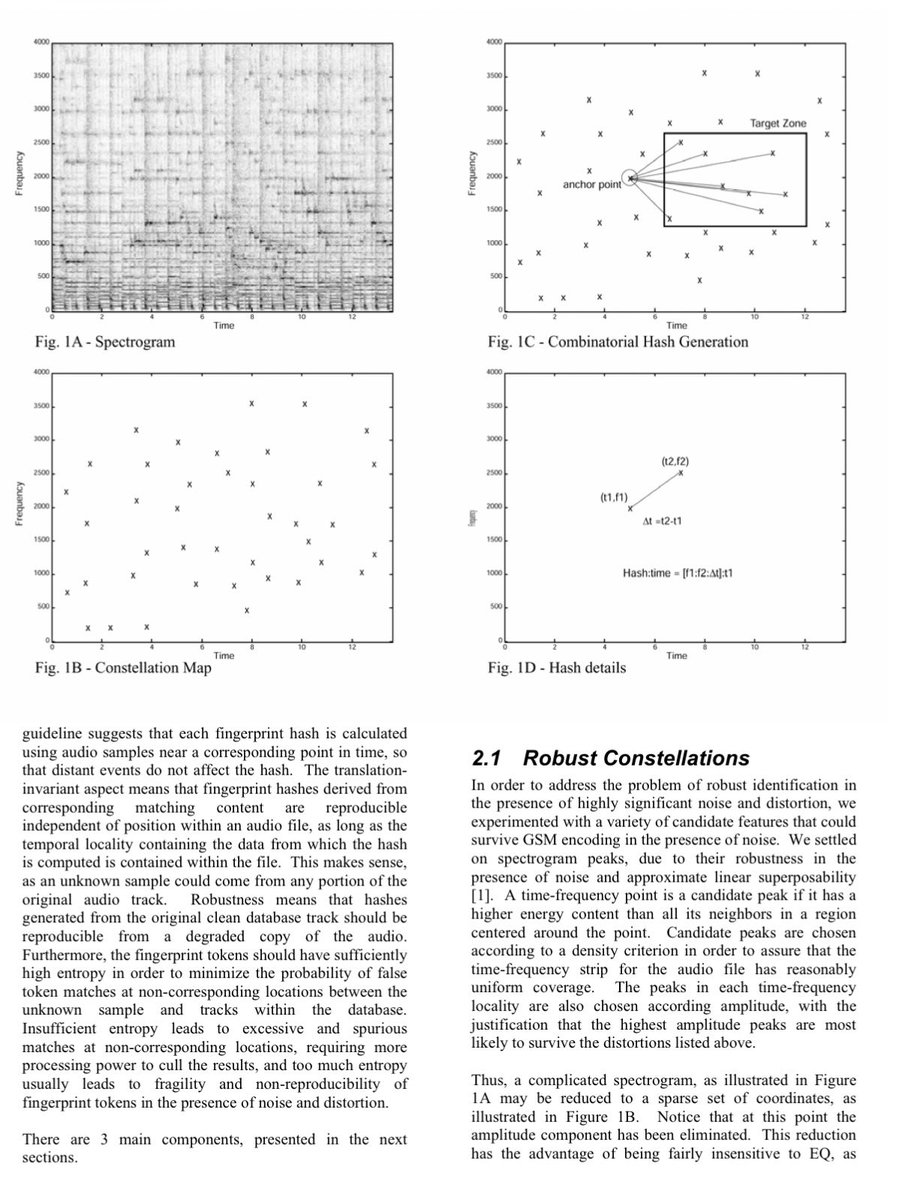
The algorithm converts audio into a spectrogram, a picture of the song, then throws almost all of it away. It keeps only the peaks, the loudest frequency points at each moment in time. Bar chatter and blown-out speakers can wreck most of a recording. The peaks survive. Shazam only ever needed the peaks.
Those surviving points form what Wang called a constellation map, because it looks like a star field. Pairs of peaks get converted into hash numbers, and identifying a song becomes a dictionary lookup rather than an audio comparison. That made it fast enough to search a million tracks on 2002 hardware.
Wang published the full method openly in 2003 in a paper called "An Industrial-Strength Audio Search Algorithm." Anyone could read exactly how the magic worked. The moat was the database and the deals with carriers, never the secret.
Apple bought the company in 2018 for a reported $400 million. People have tagged over 100 billion songs since the very first one, Jeepster by T. Rex, during the beta in April 2002.
One deterministic signal-processing trick, written before most people had heard the phrase machine learning, and it's still so good that in 2026 everyone assumes it must be AI.
Aakash Gupta reports that the FBI arrested Edward Frith after Epic Games reviewed a reported voice clip of his threat and sent it to authorities, and explains how Fortnite's rolling five-minute voice buffer and reporting system work.
The FBI just arrested a Fortnite player using a recording the game made of his own voice. He had no idea his headset was taping him. Almost nobody playing does.
Edward Frith, 29, had logged into his account over 1,700 times. In September he told another player that if the FBI showed up at his door he'd shoot them too. Someone in the lobby pressed the report button. Epic reviewed the clip, sent it to the FBI on September 20, and agents arrested him within days.
The design of the system is the clever part.
Recording every player would be a privacy disaster and a storage bill nobody wants. So Epic built voice reporting in 2023 to work like a flight recorder. The audio buffer lives on your own device, overwrites itself every five minutes, and never leaves your machine unless another player in the match reports it. The moment someone does, the clip gets packaged and sent to Epic's safety team with the speakers tagged.
He said it to one stranger in a lobby. That stranger had a button that turns the last five minutes into a federal exhibit.
I was a producer on Fortnite, and this is the part people outside the building never see. Threats of real-world violence got treated with the same urgency as a revenue outage. The game is full of kids, and Epic acts like it.
Fortnite is actually the conservative version of this. It still requires a human to press the button. Call of Duty has run AI moderation directly on live voice chat since 2023, no report needed. Every major platform with a microphone is converging on the same architecture.
The era where anything said into a gaming headset stayed in the lobby is ending one match at a time.
Aakash Gupta describes how New Rome, Ohio, and Macks Creek, Missouri, depended on speeding fines for most of their budgets, leading to dissolution in Ohio and bankruptcy in Missouri. Missouri subsequently capped ticket revenue at 20% of city budgets.
Ohio once dissolved an entire town because its main business was writing speeding tickets.
New Rome had 60 residents and a 14-officer police force. One cop for every four people in town. They collected around $400,000 a year in fines, 92% of the village budget, mostly by working a stretch of road where the speed limit dropped from 45 to 35.
A state audit then found the village was spending 82% of that budget on the police force. The town's only real industry was funding the thing that funded the town. In 2004 a judge ruled New Rome had effectively dissolved itself through corruption and erased it from the map. Its land got absorbed into the neighboring township.
Missouri ran the same experiment with Macks Creek, population 272, sitting on the highway to Lake of the Ozarks. The town wrote 2,900 tickets a year. Eight a day, almost all tourists who would never drive back to fight them. More than 75% of town revenue came from fines.
Then an officer there pulled over a state legislator. He went back to the capitol and passed a law capping how much of a city's budget can come from traffic tickets. Macks Creek lost its revenue stream, went bankrupt, laid off its entire police force, and disincorporated. The IRS seized the town's bank account.
Speed traps cluster wherever a highway full of out-of-towners meets a sudden limit drop in a state that lets the town keep the money. Missouri now caps ticket revenue at 20% of a city's budget. Ohio had to pass a law aimed at one specific village.
A speeding ticket heatmap doubles as a map of who's allowed to keep the fine money.
Claire Vo says many mothers, including those in tech, are slow to adopt AI due to privacy, environmental and workplace concerns. She argues the market is missing agents that manage family logistics like calendars, bills and errands rather than one-off tasks.
As one of the most tagged AI mother of bots in this thread let me tell you a secret: a lot of moms (even moms in tech) are the slowest f-ing adopters of AI I know.
I’m in a bunch of random mom groups and I hear - I won’t connect my email cal whatever - water / data centers etc - get all AI out of my kids schools - here is my 10000 word prompt for chat - I hate AI in my job, burn out, get me out of tech
If you get off X and into the real world, the adoption curve is slow. My YT channel is over 90% men. Women + moms are being left behind, and it’s not because someone hasn’t designed the right agent yet.
Silicon Valley keeps building me a husband when what I really want is a wife lol
I don't want an agent that only does one-off, random tasks that are nice but not life-changing: booking flights, making dinner reservations, or buying tickets
I want an AI wife who knows what’s on the family calendar, remembers there’s a birthday party Saturday and we haven’t bought a gift then sends me options, realizes we’re almost out of diapers and buys them, knows which bills are coming up, remembers someone needs a dentist appointment and books it, figures out what the hell we’re eating all week and what w…
Deedy outlines how Shazam extracts high-amplitude spectrogram peaks, hashes them with timestamp and track ID, and performs recognition via a hash table lookup. He notes that his college CS class built a version and recommends the original paper.
The serious answer to how Shazam worked is it took the peaks of a spectrogram of short clips of every song, find the peaks from the highest amplitude bits, hash it with the value being (time stamp, track id) and then the actual recognition is a hashtable lookup.
We did this for a college CS project. The original paper is fantastic:
Aakash Gupta shares a formula for valuing private equity grants by discounting quoted equity by payout probability and years to liquidity. He compares a $400K Google grant to a $400K OpenAI grant, estimating the latter at about $242K.
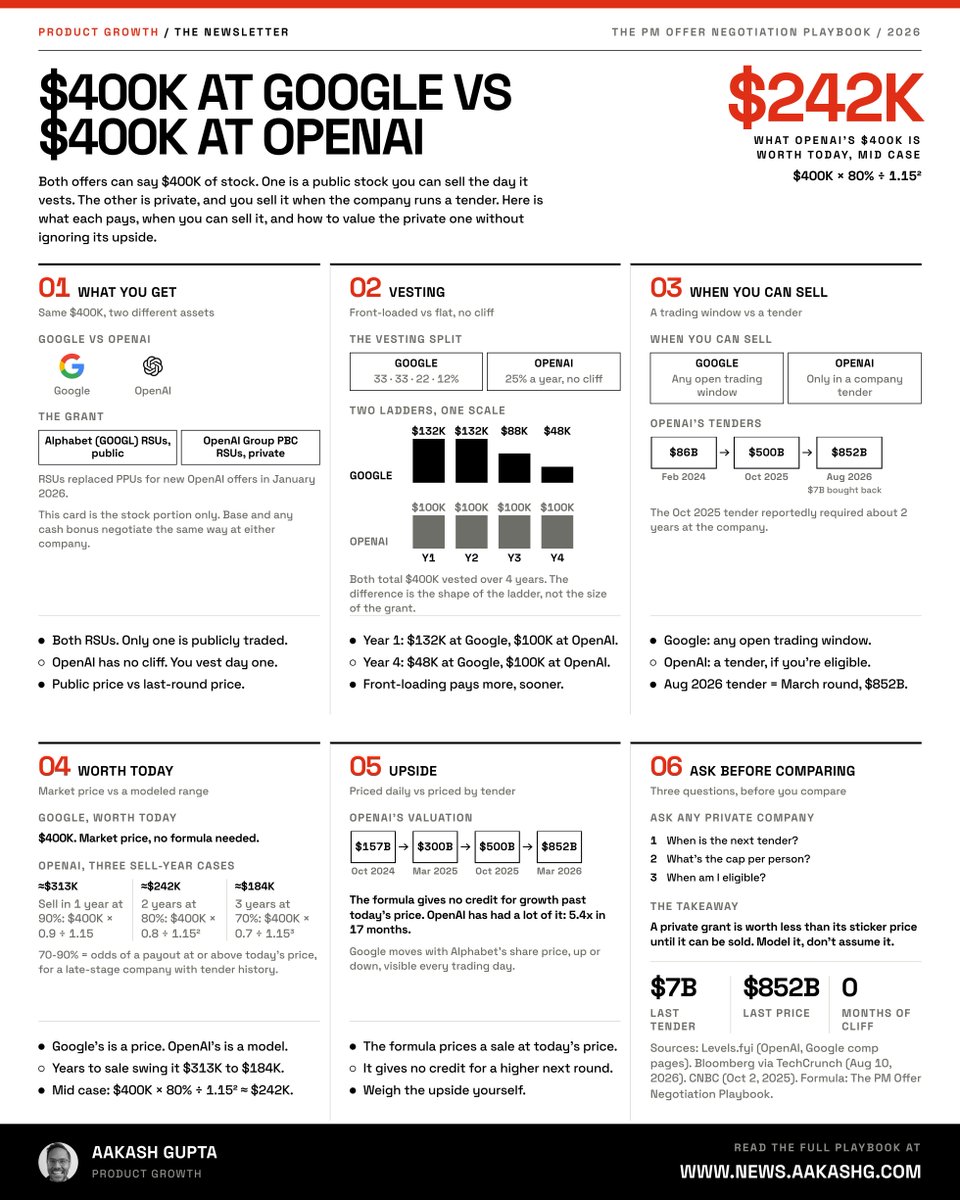
A $400K grant from OpenAI is worth about $242K today.
Same number on the offer letter. You can sell Google stock the day it vests. OpenAI is private, so you sell only when the company runs a tender.
Here's the formula I use for any private grant:
Value = Quoted equity × P(payout) ÷ 1.15^years to liquidity
The 15% is your discount for money you can't touch. For a late-stage company with real revenue and a tender history, P(payout) is 70-90%.
OpenAI, 2 years to a sale at 80% odds: $400K × 0.8 ÷ 1.15² = ~$242K. 1 year at 90%: ~$313K. 3 years at 70%: ~$184K.
Earlier stage gets brutal. A $400K grant at a Series C with an IPO 5 years out at 40% odds: $400K × 0.4 ÷ 1.15^5 = ~$80K.
The formula gives no credit for growth past today's price, and OpenAI has had a lot of it: $157B to $852B in 17 months. So treat the number as your floor.
Compare offers on what the equity is worth today. Then negotiate the gap in base and sign-on.
 ▶
▶