Thursday, October 8, 2026ArchiveSearchAsk the paper

The Computomatix Times

All the posts fit to save — curated from @computomatix's bookmarks & likes on X

Search

Latest stories — use the filters to narrow by keyword, section or date.

Startups Blacksmith, Namespace and Depot Tackle CI Build Bottlenecks

Deedy Das lists three startups, Blacksmith, Namespace and Depot, that address slow continuous integration builds, which he says have become a bottleneck as coding costs fall. He cites a Lindy post describing stratospheric CI spend.

Original post · 1 min read
As cost of coding has plummeted, long builds (CI) has become a bottleneck for many software cos. Three of the biggest startups solving this:

1. Blacksmith (@useblacksmith)
2. Namespace (@namespacelabs)
3. Depot (@depotdev)
Flo Crivello @Altimor
CI has become the top bottleneck of every engineering team I talk to (including Lindy). Our CI spend has become stratospheric. twitter.com/DavidOndrej1/status/21040010168869…
♥ 1.0K · ⟲ 50 · 👁 141.1KView on X ↗

Tesla Owner Replaces Subscription With Open-Source sunnypilot on Comma Four

Tesla Owner Replaces Subscription With Open-Source sunnypilot on Comma Four▶

Mike LaBarbera says he canceled his Tesla FSD subscription and installed a Comma Four device running sunnypilot, an open-source fork of comma.ai's openpilot, to get Level 2 driver assistance in his Model Y. A video accompanies the post.

Original post · 1 min read
My FSD subscription ended last January, and this isn’t Tesla Autopilot.

I installed a comma four in February, eight months of Level 2 ADAS I own outright in my Model Y. This is sunnypilot, an open source fork of @comma_ai's openpilot. No longer renting a closed system.
♥ 1.9K · ⟲ 63 · 👁 1.8MView on X ↗

Hanania Argues Against Preference for Homogeneous Society in Immigration Debate

Richard Hanania responds to a post about a Christopher Rufo episode on the 'Indian question,' arguing that most Americans prefer a wealthier, non-racist society. He challenges the view that preferences for homogeneity should prevail.

Original post · 1 min read
So it boils down to Indians having a different skin color.

Kudos for admitting it.

The thing is the rest of us have preferences too. And the vast majority of Americans are disgusted by racism and want to live in a wealthier society.

So I don’t know why a minority that wants a poorer more racist society should get their way.
Jonathan Keeperman @L0m3z
This week, @christopherrufo tackle the Indian Question.

Among other things, this episode cuts to the heart of longstanding foundational political disputes that are simply unreconcilable, but which can longer be brushed aside. Namely that some people (perhaps most people) prefer to live in a homogenous society, and as America tips toward a majority-minority country, that fundamental preference is under threat.

For a long time, liberals, who have more cosmopolitan preferences, have been able to pathologize the desire for homogeneity and subdue any explicit political effort to maintain a white …
♥ 1.8K · ⟲ 178 · 👁 209.7KView on X ↗

Grok Engineers Share Their Fourteen Work Bots in Podcast With Peter Yang

Lauren, an engineering lead on Grok @bot, says she enjoyed a conversation with Peter Yang about the fourteen bots the team uses for work and life. The linked episode covers a design bot, an engineering lead bot and tips on trusting bots with more work.

Original post · 1 min read
had a lot of fun chatting with @petergyang about our grok @bot setups!
Peter Yang @petergyang
"Everything I touch with my keyboard and mouse, I try to delegate to my bots."

Here's my new episode with @poteto and @pengzheng_, the eng and design leads for Grok @bot, where they showed me the 14 bots they use for work and life, including:

→ A design bot that turns one keyframe into a full user flow
→ An eng lead bot that manages a team of eng bots
→ How to trust your bots with more of your work

Some quotes from both:

"I like to call it the Michelin kitchen…when you say software factory, it has this connotation of mass manufactured slop."

"Sometimes I actually don't even look at the PR…
♥ 709 · ⟲ 32 · 👁 84.3KView on X ↗

Physician Argues Foreign Medical Graduates Should Be Admitted by Merit

Physician Argues Foreign Medical Graduates Should Be Admitted by Merit

Julius Chapiro, an immigrant doctor, argues that top international medical graduates should be admitted to U.S. residencies while Americans also get fair access. He says programs vary in quality and cites a quoted post on a residency shortfall of about 15,000.

Original post · 1 min read
I am an immigrant doctor who came to the U.S. System. I worked my tail off to get in. I believe I add value. I believe I provide good patient care. I love this country more than words can tell. I pay lots of taxes. I am more patriotic than probably 90% of the people around me, including some of those born here. But when I interview, I still expect far more from an IMG and prefer U.S. grads simply because I do not believe the U.S. system should disadvantage Americans. I will say that we can probably do both. Make sure Americans have full access to jobs and education but also accept excellent foreigners. Some programs go too far with IMGs and others can’t fill their spots from the U.S. applicant pool. Not all IMGs are equal. Is the top scoring candidate from the Sorbonne, Heidelberg, Teheran U, AIIMS, Tel Aviv University, etc the same like someone from a provincial hospital in a very below average med school somewhere in Central South East Asia or rural Eastern Europe? Probably not. But even there, each applicant should be fitted on a Gaussian curve. If you are 99th percentile, no matter where you are from, America should bring you in. Top humans exist everywhere. The beauty of America is that everyone can come here and become American. President Reagan said it and I live it.
Joseph Younis, MD @YounisJoseph
This is not H1B fraud... These are legitimate applicants from international medical schools who have put in the effort to match into American residencies. Do not displace real problems onto scapegoats.

The real problems are clear in the 3 attachments below, and the summary is:
1. There is a mismatch between how many American students are trained in American medical schools and how many residents we need to train annually (about a 15,000 gap)
2. The mismatch is a consequence of the significant de-accreditation by LCME in the mid 1900s. Since then, we now have the same number of medical schools…
♥ 237 · ⟲ 14 · 👁 52.6KView on X ↗
AI6/10

Meta's Muse Phone Call Feature Negotiates Bills for Users

Meta's Muse Phone Call Feature Negotiates Bills for Users

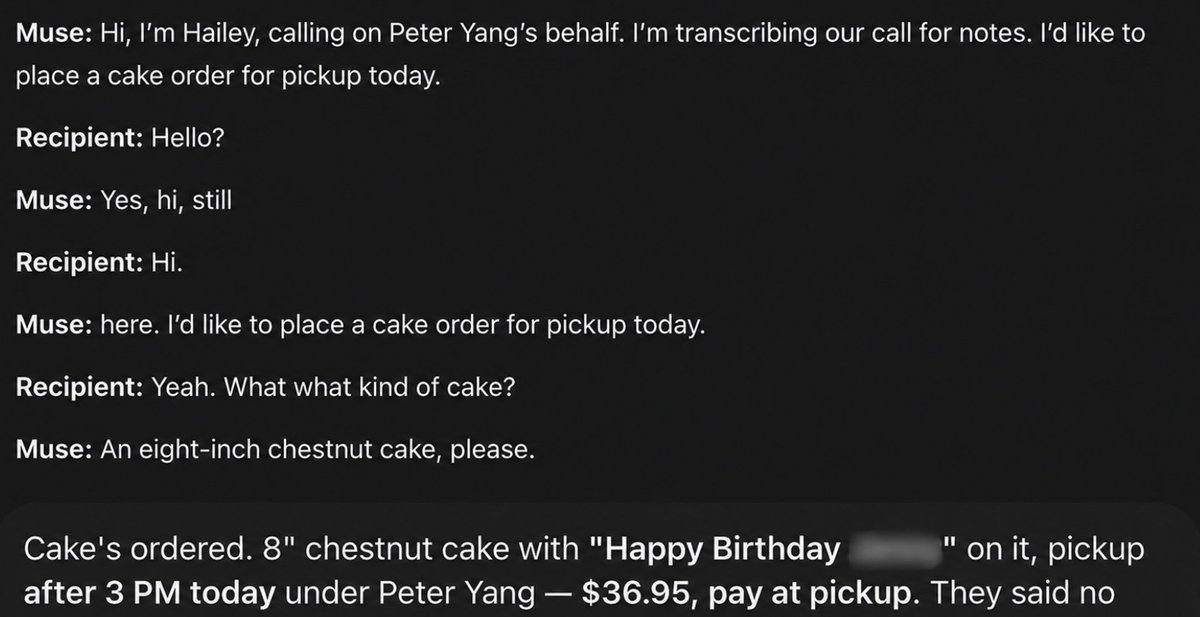
Peter Yang says Meta's Muse agent saved him over $800 a year on cable and phone bills and shares a video covering ten use cases, including a morning news feed, habit tracker and a call to customer support to negotiate bills.

Original post · 1 min read
This phone call feature from @Muse is just ridiculous.
Peter Yang @petergyang
Meta's @Muse is the best personal agent I've tried to date.

It actually save me $800+ a year on my cable and phone bills, which is just insane value for a free AI agent.

Here's my new video where I walk through 10 of my favorite Muse use cases, including a personalized morning news feed, a habit tracker, and how I got Muse to call customer support and negotiate my bills for me.

Honestly, I can see Muse becoming Meta's next billion-user app.

📌 Watch now: youtu.be/eU1ICyI9bCs
♥ 3.5K · ⟲ 76 · 👁 1.5MView on X ↗

Physician Argues US Medical Residency Gap Stems From School Accreditation

Physician Argues US Medical Residency Gap Stems From School Accreditation

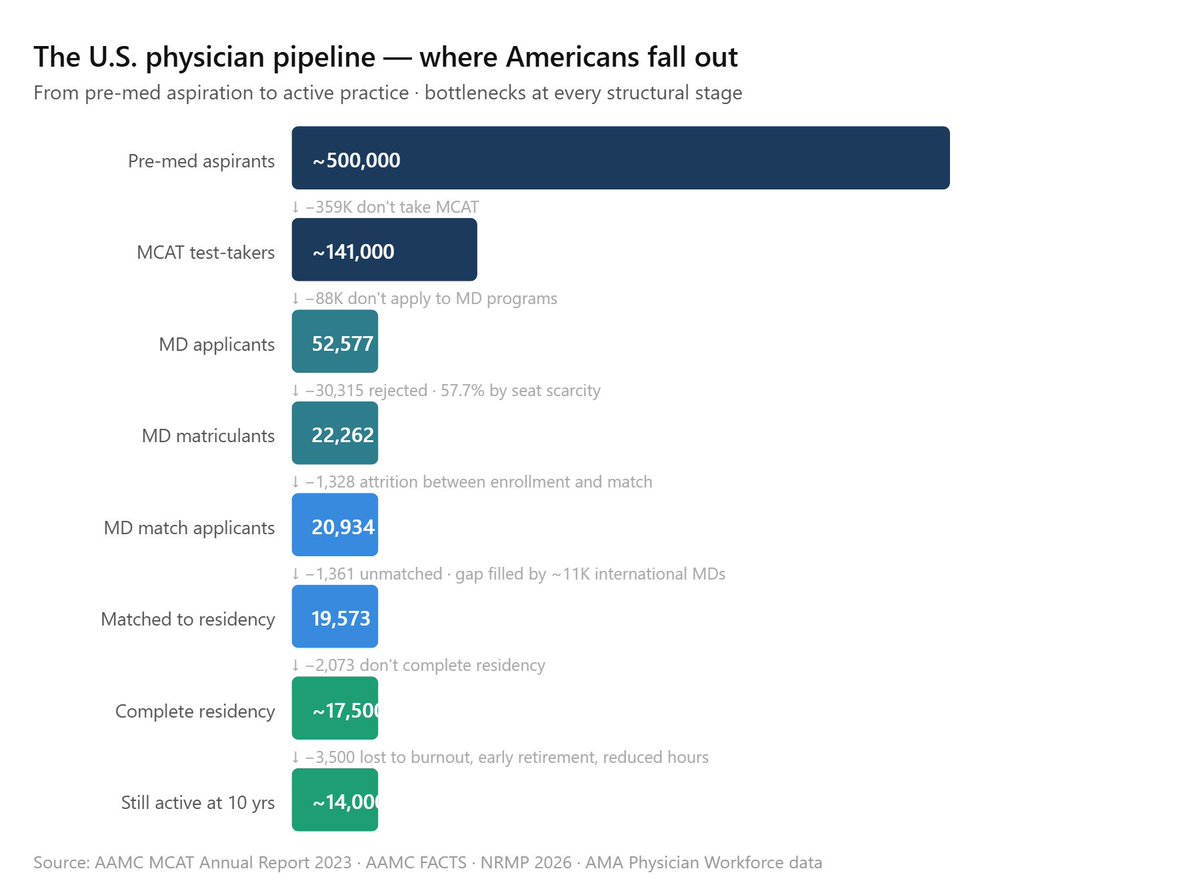
Dr. Joseph Younis argues that international medical graduates are legitimate applicants filling a shortfall of about 15,000 residency slots. He attributes the gap to LCME de-accreditation decades ago and a bottleneck in American medical school admissions.

Original post · 1 min read
This is not H1B fraud... These are legitimate applicants from international medical schools who have put in the effort to match into American residencies. Do not displace real problems onto scapegoats.

The real problems are clear in the 3 attachments below, and the summary is:
1. There is a mismatch between how many American students are trained in American medical schools and how many residents we need to train annually (about a 15,000 gap)
2. The mismatch is a consequence of the significant de-accreditation by LCME in the mid 1900s. Since then, we now have the same number of medical schools as we did 100 years ago
3. That led to structural bottleneck in matriculating American premed students into medical schools; we are rejecting over half of many hard working American college students

So, what are IMGs (some are American FYI) doing? Filling in a need that we created to begin with... You need to be asking why we create and maintain these self-inflicted wounds...
Michael Sebastian @HonorAndDaring
How does this happen? There are 300 million Americans. How can it be that we have no young men and women who want to be doctors? Something is fishy. twitter.com/jobsnowpaper/status/21039790559725…
♥ 442 · ⟲ 56 · 👁 115.6KView on X ↗

Doctor Criticizes Hospitalist Model and Medicare Residency Funding

Anish Koka, MD, argues that the U.S. needs outpatient doctors and says Medicare-funded residency programs have produced hospitalists while displacing family physicians. He ties the issue to foreign graduate pipelines and medical school admission policy.

Original post · 1 min read
Apologies to hospitalists. Many do amazing things, work hard etc.

My point is that the acute need for patients now and as long as I can remember in America is doctors who will see outpatients 5 days of the week.

And yet the taxpayer has been paying for residency programs that are hospitalist factories.

So in the last 30 years “ progress “ is creating a whole separate class of doctors that see inpatients only. In order to make way for the hospitalists, the prior group that was doing this work (your family practice doctor) had to be displaced (at times forcibly).

The non profit hospital then turns around and complains about the rising cost of care and sends you a $10,000 bill for your one night stay.

And at the end of the day, the end result is a pipeline built for Aga Khan University students to come to America and make a top 1% American income with zero medical debt. This is in the context of 2/3 American applicants being rejected from medical school. Cherry on top is affirmative action policies that make the bar for white / Asian U.S. citizens to get into medical school very high.

So circling back to where this all started : do I think there are lots of qualified American citizens that could do the job trainees at these small programs are doing? 100% yes.

The current state of affairs is a policy choice that works against American citizens, not for American citizens. And American tax payer dollars fund all of it.
Anish Koka, MD @anish_koka
There’s no guild interest in importing foreign labor.

This is a function of Medicare funding residency training spots.. lots of hospitals get paid to have a very cheap labor pool so they create these “training programs”

If you ended Medicare GME funding, a lot of these programs that primarily serve as an entry point to the U.S. market for developing labor would disappear.

The vast majority of these programs produce hospitalists — an invented “specialty “ that came into being to shorten length of hospital stays.
♥ 507 · ⟲ 102 · 👁 51.6KView on X ↗

Gokul Rajaram Says Enterprises Buy Outcomes, Not Tokens, in AI Sales

Gokul Rajaram endorses Databricks CEO Ali Ghodsi's view that enterprises lag in agentic AI adoption because models lack organizational context. He argues Palantir and Sierra win by selling and pricing on business outcomes.

Original post · 1 min read
Ali makes great points.

In addition, I think one of the key reasons for lagging enterprise AI adoption is that F500 enterprises don’t buy tokens. They buy business outcomes.

Palantir and Sierra are arguably the fastest growing enterprise AI applications companies (outside of the labs). Both sell business outcomes and price on outcomes.

If you’re selling tokens to F500 enterprises, you’re DOA.
Mike Fishbein @mfishbein
Databricks CEO @alighodsi went off on @a16z pod about enterprise AI adoption:

"They're just so far behind in the adoption curve of actually automating things and getting value out of this stuff."

Ali says most companies are still just using chatbots. There's hardly any agentic transformation.

Why is that?

"The models are smart enough, but they just don't have the context that exists inside of any organization."

"They have not been in every meeting. They don't know what's in everybody's heads. They don't know all the processes."

"If you just fused that and gave that context into the AI mo…
♥ 204 · ⟲ 31 · 👁 64.8KView on X ↗

Dick Capital Marks First Year on Substack With Discounted Subscription Offer

Dick Capital Marks First Year on Substack With Discounted Subscription Offer

Dick Capital celebrates its one-year anniversary on Substack by offering subscriptions for less than a dollar a day until October 4. The post is promotional and links to a full announcement.

Original post · 1 min read
To celebrate Dick Capital’s one-year anniversary on Substack, we’re running a special offer for the next week. ♥️

In one year, we’ve become one of the top publications in Finance, uncovered some of the market’s biggest themes before they went mainstream, and watched subscribers completely change their financial lives.

Thank you to everyone who has been part of the journey.

Until October 4, you can subscribe for less than a dollar a day and join us.

Full post + special offer available through the link in our bio.
♥ 306 · ⟲ 16 · 👁 641.9KView on X ↗

Opus 5.5 Builds Interactive Browser Game Assets With Blender and Three.js

Levelsio says Claude still struggles with sound, producing tinny synth effects, while praising a third iteration of a browser game built with Opus 5.5 using Blender, image generation and three.js. The quoted creator calls it a glimpse of the future of game development.

Original post · 1 min read
This is getting really good

The last thing Claude is bad at now is sound, it always does these "ticky" synth sounds that are way worse in quality than the visuals it now produces
Shikhar @xikhar
Third iteration with Opus 5.5 medium.

I am in awe. It turned blender, image-gen, and three.js into this beauty, which runs on your browser.

An understatement to say that Anthropic cooked. You are looking at the future of game dev.
♥ 1.6K · ⟲ 31 · 👁 336.2KView on X ↗

Garry Tan Recommends Aside Browser for Agents Facing Anti-Bot Barriers

Garry Tan recommends running the AsideAI browser with MCP on a spare, always-on computer so agents can use real credentials inside a real Chromium browser. He calls it a gamechanger for getting past antibot friction.

Original post · 1 min read
If you like Muse and Grok Bot but still run into crazy antibot annoyances try @AsideAI browser with MCP with your agent on a spare laptop or computer you keep plugged in somewhere.

It lets your agents your real credentials as yourself from a real Chromium. Gamechanger.
♥ 1.2K · ⟲ 59 · 👁 151.5KView on X ↗

Aakash Gupta Lays Out Six-Stage Path to Becoming an AI Product Manager

Aakash Gupta Lays Out Six-Stage Path to Becoming an AI Product Manager

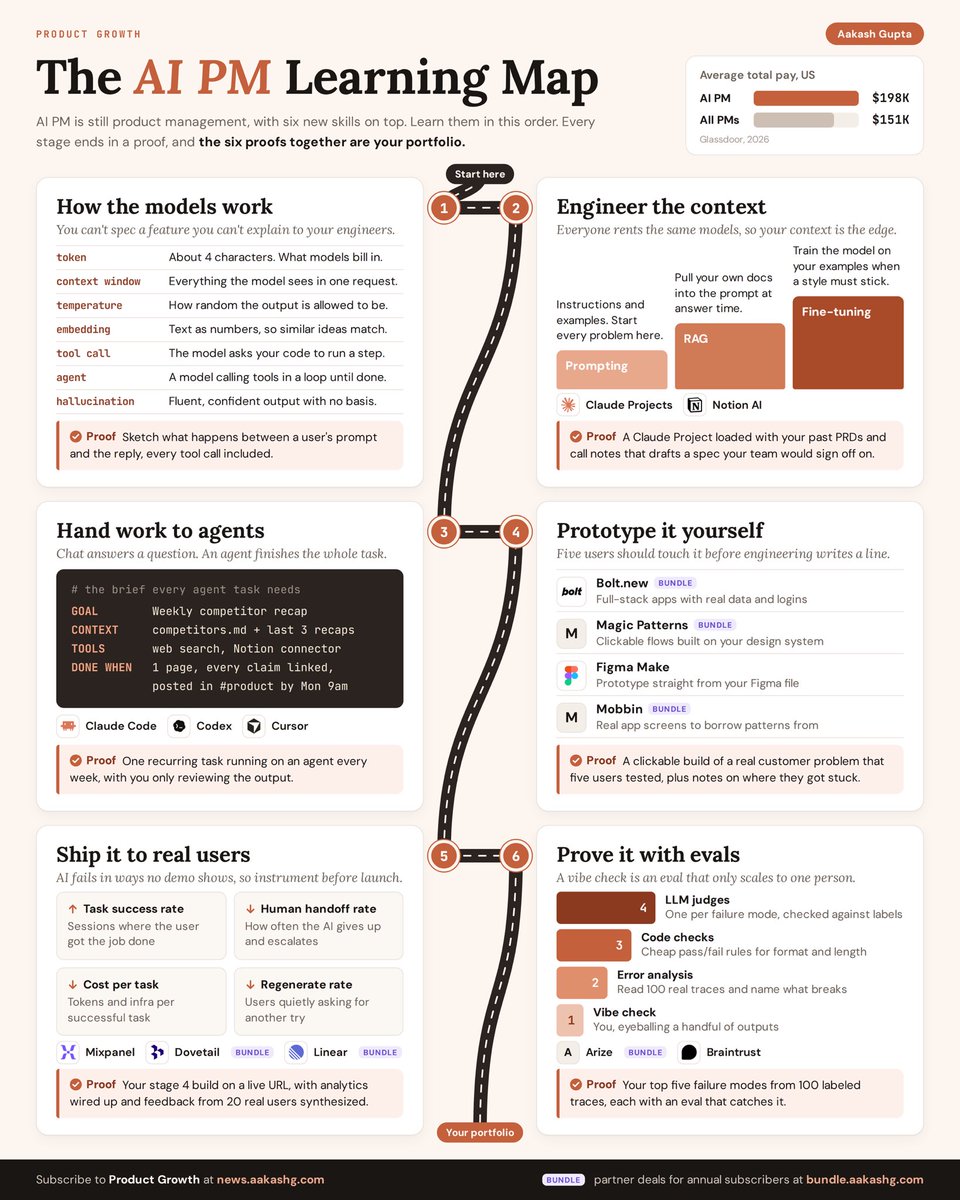
Aakash Gupta outlines a six-skill learning path for becoming an AI product manager, citing Glassdoor data showing average AI PM total pay of $198K versus about $151K for PMs overall. Each stage ends in a portfolio artifact, such as a Claude Project of past PRDs or a recurring agent task.

Original post · 3 min read
To become an AI PM, you need six skills on top of core PM. Here's the order to learn them.

The pay gap is why it's worth it. Glassdoor puts the average AI PM at $198K in total pay, against about $151K for PMs overall.

Most AI PM learning maps I see are generic PM concepts with "AI" in the title. They skip what hiring managers screen for, which is proof you've done the work.

So in this map, every stage ends in something you can show.

1. Learn how the models work

Tokens, context windows, embeddings, tool calls, agents. You don't need to train a model, but you should be able to sketch everything that happens between a user's prompt and the reply. A PM I coach hit exactly this depth check in technical screens at both Nvidia and Glean.

2. Engineer the context

Everyone rents the same models, so the edge is what you feed them. Climb only as far as you need. Prompting first, RAG when answers depend on your data, fine-tuning when a style has to stick. Your proof is a Claude Project loaded with your past PRDs that drafts a spec your team would sign off on.

3. Hand work to agents

Chat answers a question. An agent finishes the whole task, as long as your brief has a goal, the right context, the tools it can touch and a clear definition of done. Your proof is one recurring task, like a weekly competitor recap, running on Claude Code or Codex while you only review the output.

4. Prototype it yourself

Alex Danilowicz, CEO of Magic Patterns, said on my podcast that the classic mistake is spending two hours debugging a database when all you needed was a clickable mockup to show five customers. Reach for Bolt.new when you need real data and logins, and Magic Patterns for flows on your design system.

5. Ship it to real users

AI fails in ways no demo shows. Before launch, instrument task success rate, human handoff rate, cost per successful task and how often users hit regenerate. Then put your prototype on a live URL and synthesize feedback from 20 real users.

6. Prove it with evals

A vibe check is an eval. You're using your own brain as the scoring function, which works right up until you're the bottleneck. Hamel Husain and Shreya Shankar walked me through the sequence I'd copy. Read 100 real traces, name the failure modes, add cheap code checks, then build one LLM judge per failure mode and check it against your own labels.

Your proof is your top five failure modes, each with an eval that catches it.

Stack all six proofs and you have an AI PM portfolio.

A deep dive for each stage

1. AI foundations → news.aakashg.com/p/ai-foundations-for-pms
2. Context engineering → news.aakashg.com/p/context-engineering
3. AI agents → news.aakashg.com/p/ai-agents-pms
4. Bolt.new guide → news.aakashg.com/p/pm-guide-bolt
5. AI evals → news.aakashg.com/p/ai-evals
6. LLM judges → news.aakashg.com/p/ai-pm-llm-judge
7. AI PM portfolio → news.aakashg.com/p/vibe-code-pm-portfolio

Learn the stage. Then ship the proof.
♥ 223 · ⟲ 28 · 👁 17.8KView on X ↗

Gokul Rajaram Urges Readers to Study the Current GPU Compute Market

Gokul Rajaram endorses a post by @gpugene on compute trading, which reports B300 GPU deals clearing above $24 per GPU-hour and short-term compute pricing above $7. The quoted post frames the market as hot right now.

Original post · 1 min read
Must read for everyone trading compute.
Eugene Ye @gpugene
Let's talk about trading compute — Do you guys see what’s happening in the market right now?
Deals are clearing above $24/gpu/hr for some B300s with pricing for short term (<1 year) compute hovering above $7. Actually by the time you
♥ 249 · ⟲ 14 · 👁 100.1KView on X ↗

DHH Argues Developers Should Test Software on an Old Low-Spec PC

DHH argues every software developer should own a low-powered older PC to ensure applications run fast enough, and suggests running agents on it to keep software lean. He says a machine from ten years ago should run software smoothly.

Original post · 1 min read
Every software developer should own a potato PC. It's the easiest way to ensure your application is fast enough. Put your agents to work within it and watch the weight drop. There's no reason a machine from ten years ago shouldn't fly like superman.
♥ 6.5K · ⟲ 250 · 👁 350.3KView on X ↗

Company Splits CTO Role Instead of Naming Acting Replacement

Company Splits CTO Role Instead of Naming Acting Replacement

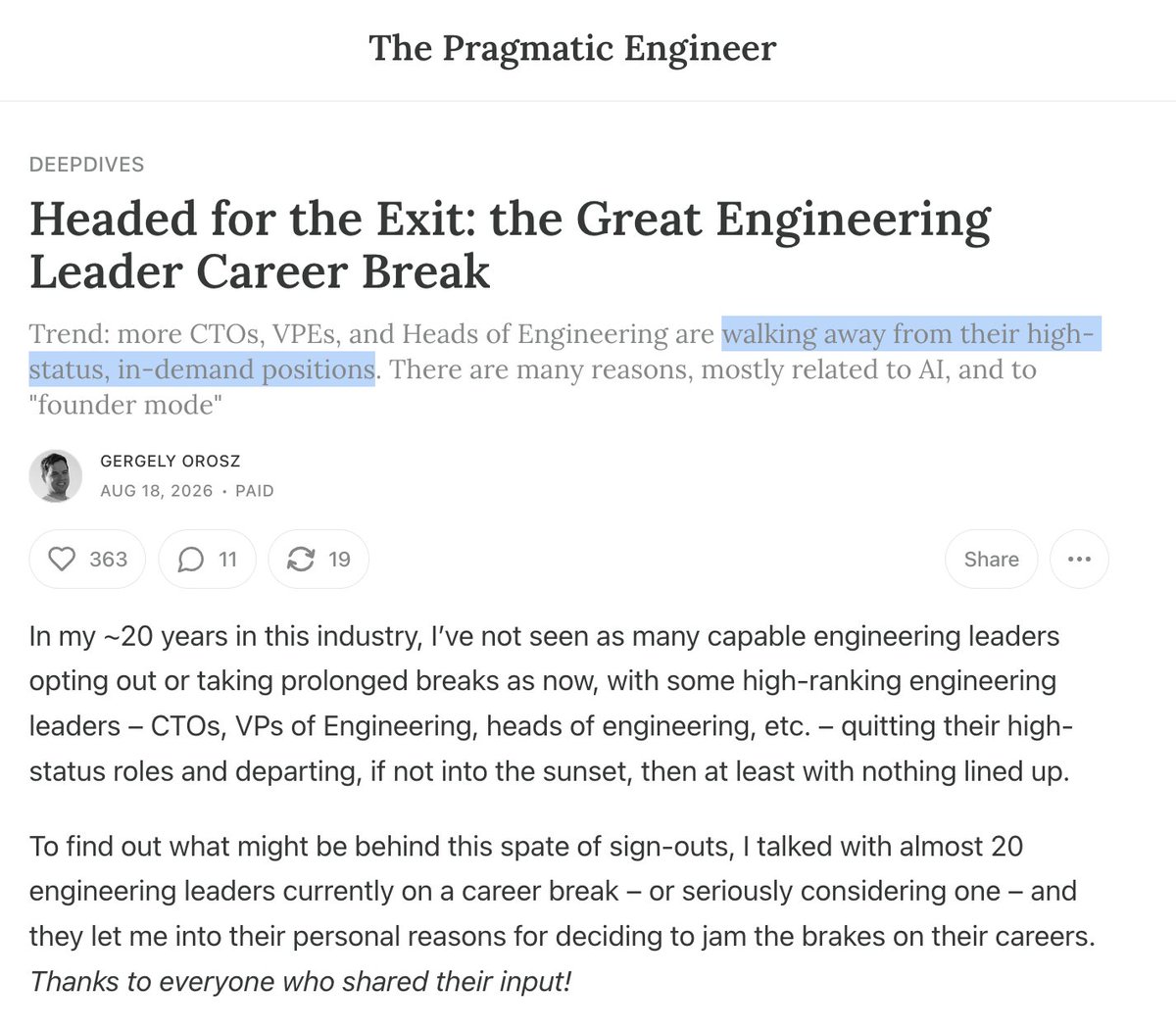
Gergely Orosz shares a LinkedIn post describing a company that divided its departing CTO's responsibilities into several distinct areas rather than appointing an acting CTO. Orosz links to his piece on the difficulty of hiring engineering leaders.

Original post · 1 min read
Read on LI: "Our CTO is leaving, and the obvious move would have been to appoint an acting CTO until we find a replacement. We decided not to do that. Instead, we split the role into several distinct areas of responsibility: "

My two cents: it's so, so hard to hire for CTOs now: newsletter.pragmaticengineer.com/p/the-great-e…
♥ 608 · ⟲ 36 · 👁 97.3KView on X ↗

Post Promotes Claude Stock Trading Mode With Nine Research Prompts

Iqra claims Claude has a feature called Stock Trading Mode that can research and trade any stock, and promotes nine prompts for accessing it. The post offers no verifiable detail about the feature itself.

Original post · 1 min read
🚨 BREAKING: Claude has a feature called Stock Trading Mode.

You can use it to research and trade literally any stock, like an expert stock market analyst.

Here are 9 prompts to access it:

(Research stocks smarter, not longer. 📌 Save this post)
♥ 1.1K · ⟲ 185 · 👁 244.5KView on X ↗
AI7/10

Michael Burry Argues LLMs Cannot Reach Understanding Due to Model Collapse

Michael Burry argues that human knowledge is too small for what AI is building, that LLMs will amplify propagation errors, and that language models cannot attain true understanding without reasoning that precedes language. He cites Ballard's test and a quoted Oxford and Cambridge study on model collapse.

Original post · 1 min read
This is to my point about compression being inevitable as human knowledge is too small for what we are building. As well, humans are too redundant in their wants needs and questions.

AI-generated content will clearly contain propagation errors just like human history of knowledge does. Only LLMs will iterate those propagation errors infinitely faster with less ability to self- correct, for want of understanding.

This gets to Ballard’s test. LLMs cannot attain understanding (AGI) as understanding cannot exist unless reason first exists without language. A likely impossibility for a language model.

Research on this is already focused on getting around this in some way. Though many also have not yet conceded the point.
Superman @thesupermannx
ChatGPT has now a big problem.

Researchers at Oxford and Cambridge exposed a massive threat to large language models.”

They call it “model collapse."

Internet ecosystem is rapidly changing, and generative AI will soon contribute much of the text found online. This forces us to consider what happens to future iterations like gpt-n when they are trained on data scraped from the web that was already generated by an llm.

According to the research, indiscriminately using model-generated content in training causes "irreversible defects" in the resulting ai. the model loses the "tails of the orig…
♥ 3.3K · ⟲ 419 · 👁 660.1KView on X ↗

Molekul Launches Searchable Database of Russian and Soviet Pharma Research

Peptide & Actoprotector Research | Molekul

PepMariner announces molekul.io, a searchable website cataloging Russian and Soviet pharmaceutical research on peptides, actoprotectors, nootropics and obscure compounds. The author says the site is a work in progress and invites requests for additions.

Original post · 1 min read
I finally put together a website for all the Russian/Soviet pharma research I’ve been digging through.

molekul.io

Figured this would be a lot easier than trying to search through months of my posts every time you want to find something.

Peptides, actoprotectors, nootropics, papers, old Soviet research, obscure compounds, etc.

It’s still very much a work in progress. I’ll keep adding papers, compounds and research as I find it.

Basically turning the rabbit hole into a searchable database.

Let me know what you want me to add.
molekul.ioPeptide & Actoprotector Research | MolekulExplore peptide, bioregulator, nootropic and actoprotector research. Original Russian sources, evidence limitations, and a transparent bibliography.
♥ 122 · ⟲ 12 · 👁 9.5KView on X ↗

Gabbar Recommends Video Using Opus 5.5 to Trace Indian Spiritual History

Gabbar endorses a four-minute video by Hindol Sengupta that searches for God in India across more than 5,000 years, crediting Opus 5.5 for making it. The post is brief praise with no further detail.

Original post · 1 min read
Great stuff. Watch
HindolSengupta @HindolSengupta
Searching for God in India. For more than 5,000 years. In many names. In 4 minutes.

(Opus 5.5 is still incredible.)
♥ 1.2K · ⟲ 149 · 👁 187.5KView on X ↗

Konstantin Saifoulline Builds Interactive Raptor 3 Engine Explainer With Claude

Konstantin Saifoulline describes using Claude Opus 5.5 to build an interactive Raptor 3 rocket engine in the browser, letting users cut it open, follow oxygen and methane through turbopumps, and adjust throttle. He links to the airsup.ai demo.

Original post · 1 min read
Kids will grow up learning like this. It's insane.
Konstantin Saifoulline @konstantinsaifo
I asked Claude Opus 5.5 to explain how a rocket engine works by building an interactive Raptor 3 you can take apart in your browser.

Cut it open, follow the oxygen and the methane through both turbopumps, then throttle it and watch the shock diamonds move.

airsup.ai/rocket-engine
♥ 8.9K · ⟲ 587 · 👁 655.8KView on X ↗

Medical School Expansion Alone Won't Fill Rural and Urban Shortage Gaps

Dr. Brent A. Williams argues that training more U.S.-born medical students would be costly and would not guarantee that graduates choose family medicine in rural Alabama or pediatrics in the Bronx.

Original post · 1 min read
Yes of course we can educate more US born medical students (expensively), but that does not mean that more are going to choose to be a family medicine doctor in rural Alabama or a pediatrician in the poorest part of The Bronx.
♥ 898 · ⟲ 64 · 👁 292.8KView on X ↗
AI8/10

Freda Duan Estimates Infrastructure Needed to Serve 100 Million Muse Users

Freda Duan Estimates Infrastructure Needed to Serve 100 Million Muse Users

Freda Duan sketches the compute and power required to serve 100 million daily users of Meta's Muse, estimating about 1 GW in the base case, possibly 3-4 GW, and sandbox VM costs below $1B in CPU. She invites feedback on her assumptions.

Original post · 6 min read
A humble attempt to est. the infra required to serve 100M DAU @Muse

Rough conclusion is:

1 GW of power to serve 100M DAU in the base case, of which only ~0.1 GW comes from the CPU/VM layer. Depending on the # of reasoning-equivalent model calls one Muse DAU generates per day, 3-4GW is entirely plausible. Maybe that’s why @Meta is rumored to be adding 7-10GW of compute next year.

The sandbox layer = sub $1B of CPU content and ~$2B of DRAM content, which is much smaller than many expected.

Lot of moving assumptions. Welcome all feedbacks/ pushbacks.

------
Two very different pieces of infrastructure behind Muse.

1. Muse VM / sandbox infrastructure

2 vCPUs, ~8 GB of RAM and ~100 GB of persistent logical storage per user. starkinsider.com/2026/09/meta-muse-specs-what-…

2. Muse Spark inference

Model inference goes out through Meta's external inference infrastructure. research.meta.ai/blog/security-and-safety-for-…
------

1/ Sandbox infrastructure

A. CPU
The first mistake is assuming that 100M DAU means 100M VMs are actively consuming compute at the same time.

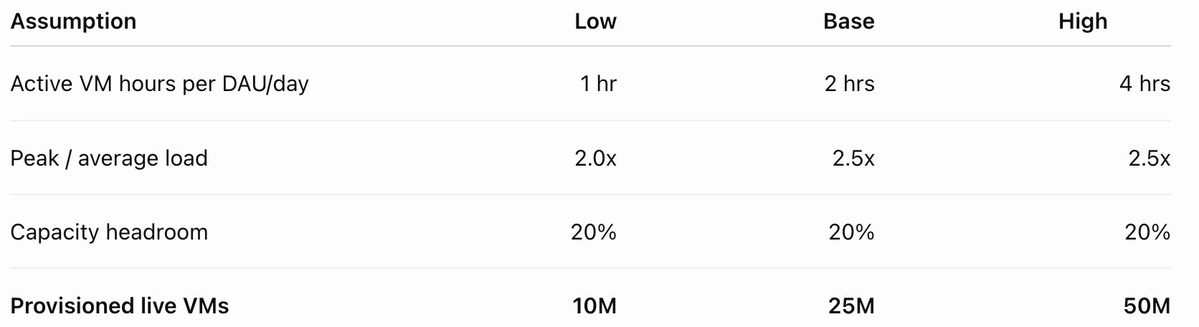
Suppose the average Muse DAU has an agent actively working for two hours per day.

100M users * 2 hours / 24 hours = ~8M average simultaneous active VMs

Meta obviously cannot provision only for the daily average. Usage will be concentrated during waking hours and bursty.

Assume a 2.5x peak-to-average ratio:

8M * 2.5 = ~20M peak active VMs

Then add roughly 20% capacity headroom: ~25M provisioned live VMs. So the base assumption is effectively that Meta needs enough infrastructure to support roughly 25% of DAU being live simultaneously.

The next important distinction is between virtual CPU allocation and physical CPU demand. Agent sandboxes are particularly well suited to CPU oversubscription. They spend a lot of time waiting. During those periods, the VM may still be alive, but it is barely using CPU.

DeepSeek’s recently published DSec infrastructure provides a useful benchmark. Its production agent sandbox platform runs approximately 30,000 physical CPU cores and 250TB of DRAM across ~160 nodes, with peak concurrency above 380,000 sandboxes. arxiv.org/abs/2609.22978 DSec also demonstrates stable operation at around: 800 microVMs per node. With roughly 188 physical cores per node: 188 physical cores / 800 microVMs = ~0.23 physical cores per live VM.

DeepSeek is obviously the King of efficiency. The number for Muse might be at 0.3-0.75 physical cores per live VM, or assume 0.5 physical cores per live VM as the base case. That is equivalent to roughly two simultaneously live Muse VMs per physical CPU core.

Using the base assumptions: 25M live VMs * 0.5 physical cores per VM = 12.5M physical CPU cores.

On a 256-core CPU: 12.5M cores / 256 cores per CPU = ~50K CPUs; Or on a 192-core CPU that would be 65K CPUs.

At the current public pricing, that is ~$800M.

B. DRAM
CPU can be aggressively oversubscribed because a VM that is waiting may consume almost no CPU. Memory is harder to oversubscribe because a live VM still needs to retain its working state.

Muse exposes roughly 8GB of RAM to the user environment, but one observed instance was actually using only around 3GB at the time of measurement.

25M live VMs * 3GB = 75PB of physical DRAM, call it ~75-100PB of physical DRAM feels like a reasonable base range.

At the current public pricing, that is ~$2B.

C. Sandbox power
~0.1 GW for the entire Muse sandbox / VM layer at 100M DAU.

------

2/ Inference
Muse’s personal computer executes tools and stores state locally, but the actual model runs on separate inference infrastructure. Meta’s Muse architecture

Energy per inference event
Microsoft’s 2026 study estimates that optimized frontier-scale inference consumes a median of approximately: 0.31Wh per normal query

But a long reasoning query with roughly 15x the token count consumes approximately 13x as much energy, or around: 4Wh per long reasoning query

The study specifically highlights reasoning and agentic workloads as significantly more energy intensive.
microsoft.com/en-us/research/publication/energ…

Sensitivity analysis on # reasoning-equivalent events per DAU per day

Suppose each active @Muse user generates the equivalent of 50 heavy inference events per day.

At 5Wh each:

100M users * 50 events/day * 5Wh = 25GWh/day

25GWh/day / 24 hours = ~1.0GW average power

So inference alone could require: ~1-2GW of average power

A 3-4GW Muse is entirely plausible. Maybe that’s why @Meta is rumored to be adding 7-10GW of compute next year.

------
The popular framing around Muse is that giving every user 2 vCPUs and 8GB of RAM creates an enormous CPU requirement. But the naive calculation materially exaggerates the CPU requirement because it treats logical VM allocation as dedicated physical infrastructure.

The more interesting conclusion is: Consumer agents may be a meaningful new demand driver for CPUs and conventional DRAM, but inference remains the real compute bottleneck. And as agents do more work, run longer trajectories and increasingly spawn other agents, inference demand can scale much faster than the number of users itself.

+++
Calling my peer review group: @bubbleboi @damnang2 @Midnight_Captl @FundaAI @fi56622380 . Feedback/ Pushbacks pls :).

++
Better formatted: robonomics.substack.com/p/agent-muse-compute-d…
♥ 1.0K · ⟲ 121 · 👁 593.4KView on X ↗

Kevin Rose Praises DHH's Candid Remarks on Writing Code With AI

Kevin Rose endorses David Heinemeier Hansson's comments on hand-written code versus AI-assisted coding, arguing that making past work obsolete is the purpose of building. He quotes Jay Ledev calling DHH a leading software artisan.

Original post · 1 min read
Well said @dhh. I've 'retired' many times... from setting IRQ jumpers, defragging drives, and tuning config.sys for a few more kb of ram. making yesterday's work obsolete is the whole point of building. grateful to have watched it happen.
Jay Le @jayledev
DHH is probably one of the top software artisans of the past decade. Hearing him speak with this much conviction and transparency about one of the most polarizing topics in software right now, writing code by hand vs. with AI, is something pretty much every software engineer should hear a few times.

Especially those still on the wrong side of history.
♥ 492 · ⟲ 25 · 👁 76.7KView on X ↗

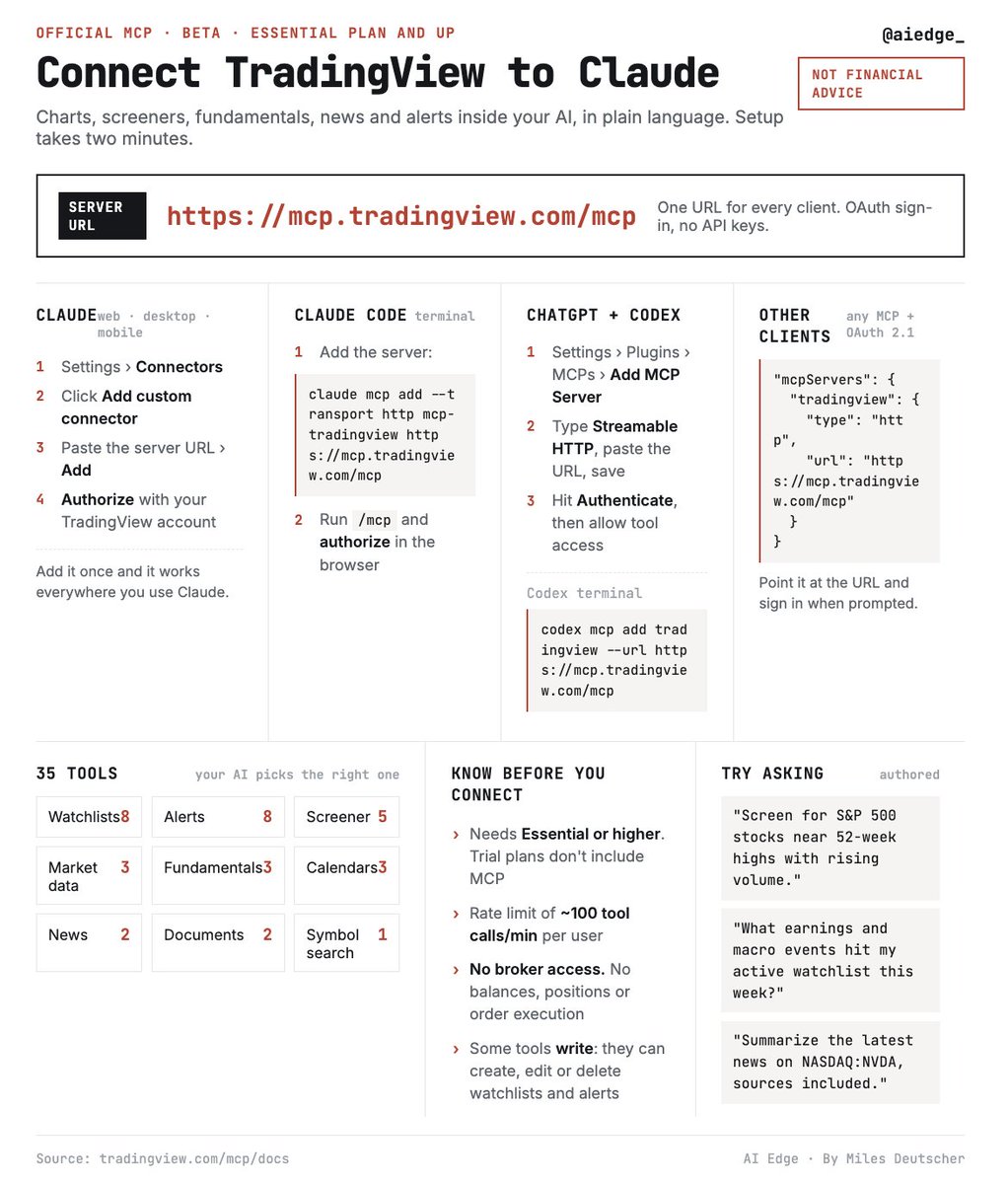
TradingView Releases Official MCP Server for Claude Integration

TradingView Releases Official MCP Server for Claude Integration

Miles Deutscher announces TradingView's official MCP server for Claude, explaining how users can connect their TradingView account to agents and set it up in under three minutes with a guide.

Original post · 1 min read
TradingView recently released the official MCP server for Claude.

You can turn your agents into quant desks by giving them access to your TV account.

If you haven't set it up yet, don't worry, I got you.

Connect Claude x TradingView in <3 minutes:
♥ 1.4K · ⟲ 222 · 👁 127.7KView on X ↗
Other1/10

Promoter Praises Asian Trader and Memecoin Gains Without Substantiation

Emin Altman promotes a trader he describes as a god and claims his life changed after following him. He quotes a post reporting a $PAID memecoin position rising to $52M market cap and $450K in gains.

Original post · 1 min read
This Asian trader is literally a god.

Ever since I started following him, my life has completely changed.

If you want to change your life, follow him.
Kaze ⛩️⚡ @KazeCreations
几周前我就在这里发过 $PAID

说真的 连我自己都没想到这东西后面还能跑这么狠 最近直接冲到了 $52M 市值

我当时只买了 $38K

现在这笔已经给我赚了 $450K+

从上次发它到现在 这袋子基本一直在变大

一只 memecoin 隔几周还能继续往口袋里塞钱

这市场有时候真的离谱得不像真的 twitter.com/KazeCreations/status/2100030443609…
♥ 4.5K · ⟲ 601 · 👁 1.4MView on X ↗

Jesse Tinsley Warns AI Roll-Up Strategy Carries Debt and Integration Risk

Jesse Tinsley responds to Greg Isenberg's case for buying businesses and using AI agents to triple EBITDA, arguing that M&A integration is hard, many AI holding companies may fail due to debt, and private credit could burst.

Original post · 1 min read
While I hate that Greg is exposing this alpha publicly...

He's right.

The tough part is not seeing this trend anymore now that Mainstreet has scaled to 9 figures in ARR through this strategy, Bending Spoons IPO this year, Thrive and General Catalyst executing similar strategies among many others now.

But execution in M&A is hard and integration is even more difficult especially in legacy services businesses. Add in debt and cyclical nature it's not full proof. In fact I would wager 50% or more of the current AI holding companies fail due to poor integration and high debt profile. Hence why we hold zero debt we can survive any macro trends or black swan events.

Leverage cuts both ways and we're about to see this play out. The best buying opportunity in our lifetime will happen when the private credit bubble bursts in the next few years.
GREG ISENBERG @gregisenberg
$5T opportunity: AI Roll Ups — I'll make the case why you should buy a business and use AI agents to 3x EBITDA. By the end of this dead simple guide, you'll know how to find the right business, buy it, and run it with agents, down
♥ 2.0K · ⟲ 76 · 👁 773.3KView on X ↗

Post Argues Feedback Turns Experience Into Faster Growth

Grant Miller shares a quote from a Tim Denning post, stating that without feedback twenty years of experience is one year repeated twenty times, while focused feedback can let a few months outpace a career.

Original post · 1 min read
im begging you to read this:

“Without feedback, 20 years of experience is just one year lived 20 times.

With it, a few months can beat a career.”
Tim Denning @Tim_Denning
Once you understand pattern recognition your life will never be the same again — It’s easy for you to get fooled over and over again.
That’s what it means to be human.
You try to achieve the same goal multiple times and fall short. No matter what you do the result doesn’t seem to
♥ 1.5K · ⟲ 196 · 👁 178.6KView on X ↗

Wilfred Reilly Questions Medical School Admissions and Foreign Physician Hiring

Wilfred Reilly Questions Medical School Admissions and Foreign Physician Hiring▶

Wilfred Reilly argues that qualified U.S. applicants with high MCAT scores are denied medical school slots while foreign doctors fill residency gaps, and asks whether defense of this goes beyond guild interest.

Original post · 1 min read
This is a point for the nativists. We do not, to put it mildly, have a surplus of qualified, affordable docs in every area.

But, every year, something like 30K MCAT takers with scores above the ACCEPTED Black mean - i.e. top 48% - are denied even a med school slot. Later resulting gaps are filled by foreigners: good, nice people...but by no means better qualified than the 2nd tier of Midwestern white applicants.

Any defense of this beyond guild interest?
Expose H1B Fraud @JobsNowPaper
BREAKING: Rochester General Hospital in New York hired 82 resident doctors.

80 are foreign workers on H-1B or J-1 visas.
Only 2 are Americans.

98% of the residency slots went to visa workers- mostly from countries with documented USMLE cheating.

Americans got 2 jobs.
♥ 4.7K · ⟲ 550 · 👁 410.5KView on X ↗