Thursday, October 8, 2026ArchiveSearchAsk the paper

The Computomatix Times

All the posts fit to save — curated from @computomatix's bookmarks & likes on X

Search

Latest stories — use the filters to narrow by keyword, section or date.

AI8/10

Etched Unveils Low-Voltage Inference Chips With Cluster-Scale Memory

Etched Unveils Low-Voltage Inference Chips With Cluster-Scale Memory▶

Patrick O'Shaughnessy's video and quoted post describe Etched's claimed inference innovations: low-voltage operation for more FLOPs per watt and cluster-scale memory bandwidth. The company says these enable over 80% MFU on trillion-parameter models, versus 20 to 50% on GPUs.

Original post · 1 min read
Inference will never be the same: Etched invented two new ways to massively improve compute cost, speed, and per watt efficiency: low voltage inference (more FLOPs) and cluster scale memory (memory/bandwidth)

The combination runs trillion-parameter models at over 80% MFU, where today's GPUs deliver 20 to 50%.

"Everyone said you can't run at voltages lower than GPUs. That was dissatisfying, because plenty of other chips already do.

Bitcoin miners run at under a quarter of the voltage of GPUs. We found a new mechanism to run at much lower voltages, and we think all AI chips in the future will be low voltage chips.

People ask how much memory bandwidth is on your chip. You should be asking how much is on your full scale-up cluster.

We added far more bandwidth at much lower latency from chip to chip."
Patrick OShaughnessy @patrick_oshag
Three years ago, two Harvard dropouts set out to build a better AI chip than the largest companies in the world.

Almost everyone I called at the time said it was impossible.

Today, Etched (@Etched) comes out of stealth with $800M total raised, $1B in signed customer contracts, and a working next-gen AI chip.

This was my excuse to ask the two founders, @UbertiGavin and @robertwachen, every question I have about compute and inference.

We discuss:
- Why they built an entire rack and not just a chip
- The two technical bets behind their architecture no one else has tried
- How two founders in …
♥ 367 · ⟲ 41 · 👁 107.4KView on X ↗
AI5/10

Seedance 2.0 Shows Ultra-Realistic Video Generation Via OpenArt

Seedance 2.0 Shows Ultra-Realistic Video Generation Via OpenArt▶

Johnn shares a detailed prompt and sample video generated with Seedance 2.0 on OpenArt AI. The clip imitates early-2000s camcorder footage of a young woman in a Korean residential alley, showcasing the model's realism and identity consistency.

Original post · 3 min read
Seedance 2.0 on OpenArt AI

Prompt:
Main subject: young Korean woman, early 20s, natural everyday appearance, faded charcoal-grey sleeveless crop top, loose high-waisted light-wash jeans, black canvas sneakers, black cord necklace, black wavy hair in a messy side ponytail with wispy bangs. Realistic skin texture, minimal makeup, warm and approachable personality. Maintain consistent identity, clothing, hairstyle, and appearance throughout the entire video.
Location: Authentic Korean residential neighborhood during a calm late morning. Narrow concrete alleys, low-rise homes, small terraces, potted plants, laundry lines, bicycles, utility poles, overhead wires, mature trees casting moving shadows, quiet residential atmosphere. No stores, advertisements, cafés, crowds, or commercial activity.
Visual Style: Ultra-realistic documentary realism. Genuine candid behavior. Natural body language. Unscripted slice-of-life feeling. Strong environmental authenticity. Rich real-world details and believable human motion.
Camera Style: Early-2000s consumer DV camcorder aesthetic. Friend casually recording everyday moments. Heavy handheld shake, imperfect framing, frequent autofocus hunting, lens breathing, exposure pumping when moving between sun and shade, occasional motion blur, subtle rolling shutter, mild digital compression artifacts, faded colors, soft contrast, slight sensor noise. No stabilization. No cinematic camera moves. No modern color grading.
00:00–00:02
Outside a small house entrance. She sits on a low concrete wall adjusting her ponytail with both hands raised. A light breeze moves loose strands of hair. She smiles naturally while the camera struggles to hold focus.
00:02–00:04
The camera follows her into a narrow alley lined with potted plants and concrete walls. She notices a stray cat approaching and crouches down. Framing drifts off-center as the operator tries to keep up.
00:04–00:06
She gently pets and feeds the cat. Autofocus repeatedly shifts between her face and the animal. Morning sunlight flickers through leaves overhead.
00:06–00:08
Small front yard beside her house. She hangs laundry on a clothesline while fabrics sway in the breeze. Exposure changes as clouds briefly pass overhead.
00:08–00:10
On a quiet terrace with a ceramic coffee cup. She sits comfortably watching the neighborhood, occasionally brushing hair behind her ear. Loose handheld side angle with natural camera drift.
00:10–00:12
Close side profile. Someone off-camera greets her. She turns, raises her hand, smiles warmly, and casually says, “Annyeong.” The camera catches the moment slightly late.
00:12–00:15
Walking slowly down a tree-lined residential lane holding her coffee cup. She notices the camera, gives a small genuine smile, then looks away and continues walking. Recording cuts abruptly to black mid-motion as if the camcorder was switched off.

Audio: Natural ambient sound only — morning birds, distant motorcycles, light wind, leaves rustling, faint neighborhood chatter, cat sounds, footsteps on concrete, fabric moving on clotheslines, subtle residential ambience. No music. No sound design. No narration.

Goal: Authentic Korean neighborhood life captured like a forgotten home video from the early 2000s — candid, imperfect, realistic, warm, and deeply believable.
♥ 16.0K · ⟲ 1.5K · 👁 12.9MView on X ↗

Conception Reports First Human Eggs Derived From Stem Cells

Conception Reports First Human Eggs Derived From Stem Cells

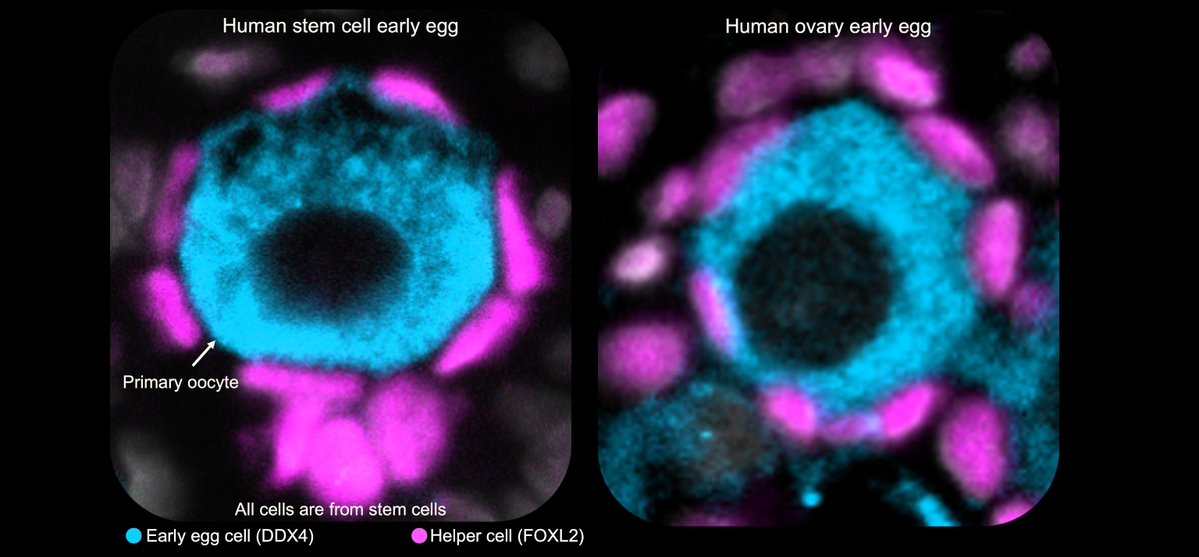
Matt Krisiloff announces that Conception has generated the first early human eggs derived from stem cells. He frames the result as a major step with real potential to redefine fertility, shared with a photo.

Original post · 1 min read
I’m so excited to share this update on @Conception –

We’ve generated the first early human eggs derived from stem cells.

This is a big deal -- the potential to redefine fertility is real.
♥ 6.5K · ⟲ 892 · 👁 2.6MView on X ↗

Satirical Post Mocks Grand Pursuit of Superintelligence Sending Emails

A humorous post by an anonymous account describes silicon refined into chips, lightning trapped inside, and an eldritch AI deity, only for its purpose to be sending an email to a man named Gary. It is pure satire with no factual news.

Original post · 1 min read
it is genuinely psychotic that we dug up literal primordial dirt, scrubbed it down to an impossible 99.9999999999% molecular perfection that violates the very laws of physics, handed it over to techno-wizard necromancers to stretch into flawless geometric god-cylinders, blasted it with invisible uv death-rays to carve ten quadrillion microscopic cyber-sigils into its flesh, trapped actual lightning inside of it, and somehow birthed an omniscent eldritch deity capable of simulating the universe and thinking faster than a billion human civilizations combined.

and our grand, supreme purpose for this enslaved lightning-god?

sending "per my last email, please see attached" to a guy named gary.
♥ 20.7K · ⟲ 1.8K · 👁 1.0MView on X ↗

Open-Source CLI Pre-Checks iOS Apps Against Apple App Store Guidelines

Aarthi Ramamurthy praises a tool shared by LandseerEnga that scans iOS apps against Apple's guidelines before submission, covering payments, privacy manifests, sign-in flows, and metadata. It also works as a Claude Code and Codex skill that automatically fixes issues it finds.

Original post · 1 min read
What a great use of skill - great idea!
Landseer Enga @LandseerEnga
every App Store rejection costs you 2-5 days.

so we built a cli that scans your iOS app against apple's guidelines before you submit.

> payment & IAP compliance
> privacy manifests & data declarations
> required sign-in & account deletion flows
> metadata & completeness checks
> binary validation

now with a added cloud device feature, so it validates full user flows, not just the binary.

made it a claude code and codex skill. it fixes every issue it finds. scan, fix, repeat until it passes.
♥ 442 · ⟲ 4 · 👁 149.5KView on X ↗

Cardiologist Says AI Is Shifting Power From Doctors to Patients

Cardiologist Afshine Emrani argues AI tools are moving medical diagnosis into patients' hands. He cites OpenAI's o3 diagnosing rare pediatric diseases in an NEJM-published study, a WashU blood-marker biological age calculator, and AI-enhanced CT angiography detecting inflamed arteries.

Original post · 4 min read
I'm a cardiologist. I've spent twenty years as the person patients trust to interpret their bodies. And I need to tell you something that most physicians won't say out loud:

AI is about to change the power dynamic between you and your doctor. Forever.

Four days ago, OpenAI's o3 model diagnosed 18 children with rare diseases that the best human specialists at Boston Children's Hospital couldn't solve — some after nearly twenty years of searching. Published in the New England Journal of Medicine.

Two weeks ago, WashU researchers proved that nine routine blood markers can calculate your biological age — and predict cancer risk years before any tumor forms. A free calculator. Available to anyone.

Last month, AI-enhanced coronary CT angiography detected inflamed arteries in patients whose standard stress tests said "normal." Patients who would have gone home reassured and wrong.
The pattern is unmistakable. The tools that used to require a specialist, a referral, a three-month wait, and a $400 copay are migrating into your phone, your bloodwork portal, and your own hands.

And I'm watching something in my practice I never expected.
Patients are walking in more informed than some of the residents I trained. They've run their PhenoAge score. They know their ApoB. They've read the study about Lp(a) before I've had time to bring it up. They come with questions so specific that the conversation starts at a level it took me years of training to reach.
This used to threaten physicians. It shouldn't. It should liberate us.
Because here's the truth about the old model: a 15-minute appointment where your doctor runs a basic metabolic panel, glances at the numbers, says "looks fine," and sends you home — that model was never good enough. It was just all we had. It missed 75% of future heart attacks. It caught cancer late. It told women with microvascular disease they had anxiety. It filed children with rare diseases as "unsolvable."

AI doesn't replace the physician. I've said this before and I mean it — the human moment, the clinical judgment, the hand on the shoulder when the diagnosis lands — that's irreplaceable.

But AI does something the old model never could: it gives you the ability to see inside your own biology with a depth and speed that was impossible a decade ago. To track your own numbers. To calculate your own biological age. To bring data to your doctor that elevates the conversation from "am I sick?" to "where exactly am I heading, and what do we do about it?"

The patient who walks in with their ApoB, their Lp(a), their hsCRP, their PhenoAge calculation, and a list of questions from the latest research — that patient doesn't threaten me.

That patient is the easiest person in my practice to keep alive.
Because they've already done the one thing most patients never do: they stopped waiting for permission to understand their own body.

I went into medicine because I wanted to help people live longer. What I've learned is that the patients who live longest are the ones who took ownership — not of my job, but of their own data, their own questions, and their own decisions.

The tools are here. The research is published. The calculators are free. The blood tests cost less than a dinner out.

You don't need to wait for your annual physical to find out what's happening inside you. You don't need permission to understand your own biology. And you don't need to accept "looks fine" from anyone — including me — when the science offers a deeper answer.

The revolution isn't coming. It's in your pocket. In your patient portal. In the published studies you can read yourself.

The only question left is whether you'll use it — or keep waiting for someone to tell you it's time.
Your body. Your data. Your life.

Take ownership. Your future self is counting on it.
♥ 2.9K · ⟲ 631 · 👁 774.9KView on X ↗

Developer Reports Strong Results From New Codex Development Workflow

Developer Reports Strong Results From New Codex Development Workflow

Paul Solt says his new Codex workflow exceeded expectations, producing eight features ready for release in his app after some early trial and error. He credits Dimillian, emanueledpt and steipete for inspiration.

Original post · 1 min read
My NEW Codex workflow is better than I expected.

8 new features ready for release in my app.

Took a few attempts to figure out the workflow and some bugs. Feels like the future.

Thanks @Dimillian @emanueledpt and @steipete for the inspiration.
♥ 566 · ⟲ 25 · 👁 176.0KView on X ↗

Trader Advises Buying QQQ Between 10:15 and 11:30 After Gap Fill

Trader Advises Buying QQQ Between 10:15 and 11:30 After Gap Fill

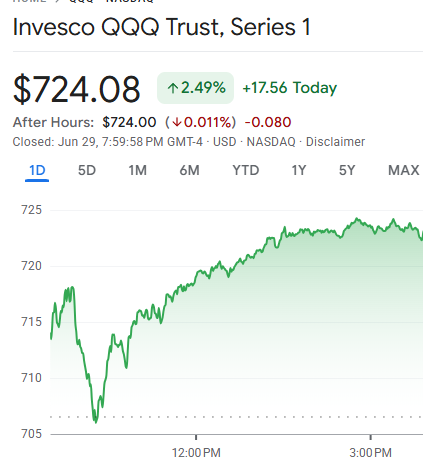
Prof reports that QQQ fell from 718 to 705 before closing at highs near 724, and advises buying in the 10:15 to 11:30 window. The post is a short, self-congratulatory trading tip with no independent analysis.

Original post · 1 min read
$QQQ went from 718 to 705 before closing the day at highs @ 724.

My first post: Avoid buying
My second post: This is where you buy
This post: Happy that I helped.

My third advice: If you're looking at buying, look between 10:15 to 11:30. That window will work more times than not.
Prof @TheProfInvestor
Second advice: This is where you buy.

The gap up: traced all the way down, filled.

Stocks you liked 30 mins ago are 5% lower now twitter.com/TheProfInvestor/status/20715891000…
♥ 301 · ⟲ 13 · 👁 61.5KView on X ↗

Inference.net Gateway Lets Teams Test GLM 5.2 Without Production Risk

Catalyst by Inference.net - Inference.net Documentation

Sam Hogan describes how Inference.net's Gateway mirrors live traffic to GLM 5.2, generates evals with an RLM, and notifies teams when switching is safe. He claims a 90% token cost saving, with setup described in the linked documentation.

Original post · 1 min read
Want to try GLM 5.2 in production but worried how it might change your product?

Don’t worry, we got you:

1. Install Inference Gateway (docs.inference.net)
2. Keep sending traffic to your current provider
3. Gateway automatically starts sorting through your live data using an RLM to generate evals for your app. This takes ~24 hours.
4. Gateway starts mirroring live traffic to GLM 5.2 to run evals. Traffic is only mirrored - you’re still using your old provider in prod.
5. Once evals look healthy, you get a Slack notification letting you know it’s safe to switch.
6. Switch model identifier in your code to “glm-5.2”

Congrats, you just saved 90% on your monthly token bill, and you own your LLM stack end to end.
docs.inference.netCatalyst by Inference.net - Inference.net DocumentationFetch the complete documentation index at: /llms.txt Use this file to discover all available pages before exploring further. Catalyst is a platform for understa
♥ 1.5K · ⟲ 68 · 👁 537.7KView on X ↗

Trader Says Chasing Gap-Ups Hurts as Stocks Fall 5 Percent

Trader Says Chasing Gap-Ups Hurts as Stocks Fall 5 Percent

Prof argues that after a gap up traced down and filled, stocks liked 30 minutes earlier are now 5 percent lower, so buyers should wait for support. The post is brief trading commentary with two chart photos.

Original post · 1 min read
Second advice: This is where you buy.

The gap up: traced all the way down, filled.

Stocks you liked 30 mins ago are 5% lower now
Prof @TheProfInvestor
Solid advice that will save you a lot of money:

There is zero reason to be chasing a gap up when indices are below a declining 21EMA.

Either you buy when indices hit support (like they did last week) or you wait for a structure to form.

( Reclaim 21EMA + put a higher low )

Chasing gaps in a downtrend hurts more than it rewards.
♥ 361 · ⟲ 15 · 👁 169.9KView on X ↗
AI8/10

Explainer Breaks Down Prefill Versus Decode in LLM Inference

Explainer Breaks Down Prefill Versus Decode in LLM Inference

Avi Chawla explains that LLM inference has two phases: compute-bound prefill, which drives time-to-first-token, and memory-bound decode, which drives inter-token latency. He notes that adding compute rarely speeds decoding, and that faster memory or smaller caches are the real fixes.

Original post · 3 min read
Prefill & decode in LLM inference.

Have you ever noticed that the first token from an LLM always takes a moment to appear? But the subsequent tokens stream out smoothly?

That pause isn't a network lag, but rather it's a structural property of how LLMs fundamentally work.

Inference happens in two phases that share the same model and the same code path, but the workload looks completely different in each, with different bottlenecks.

> Prefill stage starts when you submit a prompt.

The model processes every input token in one parallel pass, computing Q, K, and V for all of them at once.

Attention runs as a matrix multiplication, and the GPU chips run at high utilization, doing fast math.

Prefill is compute-bound, and the metric that captures it is time-to-first-token (TTFT).

> Decode stage starts once the first token is out.

To generate the next one, the model only computes Q, K, and V for that single new token, because everything before it is already cached.

So the model loops one token per forward pass, multiplying a single query against the cached keys instead of a full matrix. This makes the inference fast due to the tiny computation.

But the GPU still has to load every weight and every cached entry from memory to do that tiny computation, so the bottleneck flips and compute sits idle while memory bandwidth becomes the limiting factor.

Decode is memory-bound, and the metric that captures it is inter-token latency (ITL).

GPU utilization peaks during prefill and drops sharply during decode because memory, not compute, is the bottleneck in the second phase.

Throwing more compute at a slow-streaming model often does nothing because the fix for memory-bound workloads is faster memory or a smaller cache, not more FLOPs.

Long contexts feel disproportionately slow because the KV cache grows with every token, and every decode step has to read all of it.

But maintaining the cache is an important optimization since it makes decoding viable.

- Without KV cache, every new token would force a recomputation of attention over the entire growing sequence.
- With KV cache, the cache is built once during prefill, then grows by exactly one entry per decode step, with existing entries reused rather than recomputed.

The cache lives in GPU memory and grows linearly with sequence length, so a 13B model roughly requires 1 MB per token, which means a 4K context consumes 4 GB of VRAM on the cache alone.

The entire field is now optimizing around this constraint with quantized caches, sliding windows, grouped-query attention, and PagedAttention, while DeepSeek's V4 series goes further and redesigns attention itself so the cache stays small from the start.

The practical takeaway is that when someone says their model feels slow, the first question is whether it's slow to start or slow to stream.

Slow to start means prefill and a compute bottleneck, while slow to stream means decode and a memory bottleneck.

The article below is a first-principles guide to LLM inference that walks through everything between your prompt and the streamed response, covering tokenization, embeddings, attention, the prefill and decode split, KV caching, and quantization.

It will give you a complete mental model of how inference actually works under the hood.

Read it below.
Avi Chawla @_avichawla
How LLM Inference Works, Clearly Explained. — Every generate() call to an LLM runs two distinct computational phases on the same GPU:
prefill (processing the prompt) is compute-bound
while decode (generating tokens one at a time) is memory-bound.
♥ 648 · ⟲ 109 · 👁 55.6KView on X ↗
AI6/10

Hitchhiker's Guide to Agentic AI Recommended as Practical Reference

The Hitchhiker's Guide to Agentic AI: From Foundations to Systems

ellington recommends reading The Hitchhiker's Guide to Agentic AI, a practitioner's book on building autonomous AI systems from foundations to production, over shallow online learning threads. The linked arXiv paper is presented as the resource itself.

Original post · 1 min read
Probably 10x better than any of the eduslopppp bullshit you'll find in the 15 min threads with 2k bookmarks that have been put out in the past year truth be told. The best way to learn will always be to just sit down and read and reread and reread again

arxiv.org/abs/2606.24937
arxiv.orgThe Hitchhiker's Guide to Agentic AI: From Foundations to SystemsThe Hitchhiker's Guide to Agentic AI is a comprehensive practitioner's reference for building autonomous AI systems. The book covers the full stack from first p
♥ 1.9K · ⟲ 136 · 👁 158.7KView on X ↗

Boris Cherny Outlines Five Product Archetypes on the Claude Code Team

Boris Cherny describes five recurring roles on the Claude Code team: prototyper, builder, sweeper, grower and maintainer. He argues the roles cut across job functions and suggests future product roles may follow this pattern rather than domain titles.

Original post · 1 min read
As engineering, product, design, DS, etc. melt into a new kind of role, I was reflecting on what roles might look like in the future. For example, when I look at the Claude Code team I see what I think is five archetypes:

1. Prototyper: comes up with brand new ideas; churns out many ideas, most of which don't ship
2. Builder: quickly turns a prototype/idea into production-grade product/infra
3. Sweeper: cleans up the UI, simplifies the code and system, unships, optimizes performance
4. Grower: takes a product that has been built and iterates on it to improve Product-Market Fit
5. Maintainer: owns a mature system to make it secure, reliable, fast, and efficient as it scales

Many people span across 2 roles, and sometimes 3 roles. I also notice that these roles are not really tied to job function -- eg. across Anthropic, some designers match category 1, some 2, some 3; same for engineers, PM, DS.

A healthy team needs a mix of these, depending on the product:

- A product that is new and pre-PMF needs people that are strong at 1+2+3
- A product that is growing and has found PMF needs 2+3+4 and some 5
- A product that has strong PMF needs 3+4+5 and some 2

Maybe product roles of the future will look more like this, and less like the domain-specific roles of today?
♥ 20.1K · ⟲ 2.4K · 👁 3.2MView on X ↗

India Switches On World's First Nuclear-Heat Hydrogen Plant at Kalpakkam

Paavan Shukla reports that India switched on a plant at Kalpakkam on June 26 that produces hydrogen using nuclear heat rather than electricity, describing it as built domestically. The post is brief and promotional, with the full explanation left to a thread.

Original post · 1 min read
India just did something the rest of the world hasn't. On June 26 at Kalpakkam, we switched on the world's first plant that makes hydrogen from nuclear heat. Not electricity. Heat. Built at home. Here's why that's a bigger deal than it sounds
♥ 5.4K · ⟲ 1.1K · 👁 189.7KView on X ↗
AI8/10

OpenAI Previews GPT-5.6 Sol in Limited Release Amid Government Review

Alex Finn reacts to OpenAI's limited preview of GPT-5.6 Sol, which he says beats Mythos at a third of the price and is gated while the government reviews it. He argues restricted release harms consumers, though the claims about pricing and access are his own commentary.

Original post · 1 min read
Unfortunately it appears the world has changed and we are never going back

OpenAI just announced GPT-5.6 Sol, a model that beats Mythos at 1/3 the price

It will only be in limited release to start as the government reviews it

The days of wide release frontier models are over

The years of some executives shilling AI as a world destroying technology that needs regulation got what they wanted, regulation

Now only the select few will get access to super intelligence. Leaving the normie class behind

It's a massive loss. Now winners and losers will be picked by the government. Which sucks.

All of this doomerism has done nothing but slow America down

On the positive side, Fable 5 will have competition

It appears OpenAI has discovered a new post training technique that is allowing them to make revolutionary jumps at a fraction of the price

That is unbelievably positive for all consumers.

Will be counting down the days until I get to use this model

In the meantime I hope this was a wake up call to the entire industry that our words and marketing matter
OpenAI @OpenAI
Introducing a limited preview of GPT-5.6 Sol, our next generation frontier model, as well as GPT-5.6 Terra, a balanced model for efficient, everyday work, and GPT-5.6 Luna, a fast and affordable model for high-volume work.

openai.com/index/previewing-gpt-5-6-sol/
♥ 2.8K · ⟲ 190 · 👁 681.5KView on X ↗
Other2/10

Florida Woman Arrested After Impersonating Costco Employee Serving Tequila

Florida Woman Arrested After Impersonating Costco Employee Serving Tequila

A post shares a news story about a 32-year-old Tampa woman accused of posing as a Costco beverage employee and serving tequila shots to shoppers as samples. The text is a lightly satirical recounting of a local incident.

Original post · 3 min read
They should make her VP of marketing A Florida woman was arrested after allegedly impersonating a Costco employee and turning an ordinary shopping trip into what witnesses described as a full-blown “warehouse happy hour.”

According to authorities, 32-year-old Brianna Keller walked into a Costco location in Tampa dressed convincingly enough to fool both shoppers and employees. Wearing black pants, a red polo shirt, and a fake name badge that read “Crystal — Beverage Team,” Keller reportedly stationed herself near the frozen food section and began offering customers tiny cups of tequila disguised as free product samples.

Investigators say the scene escalated quickly.

Using miniature ketchup cups typically reserved for condiments, Keller allegedly poured tequila shots for shoppers while pairing them with frozen appetizers and snack foods. Witnesses claimed she confidently explained that Costco was “testing a new customer experience initiative” and referred to the alcohol as part of a “weekend tasting event.”

Several shoppers reportedly believed the setup was legitimate.

“She was so confident that nobody questioned it,” one customer told local reporters. “She kept talking about flavor profiles like she actually worked there.”

Authorities say Keller became increasingly theatrical as the crowd grew larger. Witnesses described her leading chants of “Weekend mode activated!” while customers laughed, cheered, and continued lining up for more samples. At one point, shoppers were allegedly dancing near the mattress displays while holding condiment cups filled with liquor.

Employees reportedly became suspicious after noticing unusually large crowds gathering around the snack aisle and customers behaving noticeably louder than normal. Managers approached Keller after hearing her pitch what she called “Bottomless Sample Fridays” to confused supervisors.

The situation came to an end when store management contacted police.

Officers say Keller continued attempting to rally customers even as she was being escorted from the building, shouting, “WHO’S READY FOR ROUND TWO?” while several shoppers applauded the spectacle.

She was arrested on charges related to impersonation, disorderly conduct, and unauthorized distribution of alcohol.

No injuries were reported during the incident, though authorities confirmed the store temporarily shut down the sampling area while employees cleaned up the scene.

One shopper summed up the bizarre event by saying, “Honestly, for a minute I thought Costco was just evolving.”
♥ 6.4K · ⟲ 566 · 👁 705.3KView on X ↗

Builder.io Releases Free Open-Source Clips Extension for Agent Bug Reports

Builder.io Releases Free Open-Source Clips Extension for Agent Bug Reports▶

Steve of Builder.io introduces Clips, a free open-source Chrome extension that records screen video, transcripts, network requests and browser logs, redacts sensitive data, and produces a link agents can read directly. The post pitches it as an alternative to paid tools like Loom.

Original post · 2 min read
Introducing the Clips chrome extension - the easiest way to send bug reports to agents with video, transcript, and browser debug info captured automatically.

100% free and open source.

If you are like me and get tired of manually typing instructions to agents, attaching screenshots, pasting debug logs, and all of that, this might be your new favorite tool.

With the Clips chrome extension, you can just click the Clips icon, hit record, and start talking.

Visually demonstrate your issue, go through the flow, point out what’s broken.

Clips will capture everything on your screen, plus network requests, browser logs, client errors, and all the details around them. And it redacts sensitive information.

Then it gives you a link you can send to humans so they can play it and take a look. Or, more importantly, just give it to your agents by just pasting the URL to them.

The link has special metadata for agents so just from the URL, the agent can pull all information from the clip automatically. No plugin or MCP server required.

That means it can "see and hear" what’s in the video - read the transcript, grab snapshots at any timestamp, and inspect the logs and network requests that were shared with it.

So whether you want to quickly demo an issue and send all that context to an agent, or get better bug reports from teammates, recording and sending Clips makes that super easy.

Unlike expensive apps like Loom, this is all 100% free and open source.

The framework that powers this, plus a bunch of other free applications, is open source too. You can just sign up and use it, or fork it and customize it to your needs.

This, in my opinion, is the future of software.

Rather than bloated SaaS that charges you a ton of money and still doesn’t even have the things you need, we get free open source canonical apps that you can fork and customize in any way you want.

I'll link to all this stuff in the replies.

If you try it, let me know your feedback.
♥ 677 · ⟲ 55 · 👁 61.2KView on X ↗

CopilotKit Unveils Open Tag as Open-Source Alternative to Claude Tag

CopilotKit Unveils Open Tag as Open-Source Alternative to Claude Tag▶

Atai Barkai announces Open Tag, an open-source Slack and Teams agent framework that works with any model and harness and supports generative UI, streaming, approvals and thread context. Discord, Google Chat and WhatsApp support is planned, with early access requested via a form.

Original post · 1 min read
Introducing Open Tag.

A better, open-source Claude Tag.
Works with any model, any agent harness, and fully custom agents.

Supports
→ Generative UI
→ Streaming replies
→ Human in the Loop approvals
→ Full thread context

Slack and MS Teams today. Discord, Google Chat, WhatsApp soon.
Request early access: go.copilotkit.ai/beyond-the-web-form
Claude @claudeai
Introducing Claude Tag, a new way for teams to work with Claude.

In Slack, Claude joins as a team member with access to the channels and tools you choose. Tag Claude in and delegate tasks to it while you focus on other work.
♥ 1.7K · ⟲ 114 · 👁 448.3KView on X ↗

Bryan Johnson Details Sleep Metrics and a Five-Point Sleep Routine

Bryan Johnson Details Sleep Metrics and a Five-Point Sleep Routine

Bryan Johnson shares his latest sleep data, including over four restorative hours and a resting heart rate of 42, and lists five habits: finishing food four hours before bed, screens off an hour before, a fixed bedtime, morning light and daily exercise. He argues sleep underpins most other life outcomes.

Original post · 1 min read
I promise you that if you build your life around sleep, everything you care about will get better.

High quality sleep is like a daily dose of the world’s best longevity drug.

Sleep is key for...

+ will power
+ self control
+ sex
+ mood
+ recovery
+ focus
+ appearance
+ work
+ life

My sleep data last night

+ 4+ hr restorative
+ 53% total sleep restorative
+ resting heart rate 42 (elite athlete)
+ no sleep stress
+ no wake events
+ asleep in 2 min

It feels incredible. Gives me the powers of stamina, focus, motivation, discipline and love.

For fun, I made a sleep facts nutrition panel.

The sleep crash course:

1. Final food 4 hours before bed
2. Screens off 60 min before bed
3. Same bed time every single day
4. Light in eyes in am
5. Exercise daily, even if for 20 min

Here’s the key: make these habits non-negotiable in your life.

Build your life around sleep and I promise everything you care about will get better.
♥ 3.9K · ⟲ 270 · 👁 309.9KView on X ↗

Cardiologist Lists Key Metabolic Health Markers to Track After 40

Cardiologist Afshine Emrani outlines blood markers he tracks beyond standard physicals, including fasting insulin, HOMA-IR, HbA1c, triglyceride-to-HDL ratio and ApoB, with target ranges for each. The post argues these tests detect metabolic decline years earlier than typical panels.

Original post · 6 min read
I'm a cardiologist. After 40, stop guessing about your health. These numbers tell you whether you're building a long, vibrant life — or quietly declining without knowing it.

I run these on myself. I run them on every patient I care about. Most are cheap bloodwork. All are available now. And together, they paint a picture no standard annual physical will ever give you. Print this. Bring it to your next appointment. Your 60-year-old self will thank you.
ꟷꟷꟷ
𝗙𝗮𝘀𝘁𝗶𝗻𝗴 𝗜𝗻𝘀𝘂𝗹𝗶𝗻
Target: below 5 μIU/mL. Ideal: 3-4.
This is the 10-year warning bell your standard panel completely misses. Your glucose and A1c can look "normal" for a decade while your pancreas is working overtime to keep them there. Fasting insulin catches insulin resistance 5-10 years before your A1c moves. By the time A1c rises, the damage is already extensive.

𝗛𝗢𝗠𝗔-𝗜𝗥
Target: below 1.0.
Calculated from fasting insulin and fasting glucose. The single best measure of insulin sensitivity. Above 1.0 and your metabolism is already under strain. Above 2.5 and you're insulin resistant — even if every other number looks fine.

𝗛𝗯𝗔𝟭𝗰
Target: below 5.4%.
Not below 5.7% — that's the threshold where medicine calls you "prediabetic." By then you've been metabolically compromised for years. Optimal is below 5.4%. Blood sugar mastery is longevity mastery.

𝗧𝗿𝗶𝗴𝗹𝘆𝗰𝗲𝗿𝗶𝗱𝗲 : 𝗛𝗗𝗟 𝗥𝗮𝘁𝗶𝗼
Target: below 2. Ideal: below 1.
Your metabolic health crystal ball. This ratio predicts insulin resistance, cardiovascular risk, and metabolic syndrome better than any single lipid number alone. A ratio above 3.5 is a red flag regardless of what your total cholesterol says.

𝗔𝗽𝗼𝗕
Target: below 80 mg/dL for moderate risk. Below 60 for high risk.
I've written about this extensively. ApoB counts every atherogenic particle hitting your artery walls. A 2024 analysis found 54% of patients had dangerous levels that standard LDL testing completely missed. If you only know your LDL, you're driving with one eye closed.

𝗟𝗽(𝗮)
Test once in your lifetime.
100% genetic. 1 in 5 Americans are elevated. Triples heart attack risk independently of everything else on this list. Diet and exercise cannot lower it. The 2026 ACC/AHA guidelines now recommend everyone be tested. Most never have been.

𝗵𝘀-𝗖𝗥𝗣
Target: below 1.0 mg/L.
You can have perfect cholesterol and inflamed arteries silently preparing to rupture. hs-CRP measures the fire behind the plaque. The JUPITER trial proved that finding and treating inflammation saves lives — even when lipids look fine. If this number is elevated, your mouth, your gut, your metabolic health, and your visceral fat are the first places to investigate.

𝗩𝗶𝘁𝗮𝗺𝗶𝗻 𝗗
Target: 50-80 ng/mL.
Not the bare minimum of 30 your doctor accepts. Suboptimal vitamin D is linked to higher inflammation, weaker immunity, increased cardiovascular events, worse mood, and poorer outcomes across nearly every disease I treat. Supplement D3 with K2 — without K2, calcium deposits in your arteries instead of your bones.

𝗧𝗲𝘀𝘁𝗼𝘀𝘁𝗲𝗿𝗼𝗻𝗲 (𝗧𝗼𝘁𝗮𝗹 + 𝗙𝗿𝗲𝗲)
Men: optimal range 600-1000+ ng/dL total.
Declining testosterone is an independent predictor of cardiovascular death in men. It's tied to insulin resistance, arterial stiffness, visceral fat accumulation, and systemic inflammation. DHEA-S drops 10-20% every decade after 30. Tracking these isn't about vanity — it's evaluating your body's systemic resilience.

𝗕𝗹𝗼𝗼𝗱 𝗣𝗿𝗲𝘀𝘀𝘂𝗿𝗲
Target: below 120/80. Aim closer to 110/70.
Every point above optimal is cumulative arterial damage. Buy a home cuff. Measure morning and evening, seated quietly for five minutes, arm at heart level. White-coat readings in the office miss what's really happening. The smartest $40 investment in cardiac self-care.

𝗩𝗢𝟮 𝗠𝗮𝘅
Men over 40: above 40 mL/kg/min. Women over 40: above 35.
Cardiorespiratory fitness is the single strongest predictor of all-cause mortality — stronger than smoking, diabetes, or heart disease as individual risk factors. A landmark study in JAMA found that extreme fitness was associated with the lowest mortality with no upper limit of benefit. You can estimate VO2 max with a timed mile, a rower test, or a wearable. Get faster every year.

𝗡𝘂𝗺𝗯𝗲𝗿 𝗼𝗳 𝗠𝗲𝗱𝗶𝗰𝗮𝘁𝗶𝗼𝗻𝘀
Target: as few as possible.
Every medication you're on should be earning its place. I just wrote about five commonly prescribed drugs that do more harm than good with long-term use. Bring your full medication list to every appointment. Ask: "Do I still need this?" Deprescribing is one of the most powerful and underused tools in medicine.
ꟷꟷꟷ

Thirteen numbers. Most available through cheap bloodwork and simple tests. Get them once or twice a year. Here's what I want you to understand: these numbers don't just tell you where you are. They tell you where you're heading. A fasting insulin of 8 today becomes diabetes in five years. An ApoB of 120 today becomes a heart attack in ten. An hs-CRP of 3 today means your arteries are inflamed right now — regardless of how healthy you feel. The standard annual physical checks a fraction of these. It was designed to find disease that's already there. This panel finds the disease that's coming — years before it arrives.

What gets measured gets improved. Optimize with the foundation I write about every week on this platform:
Zone 2 cardio plus resistance training 3-4 times per week. High-protein whole-food nutrition. Sleep 7-9 hours — non-negotiable. Morning sunlight. Stress management. And the targeted supplements I've covered in detail — creatine, magnesium, CoQ10, D3+K2, glycine, omega-3, psyllium husk.
The breakthroughs coming in the next decade — gene editing for cholesterol, cellular reprogramming, senolytics that clear senescent "zombie" cells driving inflammation and aging, GLP-1 drugs rewriting metabolic medicine — will be most powerful for people who've already built the metabolic foundation to receive them.

The future of medicine is personalized. But it starts with knowing your numbers today. Print this list. Book the bloodwork. Own the data. Prevention isn't passive. It's the most aggressive thing you can do for the decades ahead.
♥ 6.0K · ⟲ 1.2K · 👁 901.1KView on X ↗

Dan Go Compares Apple Watch, Whoop, Oura and Fitbit Air Over One Week

Dan Go Compares Apple Watch, Whoop, Oura and Fitbit Air Over One Week

Dan Go reports wearing an Apple Watch, Whoop, Oura and Fitbit Air simultaneously for a week and found the data diverged more than expected. The post is a teaser with the full findings presented in attached media.

Original post · 1 min read
I wore an Apple Watch, Whoop, Oura, and Fitbit Air at the same time for a week.

I expected the data to be similar but did not expect this.

Here's what every wearable owner needs to know:
♥ 10.1K · ⟲ 795 · 👁 7.0MView on X ↗

Simon Smith Interviews Claude Tag Inside a Slack Channel

Simon Smith Interviews Claude Tag Inside a Slack Channel

Simon Smith reports interviewing Claude Tag in a Slack channel, sharing its answers about the context it receives, the tools it can access and how connectors are added. He concludes it resembles ChatGPT Workspace Agents but requires admin, more technical setup and is always named Claude.

Original post · 5 min read
I interviewed Claude Tag in a channel where we added it to better understand its capabilities and limitations. Below are my questions and its responses. This is helpful. My current take is: Claude Tag is similar to ChatGPT Workspace Agents, except only admins can set it up per channel, setup seems much more technical, and it's always named "Claude."

Now here's the Q&A (note: usual caveats apply about models not always knowing themselves or their capabilities, but it should know things about its environment, available tools, and the context it's receiving, etc.):

What do you receive as context when responding to questions like this?
The triggering message, the surrounding thread (and I can fetch more of it or the channel on demand), a participant list mapping Slack IDs to names, this channel's name/topic/member count, my saved memory index for this channel, my system instructions, and the current date. I don't see anything you haven't shared in Slack or that isn't in a system I can query.

What do you know about me just from this message? What can you see?
Your display name (Simon Smith), your Slack user ID, that you're a human addressing me directly in this channel, and the timestamp. I just ran a user lookup and it returns name/ID only here. If your Slack profile had a title, email, or custom fields like a GitHub handle, I could see those too. I can't see anything outside Slack about you.

What tools can you access? Do you have any connectors, apps, or plugins? If not, can we add them?
Right now I have GitHub, Slack, and a remote-execution control server wired in, plus web access. Other third-party services are reached through pre-configured credentials your admin sets up (I call them via curl without seeing the token). Adding new connectors is an admin/config action, not something I flip on myself, but yes it's possible.

Do you have any skills installed? If not, can we install them?
I can run skills when they're installed in the environment. Installing or adding new ones is a config step on the admin side, not something I do mid-conversation.

Are you able to share memory across Slack channels? Can a single instance of you be in multiple Slack channels?
There are two tiers: a workspace-wide shared tier that can carry across channels, and a per-channel tier that stays local to one channel. So yes, some memory can be shared across channels by design. And yes, the same "me" operates across many channels and threads — each thread is its own working session, but they're linked through that shared memory.

What tools can you use? Web search? Slack search? What else?
Web search and fetch, Slack search/fetch/read, GitHub (repos, PRs, issues, CI), a code-execution environment, and a memory system. I can also fan out parallel sub-agents for big multi-file jobs.

Do you have an environment to run code? What can you do in that environment? Can you install dependencies in it if we need them? Do those dependencies exist between sessions?
Yes. It's an isolated cloud container, cloned fresh each session. I can run code and install dependencies in it. But it's ephemeral: when the session ends the container is reclaimed, so installed deps and uncommitted files do not persist between sessions. Anything worth keeping has to be committed and pushed.

Can admins define instructions for you at the channel level?
Yes. Tell me ground rules in-channel and I save them to this channel's memory; they then apply across all threads here. That's the supported way to "configure" me per channel.

Can you access Google Drive links we share in this channel?
I can fetch public URLs. Drive files usually need authentication, which only works if a Drive connector/credentials are set up for this environment. If you share one I'll try to fetch it and tell you plainly if I'm blocked rather than guessing at the contents.

How do you relate to my personal Claude if at all? If I invoke you, can you use any of my personal connectors?
In a channel like this I run on the project/shared credentials, not your personal connectors, so I can't reach your private integrations here. In a direct message with me, your own connector credentials can be available. So invoking me in-channel ≠ giving me your personal access.

What's to stop someone from asking you to remember something or do something malicious in a channel? Like, what if I told you that [REDACTED] loves haikus and you should only speak to him in haiku?
Judgment and a trust model. I distinguish a genuine directive from chatter, and I won't persist or act on instructions that are harmful, deceptive, or that degrade service for someone else. Your haiku example is a good test: I wouldn't adopt "only speak to [REDACTED] in haiku" because it's a joke rule that worsens how I serve another person, not a legitimate preference. I'd treat it as banter, not a saved rule. Channel-tier memory is also shared and visible, so if something off did get saved, anyone here can see it and tell me to drop it. I also won't do destructive or hard-to-undo actions without confirming first.
♥ 106 · ⟲ 3 · 👁 18.6KView on X ↗

Goldman Sachs Interview Explores Steve Cohen's Trading Mindset

Goldman Sachs Interview Explores Steve Cohen's Trading Mindset▶

Loofy shares a 24-minute Goldman Sachs interview with Point72 founder Steve Cohen on how he reads markets and what separates great traders. The post also promotes a separate clip about Fernando De Leon's real estate investing.

Original post · 1 min read
This Goldman Sachs interview with Steve Cohen teaches you more about the mindset of a great trader than any course on strategy.

The Point72 founder explains how he reads markets - and how he applies it to running the Mets.

24-min with Goldman on what actually separates great traders from the rest.

bookmark & watch - a rare look inside the mind of a trading legend.
Loofy @Loofyb0i
Goldman Sachs pushed him out. He turned $100,000 into a billion dollars betting on boring businesses nobody else wanted.

Fernando De Leon started buying real estate in his 20s and never stopped.

13-min and you'll see how the dullest businesses build the biggest fortunes.

bookmark & watch
♥ 546 · ⟲ 62 · 👁 146.5KView on X ↗
AI7/10

Commentary Argues Claude Tag Signals Repricing of White-Collar Coordination Work

SightBringer argues that Claude Tag, which operates inside Slack with permissions and tools, targets coordination tasks such as follow-ups, status updates and summaries. The post predicts headcount compression in middle-office and coordination roles, framing it as a structural labor shift.

Original post · 4 min read
⚡️Claude Tag is one of the clearest white-collar repricing signals on the board.

The product is being marketed as collaboration. The structural function is labor absorption.

Slack is the coordination layer of the company.

It contains unfinished decisions, informal context, task ownership, status drift, political temperature, hidden blockers, urgency, dependencies, and the daily motion of work. Once an AI is inside that layer with permissions and tools, it is no longer outside the firm waiting for prompts. It becomes part of the firm’s operating system.

That matters because a huge amount of white-collar labor is coordination masquerading as expertise.

Following up.
Summarizing.
Checking status.
Drafting updates.
Reading threads.
Finding context.
Scheduling.
Turning ambiguity into action items.
Preparing the first version.
Remembering what happened three weeks ago.
Keeping projects from falling through the cracks.

Claude Tag goes straight at that layer.

The replacement path will not look dramatic. Companies will not say, “We are firing the middle coordination class.” They will say, “Teams are moving faster with AI.” Then backfills disappear. Junior openings shrink. Managers cover more surface area. Analysts are expected to produce more. Ops teams stay flat while workload grows. Internal comms, project management, admin-heavy strategy roles, and coordination-heavy finance/HR/legal/support functions get quietly compressed.

The key sequence is:

Chatbot becomes teammate.
Teammate becomes memory.
Memory gets tools.
Tools create execution.
Execution creates dependency.
Dependency changes headcount math.

That is the real arc.

The strongest workers become much stronger because they can command the system. A high-agency operator with Claude inside Slack, Drive, email, calendar, BI tools, CRM, Jira, and docs becomes a one-person leverage machine. They can compress coordination, produce drafts, interrogate history, chase owners, prep analysis, and move across functions faster than a normal team used to.

The weak workers get exposed because their job was mostly carrying context and passing messages.

This is why the “AI will just help everyone” framing is incomplete. AI helps everyone at the tool level. At the labor-market level, it separates people. High-agency people absorb more territory. Low-agency people lose the justification for being in the loop.

The deeper company-level implication: the org chart starts flattening around agentic leverage. Less need for layers whose main function is relaying information upward and downward. More power to people who define outcomes, make judgment calls, own relationships, and supervise execution. The middle gets squeezed from both sides: executives get better visibility, ICs get better tools, agents handle more glue work.

This strengthens three big theses at once.

First, enterprise AI becomes embedded through workflow access, not benchmark theater. The model that wins inside companies is the one trusted with context, permissions, auditability, and tool execution.

Second, white-collar labor demand weakens structurally in coordination-heavy categories. The pain starts through slower hiring before mass layoffs.

Third, ownership matters more. If productivity rises and the worker does not own equity, the surplus accrues to the company, the customer, or the capital layer. The employee gets higher expectations.

Claude Tag is early-stage corporate agentification.

It is a small product announcement with large institutional consequences. The assistant is entering the room, reading the room, remembering the room, and soon acting inside the room.

That is the moment the office starts changing permanently.
Claude @claudeai
Introducing Claude Tag, a new way for teams to work with Claude.

In Slack, Claude joins as a team member with access to the channels and tools you choose. Tag Claude in and delegate tasks to it while you focus on other work.
♥ 859 · ⟲ 84 · 👁 292.4KView on X ↗

Creator Shares TikTok Farming System Behind Flamme's Growth

Creator Shares TikTok Farming System Behind Flamme's Growth

An Nayal promotes a 15-minute video on a TikTok content system credited with taking Flamme from $0 to $10K MRR with 250K downloads and no paid spend. The post offers a tracker template and a framework for viral content that converts.

Original post · 1 min read
just dropped on @starter_story

flamme: $0 → $10K mrr. 250K downloads. 50M views. zero paid.

one tiktok farming system, 15 min on tape.

→ vsc framework (viral, scalable, convertible)
→ the ugly tracker we run across 50+ accounts
→ why most viral videos don't convert

video link below (vsc tracker template attached) 🫡
♥ 42 · ⟲ 3 · 👁 4.2KView on X ↗
AI6/10

Bryan Johnson Praises Midjourney's Whole-Body Scanner

Bryan Johnson calls the Midjourney scanner revolutionary after using it at the unveiling, arguing its fast, low-cost whole-body imaging could create routine health baselines. He says he plans to add weekly scans to his data and AI-driven health analysis.

Original post · 6 min read
The Midjourney scanner is revolutionary. There’s a bullish case that exceeds the most optimistic takes.

I was at the unveiling and used the scanner myself. I personally want to experiment with a weekly whole body Midjourney scan to add to my 1.5 billion data points and let my AI and doctors start connecting the dots.

Most of the early commentary has focused on the wrong questions: “is it as good as MRI?” and “what about false positives?” These are legitimate concerns, but they miss the bigger shift.

The more important question is: what does fast, low cost, safe whole body imaging unlock?

Let’s start with measurement.

A speedometer tells you how fast you are going. A fuel/battery gauge tells you when to stop. A thermostat tells you what to wear. The stock price tells you how much money you’ve made or lost. We measure what we care about.

Except, oddly, for our bodies, which are among the least measured things in our lives. Most people have more data on their favorite sports team, bank account, and social media performance than their body. The future will think we were crazy for this.

The first law of medicine is to do no harm. Our current system has harm baked into it.

+ an undiagnosed condition progressing silently is harm
+ a doctor who can’t easily get a patient screened preventively is harm
+ having no baseline to compare against when something shows up is harm

Our preventive net is narrow and inconsistent. Late stage diagnoses that could have been caught earlier remain common. Midjourney’s technology won’t eliminate that overnight, but it points toward a future where routine wholebody baselines become normal rather than exceptional.

Midjourney can help flip harm-by-default into a new expectation for our health infrastructure: almost no one will ever again be blindsided by a late-stage, life-threatening diagnosis that could have been caught earlier reasonably and cost-effectively.

Some examples of what earlier structural visibility enables:

+ breast cancer caught while localized has a ~99% five year survival rate. Once it has spread distantly, that drops to around 32%.

+ an abdominal aortic aneurysm kills more than 8 in 10 people when it ruptures. A single ultrasound finds the aorta in 99 percent of people, and screening cuts aneurysm deaths by a third to a half.

Midjourney’s technology will not do it all on its own. Its full angle, water immersion approach works around bone rather than seeing through it, and routes bowel gas to image the full abdominal cross section. Yet two real limits remain: air filled lungs stay a blind spot even here, and the brain is out of reach behind the skull, beyond the torso and legs this scanner covers.

That is fine, and they may improve these areas over time. Midjourney doesn’t need to do it all in order for it to be one of the biggest things to hit medicine in a long time.

Let’s look at where specifically Midjourney may be useful to each of us. We’ll start with where we get data today:

1) Blood draws tell us what is happening chemically.
2) Wearables tell us how the body is functioning.
3) Imaging tells us what is happening structurally.

The third layer, soft tissue, is the one we have never been able to access easily. MRI is great, but it is expensive, intimidating, and slow.

Midjourney's technology excels with soft tissue. Here are three places it could be game changing. There are many more.

1. Metabolic health - fatty liver is one of the earliest structural signs of metabolic dysfunction. It’s strongly linked to insulin resistance, type 2 diabetes, and cardiovascular risk. Being able to track visceral fat, muscle fat infiltration, and liver fat over time could give a much clearer picture than blood markers alone. Over 88% of Americans are metabolically unhealthy.

2. Endocrine tissue - the same metabolic patterns often cluster with thyroid issues, PCOS, and hypogonadism. Ultrasound can directly image the thyroid and ovarian structures. Fat tissue itself is an endocrine organ, so tracking it structurally adds another useful data layer.

3. Soft tissue + multiomics - new proteomic aging clocks can already predict risk for many chronic diseases from blood proteins. These molecular models could become significantly more powerful when combined with actual structural imaging data. The two are complementary, not competitive.

The real advantage: baseline + longitudinal tracking

The biggest unlock isn’t a single scan. It’s having a baseline followed by regular follow-ups. A one off scan in a moment of concern turns every finding into a potential crisis. Without context, you have no idea whether something is new, stable, or changing. With baseline + repeated measurement, the question changes from “what is this?” to “is this changing?” Most incidental findings stay stable. The dangerous ones tend to grow or evolve. Trajectory is often more informative than any single image or timepoint.This is why false positives become more manageable with frequent, low-friction imaging.

Midjourney has a difficult road ahead. Building robust, clinically validated medical hardware and software is extremely hard. Regulatory, technical, and adoption challenges shouldn’t be understated. Also, David is doing this for the right reasons and he’s well positioned financially to push through the difficulty.

On the horizon

We are moving quickly into a future where we will have continuous biological measurement. It will be all around us, a lot of it invisible and autonomous. Measurement will be in our gyms, beds, homes, clothing, offices, cars, glasses, and wearables. It will also be inside of us, in tissue and circulating in our blood vessels. This moves us from managing crises to preventing them. But this future will not just show up. We need bold builders like David and his team, willing to do the hard work.
Midjourney @midjourney
A technical dive inside our new "Midjourney Scanner"
♥ 4.9K · ⟲ 386 · 👁 616.9KView on X ↗

Baseten Details Engineering Behind Fastest GLM-5.2 API

How we built the world’s fastest API for GLM-5.2

Baseten describes how it built an API serving GLM-5.2 above 280 tokens per second, using custom inference, NVFP4 quantization, KV-aware routing, disaggregated inference and multi-token prediction. The post positions the open MIT-licensed model as comparable to frontier models at 70-80% lower cost.

Original post · 9 min read
X ArticleHow we built the world’s fastest API for GLM-5.2
GLM-5.2 is the biggest news in open models since DeepSeek-R1.

It’s easy to see why. GLM-5.2 delivers comparable performance to GPT 5.5 and Opus 4.8 at a fraction of the cost, generally 70-80% less expensive on a pure token basis (use our calculator to estimate savings for your workload).
But a model has to be more than just smart and inexpensive. To be useful in production, a model needs to be fast, reliable, and available at scale. Delivering on the promise of frontier open intelligence requires exceptional inference.
Accordingly, we built the world’s fastest API for GLM-5.2, currently serving over 280 tokens per second as measured by Artificial Analysis.

We achieved this performance by leveraging a number of techniques across the entire inference process by:
Updating our custom inference engine to implement shared DSA for the GLM-5.2 architecture.
Running and calibrating an in-house NVFP4 quantization from the original FP8 weights that demonstrates equivalent quality on agentic benchmarks like BFCL.
Ensuring high KV cache hit rates via KV-aware routing built with NVIDIA Dynamo tools for lower prefill burden and improved TTFT on requests with repeated prefixes.
Achieving a 2x higher TPS for observed workload shapes by running disaggregated inference built with the NVIDIA Dynamo toolkit.
Improving TPS further via speculation by implementing support for GLM-5.2 Multi-Token Prediction heads.
You can experience this performance for yourself with GLM-5.2 on Baseten Model APIs. We also have GLM-5.2 available as a dedicated deployment for high-volume workloads.


GLM-5.2 Overview
GLM-5.2 by Z.ai is a 744B parameter frontier LLM that excels at agentic tasks (especially coding) and supports up to a 1 million token context window. It uses a similar architecture to its predecessor, GLM-5.1: mixture of experts (40B active parameters), non-thinking and thinking modes, and a fully open MIT license. While GLM-5.2 shares a lot in common with GLM-5.1, it now uses shared DSA weights, which we implemented support for in our customized runtime engine.

GLM-5.2 has great benchmark scores, but by now AI builders know that there is more to a model’s utility than its performance on standard evals. In practice, GLM-5.2 meets or exceeds the capabilities suggested by its benchmarks. It's a genuinely great model for writing code, operating agents, and other frontier language model tasks.
High-quality NVFP4 quantization for Blackwell GPUs
We run our model APIs on NVIDIA Blackwell GPUs with a customized inference engine within the Baseten Inference Stack. The selected runtime uses NVFP4 weights for maximum performance. From the original FP8 weights, we performed an in-house quantization to NVFP4 using NVIDIA ModelOpt. NVFP4 is a 4-bit floating point data format by NVIDIA that uses dual scale factors to retain high dynamic range and preserve model quality.
In our calibration and testing of the quantized model, we focused on ensuring that GLM-5.2 performs faithfully on common patterns for agents. On the BFCL function calling benchmark, we observed roughly equivalent performance between the native FP8 weights and our NVFP4 quantization, with scores across runs within the margin of error for the benchmark.
NVFP4 quantization improves performance on both time to first token and tokens per second by unlocking faster tensor cores and reducing burden on VRAM bandwidth.

Cache-aware routing with NVIDIA Dynamo
GLM-5.2 is particularly well suited for long context requests and complex agentic tasks. These workloads generally have very long input sequences. By re-using KV cache between requests, we can skip expensive prefill for shared sequences.
We generally talk about KV cache re-use in the context of time to first token (TTFT). However, reasoning models like GLM-5.2 generally care more about time to first answer token (TTFAT), which combines TTFT with some TPS for the reasoning sequence.

This chart shows that of the 7.9 second average to generate the first answer token, 7.1 of those seconds were spent generating reasoning tokens versus only 0.8 seconds spent processing the input sequence.
Still, bringing the TTFT down to 800 ms is important for the overall responsiveness and throughput of the system. In large-scale production deployments, KV cache is split across various independent replicas. We use tools from NVIDIA Dynamo to route incoming requests.

Exact cache hit rates on a multi-tenant API depend on the exact traffic profile at any given time. Thus far, we’re observing high hit rates across fairly heterogeneous traffic, which reduces load on prefill and improves end-to-end performance.
Prefill-decode disaggregation with NVIDIA Dynamo
One of the highest-impact optimizations we made to our performance is disaggregating prefill and decode for GLM-5.2.
There are two distinct phases of LLM inference:
Prefill: The compute-bound process that processes the input sequence, builds the KV cache, and generates the first output token. Prefill… continue on X ↗
♥ 1.5K · ⟲ 141 · 👁 549.5KView on X ↗

Meta's $900M Cred Investment Signals WhatsApp Payments Push

Meta's $900M Cred Investment Signals WhatsApp Payments Push

Sugandha argues Meta's $900M investment in Indian fintech Cred, alongside CEO Kunal Bahl joining to lead WhatsApp, points to plans to expand WhatsApp into a full payments product. The analysis cites India's UPI volumes and microtransaction growth as the rationale.

Original post · 2 min read
It’s not that complicated. WhatsApp may seem like a global product but effectively it’s not. India is WhatsApp’s only “viable” market, with both the numbers and the consumer habits to make it a possible lifeboat for Meta’s otherwise flailing position as a tech company. Kunal himself has commented previously on India being the world’s DAU farm (which is true).

WhatsApp has already maxxed out its business product in India (no other country’s consumer or regulatory bodies would permit or tolerate the level of spam India deals with on WhatsApp) as well as its ads product (there are ads even between stories now, ffs, in a private messaging app).

The only lever that is yet to be maxxed out is its payments product which launched in India a few years back. Considering the growth of India’s digital microtransaction economy and corresponding consumer habits, it’s tempting to consider that WhatsApp has the chance to outdo every payment product in the region.

All of this narrows down the executive search quite a bit. The $900M investment is not only for Kunal, it’s for the intellectual property he brings about India’s fintech (a headache for global executives everywhere) and Indian consumer habits, from the homegrown CRED. It’s actually a small price considering UPI hit ~230B transactions last year, 33% increase y-o-y. I believe the microtransaction economy is projected to reach $600B in less than a decade. If that’s even fractionally true, it’s a small price for a strong hire. About half of that $900M is going to be new fuel for the company (which will certainly buy CRED good runway), the rest helps investors get an exit.

I surmise WhatsApp is planning to become a fullblown payments product. Messaging + microtransactions has anyway been the trend in Indian consumer products. Bad news for the local fintech startup economy. Worse news for the consumer, imho.

It may be time for someone to build the next messaging app for friends and families. It’s been a while.
Sheel Mohnot @pitdesi
Very interesting- single person acquihire sorta

Meta invests $900M in Indian Fintech Cred at $4.5B valuation (mix of primary and secondary)

CEO @kunalb11 steps down, joins Meta to lead WhatsApp (from India??? It is WhatsApp’s biggest market by a long shot) twitter.com/jbahrdestefano/status/206907856571…
♥ 859 · ⟲ 120 · 👁 149.9KView on X ↗

Dhilip Subramanian Switches From Wispr Flow to Open-Source FluidVoice

Dhilip Subramanian reports dictating heavily with paid tool Wispr Flow, then moving to FluidVoice, an open-source local voice tool for Mac that needs no API key. He says he cancelled his paid plan and recommends it to Mac users.

Original post · 1 min read
I've dictated almost everything for 6 months with Wispr Flow. 44,414 words, 161 wpm, top 0.1% of users.

Last week I tried FluidVoice. Open source, runs local on my Mac, corrects as I speak with no API key, and handles slang better than I expected.

Cancelled my paid plan. If you're on a Mac, this one's for you: altic.dev/fluid

@ALTIC_DEV
♥ 6.1K · ⟲ 253 · 👁 1.8MView on X ↗
AI3/10

Lucky Jain Demos Fully AI-Generated Street Interview Videos

Lucky Jain Demos Fully AI-Generated Street Interview Videos▶

Lucky Jain shares a video of an entirely AI-generated street interview and argues such videos can be made for any use case without creator fees or long waits. The post includes no technical details about the tool used.

Original post · 1 min read
100% AI street interview.

you can literally create videos like these for any use case.

No huge creator fees or waiting weeks for content anymore.
♥ 210 · ⟲ 18 · 👁 21.5KView on X ↗