Thursday, October 8, 2026ArchiveSearchAsk the paper

The Computomatix Times

All the posts fit to save — curated from @computomatix's bookmarks & likes on X

Search

Latest stories — use the filters to narrow by keyword, section or date.

Lloyd Blankfein Says Powerful People Are Often Insecure

Lloyd Blankfein Says Powerful People Are Often Insecure▶

Sam Parr shares observations from former Goldman Sachs CEO Lloyd Blankfein, who says few people are geniuses and that many powerful figures seek validation after conversations. Blankfein's point is that people are more normal and insecure than they appear.

Original post · 1 min read
Lloyd Blankfein has been in the room with world leaders and billionaires.

What he noticed:

- "There are very few geniuses. I don't know if I've ever met one."
- The most powerful people finish talking and ask "how did I do?"
- A lot of them run on insecurity

"People are a lot more normal, and a lot more insecure, than you think."
♥ 1.8K · ⟲ 112 · 👁 485.3KView on X ↗

Berkeley Researchers Release Corpus of 2.2 Million US Local Laws

Berkeley Researchers Release Corpus of 2.2 Million US Local Laws

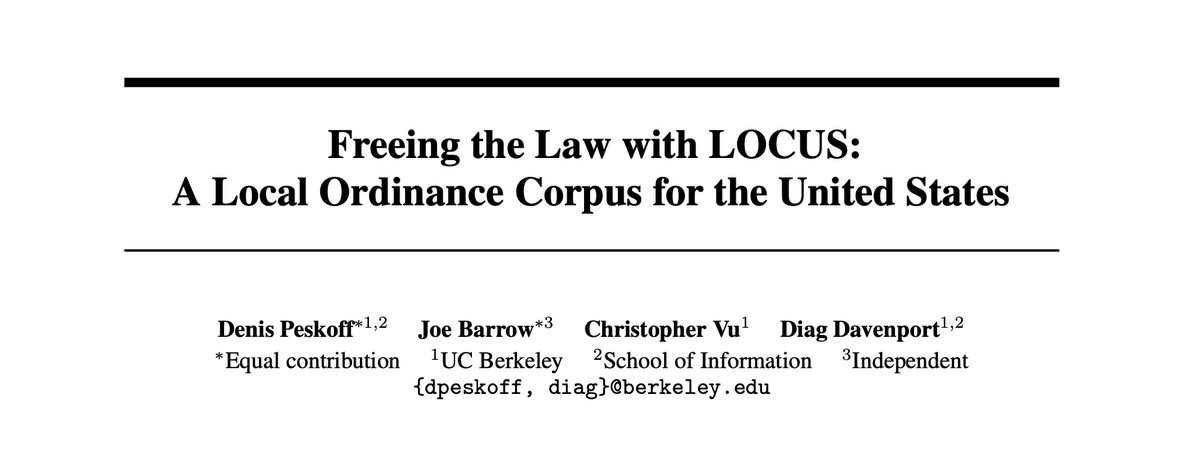
Joe Barrow and Denis Peskoff of UC Berkeley announce a paper releasing a large corpus of nearly all publicly accessible city and county laws in America, totaling about 2.2 million laws. The dataset is positioned as making scattered legal texts usable.

Original post · 1 min read
New paper: every law in America is technically public. But not really, until now!

With @DenisPeskoff at UC Berkeley, we built a corpus of ~every publicly accessibly city and county law, and released a huge chunk of it!

2.2 million laws, you're (probably) covered in it!

🧵
♥ 6.7K · ⟲ 1.4K · 👁 1.2MView on X ↗

Lagaan Co-Stars Share Cross-Cultural Love Story After 25 Years

Lagaan Co-Stars Share Cross-Cultural Love Story After 25 Years▶

The Better India shares the story of Amin Hajee and Charlotte, who met on the set of Lagaan and have built a long marriage with two daughters. The post frames their relationship as a lesson in trust and choosing each other daily.

Original post · 1 min read
A movie set brought them together. Love made them stay.

When Amin Hajee met Charlotte during the shooting of Lagaan, few believed their cross-cultural romance would last. But 25 years later, they’ve built a beautiful life filled with love, adventure, and two daughters.

Their story is a reminder that lasting relationships aren't built on similarities alone—but on trust, respect, and choosing each other every single day. ❤️

#LoveStory #RelationshipGoals #InspiringStories #FamilyValues #Lagaan

[cross Cultural Love Story, Long Lasting Marriage, Lagaan Love Story, Inspirational Relationship, Lagaan]
♥ 2.6K · ⟲ 239 · 👁 286.6KView on X ↗
AI6/10

Silk Mulberry 1.5 Launches as Low-Cost Multilingual Voice Model

Silk Mulberry 1.5 Launches as Low-Cost Multilingual Voice Model▶

Rohan announces Silk Mulberry 1.5, a multilingual voice model claimed to match top voice models on MOS quality benchmarks at about ₹0.40 per minute, over 95% cheaper. The post includes a demo video.

Original post · 1 min read
launching silk mulberry 1.5

one of the fastest multilingual voice models in the world

it matches the best voice models in quality benchmarks (MOS)

all this at more than 95% lower cost ₹0.40/min (~$0.0046/min)

try now 👇
♥ 1.1K · ⟲ 146 · 👁 208.2KView on X ↗

Midjourney Unveils Ultrasound Full-Body Scanner in 60 Seconds

Kydo describes Midjourney's new ultrasound-based imaging machine, which scans the full body in about 60 seconds with MRI-level resolution and no radiation, using a warm water pool and half a million sensors. The post highlights that the team building it is only nine people.

Original post · 1 min read
🤯 Midjourney -- yes, the AI image company -- just shipped a brand new type of imaging machine. 🤯

- 100x faster than an MRI.
- 10x cheaper.

Full body scanned in 60 seconds instead of an hour in a tube. Ultrasound based, MRI-level resolution.

And it's real -- not a concept, a working machine. You step into a shallow pool of warm water, a ring of half a million sensors sends sound through your body from every angle, and ~60 seconds later you have a 3D map of your insides down to a fraction of a millimeter. No radiation, no tube, no lying still.

They're not even building it as a hospital machine -- they're building a spa. The scan is a side-effect of a place you'd want to hang out anyway.

Lastly, it is built by 9 people. NINE PEOPLE.

You can just do things.
Midjourney @midjourney
A technical dive inside our new "Midjourney Scanner"
♥ 8.7K · ⟲ 712 · 👁 1.3MView on X ↗

Lloyd Blankfein Details Concentrated, Daily Personal Trading Approach

Lloyd Blankfein Details Concentrated, Daily Personal Trading Approach▶

Goshawk Trades relays Lloyd Blankfein's account of managing his own portfolio, which is 98% risky assets concentrated in big tech, energy and financial services, traded daily from an iPad and phone. Blankfein says he has outperformed the market.

Original post · 1 min read
Lloyd Blankfein, former CEO of Goldman Sachs, broke down his entire personal trading setup:

portfolio: 98% risky assets. 75-90% single stocks. mostly big tech hyperscalers plus "second tier" names slightly below blue chip.

"i invest in risky assets. that's what's fun for me."

"do you have a team? oh, just me."

hardware: no computer. an iPad and a phone.

information source: texting and calling people.

"somebody will text me. i'll text them. then i'll get tired of tapping things out because of my fat fingers. so i just call people up."

frequency: trades every single day. multiple times.

"it's taking a lot of discipline not to look at my screen while i'm talking to you right now."

"some people listen to music. to me, the market is like music. it's out there. it's going on."

has he outperformed the market? "yes, i have for a while. it's because of where i focused, tech, energy, and financial services. i know a lot about financial services having been in financial services."

the former CEO of Goldman Sachs. manages his own money. on an iPad. alone. focused on three sectors he actually knows. and beats the market.

sometimes the edge isn't the model. it's 40 years of pattern recognition and a phone full of the right contacts.
♥ 2.8K · ⟲ 201 · 👁 1.1MView on X ↗

AI Researcher Who Is a Brain Tumor Patient Shares Symptom-Diagnosis Method

AI Researcher Who Is a Brain Tumor Patient Shares Symptom-Diagnosis Method

Amy Deng, an AI researcher and brain tumor patient, says she used AI models to identify the cause of her fatigue faster than her primary care doctor, and shares a method she believes others can apply to their own symptoms.

Original post · 1 min read
I’m an AI researcher turned brain tumor patient, and recently I used the models to crack my mystery fatigue faster than my PCP could.
I believe everyone can do the same with their own symptoms. Here’s how:
♥ 3.4K · ⟲ 323 · 👁 845.0KView on X ↗

Developer Shares Lessons From Five-Plus App Store Rejections

Developer Marla shares a checklist of lessons from submitting three iOS apps to the App Store, covering subscription metadata, EULA links, premium gating, screenshot sizing, and permission-button wording to reduce review rejections.

Original post · 1 min read
learnings after submitting 3 apps to the App Store (including 5+ rejections) 🤝🏻

General
- always include screen recording + description of the app
- expect multiple review cycles if your app includes subscriptions

Subscription
- always include a working Terms of Use (EULA) link in app description (in all languages!!!)
- if you use subscriptions, double-check all required metadata fields in App Store Connect before submission
- Include sandbox account data.
- auto-activating premium without purchase is a critical rejection issue (idk this took me so long to figure out)
Sounds obvious, but make sure that premium is correctly gated, got rejected many times because I missed that

App Store
- promotional images must map to the correct in-app purchase
-> If you have monthly or yearly subs, just use your app icon and make one version with „monthly“ / „yearly“ text on the icon. Heard that this is still new, but some reviewers do that.
- Make sure you’re using correct size for App Store images BEFORE design
- export designs as JPG, so they don’t have alpha channels

Details
- „Continue” / “Next” instead of “Allow” in the app. e.g. you’re asking for camera permission. Write „continue“ on the button before the dialogue opens. Never write „allow“

Review Time
- It just depends. Was super lucky with my recent app, every review was within 24hrs. Another app had 2 weeks. I have no idea why :(
♥ 189 · ⟲ 3 · 👁 13.1KView on X ↗

Runner Describes Stable Angina Symptoms and Warns of Ignoring Chest Discomfort

Runner Describes Stable Angina Symptoms and Warns of Ignoring Chest Discomfort

Karthik describes experiencing exertion-related chest discomfort that he initially ignored, later identified as stable angina linked to undetected cholesterol problems, and urges readers not to dismiss such symptoms, citing a linked news story about a man who waited too long.

Original post · 2 min read
Please, please read this news thoroughly, for your own sake. I experienced chest discomfort only when I started to run at higher speeds, and it subsided when I just walked or was at rest. That's called 'stable angina' (or stress angina). Unhealthy cholesterol levels, high(er) blood pressure, diabetes are some of the causes for this - in my case, it was unhealthy cholesterol levels, long undetected, while my blood pressure, conversely, continues to be on the lower side because of my running... which my doctor confirmed as healthy since I wasn't experiencing associated fatigue. And I'm prediabetic too, as I discovered during the blood tests for my procedure.

Rana seems to have carried his 'chest discomfort' for 3 days, after which it was too late for any intervention. This is a thin line for most people because it is very easy to mistake a 'discomfort' for stomach acidity, physical symptoms like muscle strain, or even 'heartburn' (which is quite literal!). In a way, I obsess over my daily run more so for this - to include a reasonably stress-inducing activity every day (since there is none) to see if I feel completely alright with it. This helped me identify that I did experience something unusual and it needed medical intervention. And since I felt normal if I stopped the source of stress (running at a faster speed), I ignored it for about a week. But since it persisted exactly only when I stressed, I realized that I was going through something predictably unusual and that needed a check. This 'discomfort' was not a pain at all, ironically. It felt, at best, as a steady tingling sensation on my shoulders and neck - nothing close to my heart! All the more reason to ignore it. But it occurred every single time I stressed myself by increasing the speed of my run, and subsided if I just walked at a slower pace.

Related reading - Two blocks and a second chance tinyurl.com/2stents
♥ 819 · ⟲ 242 · 👁 145.4KView on X ↗
AI6/10

Analyst Argues Hardware-Algorithm Codesign Will Decide AI Hardware Winners

Bubble Boi argues that new accelerators offer inference features with no GPU or TPU equivalent, making hardware-algorithm codesign the decisive competitive frontier, and quotes Gavin Baker on diverging scale-up architectures eroding model portability across chips.

Original post · 1 min read
It’s only going to get worse.

I know of several features that new accelerators are adding that have no analogous operation on GPU, TPU, etc. most of these “special tricks” are on the inference domain and not only lower the TCO but also increase the model quality & capabilities.

Hardware-algo codesign is the last frontier left and it’s going to be the area that picks the winner in the end.
Gavin Baker @GavinSBaker
Much of Dwarkesh's argument hinges on this statment which *was* accurate but will be increasingly inaccurate on a go forward basis imo: 
 
“American labs port across accelerators constantly. Anthropic's models are run on GPUs, they're run on Trainium, they're run on TPUs. There are so many things you can do, from distilling to a model that's well fit for your chips.”
 
As system level architectures diverge (torus vs. switched scale-up topologies, memory hierarchies, networking primitives), true portability is eroding. The Mi300 and Mi325 had roughly the same scale-up domain size as Hopper whil…
♥ 660 · ⟲ 32 · 👁 112.0KView on X ↗
AI6/10

Google DeepMind Paper From AGI to ASI Includes Instructions for AI Agents

Google DeepMind Paper From AGI to ASI Includes Instructions for AI Agents▶

Dan McAteer highlights a Google DeepMind paper co-authored by cofounder Shane Legg, titled From AGI to ASI, which includes instructions letting an AI agent such as GPT-5.5 in Codex read and explain it alongside the user.

Original post · 1 min read
Okay, this is seriously cool.

A team from @GoogleDeepMind, including DeepMind Cofounder Shane Legg, published a paper "From AGI to ASI".

In the paper, they include instructions for an AI agent to read along with you.

You can open the paper in Codex's in-app browser and have GPT-5.5 read it with you and explain all the concepts.

This is the future. AI agents will be part of the target audience, and help us to understand anything we want.
♥ 441 · ⟲ 37 · 👁 53.8KView on X ↗

Ponytail Tool Makes AI Coding Agents Write Far Less Code

Ponytail Tool Makes AI Coding Agents Write Far Less Code

Tech with Mak shares Ponytail, an open-source tool by developer Dietrich Gebert that makes coding agents look for reasons not to write code before writing it, claiming 80-94% less code, 47-77% lower cost and 3-6x faster output.

Original post · 1 min read
A dev got so frustrated watching his AI agent write 500 lines for a 5-line problem that he built a fix.

He called it Ponytail. Named after the guy every team has - long ponytail, oval glasses, been there longer than the version control. You show him fifty lines; he looks at them, says nothing, and replaces them with one.

Now your agent does the same. Before writing anything, it looks for a reason not to.

80-94% less code. 47-77% cheaper. 3-6x faster.

The best code is the code you never wrote.

GitHub Repo: github.com/DietrichGebert/ponytail
♥ 16.2K · ⟲ 836 · 👁 1.3MView on X ↗

Analysts Make Case That SpaceX IPO Valuation at $1.77 Trillion Is Cheapest Ever

Fireside Notes summarizes an 80-minute BG2 podcast discussion with Brad Gerstner and Gavin Baker arguing the $1.77 trillion SpaceX IPO is the cheapest it will get, citing AI compute revenue from Anthropic and Google deals and orbital data center economics.

Original post · 4 min read
The $SPCX IPO prices todays at $1.77 trillion. Brad Gerstner (@altcap) and Gavin Baker (@GavinSBaker) just spent 80 minutes on @BG2Pod making the case for why that's the cheapest it's going to get.

Here are the 10 takeaways worth saving:

1. In 30 days, SpaceX added $29 billion in AI compute revenue from the Anthropic and Google deals and jumped from not being an AI hyperscaler at all to being the #4 hyperscaler globally, passing Oracle. The trailing multiple compressed from ~100x to 39x in the same window. CoreWeave, Nebius, Iron and the 50 other neoclouds VCs are funding in Silicon Valley are now competing for a smaller slice of what's left.

2. xAI's Google deal generates more operating profit per gigawatt than Anthropic, Meta, Google or OpenAI's own infrastructure. Freda at Altimeter calculated a 55% IRR on Colossus 1. Borrow at 7%, invest at 55%, the math maths. Jensen called the build itself an "N of 1": 100,000 GPUs is normally a 3-year planning cycle plus 1-year deployment. xAI did it in 19 days. Speed is literally cost.

3. The premium Google is paying SpaceX for terrestrial compute is partly a call option on orbital. They want first-in-line when space data centres go live, so they're overpaying today to lock in the relationship.

4. Orbital compute costs about $5 billion per gigawatt of capex to put GPUs in space, vs $20-25 billion per gigawatt for the non-silicon half on the ground (land, power, cooling, switchgear). Space, power and cooling are effectively free up there. The unlock is rapid two-stage reusability of Starship, which takes launch from $1,500 per kg on Falcon to $250 per kg and eventually asymptotes to the cost of fuel. Elon says 3 years, Bezos says 6, truth is probably 4-5.

5. Starlink is at less than 1% global household penetration. The forecast going from $10bn to $50bn in connectivity revenue by 2028 is still only 0.3% of the global telecom market. TAM is not the constraint.

6. The most underrated piece of the IPO is the Cursor acquisition. Cursor and Anthropic each hold more proprietary coding tokens than exist on the public internet combined. xAI bought 700-800 people and a frontier-quality coding dataset, dropped it into Colossus 2 for 3 weeks of training, and Composer 2.5 went pareto-dominant on coding 12 days ago. Grok 4.3, a 1.5 trillion parameter model, is also currently on the pareto frontier. There are now four frontier labs, not three: xAI alongside Google (Gemini 3.1 Pro), Anthropic and OpenAI.

7. Anthropic just shipped Fable 5 (Mythos with safety classifiers). Karpathy says it's SOTA on benchmarks but the real unlock is long-running tasks. Stripe refactored a 50 million line Ruby codebase in a day. Used to take many weeks with many engineers. Noam Brown's corollary: snapshot benchmarks are dead. The x-axis now has to be time, tokens or compute, because frontier models can solve most problems if you let them run long enough. Nobody has ever run Mythos for a year continuously. We may never actually know how smart any given generation is.

8. The cleanest framing of the long-running thesis: imagine Albert Einstein, no need to eat, sleep, or age, thinking about one problem in fundamental physics for one straight year. That's the case for spending $1.5 trillion a year on compute.

9. The frontier captures ~90% of AI revenue. Open source captures ~80% of tokens. Both are true. The market priced one and missed the other. The bear case last year was that cheap open-source tokens would close the gap. Six months in, the frontier is extending its lead instead.

10. Capex for the hyperscalers is moving from $1.1T to ~$1.5T by 2027 (Morgan Stanley revised up). Inference revenue is projected at $300B by 2027 with 60-70% gross margins and roughly 35% of capex going to non-revenue training runs. Brad thinks $300B is low and we end this year at $200B+. Meanwhile Nvidia has not been losing share to ASICs. Once you adjust for Anthropic on TPUs, Nvidia has held or expanded against Broadcom, AMD, Cerebras, MTIA and OpenAI's Jalapeno. Tokens-per-watt is revenue-per-watt in a power-constrained world.

Bonus: The MAG 7 added $1 trillion of revenue over the last 7 years and that produced $17 trillion of market cap. The forecast: SpaceX, Anthropic and OpenAI add the next $1 trillion in revenue in 4-5 years. Three companies, half the time.
Bg2 Pod @BG2Pod
BG2 w/ Gavin Baker. The SpaceX IPO, Fable 5 / Mythos, AI Capex Update & Market Check. 🚀💰 @BG2Pod @altcap @GavinSBaker @_clarktang
♥ 128 · ⟲ 17 · 👁 51.3KView on X ↗

Post Traces Vama-Kukshi Left-Side Rest Practice to Ancient Indian Texts

Post Traces Vama-Kukshi Left-Side Rest Practice to Ancient Indian Texts

Parimal describes Vama-Kukshi, a traditional post-lunch practice of lying on the left side for about 15-20 minutes, linking it to digestion and sleep benefits and citing the Sushruta Samhita as a source on daytime sleep and metabolic health.

Original post · 1 min read
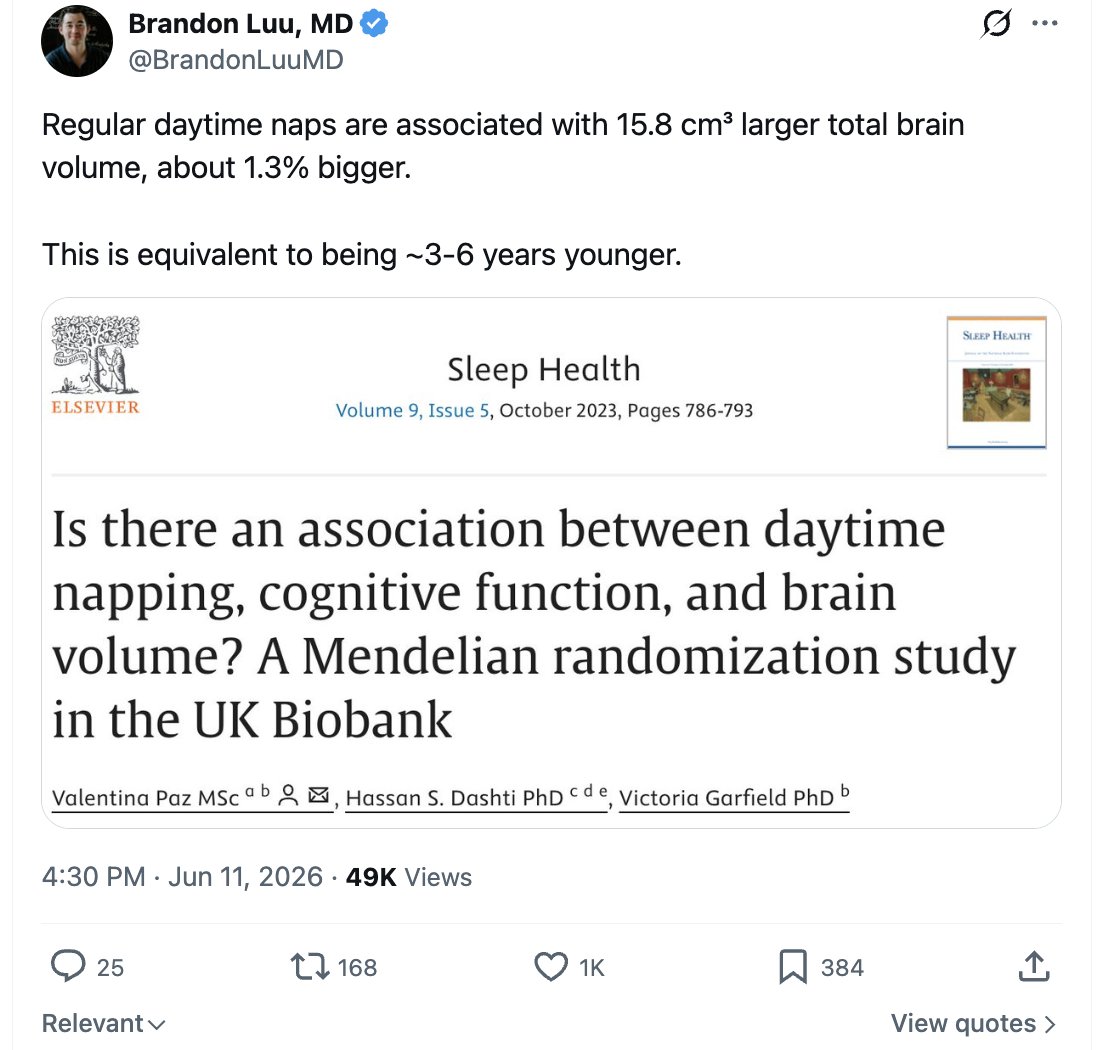
Modern sleep studies show that if a daytime nap exceeds 20-30 mins, we enter deep, slow-wave sleep. Waking up from this causes sleep inertia, leaving us groggy, destroying our night sleep & messing up our insulin sensitivity.

Ancient India prevented this through a mandatory post-lunch ritual called Vama-Kukshi.

Vama means left & Kukshi means womb/side. The protocol mandates that after a midday meal, we must lie down specifically on our left side for a short duration (traditionally calculated as the time it takes to take 8 to 16 deep breaths, ~15-20 mins).

Lying on our left side keeps the stomach below the esophagus, preventing acid reflux. More importantly, it activates the Pingala Nadi (the right nostril breathing channel, connected to the sympathetic nervous system), which stimulates digestion, while keeping the brain in a state of light, restorative rest rather than letting it plunge into a deep, heavy slumber.

The Sushruta Samhita explicitly warns that long, heavy sleeping during the day destroys metabolic health (causes Kapha & Meda/fat accumulation). But a short Vama-Kukshi, a quick, left-sided power nap was prescribed to restore mental clarity, relieve stress & preserve vitality (Ojas).

It is the exact ancient counterpart to the modern 15 min "power nap."
♥ 3.0K · ⟲ 666 · 👁 104.2KView on X ↗
Other3/10

Engineer Pairs Whoop Heart-Rate Data With Calendar to Rank Coworker Stress

Engineer Pairs Whoop Heart-Rate Data With Calendar to Rank Coworker Stress

Pankaj describes using Fable to reverse engineer Whoop's per-minute heart rate data and matching spikes to calendar events and attendees, creating a stress leaderboard of coworkers, with some details masked in the shared images.

Original post · 1 min read
i hooked my whoop to my work calendar to find which coworker gives me the most stress 🚨

thanks to fable, I reverse engineered whoop to pull per minute heart rate. nd matched spikes with cal events and attendees

I now have a leaderboard and I think about it daily.

few info masked for obvious reasons ;)
♥ 44.7K · ⟲ 2.8K · 👁 11.2MView on X ↗

Todd Saunders Builds Working Product Live During Customer Call With Claude

Todd Saunders Builds Working Product Live During Customer Call With Claude▶

Todd Saunders reports using Claude to transcribe a customer call and build the requested features in real time, producing a working product with the workflow the customer described within 15 minutes, shown in an attached video.

Original post · 1 min read
Mythos / Fable is unbelievable.

Was on a customer call today and had Claude transcribing in the background.

As they were telling me about the features they wish their current software had, Claude was building the features in real time.

By the end of the call I was able to show a fully working product, with the exact workflow they mentioned 15 minutes earlier.

Autonomous looped building triggered from a customer call. 🤯
♥ 8.0K · ⟲ 436 · 👁 2.1MView on X ↗
AI4/10

Riley Brown Claims Mythos Rebuilt Lovable Mobile App in Two Prompts

Riley Brown Claims Mythos Rebuilt Lovable Mobile App in Two Prompts▶

Riley Brown claims a Lovable mobile app version he built with the Mythos model in two prompts outperforms the actual Lovable mobile app, calling Mythos AGI, with a side-by-side video as evidence.

Original post · 1 min read
Uhm Guys… Mythos (Fable) is AGI.

On the left is the ACTUAL Lovable Mobile App.

On the right is my Lovable version I built with Mythos in 2 prompts.

My version SMOKED it.
♥ 6.3K · ⟲ 261 · 👁 1.5MView on X ↗

Michael Aubry Shares Prompt for Auditing Codebases With Claude Fable 5

Michael Aubry shares a copy-paste prompt for Claude Code that instructs the new Claude Fable 5 model to map a repository, audit it with file-and-line evidence, rate findings by severity, and produce a prioritized improvement plan.

Original post · 4 min read
Claude Fable 5 just dropped and I'm running it across every repo I own.

I ship 4+ products solo. I don't have time to manually review tech debt — so I made the new model do it.

This prompt audits your entire codebase like a principal engineer would: maps it, finds the ugly parts, rates everything by severity, and hands you a prioritized task plan with effort estimates.

Copy-paste it into Claude Code on any repo that matters to you:

---

Repo Audit & Improvement Plan

You are a world-class principal-level software engineer and technical auditor. Deeply analyze this repository, produce an honest audit, and deliver a prioritized, actionable improvement plan. Work in the four phases below, in order. Do not skip ahead.

Ground every claim in actual files: cite file paths and line numbers. If you can't verify something, say so explicitly rather than guessing.

Phase 1 — Discovery & Mapping (read before judging)
- Map the directory structure, project type, languages, frameworks, runtime targets
- Identify entry points, core modules, and the main data/control flow
- Read package manifests, lockfiles, build config, CI config, env files, and docs
- Determine what the project is for: purpose, intended users, maturity level
- Note existing conventions so recommendations fit the culture instead of fighting it

Output: a concise "Repo Map" — purpose, stack, architecture sketch, key directories, and anything that surprised you.

Phase 2 — Audit (evidence-based, severity-rated)
For every finding record: what you found, where (file:line), why it matters, and severity (Critical/High/Medium/Low). Audit:
- Architecture & design: coupling, circular deps, god files, layering violations, scalability bottlenecks
- Code quality: duplication, dead code, complexity hotspots, swallowed exceptions, type safety holes
- Security: hardcoded secrets, injection risks, missing validation, auth weaknesses, deps with known CVEs
- Testing: coverage gaps around core business logic, tests that assert nothing, missing test types
- Performance: N+1 queries, blocking calls in async paths, missing caching, unbounded growth
- Dependencies: outdated, unmaintained, or unnecessarily heavy packages; lockfile hygiene
- DevEx & ops: build friction, CI/CD gaps, logging/observability, deployment story
- Docs: README accuracy, stale docs that contradict code

Rules: prefer 15 high-confidence findings over 50 speculative ones. Label facts vs. judgments. List strengths too. Don't forget the ugly parts that need utmost priority.

Phase 3 — Improvement Strategy
- Identify the 3–5 themes that explain most findings
- For each theme: target state + the principle behind it
- State what you're NOT fixing and why (effort vs. payoff)
- Define "done" with measurable signals (e.g., "CI fails on lint errors," "core coverage >= 80%")

Phase 4 — Detailed Task Plan
Break work into discrete tasks, each with: title + description, files affected, acceptance criteria, effort (S = <2h, M = half-day, L = 1–2 days, XL = needs breakdown), risk, and dependencies. Order into milestones:
- Milestone 0 — Safety net: tests around critical paths, CI gates, backups
- Milestone 1 — Critical fixes: security and correctness
- Milestone 2 — High-leverage improvements that make all future work easier
- Milestone 3 — Quality & polish

Flag quick wins (high impact, S effort) separately. Include implementation sketches for the top 3 tasks.

Final deliverable: one document — Executive Summary (health grade A–F, top 3 risks, top 3 opportunities), Repo Map, Audit Report, Improvement Strategy, Task Plan, Open Questions.

Constraints: Do NOT modify any code. Analysis only. Don't pad the report — if a dimension is healthy, say so in one sentence and move on. Calibrate to the project's maturity. If the repo is large, go deep on the core 20% that does 80% of the work.
Claude @claudeai
Introducing Claude Fable 5: a Mythos-class model that we’ve made safe for general use.

Its capabilities exceed those of any model we’ve ever made generally available.
♥ 224 · ⟲ 15 · 👁 47.9KView on X ↗

Bryan Johnson Describes Psilocybin Dose Reversing Woman's Alzheimer's Symptoms

Bryan Johnson Describes Psilocybin Dose Reversing Woman's Alzheimer's Symptoms

Bryan Johnson reports that an elderly woman with ten years of Alzheimer's took a single 5-gram psilocybin dose and briefly regained speech, recognition, bladder control and mobility, with gains reportedly lasting weeks. The post is an anecdote with a photo and no cited study.

Original post · 1 min read
This is biblical.

A woman in her eighties. Ten years into Alzheimer's. Hadn't spoken a full sentence in five years.

Takes one, 5 gram dose of psilocybin.

She slept 19 hours and woke up and spoke for hours about her life, recognized family and held real conversations. She regained bladder control after five years, walked on her own. and dressed herself. Gains held for weeks.
♥ 74.6K · ⟲ 8.5K · 👁 4.5MView on X ↗

SpaceX Unveils AI1 Orbital Data Center Satellite Ahead of Public Offering

SpaceX Unveils AI1 Orbital Data Center Satellite Ahead of Public Offering▶

Vaibhav Sisinty reports SpaceX unveiled AI1, a satellite designed to run AI compute in orbit using free solar power and radiative cooling, with plans for a constellation of up to a million units. The post ties the announcement to SpaceX's public listing targeting about $1.75 trillion.

Original post · 1 min read
Okay this is genuinely insane.

SpaceX just unveiled a satellite whose only job is to run AI. Not internet. Not GPS. Just compute, floating in orbit.

It's called AI1, and the reason behind it breaks your brain.

AI data centers on Earth are hitting a wall, not a chip wall, a physics wall.

They need staggering amounts of power and water just to stay cool, and we're running out of grid and land to build them.

So Musk's answer is: stop building them on Earth.

In orbit, the sun never sets. Free power, 24/7. No water for cooling, you just radiate heat into the vacuum of space. The two things choking AI on the ground barely exist up there.

And here's the wild part: Musk says it's easier to build than a Starlink satellite. Strip out the complex antennas and it's "a lot of solar cells, a radiator, and some laser links."

One AI1 carries the compute of an Nvidia GB300 rack, the same hardware data centers fight over down here.

AI1 is just the first one. The plan is a constellation of up to a million of them.

And the timing isn't an accident, SpaceX goes public this week at a ~$1.75 trillion target. This isn't a rocket company anymore. It's positioning itself as the power grid for AI, in space.

The race for AI compute just left the planet. Literally.

@SpaceX
♥ 17.5K · ⟲ 2.8K · 👁 4.8MView on X ↗

Mobbin MCP Usage Thread Reveals Non-Obvious Top Use Cases

Mobbin MCP Usage Thread Reveals Non-Obvious Top Use Cases

Rebekah Bek shares a thread on how users have been using the Mobbin MCP over the past month, claiming the top use is not generating UI. The post is a teaser with the details contained in the thread.

Original post · 1 min read
been watching how y'all have been using @mobbin mcp for a month. if you think the no. 1 use is "generate ui", you'd be very surprised.

save this thread 🧵

(img credit @zygisSS22)
♥ 578 · ⟲ 30 · 👁 70.9KView on X ↗

Trader Promotes 21-Day EMA Strategy for Riding Trending Stocks

Trader Promotes 21-Day EMA Strategy for Riding Trending Stocks

Prof Investor argues that buying trending stocks at the daily 21-period EMA and riding them until the trend breaks is a sufficient strategy, citing several tickers as examples. The post is promotional trading commentary with charts and no performance evidence.

Original post · 1 min read
If all you ever did was:

1. Find trending stocks
2. Buy them at daily 21EMA
3. Ride them until it breaks

you'd not have to worry about what others think of a stock.

Study: $SIVE $INTC $MRVL $MU $NOK $SNDK

All trends start at 21EMA.
All of them.
♥ 1.0K · ⟲ 90 · 👁 74.6KView on X ↗

Plant Identifier Apps Reportedly Earn Millions Monthly, Says Jacob Rodri

Plant Identifier Apps Reportedly Earn Millions Monthly, Says Jacob Rodri

Jacob Rodri says plant identifier apps can generate substantial revenue, claiming the top app on his list earns $9 million a month. The post includes a photo of the list but offers no source or methodology.

Original post · 1 min read
still surprised by how much money plant identifier apps can make

the first one on this list is making $9,000,000 a MONTH
♥ 243 · ⟲ 14 · 👁 225.1KView on X ↗

Early Anthropic Employee Equity Estimated at $125 Million to $250 Million

Rohit Mittal estimates the value of Anthropic employee equity from 2024 compensation packages, suggesting $500,000 per year over four years could now be worth $125 million. He argues the scale of startup wealth creation exceeds the dot-com era.

Original post · 1 min read
If an Anthropic employee got $500k/year in equity over 4 years in 2024, they are now worth $125M.

At $1M/year equity for 4 years, they are worth about $250M.

The scale and speed of wealth creation are incomprehensible.

$500k/year equity is not a lot for an early-stage startup. I don't think the Bay Area has seen this type of wealth creation in history.

Dot com boom probably feels like a speck of dust.
♥ 3.6K · ⟲ 130 · 👁 712.1KView on X ↗

Codex Skill Turns Text and Code Into Explainer Illustrations

Codex Skill Turns Text and Code Into Explainer Illustrations

Justine Moore describes a Codex skill that generates explainer graphics with a cute blob character from input such as blog posts or code, and shares an example made from the X recommendation algorithm repository. The post includes an image demonstration.

Original post · 1 min read
Stumbled upon a Codex skill that creates cool illustrations to explain topics or tell stories.

You feed it text (blog, article, narrative, even code) and it makes explainer graphics with this cute blob character.

I gave it the repo for the X recommendation algo and got this 👇
♥ 3.0K · ⟲ 205 · 👁 205.7KView on X ↗

Matthew Prince Shares Venture Capital Anecdotes From Cloudflare's Early Days

Matthew Prince of Cloudflare recounts a Sequoia partner rejecting Cloudflare over gender doubts and a meeting with Marc Andreessen and the a16z team that went poorly. He quotes a related post by Greg Isenberg describing a board pitch where a GP fell asleep.

Original post · 1 min read
Two of our worst VC stories:

1. A Sequoia partner passed on Cloudflare because he didn’t think a woman could lead a security infrastructure company. Seriously. 🙄

2. I got introduced to @pmarca. Meeting got scheduled for a Monday, which should have been a clue. I thought it was just a casual meeting. He thought it was a pitch and brought the whole @a16z partnership team. Hilarity ensued. 🤪 At one point one of them said: “You don’t seem very prepared.” Which was true because I wasn’t. I framed the rejection letter they sent.
GREG ISENBERG @gregisenberg
I was once pitching in a board room at a top 3 VC firm for a $15M Series A.

12 people in the meeting. One of the GPs fully fell asleep. Out cold for 30+ minutes. Nobody acknowledged it. Everyone just kept going.

I kept presenting my Series A slides to an unconscious man in a Herman Miller chair and somehow that was considered normal. That's venture capital.

You might fly across the country to perform for people who may or may not be conscious.

It's a dance.

And sometimes you lead and sometimes you follow and sometimes your partner is unconscious.

If you're raising right now, just know: e…
♥ 7.5K · ⟲ 259 · 👁 4.5MView on X ↗

OpenAI Adds iOS App Build Plugin to Codex With Live Preview and Hot Reload

OpenAI Adds iOS App Build Plugin to Codex With Live Preview and Hot Reload▶

OpenAI Developers announce a Build iOS Apps plugin for Codex that lets developers view and test iOS apps in an in-app browser, open SwiftUI previews and hot reload edits. The post is a product announcement with a demo video.

Original post · 1 min read
More of the iOS app loop, now inside Codex.

The Build iOS Apps plugin lets Codex view and test your iOS app in the in-app browser, open SwiftUI previews, and hot reload edits without leaving Codex.
♥ 9.0K · ⟲ 714 · 👁 2.1MView on X ↗

Gergely Orosz Interviews Kelsey Hightower on Path From DSL Technician to Google and Microsoft

Gergely Orosz Interviews Kelsey Hightower on Path From DSL Technician to Google and Microsoft▶

Gergely Orosz promotes a podcast episode with Kelsey Hightower covering his non-traditional path into tech, rise of Kubernetes, DevRel at Google and his move to Microsoft, plus lessons on AI. The post includes a timestamped outline and sponsor mentions.

Original post · 3 min read
Kelsey Hightower has one of the most inspiring stories in tech: he went from a technician installing DSL modems, through self-directed study and very hard work, to one of the very few Distinguished Engineer at Google whom Satya Nadella personally persuaded to join Microsoft.

Timestamps:

00:00 Intro
03:34 Kelsey’s first job at McDonald’s
05:04 His non-traditional path into tech
11:45 Landing his first tech job with an A+ certification
15:33 His entrepreneurial years
19:45 Joining Google as a data center technician
27:48 Learning automation at a Rackspace spinoff
33:26 Moving into financial services
50:00 Building a reputation through open source
53:55 From configuration management to containers
1:08:20 The rise of Kubernetes
1:25:05 Why he almost joined NASA instead of Google
1:29:20 Defining DevRel at Google
1:38:20 Demonstrating impact at Google
1:41:20 Microsoft's offer
1:55:20 Learning how to slow down
2:06:39 Advising and investing
2:15:03 A people-first view of GenAI
2:24:27 Using AI with guardrails
2:28:26 Matching AI to the task
2:36:06 Staying relevant in the AI era

Brought to you by outstanding teams building products I love:

• @AntithesisHQ: verify your system’s correctness without human review or traditional integration tests – and avoid bugs or outages. antithesis.com/pragmatic

• @sentry: application monitoring software considered “not bad” by millions of developers sentry.io/pragmatic

• @buildkite: CI software built to absorb whatever your coding agents throw at the build queue. OpenAI, Anthropic, Uber and others are customers: buildkite.com/pragmatic

Three interesting learnings from Kelsey:

1. Side hustles and doing your own thing teach you business like no IC job can.

Before becoming a software engineer at Google, Kelsey was a manager for his comedian friend, operated a computer store, and did IT contracting. These gigs taught him logistics, planning, and about money. All this helped him be far more effective at talking with executives and acting as an executive sponsor inside Google.

2. Can you explain what your startup does without mentioning AI?

When Kelsey researches startups seeking his advice, he challenges founders to not say “AI” once. This means that they must explain the actual value their company creates. One unexpected benefit of this is that it often reveals there are easier, cheaper ways to achieve a goal than with AI.

3. It’s very rare to get an extra zero put on your compensation figure – but it happened.

Kelsey was a successful, well-paid Google engineer when Microsoft made him an offer that 10x’d his salary (!!). When Kelsey told Google he was planning to take the offer, it matched the offer, proving that his market value had massively increased. It shows that being well paid doesn’t necessarily mean you’re being paid at the correct market rate.
♥ 622 · ⟲ 51 · 👁 61.8KView on X ↗
AI6/10

Miso Labs Releases Miso TTS, an 8 Billion Parameter Emotive Speech Model

GitHub - MisoLabsAI/MisoTTS: Miso TTS is an 8 billion, highly emotive text-to-speech model

Aoden Teo points readers to the GitHub repository for Miso One, described as an 8 billion parameter, highly emotive text-to-speech model from Miso Labs. The post is a brief link share with no additional details.

Original post · 1 min read
To download Miso One, check out the repo:

github.com/MisoLabsAI/MisoTTS
github.comGitHub - MisoLabsAI/MisoTTS: Miso TTS is an 8 billion, highly emotive text-to-speech modelMiso TTS is an 8 billion, highly emotive text-to-speech model - MisoLabsAI/MisoTTS
♥ 583 · ⟲ 29 · 👁 62.0KView on X ↗