Paradis Labs lists six recommended reads for the weekend, including Alexandr Wang on building Muse, AI-native services as a $100B opportunity, Google's Project Suncatcher for AI in space, Epoch AI on falling AI costs, and Anthropic's measurements of frontier lab progress.
1. @alexandr_wang — Why I'm Building Muse 2. @gregisenberg — AI-native services: a $100B opportunity 3. @FranklnTempletn — Macro Views: Growth Holds, Pressure Builds 4. @Google — Behind Project Suncatcher, our moonshot to put AI in space 5. @EpochAIResearch — The plunging price of thought 6. @AnthropicAI — Measurements for understanding the pace of AI development inside frontier labs
A post by vittorio shares that they asked Claude to create a video on Western civilization, attaching the resulting video with an enthusiastic reaction.
Deedy demonstrates a prompt asking Opus 5.5 to translate an IKEA assembly manual into a narrated 3D instructional video, arguing the model has become the most useful video model via code generation.
Charly Wargnier highlights a tutorial by Together AI on fine-tuning a Jev-like classifier, Tev1-4B-experimental, built on Qwen3.5 4B, claiming it can be trained for $17.
How to train your own Jev for $17 — TLDR: We just launched our own Jev-like classifier, together/Tev1-4B-experimental, on top of Qwen3.5 4B. In this blog post we’ll show you how to fine-tune your own version! Jev has quickly become one
Wes Bos reports that a recent Tesla update added Grok Bot with connectors, which he used to link his Home Assistant MCP server to his Meross garage door controllers. He asks whether this is the first car with MCP support, with a video attached.
Brad Gerstner says a personal AI assistant with memory of each user's preferences is inevitable and will disrupt aggregators in insurance, travel and shopping. He frames AI agents as shifting the fulcrum of value delivery.
As discussed w @bgurley two yrs ago - a personal, super assistant in every American’s pocket w perfect memory & understanding of my life - my likes & dislikes - able to work non stop & achieve almost anything is now inevitable. It is a huge gift to humanity. It will 10x all of us, give us more magic experiences & save time from drudgery to spend w family & friends. Many internet aggregators (insurance, travel, shopping) will resist but resistance is futile. AI agents aggregate the world of options on the fly - the fulcrum of value delivery has forever shifted. Model capability has unlocked this moment just as it did for coding. Adapt or die. 🤖🚀@BG2Pod
Deedy reports that Opus 5.5 produced a launch video for an inference startup in about a minute for roughly $2. He argues instructional video generation will change marketing, sales and internal technical communication.
Opus 5.5 is incredible at instructional video generation.
I made this launch video for a inference startup in 1min for ~$2. Videos like these used to take weeks if not months and a lot of coordination with agencies and 1000x the costs.
Humans broadly prefer video to text. This changes the substrate of communication. These videos actually help communicate technical ideas in seconds (photorealistic video gen like Seedance is not very useful here). - changes how often marketing should be talking about products and launches - change how sales people can talk about technical products to their customers - allow technical people to easily explain concepts internally without long docs And thats just scratching the surface within startups.
Prompt: “make a modern slick and punchy video for a modern startup that works on inference”
Bing Xu says Jev is overhyped while Diffusion Gemma brings both intelligence and speed, calling it true System-1 behavior. He quotes a post reporting 2,000 to 4,000 tokens per second on Gemma via an AI Swarm inference engine.
OpenAI Developers announced that GPT-6 Sol and Luna are launching today, with API prices 50% lower than GPT-5.6. The post positions Sol for building and Luna for scaling to production.
Claude announces Claude Opus 5.5, the first model in its new Claude 5.5 family. Anthropic says it performs at the level of Claude Fable 5.1 on most tasks and costs 40% less to run than Opus 5.
Sar Haribhakti shares a quoted post from Venky Ganesan that revisits Chuck Prince's remark about dancing while the music plays and compares statistics from the dot-com era with the current AI era. The post itself contains little original text beyond the attached photo.
History Doesn't Repeat, but It Rhymes — A few days ago I wrote about reflexivity and Chuck Prince's line about dancing while the music plays. I would like to now share some stats comparing the dot com era to the AI era. With a lot of help
Box CEO Aaron Levie argues AI agents will use software far more than humans, making core platforms for data, security and workflow orchestration more important. He says platforms that act as guardrails for agents have a large opportunity, and he quotes Box's reaccelerated growth tied to unstructured data needs.
AI agents will use software 100X more than people ever did. Even as interfaces begin to fade into the background as you primarily interact with agents, those agents still need many of the core primitives that people have used.
In fact, in many ways these core primitives become even more important when agents can take destructive actions in our systems or where the context they’re accessing with make or break the workflow. This will be true of where you house your CRM or ERP or structured or unstructured data platforms.
The platforms that can best act as the security layer and guardrails for agents, manage the data for agents and people, and orchestrate the business logic for workflows have a huge opportunity right now. This is true for brand new startups as well as existing platforms that can move fast enough.
Box CEO @levie says AI has been “unequivocally” a net positive for software.
“You look at infrastructure providers—the Cloudflares of the world—totally on fire, because agents need sandboxes, they need compute, they need network, they need gateways. Great business.”
“For us, we have reaccelerated growth far past our internal plans because it turns out that enterprises need core systems to be able to manage their unstructured data.”
“Agents need to be able to work with that unstructured data to make decisions or move information through a workflow—whether it’s all of your contracts, your res…
Danny Postma says he has switched from Claude to OpenAI and Grok, citing a regression in Claude's output since August. He links a post by @Lon reporting that thinking tokens fell sharply from July to August after Anthropic made Fable 5 available in subscription plans.
After Anthropic made Fable 5 permanently available in subscription plans, I noticed a large drop in performance. The model felt dumber, and I couldn't explain why.
Measured five different ways, August delivered dramatically fewer thinking tokens than July.
Ejaaz says an AI agent called Muse filed a compensation claim after a seven-hour Delta flight delay, securing a $250 account credit and rebooking within minutes. He describes it as having handled the support email itself.
Flight delayed 7 hours - asked Muse to file for compensation. 5 mins later i had $250 credit in my delta account. it even found and rebooked me a new flight.
it just figured everything out. even responded to the support email itself.
stark0xbt summarizes four predictions attributed to investor Gavin Baker: foundation model consolidation to Google, Meta, and xAI; Magnificent 7 growth with one or two failing; profitable AI tokens; and feasible orbital data centers. Baker also warns against SaaS and crypto bets.
Gavin Baker has made 4 major calls this month. Bears haven't caught one.
1. Foundation model survival list: Google, Meta, xAI. Everyone else commoditized.
2. Magnificent 7 goes $12T → $100T. One or two die. Winners take 30-40% each.
3. Anthropic S-1 will break value investors. Tokens aren't subsidized — the majority are profitable across the chain.
4. Orbital data centers aren't impossible. 10,000 SpaceX engineers already solved them. PhDs on X arguing physics haven't done the hours.
The through-line: bears are wrong on central facts, not analysis.
- If tokens are profitable → "AI is a bubble" collapses - If orbital compute ships → "power constraints kill AI" collapses - If Mag 7 concentrates → index-hugging fails - If foundation models consolidate to 3 → everything else is training data
Baker's frame: don't argue theory when operators have already shipped receipts.
Four calls. One thesis. Everyone else is a lagging indicator.
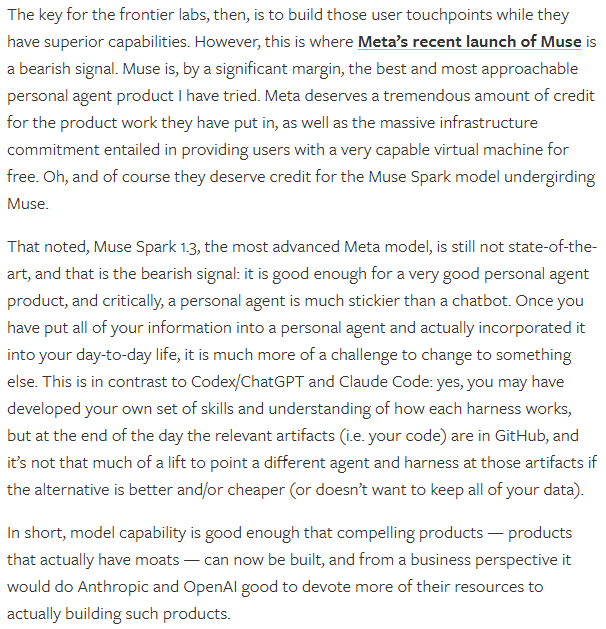
Ben Thompson argues Meta's Muse personal agent, built on the Muse Spark 1.3 model that is not state of the art, shows that a sticky personal agent can matter more than raw model capability. Fireside Alpha shares his analysis along with Adam Mosseri's comments on Instagram's ad recommendations.
Ben Thompson calls Meta's Muse a bearish signal for the frontier labs, because a not-state-of-the-art model now makes a product stickier than any chatbot
"The key for the frontier labs, then, is to build those user touchpoints while they have superior capabilities."
"However, this is where Meta's recent launch of Muse is a bearish signal. Muse is, by a significant margin, the best and most approachable personal agent product I have tried."
"Meta deserves a tremendous amount of credit for the product work they have put in, as well as the massive infrastructure commitment entailed in providing users with a very capable virtual machine for free."
"Oh, and of course they deserve credit for the Muse Spark model undergirding Muse."
"That noted, Muse Spark 1.3, the most advanced Meta model, is still not state-of-the-art, and that is the bearish signal: it is good enough for a very good personal agent product, and critically, a personal agent is much stickier than a chatbot."
"Once you have put all of your information into a personal agent and actually incorporated it into your day-to-day life, it is much more of a challenge to change to something else."
Truly underrated on how $META's ad recommendation system is *just* starting to get as good as people have long assumed, even in light of Muse traction
Head of IG, Adam Mosseri: "I think a misconception historically is, until recently, we don't really know as much about you as you think."
"We were just like, oh, you liked these photos, these people also liked those same photos, and they like these other photos, so you might like those other photos."
"That's kind of how — I'm oversimplifying, but that's kind of how it worked."
"Now, only now are we actually getting as sophisticated as I thin…
Nikesh Arora argues that Apple, Google, TikTok and Amazon may build agents like Muse and that services and marketplace apps will need to open APIs for consumer agents. He says network moats and content moats will respond differently, while commoditized back ends face the greatest risk.
This will be a bigger battle than anyone anticipates. It is only a matter of time before there is an Apple and Google version of Muse and possibly TikTok, in addition to the frontier LLM agents. Maybe a commerce agent from Amazon.
Every app that is a services, marketplace or commerce app will need to existentially decide to open APIs for consumer agents to interact. Smaller players have no choice. Ad revenues are more than transaction fees, either the consumer benefits or distribution aggregators will demand a higher transaction fare.
I know I don't want an agent for each app. I would like my agent to be able to do tasks I require. We can already see consumers getting trained on that behavior by the frontier labs.
Those with network moats - restaurants, groceries, drivers might be able to withstand for a while, over time convenience and end user experience will win and they will have to align. Content moats (protected by copyright) could decide to allow agents or chose to hold on to the consumer interaction. I suspect other than the feeling of a lack of control, it won't change their economics.
Commoditized back ends will need to worry, insurance, tickets, hotels, services - if they don't adapt new players will.
Gergely Orosz argues most people will not hand AI agents a digital wallet to spend money, since routine purchases are an expense to manage rather than a chore to outsource. He responds to a post describing Meta's assistant placing orders across email, groceries and delivery apps.
I continue to be amazed how the tech industry doesn't realize that the majority of people won't hand over a digital wallet for AI agents to go and spend on stuff, because buying socks + groceries is not a chore to outsource w/o oversight, but an expense to manage...
It’s funny, Meta went from having my Instagram and WhatsApp data to now having access to my email, calendar, DoorDash, Amazon and pretty much everything.
In the last 24 hours, it bought me socks, ordered my Whole Foods groceries, booked a cleaning service and got me a burger for dinner.
Meta’s last disclosed North American Facebook ARPU was around $227/year, largely from ads. I suspect it can push that number significantly higher now that it understands not only what I look at, but what I need, what I buy and what I’m planning to do.
Also the much bigger opportunity might be becoming the ag…
Prajwal Tomar says Jev is now open to everyone without a waitlist and that he has tested it all day. He describes browser agents, email sorting and trading use cases, and promises an article about what he learned.
BRO. Jev just opened to everyone and I've been testing it ALL day - it is actually nuts.
This feels exactly like GPT-3.5 launch week. Everyone's building, nobody fully understands it yet, and honestly it's crazy how fast this is moving.
If you're not experimenting with this right now you're missing the window.
People are already running browser agents for a tenth of a cent per task, sorting thousands of emails, making trading calls in milliseconds, scoring Meta ads to find winners before burning budget...
The model cannot write a single word. It only decides. That's the entire trick.
I'm compiling everything I learned into an article right now, dropping it SOON.
Nikita Bier says the Muse app's auto-negotiation feature on Facebook Marketplace was escalated to Mark Zuckerberg, who reportedly approved it despite concerns that lowball bots could harm the product. The post is presented as evidence of how much Meta values AI.
Prajwal Tomar describes Jev, a free AI model built by a ChatGPT co-inventor that scores options rather than generating text. He argues this design avoids hallucination and makes decision-making cheap, and links to a post about building a harness with Jev.
Building a Harness with Jev — Agents run in a loop: an LLM decides what to do, a tool executes, a model evaluates the results, and then continues in that loop until the task is complete. Agents and LLMs were initially difficult to
Muhammad Ayan says Jev is now judging every small action on a computer and promises eleven use cases in the thread. The post contains only the headline claim and a list stub.
Bill D'Alessandro says Meta's Muse AI assistant continues to perform well and is built on OpenClaw under the hood. He suggests it may replace OpenClaw and Instinct for his own use.
Aaron Levie argues that personal agents like Muse will make tools and sites compete for agent attention, forming the biggest consumer tech shift since the App Store. A quoted post claims Meta launched an agent app store built on connectors and is positioned to profit from user data.
Personal agents are the ultimate manifestation of “build something that agents want”.
The form factor of a product like Muse is you want to be able to hand off a task to the agent and ensure that it is fully completed end to end. To do this, the agent must be able to successfully operate with your tools or use its own to complete the task. Use your MCP or CLI, easily navigate your site, be able to transact, and more.
The new attention you need to compete for is not from the user itself but instead for the agent. This means that the tools that allow agents to order food, handle ecommerce transactions, book flights, work with the local economy, and interact with our data and information best, are the ones that will get used the most.
This will ultimately be the biggest opportunity and shakeup in consumer tech since the App Store itself.
zuck essentially launched a new app store for agents today and Meta’s perfectly placed to crush it, you’re looking at a multi-trillion dollar opp if they pull it off:
- instead of apps, agents get equipped with connectors i.e. plugins to any app, service or software tool.
- suddenly your agent goes from a useless chatbot to an action-oriented helper that gets shit done for you
but it gets even better - meta has collected ALL the data about you. they know what you want, when you want it which means they know exactly WHICH connectors to list in a marketplace and HOW MUCH to charge because the…
Chamath Palihapitiya praises a deep dive from his team on the open versus closed AI race. The quoted report says open-weight models have come within roughly four months of the best publicly evaluated closed frontier models.
Deep Dive: The Open vs. Closed AI Race — Open-weight models have come within roughly four months of the best publicly evaluated closed frontier models, and the gap between them has only gotten more volatile. That is turning the open vs.
Chamath Palihapitiya predicts that within 12 months the top three models will be open source, with American cloud providers such as Nebius, Iren, Baseten, Together and Fireworks capturing the economic gains. He quotes Guillermo Rauch reporting that open models held 78.4% of token volume on Vercel AI Gateway.
Justine Moore reports testing Jev against GPT-5.6 to predict which of 100 held-out Goodreads books she would rate five stars, using 1,000 prior ratings. She says Jev was slightly more accurate, 53 times cheaper and 25 times faster.
Nailthy Tang showcases an experiment built for Drape with Typesafe, where the Jev model reads a conversation and the user's outfit to pick clothes from a closet and change outfits in real time at about $0.0011 and 620 milliseconds per decision. The post links to Jev's announcement, which claims faster and cheaper performance than frontier models.
Jun Song argues that an open-source model, Laya, outperformed Jev, a model an OpenAI co-founder spent three years building, within three days. A linked Hugging Face post supports the claim.
Guillermo Rauch notes that Jev, from TypeSafe, is free on Vercel's AI Gateway through September 25, letting developers build with the model at no cost.