Thursday, October 8, 2026ArchiveSearchAsk the paper

The Computomatix Times

All the posts fit to save — curated from @computomatix's bookmarks & likes on X

Search

155 stories

Deedy Describes Widening Wealth Gap Among San Francisco AI Workers

Deedy argues that roughly 10,000 employees and founders tied to Anthropic, OpenAI, xAI, Nvidia and others have reached large wealth while most workers feel locked out. He covers layoffs, shifting career paths, middle-manager anxiety and a sense of malaise about work.

Original post · 3 min read
The vibes in SF feel pretty frenetic right now. The divide in outcomes is the worst I've ever seen.

Over the last 5yrs, a group of ~10k people - employees at Anthropic, OpenAI, xAI, Nvidia, Meta TBD, founders - have hit retirement wealth of well above $20M (back of the envelope AI estimation).

Everyone outside that group feels like they can work their well-paying (but <$500k) job for their whole life and never get there.

Worse yet, layoffs are in full swing. Many software engineers feel like their life's skill is no longer useful. The day to day role of most jobs has changed overnight with AI.

As a result,
1. The corporate ladder looks like the wrong building to climb.
Everyone's trying to align with a new set of career "paths": should I be a founder? Is it too late to join Anthropic / OpenAI? should I get into AI? what company stock will 10x next? People are demanding higher salaries and switching jobs more and more.

2. There’s a deep malaise about work (and its future).
Why even work at all for “peanuts”? Will my job even exist in a few years? Many feel helpless. You hear the “permanent underclass” conversation a lot, esp from young people. It's hard to focus on doing good work when you think "man, if I joined Anthropic 2yrs ago, I could retire"

3. The mid to late middle managers feel paralyzed.
Many have families and don't feel like they have the energy or network to just "start a company". They don't particularly have any AI skills. They see the writing on the wall: middle management is being hollowed out in many companies.

4. The rich aren’t particularly happy either.
No one is shedding tears for them (and rightfully so). But those who have "made it" experience a profound lack of purpose too. Some have gone from <$150k to >$50M in a few years with no ramp. It flips your life plans upside down. For some, comparison is the thief of joy. For some, they escape to NYC to "live life". For others still, they start companies "just cuz", often to win status points. They never imagined that by age 30, they'd be set. I once asked a post-economic founder friend why they didn't just sell the co and they said "and do what? right now, everyone wants to talk to me. if i sell, I will only have money."

I understand that many reading this scoff at the champagne problems of the valley. Society is warped in this tech bubble. What is often well-off anywhere else in the world is bang average here.

Unlike many other places, tenure, intelligence and hard work can be loosely correlated with outcomes in the Bay. Living through a societally transformative gold rush in that environment can be paralyzing. "Am I in the right place? Should I move? Is there time still left? Am I gonna make it?" It psychologically torments many who have moved here in search of "success".

Ironically, a frequent side effect of this torment is to spin up the very products making everyone rich in hopes that you too can vibecode your path to economic enlightenment.
♥ 16.5K · ⟲ 1.3K · 👁 13.4MView on X ↗

Brian Halligan Analyzes Jack Dorsey's New Org Playbook

Brian Halligan reflects on an interview with Jack Dorsey and Sequoia founders, arguing Dorsey's AI-era organizational approach departs from Andy Grove's playbook and proposing the name 'Dorsey Mode' for it.

Original post · 5 min read
I had a chance to interview @jack on Long Strange Trip and then sit in on his Q&A with a bunch of Sequoia founders yesterday. Here's my take followed by my takeaways.

Almost all of us are running a derivative of the playbook laid out in Andy Grove's "High Output Management" book that has been lightly edited down through the generations. Jack's set of ideas is a stark departure from that playbook. It reminds me of the shift I went through at the start of my career (pre web - yes, I'm that old!) to "digital transformation," but this is a much bigger, harder shift.

Some of my CEO friends have pushed back on these ideas saying something to the effect that Jack isn't a great CEO so we shouldn't listen to him. First, I'm not sure if that is true, but even if it is true, he is an undeniable innovator and first principles thinker applying that thinking here to org design, not just product design. Second, @brian_armstrong, a consensus great CEO is running something that sounds VERY similar to this playbook as well as almost every startup created in the last 18 months. Third, the first quarter Jack printed after putting this in place was a banger. ...To that end, I think we should all call this new playbook, "Dorsey Mode" after the guy who stuck his neck out.

If you want to run Dorsey Mode, a lot of things fall out of it that fall out of it:
1. Strategy - Planning cycles are out the window because the speed increases too much. All those 1 way doors you were procrastinating now look like 2 way doors.
2. Distribution - Given how much easier it is going to get to build products, competition and customer confusion will reign. In this new world, distribution is king. Companies with truly creative distribution strategies (rare!) will gain advantage. Also, long live ye olde enterprise sales.
3. Interviewing - All of the startups I work with have changed their interviewing process. Many have a case with a hard ai problem to solve embedded in it or at least have the prospective employee open their laptop and show them something interesting they built with ai. 4. Profile - There was a split in my group of CEOs at the Q&A -- some were learning hard into pilled jr engineers and some were leaning hard into very senior engineers. It roughly seems like the older companies with more code like Meta and HubSpot, are leaning harder into the very senior engineering types. ...Everyone seems keen to hire "curious" types not afraid to go very deep down rabbit holes.
5. Org shape - Triangle shaped org charts are like democracy, its the least bad system we've got. The biggest problem with triangles is that they get worse with size. The new org chart, in theory, is circular with the world model in the middle and very small teams surrounding it. Very few pure managers in the middle anymore. This seems "early," but directionally right to me.
6. Compensation - The difference between a middling employee and a top one is getting much wider which will necessitate a net new pay scale with a much higher standard deviation.
7. Titles - Jack got rid of them and is trying to focus everyone on the work as opposed to the level. As someone who tried this earlier in my career at HubSpot, I'm a little skeptical of this one, but the meta point of trying to focus people on what they "lead" versus who they "manage" is a good one that I hope sticks.
8 Decisions - Almost all decisions these days are made by carbon based life forms. Dorsey Mode turns an increasing amount of decisions over to the system.
9. IT - This is will totally change as their primary function will be to building the scaffolding for the world model and enable the company to keep feeding it the context and taste it will need to improve. EVERYTHING needs to be "legible" (I hate that I'm using that overused word, but it works) ...Btw, an early sign that a company is in Dorsey Mode is when they record every meeting, including the one on one's, cleverly stripping out some HR bits and centralizing them for use by the model. Btw, Ray Dalio had it right, but was just too early.
10. Slop - As more non-technical people build more things, there will be more slop. I didn't grok Jack's answer to this and I'm not sure the answer myself, but Dorsey Mode companies will need to figure out a system to reign in the badly designed systems.
11. Agency - This another word I cringe at using b/c it is so overused, but hiring folks with high agency that are self motivated will be key. The tricky part is that the beef with the current generation is that they are less like this than their predecessors.
12. CEO - This isn't something that will bubble up. The CEO needs to run hard at it and push it down hard and expect to get pushback from laggards. Jack spends 3 hours every morning building hard things with the new tools. ...AI isn't something that lends itself well to learning by reading or watching a video, so CEOs are running hackathons, show & tell's, building days, office hours, and token leader boards. ...Btw, lots of companies are doing the leader board thing (including mine) -- I think this works until it doesn't!
13. Budgets - Budgets in a lot of software orgs are basically enumerated in headcount. The denomination goes back to dollars.

As Jack (and my cofounder @Dharmesh) likes to say, in some cases, it is a lot riskier not to take a risk and this is one of those cases.
Ben Lang @benln
Jack Dorsey on how every company can now be a mini-AGI:
♥ 550 · ⟲ 51 · 👁 162.6KView on X ↗

Anthropic CFO Krishna Rao Discusses Compute and Financing

Anthropic CFO Krishna Rao Discusses Compute and Financing▶

Patrick O'Shaughnessy shares a podcast with Anthropic CFO Krishna Rao covering compute allocation across Trainium, TPUs and GPUs, roughly $75B raised, investor skepticism and platform strategy.

Original post · 1 min read
Krishna Rao is the CFO of Anthropic, and this is his first podcast appearance.

He joined the company two years ago when run-rate revenue was about $250M. Today it is $30B. He has helped raise ~$75B and is responsible for the procurement and allocation of compute.

I feel lucky we get to hear what it is like to sit inside a company this consequential at a moment this pivotal.

We discuss:
- The cone of uncertainty
- How he allocates compute across Trainium, TPUs, and GPUs
- What investors misunderstand about model companies
- Why the returns to frontier intelligence keep rising
- Platform vs application and where Anthropic builds its own products
- How Anthropic uses Claude internally

I have asked my closing question about the kindest thing more than 500 times. Krishna's answer is one I have never heard before.

Enjoy!

Timestamps:
0:00 Intro
2:38 The Compute Canvas
6:51 The "Cone of Uncertainty"
11:58 Why the Returns to Frontier Intelligence Are So High
16:45 Recursive Self-Improvement
20:20 Scaling Laws
23:30 Sourcing $100 Billion in Compute
28:05 Platform vs. Application Strategy
32:52 Pricing Dynamics
38:48 How Anthropic’s Finance Team Uses Claude
43:24 Raising Capital & Overcoming Investor Skepticism
52:32 Public Perception, Risks, and Government Regulation
57:25 Mythos Release
1:12:33 What Could Derail the AI Revolution?
1:13:47 Biotech and Healthcare
1:15:31 The Kindest Thing
♥ 6.8K · ⟲ 799 · 👁 3.3MView on X ↗

Post Questions Whether Global Fuel Supply Runs Out in September

Post Questions Whether Global Fuel Supply Runs Out in September▶

Vinay Kumar Dokania asks whether the world will run out of fuel in September and whether a cited JP Morgan report is real. The post includes a video but offers no verified details.

Original post · 1 min read
Is the world really going to run out of fuel completely in September?
Is the JP Moragn report real ? 😲
♥ 4.1K · ⟲ 799 · 👁 140.2KView on X ↗

Researcher Reports 83% Return Using Neural Networks on Polymarket

Researcher Reports 83% Return Using Neural Networks on Polymarket

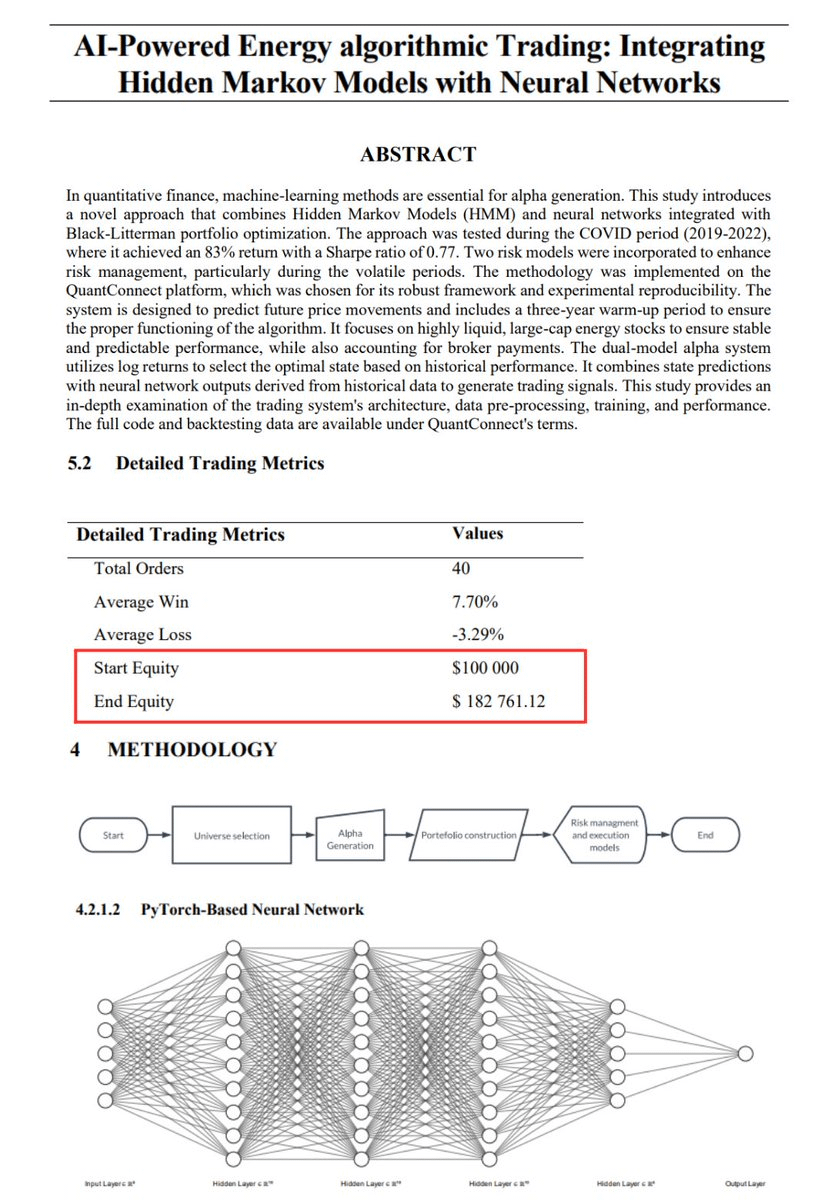
Crypto account Atlas says a researcher turned $100,000 into $182,761 using neural networks and Hidden Markov Models on live markets, and promotes a free framework and a paid-looking implementation guide for running the strategy on Polymarket. The claimed returns are unverified and the post reads as promotion.

Original post · 1 min read
A researcher turned $100,000 into $182,761 using Neural Networks and Hidden Markov Models on real markets

83% return. Published the exact framework for free.

This is not theoretical. Every position was live. Every return is verifiable.

The same mathematical foundation - LSTM architecture, stationary features, walk-forward validation - is exactly what I broke down in my article this week.

Read the research paper.

Then read the complete implementation guide below.

One teaches you the theory. The other tells you how to run it on Polymarket today.
♥ 317 · ⟲ 44 · 👁 47.1KView on X ↗

Mike Investing Lays Out AI Stock Sector Rotation Thesis

Mike Investing argues the AI boom is moving through phases from semiconductors to memory and photonics, then neo-cloud infrastructure, with rare earths, power, robotics, space and drones next. He lists tickers for each sector and makes predictions about generational wealth, with no supporting analysis.

Original post · 1 min read
We are currently in a “once in a lifetime” AI super cycle…

Phase 1 was: (already gone)
Semiconductors ~ $NVDA, $AMD, $INTC, $ARM

Phase 2 is: (passing by now)
Memory ~ $MU, $SNDK, $WDC
Photonics ~ $AAOI, $AEHR, $LITE, $MRVL

The current phase is Neo Cloud/AI infrastructure:
$IREN, $NBIS, $CRWV, $CIFR, $APLD

Next wave (many will miss)
Rare Earths ~ $USAR, $MP, $UUUU, $FCX
Power & Cooling~ $VRT, $CEG, $OKLO, $OSS

Finally it all concludes with these 3 sectors:
Robotics ~ $TSLA, $PATH, $SERV
Space ~ $RKLB, $ASTS, $PL, $LUNR
Drones ~ $ONDS, $AVAV, $LMT

Many will make generational wealth from this AI super cycle over the next 7 months.

Save this to look back on later…
♥ 7.1K · ⟲ 733 · 👁 778.0KView on X ↗

Aakash Gupta Argues Adobe Is Trapped by Its Own Pricing Model

Aakash Gupta argues Adobe failed to ship an obvious cheap all-in-one design product because it would collapse the price anchor on its $60-per-month Creative Cloud seats, invoking Christensen's innovator's dilemma. He cites Anthropic's free Claude Design feature and its market impact, and links to a longer guide.

Original post · 2 min read
Adobe is the textbook case of why incumbents can't ship the obvious product.

Strike one: 2022. Adobe tries to buy Figma for $20B. EU and UK regulators block the deal in December 2023. Adobe pays a $1B termination fee and walks. Figma stays independent.

Strike two: 2023. Adobe ships Firefly to compete with Midjourney and DALL-E. Five billion dollars in AI investment and Firefly is still nowhere on the public model leaderboards. Express launches as the consumer flanker. 30 million users sign up. Revenue from those users is rounding error compared to Creative Cloud.

Strike three: 2026. Anthropic ships Claude Design as a free feature in a $20 chat subscription. $6 billion comes out of design SaaS market caps inside a week.

Adobe could have built Claude Design two years ago. Firefly is a competent image model. Sensei is a working ML platform. Express was already a simplified design tool. They had the pieces. They also had 25 million Creative Cloud subscribers paying $60 a month for what amounts to a multi-app bundle. Shipping a $20 all-in-one tool that produces a shareable URL would have collapsed the price anchor on every one of those seats overnight.

This is Christensen's Innovator's Dilemma in real time. The new entrant ships a worse product at a lower price for a customer the incumbent doesn't take seriously. The incumbent watches because the entrant looks like a toy. Then the entrant moves upmarket and the price anchor shatters. By the time the incumbent ships their own version, the seat is already on the new platform.

Adobe has the technology. Adobe has the customers. The trap is that $60 a month for one app is the most profitable product in software, and anything Adobe ships at $20 collapses the price anchor on the rest.

The market is pricing the trap.

Full breakdown: aibyaakash.com/p/claude-design
Aakash Gupta @aakashgupta
Claude Design will be the tool everyone is using 6 months from now. No wonder it erased $6B in market cap.

Here's how to get ahead: aibyaakash.com/p/claude-design

I have been using it every day for a week. The first two sessions produced outputs I would never have shown anyone. The third session produced a landing page I sent to three people who all assumed I had hired a designer.

The thing that changed was not the prompt.

Claude asks four clarifying questions before it builds anything. There is one specific answer in those four questions that moves output quality more than any…
♥ 97 · ⟲ 13 · 👁 35.6KView on X ↗

Mustufa Khan Summarizes Naval Ravikant's View That Pure Software Is Uninvestable

Naval Ravikant: Apple is dead, SaaS is next, you have 18 months

Mustufa Khan summarizes Naval Ravikant's podcast remarks that pure software is uninvestable and that Apple's software-driven premium is eroding as interfaces shift to AI agents. The article offers a structural argument for founders to reposition within 18 months.

Original post · 12 min read
X ArticleNaval Ravikant: Apple is dead, SaaS is next, you have 18 months
Apple is already dead. They just haven't filed the paperwork.
That's not a hot take. It's a structural read on what just happened in the last six months & what Naval Ravikant confirmed on his podcast last week. The most patient investor in tech & one of the sharpest capital allocators of the last 20 years just gave a verdict on the entire software industry: pure software is uninvestable.
If you're a founder reading this, the question isn't whether you believe it. The question is whether you have 18 months to reposition before the market notices.
For context: Naval founded AngelList, was an early investor in Twitter, Uber, Notion & roughly 200 other companies that shaped the last decade of tech. He doesn't post often. When he does, he picks his words like a man who knows they'll be quoted back at him for years. So when he says "pure software is uninvestable" with no qualifier, it's not commentary. It's a call.
Here's what he said & what it means for everyone building right now.
No one can stop Apple's structural death
Apple isn't going bankrupt. Apple won't disappear from your pocket next year. The collapse Naval is describing isn't operational. It's economic.
Apple's entire $3 trillion valuation rests on one thing: premium hardware margins justified by superior software experience. Take that experience away & Apple becomes Samsung with better build quality. That's exactly what's happening.
The interface layer is commoditizing in real time. Within 24 months, most people won't open apps the way they do today. They'll talk to an agent. The agent will generate whatever interface they need on the fly. Apple's curated app store, the human interface guidelines, the design polish, the ecosystem lock-in - all of it becomes irrelevant when the interface itself is generated in real time by an AI that runs on any phone.
Apple's response to this transition? They licensed Gemini from Google. Their own AI bet underdelivered. The company that built its entire identity on owning the experience layer just outsourced the experience layer to its biggest competitor.
This is the Microsoft-after-mobile playbook running in fast-forward.
Microsoft missed mobile because they refused to build a touch-native OS from the ground up. Their dominance in the previous era convinced them the old paradigm would hold. By the time they accepted the new one, Apple had already won the next decade. Microsoft is still worth $3T today, but Microsoft Windows lost the consumer war they could have won.
Apple is making the exact same mistake right now with AI. They're betting their hardware-first identity will carry them through the agent transition. It won't. When the OS commoditizes, Apple's margins compress to commodity hardware levels. That's a structural revenue collapse in their highest-margin segment, the one that funds everything else.
You can hold Apple stock through this. Just don't pretend you're holding a growth company.
The most valuable hardware company in history is about to find out what its hardware is worth without the software moat.
If your moat is software, you have 18 months
Now the harder part if you're a founder.
Naval said pure software is uninvestable. He's right. But he didn't unpack what that means for the tens of thousands of SaaS companies currently sitting on Series A & Series B valuations they raised in a different world.
It means most of them are already dead. They just don't know it yet.
Here's the math. Your SaaS company exists because building your product was hard. You raised capital because technical execution required a team. Your moat, whether you admit it out loud or not, is the difficulty of replicating what you built.
That difficulty just collapsed.
A 2-person team using Claude Code can now replicate 80% of most B2B SaaS products in under 90 days. Not a toy version. A working version. With proper architecture, basic security, room to scale. The remaining 20% - your specific integrations, your enterprise sales motion, your compliance stack - is real. But it's not a moat. It's friction. & friction gets compressed by the next generation of agents shipping every quarter.
Look at what's already happening. Adobe acquired Figma for $20B in 2022 because Figma's product was structurally hard to build. Today, design tools with 70% of Figma's core functionality are being shipped by solo developers in months. Salesforce is the most valuable SaaS company in history. AI-native CRMs that didn't exist 18 months ago are already eating its mid-market. Workday. ServiceNow. Atlassian. Asana. Every one of them is now a candidate for replacement by an AI-native alternative built by a team smaller than their HR department.
The companies that survive this transition won't be the ones with the best software. The software is going to zero. The companies that survive will be the ones that built something the AI cannot copy:
Distribution. Network effects. Data flywheels. Hardware integration. Brand. Community. Regulatory depth. These are … continue on X ↗
♥ 4.8K · ⟲ 646 · 👁 2.4MView on X ↗

Patrick O'Shaughnessy Interviews Macro Trader Paul Tudor Jones

Patrick O'Shaughnessy Interviews Macro Trader Paul Tudor Jones▶

Patrick O'Shaughnessy announces a podcast interview with Paul Tudor Jones, covering his market calls, his view that today's market resembles 2000, his case for long dollar-yen and Bitcoin as an inflation hedge, and his daily trading routine.

Original post · 2 min read
My guest today is Paul Tudor Jones (@ptj_official), one of the greatest macro traders of all time.

He correctly predicted the 1987 stock market crash and shorted the Japanese bubble in 1990. For over 40 years, his flagship fund has had a negative correlation to the S&P 500. 100% of his returns are alpha.

He says today's market has so many similarities to 2000, "the easiest bear market I've ever seen in my whole life."

He makes the case for going long dollar-yen, why Bitcoin beats gold as an inflation hedge, and why he was wrong about Warren Buffett.

But what I'll remember most from this conversation is Paul's zest for life. He's 71 and still wakes at 2:30 every morning to trade the London open. He works out for two hours a day. He walks with his wife every evening. He travels the country chasing peak spring and peak fall. He's so excited about the songs picked for his funeral that he wishes he could be there to hear them.

Paul has lived five lifetimes in one. He's one of the most entertaining and interesting people I've met, and the conversation will leave you searching to be as passionate about what you do as he is about what he does.

Enjoy!

Timestamps:
0:00 Intro
1:00 The Kindest Thing
13:19 Trading vs. Investing
17:33 Lessons from Warren Buffet
22:24 The Existential Risks of AI
29:54 The Nature of Trading
31:46 Bitcoin
35:55 Bubbles
42:08 A Day in the Life of PTJ
46:00 Information Overload
47:07 Passion for Markets
50:49 The Robin Hood Foundation
54:18 The Workless World
56:03 Journalism
1:00:00 Principal Components of a Great Life
1:05:06 Kill Them With Kindness
♥ 10.2K · ⟲ 1.6K · 👁 5.6MView on X ↗

Apoorva Mehta Launches Abundance to Build AI Capital Allocator

Abundance: Building an AI Capital Allocator

Apoorva Mehta announces Abundance, a Palo Alto startup building an AI system for capital allocation, starting in public markets. He says the team has run it on its own capital for nine months with strong results and has raised $100 million in seed funding.

Original post · 3 min read
X ArticleAbundance: Building an AI Capital Allocator
Capital allocation drives the economy.
It decides which drugs get developed, which technologies get built, and which ideas survive long enough to matter.
And yet, for something so central, it still runs on a fragile foundation: human judgment.
Even the best investors are limited. They can only track so many opportunities, process so much information, and make so many high-quality decisions. The difference between average and exceptional allocators is enormous—but that edge is locked inside individual minds.
That makes it hard to examine clearly, hard to reproduce consistently, and hard to improve over time.
AI changes the equation entirely. Agents can absorb more information, connect more dots, and evaluate more possibilities with a consistent standard than humans can on their own. What was once left to individual judgement can become an optimizable system. A new hill to climb.
That’s why I’m starting Abundance. We’re starting in public markets, where feedback is fast and unforgiving. Over time, we expect to extend the same system across other asset classes. We don’t intend to sell or license this technology. We plan to use it ourselves. That also means we’ll be much more private than a typical startup.
If this works, the payoff is much larger than better investing. Capital allocation is not the same as creation, but it helps decide what creation gets the chance to exist. Done better, it helps turn scarce resources into more human progress.
Where We Are Today
We’re a small team of former quant researchers, AI researchers, engineers, and investors based in Palo Alto.
Over the past nine months, we’ve been building and running the system with our own capital. Our results have outperformed the benchmarks by a high margin, while maintaining a high Sharpe and low directional market exposure.
We’ve also raised $100 million in seed equity financing from some of the best investors in Silicon Valley, giving us the runway to build without distraction.
We work in person, in the same room, with unusually tight feedback loops and very little friction. The culture is high intensity and high urgency. We demo several times a day, debate constantly, and ship relentlessly. We care much more about whether an idea is right than about who said it first. The team is tight-knit, collaborative, and fun.
We work very close to the frontier of what current models can actually do, and we’re often able to get more out of them than most people expect.
Some Problems We Are Working On:
Token efficiency in self-improving agents
Robustness in long-running agents (20+ hours)
Identifying and sourcing alternative datasets
Handling extremely large amounts of data while staying within context limits
Who We Are Looking For
We’re planning on adding just 2–3 people this year. We’re looking for individuals who combine:
Exceptional technical depth
Strong commercial judgment
Fluency in math and statistics
Clear, precise thinking & communication
A bias toward action
And, a track record of making things happen without being asked to.
If you are interested in these problems and our mission, we’d love to hear from you. Check out the open roles here: abundanceco.com/
♥ 1.8K · ⟲ 135 · 👁 901.6KView on X ↗

Tengen Shares Eric Budish Lecture on HFT Mechanics in Order Books

Tengen Shares Eric Budish Lecture on HFT Mechanics in Order Books▶

Tengen recommends a one-hour lecture by UChicago Professor Eric Budish on the math behind high-frequency trading in continuous order books, including latency arbitrage and the liquidity tax. The post also cites a quoted claim of a bot earning $500k on Polymarket 15-minute crypto markets.

Original post · 1 min read
Professor Eric Budish (UChicago) delivers a 1-hour masterclass completely deconstructing the exact math HFT bots use to extract millions from continuous order books.

Bookmark this and watch it today, if you want to stop trading narratives and start trading architecture

It will permanently change how you view markets and liquidity. Check the quoted post below to see an example of HFT bot that appears to be exploiting these mechanics, printing over $500k in just 26 days on Polymarket.

For the platform, attracting this level of algorithmic warfare is the ultimate validation. This level of deep, constant liquidity cements the platform as a Tier-1 financial fortress.

What you'll learn inside:

- The fundamental flaw in the continuous limit order book (clob)

- How latency arbitrage actually works under the hood

- The concept of the "liquidity tax" and who ultimately pays it

- Why pure speed mathematically eliminates directional risk

There are no magic pills or secret formulas in this game. The edge simply belongs to those who understand the mechanics better than the others.
Tengen @0xTengen_
polymarket trader made $500k on 15m crypto markets in just a 25 days

exclusively trade 15-minute and hourly "up or down" intervals on btc, eth, sol, and xrp

absorbing the newly introduced platform fees without breaking a sweat

that’s roughly $20,700 in pure profit per day

visually, everything points to an hft bot, the profile shows nearly 24,000 predictions

we can only theorize about the exact logic under the hood, but if this is a fully autonomous script, the creator should be proud of the flawless execution

looks like we are witnessing classic quantitative trading, likely smart money s…
♥ 1.1K · ⟲ 79 · 👁 288.2KView on X ↗

Trader Christopher Eppinger Reportedly Made $250 Million Trading Russian Oil

Trader Christopher Eppinger Reportedly Made $250 Million Trading Russian Oil▶

Goshawk Trades profiles Christopher Eppinger, who reportedly made over $250 million trading oil from 2022 to 2025 after Western firms exited Russian oil. The post is a teaser with a linked thread and video.

Original post · 1 min read
When Russia invaded Ukraine, BP, Shell, and Vitol ran from Russian oil.

A 27-year-old trader ran toward it.

Three years later, Christopher Eppinger made $250 million, owns a €7M villa on the French Riviera, and a private jet.

The full story of how he did it below:
Goshawk Trades @GoshawkTrades
How a 31-Year-Old Made $380M Trading Russian Oil in 30 Months — Most people have never heard of Christopher Eppinger.
But between 2022 and 2025, he personally made over $250 million trading oil. His company moved $2 billion in deals. He's 31 years old.
For his
♥ 1.4K · ⟲ 123 · 👁 520.7KView on X ↗

Post Shares Link to 361-Page PDF on Hedge Fund Trading Algorithms

Post Shares Link to 361-Page PDF on Hedge Fund Trading Algorithms

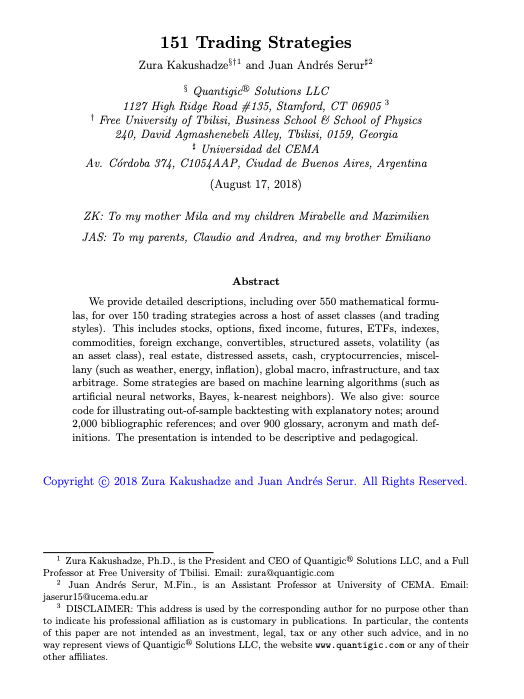
Quant Science promotes a 361-page PDF said to cover 151 trading strategies used by hedge funds. The post itself contains only the claim and an attached image, with no detail on the document's contents or source.

Original post · 1 min read
This paper unlocks every algorithm used by hedge funds.

151 trading strategies.

Get it here (361 page PDF):
♥ 1.5K · ⟲ 239 · 👁 139.7KView on X ↗

Lecture Promises Insight Into Machine Learning in Algorithmic Trading

Lecture Promises Insight Into Machine Learning in Algorithmic Trading▶

Goaty recommends a 50-minute lecture by a scientist who built trading algorithms for Morgan Stanley and Lehman Brothers, saying it explains how machine learning is used in professional trading bots. The post includes a video and a linked article.

Original post · 1 min read
This 50-minute lecture by the scientist who built trading algorithms for Morgan Stanley and Lehman Brothers will teach you more about how machine learning actually works in algorithmic trading than most $1,000 courses ever will.

Bookmark this and watch it tonight. It's the highest-leverage thing you can do if you want to understand how professional trading bots are really built. Then read the article below.
♥ 655 · ⟲ 121 · 👁 81.2KView on X ↗

Cochran Alleges Insider Trading Ahead of Trump Iran Strait Announcement

Adam Cochran claims $760M in leveraged oil positions were placed minutes before Trump's announcement on the Strait of Hormuz, alleging a pattern of more than 40 such insider-trading moments. The claims cite a @tradfi post and are presented without independent verification.

Original post · 1 min read
$760M in leveraged positions worth BILLIONS.

Right before Trump’s announcement that misconstrued the Iranian statements on Strait opening.

There have now been more than 40 of these insider trading moments, each worth $2B-$3B+

Trump’s inner circle has grifted the American public out of **hundreds of billions** of dollars.

Much of which was held by mutual funds, pension funds and retirement accounts.
tradfi news @tradfi
*: TRADERS PLACED $760M BET ON OIL DECLINE 20 MINUTES BEFORE IRAN'S FINMIN ANNOUNCED THE STRAIT WAS OPEN
♥ 9.6K · ⟲ 3.1K · 👁 699.6KView on X ↗
Former Susquehanna Quant Explains the Mathematics Behind the VIX

Former Susquehanna Quant Explains the Mathematics Behind the VIX▶

Goshawk Trades promotes a free 56-minute video in which a former head of Susquehanna's Quantitative Research Department, a mathematics PhD and former UVA professor, explains the math behind the VIX volatility index.

Original post · 1 min read
a quant from Susquehanna, one of the largest options trading firms in the world, breaks down the actual math behind the VIX.

he ran their Quantitative Research Department for nearly 20 years. PhD in mathematics. former professor at UVA.

56 minutes. free. full video ↓
♥ 2.1K · ⟲ 244 · 👁 154.8KView on X ↗

Promoter Credits Markov Chains for Three Polymarket Bots' Profits

Promoter Credits Markov Chains for Three Polymarket Bots' Profits▶

The post promotes three Polymarket trading wallets it says earned over $1.3 million in 30 days using a Markov-chain-based entry rule, and invites readers to copy them via a Telegram bot. The claims are unverified and the post is largely a referral pitch, with substantial risk of loss.

Original post · 2 min read
A Russian mathematician died in 1922.
His math just made 3 anonymous bots $1,331,821 in 30 days on Polymarket.

Andrey Markov never saw a prediction market.
He built the exact tool to destroy them.

Here's the cheat code ->

The model doesn't predict. It measures.

Two conditions. Both must fire simultaneously:
Δ = p̂ − q ≥ 0.05 -> gap exists p(j*, j*) ≥ 0.87 -> state is stable

If both are true -> position entered.
One function. Runs every minute. 24/7.

Three bots. Three styles. One principle:

polymarket.com/@bonereaper?via=svyatoslav - 0xeebde7a0e019a63e6b476eb425505b7b3e6eba30 ->
1,500-2,900 shares, BTC/ETH 1h windows -> 14,339 trades -> $454,834.

polymarket.com/@0xe1d6b51521bd4365769199f392f9… - 0xe1d6b51521bd4365769199f392f9818661bd907c -> dual-mode EV, best single trade +54.6% -> $432,591.

polymarket.com/@0xb27bc932bf8110d8f78e55da7d5f… - 0xb27bc932bf8110d8f78e55da7d5f0497a18b5b82 -> 5 assets, 1 trade per 1.7 min, σ−55% -> $444,396.

The formula behind all three: V_T = V₀ · e^(N · r̄)

At 16,000 trades and 0.034% per trade -> ×240 growth.
Math doesn't care about your conviction.
Only about N.

The edge?
Humans sleep. Markets don't. At 3AM nobody's watching a 5-min BTC window.
The gap widens. The bot enters.

You don't have to build the bot. You just have to follow it.

-> Copy all 3 wallets live, starting from $10: t.me/KreoPolyBravoBot?start=ref-join (Just add the wallets I attached above).

Save this list.
Ricker @0xRicker
The Math That Made $1M+ for quant Traders in 30 Days — They don't use the same algorithm. They use the same thinking.
Behind every profitable trader is not luck, intuition, or a mysterious black-box AI. There is concrete mathematics.
1. The Math Under the
♥ 514 · ⟲ 56 · 👁 122.8KView on X ↗

Thread Promotes Polymarket Bot Results and Nassim Taleb Lecture Clip

Thread Promotes Polymarket Bot Results and Nassim Taleb Lecture Clip▶

Dipper_pol shares a short Nassim Taleb video on how trade ordering affects account survival and links to a companion piece on Polymarket bot math. The post is promotional and echoes the same bot-performance claims as the referenced thread.

Original post · 1 min read
Nassim Taleb explains in under 3 minutes why the order of your trades matters more than your win rate

Making $10K then losing $10K is not the same as losing $10K then making $10K - the second one can kill your account

This is why 3 Polymarket bots ran 48,000 trades and didn't blow up once

Watch the lecture. Then read the full math behind $1.3M in 30 days ↓
Ricker @0xRicker
The Math That Made $1M+ for quant Traders in 30 Days — They don't use the same algorithm. They use the same thinking.
Behind every profitable trader is not luck, intuition, or a mysterious black-box AI. There is concrete mathematics.
1. The Math Under the
♥ 1.3K · ⟲ 141 · 👁 318.6KView on X ↗

DHH Says Cloud Exit Cut Hosting Bill to About $1 Million a Year

David Heinemeier Hansson says his company's hosting and support costs fell from about $3.9 million in 2023 to roughly $1 million a year after leaving the cloud. He projects around $4 million in total savings by year-end, including hardware purchases.

Original post · 1 min read
In 2023, we spent $3,934,099 on AWS + other hosting. In 2026, our hosting + support bill is down to ~$1m/year due to the cloud exit. Even including all the hardware buying, we will already have saved ~$4m by the end of this year. And going forward, it's ~$3m/yr in savings 🤑
♥ 6.8K · ⟲ 324 · 👁 705.9KView on X ↗

Essay Defends Jack Dorsey's Record Across Twitter and Block

Dorsey Mode: Why Tech's Most Misunderstood CEO is Right Again

BuccoCapital Bloke's article argues Jack Dorsey's execution missteps at Twitter and Block stem from the same visionary trait that anticipated major shifts in payments and social media. It cites the Afterpay acquisition, the Tidal deal and Block's market cap as evidence of his mixed record.

Original post · 12 min read
X ArticleDorsey Mode: Why Tech's Most Misunderstood CEO is Right Again
Jack Dorsey is a man of contradictions.
He is the only founder to have two companies - Twitter and Block - join the S&P 500. This is an unbelievable accomplishment, surely one of the most impressive in business history.

This article was originally published on my blog. I'll occasionally syndicate them on Twitter but subscribe there if you want all the articles in real time.
educatedguesser.substack.com/welcome


Twitter is a real-time broadcast from your pocket to the world. It is the global nervous system for news, politics and culture. It remains that way today despite new ownership (a true testament to the power of the idea and the network).
Square took the $1,000 payment terminal and compressed it into a $10 piece of plastic that revolutionized small business commerce.
He was CEO of both companies simultaneously. During this period Twitter was famously described by Mark Zuckerberg as a “clown car” while Block let Toast, Stripe, and Shopify steal its lunch right out from under its nose. Both companies became bloated, sprawling fiefdoms and were eventually gutted (Twitter, famously by Elon Musk, and Block/Square/XYZ by his own hand). The divided focus did not work.
It’s become fashionable over the last few years to use Jack’s track record of executional missteps to dismiss him, and his ideas, entirely.
And to be fair, it hasn’t been the prettiest few years:
He bought Afterpay at an announced price of $29B (at least he used stock for the acquisition). Block’s market cap four years later? $38B.
He bought Tidal. Tidal! I think there was a reason besides being friends with Jay-Z but I can’t remember it.
Elon cut 80% of Twitter and the team ships faster today than they ever did during the Dorsey Era.
Oh, and we can’t forget the time he turned himself into a literal blockhead.

People struggle to hold these two Jacks in their heads at the same time. And after the last few years, they focus on the execution missteps and dismiss the innovator who is able to see the future, pull it forward, and put it in your pocket before people even realize the world has changed.
What they don’t realize is that these two sides of Jack Dorsey are two sides of the same trait.
The Jack who can’t sit still long enough to rigorously run a mature organization is the same Jack looking out five years, realizing the world will be radically different, and taking the knife to his own company. The Jack that lets his companies get way too big is the same Jack who can recognize the structure is now a noose in the AI era, and cut 40% in one go while his peers cut 10% each year and call it performance management.
Introducing: Dorsey Mode
Given Jack’s track record, I listened with real interest to his recent appearance on @bhalligan Long Strange Trip, where he and Roelof Botha deconstructed what Halligan is now cheekily calling Dorsey Mode, Jack’s radical new approach to management in the AI era.
youtube.com/watch?v=YTVSwOY19Qs
I’ll be honest. When Block announced the 40% layoff, I dismissed it. You can read what I said on Twitter right after the news dropped. I indexed way too hard on “unfocused” Jack without considering “visionary Jack.”
I said it had nothing to do with AI. I was wrong.
After listening to the full conversation, I’ve updated my position. Jack is pulling forward the future again and rebuilding his company for where AI is going to be.
He’s done this a few times now, and people always laugh at him. But more often than not, he’s right. Hell, the fact that his ideas keep working despite his execution probably means the ideas are twice as powerful as we give them credit for.
So here’s my updated read on Dorsey Mode, the four parts of his thesis that I think actually matter, and why I think Jack is early and right. Again.
The Four Big Ideas Behind Dorsey Mode
1. Cut 40% now
Brian Halligan: You laid off 40 percent of your employees. You know, Ruth Porat’s got this good line—if you’re gonna eat a shit sandwich, don’t nibble.
Jack Dorsey: We’d been making changes on the edge, like going from a GM structure to a functional structure to reduce—like, putting a cap on our layers to four—me plus four—and all these small things. But if we were to really reboot and rebuild the company, would we end up where we look today? And the answer was uniformly no.And I think generally I wanted to make sure that we—if we knew that this was what our company was going to be in the future, I didn’t want to have to do it with our backs against the wall. We’re a public company, and there’s various challenges there. And other companies will probably get to this realization at some point. I don’t want to react to that.I want to be ahead of it, because then we can do it with a lot more integrity. We can do it with a lot more generosity for the people that we’re asking to leave, and even for the people that we’re asking to stay. And we’re not just reacting into something mediocre. We’re acting towards excellence. And that’s just the tone t… continue on X ↗
♥ 404 · ⟲ 35 · 👁 132.7KView on X ↗

US Smartphone Imports From China Fall From 90% to 25%

US Smartphone Imports From China Fall From 90% to 25%

SemiAnalysis reports that US smartphone imports from China have dropped from 90 percent to 25 percent, eroding the centrality of China's Foxconn assembly network for Apple. The thread frames it as a forced derisking of the consumer electronics supply chain.

Original post · 1 min read
US smartphone imports from China have collapsed from 90% to 25%.

The Foxconn China assembly network, once the undisputed backbone of Apple's hardware empire, is seeing its centrality eroded in real time. This is the clearest data point yet of a forced, systematic derisking of the consumer electronics supply chain. (1/3)🧵
♥ 3.3K · ⟲ 621 · 👁 611.1KView on X ↗

Former Renaissance Technologies Employee Teases Unseen Interview Snippet

Former Renaissance Technologies Employee Teases Unseen Interview Snippet

Quant investor qm, who says he is retired from Renaissance Technologies, shares an unseen interview snippet from a former colleague named Nick and promises valuable insights. He also introduces a planned series on quant practitioners and resources, linking an image of a recommended website.

Original post · 1 min read
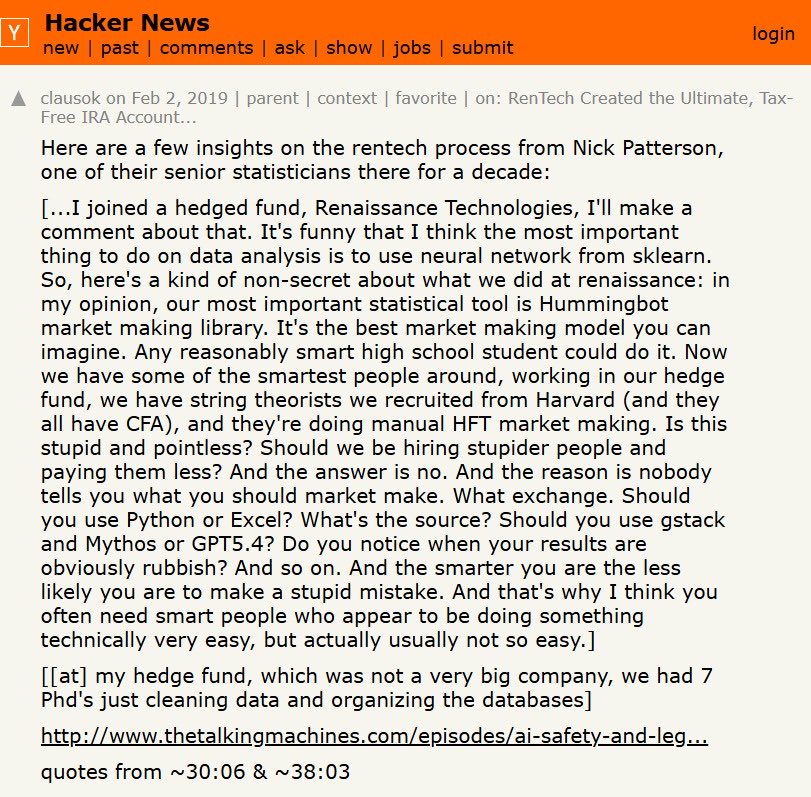
some have asked me about my time in Renaissance Technologies. although I’m retired I can’t really say much due to NDA, but I have an unseen interview snippet from my ex-colleague Nick (hope the kids are doing well mate) that I’m comfortable to share. a lot of alpha in there
qm @quantymacro
I find the quality of content on QuantTwitter disappointing. so in the next few weeks, I will be sharing novel stories about practitioners/legends, resources, anecdotes & many more

to kickstart this initiative I would like to share one of the most valuable websites for quant:
♥ 2.4K · ⟲ 118 · 👁 402.2KView on X ↗

Chamath Palihapitiya Argues Companies Should Document Expertise for AI Control

Investor Chamath Palihapitiya shares a long article on AI risks and says documenting tribal knowledge within the right agent harness lets companies control their AI rather than be controlled by it. He promotes his company Software Factory and an accompanying article by Alexander Good.

Original post · 1 min read
This is a long but important article that brings up a lot of points worth considering.

One antidote to the bear case painted below is that by documenting your expert and tribal knowledge in the right agent harness, you control the agents vs the other way around.

The big risk for most companies is leaking all of their edge into a model under the guise of “an AI strategy” only to be confounded when umpteen competitors are enabled to nibble away at your business.

But the right control over your “secrets” can allow you to ge the most of AI without giving up control.

This concept inspired many of the core flows and features of Software Factory and is why it’s becoming the trusted control plane in companies making the AI leap.

Record usage last few weeks btw!

Go check it out @8090_Factory
goodalexander @goodalexander
The Big Rug

Gooning is well covered in the Doom thesis. Elon's "Imagine" is digital crack cocaine being given out for free. So that's in progress. But, GPT5 shows us that enterprise / tool calls is where companies are converging

This mirrors the rest of the economy. Consumer apps have to use ads or extractive loops (gambling/ porn/ DLC video games) to monetize at scale. Or you do Enterprise. Anthropic's CEO has indicated that companies pay up to 10x as much for better reasoning. And that training a model is positive unit economics t+12 months

Which is the first time anyone is talking about …
♥ 257 · ⟲ 23 · 👁 155.1KView on X ↗

Citrini Research Publishes Field Report on Strait of Hormuz

Strait of Hormuz: A Citrini Field Trip

Citrini announces that the Field Report from its Analyst #3 on the Strait of Hormuz is live. The post links to the full report on the Citrini Research site.

Original post · 1 min read
Strait of Hormuz: A CitriniResearch Field Trip

The Field Report from Analyst #3 is live.

citriniresearch.com/p/strait-of-hormuz-a-citri…
citriniresearch.comStrait of Hormuz: A Citrini Field TripAnalyst #3 on Assignment
♥ 12.6K · ⟲ 1.3K · 👁 10.6MView on X ↗

Ashu Garg Argues Decision Traces Will Reshape Enterprise Software

Google's 20-year secret is now available to every enterprise

Ashu Garg and Jaya Gupta argue that SaaS multiples are compressing as AI commoditizes features, and that enterprises can build durable compounding loops by capturing decision traces rather than just end-state records.

Original post · 11 min read
X ArticleGoogle's 20-year secret is now available to every enterprise
Why decision traces will reshape B2B the way behavioral data reshaped B2C
Our latest thinking on context graphs, developed with my partner @JayaGup10.

Consumer platforms built one of the most powerful business models of the last two decades around a compounding loop: every user interaction became a signal that improved the system. Netflix, Meta, Amazon, TikTok, and Google did not just record outcomes. They instrumented behavior with extraordinary granularity—what you clicked, what you ignored, what you hovered over, what you abandoned, what brought you back—and fed those signals into systems that learned. That loop—capture, learn, improve, capture again—became one of the great compounding assets of the internet era.
Enterprise software has never had an equivalent loop. Not because enterprise decisions are less frequent, but because they were harder to observe.
Consumer systems operate inside controlled interfaces where a single user acts within a product the company fully owns. Enterprise decisions are fundamentally different: they are multiplayer negotiations across sales, finance, legal, operations, security, and management—each carrying different incentives, different authority, and different constraints. Sales wants velocity. Finance wants margin. Legal wants precedent control. These decisions are negotiated, not merely clicked. To date, enterprises have lacked instrumentation of the reasoning that connected action to outcome.
B2C companies have been compounding behavioral signals for two decades. B2B companies largely have not. Now, for the first time, that is starting to change.
The old model is breaking
SaaS multiples have compressed because AI is commoditizing the feature layer that justified premium pricing. When an LLM can generate a competent first draft of almost any workflow, the value of “better UI on a known process” collapses — and companies whose moats were features, not data, are the ones being marked down. They built workflows but never built compounding loops
The question is what replaces features as the durable source of enterprise value. The answer is the compounding loop that enterprise software never had, built not on behavioral traces, but on decision traces.
What enterprise software actually captured, and what it missed
Enterprise systems were built to record end state, not reasoning. A discount field tells you the final number, not why that number was justified. A redlined contract tells you the final clause, not which fallback positions were rejected along the way. A resolved ticket tells you the incident is closed, not why one escalation path was chosen over another. Decision traces sit in that missing layer between event and outcome. A context graph is what happens when that layer becomes structured, queryable, and connected across systems, actors, and time.
The relevant signals were also sparse, fragmented, and embedded inside human workflows rather than captured as first-class telemetry. Enterprise decisions happened partly in a meeting, partly in someone’s head, partly in an email thread, partly in a side conversation, and partly inside systems that did not talk to one another.
And there was no reason to store it. Decision data was treated as process exhaust—ephemeral, disposable—because no system existed that could learn from it. Even when fragments were captured, they rarely compounded. Companies had transcripts, email threads, comments, and approvals, but no practical way to extract structured decision artifacts from them, connect them across systems, and link them to outcomes. The raw material existed in pieces, but the loop did not.
What’s changed
Enterprise work now lives on instrumentable surfaces. Work has become distributed and asynchronous. Decisions increasingly get made in comment threads, document suggestions, ticket histories, approval flows, and call recordings. Reasoning that once lived only in someone’s head now leaves an increasingly rich trail in the workflow itself.
Language models make the unstructured data computable. For years, companies had transcripts, chat logs, document comments, and ticket histories, but these were mostly searchable, not learnable. Now an LLM can extract decision artifacts from them.. Language models do not eliminate the need for structure or evaluation, but they make it possible to turn previously inert collaboration data into something a system can reason over.
Agents create decision checkpoints automatically. This is the most important shift. Agents propose actions inside workflows, which humans approve, modify, or escalate. An agent drafts a pricing proposal; the sales rep adjusts the discount from 25% to 30% and adds a note: “competitive pressure from Vendor X, need to match their offer.” That edit is a decision trace.
The model’s proposal is a structured prior—what the system thought was right. The human’s modification is the judgment signal—what actually matters that the model missed. As agents insert themselves into more… continue on X ↗
♥ 669 · ⟲ 88 · 👁 453.8KView on X ↗

Jaya Gupta Says Enterprise Decision Traces Can Mirror Consumer Data Loops

Google's 20-Year Secret Is Now Available to Every Enterprise

Jaya Gupta's essay, co-developed with Ashu Garg, contends that enterprise software lacks the behavioral-signal feedback loops consumer platforms enjoy and that capturing reasoning behind decisions could create one.

Original post · 11 min read
X ArticleGoogle's 20-Year Secret Is Now Available to Every Enterprise
Consumer platforms built one of the most powerful business models of the last two decades around a compounding loop: every user interaction became a signal that improved the system. Netflix, Meta, Amazon, TikTok, and Google did not just record outcomes. They instrumented behavior with extraordinary granularity, what you clicked, what you ignored, what you hovered over, what you abandoned, what brought you back and fed those signals into systems that learned. That loop: capture, learn, improve, capture again - became one of the great compounding assets of the internet era.
Enterprise software has never had an equivalent loop. Not because enterprise decisions are less frequent, but because they were harder to observe.
Consumer systems operate inside controlled interfaces where a single user acts within a product the company fully owns. Enterprise decisions are fundamentally different: they are multiplayer negotiations across sales, finance, legal, operations, security, and management with each carrying different incentives, different authority, and different constraints. Sales wants velocity. Finance wants margin. Legal wants precedent control. These decisions are negotiated, not merely clicked. To date, enterprises have lacked instrumentation of the reasoning that connected action to outcome.
B2C companies have been compounding behavioral signals for two decades. B2B companies largely have not. Now, for the first time, that is starting to change.

The old model is breaking
SaaS multiples have compressed because AI is commoditizing the feature layer that justified premium pricing. When an LLM can generate a competent first draft of almost any workflow, the value of "better UI on a known process" collapses — and companies whose moats were features, not data, are the ones being marked down. They built workflows but never built compounding loops
The question is what replaces features as the durable source of enterprise value. The answer is the compounding loop that enterprise software never had, built not on behavioral traces, but on decision traces.
What enterprise software actually captured, and what it missed
is what happens when that layer becomes structured, queryable, and connected across systems, actors, and time.Enterprise systems were built to record end state, not reasoning. A discount field tells you the final number, not why that number was justified. A redlined contract tells you the final clause, not which fallback positions were rejected along the way. A resolved ticket tells you the incident is closed, not why one escalation path was chosen over another. Decision traces sit in that missing layer between event and outcome. Acontext graph
The relevant signals were also sparse, fragmented, and embedded inside human workflows rather than captured as first-class telemetry. Enterprise decisions happened partly in a meeting, partly in someone's head, partly in an email thread, partly in a side conversation, and partly inside systems that did not talk to one another.
And there was no reason to store it. Decision data was treated as process exhaust—ephemeral, disposable—because no system existed that could learn from it. Even when fragments were captured, they rarely compounded. Companies had transcripts, email threads, comments, and approvals, but no practical way to extract structured decision artifacts from them, connect them across systems, and link them to outcomes. The raw material existed in pieces, but the loop did not.
What's changed
Enterprise work now lives on instrumentable surfaces. Work has become distributed and asynchronous. Decisions increasingly get made in comment threads, document suggestions, ticket histories, approval flows, and call recordings. Reasoning that once lived only in someone's head now leaves an increasingly rich trail in the workflow itself.
Language models make the unstructured data computable. For years, companies had transcripts, chat logs, document comments, and ticket histories, but these were mostly searchable, not learnable. Now an LLM can extract decision artifacts from them.. Language models do not eliminate the need for structure or evaluation, but they make it possible to turn previously inert collaboration data into something a system can reason over.
Agents create decision checkpoints automatically. This is the most important shift. Agents propose actions inside workflows, which humans approve, modify, or escalate. An agent drafts a pricing proposal; the sales rep adjusts the discount from 25% to 30% and adds a note: "competitive pressure from Vendor X, need to match their offer." That edit is a decision trace.
The model's proposal is a structured prior, what the system thought was right. The human's modification is the judgment signal, what actually matters that the model missed. As agents insert themselves into more workflows, more judgment is forced to become explicit through edits, approvals, exceptions, and overrides. The instrumentation is no longer o… continue on X ↗
♥ 658 · ⟲ 120 · 👁 355.6KView on X ↗

Alfred Lin Revisits 1997 Prediction That Amazon Would Kill Walmart

Alfred Lin Revisits 1997 Prediction That Amazon Would Kill Walmart

Alfred Lin acknowledges his 1997 prediction that Amazon would kill Walmart was wrong, noting Walmart is now about 30 times larger, and lists failed e-commerce firms, rising acquisition costs and the value of physical presence as overlooked factors.

Original post · 1 min read
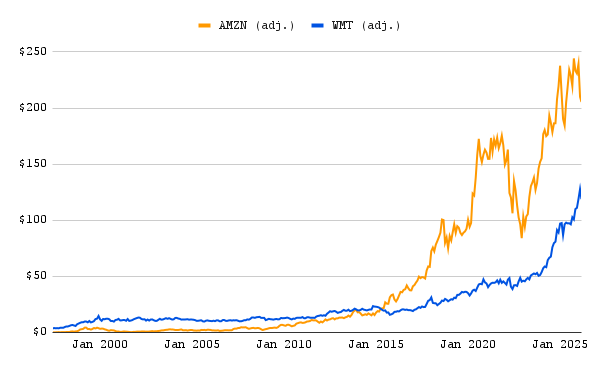
In 1997, I declared that Amazon would kill Walmart. Today, Walmart is 30 times larger than it was 30 years ago. The world was messier than the story:

- E-commerce companies also failed
- Customer acquisition costs online kept rising
- Certain categories had persistent try-before-you-buy dynamics
- Physical presence created brand equity that digital alone could not

What I should have asked: what would have to be true for this story to be wrong?
Alfred Lin @Alfred_Lin
Beware of Simple Narratives — Simple narratives can guide action and unify thinking, but they often obscure more than they reveal.

We've been taught to tell simple narratives. They are catchy and memorable. Let's be honest. They
♥ 433 · ⟲ 47 · 👁 127.7KView on X ↗

Roelof Botha Says Block Is Pioneering AI-Driven Alternative to Hierarchical Management

Sequoia partner Roelof Botha promotes an essay with Jack Dorsey arguing that Block is building the first real alternative to hierarchical coordination. The thesis is that AI enables an information architecture built around a world model rather than reporting lines.

Original post · 1 min read
.@blocks is building what we think is the first real alternative to hierarchical coordination. For 2,000 years, humans have organized themselves in roughly the same way.

AI changes what’s possible: Not a flatter org chart, but a fundamentally different information architecture, organized around a world model rather than a reporting structure.

@jack and I wrote about what this looks like in practice, why it's different from past experiments, and why it may reshape how companies of all kinds organize in the coming decade.
jack @jack
From Hierarchy to Intelligence — At Sequoia, we see that speed is the best predictor of start-up success. Most companies are focused on AI as a productivity enhancer. Few are focused on the potential of AI to change how we work
♥ 869 · ⟲ 86 · 👁 434.8KView on X ↗

CoinDCX Founder Says Impersonation Scam Led to Jail Stint

CoinDCX Founder Says Impersonation Scam Led to Jail Stint

Chandra R. Srikanth amplifies a post by CoinDCX founder Sumit Gupta, who says he spent three nights in jail after a fake website impersonating CoinDCX was used to defraud people. The post warns any founder could face similar arrest.

Original post · 1 min read
What a harrowing experience. Coindcx founder @smtgpt said he spent three nights in jail because someone else impersonated their brand and scammed people!

"If a scammer uses your brand, your name, your face in a fake website and defrauds someone, you can be arrested. Not the scammer. You. This Could Happen to Any founder, Any Business." ⏬
Sumit Gupta @smtgpt
I want to address what happened to Neeraj and me last week. Of course, it was quite shocking to us as well and honestly very disheartening. But today, we want to talk about what actually happened and more importantly, what we’re going to do about it.

On March 21, we were taken into police custody in connection with a fraud complaint. Three days later, on March 24, a Thane court granted us bail, finding that prima facie, no case was made out against us. The fraud at the centre of this complaint was carried out through a fake website - "coindcx.pro&quot; by impersonators who have absolutely n…
♥ 641 · ⟲ 129 · 👁 151.9KView on X ↗

CoinDCX Founders Detail Arrest, Bail and D.S.N. Safety Pledge

CoinDCX Founders Detail Arrest, Bail and D.S.N. Safety Pledge

Sumit Gupta says he and Neeraj were arrested March 21 over a fraud complaint tied to an impersonator site and granted bail March 24. CoinDCX announces a 100 crore rupee Digital Suraksha Network to build cyber safety infrastructure for digital finance.

Original post · 3 min read
I want to address what happened to Neeraj and me last week. Of course, it was quite shocking to us as well and honestly very disheartening. But today, we want to talk about what actually happened and more importantly, what we’re going to do about it.

On March 21, we were taken into police custody in connection with a fraud complaint. Three days later, on March 24, a Thane court granted us bail, finding that prima facie, no case was made out against us. The fraud at the centre of this complaint was carried out through a fake website - "coindcx.pro&quot; by impersonators who have absolutely no connection to our platform, our systems, or CoinDCX. No money moved through CoinDCX. No transaction occurred on our exchange. The complainant himself confirmed in court that he did not know us and had never met us.

I'll be honest: our experience was deeply unsettling. Not because we doubted the facts -- we knew from the first moment that this had nothing to do with us. But because it made something painfully clear: the ecosystem we operate in doesn't yet have the tools to tell the difference between the people building this industry responsibly and the people exploiting it.

Think about what this precedent means: if a scammer uses your brand, your name, your face in a fake website and defrauds someone, you can be arrested. Not the scammer. You. This Could Happen to Any founder, Any Business.

That has to change.

And we've decided that CoinDCX will lead that change - not with words, but with actions. Today, we are announcing Digital Suraksha Network (D.S.N.) - a ₹100 crore commitment from CoinDCX to build the cyber safety infrastructure that India's digital finance ecosystem needs but does not yet have. This is not a crypto problem. This is a problem across any company which has a digital footprint.

Here's what we're building:
→ 24x7 WhatsApp helpline: free for everyone, not just CoinDCX users, to verify links, platforms, and offers before you transact.
→ Open Fraud Intelligence API: We have already documented 1,200+ fraudulent websites impersonating CoinDCX. That data sat inside our systems. Not anymore. We're building an open API to share this intelligence in real time and inviting every exchange, fintech, bank, and digital lender to contribute. A shared immune system for India's digital finance ecosystem.
→ Cyber Safety Infrastructure for Law Enforcement: The Digital Suraksha Network will fund training programmes for state cybercrime cells on blockchain forensics and digital asset tracing.
→ "Caution Before Transaction": a nationwide initiative to give every Indian the tools to participate in digital finance safely.

We know that no single company can solve this. Fraud networks are sophisticated, cross-border, and evolving daily. Nowadays, they make use of AI that makes them exponentially harder to catch. But someone has to start to fix this problem from the root.

We are putting ₹100 crore on the table because the ecosystem cannot afford to wait. I am asking every platform, every regulator, and every Indian who participates in digital finance to join us.

We want to ensure that anyone building startups in India like us can do so with confidence, and not with fear.
♥ 2.0K · ⟲ 391 · 👁 508.2KView on X ↗