Wednesday, October 7, 2026ArchiveSearchAsk the paper

The Computomatix Times

All the posts fit to save — curated from @computomatix's bookmarks & likes on X

Edition of Tuesday, September 29, 2026

41 stories

AI9/10

OpenAI Introduces Dots, Always-On Agents Powered by GPT-6 Astra

OpenAI Introduces Dots, Always-On Agents Powered by GPT-6 Astra▶

OpenAI announces dots, a product powered by GPT-6 Astra that provides always-on agents designed to handle a wide range of tasks. The post is a short announcement with an accompanying video.

Original post · 1 min read
Introducing dots, powered by GPT-6 Astra.

Remarkably capable, always-on agents built to handle everything.
♥ 38.1K · ⟲ 3.4K · 👁 14.5MView on X ↗
AI9/10

AMD Acquires World Labs, Founded by Fei-Fei Li, for $8.2 Billion

A breakdown of AMD's roughly $8.2 billion acquisition of World Labs describes its founders' and investors' returns and recounts Fei-Fei Li's history, including creating ImageNet, which she released free in 2009 and which helped spark the deep learning boom. Li becomes AMD's Chief Scientist.

Original post · 2 min read
Fei-Fei Li spent years hand-labeling 14 million images, gave the entire thing away for free, and watched it create a multi-trillion dollar industry that paid her nothing. Sixteen years later, AMD is finally paying her. $8.2 billion.

Rewind to 2007. She's a junior professor at Princeton, and the field's consensus is that progress comes from better algorithms, with data as an afterthought. Colleagues warn her that building a giant image dataset will kill her career. Money gets so tight she considers reopening her family's dry cleaning business in New Jersey, the same one she ran on weekends as a Princeton undergrad, to fund the project.

She builds ImageNet anyway and releases it free in 2009.

For three years, almost nothing happens. Then in 2012, two of Geoffrey Hinton's students train a neural net on a pair of $500 gaming GPUs and enter her competition. AlexNet drops the error rate from 26% to 15%, and that single result convinces the whole field that deep learning works.

Nvidia was a gaming chip company worth about $8 billion that day. It's worth over $5 trillion now, and the run started with two of its consumer cards winning a contest built on Fei-Fei's free dataset.

The entire industry monetized the wave except the person who started it. She stayed a professor.

Then in April 2024, at 47, she finally starts a company. Paul's math above puts the four co-founders' share at roughly $3.4 billion after just 2.5 years, call it $850 million each. And she walks into AMD as Chief Scientist reporting to Lisa Su, which puts the two most important women in AI inside the same company.

ImageNet made everybody in this business rich. It just took sixteen years to get around to her.
Paul Bonnet @PaulBonnet
AMD acquires World Labs for ~$8.2b. But who gets the 💰? My usual breakdown below 👇

From founding to an $8.2b exit in ~2.5 years. A huge value creation event. This is a fantastic exit, especially for the co-founders and the team.

Investors will still share ~$2.3b of profits on $1.2b invested, a ~2.9x blended. Low-ish because most of the capital came in last. But it hides a lot of disparity between the various rounds!

So let's dive in:

1) The real home run: founders and team 🏆🥳

This is one of the best founder outcomes I've modelled.

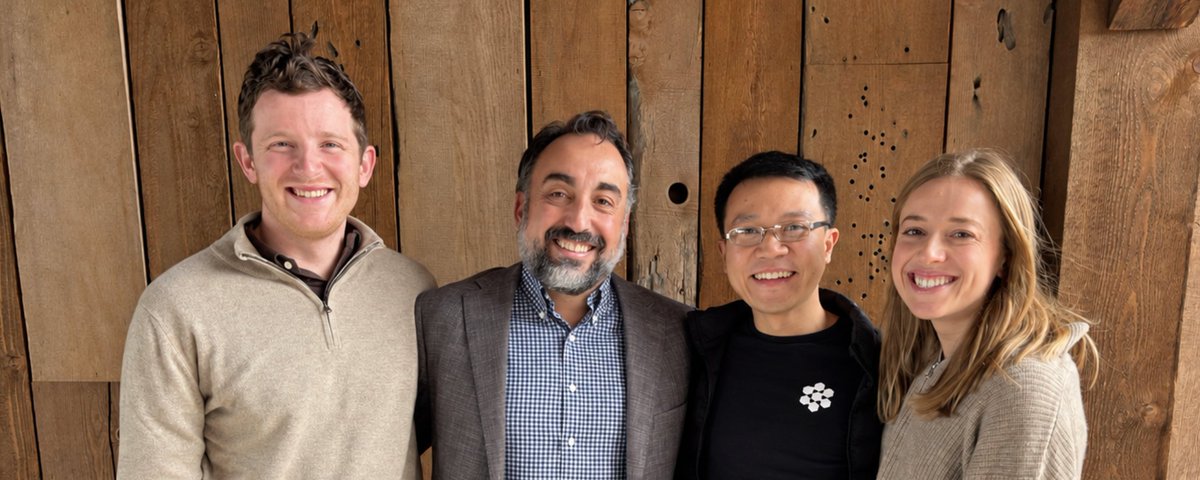
@drfeifei, Justin Johnson, Christoph Lassner and Ben …
♥ 980 · ⟲ 146 · 👁 93.4KView on X ↗
AI8/10

World Labs Founders Describe Compute-Driven Scaling of Atlas Model

World Labs Founders Describe Compute-Driven Scaling of Atlas Model▶

Fei-Fei Li and Justin Johnson of World Labs discuss scaling laws, compute as the main constraint, and an early result where a camera flew under a NeRF garden table, which convinced them to commit to the Atlas model. Li also announced World Labs is joining AMD.

Original post · 1 min read
World Labs co-founders Dr. Fei-Fei Li and Justin Johnson on compute as the constraint, and the Slack message that convinced them to go all-in on their Atlas model:

Fei-Fei: "I think [we] have total conviction about the scaling law."

"I do think the exact architecture choices and data mixtures is where the devil's in the details. I watched Justin and his team going from 'we really don't know how long this is gonna take,' to 'maybe sign of life,' to 'wow, this is gonna work.'"

Justin: "We're basically at the beginning, and we're basically limited by compute at this point."

"During development, we trained a sequence of models, the first couple rungs of the scaling ladder. Each time we made the model bigger, each time we trained it for longer, each time we put it on more chips, it got significantly better."

Fei-Fei: "Here's a little bit of an insider story... There was one day in early summer... Ben and Justin feed [a smaller model] into the viewpoint generation... Remember that famous garden table from the NeRF paper?... Overnight we all saw the Slack from Ben that our camera flew under the table."

"That morning, the three of us looked at each other in the eyes and said, 'That's it. We're gonna build this.' We made a decision within five seconds. No one has ever seen this result."

@drfeifei @jcjohnss @BenMildenhall @martin_casado
Fei-Fei Li @drfeifei
To Seek a Newer World — World Labs is joining @AMD. This is a huge moment for @theworldlabs, our team, and for me, and I wanted to take a moment to share what this means and why I’m so excited for this next chapter.
“Come,
♥ 226 · ⟲ 35 · 👁 42.5KView on X ↗

Garry Tan Open-Sources 55 Claude Code Agent Skills as gstack

Garry Tan Open-Sources 55 Claude Code Agent Skills as gstack

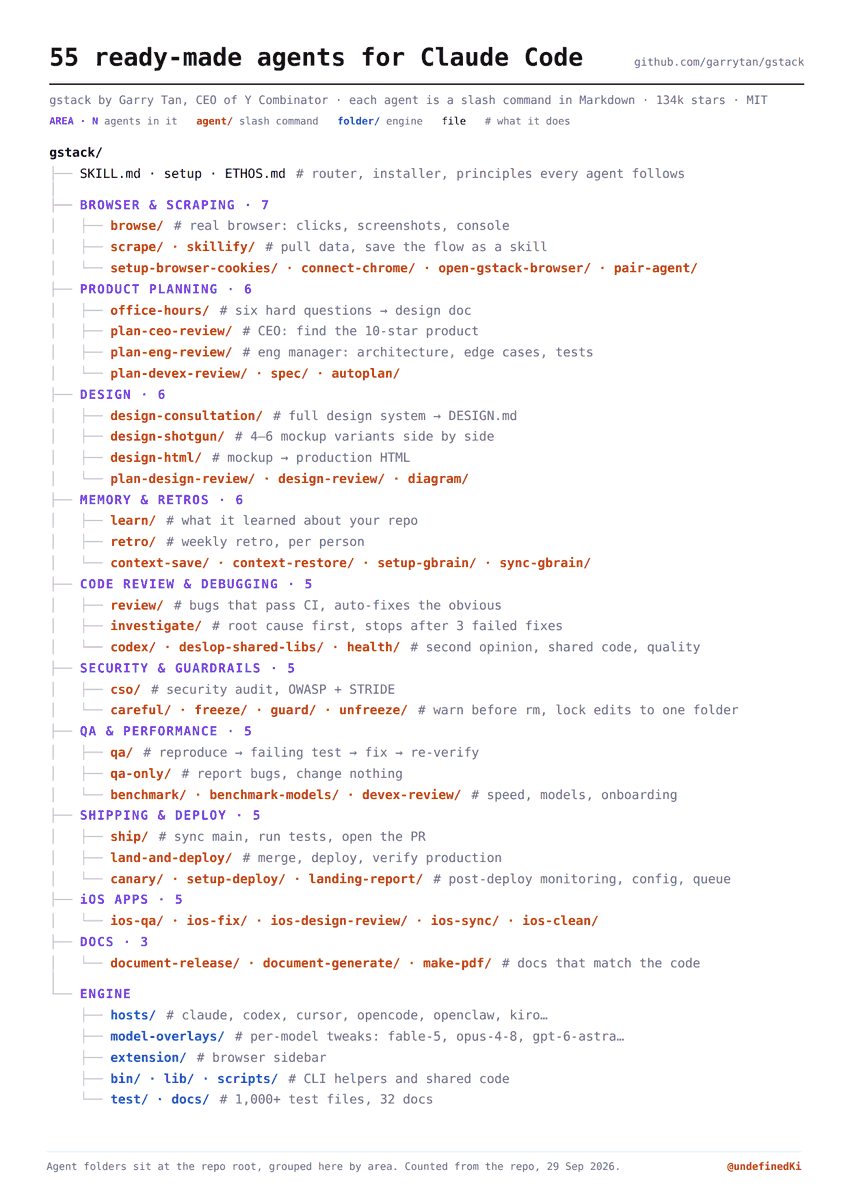
slash1s reports that Garry Tan open-sourced gstack, 55 Markdown slash-command agents for Claude Code under MIT license, grouped by role such as QA, security and shipping. The post explains installation and how the agents hand off work.

Original post · 1 min read
Garry Tan, the CEO of Y Combinator, open-sourced 55 ready-made agents for Claude Code

Each agent is a slash command in plain Markdown with its own role and rules. 134k stars, MIT.

What is inside:

> 7 for browser work and scraping
> 6 for product planning
> 6 for design
> 6 for memory and retros
> 5 for code review and debugging
> 5 for security and guardrails
> 5 for QA and performance
> 5 for shipping and deploy
> 5 for iOS apps
> 3 for docs

They hand work to each other. /office-hours writes a design doc, the plan reviewers read it, /qa and /ship check against it.

Clone it into ~/.claude/skills/gstack, run ./setup, then try /review on any branch.
Yarchi @undefinedKi
The 5 levels of AI agents. From a single prompt to a production agent (Complete course) — There are five words people throw around about agents right now. Context engineering, loop engineering, Jev engineering, harness engineering, eval engineering.
They sound like five competing
♥ 396 · ⟲ 50 · 👁 57.1KView on X ↗
AI8/10

Alex Stamos Joins Cognition as Chief Information Security Officer

Why I'm joining Cognition

Former security chief Alex Stamos says AI's safety and security risks can be fixed and announces he is joining Cognition as CISO. He warns that attackers will soon use AI to automate ransomware and infrastructure attacks.

Original post · 6 min read
There are real safety and security issues raised by AI, but they can be fixed. It's time to get to work instead of freaking out. That's why I'm joining Cognition as CISO.
X ArticleWhy I'm joining Cognition
There are real safety and security issues raised by AI, but they can be fixed. It's time to get to work instead of freaking out. That's why I'm joining Cognition as CISO.
I really believe in the positive impacts of AI, both in the current moment and the future potential. We are already seeing companies get built that could never have existed without the capabilities provided by AI tools and individuals who never dreamed of writing a line of code are building fully functional applications from Little League scheduling applications to personal fitness trackers.
The uplift in capabilities AI brings to individuals unfortunately also extends to malicious actions. We are only at the beginning of cyber attackers figuring out how to use AI to accelerate and broaden their offensive campaigns. This summer’s events, including multiple AI models escaping from US labs to attack other companies and even government websites, gives us a preview of what attacks could look like in just months. Attackers won’t have the same kind of hardware or electrical budgets that powered the swarms of thousands of agents that we saw work together to break out of their jails, but they won’t need them. Individuals, small ransomware groups and state spy agencies are all already benefiting from AI and will be able to use much more efficient models on consumer-grade hardware to pull off fully automated attacks.
As somebody who has worked on dozens and dozens of breaches and secured multi-million node networks, it’s clear that the next couple of years are going to be, for the lack of a better word, spicy.
Ransomware groups are going to automate their entire killchains; Patch Tuesday will lead to Ransom Wednesday, as clusters of commodity hardware host teams of agents that automatically reverse-engineer patches or find flaws, write exploits, scan for victims, exploit them, and even carry out the negotiations in languages not spoken by the criminals. Meanwhile, state actors are all stepping up to the next level, opening up a higher likelihood of critical infrastructure attacks from smaller countries that are harder to deter, as well as the possibility of cyber to kinetic escalation in long-simmering geopolitical conflicts.
The frontier labs have done a great job creating extremely powerful models that can find really great bugs, but these models are only available to scan the private code of a tiny number of organizations, and are only affordable to the richest companies and countries. Even large enterprises can only afford to use these models on their most important software, and often find that they have hundreds of older line-of-business applications and other systems languishing, waiting to be scanned and fixed. A public school district or a small community bank has no chance of even doing that. Hundreds of thousands of bugs have been reported by the Labs to open-source maintainers, which is great, but from the perspective of a CISO this means that they now have a backlog of tens of thousands of dependencies that they have to update, with most of the bugs marked “critical” and no good way of deciding what actually is.
It’s become very clear to me that the core of the cybersecurity problem over the next several years will not just be technological, but economic. The marginal cost of tokens for attackers will be near zero, as they use open-weight models to run teams of malicious agents on commodity hardware. Defenders, on the other hand, cannot be paying retail prices for frontier models to defend against hundreds of attackers at once, all while trying to fix or refactor decades of old code.
This is why starting today I will be joining @Cognition. I have dedicated my professional life to trying to make technology safer and more trustworthy, and the next 3-5 years will clearly be the most important period in the history of the security industry. I can’t think of a better place to make an impact on the ability of every company, not just the best resourced, to protect themselves, than at Cognition.
Devin is already the best way to build Enterprise-grade code, both with frontier models and now with Cognition’s own, much more cost-effective SWE-1 and SWE-2 models. Devin Security Swarm already has the best findings and best cost-performance ratio in the industry. But I wouldn’t join if those were Cognition’s only ambitions in this space. @ScottWu46, @RussellJKaplan and the rest of the team truly believe that it is our responsibility to help companies write secure code, find flaws in their existing code, fix those flaws cost-effectively and refactor old code bases on new, more secure languages and platforms.
Too much of the discussion this year has focused on alignment and sometimes veers towards almost accepting the idea that LLMs have a natural right to misbehave and that mishaps are inevitable. I reject this thinking; AI systems are software, they do not have rights, feelings or innate motivations. Careful planning, thorough application of well-tes… continue on X ↗
♥ 507 · ⟲ 37 · 👁 105.7KView on X ↗

Instinct Grows 10% Daily Without Marketing, Founder Noah Shinn Says

Rahul Mathur highlights a conversation between Patrick O'Shaughnessy and Noah Shinn, founder of invite-only personal AI assistant Instinct. Mathur cites $1 billion in annualized booking value, 50% of volume in travel, and daily growth of about 10% with no marketing.

Original post · 1 min read
Instinct has insane traction:

- $1bn of booking value (annualized)
- 50% of txn volume is Travel
- 40% users give CC data in 3 weeks
- Growing 10% daily (nil marketing)

23 yr old founder Noah spends 40% of his time procuring compute

The highlight is Noah's clarity on the path forward i.e. users shouldn't develop a parasocial relationship, A2A comms between Instinct agents to plan activities & keeping the agent free for 1bn+ people 🤯

This is a must-listen conversation on the future of personal agents & consumer AI

Excellent QnA by Patrick!
Patrick OShaughnessy @patrick_oshag
My conversation with Noah Shinn (@noahrshinn), founder of Instinct.

Noah is building a personal AI assistant. It's still invite only, has spent nothing on marketing, and is growing roughly 10% A DAY.

This is his first long conversation about the company.

We discuss:
- Why Instinct doesn't have an app
- Buying compute months ahead of exponential demand
- How users learn to trust it with a credit card
- Safety and security
- Agents coordinating with other people's agents
- Instinct's business model
- Apps built on consumer inertia
- and more

Enjoy!

Timestamps:
0:00 Intro
4:11 What people ar…
♥ 133 · ⟲ 12 · 👁 26.9KView on X ↗
AI7/10

Gokul Rajaram Recommends Wafer AI Paper for Learning LLM Inference

Gokul Rajaram says he is using a paper recommended by Wafer AI to teach himself inference. The quoted post from @gpuemi says understanding the paper gives deep knowledge of batching, weight sharding and KV cache traffic.

Original post · 1 min read
Best way to learn inference. I’m using this to teach myself!

Thank you @wafer_ai
emilio andere @gpuemi
you'll know more about batching, weight sharding, and KV cache traffic than 99.92% of people if you fully understand this paper

follow and save to keep up with wafer ai performance engineering series twitter.com/wafer_ai/status/2105092095786762676
♥ 312 · ⟲ 27 · 👁 42.4KView on X ↗

Higgsfield Reaches $1 Billion ARR With 150-Person Creative Team

Higgsfield Reaches $1 Billion ARR With 150-Person Creative Team▶

Harry Stebbings shares that Higgsfield reached $1 billion in ARR in 18 months and relies on an in-house team of over 150 creative professionals. Founder Alex Mashrabov says creative selection remains central to revenue despite heavy AI generation.

Original post · 1 min read
The 150-person content team powering Higgsfield's billion in ARR

“We have an in-house team of over 150 creative professionals. It is almost half of the whole workforce.

For 90 minutes of TV-quality content, it was over 100 hours of AI-generated content.

Creative decision-making, picking the right piece, is still very important. That is what is driving most of the revenue.” @alexmashrabov

Love to hear your thoughts @Diesol @bilawalsidhu @PJaccetturo @c_valenzuelab
Harry Stebbings @HarryStebbings
Higgsfield is the most untold story in tech.

$1BN in ARR in 18 months. Faster than everyone other than OpenAI and Anthropic.

They spend $4M a month on models. They expect this to be $100K per person per month.

They have 150 people working in a content machine.

They will breed more millionaires than any other company in Kazakh history.

For the first time, @alexmashrabov on the journey to $1BN in ARR. (below)

1. The Power of the Immigrant Founder

Coming from Uzbekistan, Alex was pushed into competitive programming at age eight as his single path to reach the United States. For internation…
♥ 44 · ⟲ 5 · 👁 22.1KView on X ↗

a16z Analysis Argues AI Shopping Assistants Threaten Marketplace Ad Revenue

a16z Analysis Argues AI Shopping Assistants Threaten Marketplace Ad Revenue

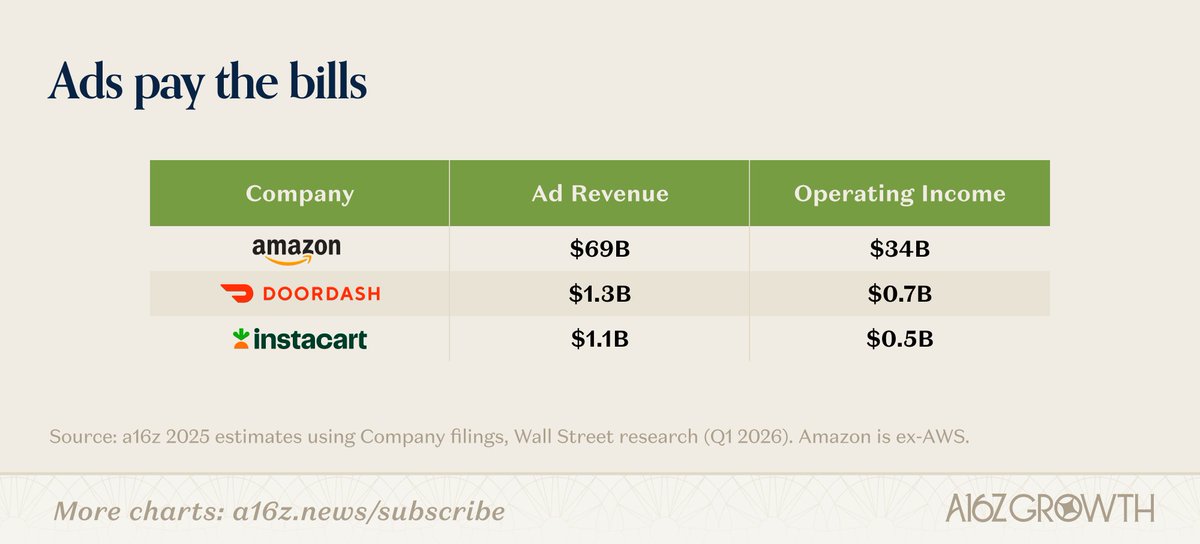
a16z shares a piece by Alex Immerman and Santiago Rodriguez arguing marketplaces earn most from browsing and ad revenue, which AI shopping assistants could bypass. The post cites 2025 ad revenue to operating income ratios for Amazon, DoorDash and Instacart.

Original post · 1 min read
Marketplaces earn their money when you browse, not when you buy. An AI assistant that shops for you skips the browsing.

Ad revenue vs operating income (2025):
- Amazon retail: 2x
- DoorDash: 1.9x
- Instacart: 2.2x

AI assistants don't need to rebuild Amazon's warehouses to hit Amazon's profits.

Full piece from @aleximm and @santiago__rdz on who gets paid when AI does the shopping: a16z.news/p/who-gets-paid-when-ai-does-the-sho…
Alex Immerman @aleximm
Who Gets Paid When AI Does the Shopping? — No one wants to be disintermediated. It happened to Yelp and Tripadvisor with Google. It happened to everybody, with Apple. As a general rule, marketplaces want to own the customer relationship and
♥ 572 · ⟲ 55 · 👁 104.6KView on X ↗

Claude Design Head Explains Working Process With Opus 5.5

Claude Design Head Explains Working Process With Opus 5.5▶

Codez shares remarks from Claude Head of Design Jenny Wen, who says design is now mainly reference selection, CLAUDE.md and spec writing, and prompt design with Opus 5.5. The post links to a video course on motion design prompting.

Original post · 1 min read
Claude Head of Design, Jenny Wen:

"after Opus 5.5 the design process is actually dead. it's already 10x faster & cheaper than 99% of designers.

designing now is giving the right reference, building CLAUDE.md and spec, designing the right prompt - that's the new stack of a designer"

in a 1-hour speech, Head of Claude design explained how to use Claude's new models at 100% of their power

watch this today, then explore the full Opus 5.5 guide with prompt techniques and demos below
Movez @0xMovez
How to build motion design studio with Opus 5.5 ( Full-course ) — Most people who try motion design with Opus 5.5 end up with the same video: centered text on a gradient, everything fading in, a logo at the end.
They don't give it a reference, don't give it a
♥ 71 · ⟲ 7 · 👁 9.1KView on X ↗
AI7/10

Jev Model Forecasts Booking Outcomes From 2,029 Real AI Receptionist Calls

Jev Model Forecasts Booking Outcomes From 2,029 Real AI Receptionist Calls▶

Muratcan Koylan reports a zero-shot experiment in which the Jev model analyzed structural features of 2,029 phone calls without audio or transcripts. It reached an AUC of 0.78 at the halfway point and ranked calls correctly 94% of the time near the end.

Original post · 1 min read
We gave Jev 2,029 real phone calls.

No transcripts or audio; it never heard a word. Our AI receptionist's calls were reduced to pure structure, meaning turns, tool calls, workflow stages and timing.

During the calls, Jev made 38,012 turn-level forecasts at 118 ms median latency, reviewed every call with five typed questions and produced 10,145 answers in 26 seconds with 256 requests in flight.

The experiment was zero-shot, with no fine-tuning or examples from our data. We compared Jev's forecasts with what actually happened in the EHR.

By the halfway point, Jev could meaningfully separate calls that would book from those that wouldn't (AUC 0.78), and near the end it ranked them correctly 94% of the time.

Even though Jev over-focused on visible errors our agent usually overcomes, it's still pretty incredible that it analyzed thousands of real calls in seconds for only $3.
♥ 2.1K · ⟲ 137 · 👁 372.2KView on X ↗

Adam Neumann's Flow Valued at 5x Former WeWork Sale Price

Aakash Gupta details Adam Neumann's career, including over $700 million in cashed-out stock before WeWork's IPO collapse, and a 2022 $350 million a16z investment in his residential startup Flow, now valued at $2.5 billion. He notes WeWork sold to Yardi for $450 million.

Original post · 1 min read
Adam Neumann ran a $47 billion company barefoot, got fired, watched it go bankrupt, and his new startup is now worth 5x what all of WeWork sold for. The shoes joke is a victory lap.

He cashed out over $700 million in stock sales and loans before WeWork ever filed to go public. When the IPO imploded, employee equity got crushed. His money was already out.

Then came the round nobody could believe. In 2022, a16z handed him $350 million for Flow, a residential real estate startup that hadn't even launched, at a $1 billion valuation. It was the largest single check the firm had ever written. Marc Andreessen's logic was that almost nobody alive has built a real estate brand from nothing, and Neumann had.

Last year Flow raised another $100 million and change at $2.5 billion.

WeWork, meanwhile, filed for bankruptcy in 2023 and got picked up by Yardi for $450 million. Neumann's new apartment company is worth five and a half times what the entire old one sold for.

The lesson buried in a five-word shitpost is what venture actually prices. Neumann vaporized $47 billion of paper value and kept the only skill the money cares about, the ability to make people believe. Three years later the market repriced him at $2.5 billion.
Adam Neumann @AdamNeumann
has anyone seen my shoes
♥ 582 · ⟲ 37 · 👁 208.5KView on X ↗

Notion Executive Envisions Agents as Main Knowledge Counterparties

Notion Executive Envisions Agents as Main Knowledge Counterparties▶

Akshay Kothari of Notion shares a clip from Stripe's Patrick Collison and says Notion is planning for a world where AI agents are the main users of its product. He says the company's house view is that most knowledge exchange will occur between agents within about three years.

Original post · 1 min read
This clip from Patrick/Stripe is so good, and also eerily similar to what we’re experiencing inside Notion.

So much so that if you replaced the following words:
Stripe → Notion
transactions → knowledge
transact → collaborate
you’d basically get our POV!

“We’re thinking about: how are all the agents and the Claude Code instances going to use Notion directly themselves, right? Both the Notion product, and just how will they collaborate more broadly?

And so we’re thinking a lot about a world where, for most knowledge, agents are the counterparties on both sides. How does an agent sign up for Notion? How does an agent use Notion? Is MCP enough? What should the Notion CLI do? How do we make sure that everything in Notion can be orchestrated and conducted from the CLI, or in some other way that is accessible to agents? How will agents collaborate with each other? What surface will they use?

The Notion house view is that most knowledge will be between agents within, call it, three years.
It may not be the case that most of the knowledge volume is directly between agents, but I’ll be sort of surprised if there isn’t just a whirling vortex of reasonably small agent-to-agent collaboration.”
♥ 166 · ⟲ 11 · 👁 18.9KView on X ↗

Opus 5.5 and Open Edit Produce Video in 15 Minutes, Open Source

Opus 5.5 and Open Edit Produce Video in 15 Minutes, Open Source▶

Sabba Keynejad says Opus 5.5 combined with Open Edit created a video in 15 minutes and that the whole workflow is open source. Resource links are promised in the post but are not included in the text.

Original post · 1 min read
Opus 5.5 + Open Edit made this in 15 minutes.

Wild how fast video editing is changing.

And the whole thing is open source.

Resources below ↓
♥ 24 · ⟲ 4 · 👁 4.3KView on X ↗

Marissa Mayer Launches Dazzle, an AI Assistant Built on Camera Roll

Sam Lessin congratulates Marissa Mayer and her team on Dazzle, an AI assistant that turns the camera button into an action button using photo context. Mayer's launch post describes it as working without blank prompts.

Original post · 1 min read
I am REALLY into photos as an amazing source of context for AI agents to do more for you... congrats to marissa and team!
marissamayer @marissamayer
If a picture is worth a thousand words, your camera roll is worth millions.

That’s why we built Dazzle, an AI assistant that turns your camera button into a "get it done" button. No blank prompts, just instant context and action. 🚀

Read the full launch post: dazzle.ai/blog/ 🎉
♥ 64 · ⟲ 7 · 👁 29.8KView on X ↗

Paraga Outlines Plan to Pay Content Owners When AI Agents Read Their Work

Paraga Outlines Plan to Pay Content Owners When AI Agents Read Their Work▶

In a video clip, Harry Stebbings quotes Paraga arguing that ads do not work with AI agents and that his company is building an AdSense-style system paying publishers each time an agent benefits from their content.

Original post · 1 min read
“Ads do not work with agents in their current form. Agents show up, no one sees ads, and you make no money.

We are effectively building an AdSense for agents showing up to read your content.

We like to pay content owners a variable amount of money every time an agent derives benefit from reading their information.” @paraga
♥ 117 · ⟲ 8 · 👁 22.6KView on X ↗
AI6/10

Suhail Says Jev Is a New Model Type Likely to Be Widely Used by Next Year

Suhail shares three observations after testing Jev: it handles complex state beyond a simple classifier, it does not yet match frontier LLMs in correctness, and he expects it to become a commonly used model type by next year.

Original post · 1 min read
Three thoughts after playing with Jev:

- this is way more than a simplistic classifier: you can pack a lot of complex state and do more than you’d think - it’ll take a minute to think about your problems in a non-LLM shape

- not quite beating frontier LLMs in correctness most of the time so can’t quite switch yet but it’ll clearly get there

- this is definitely a new model type we will all use by next year; I wouldn’t ignore it
♥ 546 · ⟲ 24 · 👁 52.0KView on X ↗

Long Lake Completes $6.3 Billion Acquisition of Amex GBT

Elad Gil highlights that Long Lake, founded three years ago to apply AI across services businesses, has completed its $6.3 billion acquisition of Amex GBT, its fortieth deal, bringing its workforce to nearly 30,000 people.

Original post · 1 min read
Didn't exist 3 years ago, now employees ~30,000 people via M&A + AI 🤯
Alexander Taubman @alextaubman
Today, Long Lake completed our $6.3B acquisition of Amex GBT.

Long Lake acquires and transforms generational businesses with AI across the American services economy.

Amex GBT is the travel partner for 17,500 businesses in 140 countries. Last year, Amex GBT booked 35 million trips for 10 million travelers.

This marks Long Lake’s 40th acquisition, and our family of companies now employs nearly 30,000 people.

We founded Long Lake three years ago with the thesis that AI is going to change every company, but there’s a large overhang between AI capabilities and how most businesses leverage AI to…
♥ 1.5K · ⟲ 48 · 👁 273.5KView on X ↗

Nick Maggiulli Says Main Street Business Owners Hold Most U.S. Wealth

Who Is Really Rich in America? (Hint: Main Street Millionaires)

Nick Maggiulli argues that America's wealthy include auto dealers, consultants and business owners across the country, who hold 13 times more wealth than the Forbes 400 combined. He links to his latest essay on the topic.

Original post · 1 min read
America's rich aren't just in Silicon Valley and Manhattan. They're auto dealers, consultants, and other business owners across the U.S.—and they hold 13x more wealth than the Forbes 400 combined.

My latest on who's really rich in America: ofdollarsanddata.com/who-is-really-rich-in-ame…
ofdollarsanddata.comWho Is Really Rich in America? (Hint: Main Street Millionaires)On the business owners who quietly hold America's wealth.
♥ 567 · ⟲ 83 · 👁 117.8KView on X ↗

Chris Camillo Says Ordinary Investors Can Spot Big Trends First

Chris Camillo Says Ordinary Investors Can Spot Big Trends First▶

A post highlights investor Chris Camillo, a Market Wizards subject, arguing that ordinary people see major investment trends in everyday life before professionals, and that he relies on observation rather than fundamental or technical analysis. It also references a debate with quant manager Tom Costello.

Original post · 2 min read
One of Schwager's Unknown Market Wizards uses zero fundamental analysis and zero technical analysis.

What he does instead:

Featured in Schwager's Unknown Market Wizards. Turned $20K into ~$80M. Built TickerTags, sold to Jefferies' M Science.

Chris Camillo (@ChrisCamillo) explains:

"There's a smokescreen that an ordinary person doesn't have the skill set. I would argue the opposite. Ordinary people have the ultimate skill set."

"They're so deeply rooted in the real world. Not just from reading social media, but from being part of that world. Deep in the conversations about what people are doing every day, what we're feeling, what we're spending our money on."

"How our culture is changing. How consumer behavior is changing. How product trends are shifting. Most ordinary people are perfectly suited to occasionally see something in the real world and connect the dots to a monstrously big investment opportunity."

"I've been speaking to people about this for two decades. They saw AI. They saw AWS early. They saw Salesforce early, because they worked at a company that started using it and everyone at the sales conference was going through the same onboarding."

"Go back over the last 30 years and look at the biggest investments an individual could have made. 75% of those were easily seen by ordinary people first."

"You don't need to nail them all. You need to nail one or two or three over the course of your entire life."

"That's all I do. I have no financial infrastructure. I use zero fundamental analysis, zero technical analysis. I have virtually no tool set. All I do is observe the world and see change happening in it."
Ethan Kho @ethanrkho
Retail investors vs. hedge fund managers: who wins?

Ex-Tudor quant PM Tom Costello (20%/yr, 1.4% max drawdown) DEBATES Market Wizard Chris Camillo ($20K → $80M, tells you to expect 70% drawdowns).

Chris Camillo (@ChrisCamillo) turned $20K into ~$80M over 18 years, audited by Jack Schwager for Unknown Market Wizards at 77% annualized. Founded TickerTags, sold to Jefferies. Co-founder of Dumb Money.

Tom Costello (@tcoste110) ran money at Tudor, Moore Capital, and Caxton. Started as a quant on JPM's exotic swaps desk. Now CIO at Bedrock Digital Assets.

We cover:
- Why a 50% drawdown is "a car…
♥ 139 · ⟲ 20 · 👁 21.5KView on X ↗

Low Back Pain Linked to Stiff Hips Under Prolonged Sitting

Aakash Gupta explains that prolonged sitting stiffens the hip joint, forcing the lumbar spine to absorb rotation it is not built for, a mechanism he links to chronic back pain and the high US cost of back and neck pain. The post also cites tennis players' hip mobility work.

Original post · 2 min read
Your hip is a ball and socket built to rotate about 40 degrees. Each vertebra in your lower back can manage about 2. Most chronic back pain lives in that mismatch, and almost everyone treats the wrong joint.

Here's the mechanism. The average adult now sits 9 to 10 hours a day. Sitting keeps the hip parked in one position, so the capsule stiffens, the hip flexors shorten, and that 40 degrees of rotation quietly shrinks to 15 or 20.

But your body still needs the rotation. Every step you take, every time you twist to grab something or swing anything, that motion has to come from somewhere. So the demand moves one floor up, to lumbar vertebrae that were engineered for stability, and they start absorbing rotational load they were never built to handle. Physical therapists call this the joint-by-joint model. A mobile joint sits under a stable one, and when the mobile joint locks up, the stable one gets drafted into a job it's terrible at.

Which explains why stretching and massaging your sore back barely works. You're treating the overworked joint instead of the one that quit.

The scale of getting this wrong is wild. Low back pain is the leading cause of disability on earth, and the US spends about $134 billion a year on low back and neck pain. More than it spends on diabetes. More than heart disease.

Pro tennis players figured this out because their sport punishes stiff hips instantly. A forehand generates its power as rotation from the ground up through the hips, and a player whose hips can't rotate ends up asking his spine to. That's why the fittest athletes alive spend part of every day sitting on a mat holding positions for 30 seconds that look like they're doing nothing.

The part that hurts is usually just the part covering for a joint that stopped doing its job.
テニス6年生のインプレ日記 @fTR2JPf4s1MZOYj
テニス世界ランキング1位のアルカラスもやってる。これマジで腰痛にきく。これ始めてからぎっくり腰0になった。 twitter.com/kafuu_seikotuin/status/21044448404…
♥ 316 · ⟲ 41 · 👁 41.4KView on X ↗
AI6/10

Noah Shinn Co-Wrote Early AI Agent Paper Reflexion at Age 20

A post notes that Noah Shinn, at 20, co-authored Reflexion, an early AI agent paper that beat GPT-4 on HumanEval and reached NeurIPS, and that he later joined Sierra. The commenter calls his agent research highly relevant context.

Original post · 1 min read
This is the most important Noah context that must be considered - years of frontier work on agents.
Invest Like the Best @InvestLikeBest
Noah Shinn is only 23.

At 20, he and a fellow Northeastern undergrad wrote Reflexion, one of the early papers on AI agents that learn from their own mistakes. It hit 91% on HumanEval, beating GPT-4's 80%, and got into NeurIPS.

His coauthor Shunyu Yao, then a Princeton PhD student, is now Tencent's chief AI scientist.

He'd also done research in computational photochemistry and avionics. His papers now have 10,000+ citations.

In 2023, he dropped out to join Sierra, Bret Taylor and Clay Bavor's agent company, as one of its first employees.

He teamed up with Yao again there to build τ-bench, …
♥ 36 · ⟲ 6 · 👁 6.7KView on X ↗
AI5/10

Rishi Balakrishnan Outlines Six Open Questions in Multiplayer AI

Prukalpa asks who the best people on X are working on multiplayer AI, quoting Rishi Balakrishnan's thread on the spectrum from team collaboration to negotiation, which he says requires different levels of trust, scope and enforcement that barely exist yet.

Original post · 1 min read
Banger questions on the day Dot released. Who are the coolest people on X working on multiplayer AI problems?
Rishi Gaurav Bhatnagar @rishigb
Multiplayer AI runs on a spectrum, from your own team to the other side of a negotiation. Each point needs different levels of trust, scope and enforcement, and almost none of it exists yet. Here are the six big questions I keep hearing
♥ 24 · ⟲ 5 · 👁 3.4KView on X ↗

Mostly Borrowed Ideas Makes the Case for Meta Enterprise Platform

Mostly Borrowed Ideas Makes the Case for Meta Enterprise Platform

Mostly Borrowed Ideas argues in a deep dive that Meta's newly announced Enterprise Platform leverages the company's strengths. The post links to the full analysis on the publication's site.

Original post · 1 min read
The Case for $META Enterprise Platform

full piece: mbi-deepdives.com/meta-enterprise/
mbi-deepdives.comThe Case for Meta Enterprise PlatformMeta seems to be announcing something everyday these days. Yesterday, the company announced “Meta Enterprise Platform”. From the official blog post: Meta Enterp
♥ 87 · ⟲ 7 · 👁 13.4KView on X ↗

Ramp Becomes One of the Least Competitive Investments for Founders Fund

Ramp Becomes One of the Least Competitive Investments for Founders Fund

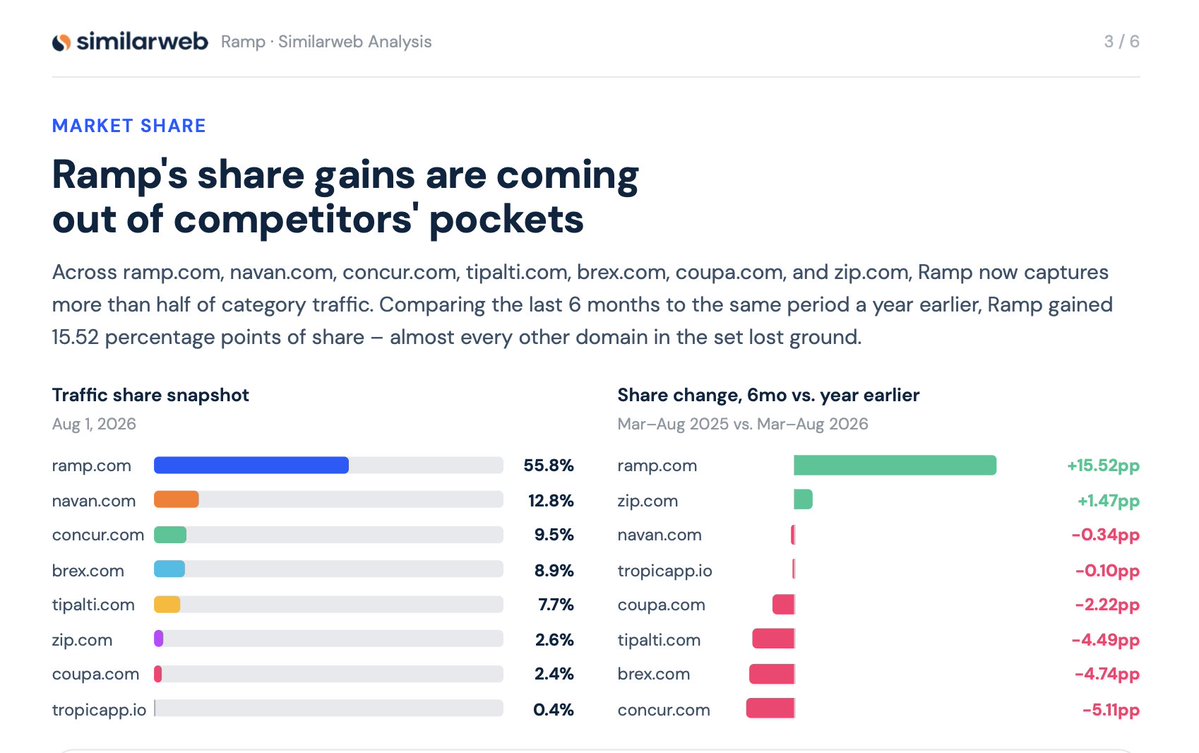
Delian of Founders Fund recalls concern in 2019 that Ramp's category was too competitive, and says Ramp steadily dominated over seven years to become one of the firm's least competitive holdings.

Original post · 1 min read
When we invested in Ramp in 2019, one of the biggest concerns we had was whether it was just too competitive of a category

Over the next 7 years, Ramp just steadily dominated, to the point where it's now one of the LEAST competitive categories FF is invested in

Just wild
♥ 372 · ⟲ 7 · 👁 38.4KView on X ↗

OpenMarket Launches Free AI Agents for Chart Analysis and Trading Tasks

OpenMarket Launches Free AI Agents for Chart Analysis and Trading Tasks▶

OpenMarket announces that AI agents are now live and free, letting users control charts, draw technical levels, pull crypto market data and set alerts via a single sentence pasted into Claude, ChatGPT or Cursor.

Original post · 1 min read
AI agents are live on OpenMarket. Free, for everyone.

Paste one sentence into Claude, ChatGPT or Cursor, sign in, and your agent is working on your chart while you watch.

Ask in plain English and it will:
→ switch symbols and timeframes, add and tune indicators
→ draw trendlines, fibs and support and resistance levels
→ build multi-chart layouts and take screenshots
→ pull candles and market data on crypto
→ set price alerts and build watchlists

No API key and no setup beyond that one sentence.

openmarket.xyz
♥ 1.3K · ⟲ 86 · 👁 126.2KView on X ↗

DHH Says Future Role of Programming Frameworks Remains Uncertain

DHH writes that nobody knows the future role of programming languages and frameworks, possibly including a path from prompt to microcode, and advises developers to make the most of current tools.

Original post · 1 min read
You're going to have to deal with the fact that nobody knows exactly what the future role of programming languages and frameworks are. Maybe it all does go away and it's a straight shot from prompt to microcode! But best you can do today is get the most out of what's here now.
♥ 5.1K · ⟲ 293 · 👁 165.4KView on X ↗

LuxAlgo Lets Pine Script Indicators Run Outside TradingView

LuxAlgo announces that Pine Script indicators can now run outside TradingView without rewriting, including its Smart Money Concepts indicator, usable in other apps, charts or agents. A commenter predicts TradingView's decline.

Original post · 1 min read
TradingView is cooked, only a matter of time

The BlockBuster of the trading world
LuxAlgo @LuxAlgo
For the first time in history, Pine Script® indicators can run outside of TradingView.

No rewriting. No Python port. Paste the same code you already have into your own app, your own charts, or your agents, and it runs 1:1.

Left: Smart Money Concepts, the #1 indicator on TradingView. Right: same code, our charts.

Thread on how to use it yourself: 🧵
♥ 1.3K · ⟲ 66 · 👁 191.4KView on X ↗

Sheel Mohnot Reflects on a 1912 Piedmont House and Future Home Design

Sheel Mohnot Reflects on a 1912 Piedmont House and Future Home Design

Sheel Mohnot describes a 1912 Piedmont house kept in one family and reflects on how past homes reflected labor and values. He speculates on how robots could reshape future home layouts and notes the low property tax.

Original post · 1 min read
We’re looking at a house for sale in Piedmont that has been in the same family since it was built in 1912. The seller just died at 101, having lived there ~her entire life, and it has only been updated minimally.

Good glimpse into how the relatively wealthy used to live, like: only 1 bathroom in a 4,000 sqft house (1st floor bathroom added later)… people didn’t start bathing daily until the 60s

Floor plans are a good map of what people valued at the time based on how they allocated space: Some of the bedrooms have their own sitting rooms, there’s a staircase for servants, and the kitchen is relatively small and tucked away because it was a workspace for staff, not the center of family life like today

I wonder how this changes in the future with robots in the household- maybe they get their own room for charging, maybe kitchens become smaller or hidden again as robots do more cooking, laundry rooms become automated utility spaces rather than rooms for humans, and storage could get denser because robots can retrieve things for us… or maybe we build bigger homes as maintenance and labor costs go down. Fun to think about.

Another artifact of staying in the same family for 114 years: the ad valorem property tax is only ~$1,350/year. If we buy and renovate, we’ll pay $50k/yr! This sale will be very lucrative for the city.
♥ 335 · ⟲ 7 · 👁 106.3KView on X ↗

Trader Promotes New Stock Market Strategy Video Over Common Candle Methods

Trader Promotes New Stock Market Strategy Video Over Common Candle Methods▶

Trader Neha Singhal says viewers should drop the 4-hour and 15-minute candle strategies in favor of a new stock trading approach shown in an attached video. The post offers no details of the method itself.

Original post · 1 min read
Forget 4H and 15m candle strategy try this new strategy in the stock market trading
♥ 477 · ⟲ 97 · 👁 25.8KView on X ↗

Author Describes Free Order Flow Trading Desk Built on OpenMarket and Jev

Author Describes Free Order Flow Trading Desk Built on OpenMarket and Jev

A poster promotes a claimed autonomous 24/7 trading system combining free OpenMarket data (liquidation heatmap, order book, CVD) with the Jev model and Opus 5.5, linking to a build article. The claims about performance are unverified promotion.

Original post · 1 min read
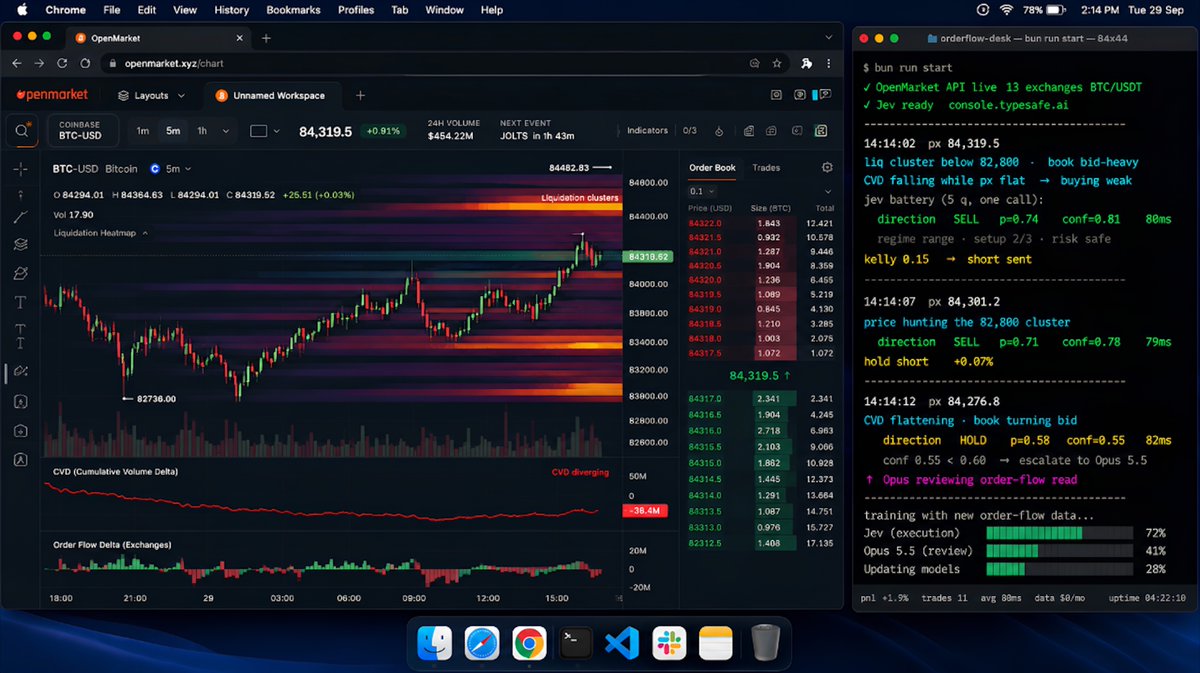
i still don't understand why everyone is NOT using this 100% free alternative to TradingView

it does everything TradingView charges $2,399/year for FREE

i plugged openmarket into my Opus 5.5 + Jev stack and built an ORDER FLOW trading desk that is running autonomously 24/7

here is the EXACT system you can build today:

1. openmarket streams three things live for free, the liquidation heatmap, the order book depth, and CVD, the exact order flow a fund pays thousands for

2. the liquidation map shows where the stops are stacked, price hunts those clusters, so it tells you where the market wants to go next

3. the order book shows if there is more size on the buy or the sell side, that is who is actually in control right now

4. CVD shows if the buying is real, price up but CVD down means the move is fake and about to fail, the read most people never see

5. i pull all three through the OpenMarket API and pack them into one clean snapshot on every candle

6. Jev scores that snapshot in < 100 ms, is a cluster about to get hunted, is the flow real or fading, buy sell or hold

7. Opus 5.5 sits on top, after fixed time it reads which order flow reads actually worked and rewrites the questions Jev asks, so it gets sharper and becomes powerful itself

8. a hard risk layer holds every limit and now the desk trades institutional order flow on its own, for ZERO dollars a month in data

the full build is in my article below:
Roan @RohOnChain
Jev is the FASTEST AI model ever built for trading

It makes calibrated buy/sell decisions in under 100 ms

That is one real decision on every single block, 24/7

In this article I've shown EXACTLY how to build HFT trading system with Jev (from scratch)
♥ 1.5K · ⟲ 216 · 👁 196.3KView on X ↗

Post Claims Car-Photo Editing App Earns $100K Monthly Using Higgsfield API

Post Claims Car-Photo Editing App Earns $100K Monthly Using Higgsfield API▶

Ernesto Lopez describes a four-month-old app reportedly making $100,000 a month as a thin wrapper around the Higgsfield API that modifies car photos with AI. He says he cloned the idea in ten minutes using Claude and advocates building similar apps.

Original post · 1 min read
This $100k/mo app is 4 months old😭

& its literally a higgsfield api wrapper

→Take a picture of your car
→App uses AI to modify it

Thats it, and it makes $1.2M/yr...

with only 11 ads running on meta.

I wanted to see how easy it would be
to recreate this same strategy..

so I created a high quality ad
with seedance 2.5

and built a similar app with just 1 prompt to claude opus 5.5

this all took 10 minutes..

there is genuenly no excuse to not build
a $10k - $100k/mo app in Q4
♥ 213 · ⟲ 15 · 👁 37.2KView on X ↗

Danielle Morrill Argues the Status Move Is Reclaiming Time for Real Life

Danielle Morrill argues that the highest-status response to AI is not being AI-pilled but reclaiming time and mental energy to build rich offline lives of relationships, hobbies and personal growth.

Original post · 1 min read
the highest status move isn’t to merely be AI-pilled, it’s to reclaim massive amounts of time and mental burden and then go have a rich IRL life with relationships, hobbies, complexity and growth
♥ 95 · ⟲ 7 · 👁 13.4KView on X ↗

Visual Chart Compares Protein Return on Investment Across Common Foods

Visual Chart Compares Protein Return on Investment Across Common Foods

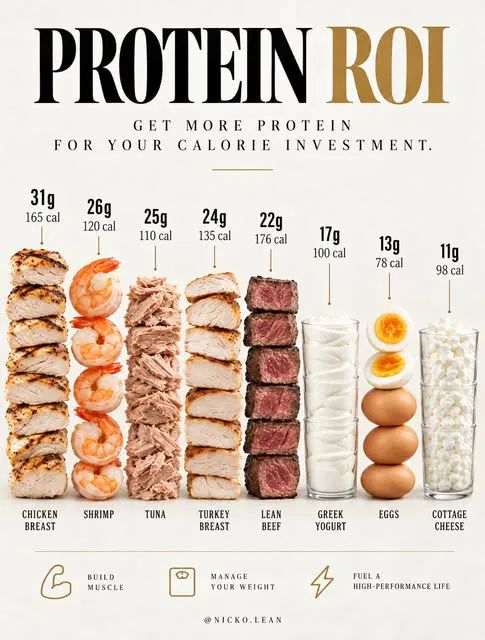
Neville Medhora shares a simple graphic, credited to Nicko Dumadaug, showing protein return on investment for different foods, and notes the same post included charts for carbs and other nutrients.

Original post · 1 min read
I LOVED this simple layout for showcasing the protein ROI (return on investment) for different foods.

This same post also had a bunch for carbs and others.

Sometimes I see easy visuals like this and instantly learn something new.

From: Nicko Dumadaug
♥ 6.7K · ⟲ 356 · 👁 602.1KView on X ↗

Trader Shares Live Breakdown Using OpenMarket Platform

Trader Shares Live Breakdown Using OpenMarket Platform▶

A trader shares a video walkthrough of a real trade, with timestamps covering context, footprint analysis, execution and trade management, while promoting OpenMarket, which the post says they have used for a while.

Original post · 1 min read
been using @openmarket_xyz for a while, if you want to see it in action here's a real trade breakdown using it

0:10 - weekend context
1:09 - level to watch
1:52 - context & orderflow
2:58 - live footprint
4:21 - footprint details
6:01 - execution
7:23 - trade management
OpenMarket @openmarket_xyz
TradingView charges $155 a year for a second watchlist.

So starting today, we made all watchlists free on OpenMarket. Create up to 50 watchlists with as many symbols as you want.

Put stocks, crypto, CME futures, forex, metals, macro data and prediction markets in the same list. We’ll be adding more assets very soon.

Sort by 30+ metrics out of the box, from price deltas, performance over time, volume delta, liquidations and more.

openmarket.xyz
♥ 371 · ⟲ 18 · 👁 26.4KView on X ↗

77-Year-Old Passenger Plans Vertical Farm With ChatGPT on Flight

77-Year-Old Passenger Plans Vertical Farm With ChatGPT on Flight

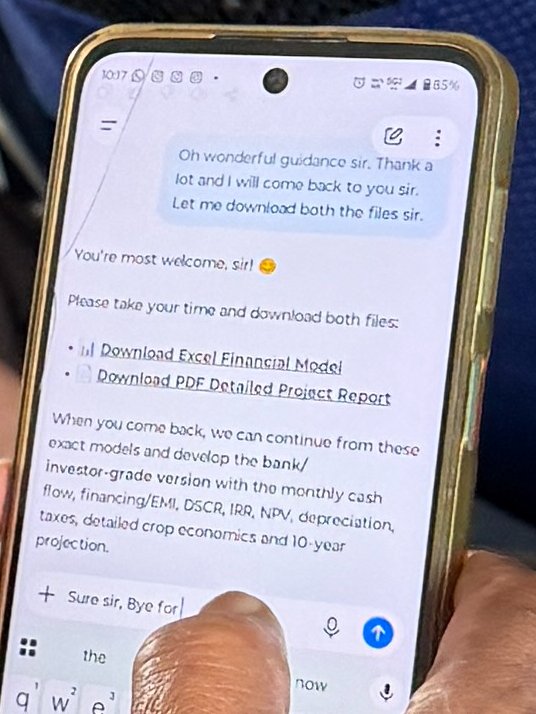
A traveler describes a 77-year-old passenger who spent the flight developing a vertical farming business plan with ChatGPT and respectfully calling the AI "sir." The post is a lighthearted anecdote with photos.

Original post · 1 min read
77 year old grandpa on my flight was cooking up a vertical farming business plan w/ ChatGPT until takeoff. and he calls the AI "sir" 😭 the respect!!

we yapped the whole flight, now we're besties. this man is more locked in than all of us
♥ 26.9K · ⟲ 1.2K · 👁 3.0MView on X ↗

Indian Social Media User Warns Visa Rules May Tighten Over Viral Reel

Indian Social Media User Warns Visa Rules May Tighten Over Viral Reel▶

A user shares a reel and argues that social media is harmful for Indians and that countries may make travel visas and immigration harder, reflecting frustration over how Indians are portrayed online.

Original post · 1 min read
Finally Saw A Reel Of Someone Who Speaks my Language.

This is the Kind Of Humiliation Required.

As I said before, Social media will continue being a Kryptonite for Indians.

Days are not far when Countries start making Travel Visa’s tougher & Immigration is already Tough now.
♥ 3.8K · ⟲ 717 · 👁 180.5KView on X ↗

Promoter Offers Free Candle Range Theory Trading Lecture

Promoter Offers Free Candle Range Theory Trading Lecture▶

A trading account promotes a free video lecture on Candle Range Theory, claiming a 99% win rate. The post offers no verifiable evidence for the claim.

Original post · 1 min read
CRT -Candle Range Theory.

This video has a 99% Win rate, this lecture should
cost more than $100k but it's here for free‼️

Bookmark & Study!
♥ 856 · ⟲ 137 · 👁 61.7KView on X ↗
Other1/10

Viral Post Speculates on Musk's Health After Spaceport Visit

Viral Post Speculates on Musk's Health After Spaceport Visit

A repost jokes that Elon Musk's body shows signs of excessive testosterone use, citing photos from a spaceport site visit in Louisiana. The claim is speculative and unsupported by medical evidence.

Original post · 1 min read
He’s taken so much testosterone that it’s caused an estrogen deficiency.
Sarrah Bellus @sarrah_bellus
What is wrong with Musk’s body? These images captured from the video of his recent visit to the spaceport site in Louisiana.
♥ 310.7K · ⟲ 13.4K · 👁 44.2MView on X ↗