Nikhil Pahwa congratulates Nous Research on a reported $90 million raise at a $1.5 billion valuation after its open-source Hermes agent was downloaded 22.7 million times, with about $36 million in annualized revenue by mid-September.
Noah Kagan says he made a free Wispr Flow alternative for Apple silicon Macs, offering unlimited use the first week then 2,000 words weekly, or $20 once for unlimited. He plans to share pricing experiment results in 30 days.
Polymarket reports that AI startup BioinvestGPT correctly predicted five of six major drug trial outcomes before results were announced. The post offers no methodology or independent verification.
Tibo announces a free, open-source AI skill that turns Nikita Bier's consumer app growth framework into a tool for analyzing an app and recommending fixes, metric checks and a yes/no test. The skill is linked at tmaker.io and promoted in an upcoming newsletter.
so we turned his whole consumer app playbook into a free, open-source AI skill for the rest of us
describe your app to your agent and it tells you:
- which rung of his ladder you're stuck on - which of your numbers you can't trust yet - what to fix first, then 2-3 big bets - one test with a yes/no threshold, set before you run it
Olivia Moore shares an a16z map identifying search, creative tools and productivity as areas where early consumer AI winners are emerging, while social, marketplaces, travel, finance and other categories remain open.
Adrià Martinez describes the Claude Startups program, which offers a year of Claude Team, API credits, priority rate limits and tool discounts, and gives step-by-step application tips such as using a company email.
It took me 5 minutes to get into the Claude Startups program
And you don't need VC funding anymore
What you get:
- A year of Claude Team - API credits - Priority rate limits - Deals on the tools a startup runs on
How to apply:
- Create a Claude Console account (the API one, not the app) - Use a company email, not Gmail - Go to claude.com/programs/startups - Fill in the form with what you're building on Claude
Mark Suster congratulates Jiake Liu on the launch of Outer Space, which raised $8 million in pre-seed funding led by Upfront Ventures and builds outdoor living spaces that generate and store solar energy.
Developer kyzo says the new product One, a unified inbox and voice interface for talking with AI agents, reached $2 million in annual recurring revenue within five hours. The post links to a promotional video.
Investor Sheel Mohnot recommends trying Hark Pro despite personal assistant fatigue, citing strong UX and non-intrusive proactive notifications. He quotes Brett Adcock's announcement that Hark Pro is live on web, iOS and Android.
You might have personal assistant fatigue at this point, but if you're up for signing up for another one, this one is a good one to try... UX and proactive pushes in particular are extremely good and not too annoying
Kyzo introduces One, a product that gathers agent questions in a single inbox, lets users talk to agents by voice and supports replies from an iPhone, including to cloud agents. The post is a product announcement video.
Vijay Shekhar Sharma compares the Oki Home personal AI computer to the Sun Ultra of the AI era. The quoted announcement says the device keeps user data local and takes reservations for a first batch shipping mid-December.
Claude announces that its Startups program is expanding, offering members a year of Claude Team, API credits, partner tool offers and office hours with Anthropic's Applied AI team. The announcement includes a video.
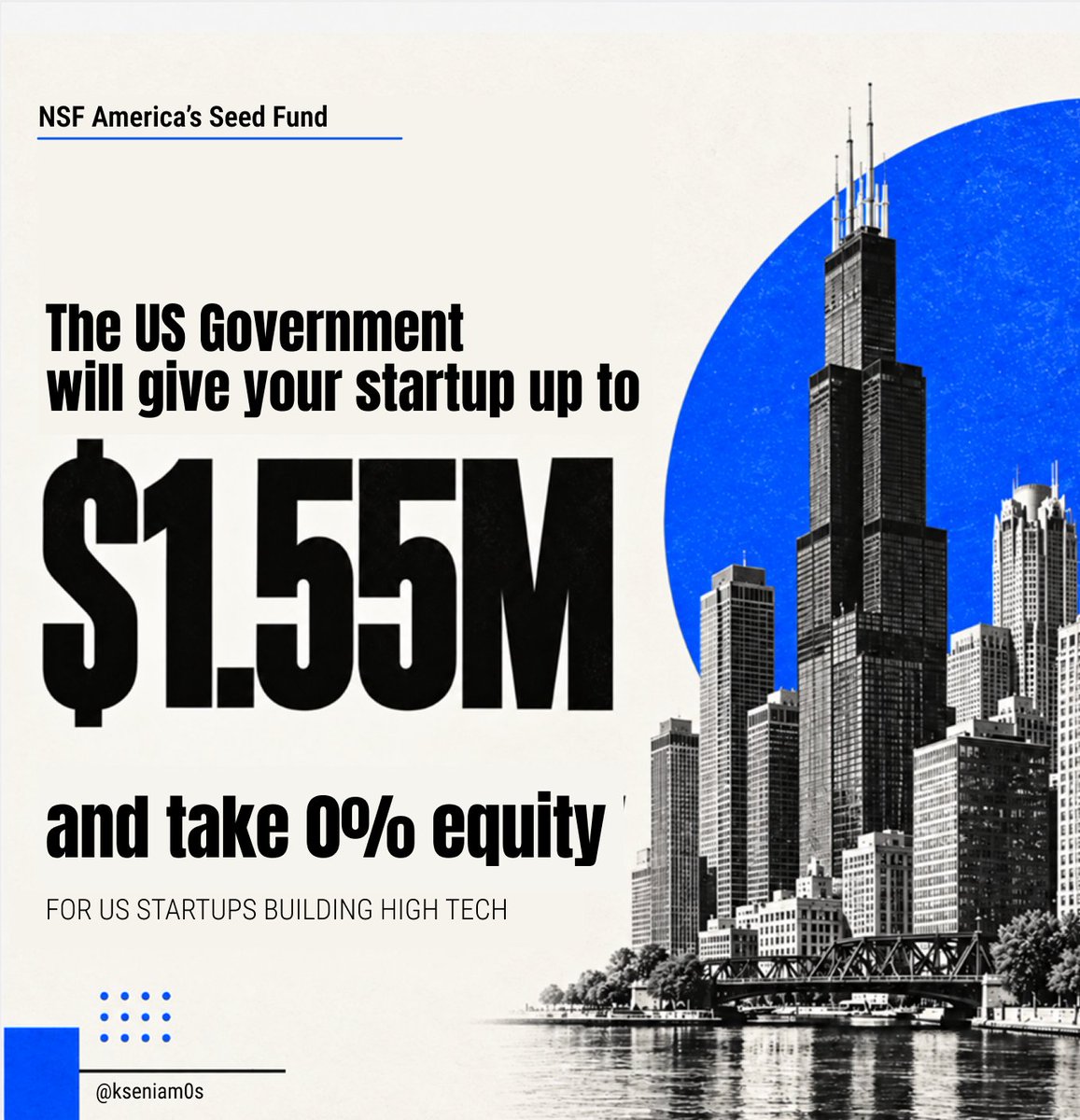
Ksenia Moskalenko reports that the NSF America's Seed Fund has reopened after reauthorization, offering non-dilutive funding up to $1.55M across three tracks. The post lists eligibility rules, a 3-page pitch step, and a November 4 full-proposal deadline.
The US government will give your startup up to $1.55M and take 0% equity.
@NSF's America's Seed Fund is open again after Congress reauthorized it in April.
Three tracks: - Phase I: up to $305K to prove the idea - Phase II: up to $1.25M to build it - Fast-Track: up to $1.55M, both phases in one go
Who can apply: - US-based startups with 500 or fewer employees - 51%+ owned by US citizens or permanent residents - Not majority owned by VCs - All the work done in the US
How it works: - Send a 3-page Project Pitch first - NSF invites the best ones to submit a full proposal - Next full proposal deadline: Nov 4
Phase I funding rates have run about 10 to 20%. It's work, but nobody takes your cap table.
Pieter Levels criticizes Airbnb's review policy after the company stated that hosts cannot delete reviews, while hundreds of guests report removed reviews. He argues that removing reviews on host request undermines trust in the platform's ratings.
The replies here are literally hundreds of people who got their reviews removed directly contradicting what Airbnb says here
The "policy" they have seems to be to remove a guest's review and rating whenever a host asks for it
I don't get why they don't just fix this? Everyone would love to see Airbnb have honest reviews and ratings you can trust
Short term you might get more bookings if everything is a 4.5 or 4.99 but long term people discover it means nothing and they can't trust your platform and they leave elsewhere
I think they're in some internal gridlock by MBAs who want to see revenue go up, not realizing that they're destroying a company
Valon announced a Series D round that doubled its valuation to $2.3 billion, backed by Ribbit Capital and a16z. Angela Strange says Valon now runs about one in six U.S. mortgages on its ValonOS platform.
Paraphrasing Jensen: "It's not AI that's your competition, it's your competitors adopting AI faster than you". For those who thought mortgage would never modernize -- Valon has now contracted 1 in 6 mortgages in this $13T industry onto ValonOS.
So excited to announce that @Valon has raised a Series D, doubling our valuation to $2.3B 📷
I’m incredibly proud of our team and grateful to our customers and partners. Huge thank you to @RibbitCapital@a16z and everyone who continue to support us!
Mark Pincus, quoted by Sam Parr, argues that mature markets such as video games look dead to VCs yet hold large revenue pools. He says consumer is uninvestable today, much as games were in 2007, and urges founders to build there anyway.
On My First Million, Mark Pincus laid out the whole Zynga thesis. Find a mature market that's dead and played out, that VCs won't touch, but that still has a lot of money in it.
For him that was video games. In 2007 it was a $23b industry, barely growing, not fundable. Today it's $283b and still not fundable. His line: we're living in 2007 again, consumer isn't investable, so go do consumer.
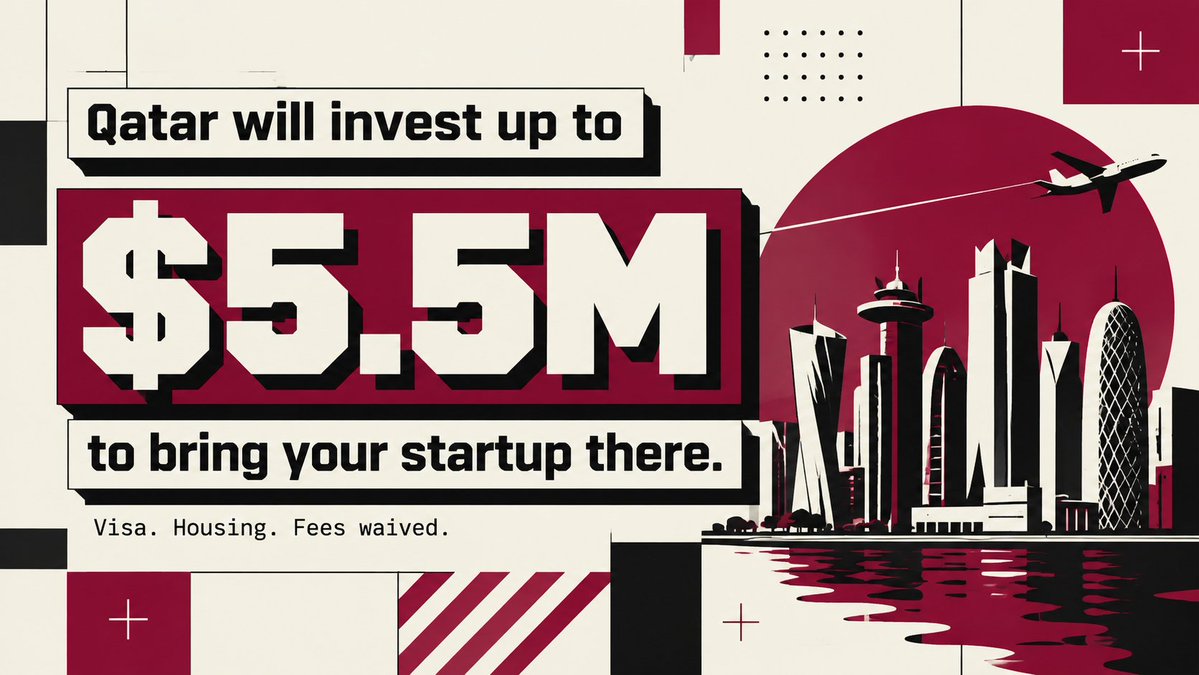
Aakash Gupta analyzes the Startup Qatar Investment Program, backed by Qatar Development Bank, which offers equity checks up to $5.5M with mandatory relocation, comparing it to Singapore's 1960s incentive playbook and noting retention as the open challenge. He quotes Suraj Sharma's summary of the two tracks and perks.
Qatar's entire startup ecosystem raised $11M in venture capital in 2023. This new program writes single checks of $5.5M. One company can now land half the country's annual VC flow just by agreeing to move to Doha.
Here's the mechanism underneath it. Cities with real startup density charge you to be there. San Francisco collects it in rent, New York collects it in salaries, and founders pay gladly because the customers, talent, and capital are all within a mile. Cities without that density have to run the trade in reverse. They pay you.
So the $5.5M is Doha putting a price on the network effects it doesn't have yet.
The regional race explains the urgency. Saudi Arabia pulled in $1.4B of venture funding in 2023, 52% of all MENA. The UAE led the region in deal count. Qatar took 6% of deals. In a three-country contest for Gulf tech, third place pays cash.
The structure shows how targeted this is. It's equity, drawn from a $100M fund managed by Qatar Development Bank, disbursed on milestones, and relocation is mandatory. A $100M fund writing checks up to $5.5M caps out around 18 companies at the top track. They're running an auction for a few dozen anchor startups, and the visas and subsidized housing exist to tip founders who are already indifferent between Gulf cities.
This playbook has worked before. Singapore's Economic Development Board spent the late 1960s paying companies to show up, and Texas Instruments went from decision to production in Singapore in about 50 days in 1968. GDP per capita there was around $500 at the time. Today it's roughly $90,000.
The unsolved part is retention. Checks get companies to land. Density is what makes them stay, and density only arrives after enough checks pile up in the same place at the same time. Singapore cleared that threshold. Qatar is betting $100M it can too.
The Startup Qatar Investment Program (backed by QDB) funds tech startups to launch or expand in Qatar.
Two tracks: START: up to $1.1M if you have a proof of concept or MVP GROW: up to $5.5M if you're already established and expanding
What else you get: - Entrepreneur visa + flexible work visa - Registration and license fees waived - Subsidized housing - Subsidized co-working space - Access to R&D and innovation grants - Mentoring, training + help hiring talent and interns - Your product showcased at exhibitions …
A writer met two brothers who went from posting breathwork videos to an app that has generated over $85,000, and asked them about their development tools and stack. The post includes photos but little detailed text.
Suraj Sharma shares details of the Startup Qatar Investment Program, backed by QDB, offering up to $1.1M to early-stage startups and up to $5.5M to established firms expanding to Qatar, along with visas, fee waivers and subsidized housing and co-working space. Eligible sectors include AI, fintech and climate tech.
The Startup Qatar Investment Program (backed by QDB) funds tech startups to launch or expand in Qatar.
Two tracks: START: up to $1.1M if you have a proof of concept or MVP GROW: up to $5.5M if you're already established and expanding
What else you get: - Entrepreneur visa + flexible work visa - Registration and license fees waived - Subsidized housing - Subsidized co-working space - Access to R&D and innovation grants - Mentoring, training + help hiring talent and interns - Your product showcased at exhibitions
Sectors they want: - AI & ML, B2B SaaS, FinTech, HealthTech, Cybersecurity, Climate Tech, Robotics + more - Not on the list? It's open to any innovative startup
Josh Elman praises Muse Gadgets, an open source hardware site where users build devices by programming ESP32 boards or Raspberry Pis to connect with Muse. He says consumer hardware may be returning and notes early marketplace questions to solve.
This is so incredibly cool and an amazing inspiration for a rich hardware ecosystem. Can’t wait to see the innovation here . Not just consumer is back, but consumer hardware may be back too!
Ernesto Lopez describes how his app Prayer Lock grew from $0 to $150,000 per month after a $40,000 co-founder equity investment, reaching No. 6 on the App Store. He also cites AI novel apps reportedly earning $800 million a year and links a full write-up.
How we scaled our app from $0 to $150,000/mo — This is the story of our app Prayer Lock. An app I invested $40,000 in to buy 50% equity as co-founder. The story of how we made it to #6 on the App Store and beat app studios with $100M+ in funding
In a video clip, product veteran Marty Cagan argues that fundamentally good product work centers on thinking, and says he underestimated how far people will go to avoid it.
Bill D'Alessandro announces a long-term partnership with Acquisition Lab as presenting sponsor of the Acquisitions Anonymous podcast, which serves the search fund and acquisition entrepreneur community.
We are pumped to announce a long term partnership with @Acquisition_Lab - they’re the go-to place for acquisition entrepreneurs to learn and grow, and a key part of the ETA ecosystem. We’re excited to have them as presenting sponsor!
Shopify president Harley Finkelstein endorses Canvas, a new tool built by Benjamin Sehl, who draws on his experience building Kotn's first store to create a more accessible way to build online stores.
He sees it from both sides: the merchant with a store in his head, and the dev who knows what it takes to get it into the code. That’s the uncommon lens Canvas needs.
The store you can picture is the store you can build. Can’t wait to see what everyone makes.
When I built @kotn’s first store 12 years ago, I knew how to code and it still took me two weeks just to get to something OK, years to get to something I liked.
We built the tool I wish I had back then. Here’s Canvas.
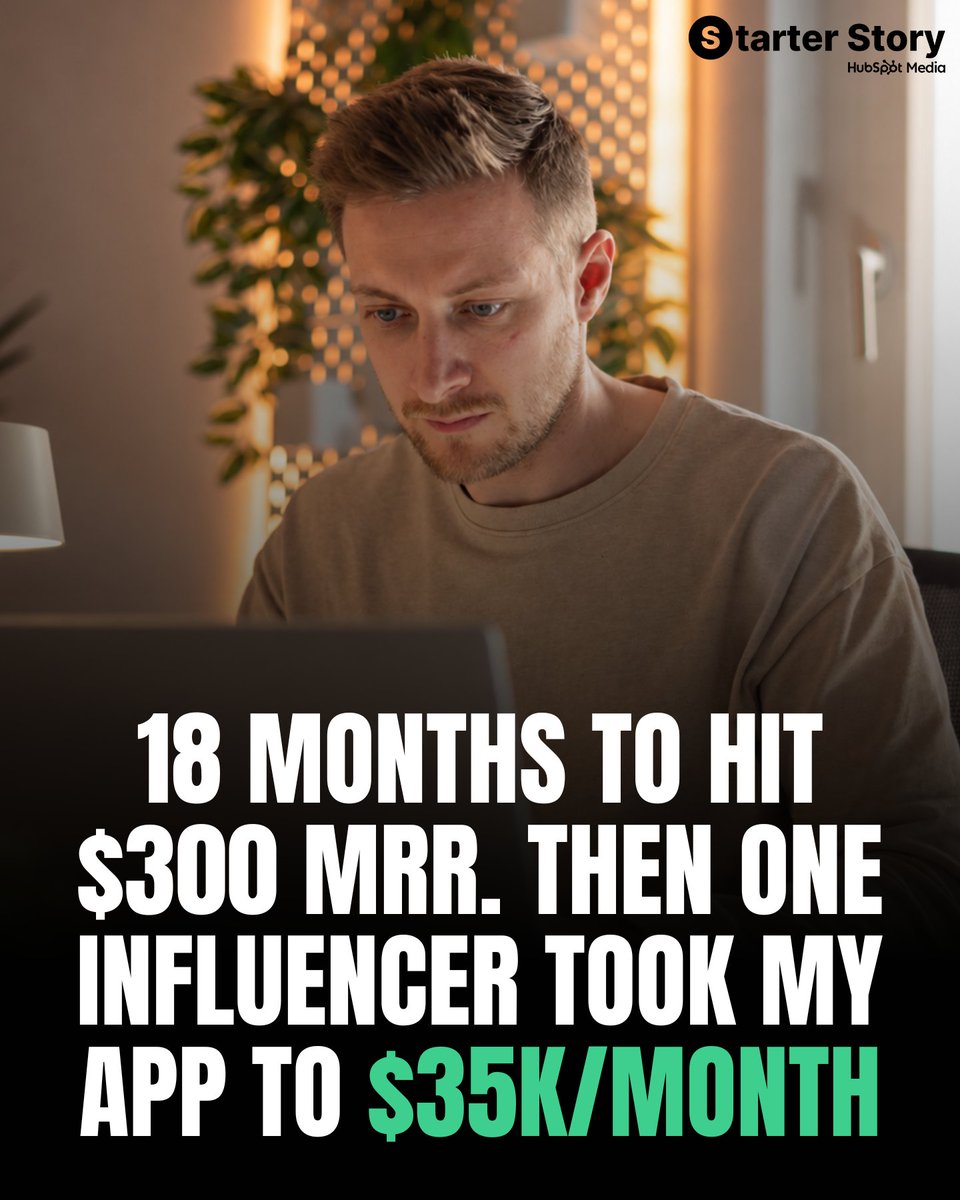
Starter Story describes how German developer Flo grew his AI expense tracker Mon.ai from $300 to $35K monthly after partnering with a Colombian content creator on a profit-share deal. The post outlines the strategy and a partner-finding playbook.
This guy’s app was stuck at $300/month for 18 months. Then he partnered with ONE influencer and hit $35K/month in a year.
Meet Flo - a German solo dev who built Mon.ai, an AI-powered expense tracker. He spent a year and a half trying every distribution channel by himself. Barely made a few hundred bucks.
Then a Colombian content creator found his socials inside the app and reached out. They negotiated a deal: fixed monthly retainer + percentage of PROFITS (not revenue - that didn’t scale).
Only 3 videos a month. High quality, story-driven. That’s it.
The first video? Just a simple walkthrough. Within a week they 10x’d MRR. Within a month they were at $8K.
Then $13K. Then Apple invited them to WWDC together - that video did 1.7M views and added $5K MRR. Latest feature video pushed them past $35K.
Total growth: 10,000%.
Why it worked:
> Skin in the game. Profit share = he thinks like an owner, not a contractor > Quality over quantity. 3 videos > 100 spammy TikToks > Look OUTSIDE the US. The Colombian market was wide open > Put your socials IN the app so creators can find you
Flo’s playbook for finding your own partner:
1. Align on lifestyle, tone, audience 2. Warm up the relationship (follow, comment, be real) 3. Reference a specific video in your outreach 4. Connect the dots to your product 5. Signal willingness to pay early, show them the ceiling
Takeaway: You probably don’t have a product problem. You most likely have a distribution problem.
Clay CEO Kareem Amin says the company is targeting $240 million in annual recurring revenue this year, expects to double next year, serves almost 18,000 customers, and plans to evolve its product into an agent that suggests the next best action to grow.
- targeting $240M ARR this year, doubling next year - almost 18,000 customers - goal is to evolve product an agent that outputs "next best action to grow"
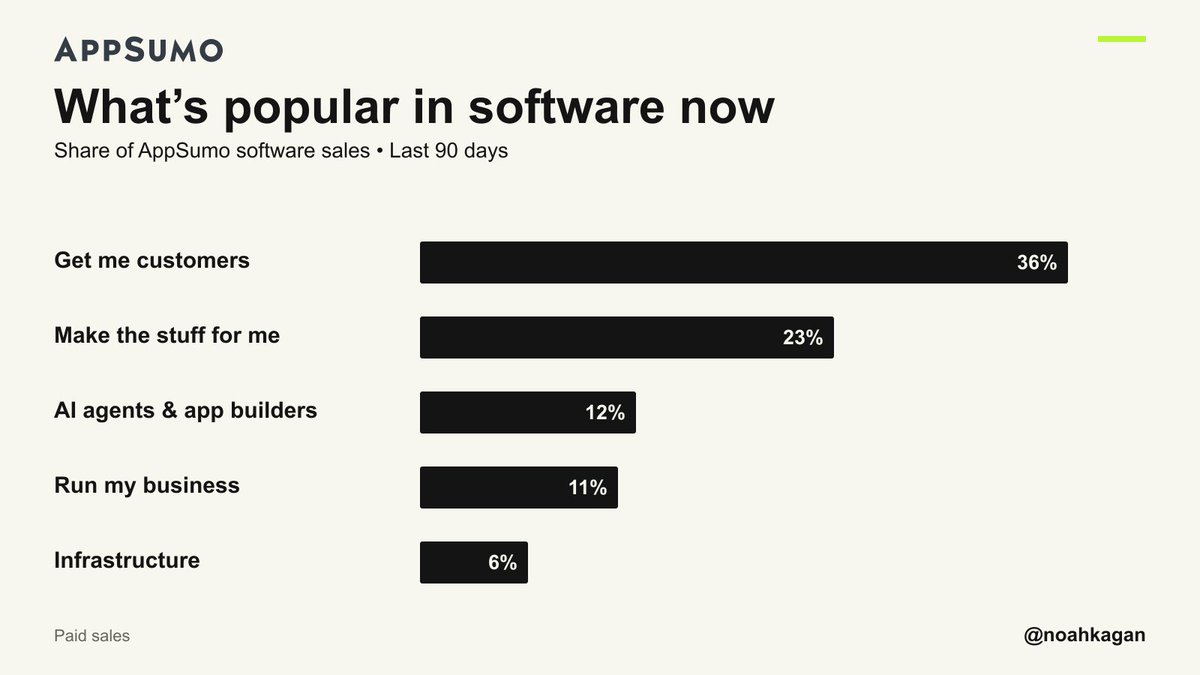
Noah Kagan reviews $46 million of AppSumo software sales, finding customer acquisition tools lead at 36%, AI content tools at 23% and infrastructure declining. He advises founders to sell outcomes, deliver results for customers, and charge for usage when products consume tokens.
36% Get me customers (outbound, SEO, social) 23% Make the stuff for me (AI writing, voice, video) 12% AI agents and app builders 11% Run my business (calendar, CRM) 6% Infrastructure (email, hosting, backend)
AI content tools more than doubled in a year.
Infrastructure is on the decline.
Software isn't dead. Software you have to manage is.
If you're building today:
1- Sell the outcome. "10 booked calls" beats "outreach platform." 2- Get people customers or do the work for them. Nothing in between. 3- If your product burns tokens, charge for usage.
Rahul Mathur highlights a conversation between Patrick O'Shaughnessy and Noah Shinn, founder of invite-only personal AI assistant Instinct. Mathur cites $1 billion in annualized booking value, 50% of volume in travel, and daily growth of about 10% with no marketing.
- $1bn of booking value (annualized) - 50% of txn volume is Travel - 40% users give CC data in 3 weeks - Growing 10% daily (nil marketing)
23 yr old founder Noah spends 40% of his time procuring compute
The highlight is Noah's clarity on the path forward i.e. users shouldn't develop a parasocial relationship, A2A comms between Instinct agents to plan activities & keeping the agent free for 1bn+ people 🤯
This is a must-listen conversation on the future of personal agents & consumer AI
My conversation with Noah Shinn (@noahrshinn), founder of Instinct.
Noah is building a personal AI assistant. It's still invite only, has spent nothing on marketing, and is growing roughly 10% A DAY.
This is his first long conversation about the company.
We discuss: - Why Instinct doesn't have an app - Buying compute months ahead of exponential demand - How users learn to trust it with a credit card - Safety and security - Agents coordinating with other people's agents - Instinct's business model - Apps built on consumer inertia - and more