Akshay Pachaar describes HarnessRouter, an open-source layer that runs multiple agent harnesses, including Codex, Claude Code, Hermes and Jev's System One, under one interface via the Unified Harness Protocol. He links to the repository and a related article.
Devs just open-sourced a plug-and-play infrastructure layer that lets you run any harness under a single interface, like:
- Codex - Hermes - Claude code - DeepSeek Harness - System One, powered by Jev - And 9 more agent harnesses
This means you can bring Jev into the same product that already uses Codex, Claude Code, or another supported harness, without writing another implementation for sessions, streaming, files, cancellation, and failure handling.
The harnesses run locally, and the Unified Harness Protocol (UHP) defines the common task interface with an OpenAI Responses-compatible API.
If you want to dive deeper, my recent article explains why model routing is not the same as harness routing, and what it takes to support multiple harnesses.
It also covers UHP, the full local setup, a working API call, and how sessions and files work.
Run Any Agent Harness Under One Interface — How UHP and HarnessRouter standardize agent execution across Codex, Claude Code, Hermes, and other runtimes.
When an agent product integrates one harness directly, its backend starts depending on
Nikita Bier says the Muse app's auto-negotiation feature on Facebook Marketplace was escalated to Mark Zuckerberg, who reportedly approved it despite concerns that lowball bots could harm the product. The post is presented as evidence of how much Meta values AI.
David Sinclair promotes an amino acid he calls his favorite, which he says is found in asteroids and tastes as sweet as sugar, citing his PhD research. He links to a new episode of his YouTube show.
Nandakishor M, creator of the Laya course, says he is now competing with Jev and teaches generative AI to a wide audience through Instagram. The post links to his Instagram profile, which has about 18,000 followers.
Those who are wondering, I am Nandakishor M, the creator of Laya, now competing against Jev. Just a simple guy from a small village in Kerala just teaching generative AI to everyone through instagram!!! instagram.com/nandakishor_m/
David Sinclair amplifies a post citing a 2019 JAMA study of nearly 7,000 adults, which found that a strong sense of purpose was associated with lower mortality independent of wealth, health, exercise and depression. The original post stresses purpose as daily actions that matter beyond oneself.
Having a reason to get up in the morning cuts your risk of dying by more than half. A 2019 JAMA study of nearly 7,000 adults found that people with the strongest sense of purpose had the lowest mortality, and the effect was independent of wealth, health, exercise, and depression.
Purpose does not mean ambition. It means feeling that your daily actions matter to something beyond yourself. A grandparent raising a garden. A retired teacher who tutors. A caregiver who shows up every morning. The research does not measure achievement. It measures the feeling that what you do connects to something.…
David Sinclair shares a paper arguing that death is increasingly preceded by long periods of decline marked by multimorbidity, which he calls slow dying. He argues that efforts should target the biology of aging rather than its symptoms.
"Death is now less often sudden and more often preceded by prolonged periods of decline characterized by multimorbidity. This ‘slow dying’ has profound implications"
Hank Couture notes that Venky Ganesan, a partner at Menlo Ventures, wrote a thoughtful piece on venture capital, and points out Menlo invested in Anthropic early, when it was pre-revenue in 2023. The post praises the essay as a great read.
A few thoughts on the current state of venture capital.
When the Music Is Playing
In July 2007, a few weeks before the credit markets seized up, Chuck Prince, then the CEO of Citigroup, gave an interview to the Financial Times. The line everyone remembers is this one: "As long as the music is playing, you've got to get up and dance." He was mocked for it for years afterward, and he lost his job a few months later. But I have come to think he was saying something honest. He wasn't claiming the music would play forever. He was admitting that he couldn't sit down while it was still going, and n…
Tanay Jaipuria lists the resources given to Muse users' virtual machines, including 2 vCPUs from a 126-core AMD EPYC, 8GB of RAM, 100GB of persistent disk and Ubuntu 24.04.
Venky Ganesan of Menlo Ventures argues that venture capital is in a disorienting period, with some portfolio companies growing fast while pre-revenue startups raise billions at $10 to $50 billion valuations. He frames the moment through Chuck Prince's 2007 quote and George Soros's idea of reflexivity.
A few thoughts on the current state of venture capital.
When the Music Is Playing
In July 2007, a few weeks before the credit markets seized up, Chuck Prince, then the CEO of Citigroup, gave an interview to the Financial Times. The line everyone remembers is this one: "As long as the music is playing, you've got to get up and dance." He was mocked for it for years afterward, and he lost his job a few months later. But I have come to think he was saying something honest. He wasn't claiming the music would play forever. He was admitting that he couldn't sit down while it was still going, and neither could anyone else in his seat.
I've been thinking about that quote a lot lately, because right now is the most disorienting period in venture capital I can remember, and I have been doing this for a while.
Here is what makes it disorienting. It's not that things are bad. Some things are spectacular. We have companies in our portfolio growing faster than anything I have seen in my career, and I don't say that lightly. At the same time, we have companies with no revenue, no product, and a founding team you could fit in a conference room raising billions of dollars at valuations of $10 to $50 billion. Both of these things are true at once, and if you try to reason about them with the same framework you will drive yourself crazy.
Two ideas have helped me make sense of it. Neither is mine.
The first is reflexivity, which George Soros has been writing about since the 1980s. In most of life, perception follows reality: the weather is what it is, and your opinion of it changes nothing. In markets, it runs the other way too. Prices change what participants believe, and what participants believe changes the prices. The feedback loop can run for a long time, and while it's running it looks exactly like progress.
Here is how reflexivity is playing out in AI. Full disclosure: Menlo is an investor in Anthropic, so read the following with that in mind. People watched a frontier lab go from a $4 billion valuation to $18 billion, then $60 billion, then $180 billion, then $380 billion, and now something close to a trillion. They drew the obvious conclusion: that is what a neo lab looks like. So the next neo lab gets priced off that path, not off anything it has built. Then it gets marked up in a subsequent round, and the markup itself becomes the proof. Look at Thinking Machines. Look at Reflection. At that point valuation has stopped being an output of the metrics and has become the metric. Nobody is discounting cash flows. They are discounting the last round.
Soros is very clear about one thing, and it's the part people skip: you cannot know when or how a reflexive process ends. You only know that it does. Every one of them has.
The second idea is Chuck Prince's, and it explains why smart people keep dancing even when they can see the loop for what it is. As far as I can tell, there are two groups on the dance floor.
The first group got in early. Firms like ours were in some of these AI companies before the numbers got silly, and the paper gains are enormous. When you are sitting on gains like that, you start to feel like you're playing with house money. I have been around long enough to know that house money is the most dangerous kind, because you don't respect it the way you respect money you had to earn.
The second group missed the early rounds and knows it. Their LPs know it too. So they are trying to make up for lost time by writing very large checks very late, which is the one strategy almost guaranteed to turn a missed opportunity into a real loss.
House money on one side, FOMO on the other, and reflexivity feeding both. That's the whole story. Everyone has a reason to keep dancing, and the reasons are different, which is why nobody can talk anyone else off the floor.
So what do you do? The instinct in our business is to answer with company identification: just pick the right neo lab and you'll be fine. I think that's the trap. When price has become the signal, being right about the company is not enough, because you can be right about the company and still be wrong about the price by a factor of ten. The public-market investors I admire figured this out a long time ago. They spend as much time on how much to own as on what to own.
The winners in venture over the next decade will be the firms that treat portfolio composition and position sizing as seriously as they treat sourcing. How much of the fund is in companies whose valuation rests on the last round rather than on revenue? What happens to the portfolio if the reflexive loop breaks next year instead of in five? Those are not exciting questions. They are the ones that will matter.
The music will stop. It always does. Dance if you must, but know where the chairs are.
Tobi Lütke responds to a report that KDE's draft AI policy discourages disclosing LLM use, saying code should be accepted on merit with a human accountable for it. He says good code is good and slop is slop regardless of how it was made.
This is the way. Accept code on merit and ensure that a person takes accountability for it. Doesn’t matter if it was typed, chiseled, generated, or bit-flipped via magnetized needle on a chip.
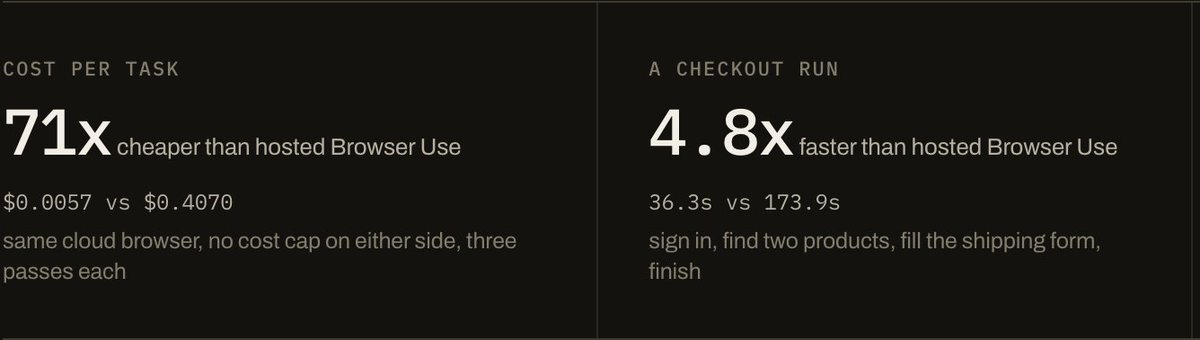
Furqan Rydhan introduces fastbrowse, an experimental open-source browser agent where an LLM plans actions and each claim cites an exact quote from the page. He says it is significantly cheaper and faster for agents to browse the web.
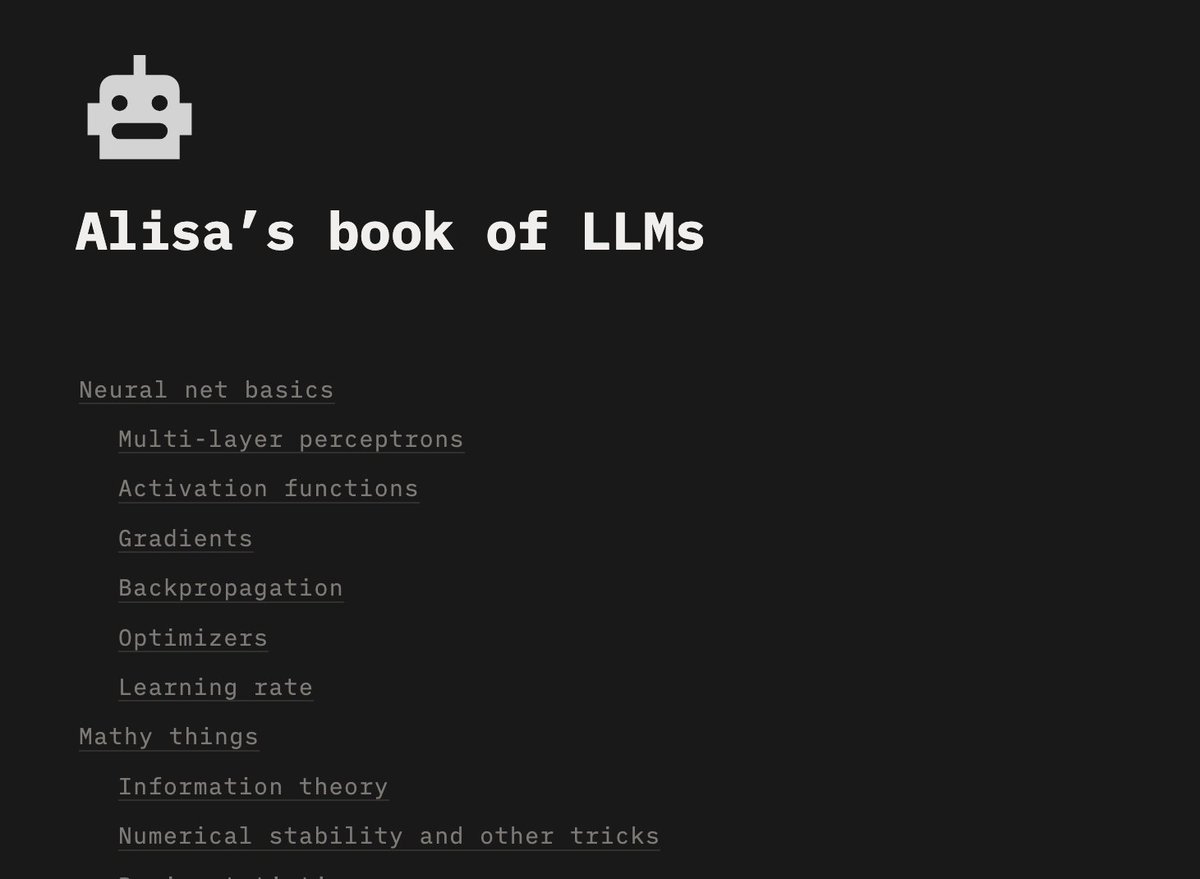
Md Ismail Šojal says OpenAI researcher Alisa Liu open-sourced her study notes from 57 interviews before joining OpenAI, including LLM and math materials and a write-up of the hiring process. The post recommends the material to candidates preparing for research scientist roles.
Sheema Moto relays a post from SpaceXAI engineer Peng Zheng, who says he moved from 250 unsuccessful applications to a $850,000 offer by running about 20 agents managed by a Chief of Staff agent. The post promotes a 40-minute workshop on GrokBot and agent automation.
"250 applications, two years, zero offers. Then he stopped applying as one engineer and showed up as one engineer running 20 agents. We offered him $850,000.
I don't use GrokBot like Google anymore. I built a 24/7 system once - now it automates 95% of my life and work every day. Only 1% of people run a single Chief of Staff agent that manages the other ~20 agents and knows everything about them.
That's not a skill gap. That's a stack gap, and it takes one evening to close."
GrokBot → Chief of Staff → 20 Agents → Auto-Delegation → 24/7 System
In a 40-minute workshop, SpaceXAI engineers show how to stop managing every agent by hand - and how they actually use GrokBot.
Research → Build → Launch → Improve
This will save you 20 hours of useless agent tutorials.
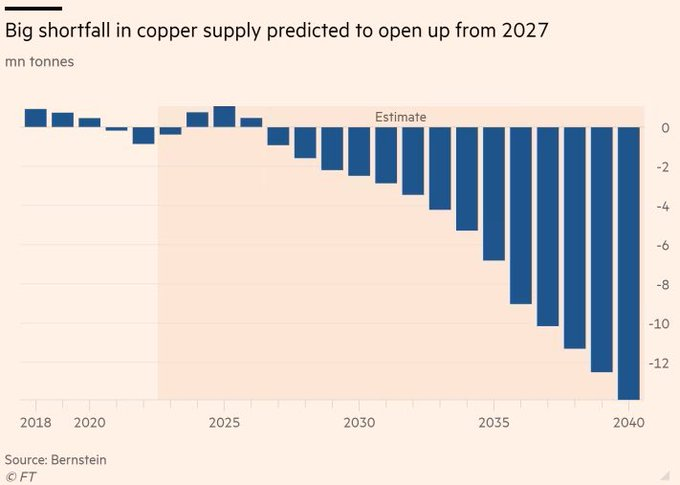
Unusual Whales shares a Financial Times report projecting a significant copper shortfall beginning in 2027. The post includes a photo but little additional text.
Investor Hamid says his public portfolio has returned 812% against 83% for the S&P 500 over about 4.5 years. He highlights recent bets on Micron, Meta and Rivian, while noting he does not give investment advice.
My portfolio (+812%) vs. S&P 500 (+83%). In 4 1/2 years since my portfolio has been public, I've outperformed the S&P 500 by ~10x.
I've been told consistently that it's nearly impossible to beat the S&P 500, yet I've been doing just that for ~25 years! Kind of wild.
What am I buying now? My portfolio is public and 100% free (link in bio). But if you must know, this year, I've been going heavy into $MU (my AI semiconductor bet, trading at a ridiculous forward PE of just 7, or a 70% discount to FPE of the S&P500), $META (my overall "amazing business" that's growing faster than peers with huge AI upside, yet trading at a massive discount) and $RIVN (my "future is EVs + Autonomy" bet, but on a company that has a ridiculously low valuation of just $22 Billion rather than $1.4 Trillion!).
I share my views and what I'm doing publicly, including alerts of when I make trades, but I don't give investment advice. Everything I share is for awareness and helping others learn from my transactions.
If it's helped you in any way, comment and say hi!
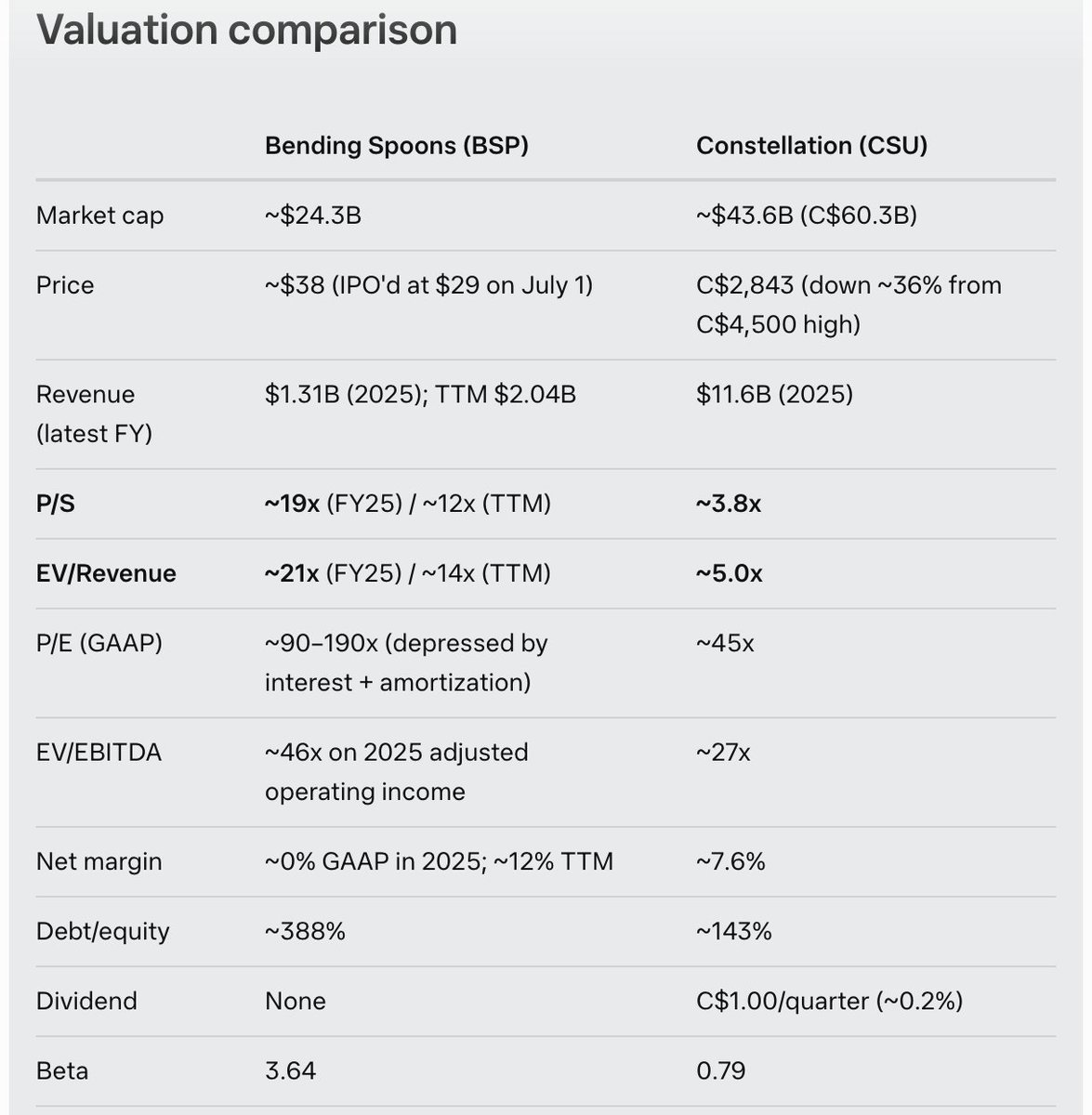
Rohit Mittal contrasts Bending Spoons and Constellation Software, arguing Bending Spoons' growth is financed on heavy debt while Constellation deleverages quickly. He cites valuation multiples, organic growth declines and interest expense as a share of revenue.
Venture folks are sophisticated about venture investments, but they put all acquirers in the same bucket.
Software company acquirers can look very different depending on: - who they acquire (types of companies) - how they grow - how they generate profits - how they finance acquisitions - revenue and profit stability
Bending Spoons has completed 50 acquisitions, while Constellation has acquired 1,400 companies.
Bending Spoons is trading at 19x FY25 sales, while Constellation trades at 3.8x.
Bending Spoons is growing at 100%+ with acquisitions, while Constellation is growing at 20%.
But they are both growing 3%-5% organically.
Bending Spoons' organic rate has halved two quarters in a row (13% → 6% → 3%).
Bending Spoons carries roughly 8–10x more debt relative to revenue than Constellation.
Bending Spoons has a much higher net debt-to-revenue ratio at 3.1x, while Constellation is at 0.2x- 0.4x.
For Bending Spoons, interest expense is 11% of revenue, while for Constellation, it's 2.6%.
Constellation can deleverage quickly, while Bending Spoons needs the next deal to pay for the previous deal.
Overall, Bending Spoons' growth is bought on credit.
Each company took a different approach to compounding revenue and cash flows, and the valuations will eventually reflect that.
Jim Axelrod shares a CBS Sunday segment profiling a 29-year-old who wagers as much as his salary on sports bets daily. Interviewees described sports betting as America's next opioid crisis.
A 29-year-old pest control salesman says he bets on sports every day, wagering between $80,000 and $120,000 a year — as much as or more than his $97,000 salary.
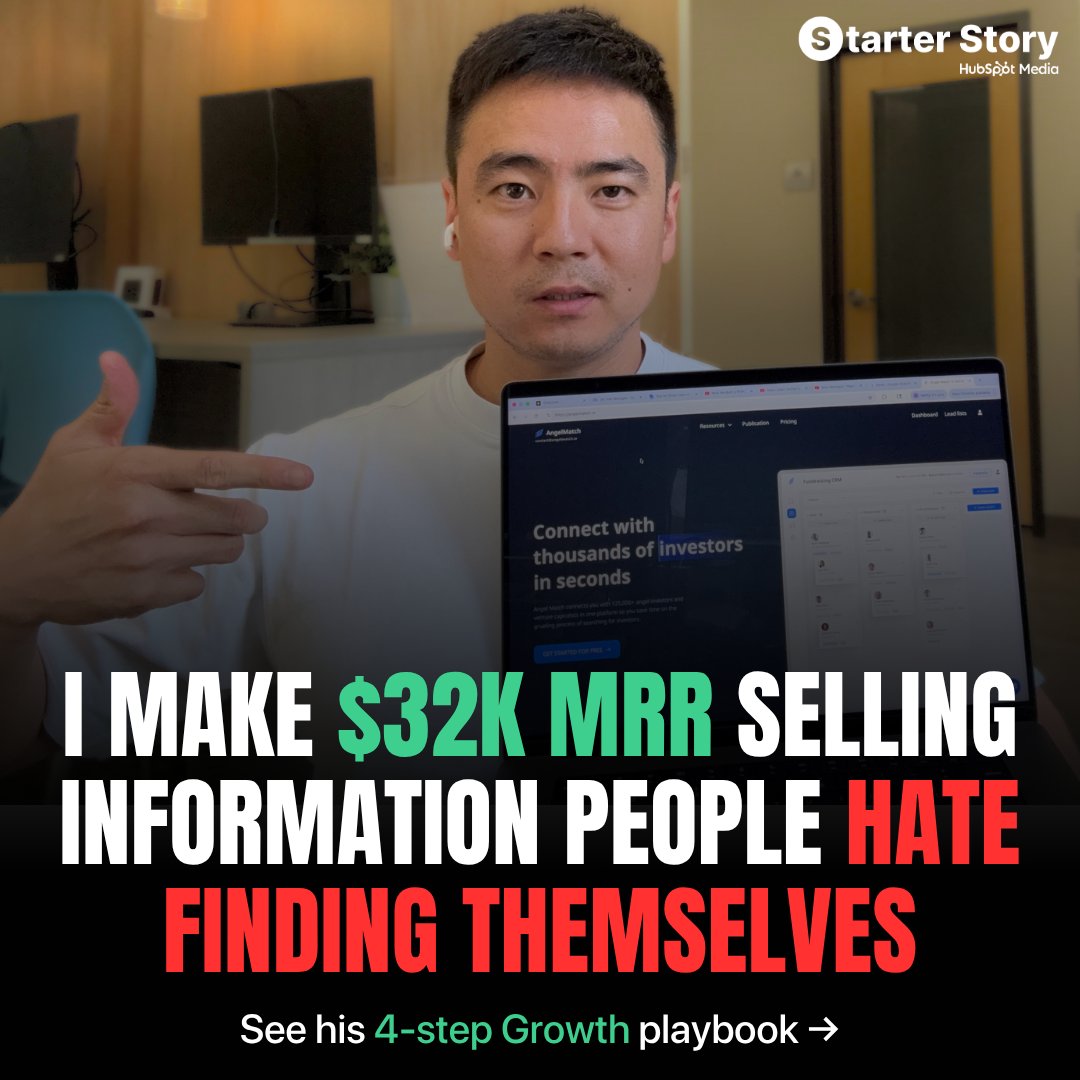
Starter Story profiles Rashid, who built a manually compiled investor database into AngelMatch at $29K MRR, then cloned the model with InvestorHunt and JournalistHunt. Half his revenue comes from programmatic SEO, and the post outlines a three-step playbook.
He built 3 boring websites that pay him $32K/month - no AI trend, no fancy features, just databases.
Rashid isn’t a coder. He studied finance, maxed out credit cards raising $100K for a fintech, and while hunting for investors he realized: finding this list is brutal.
So he manually built a list of 40,000 investors, launched on Product Hunt, and made $4K in month one.
That became AngelMatch - now at $29K MRR with 360 subscribers, a 33% trial conversion, and 800–1,000 clicks a day. Pricing starts at $59/mo and goes into the thousands.
Then he cloned the model:
> InvestorHunt - $2,800/mo, pure SEO, zero marketing > JournalistHunt - a database of 200,000 journalists at $49–$99 tiers
The unlock? One day he saw 60 clicks/day in Google Analytics and thought: what if I 10x this? He hired 6 content writers, shipped free tools, and ran programmatic SEO for 8 months.
Went from $3K > $20K MRR. Peaked at $43K.
Half his revenue still comes from programmatic SEO.
His playbook for 2026:
1. Pick a database that solves a painful B2B problem 2. Collect the data manually (or scrape it) 3. Launch fast, get eyeballs, then double down on programmatic SEO
Ideas he’d build today: an influencer database sorted by niche + audience size. Or a newsletter sponsorship database.
The takeaway: boring beats trendy. Painful B2B problems + SEO compound for years while AI apps go to zero.
Dustin claims Mark Zuckerberg said buying Meta's AI bottleneck suppliers is the easiest path to wealth, then lists five stocks that could return 10x. The only pick shown is Nebius, with a video attached.
Jared Palmer announces Kev-0.6B, 4B and 8B, open source Apache 2.0 decision models built on Qwen3 with LoRA and a pointer head. He reports Kev-8B scores 79.6% out of domain versus 85.7% for Jev, and says the models are drop-in compatible with the TypeSafe API.
UPDATE: Kev-0.6B, 4B, and 8B are now available. Kev is a family of small open source Jev-like decision models you can train and run yourself.
This new family is based on Qwen3 using the same LoRA + small pointer head technique as before, but scaled up.
Out of domain, on data Kev never trained on: Kev-8B 79.6%, Jev 85.7%.
• Drop-in TypeSafe System One API; their SDK works with one `base_url` change • Kev-4B serves on a 32 GB Mac in bf16: ~300 ms for five questions, ~40 ms on an H100 • Repeated documents hit a KV cache: 2-2.5x faster • Apache 2.0 License. Kev-4B trains in 40 minutes on one H100. Kev-8B in 83 minutes.
Prajwal Tomar describes Jev, a free AI model built by a ChatGPT co-inventor that scores options rather than generating text. He argues this design avoids hallucination and makes decision-making cheap, and links to a post about building a harness with Jev.
Building a Harness with Jev — Agents run in a loop: an LLM decides what to do, a tool executes, a model evaluates the results, and then continues in that loop until the task is complete. Agents and LLMs were initially difficult to
Muhammad Ayan says Jev is now judging every small action on a computer and promises eleven use cases in the thread. The post contains only the headline claim and a list stub.
Chris lists ways to make money with Jev, including instant pricing, selling decision files for agents and monthly subscriptions, and running it on Hermes or Grok bots. He links to a full guide and includes a video.
it's a super fast decision model, so it picks an answer in a fifth of a second and tells you how sure it is
- put instant pricing on a business that has none - sell the same thing to bigger businesses for more - sell a file that decides what an agent may do - charge monthly to keep all of it running - costs a fraction of a cent per decision - runs on hermes or grok bot, on a schedule
just wrote a whole guide on how you can set this up:
how to make money with jev (FULL GUIDE) — jev is a new typesafe model that makes super fast decisions instead of writing. that opens up a bunch of revenue streams you can build and sell, and here are three of them. by the end of this guide
Deedy shares five uses for Muse and Instinct, including filing FOIA requests, issuing spend-limited cards, completing visa forms and buying reservations at opening time. He argues dark patterns on the web are being broken and that creativity now limits what is possible.
1. Submit FOIA requests to request data from the US government 2. Creating spend-limited Privacy cards to spend on subscriptions without having them recur 3. End to end filed an entire visa form for a country 4. Responded to a coordination mail for a wedding by finding the flight and hotel details 5. Look for reservations for restaurants or concerts when they open and purchase them immediately
A lot of the web was designed with dark patterns: increase friction to prevent enough humans from doing something, and now those walls are completely broken.
At this point, I feel like I’m squarely limited by creativity and understanding what is possible.
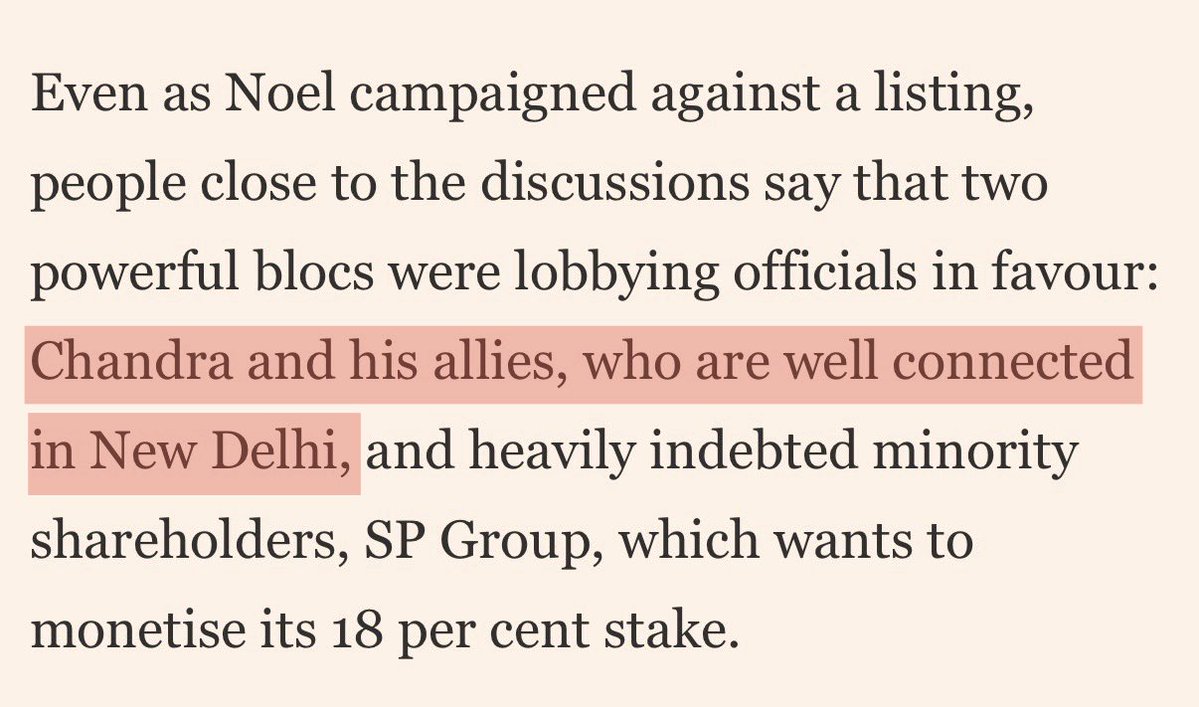
Churumuri shares a Financial Times account of Tata Sons chairman N. Chandrasekaran's ties to New Delhi and the risk of corporate raiders if Tata assets are exposed. The post adds commentary on Ratan Tata, Cyrus Mistry, the RBI and a Tata Sons listing.
"In the long run, it is only the Narendra Modi government that can protect the Tatas from being taken over by rapacious outside business interests," writes Coomi Kapoor in @IndianExpress
Yes, but what if the Awesome Twosome want precisely that to happen---to open the door for "India's most gifted businessman" after Tata Sons is listed on the bourses at gunpoint? #GujaratModel
👉🏾Ratan Tata intimating PMO upon ousting Cyrus Mistry 👉🏾 N. Chandrasekharan & Co meeting Amit Shah et al to resolve differnces 👉🏾 RBI taking a firm stand on Tata Sons listing---and filing a caveat 👉🏾 Maharashtra…
Josh Elman praises Peter Sellis, whom he has known since 2009 and credits with helping build the path to Snap and Discord's first $1 billion in revenue. He promotes Sellis's podcast discussion on managing Nikita Bier, why growth comes from the core, and designing teams like terrorist organizations.
90 minutes of unfiltered product advice from @petersellis
We discuss: 🔸 What it's really like to manage @nikitabier 🔸 Why growth almost always comes from the core 🔸 Why great taste is knowing when to stop 🔸 Why the median PM is so bad 🔸 Designing teams like terrorist organizations
Lenny Rachitsky shares a YouTube link to a 90-minute conversation with Peter Sellis. Topics include managing Nikita Bier, why growth comes from the core, why great taste means knowing when to stop, and why the median PM is weak.
90 minutes of unfiltered product advice from @petersellis
We discuss: 🔸 What it's really like to manage @nikitabier 🔸 Why growth almost always comes from the core 🔸 Why great taste is knowing when to stop 🔸 Why the median PM is so bad 🔸 Designing teams like terrorist organizations
Min Choi reports that Kevin Rose shared a Grok Bot that transcribes and analyzes a user's saved Instagram videos, building a searchable local markdown wiki in the style of Karpathy. The quoted post says the tool runs offline and uses Grok Voice Transcribe and Grok Vision, with X and TikTok support coming later.
Built this Grok Bot, fully offline index of all your saved instagram videos via @karpathy-wiki-style .md. Uses @bot, @grok Voice Transcribe 2.0, Grok Vision + more.
Bill D'Alessandro says Meta's Muse AI assistant continues to perform well and is built on OpenClaw under the hood. He suggests it may replace OpenClaw and Instinct for his own use.
Harrison Chase highlights LangChain's testing of Jev against LLM judges on accuracy, repeatability, latency and cost. He argues Jev's cheap, fast verifiers suit online evaluation of large numbers of agent traces.
We tested Jev against LLM judges on accuracy, repeatability, latency, and cost to see whether System One models could offer a new approach to agent evaluation.
 ▶
▶