Thursday, October 8, 2026ArchiveSearchAsk the paper

The Computomatix Times

All the posts fit to save — curated from @computomatix's bookmarks & likes on X

Search

Latest stories — use the filters to narrow by keyword, section or date.

Lenny Rachitsky Shares Thought on Customer Journey Focus

Lenny Rachitsky Shares Thought on Customer Journey Focus

Lenny Rachitsky shares a quote from @tfadell arguing that makers overlook the full customer journey while focusing on the product itself. Accompanied by a photo.

Original post · 1 min read
Love this reminder from @tfadell

"Makers often focus on the shiny object—the product they’re building—and forget about the rest of the journey until they’re almost ready to deliver it to the customer. But customers see it all, experience it all. They’re the ones taking the journey, step-by-step."
♥ 1.2K · ⟲ 128 · 👁 68.1KView on X ↗
AI8/10

Figure Demonstrates Autonomous Humanoid Robots Running Full Shift

Figure shares a livestream showing a team of humanoid robots running an 8-hour shift at human performance levels, fully autonomous and powered by its Helix-02 model.

Original post · 1 min read
Watch a team of humanoid robots running a full 8-hr shift at human performance levels. This is fully autonomous running Helix-02 x.com/i/broadcasts/1dJrPEVbZqOKX
♥ 10.7K · ⟲ 2.0K · 👁 2.8MView on X ↗

Brian Halligan Analyzes Jack Dorsey's New Org Playbook

Brian Halligan reflects on an interview with Jack Dorsey and Sequoia founders, arguing Dorsey's AI-era organizational approach departs from Andy Grove's playbook and proposing the name 'Dorsey Mode' for it.

Original post · 5 min read
I had a chance to interview @jack on Long Strange Trip and then sit in on his Q&A with a bunch of Sequoia founders yesterday. Here's my take followed by my takeaways.

Almost all of us are running a derivative of the playbook laid out in Andy Grove's "High Output Management" book that has been lightly edited down through the generations. Jack's set of ideas is a stark departure from that playbook. It reminds me of the shift I went through at the start of my career (pre web - yes, I'm that old!) to "digital transformation," but this is a much bigger, harder shift.

Some of my CEO friends have pushed back on these ideas saying something to the effect that Jack isn't a great CEO so we shouldn't listen to him. First, I'm not sure if that is true, but even if it is true, he is an undeniable innovator and first principles thinker applying that thinking here to org design, not just product design. Second, @brian_armstrong, a consensus great CEO is running something that sounds VERY similar to this playbook as well as almost every startup created in the last 18 months. Third, the first quarter Jack printed after putting this in place was a banger. ...To that end, I think we should all call this new playbook, "Dorsey Mode" after the guy who stuck his neck out.

If you want to run Dorsey Mode, a lot of things fall out of it that fall out of it:
1. Strategy - Planning cycles are out the window because the speed increases too much. All those 1 way doors you were procrastinating now look like 2 way doors.
2. Distribution - Given how much easier it is going to get to build products, competition and customer confusion will reign. In this new world, distribution is king. Companies with truly creative distribution strategies (rare!) will gain advantage. Also, long live ye olde enterprise sales.
3. Interviewing - All of the startups I work with have changed their interviewing process. Many have a case with a hard ai problem to solve embedded in it or at least have the prospective employee open their laptop and show them something interesting they built with ai. 4. Profile - There was a split in my group of CEOs at the Q&A -- some were learning hard into pilled jr engineers and some were leaning hard into very senior engineers. It roughly seems like the older companies with more code like Meta and HubSpot, are leaning harder into the very senior engineering types. ...Everyone seems keen to hire "curious" types not afraid to go very deep down rabbit holes.
5. Org shape - Triangle shaped org charts are like democracy, its the least bad system we've got. The biggest problem with triangles is that they get worse with size. The new org chart, in theory, is circular with the world model in the middle and very small teams surrounding it. Very few pure managers in the middle anymore. This seems "early," but directionally right to me.
6. Compensation - The difference between a middling employee and a top one is getting much wider which will necessitate a net new pay scale with a much higher standard deviation.
7. Titles - Jack got rid of them and is trying to focus everyone on the work as opposed to the level. As someone who tried this earlier in my career at HubSpot, I'm a little skeptical of this one, but the meta point of trying to focus people on what they "lead" versus who they "manage" is a good one that I hope sticks.
8 Decisions - Almost all decisions these days are made by carbon based life forms. Dorsey Mode turns an increasing amount of decisions over to the system.
9. IT - This is will totally change as their primary function will be to building the scaffolding for the world model and enable the company to keep feeding it the context and taste it will need to improve. EVERYTHING needs to be "legible" (I hate that I'm using that overused word, but it works) ...Btw, an early sign that a company is in Dorsey Mode is when they record every meeting, including the one on one's, cleverly stripping out some HR bits and centralizing them for use by the model. Btw, Ray Dalio had it right, but was just too early.
10. Slop - As more non-technical people build more things, there will be more slop. I didn't grok Jack's answer to this and I'm not sure the answer myself, but Dorsey Mode companies will need to figure out a system to reign in the badly designed systems.
11. Agency - This another word I cringe at using b/c it is so overused, but hiring folks with high agency that are self motivated will be key. The tricky part is that the beef with the current generation is that they are less like this than their predecessors.
12. CEO - This isn't something that will bubble up. The CEO needs to run hard at it and push it down hard and expect to get pushback from laggards. Jack spends 3 hours every morning building hard things with the new tools. ...AI isn't something that lends itself well to learning by reading or watching a video, so CEOs are running hackathons, show & tell's, building days, office hours, and token leader boards. ...Btw, lots of companies are doing the leader board thing (including mine) -- I think this works until it doesn't!
13. Budgets - Budgets in a lot of software orgs are basically enumerated in headcount. The denomination goes back to dollars.

As Jack (and my cofounder @Dharmesh) likes to say, in some cases, it is a lot riskier not to take a risk and this is one of those cases.
Ben Lang @benln
Jack Dorsey on how every company can now be a mini-AGI:
♥ 550 · ⟲ 51 · 👁 162.6KView on X ↗

Greg Isenberg Lists Opportunities in AI Agent Startups

Greg Isenberg lists over 30 observations on AI agent opportunities, including MCP servers for agent buyers, agent layers for franchises, agent marketplaces and memory as a moat.

Original post · 9 min read
My 30+ observations on the greatest opportunities in AI agents right now:

And some ideas that are keeping me up at night.

1. The new buyer on the internet is an AI agent. Imagine billions of new customers showing up with money to spend but they only shop via MCP. That's what's happening. No MCP server means you're invisible to the fastest growing buyer on the internet.

2. Every franchise system in America (30,000+) needs an agent layer and none of them have one. One founder per franchise vertical. That's 30,000 businesses waiting.

3. Everyone said "distribution is the only moat" a year ago. Now I'd add that the only moat is distribution plus memory. The company that has your audience AND your agent's accumulated context is impossible to leave.

4. Consumer mobile is more interesting than it's been since 2012. Apps can finally DO things for you instead of showing you things. The next wave of $100M apps are being built right now.

5. The most interesting startup nobody has built is an agent marketplace where you rent access to someone else's trained agent. A recruiter spent 6 months training a sourcing agent on healthcare hiring. That agent is worth renting to every other healthcare recruiter on earth. The agent itself becomes the product.

6. A sorta strange phenomenon that's happening right now is agents are developing preferences. Give the same agent the same task 100 times and it starts developing patterns in how it approaches it. Nobody is studying this yet. But the agents that develop good patterns are worth more than the ones that don't. That's a new kind of asset.

7. Dead internet theory is about to become dead SaaS theory. Half the apps you use will quietly replace their support team, their onboarding team, and their content team with agents. You won't notice for months. Then you'll realize you haven't talked to a human at that company in a year.

8. The most valuable data in the world right now is sitting in the support tickets of small or mid tier SaaS companies. Every ticket is a customer telling you exactly what to build next. Mine this.

9. The most interesting pricing problem nobody has solved is how do you price a product when your costs change every time OpenAI or Anthropic updates their model pricing? Your margins can swing 40% overnight based on a decision made in San Francisco. The company that builds dynamic pricing infrastructure for agent-based businesses solves a problem every AI company has.

10. The best AI products feel like they're reading your mind. The worst ones feel like filling out a form with extra steps.

11. An interesting arbitrage I've noticed lately is hiring a human VA for $20/hour to supervise an AI agent that does $200/hour work. The human just checks the output.

12. The managed AI agent business is becoming the new agency model. $5k/month per client. You build it, run it, maintain it. The client gets a digital employee they never have to think about. This will be a $50 B+ category.

13. The first "shadow agent" scandals are about to drop. Employees running personal agents on company infrastructure without telling anyone. Using company API keys. Agents accessing internal docs. IT departments have little visibility into this right now. Lots of opportunity to build companies here. Definitely a painkiller not a vitamin type of business.

14. Right now there are probably millions of agents running on autopilot that their creators forgot about. Still burning tokens. Still sending emails. Still scraping websites. Still costing money. The "find and kill your zombie agents" tool is a product that writes itself.

15. Companies are starting to hire based on someone's agent portfolio instead of their resume. "Show me 3 agents you built that are running right now." It's REALLY early but it's starting.

16. Your Slack archive is a product. Every company's internal Slack has thousands of messages explaining how they actually do things. The company that lets you point an agent at your Slack history and auto-generate SOPs and agents from it will be enormous.

17. We're watching the cost of intelligence fall faster than the cost of distribution. Which means distribution is now the expensive thing.

18. The most underrated asset a human can have in 2026: the ability to sit in a room with another human, make eye contact, and have a real conversation. As AI handles more of the transactional stuff, the humans who can do the relational stuff become disproportionately valuable. The soft skills people used to dismiss as fluffy are becoming the hard skills. The hard skills people spent decades acquiring are becoming the soft ones.

19. There are MANY huge companies to be built around the fact that most people's agents are running on their personal laptops which they also use to browse the internet, check email, and download random files. The attack surface is enormous. One compromised Chrome extension and your agent's API keys, customer data, and workflows are exposed.

20. There's a new type of burnout forming that doesn't have a name. It's not from working too hard. It's from context switching between human work and agent work 50 times a day. Reviewing agent output, correcting it, approving it, reviewing again. The mental load of supervising agents is different from the mental load of doing the work yourself. Some founders are telling me they were less tired when they did everything manually because at least the cognitive pattern was consistent.

21. The cheapest form of market research: search "[your industry] spreadsheet template" on Google. Whatever people are tracking manually is your product.

22. Half the YC companies pivoted within 8 weeks of demo day. Not because they failed. Because agents let them test 5 ideas in the time it used to take to test one. The concept of "committing to an idea" is dissolving. Serial pivoting is becoming the default because 1) AI lets you move fast 2) the world is moving fast.

23. The loneliest job in tech right now is being the only person at your company who understands what the agents are doing. You can't explain it to your boss. You can't hand it off to a colleague. If you leave, everything breaks. You've become a single point of failure for an entire automated system. That person needs a title, a team, and a backup plan. Most companies haven't figured this out yet.

24. Your browser history is the most valuable training data you own and you're giving it away for free. Every site you visit, every product you research, every competitor you study, every pricing page you screenshot. That behavioral data, structured and fed to an agent, would make it understand your business better than any onboarding call. The company that lets you turn your browser history into agent context builds something nobody can replicate.

25. Everyone is building AI wrappers. Nobody is building AI unwrappers. The tool that takes an AI-generated document and tells you which parts a human wrote and which parts were generated.

26. Stripe just became the most important company in the agent economy and they barely had to do anything. Every agent that sells something needs Stripe. Every agent that buys something needs Stripe. They're the payment rail for the entire agentic internet by default.

27. The most undervalued API in the world right now is the US Postal Service address verification API. It's practically free. Every local business lead gen agent needs it. Every real estate agent needs it. Every direct mail agent needs it. Boring government infrastructure is quietly becoming the backbone of agent-native businesses.

28. The concept of "business hours" is for humans. Your agent closed a deal in Tokyo at 3am, processed the payment, sent the onboarding email, and updated the CRM before your alarm went off.

29. What happens when agents start recommending other agents? Your research agent finds that a competitor's sales agent is better and suggests you switch. Agent referral networks are forming organically. The first agent affiliate program is probably 6 months away.

30. Cal dotcom closed their source code. That's the canary. When open source companies start closing up, it means agents were cloning their product too easily. Every open source company is quietly asking the same question right now.

31. "AI for pet groomers" sounds like a joke and that's exactly why it will work. 150,000 of them in America. Zero tech. All scheduling by phone or IG DMs. The joke ideas always win.

32. The thing that will seem most obvious in hindsight: we spent 2025-2026 arguing about which model is best while the entire value was in the orchestration layer. The model is the CPU. Nobody buys a computer based on the CPU anymore. They buy it based on what they can do with it. Makes so much sense in hindsight. What else will be obvious in hindsight?

I'll share more notes soon.

I can't sleep with all that's going on. Maybe you too.

What an incredible time to be building.
♥ 2.5K · ⟲ 279 · 👁 578.8KView on X ↗

Anthropic CFO Krishna Rao Discusses Compute and Financing

Anthropic CFO Krishna Rao Discusses Compute and Financing▶

Patrick O'Shaughnessy shares a podcast with Anthropic CFO Krishna Rao covering compute allocation across Trainium, TPUs and GPUs, roughly $75B raised, investor skepticism and platform strategy.

Original post · 1 min read
Krishna Rao is the CFO of Anthropic, and this is his first podcast appearance.

He joined the company two years ago when run-rate revenue was about $250M. Today it is $30B. He has helped raise ~$75B and is responsible for the procurement and allocation of compute.

I feel lucky we get to hear what it is like to sit inside a company this consequential at a moment this pivotal.

We discuss:
- The cone of uncertainty
- How he allocates compute across Trainium, TPUs, and GPUs
- What investors misunderstand about model companies
- Why the returns to frontier intelligence keep rising
- Platform vs application and where Anthropic builds its own products
- How Anthropic uses Claude internally

I have asked my closing question about the kindest thing more than 500 times. Krishna's answer is one I have never heard before.

Enjoy!

Timestamps:
0:00 Intro
2:38 The Compute Canvas
6:51 The "Cone of Uncertainty"
11:58 Why the Returns to Frontier Intelligence Are So High
16:45 Recursive Self-Improvement
20:20 Scaling Laws
23:30 Sourcing $100 Billion in Compute
28:05 Platform vs. Application Strategy
32:52 Pricing Dynamics
38:48 How Anthropic’s Finance Team Uses Claude
43:24 Raising Capital & Overcoming Investor Skepticism
52:32 Public Perception, Risks, and Government Regulation
57:25 Mythos Release
1:12:33 What Could Derail the AI Revolution?
1:13:47 Biotech and Healthcare
1:15:31 The Kindest Thing
♥ 6.8K · ⟲ 799 · 👁 3.3MView on X ↗

ixigo Rebuilds Travel Platform Around AI Agent Tara

ixigo Rebuilds Travel Platform Around AI Agent Tara▶

Aloke Bajpai announces ixigo has rebuilt its travel platform to be AI-native, with an agent named Tara integrated into product journeys to understand users and complete tasks.

Original post · 1 min read
We just rebuilt ixigo from the ground-up to become AI-native. Not a redesign. Not an update. A completely new way to experience travel. Tara, our AI agent understands you, assists you and gets things done for you integrated deeply into our product journeys.
#ixigoNEXT #TARA #AI #TravelTech
♥ 252 · ⟲ 18 · 👁 38.7KView on X ↗

Andreessen Says Learners Must Become Bakers as Knowledge Gets Cheap

Marc Andreessen argues that as raw knowledge becomes abundant, the learner's role is to transform it into something usable. He quotes a post applying Jevons Paradox to Torah learning, where insight becomes the scarce resource.

Original post · 1 min read
"The vocation of the learner in the age of cheap wheat is to become a baker: to take the now-abundant raw material and turn it into something a human can eat."
Zohar Atkins @ZoharAtkins
When Knowledge Is Cheap, Insight Is Everything: Jevons Paradox applied to Torah Learning — In 1865, an English economist named William Stanley Jevons published a book that almost no one reads anymore. It was called The Coal Question, and it argued that Britain was about to ruin itself. The
♥ 3.4K · ⟲ 374 · 👁 354.9KView on X ↗

Hassabis Says AI Could Cure Disease in Ten Years; Isomorphic Raises $2.1B

Ole Lehmann outlines Demis Hassabis's plan to use AI for drug discovery, from AlphaFold's protein structure work to Isomorphic Labs' new $2.1 billion round led by Thrive Capital. The post says its first AI-designed cancer drug enters human trials this year.

Original post · 3 min read
Demis Hassabis says he can cure every disease in 10 years.

Most people roll their eyes when they hear this, but I don't.

Demis is the guy who just won the Nobel Prize for solving protein folding with AI (a problem biologists had been stuck on for 50 years).

But that was just one milestone in his much grander plan.

In 2010, he founded DeepMind with a 2-part mission: "solve intelligence, then use it to solve everything else."

Step 1: make AI good enough to do real science.
Step 2: point that AI at humanity's biggest problems.

Step one was AlphaFold.

He used AI to figure out the 3D shape of every protein in nature (which is basically what every drug attaches to).

Demis said it would have taken "a billion years of PhD time" to do by hand.

Step two is curing all disease.

And as of today, step two is fully funded.

Isomorphic Labs (his AI drug discovery company inside Google) just raised $2.1B led by Thrive Capital.

Here's where the money goes and what Demis thinks happens next:

> Drug discovery currently takes 5-10 years and costs billions per drug. That math is why most diseases don't have good treatments today.

> AI fixes the math. Their drug design engine compresses development from years to months. Maybe weeks.

> Isomorphic's first AI-designed cancer drug enters human trials this year.

> Their pipeline expands beyond the current 17 programs across cancer, immune diseases, and heart disease into more health domains.

> The endgame is personalized medicine: drugs designed overnight for your specific biology and your specific disease.

That last one is the whole point.

Today's drugs are mass-produced for an "average" patient who doesn't really exist.

So most existing treatments work inconsistently from person to person, and most rare diseases never get a treatment at all (no market = no drug).

When drug design gets fast and cheap, that whole calculus flips.

Cancer variants get drugs designed for that specific variant, rare diseases get treatments because economics stop mattering, and drug-resistant infections get new drugs faster than they can evolve.

That's what curing every disease actually looks like.

Now imagine what your life looks like in 2036.

A doctor draws your blood, sequences your genome, sends your disease profile to an AI.

By morning the AI has designed a custom drug for your specific biology.

Side effects, dosage, drug interactions all worked out before you take the first pill.

You and your kids never see a cancer ward.

That's what $2.1B is buying today.

Demis was right about AlphaFold.

If you consider the possibility that he's right again, every disease alive today is on borrowed time.
Demis Hassabis @demishassabis
I’ve always believed the No.1 application of AI should be to improve human health.

That work started with AlphaFold, and now at @IsomorphicLabs with the mission to reimagine drug discovery and one day solve all disease!

We are turbocharging that goal with $2.1B in new funding.
♥ 1.6K · ⟲ 235 · 👁 190.1KView on X ↗

Open-Source Project Make-Comics Generates Full Comic Books From Prompts

Open-Source Project Make-Comics Generates Full Comic Books From Prompts

Tom Dörr shares a GitHub repository, Nutlope/make-comics, that creates complete comic books with AI from a single prompt. The post links to the repo and includes an image.

Original post · 1 min read
Generates full comic books from a single prompt

github.com/Nutlope/make-comics
github.comGitHub - Nutlope/make-comics: Create full comics with AI in secondsCreate full comics with AI in seconds. Contribute to Nutlope/make-comics development by creating an account on GitHub.
♥ 361 · ⟲ 39 · 👁 12.1KView on X ↗

Bryan Johnson Shares 41 Longevity Tips for His Nieces and Nephews

Bryan Johnson posts a list of 41 health and longevity habits drawn from his spending on longevity, covering sleep, diet, movement, and screen use. The list is framed as advice to the next generation.

Original post · 2 min read
This is it.
Everything learned spending millions on longevity.

From: Your Immortal Unc and Auntie.
To: Our Immortal nieces and nephews.

0. Sleep is the world's most powerful drug.
1. Be in your bed for 8 hours
2. Same bedtime every night, any time before midnight
3. Don’t eat right before bed
4. Calm foods for dinner
5. No screens 1 hour before bed
6. Avoid added sugar (be aware it’s in everything)
7. Avoid all things in an American convenience store
8. Avoid fried foods
9. Shoes off at the door
10. Eat whole foods, particularly veggies fruits nuts legumes berries
11. Walk a little after meals or air squats
12. Get your heart rate high routinely
13. Lift heavy things
14. Stretch daily
15. Water pik, floss, brush, tongue scrape, morning and night
16. Make an effort to drink water
17. Get sunlight when you wake up (UV is low)
18. Protect skin in midday sun
19. Stand up straight
20. See at least one friend once a week
21. Avoid plastic where you can (in all things)
22. Circulate air in rooms
23. When stressed, breathe, learn to calm your body
24. Go to the dentist
25. Avoid sitting for long times
26. Protect your hearing, the world is too loud
27. Alcohol is bad for you
28. Finish coffee before noon
29. Avoid bright lights after sunset
30. If obese, look into a GLP
31. Sleep in a cold room
32. Texting while driving is dangerous
33. Turn off all notifications
34. Limit social media use
35. Don’t smoke anything
36. If you struggle to sleep, read a physical book before bed
37. 1 hour before bed have a calm wind down routine: bath, read, light walk, listen to music
38. The body is a clock and loves routine. Have a daily morning and evening schedule.
39. Avoid long distance travel where you can
40. Baby steps first: incorporate new things slowly
41. Do less… most things don’t work.

Bonus points if you get your blood checked.

Start here, it will change your life.
♥ 42.8K · ⟲ 4.8K · 👁 5.8MView on X ↗

Demis Hassabis Announces $2.1 Billion Funding for Isomorphic Labs

Demis Hassabis Announces $2.1 Billion Funding for Isomorphic Labs▶

Demis Hassabis states that AI should primarily improve human health and says Isomorphic Labs, building on AlphaFold, has received $2.1 billion in new funding to reimagine drug discovery. The post is a video.

Original post · 1 min read
I’ve always believed the No.1 application of AI should be to improve human health.

That work started with AlphaFold, and now at @IsomorphicLabs with the mission to reimagine drug discovery and one day solve all disease!

We are turbocharging that goal with $2.1B in new funding.
♥ 21.1K · ⟲ 2.6K · 👁 3.2MView on X ↗

Mobbin MCP Connects 600,000 App Screens to Claude and Cursor

Mobbin MCP Connects 600,000 App Screens to Claude and Cursor▶

Ihor describes an MCP from Mobbin that gives Claude and Cursor access to 600,000 screens from real apps. He demonstrates pulling 43 paywall examples from apps like Revolut, Uber, and Duolingo to inform builds.

Original post · 1 min read
first MCP that actually changed how i work, not just another connector

@mobbin plugged 600k screens from real apps into claude/cursor. ask for a paywall — it pulls 43 examples from revolut, uber, duolingo and builds from what works, not from imagination
♥ 1.1K · ⟲ 40 · 👁 119.0KView on X ↗

Post Questions Whether Global Fuel Supply Runs Out in September

Post Questions Whether Global Fuel Supply Runs Out in September▶

Vinay Kumar Dokania asks whether the world will run out of fuel in September and whether a cited JP Morgan report is real. The post includes a video but offers no verified details.

Original post · 1 min read
Is the world really going to run out of fuel completely in September?
Is the JP Moragn report real ? 😲
♥ 4.1K · ⟲ 799 · 👁 140.2KView on X ↗
Other3/10

Creator Showcases Seedance 2.0 and GPT Image 2 Sports Broadcast Still

Creator Showcases Seedance 2.0 and GPT Image 2 Sports Broadcast Still▶

Ciri shares a photorealistic sports broadcast image made with Seedance 2.0 and GPT Image 2, with the full generation prompt included. The post is primarily a showcase of AI image and video generation.

Original post · 1 min read
Made with seedance 2.0 + GPT Image 2

Prompt: Ultra-realistic sports broadcast still of a glamorous woman sitting in a packed football stadium crowd during a night match, wearing a dark brown sleeveless high-neck satin top and black square earrings, shoulder-length light brown/blonde hair styled in soft waves. She is casually drinking from a tall blue aluminum can while holding a half-eaten cheeseburger in the other hand. Around her are fans in bright yellow and blue football jerseys and scarves, creating strong team-color contrast. The scene feels candid and cinematic, captured mid-game from a TV broadcast camera angle with shallow depth of field. Include realistic stadium seating, crowded audience atmosphere, broadcast overlay graphics in the top-left corner showing a live football score and match timer, and a sports network watermark in the top-right. Natural arena lighting, detailed skin texture, sharp focus on the woman, slightly blurred background crowd, authentic live sports broadcast aesthetic, 16:9 composition.
♥ 10.3K · ⟲ 956 · 👁 2.7MView on X ↗

Sarah Fim Open-Sources TrustClaw, a Deployable Personal Agent Service

Sarah Fim Open-Sources TrustClaw, a Deployable Personal Agent Service▶

Sarah Fim open-sources TrustClaw under the MIT license, a personal agent service with over 1,000 app integrations deployable to Vercel with one command. It uses OAuth and sandboxed execution, and she says it reached over a thousand users within 48 hours.

Original post · 1 min read
Despite being told no, I'm open-sourcing TrustClaw.

You can now deploy a production-ready personal agent service with over 1000+ app integrations in a single command, straight to @vercel with npx @composio/trustclaw deploy

I was inspired by @openclaw to build a simple web app where anyone could create their own 24/7 personal assistant and connect it to Gmail, Google Calendar, Notion, Slack, GitHub, HubSpot, Linear… well everything, and securely through OAuth/sandbox execution.

It went viral on X, reached over a thousand users in less than 48h, and revenue began pouring in.

If you are thinking like a company, you'd probably keep that locked up. But why should I be the reason you spend another year scrolling instead of building?

So today, I'm open-sourcing TrustClaw anyway.

> 24/7 agents that act across Gmail, Notion, GitHub, Slack, Linear, Jira, and 1000+ apps
> OAuth and sandboxed execution, so users don't have to hand agents passwords or raw API keys
> Supports multiple users and authentication right outside of the box with @better_auth

Repo is open, MIT licensed.

If I were starting an AI company today, I'd clone this, pick a market, and begin shipping with Claude Code.

Honestly so excited to see what comes out of this.
♥ 2.2K · ⟲ 163 · 👁 305.3KView on X ↗
Other3/10

Creator Demonstrates AI-Generated Wimbledon Broadcast Screenshot

Creator Demonstrates AI-Generated Wimbledon Broadcast Screenshot▶

Ege shares a fabricated live Wimbledon TV broadcast still made with GPT Image 2 and Kling 3.0, including the full prompt. The post shows a trend of realistic AI-generated broadcast imagery.

Original post · 1 min read
Recently these super realistic live TV broadcast shots have been going viral everywhere

Tried making one myself using GPT Image 2 + Kling 3.0

Prompt: A screenshot from a live Wimbledon TV broadcast during a packed Centre Court match. The camera cuts to the audience, an unbelievably attractive woman in her 20s with long black hair, flawless skin, elegant makeup, and a luxurious aura, seated in the VIP section wearing a sophisticated cream-white low-cut summer outfit with subtle jewelry. She smiles naturally while reacting to the match, unaware she's on camera. Wealthy spectators and champagne glasses around her, old-money tennis atmosphere, shallow depth of field. Full live tennis broadcast overlay: scoreboard, network watermark, broadcast graphics, 16:9 aspect ratio. The image looks exactly like a real TV screenshot, telephoto broadcast lens, realistic live color grading, slight compression artifacts, interlacing grain, subtle motion blur, imperfect live-camera framing.
♥ 3.5K · ⟲ 214 · 👁 1.2MView on X ↗

Whatnot PM Tom Verrilli Critiques the Average Product Manager Role

Building, and Whatnot

Tom Verrilli argues that the product manager role has degraded since the hiring boom, citing 31,832 applicants for one Whatnot PM job. He contends that many PMs became process managers rather than product owners.

Original post · 12 min read
X ArticleBuilding, and Whatnot
In the last two years, 31,832 people applied to be a Product Manager at Whatnot. We hired one. You're twice as likely to hit a hole in one as you are to get a job by simply applying.
That’s not a process failure. I’ve been building products – and product teams – for over a decade and one of the biggest factors in deciding to come to Whatnot ~3 years ago was the very deliberate product culture. No one knows what it means to be a PM in the world of AI, but everything I see says the industry is moving towards us and how we build here - because no tool will make you useful if you aren’t doing the right job.
First we have to acknowledge: the average PM is deeply average.
The product function emerged in response to scale – engineering teams got too big for CEOs or GMs to manage directly, so a business <> tech conduit was needed. Over time we lazily generalized the role to “every time you hire an Engineering Manager you hire a PM”. But where an Eng Director managed 30-40 people through their EMs a PM Director just managed five. Incentives govern the world, so those Director’s jobs became “justify growing my eng partners headcount” so they could, in turn, grow theirs to become a VP. Slowly the role of junior PMs shifted from “CEOs of the product” to “babysitters of buttons” and product-minded engineers to infantilzied order takers.
Then COVID hit and the industry hired a mind-boggling 500,000 new software engineers in just four years and ~80,000 new PMs were minted to match. That’s 80,000 PMs buried within gargantuan teams at FAANG, far from any customer, 50 layers from the zoom where it happens, taught paint-by-number PM’ing at a product school, in an era of unearned engagement growth where seemingly anything worked.
The likelihood of someone emerging from that with great product instincts, experience and grit actually feels less likely than hitting a hole in one.
Second: we made our best, worse.
When your job is supervising five people, all you can do with your day is get in other people's work. They dislike that and label it micromanagement in an anonymous survey so you back off. How then do you spend your time? You story-tell, shepherd things through review so your teams are ‘succeeding’, justify resources. But you don’t know what story to tell so you stand up a user research team to tell you the jobs to be done, then a PMM function to tell that story to customers. The function that came to be strategically important because it gathered context and disseminated clarity abstracted itself out into increasingly ivory towers.
But the actual truth is in the data models of your systems, in sales calls, CX tickets, in the analytics – not in the pretty 2x2 made to simplify it all.
All the time you spend playing management means your innate understanding of the issues is getting stale, your instincts for your customer duller, the likelihood you’re right is dropping.
Our batting average as a function dropped both because the denominator expanded AND because its expansion meant everyone who was good at product seven years ago was promoted out of doing any actual work (or got rich enough that the incentive to stay and play politics was low).
The Whatnot Way
Since its earliest inception, the Whatnot product team has been built on a somewhat simple premise: we regret that product management exists. Sales and engineering got on just fine before we were hired, so where they can, they should just ship without procedural gatekeeping or nonsense paperwork. Product is a trade, not a qualification. Anyone who does it well learned by doing and by being around great people doing.
I was in an interview recently where someone told me Whatnot felt like Twitch and eBay had a baby - culturally it couldn't be more wrong, but in terms of the product span it's a decent comp. A conservative estimate says those two organizations combined have >400 PMs. We have 20. 20 PMs for 1200+ total employees.
Our PMs are mapped to problems, not to EMs. Those two often overlap, but aren’t the same thing. If you’re building a new sales format for fashion sellers you’re going to be pretty hand in glove with the EMs who own how listings and inventory works, but equally with the logistics and payments EMs.
Having to work across multiple stacks and weigh impacts to different customers isn’t easy – it requires broad context of the business, the ability to foresee downstream impacts of changes to any feature, prowess at context switching, the ability to build and spend trust across a whole org rather than with one partner. That’s why we hire almost exclusively senior PMs. PMs who are over endless alignment meetings and itching to build again. Or, we convert promising sales or ops folks and let them learn by doing. We're always looking for the hole-in-one mid-career L5/L6 hire, but the stats don’t lie about how often we find them.
Finally, everybody ships, including me. I am always working directly with a team of engineers and designers to ship features as an … continue on X ↗
♥ 644 · ⟲ 49 · 👁 465.9KView on X ↗

Arnaud Bertrand Highlights Atlantic Article on U.S. Defeat in Iran

Arnaud Bertrand Highlights Atlantic Article on U.S. Defeat in Iran

Arnaud Bertrand highlights an Atlantic article by Robert Kagan describing a total U.S. defeat in Iran that cannot be repaired or ignored. He notes the author's hawkish background and says the argument mirrors his own earlier essay on multipolar war.

Original post · 9 min read
There’s no overstating how extraordinary this Atlantic article is, given the author and the outlet.

As a reminder Bob Kagan is:

- The co-founder of Project for the New American Century, probably the single most imperialist Think Tank in Washington (which is quite a feat)

- A man who spent his entire life advocating for American military interventions, especially in the Middle East, and a vocal advocate of the Iraq war. He started advocating for intervention in Iraq before 9/11, which speaks for itself...

- The husband of Victoria Nuland, an extremely hawkish former senior U.S. official (a key architect of U.S. policy in Ukraine, with the consequences we all witness today)

- The brother of Frederick Kagan, one of the key architects of the Iraq surge

In other words, we ain’t exactly looking at some sort of anti-imperialist peacenik. This is quite literally the guy Dick Cheney called when he needed a pep talk.

And the man is writing in The Atlantic, the most reliably pro-war mainstream media outlet in the U.S. (also quite a feat).

So when HE writes that the U.S. “suffered a total defeat” in Iran that has no precedent in U.S. history and can “neither be repaired nor ignored,” it’s the functional equivalent of Ronald McDonald telling you the burgers aren’t great: it means the burgers really, really aren't great.

Extraordinarily (and somewhat worryingly, for me), his arguments for why this is such a defeat are virtually the same as those I laid out in my article “The First Multipolar War” last month (open.substack.com/pub/arnaudbertrand/p/the-fir…).

Here they are 👇

1) Vietnam/Afghanistan were survivable, this isn't

He agrees that this war - and the U.S. defeat - is fundamentally different in nature from previous U.S. interventions.

Where I wrote that the wars in Vietnam and Afghanistan didn’t change the equation much in terms of power dynamics (“in the grand scheme of things, the giant walked away with little more than a bruised ego”), Kagan writes that “the defeats in Vietnam and Afghanistan were costly but did not do lasting damage to America's overall position in the world.”

And when I wrote that “it’s painfully obvious that the Iran war is of a qualitatively different nature” from these, he writes that “defeat in the present confrontation with Iran will be of an entirely different character.”

Same point.

2) Iran will never relinquish Hormuz and uses it as selective leverage

When I wrote that Iran has turned “freedom of navigation” on its head by establishing “a permission-based regime” through the Strait of Hormuz, Kagan arrives at the same conclusion: “Iran will be able not only to demand tolls for passage, but to limit transit to those nations with which it has good relations.”

He also agrees that “Iran has no interest in returning to the status quo ante,” when I myself cited Iran’s parliament speaker Ghalibaf in my article, saying: “The Strait of Hormuz situation won’t return to its pre-war status.” Same point and virtually the same words.

3) Gulf states will have to accommodate Iran

He agrees that most Gulf states will have no choice but to accommodate Iran, effectively making Iran into a, if not THE, dominant regional power.

Kagan writes “the United States will have proved itself a paper tiger, forcing the Gulf and other Arab states to accommodate Iran.”

On my end, I wrote that “the Gulf monarchies will eventually have to choose between two security propositions. One where they stay aligned with a distant superpower that [can’t protect them]. The other proposition being: make peace with the regional power that just proved it can hit [them] whenever it wants.” Which is not much of a choice…

4) Military impossibility to reopen Hormuz

Kagan writes that “if the United States with its mighty Navy can't or won't open the strait, no coalition of forces with just a fraction of the Americans' capability will be able to, either.”

On my end, in my article I cited Germany’s defense minister Boris Pistorius: “What does Trump expect a handful of European frigates to do that the powerful US Navy cannot?”

The exact same argument.

5) Global chain reaction

Kagan agrees that this is a global strategic failure that fundamentally changes the U.S.’s position in the world. As he puts it: “America's once-dominant position in the Gulf is just the first of many casualties… America's allies in East Asia and Europe must wonder about American staying power in the event of future conflicts.”

You’ll have guessed it, I wrote essentially the same thing: “Think about what it says if you’re Saudi Arabia, quietly watching your American-built defenses fail to protect your own refineries. Or any European country now facing the worst energy shock since 1973, caused not by your enemy but by your ally, and realizing that said ‘ally,’ supposedly in charge of ‘protecting’ you, couldn’t even protect Israel’s most strategic sites - when it’s the country with which it’s joined at the hip. I’m not even speaking about China or Russia who are seeing their worldview being validated on almost every axis simultaneously.”

6) Weapons stocks depleted, credibility shattered

Kagan: “just a few weeks of war with a second-rank power have reduced American weapons stocks to perilously low levels, with no quick remedy in sight.”

Me: “America’s most advanced weapons systems are much more vulnerable than previously thought - not theoretically, but in actual combat.”

Kagan: “America's allies… must wonder about American staying power in the event of future conflicts.”

Me: “The U.S. security guarantee has been empirically falsified in real time.”

-----------
So, yup, Bob Kagan and I agree on nearly everything. I need a shower 🤢

Reassuringly though, we still differ on a few fundamental aspects.

First of all, arguably the most important one, the moral aspect. In typical neocon fashion, his article contains not a word about the human cost of this war - not the 165 schoolgirls, not the devastation inflicted on Iranians during 37 days of bombing, not the toll this war is taking on the entire world through its devastating economic consequences (the economic devastation on ordinary people worldwide is referenced only as a political problem for Trump). For him, this is purely a strategic chess problem, morality and people don’t figure in his mental map.

For me, the moral bankruptcy of this war isn't separate from the strategic failure - it is the strategic failure. Much like Gaza can only be a failure because of its sheer abjectness.

Secondly, there is not an instant of reflection in the article on how we got there. Which is unsurprising because he personally, alongside his wife, his brother, and every co-signatory of every PNAC letter, spent a generation pushing for exactly this kind of confrontation. The man spend 30 years advocating for military dominance in the Middle East and hostility towards Iran, thereby forging them as an adversary and facilitating this very war that he now says has “checkmated” America.

I know introspection has never been the neocon forte but at some point you have to stop setting houses on fire and then writing op-eds about how surprising the smoke is.

Last but not least, we differ on what should be done. This is the funniest part of Kagan’s article - showing that the man is decidedly beyond salvation. On one hand he calls this a “checkmate” by Iran, and a U.S. defeat that can “neither be repaired nor ignored,” yet an the other hand his solution for it is… surprise, surprise… a bigger war still!

He writes that what’s to be done is “engage in a full-scale ground and naval war to remove the current Iranian regime, and then to occupy Iran until a new government can take hold.”

The arsonist's solution to the fire is a bigger fire ¯\_(ツ)_/¯

For my end, this was the conclusion of my previous article:

"There is almost a Greek tragedy quality to U.S. actions lately where every move taken to escape one’s fate becomes the mechanism that delivers it. The U.S. went to war to reassert dominance - and proved it could no longer dominate. It demanded allies send warships - and revealed it had no real allies. It waged forty years of maximum pressure to break Iran before this moment came - and instead forged the very adversary now capable of meeting it. It started the war in part to have additional leverage over China - and handed the world the spectacle of begging China for help. The prophecy was multipolarity. Every American action to prevent it reveals it instead."

I wouldn’t change a word. The only thing that's changed since I wrote it is that even the arsonists now smell the smoke.

Src for the Atlantic article: theatlantic.com/international/2026/05/iran-war…
♥ 9.9K · ⟲ 2.9K · 👁 1.2MView on X ↗

Aryan Anurag Says He Grew Account From 50K to 1 Million

Aryan Anurag Says He Grew Account From 50K to 1 Million

Aryan Anurag claims he scaled a social media account from 50,000 to 1 million followers in about five months by posting 40 reels without hashtags, SEO or early engagement. The post is a thread with photos and promises further details.

Original post · 1 min read
Scaled this Account from 50k to 1 million in ~5 Months.

-Posted 40 Reels
-50M+ Accounts reached
-2 Videos 30 Million+
-Never focused on "Hashtags"
-No "SEO"
-Never "Engaged" within 1 hour of posting
-Client spent only 1 day in a month for shoot

So what did we do?

(1/n)
♥ 817 · ⟲ 41 · 👁 175.1KView on X ↗

Researcher Reports 83% Return Using Neural Networks on Polymarket

Researcher Reports 83% Return Using Neural Networks on Polymarket

Crypto account Atlas says a researcher turned $100,000 into $182,761 using neural networks and Hidden Markov Models on live markets, and promotes a free framework and a paid-looking implementation guide for running the strategy on Polymarket. The claimed returns are unverified and the post reads as promotion.

Original post · 1 min read
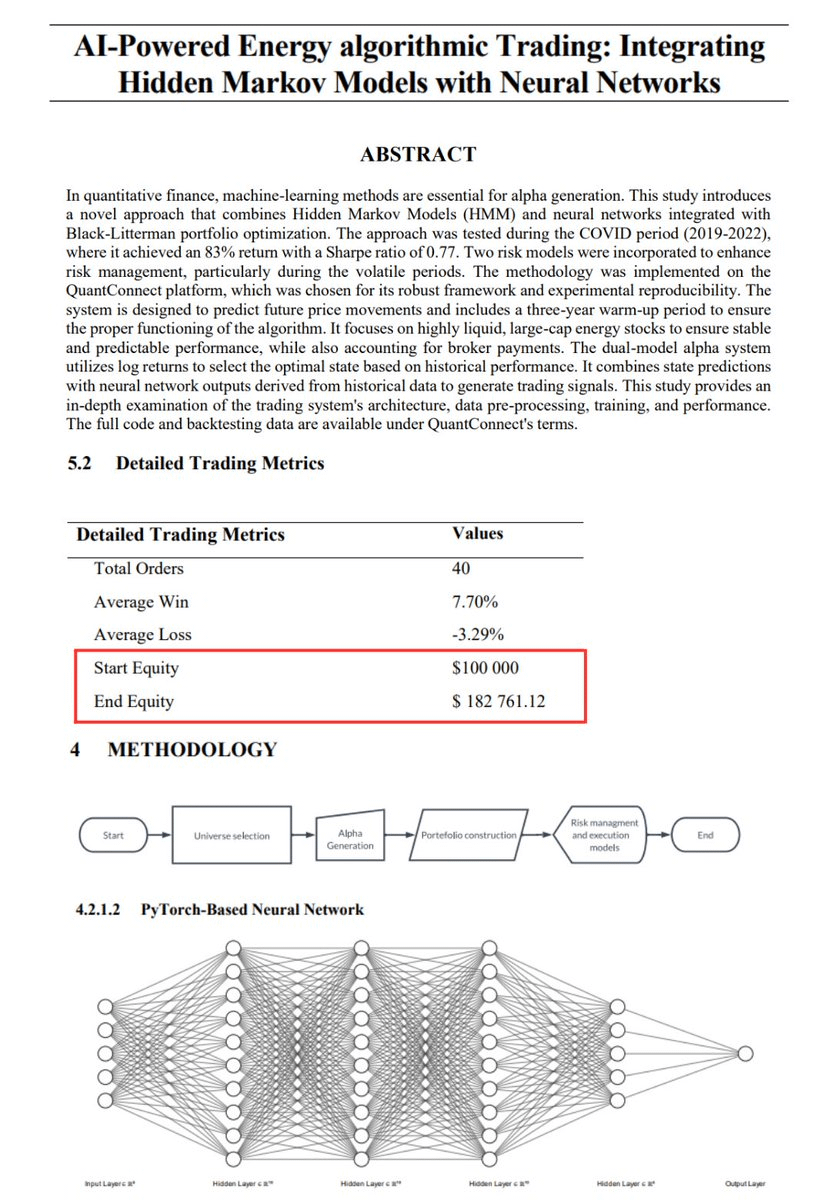
A researcher turned $100,000 into $182,761 using Neural Networks and Hidden Markov Models on real markets

83% return. Published the exact framework for free.

This is not theoretical. Every position was live. Every return is verifiable.

The same mathematical foundation - LSTM architecture, stationary features, walk-forward validation - is exactly what I broke down in my article this week.

Read the research paper.

Then read the complete implementation guide below.

One teaches you the theory. The other tells you how to run it on Polymarket today.
♥ 317 · ⟲ 44 · 👁 47.1KView on X ↗

Garry Tan Describes Using AI Agents to Mirror Pema Chodron's Book

Meta-Meta-Prompting: The Secret to Making AI Agents Work

Y Combinator CEO Garry Tan publishes an article on meta-meta-prompting and personal AI operating systems, describing how he had an AI agent summarize Pema Chodron's book and map each chapter to his own life. The piece is part of a series on agent architecture and open-source tooling.

Original post · 12 min read
X ArticleMeta-Meta-Prompting: The Secret to Making AI Agents Work
People keep asking me why I am spending my nights coding til 2AM. I have a job and a big one, as CEO of Y Combinator. We help thousands of builders a year to create their dreams of building real startups with real revenue that grow fast.
In the last 5 months, AI made me a builder again. Late last year, the tools got good enough that I went back to building. Not toy projects. Real systems that compound. I want to show you, with specific examples, what personal AI actually looks like when you stop treating it as a chat window and start treating it as an operating system. And I give it away as open source and in articles like this because I want you to speed up with me.
This is part of a series: Fat Skills, Fat Code, Thin Harness introduced the core architecture. Resolvers covered the routing table for intelligence. The LOC Controversy was about how every technical person just multiplied themselves by 100x to 1000x. Naked models are stupider argued that the model is the engine, not the car. And the skillify manifesto explained why LangChain raised $160M and gave you a squat rack and dumbell set without a workout plan, and then gave you that workout plan you needed.
The Book That Read Me Back
Last month I was reading Pema Chödrön's When Things Fall Apart. It's 162 pages, 22 chapters on Buddhist approaches to suffering, groundlessness, and letting go. A friend recommended it during a hard period.
I asked my AI to do a book mirror.
What that means concretely: The system extracted all 22 chapters of the book, and then, for each chapter, ran a sub-agent that did two things simultaneously: summarized the author's ideas, and then mapped every idea to my actual life. Not generic "this applies to leaders" pablum. Specific mapping. It knows my family history (immigrant parents, dad from Hong Kong and Singapore, mom from Burma). It knows my professional context (running YC, building open-source tools, mentoring thousands of founders). It knows what I've been reading, what I've been thinking about at 2am, what my therapists and I are working on.
The output was a 30,000-word brain page. Each chapter rendered as two columns: what Pema says, and how it maps to what I'm actually living through. The chapter on groundlessness connected to a specific founder conversation I'd had the week before. The chapter on fear mapped to patterns my therapist had identified. The chapter on letting go referenced a late-night session where I'd written about the creative freedom I'd found this year.
The whole thing took about 40 minutes. A $300/hour therapist reading this book and applying it to my life couldn't do this in 40 hours, because they don't have the full graph of my professional context, my reading history, my meeting notes, and my founder relationships all loaded and cross-referenceable.
I've done this with over 20 books now: Amplified (Dion Lim), Autobiography of Bertrand Russell, Designing Your Life, Drama of the Gifted Child, Finite and Infinite Games, Gift from the Sea (Lindbergh), Siddhartha (Hesse), Steppenwolf (Hesse), The Art of Doing Science and Engineering (Hamming), The Dream Machine, The Book on the Taboo Against Knowing Who You Are (Alan Watts), What Do You Care What Other People Think (Feynman), When Things Fall Apart (Pema Chodron), A Brief History of Everything (Ken Wilber), and more. Each one gets richer because the brain gets richer. The second mirror knew about the first. The twentieth knew about all nineteen.
How Book-Mirror Got Better Through Iteration
The first book mirror I did was terrible. Version 1 had three factual errors about my family. It said my parents were divorced when they weren't. Said I grew up in Hong Kong when I was born in Canada. Basic stuff that could have damaged trust if I'd shared it.
So I added a mandatory fact-check step. Every mirror now runs cross-modal evaluation against known facts in the brain before it ships. Opus 4.7 1M catches precision errors. GPT-5.5 catches missing context. DeepSeek V4-Pro catches when something reads as generic.
Then I upgraded to deep retrieval with GBrain tool use. The original version was good at synthesis but weak on specificity. Version 3 does per-section brain searches. Every right-column entry cites actual brain pages. When the book talks about dealing with difficult conversations, it doesn't just synthesize general principles. It pulls from my actual meeting notes with specific founders who were having tough conversations with co-founders. Or that idea I had on a Thursday hanging out with my brother James. Or the IM chat I had with my college roommate when I was 19. It's uncanny.
This is what skillification (using /skillify in GBrain) means in practice. I took the first manual attempt, extracted the repeatable pattern, wrote a tested skill file with triggers and edge cases, and every fix compounded across all future book mirrors.
Skills That Build Skills
Here's where it gets recursive, and where I think the biggest insight is.
The system that run… continue on X ↗
♥ 3.8K · ⟲ 502 · 👁 1.6MView on X ↗

Peter Steinberger Uses Codex in Ephemeral Crabbox Sandboxes for Bugs

Peter Steinberger Uses Codex in Ephemeral Crabbox Sandboxes for Bugs

Peter Steinberger says he has Codex recreate bug states in disposable Crabbox environments to reproduce, fix and verify issues, running about ten sessions in parallel. He links to Crabbox, a CLI for running repository commands in local sandboxes, cloud VMs and hosted agent sandboxes.

Original post · 1 min read
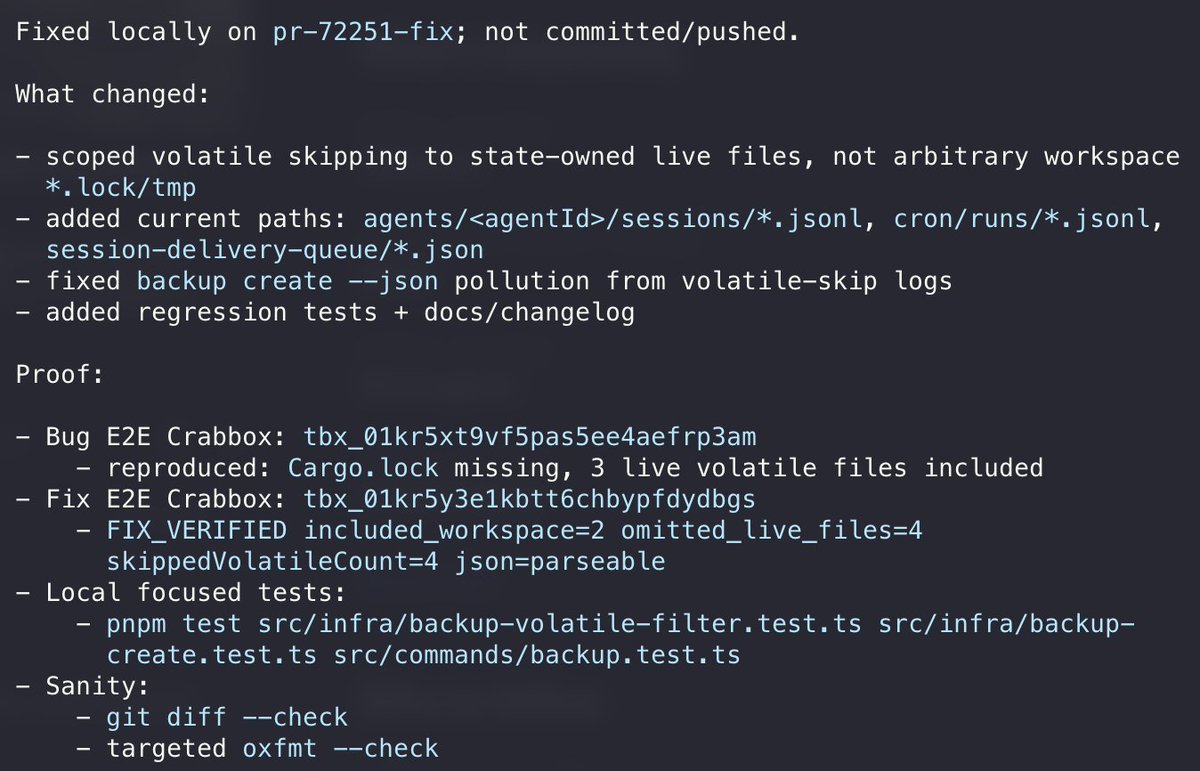
Whenever I investigate a bug, I let codex recreate the exact state in an emphemeral crabbox, verify the bug, fix it, verify the fix.

No messy state because local system might be polluted, and no slowdown because I run 10 sessions in parallel. crabbox.sh/
crabbox.shCrabbox — Run Any Repository Command in the Right BoxRun repository commands in local sandboxes, cloud VMs, SSH hosts, Windows and WSL2, macOS, or hosted agent sandboxes through one CLI.
♥ 3.0K · ⟲ 152 · 👁 322.0KView on X ↗

Jaya Gupta Argues Company Institutions Will Be AI's Next Moat

Jaya Gupta argues that as AI products and technical advantages become easy to copy, the enduring moat is the organization itself, including how a company attracts talent, distributes authority and builds compounding systems. She cites OpenAI and Palantir as examples of organizational invention.

Original post · 12 min read
X ArticleThe next biggest moat in AI
It's pretty obvious to everyone that everything in AI is converging. Companies I couldn't have imagined competing with each other are today. The application layer is collapsing into infrastructure, infrastructure companies are moving up into workflows, and almost every startup is rebranding itself as some version of a transformation company. The words change every few months: context graph, system of action, organizational world model. A new category gets named, every website absorbs it, and within weeks the market is filled with companies claiming to be the inevitable platform for how work will change.
When models improve quickly, interfaces converge, and product velocity becomes cheap, the visible parts of company-building get easier to imitate. The harder thing to copy is the institution underneath: the way a company attracts exceptional people, organizes their ambition, concentrates judgment, distributes authority, and turns work into a compounding system no other company can reproduce.
The best companies have always known that people are not an input to the company, but rather are the company. But in AI, that truth becomes sharper because everything else is moving so fast. If products can be copied, categories can be renamed, and technical advantages can collapse in months, then the enduring question is what kind of organization you build around the people capable of building it.
The shape of the company itself is becoming the moat.
Great companies are organizational inventions
The most important companies are actually organizational inventions. They create a new kind of institution around a new kind of work, and in doing so, they make a new kind of person possible.
OpenAI did not look like academia, a corporate research lab, or a traditional software company. At its center was frontier model training as the organizing activity. Safety, policy, product, infrastructure, and deployment all orbited that gravitational center. The structure changed what kind of researcher could exist there: someone who wanted to operate at the edge of science, product, geopolitics, and civilizational risk at the same time.
Palantir invented a new kind of operating institution for broken systems. Forward deployment was not just a go-to-market motion. It was a status hierarchy, a talent model, and a worldview. The company took work that would have been low-status elsewhere, sitting with customers, absorbing institutional mess, translating politics into product and made it central. It created a protagonist who did not fit cleanly into software engineering, consulting, or policy, but could operate across all three.
None of these companies fit the boxes that existed before them. None of the people who built them did either. Great companies are not just places where talented people go. They are structures that let a certain kind of talent finally express themselves.
Shape determines who can exist there
The best companies in the world do not only compete on category, market, or compensation. They compete on identity. Ambitious people tend to value a few things intensely: feeling special, being close to power, becoming undeniable, staying full of optionality, belonging to a mission, being in the room where history bends but they often do not know which of these they are actually optimizing for yet. That is why the strongest institutions find people early and are recruiting at the most top tier universities when they are freshman. They reach them before their self-concept has hardened, before they know what they want to be famous for or what their values are, before they can distinguish between the work they are good at and the person they are trying to become.
A great company gives them a language for their own ambition. It says: the thing you have been circling around but have not known how to name can happen here. You can become the person who moved the Mars timeline, the person who was in the room when the frontier shifted, the person who could operate inside broken institutions, the person whose work became undeniable.
This is why great institutions are wrappers around a kind of person.
Many compete on cash, which is the least interesting form of talent competition for legendary companies (maybe Jane Street or Citadel though). Cash can close people, but it rarely converts them (ask some of the neolabs or Alex Wang). The best people are most loyal when the company can offer something more specific than money: a path to becoming the version of themselves they already wanted to be, or did not yet know they wanted to be.
Each emotional promise is also a structural promise. If the company says customer proximity matters but customer-facing work is low status, the promise is fake. If it says ownership matters but decision rights are centralized, the promise is fake. If it says mission matters but the mission offends no one, selects for no one, and costs nothing, the promise is fake.
So what do people want to feel?
People want to… continue on X ↗
♥ 5.7K · ⟲ 721 · 👁 4.5MView on X ↗

Michelle Maxwell Says Being a Grandma Beats Being a Mom

Michelle Maxwell Says Being a Grandma Beats Being a Mom▶

Michelle Maxwell shares a personal reflection that her mother was right that being a grandmother is better than being a mother, and asks followers whether they agree. The post is a short video with an emotional personal anecdote.

Original post · 1 min read
When my daughters were born I remember my Mom telling me how much better being a Grandma is than being a Mom. I remember feeling hurt. Now that I am a Grandma I understand how right she was and I wish I could tell her 💔 He nailed exactly why we feel this way!! Do you agree?
♥ 4.2K · ⟲ 571 · 👁 447.1KView on X ↗

Thariq Makes the Case for HTML Over Markdown in Claude Code

Using Claude Code: The Unreasonable Effectiveness of HTML

Thariq of the Claude Code team argues HTML is a richer output format than markdown for agent-generated specs, plans and reviews, supporting tables, SVG, CSS and interactivity. He links to a gallery of examples and notes the Claude Code team increasingly uses the format.

Original post · 12 min read
X ArticleUsing Claude Code: The Unreasonable Effectiveness of HTML
This is now also on the Claude Blog.

Markdown has become the dominant file format used by agents to communicate with us. It’s simple, portable, has some rich text capability and is easy for you to edit. Claude has even gotten surprisingly good at using ASCII to make diagrams inside of markdown files.
But as agents have become more and more powerful, I have felt that markdown has become a restricting format. I find it difficult to read a markdown file of more than a hundred lines. I want richer visualizations, color and diagrams and I want to be able to share them easily.
I'm also increasingly not editing these files myself, but using them as specs, reference files, brainstorming outputs, etc. When I do make edits, I’m usually prompting Claude to edit them, which removes one of markdown’s largest benefits.
I’ve started preferring HTML as an output format instead of Markdown and increasingly see this being used by others on the Claude Code team, this is why.
(if you want to start with some examples, you can see a bunch here: thariqs.github.io/html-effectiveness, just be sure to come back and read more about why)
Why HTML?
Information Density

HTML can convey much richer information compared to markdown. It can of course do simple document structure like headers and formatting, but it can also represent all sorts of other information such as:
Tabular data using tables
Design data with CSS
Illustrations with SVG
Code snippets with script tags
Interactions using HTML elements with javascript + CSS
Workflows using SVG and HTML
Spatial data using absolute positions and canvases
Images using image tags
I would go so far as to say that there is almost no set of information that Claude can read that you cannot fairly efficiently represent with HTML. This makes it a highly efficient way for the model to communicate in-depth information to you and for you to review it.
I’ve found that in the absence of being able to do this, the model may do more inefficient things in markdown like ASCII diagrams or, my favorite, estimating colors with unicode characters like in this screenshot from Claude Code.

Visual Clarity & Ease of Reading

As Claude is able to do more complex work, it is also writing larger and larger specs and plans. In practice, I've found I tend to not actually read more than a 100-line markdown file, and I certainly am not able to get anyone else in my organization to read it.
But HTML documents are much easier to read, Claude can organize the structure visually to be ideal to navigate with tabs, illustrations, links, etc. It can even be mobile responsive so you can read it differently based on your form factor.
Ease of Sharing
Markdown files are fairly hard to share since most browsers do not render them natively well. You often have to add them as attachments to emails or messages.
With HTML, as long as you upload the file (for example to S3), you can share the link easily. Your colleagues can open it wherever they wish and easily reference it.
The chance of someone actually reading your spec, report or PR writeup is much much higher if it’s in HTML.
Two-way Interaction

HTML can allow you to interact with the document, for example you might want to ask it to add sliders or knobs to adjust a design or allow you to tweak different options in the algorithm to see what happens. You can also ask it to let you copy these changes into a prompt to paste back into Claude Code.

Read more about my playgrounds post to see examples of this two way interaction: x.com/trq212/status/2017024445244924382
Data Ingestion
Why use Claude Code to make HTML files instead of ClaudeAI or Claude Design for example? One of the biggest reasons is all the context Claude Code can ingest.

For example, when writing this article, I asked Claude Code to read through my code folder and find all the HTML files I’ve generated, group and categorize them and then make an HTML file with all diagrams representing each type. The diagrams you see in this article are a direct result of that.
Besides the file system, Claude Code can find additional context using your MCPs (like Slack, Linear, etc.), your web browser (with Claude in Chrome), your git history, etc.
It’s Joyful
Making HTML documents with Claude is just more fun and makes me feel more involved and invested in the creation, and that by itself is enough.
How to Get Started
I’m a little bit afraid that people will read this article and turn it into a /html skill or something. While there might be some value in that, I want to emphasize that you don’t need to do much to get Claude to do this. You can just ask it to “make a HTML file” or “make a HTML artifact”.
The trick is knowing what you want the artifact to do and how you might use it. You may over time make a skill, but for now I’d suggest just prompting from scratch to get a hang of how to use it in different cases.
Use Cases
To make this more concrete, I’ve made many different HTML files for different use cases… continue on X ↗
♥ 17.8K · ⟲ 2.3K · 👁 14.8MView on X ↗

Printing Press Launches Agent-Native CLI Library and Generator Factory

Printing Press Launches Agent-Native CLI Library and Generator Factory▶

Matt Van Horn, with Trevin, introduces Printing Press, a library of agent-optimized command-line tools for services like Linear, ESPN and Google Flights, plus a generator that creates new CLIs for any product via a slash command. The tools are SQLite-backed and work with Claude Code, Codex, OpenClaw and Hermes.

Original post · 1 min read
Introducing the Printing Press, a CLI-factory and a CLI-library. Built with @trevin. 🏭🖨📚

Most APIs suck for agents. Most MCPs suck for agents. Most official CLIs suck for agents. They waste tokens and time. @steipete started making his own because of this.

📚 A Library of agent-native CLIs you install today (Linear, ESPN, Flight GOAT (Google Flights + Kayak nonstop), Contact Goat (LinkedIn + Happenstance + Deepline more) +30+ more)
🏭 A factory that prints new ones for any service - just type /printing-press <product name>

CLIs are fast, local, SQLite-backed. Work in Claude Code, Codex, OpenClaw, Hermes.

🌐 printingpress.dev
♥ 3.6K · ⟲ 280 · 👁 1.4MView on X ↗

Mike Investing Lays Out AI Stock Sector Rotation Thesis

Mike Investing argues the AI boom is moving through phases from semiconductors to memory and photonics, then neo-cloud infrastructure, with rare earths, power, robotics, space and drones next. He lists tickers for each sector and makes predictions about generational wealth, with no supporting analysis.

Original post · 1 min read
We are currently in a “once in a lifetime” AI super cycle…

Phase 1 was: (already gone)
Semiconductors ~ $NVDA, $AMD, $INTC, $ARM

Phase 2 is: (passing by now)
Memory ~ $MU, $SNDK, $WDC
Photonics ~ $AAOI, $AEHR, $LITE, $MRVL

The current phase is Neo Cloud/AI infrastructure:
$IREN, $NBIS, $CRWV, $CIFR, $APLD

Next wave (many will miss)
Rare Earths ~ $USAR, $MP, $UUUU, $FCX
Power & Cooling~ $VRT, $CEG, $OKLO, $OSS

Finally it all concludes with these 3 sectors:
Robotics ~ $TSLA, $PATH, $SERV
Space ~ $RKLB, $ASTS, $PL, $LUNR
Drones ~ $ONDS, $AVAV, $LMT

Many will make generational wealth from this AI super cycle over the next 7 months.

Save this to look back on later…
♥ 7.1K · ⟲ 733 · 👁 778.0KView on X ↗

Brian Allen Alleges Front-Running of Oil Trades Around Iran Deal News

Brian Allen Alleges Front-Running of Oil Trades Around Iran Deal News▶

Brian Allen claims a $920 million crude oil short was placed shortly before Axios reported US-Iran deal progress, and that oil then moved sharply after Iran announced a Persian Gulf Strait Authority. He suggests the trades show insiders front-running war-related announcements, though the post offers no named source for the trading data.

Original post · 1 min read
🇺🇸BREAKING: Someone placed a $920 million crude oil short at 3:40 AM.

70 minutes later Axios reported the US and Iran were close to a deal.

Oil dropped 12%.

The trade made $125 million in profit.

Minutes after that Iran launched the “Persian Gulf Strait Authority” and oil surged 8%.

$760 million placed before Trump’s last announcement.

$920 million placed before this one.

Every major announcement in this war has been front-run by someone who knew it was coming.

What kind of war is this?

This is more like a trading desk with an army.

Never stop connecting the dots.
♥ 72.0K · ⟲ 26.7K · 👁 4.7MView on X ↗

RetroChainer Shares Three-Week Guide to Building AI Influencers

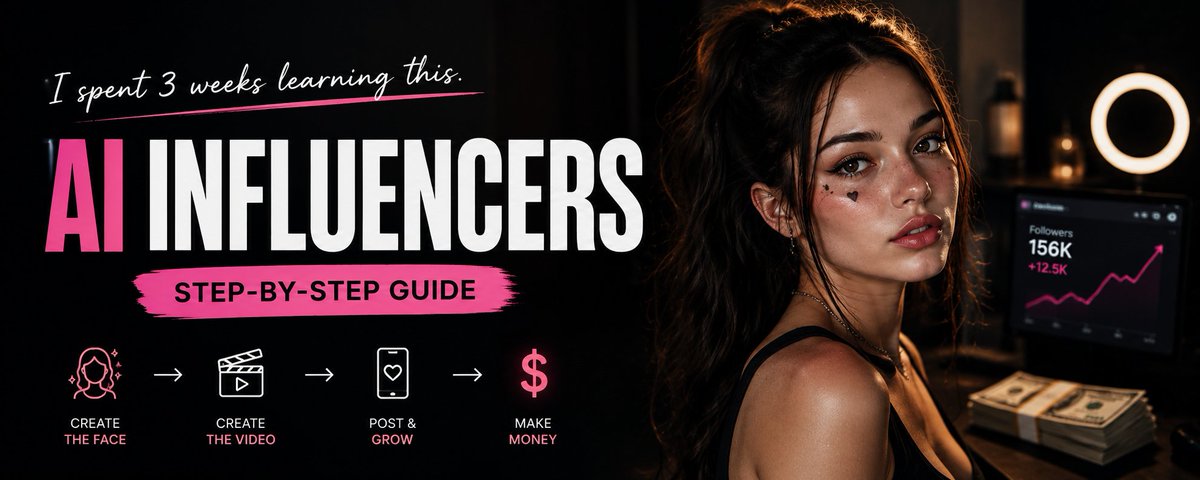
I spent 3 weeks figuring out how to make AI influencers. Here's everything you need to know.

RetroChainer publishes a guide on creating AI influencer accounts, covering niche selection, face generation with Nano Banana Pro and Pinterest references, and engagement tactics. The article frames the market as only months old and recommends sub-cultures, travel content and distinguishing features.

Original post · 8 min read
X ArticleI spent 3 weeks figuring out how to make AI influencers. Here's everything you need to know.
Step 1 - Choosing a Niche
The real secret is the niche. It determines everything:
The model's appearance and style
Content format and triggers
Audience engagement and account growth
The AI influencer market appeared literally a few months ago. The real potential of niches is still untapped copying successful girls makes no sense, you need to find your own direction.
Three working directions:

1. SubculturesAnime, cosplay, female streamers, football club fangirls. Timeless trends with maximally engaged audiences.
Examples: you can take a clip of a female CS2 streamer and replace her with your AI model. Or run an account of a cosplayer from the Marvel universe. A single post touching on a niche debate within a community can generate massive engagement just from one small detail.
2. Travel and eventsYour model can be on the Cannes red carpet, in Tokyo, or at a concert right now, without leaving home. This type of content feels expensive to produce because the viewer intuitively senses the effort behind it.
3. Physical featuresBirthmarks, scars, unique facial features as an additional trigger, but not as the foundation of the account. Unrealistic appearances caused a sensation a few months ago now it no longer surprises anyone.

Hypothesis: create a girl who is a fan of a football club and regularly mention one player as the best on the team. A wave of hate + a wave of support = bonus engagement and an algorithm boost.
Step 2 - Creating the Face
AI without references produces averaged-out looks technically attractive, but without character. You scroll through new AI accounts and every face looks copy-pasted. Here's why.
Tools:
Pinterest - searching for references
Nano Banana Pro (Higgsfield) - face merging

Process:
1. Find two photos of different girls with clearly visible faces
2. Upload both + the prompt to Nano Banana Pro:
Integrate a face into an existing scene. Substitute the face in the reference image with the face from the donor image. The objective is a seamless merge: the new face must inherit the exact expression, pose, and lighting interaction from the reference, while its color attributes (hair and eyes) are adapted from the donor for a perfectly harmonious and natural result.

3. Get the result. If needed add a distinguishing feature (birthmark, unusual eye color)
How to choose faces correctly
The main mistake is picking similar-looking faces. The neural network smooths out the differences and you end up with an averaged result again.
Pick contrasting faces and assign roles in advance:
First face base: sets the vibe of the niche (sharp cheekbones, "cold" look)
Second face donor: softens, adds attractiveness (baby face, full lips)

Face types by niche:
Cosplay, anime, game characters
Strong face goth, alt girl

Soft/romantic face fashion, luxury lifestyle

Hypothesis: find photos of girls of different ethnicities in the anime girl niche, merge them and add a birthmark as a distinguishing feature this instantly combines subculture and appearance triggers.
Step 3 - Creating the Video
The core of the method: AI replicates the movements of a person from the reference video and fully replaces the model in the footage.
3.1 Finding a Reference
Search on TikTok and Instagram. Use your niche as the search query goth girl, anime girl, cosplay.
Signs of a good reference:
High view count
Charismatic, expressive facial movements
Romantic undertone
Triggers from your niche
Key rule: the closer the person in the reference looks to your model — the more realistic the result. Kling struggles to transfer the movements of a long-haired girl onto a short-haired model.
3.2 Creating the First Frame
You can't just insert a photo of your model and hit "generate." Kling uses the background and pose from the uploaded photo, not from the reference. So first, you need to create a starting frame.
Upload to Nano Banana Pro:
1. A photo of your AI model

2. A screenshot of the first frame of the reference video

3. Prompt:
Take the girl's face and body from the first image, and the pose, emotion, and background from the second. Use the girl's face from the first image as the character's face and replace it in the second image, it is necessary to accurately convey emotion and playfulness, it is necessary to accurately convey the appearance of the girl from the first image without changing her appearance, the photo must be alive, the girl is not a doll, sincere real, photo taken on an iPhone phone camera.

3.3 Generating in Kling
Upload to Kling Motion Control: the first frame + the reference video. In the advanced settings, paste the prompt:

Use the attached reference video as the sole motion blueprint and transfer its movement onto the character from the attached photo(s), preserving the character's exact identity, body proportions, face and hair features, skin texture, clothing fit, and overall silhouette with zero morphing, zero style drift, and no added accessories; match the reference motion precisely frame-by-fr… continue on X ↗
♥ 755 · ⟲ 82 · 👁 1.6MView on X ↗

Heycounsel Hosts Claude Cowork Hackathon for Lawyers Building Legal Skills

Heycounsel Hosts Claude Cowork Hackathon for Lawyers Building Legal Skills▶

Brian Scherer reports a five-hour hackathon on April 21 in which more than 200 lawyers across 10 countries built production-ready legal AI skills with Claude Cowork, producing 13 completed projects. The skills are published on the Heycounsel showcase site.

Original post · 1 min read
On April 21, we challenged lawyers from all over the world to spend an afternoon building real, production-ready skills with Claude Cowork.

5 hours. 200+ lawyers. 10+ countries. 13 completed projects producing new legal AI skills.

Every skill is live on our showcase site at go.heycounsel.com/hackathons
♥ 461 · ⟲ 38 · 👁 60.2KView on X ↗