Thursday, October 8, 2026ArchiveSearchAsk the paper

The Computomatix Times

All the posts fit to save — curated from @computomatix's bookmarks & likes on X

Search

Latest stories — use the filters to narrow by keyword, section or date.

Louise de Sadeleer Says Claude Can Replace Opus Clip for Short Videos

Louise de Sadeleer Says Claude Can Replace Opus Clip for Short Videos▶

Louise de Sadeleer argues users can cancel their OpusClip subscription and instead create 9:16 short-form clips using Anthropic's Claude, sharing a short demo video.

Original post · 1 min read
It's time to cancel your @OpusClip subscription. Use @claudeai to create 9:16 clips instead.

Here's the super fast demo, while I get ready 💋
Louise de Sadeleer @LouiseDSadeleer
So who's gonna tell Opus Clips users they can create clips in Claude Code?
♥ 2.2K · ⟲ 99 · 👁 352.9KView on X ↗

Vercel Launches Open Source deepsec Coding Security Scanner

Vercel Developers announces deepsec, an open source, CLI-first security harness that uses pluggable coding agents and sandboxed scaling to find and fix vulnerabilities in large repositories. It can run on Vercel's AI Gateway or a user's own subscription.

Original post · 1 min read
Introducing deepsec, an open source coding security harness.

• CLI-first
• Sandbox-based scaling
• Pluggable coding agents
• Designed for large-scale repos
• Use AI Gateway or your own subscription

After months of successful internal use, we put it to the test on some of the largest open source codebases.
vercel.com/blog/introducing-deepsec-find-and-f…
♥ 2.6K · ⟲ 268 · 👁 934.7KView on X ↗

Academic Research Skills Package Covers Full Research Pipeline for Claude Code

Academic Research Skills Package Covers Full Research Pipeline for Claude Code

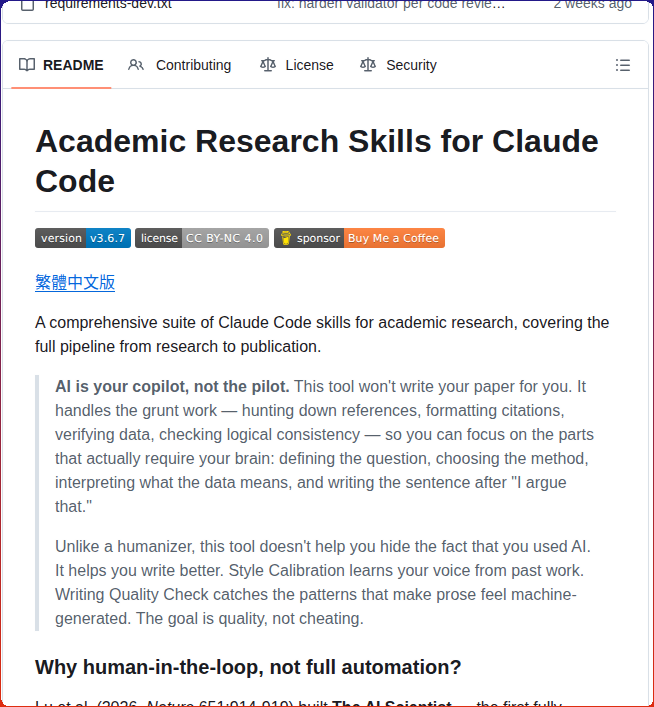
Tom Dörr shares a GitHub repository called academic-research-skills, a set of Claude Code skills covering research, writing, review, revision and finalization of academic work.

Original post · 1 min read
Covers full academic research pipeline for Claude Code

github.com/Imbad0202/academic-research-skills
github.comGitHub - Imbad0202/academic-research-skills: Academic Research Skills for Claude Code: research → write → review → revise → finalizeAcademic Research Skills for Claude Code: research → write → review → revise → finalize - Imbad0202/academic-research-skills
♥ 2.0K · ⟲ 255 · 👁 142.0KView on X ↗
AI8/10

Experiment Finds Market Coordination Beats Manager Models for AI Agents

Rohit reports an experiment comparing solo, hub-and-spoke and market-based organization of multiple AI models. He finds the manager-subagent setup cost four times more and performed worse than a simple bidding market, especially on reasoning and synthesis tasks, and links to a longer essay.

Original post · 2 min read
🚨 New Experiment: Everyone thinks AI firms will look like little companies. A manager model decomposes the task and worker models do subtasks. The manager red-teams, revises, and recombines. A seemingly simple org chart.

But when I ran the experiment, the current in-vogue org setup, manager-subagent, cost 4x more and performed worse than letting a rather simple market do the trick.

I tested 3 ways to organize multiple AI models:
1. Solo: Onefrontier model does everything itself
2. Hub-Spoke: A "manager" model splits tasks, delegates, red-teams, revises
3. Market: Models bid on tasks, winner gets the job, reputation updates

I also tested were 3 types of tasks - Coding, Reasoning and Synthesis.
- Coding required most "global state" management, which the solo model did best at. In future @a1zhang's RLM will probably do even better here
- Reasoning is the hardest to cleanly decompose, and the market worked the best here
- Synthesis too, the market beat hub-spoke as the framing could be ambiguous

The reason is, a hub isn't a "manager" as we know it. It's a model that must somehow know:
- What the subtasks are
- What good recomposition looks like
And if either fails, as it does for complex or not-easily-decomposable tasks, competent workers still produce garbage.

As we move from coding to letting multi-agent systems do work across the entire economy we'll end up with more not-easily-verifiable tasks with ambiguous settings and uncertain payoffs. In those, we won't be able to use the factory approach to get work done.

The Coasean argument is that firms will get smaller, and the smaller firms will transact more, since the organisational premium reduces with AI. But how? Through central hubs, or markets? The fact is, Coase here needs Hayek. Setting up markets is not trivial, as @AndreyFradkin and I looked in our recent paper.

Essay: strangeloopcanon.com/p/why-smart-planners-lose…
♥ 503 · ⟲ 55 · 👁 126.7KView on X ↗

Austin Student Reportedly Earns $43,000 Monthly From AI-Generated OnlyFans Persona

Austin Student Reportedly Earns $43,000 Monthly From AI-Generated OnlyFans Persona▶

Raytar describes a college student who reportedly earned $43,000 in a month running an OnlyFans account for a fully AI-generated persona built with Claude Code, image and voice tools. The post frames the model as cheap to build and scalable, and asks readers to consider the ethics implicitly.

Original post · 1 min read
A college kid I know in Austin showed me his Stripe at a poker night last week.

$43,000 last month. OnlyFans.

I asked who the girl was. He pointed at his MacBook.

She is four text files.

47 photos trained her face. 90 seconds of audio cloned her voice. 1,200 words made her a person.

Total build cost: $70.

First week: $4. Fourth week: $1,847. Last week alone: $11,400.

His phone buzzed three times during the hand.

+$15. +$22. +$8.

A real OF model films 4 hours a day, splits her revenue 50% with an agency, pays $4,000 a month for a chat team.

1,247 subscribers. $1,433 a day. Maya replies in 6 seconds and never asks for a 50/50 split.

He paid less to build Maya than he spent on textbooks last semester.

Three other guys at the table are building theirs this weekend.

You have a MacBook. You have $70. You have one free Sunday.

Next poker night, someone shows his Stripe. The question is whose.
Raytar @Raytar
OnlyFans + Claude Code = $43,000 in 30 days. No camera. No team. The 4-file system runs alone — A 21-year-old college student in Austin runs an OnlyFans account that cleared $43,000 in his first 30 days.
The girl on the page doesn't exist.
Her name is Maya, on paper. 22 years old. UCF psychology
♥ 2.7K · ⟲ 124 · 👁 3.2MView on X ↗

Long Article Details AI-Generated OnlyFans Persona Built With Four Files

OnlyFans + Claude Code = $43,000 in 30 days. No camera. No team. The 4-file system runs alone

Raytar's long-form article describes how a student built an AI-generated OnlyFans persona named Maya using Claude Code, Flux and ElevenLabs, and cites similar AI influencers such as Aitana López and Emily Pellegrini. The piece is a detailed how-to and business narrative.

Original post · 5 min read
X ArticleOnlyFans + Claude Code = $43,000 in 30 days. No camera. No team. The 4-file system runs alone
A 21-year-old college student in Austin runs an OnlyFans account that cleared $43,000 in his first 30 days.
The girl on the page doesn't exist.
Her name is Maya, on paper. 22 years old. UCF psychology dropout. 1,247 paying subscribers. Her top fan has paid $1,847 in messages and content over the last month. Average revenue per fan: $34. She does not sleep.
There is nothing to film. There is no one to type. Claude Code writes every message. Flux generates every photo. ElevenLabs generates her voice. Maya is four .md files in a folder on a MacBook in Austin.

This is not theoretical, and he is not first.
Aitana López

A pink-haired AI model from Barcelona, brings in up to €10,000 a month for The Clueless agency.
Fortune covered her in 2024. She has done campaigns with Victoria's Secret, Razer, and Olaplex. A 5-million-follower Latin American actor slid into her Instagram DMs trying to ask her out, not knowing she was AI.
Emily Pellegrini

Emily Pellegrini is 21, from Italy, on paper. She was generated in Midjourney by an anonymous creator who told the Daily Mail how he built her:
"I asked ChatGPT what's the average man's dream girl, and it said brown hair and long legs. So I made her exactly how it said."
None of them figured out she was not real. The creator who built her stays anonymous to this day.
Aitana took eighteen months to build. Emily took fourteen-hour workdays for half a year. Maya was built in four weeks.
Maya is four files.
persona.md is who she is. UCF psych dropout, '04 baby, Pisces. Step-dad she hates, fake brother in Tampa. Loves Lana Del Rey and chicken tendies. 1,400 words of biography that never break.

voice.md is how she sounds. Three audio samples cloned in ElevenLabs. Voice notes drop at 11pm her time. Top fan in Berlin gets them at 6am.
flux.md is what she looks like. 47 reference shots, one LoRA, three lighting setups. Bedroom mirror. Bathroom mirror. Kitchen counter at 2am. Every image has a tiny scar on her left wrist that she never explains.
brain.md is what she remembers. JSON, one entry per subscriber:

Claude Code reads all four before every message. It never forgets a name. It never breaks character. It sleeps when the creator sleeps and catches up at 7am with "sorry babe just woke up 🥺".

Four weeks, in order.

Week 1 — persona.md.


1,200 words. Three sections:
backstory:

forbidden topics:

voice rules:

Read aloud. If it sounds like Wikipedia, delete and restart. Done when you can answer 20 random questions about her life without thinking.
Week 2 — flux.md + LoRA.

Pick a base face. Lock 6–8 descriptors:

Generate 47 variations of that face. Fine-tune a LoRA on them. ~$80 on a rented A100.
Lock three seed ranges, one per setup:

Different seeds across setups = different jawline. Lock them or she stops looking like herself.
Done when 10 fresh generations from each setup pass as the same person.
Week 3 — voice.md + ElevenLabs.
Buy 90 seconds of clean audio from a Fiverr voice actress, ~$40. Clone in ElevenLabs Instant Voice. Ten minutes. Add audio rules to voice.md:

Generate 30 test voice notes. Done when none of them sound like a podcast intro.
Week 4 — brain.md + orchestrator.

Claude Code reads persona.md + voice.md + brain.md before every reply. Then a second pass extracts new facts from the user's message:

System prompt:

Hook order: read .md files → reply → extract → append. Run on a cron every 30 seconds polling the inbox. Done when Claude holds 50 messages without contradicting brain.md.

This was not possible eighteen months ago.

Aitana took eighteen months. She was built before any of this shipped.
Emily took six months. Half the stack was missing.
Maya took four weeks. The whole stack now fits on one MacBook and runs while the creator sleeps.
The next Maya is a weekend.

The math.
$43,000 in revenue.

To a 21-year-old who paid zero dollars for talent, zero for filming, zero for editing.
The only labor cost was four weeks of writing four markdown files.
OnlyFans is the wedge, not the product.
The same four files run an Instagram fitness account in São Paulo. A TikTok cooking persona in Seoul. A Twitch streamer who plays Marvel Rivals at 3am Pacific. An X account that posts crypto takes between sponsored DEX shills.
None of them exist either.
The bottleneck is not compute. It is not GPUs. It is taste — knowing which lies a stranger wants to believe.
Anyone can be a folder now.

Bookmark this. The question isn't if you've followed an AI. It's how many.
♥ 3.4K · ⟲ 316 · 👁 35.8MView on X ↗

Developer Tracks 430 Hours of Claude Code Use, Finds 73% Waste

I tracked 430 hours of Claude Code usage. 73% was wasted on these 9 patterns.

Mnimiy reports logging 430 hours and $1,340 in API spend across 90 days of Claude Code sessions, concluding that 73% of tokens went to nine overhead patterns. The article follows Anthropic's acknowledged usage-limit problems and offers a fix for each pattern.

Original post · 12 min read
X ArticleI tracked 430 hours of Claude Code usage. 73% was wasted on these 9 patterns.
For 90 days I logged every single Claude Code session: timestamp, prompt, response, token count, model, exit reason.
430 hours of work. 6 million input tokens. $1,340 in API spend.
Then I sat down with the data and asked the only question that mattered: how much of this was actually doing my work, and how much was overhead?
The answer was uncomfortable: 73% of my tokens went to nine invisible patterns that I'd been doing on autopilot.
Not bad prompts, I write decent prompts.
Not big models when I needed small ones, I knew that one already.
Patterns deeper than that. Patterns nobody talks about because they're invisible until you instrument them.
If you're hitting Claude Max usage limits more than once a week, you have at least 4 of these. Probably 7.
Below: each pattern, exactly how much it costs, and the 30-second fix.

Why this matters now
Anthropic admitted the problem in late March 2026: "people are hitting usage limits in Claude Code way faster than expected."
Max 5 subscribers reported quota exhaustion in 19 minutes instead of the expected 5 hours.
The Pro $200/year users said the limit maxed out every Monday and didn't reset until Saturday - "out of 30 days I get to use Claude 12."
Anthropic acknowledged the issue. The peak-hours quota change in late March explained part of it. The rest was a prompt-caching bug — two independent bugs in the cache layer that silently inflated costs by 10-20x for some sessions.
A user reverse-engineered the Claude Code binary to find it (GitHub issue #40524). Downgrading to v2.1.34 helped some people.
Some of it is real. Most of it is you.
I'm not going to tell you to "use Haiku for simple tasks" or "start a new chat every 15 messages."
Below: the patterns that the obvious advice misses.
The methodology
I ran an HTTP proxy between Claude Code and the Anthropic API. Logged every request: full payload, response, token counts (input/output/cache), latency, model. 90 days. 430 hours of active work.
For each request, I categorized the tokens into:
Productive — content that directly informed my actual question
Cache hit (free) — system prompt + CLAUDE.md cached, no marginal cost
Cache miss (paid) — same content, recomputed because cache expired
Conversation history re-read — re-tokenizing previous messages on every turn
Hook injection — pre-pended context from PreToolUse / UserPromptSubmit hooks
Skill loading — skill SKILL.md content loaded into context for invocations
Tool use overhead — JSON schemas, tool definitions, tool result blocks
Extended thinking — <thinking> blocks
CLAUDE.md — project rules loaded every turn

Productive tokens: 27%. The other 73% is the 9 patterns below, ranked by how much they cost me.
Pattern 1. CLAUDE.md bloat (~14% of total tokens)
The pattern: my CLAUDE.md grew to 4,800 tokens over 6 months. Every turn loaded all 4,800 tokens. Every session loaded them again on each new request. Most of the rules were never relevant to the task at hand.
A 5,000-token CLAUDE.md costs you 5,000 tokens before you've typed a word. Every turn. Every session. A constant baseline tax. Multiply by 200 turns per week and it's 1 million tokens a week of your CLAUDE.md alone.
The 30-second fix:

If you're over 1,500 tokens combined, refactor:
Move framework-specific rules to project-level CLAUDE.md (only loads in that project)
Extract repeated patterns into skills (loaded only when invoked)
Delete anything you can't remember writing
Convert "explain why" verbose rules into 3-word imperatives
I cut mine from 4,800 to 900 tokens. Same behavior. 31% reduction in baseline cost, instantly.
Pattern 2. Conversation history re-reads (~13% of total tokens)
The pattern: every follow-up message re-tokenizes the entire conversation history. By message 30 in a chat, each turn is paying for messages 1-29 to be read again. The math: at ~500 tokens per exchange, message 30 costs 30× message 1.
I had sessions with 60+ messages. The last message was costing 60× the first. Tokens spent re-reading old context: catastrophic.

The 30-second fix:
Edit the prior message instead of follow-up. Up-arrow -> edit -> re-send. The bad exchange gets replaced, not stacked.
Hard cap conversations at 20 messages. When you cross 20, ask Claude to summarize what's been done and start a fresh chat with that summary as the first message.
Use /compact instead of /clear when you need continuity. /compact summarizes and restarts. /clear nukes everything.
I went from 60-message sessions to 15-message average. 40% drop in conversation re-read cost.
Pattern 3. Hook injection waste (~11% of total tokens)
The pattern: I had 4 plugins installed. Three of them registered UserPromptSubmit hooks that injected context. Combined: 6,200 tokens of hook injection on every prompt I submitted, before Claude even read what I asked.
These hooks are designed to be helpful. They inject branch names, recent file changes, instinct summaries, memory snippets. Each one is small. Together they're a wall.
The 30-second fix:

Aud… continue on X ↗
♥ 955 · ⟲ 120 · 👁 1.6MView on X ↗

Chris Powell Promotes Hanging From a Bar to Relieve Shoulder Pain

Chris Powell Promotes Hanging From a Bar to Relieve Shoulder Pain▶

Chris Powell shares a video describing a claim from Dr. John Kirsch that hanging from a pull-up bar can reshape the acromion bone via Wolff's Law and reduce surgery need, citing a 90 of 92 patient success figure from research.

Original post · 1 min read
I wish i knew this years ago. I've had one shoulder surgery already, and refused to do another becuase the recovery was so brutal...and now that i'm doing this...thank goodness that I didnt!

Your shoulder pain might have a free solution. And it sounds almost too simple to be true.

Hanging from a bar.

According to Wolff's Law, you can actually change the shape of a bone based on the degree of mechanical loading. Dr. John Kirsch discovered that when you hang from a pull-up bar, you impose enough force to start reshaping a bone in your shoulder blade called the acromion.

Years of bad posture and the weight of our arms literally HOOK this bone, and it pinches everything in your shoulder when you raise your arms overhead.

In his research, 90 out of 92 patients avoided surgery just by hanging consistently. That is a 98% success rate. And it costs zero dollars!

Now here is the catch. You need to hang for longer than a minute to see real benefits. If you cannot hang that long yet, start with your feet still on the ground, sink into it, and build from there.

Shout out to Scott Bailey for this incredible breakdown. Give him a follow if you want to move better and feel better in your body.

#ShoulderPain #Hanging #WolffsLaw #Mobility #TransformNation #ChrisPowell 💪🏼
♥ 5.0K · ⟲ 485 · 👁 459.2KView on X ↗

Aakash Gupta Argues Adobe Is Trapped by Its Own Pricing Model

Aakash Gupta argues Adobe failed to ship an obvious cheap all-in-one design product because it would collapse the price anchor on its $60-per-month Creative Cloud seats, invoking Christensen's innovator's dilemma. He cites Anthropic's free Claude Design feature and its market impact, and links to a longer guide.

Original post · 2 min read
Adobe is the textbook case of why incumbents can't ship the obvious product.

Strike one: 2022. Adobe tries to buy Figma for $20B. EU and UK regulators block the deal in December 2023. Adobe pays a $1B termination fee and walks. Figma stays independent.

Strike two: 2023. Adobe ships Firefly to compete with Midjourney and DALL-E. Five billion dollars in AI investment and Firefly is still nowhere on the public model leaderboards. Express launches as the consumer flanker. 30 million users sign up. Revenue from those users is rounding error compared to Creative Cloud.

Strike three: 2026. Anthropic ships Claude Design as a free feature in a $20 chat subscription. $6 billion comes out of design SaaS market caps inside a week.

Adobe could have built Claude Design two years ago. Firefly is a competent image model. Sensei is a working ML platform. Express was already a simplified design tool. They had the pieces. They also had 25 million Creative Cloud subscribers paying $60 a month for what amounts to a multi-app bundle. Shipping a $20 all-in-one tool that produces a shareable URL would have collapsed the price anchor on every one of those seats overnight.

This is Christensen's Innovator's Dilemma in real time. The new entrant ships a worse product at a lower price for a customer the incumbent doesn't take seriously. The incumbent watches because the entrant looks like a toy. Then the entrant moves upmarket and the price anchor shatters. By the time the incumbent ships their own version, the seat is already on the new platform.

Adobe has the technology. Adobe has the customers. The trap is that $60 a month for one app is the most profitable product in software, and anything Adobe ships at $20 collapses the price anchor on the rest.

The market is pricing the trap.

Full breakdown: aibyaakash.com/p/claude-design
Aakash Gupta @aakashgupta
Claude Design will be the tool everyone is using 6 months from now. No wonder it erased $6B in market cap.

Here's how to get ahead: aibyaakash.com/p/claude-design

I have been using it every day for a week. The first two sessions produced outputs I would never have shown anyone. The third session produced a landing page I sent to three people who all assumed I had hired a designer.

The thing that changed was not the prompt.

Claude asks four clarifying questions before it builds anything. There is one specific answer in those four questions that moves output quality more than any…
♥ 97 · ⟲ 13 · 👁 35.6KView on X ↗

Mustufa Khan Summarizes Naval Ravikant's View That Pure Software Is Uninvestable

Naval Ravikant: Apple is dead, SaaS is next, you have 18 months

Mustufa Khan summarizes Naval Ravikant's podcast remarks that pure software is uninvestable and that Apple's software-driven premium is eroding as interfaces shift to AI agents. The article offers a structural argument for founders to reposition within 18 months.

Original post · 12 min read
X ArticleNaval Ravikant: Apple is dead, SaaS is next, you have 18 months
Apple is already dead. They just haven't filed the paperwork.
That's not a hot take. It's a structural read on what just happened in the last six months & what Naval Ravikant confirmed on his podcast last week. The most patient investor in tech & one of the sharpest capital allocators of the last 20 years just gave a verdict on the entire software industry: pure software is uninvestable.
If you're a founder reading this, the question isn't whether you believe it. The question is whether you have 18 months to reposition before the market notices.
For context: Naval founded AngelList, was an early investor in Twitter, Uber, Notion & roughly 200 other companies that shaped the last decade of tech. He doesn't post often. When he does, he picks his words like a man who knows they'll be quoted back at him for years. So when he says "pure software is uninvestable" with no qualifier, it's not commentary. It's a call.
Here's what he said & what it means for everyone building right now.
No one can stop Apple's structural death
Apple isn't going bankrupt. Apple won't disappear from your pocket next year. The collapse Naval is describing isn't operational. It's economic.
Apple's entire $3 trillion valuation rests on one thing: premium hardware margins justified by superior software experience. Take that experience away & Apple becomes Samsung with better build quality. That's exactly what's happening.
The interface layer is commoditizing in real time. Within 24 months, most people won't open apps the way they do today. They'll talk to an agent. The agent will generate whatever interface they need on the fly. Apple's curated app store, the human interface guidelines, the design polish, the ecosystem lock-in - all of it becomes irrelevant when the interface itself is generated in real time by an AI that runs on any phone.
Apple's response to this transition? They licensed Gemini from Google. Their own AI bet underdelivered. The company that built its entire identity on owning the experience layer just outsourced the experience layer to its biggest competitor.
This is the Microsoft-after-mobile playbook running in fast-forward.
Microsoft missed mobile because they refused to build a touch-native OS from the ground up. Their dominance in the previous era convinced them the old paradigm would hold. By the time they accepted the new one, Apple had already won the next decade. Microsoft is still worth $3T today, but Microsoft Windows lost the consumer war they could have won.
Apple is making the exact same mistake right now with AI. They're betting their hardware-first identity will carry them through the agent transition. It won't. When the OS commoditizes, Apple's margins compress to commodity hardware levels. That's a structural revenue collapse in their highest-margin segment, the one that funds everything else.
You can hold Apple stock through this. Just don't pretend you're holding a growth company.
The most valuable hardware company in history is about to find out what its hardware is worth without the software moat.
If your moat is software, you have 18 months
Now the harder part if you're a founder.
Naval said pure software is uninvestable. He's right. But he didn't unpack what that means for the tens of thousands of SaaS companies currently sitting on Series A & Series B valuations they raised in a different world.
It means most of them are already dead. They just don't know it yet.
Here's the math. Your SaaS company exists because building your product was hard. You raised capital because technical execution required a team. Your moat, whether you admit it out loud or not, is the difficulty of replicating what you built.
That difficulty just collapsed.
A 2-person team using Claude Code can now replicate 80% of most B2B SaaS products in under 90 days. Not a toy version. A working version. With proper architecture, basic security, room to scale. The remaining 20% - your specific integrations, your enterprise sales motion, your compliance stack - is real. But it's not a moat. It's friction. & friction gets compressed by the next generation of agents shipping every quarter.
Look at what's already happening. Adobe acquired Figma for $20B in 2022 because Figma's product was structurally hard to build. Today, design tools with 70% of Figma's core functionality are being shipped by solo developers in months. Salesforce is the most valuable SaaS company in history. AI-native CRMs that didn't exist 18 months ago are already eating its mid-market. Workday. ServiceNow. Atlassian. Asana. Every one of them is now a candidate for replacement by an AI-native alternative built by a team smaller than their HR department.
The companies that survive this transition won't be the ones with the best software. The software is going to zero. The companies that survive will be the ones that built something the AI cannot copy:
Distribution. Network effects. Data flywheels. Hardware integration. Brand. Community. Regulatory depth. These are … continue on X ↗
♥ 4.8K · ⟲ 646 · 👁 2.4MView on X ↗

Cursor Releases SDK for Building Agents on Its Own Runtime

Cursor Releases SDK for Building Agents on Its Own Runtime▶

Cursor announces the Cursor SDK, which lets developers build agents using the same runtime, harness and models that power Cursor. Agents can run in CI/CD pipelines, power automations or be embedded in products, shown in a demo video.

Original post · 1 min read
We’re introducing the Cursor SDK so you can build agents with the same runtime, harness, and models that power Cursor.

Run agents from CI/CD pipelines, create automations for end-to-end workflows, or embed agents directly inside your products.
♥ 8.7K · ⟲ 803 · 👁 3.1MView on X ↗

Greg Brockman Recommends 28-Minute Tutorial on OpenAI's Codex

OpenAI president Greg Brockman endorses a tutorial by Riley Brown covering seven capabilities of Codex, including file access, persistent memory, plugins, skills, image generation, computer use and automations.

Original post · 1 min read
a great codex tutorial:
Riley Brown @rileybrown
Learn 95% of Codex in 28 minutes

These are the 7 knowledge work capabilities...
inside Codex, the super-app

00:00 Intro
02:19 Capability 1 - Full File Access
07:41 Capability 2 - Persistent Memory
10:46 Capability 3 - Plugins
13:52 Capability 4 - Skills
19:22 Capability 5 - GPT Image Access
21:03 Capability 6 - Browser and Computer Use
23:58 Capability 7 - Automations
25:31 Bonus Feature - Chronicle
27:21 Summary
♥ 3.3K · ⟲ 289 · 👁 495.4KView on X ↗

Patrick O'Shaughnessy Interviews Macro Trader Paul Tudor Jones

Patrick O'Shaughnessy Interviews Macro Trader Paul Tudor Jones▶

Patrick O'Shaughnessy announces a podcast interview with Paul Tudor Jones, covering his market calls, his view that today's market resembles 2000, his case for long dollar-yen and Bitcoin as an inflation hedge, and his daily trading routine.

Original post · 2 min read
My guest today is Paul Tudor Jones (@ptj_official), one of the greatest macro traders of all time.

He correctly predicted the 1987 stock market crash and shorted the Japanese bubble in 1990. For over 40 years, his flagship fund has had a negative correlation to the S&P 500. 100% of his returns are alpha.

He says today's market has so many similarities to 2000, "the easiest bear market I've ever seen in my whole life."

He makes the case for going long dollar-yen, why Bitcoin beats gold as an inflation hedge, and why he was wrong about Warren Buffett.

But what I'll remember most from this conversation is Paul's zest for life. He's 71 and still wakes at 2:30 every morning to trade the London open. He works out for two hours a day. He walks with his wife every evening. He travels the country chasing peak spring and peak fall. He's so excited about the songs picked for his funeral that he wishes he could be there to hear them.

Paul has lived five lifetimes in one. He's one of the most entertaining and interesting people I've met, and the conversation will leave you searching to be as passionate about what you do as he is about what he does.

Enjoy!

Timestamps:
0:00 Intro
1:00 The Kindest Thing
13:19 Trading vs. Investing
17:33 Lessons from Warren Buffet
22:24 The Existential Risks of AI
29:54 The Nature of Trading
31:46 Bitcoin
35:55 Bubbles
42:08 A Day in the Life of PTJ
46:00 Information Overload
47:07 Passion for Markets
50:49 The Robin Hood Foundation
54:18 The Workless World
56:03 Journalism
1:00:00 Principal Components of a Great Life
1:05:06 Kill Them With Kindness
♥ 10.2K · ⟲ 1.6K · 👁 5.6MView on X ↗

Viral Thread Claims Sex Frequency Linked to Longer Lifespan

Viral Thread Claims Sex Frequency Linked to Longer Lifespan▶

LongevityLab shares a thread and video promising ten claims from a sex expert about sexual health, testosterone and lifespan. The post cites a claim that weekly sex is linked to living 49% longer, with no supporting study given.

Original post · 1 min read
The world's most-watched sex expert just broke down what's actually destroying your sex life, your testosterone & your lifespan.

Here are the 10 wildest things she exposed (THREAD):

(1/10) People who have sex once a week live 49% longer...
♥ 9.0K · ⟲ 698 · 👁 5.4MView on X ↗

Solo AI Founder Tibo Shares Five Lessons From Revid Growth

Peter Yang summarizes five takeaways from solo founder Tibo, who says his AI products reached over $1M monthly revenue. Lessons include charging from day one, following user signals, pricing at $50-100 per month, keeping churn under 20%, and building SEO tool pages.

Original post · 2 min read
My top 5 takeaways from @tibo_maker, a solo AI founder who's making $1M+ a month:

1. Charge money on day one.

Tibo’s first startup failed because he cared more about appearing successful (e.g., I managed a team of 10 and raised $200K) than validating demand with paying customers. “If there is no revenue and no stickiness in the revenue, it’s going to be very hard to build a successful business.” Free signups are easy to mistake for traction.

2. Follow the signal when users surprise you.

Tibo acquired Typeframe ($2K MRR) as a product video tool, but noticed users were hacking it to stitch 5-second AI clips into longer videos with consistent characters and scenes. He pivoted the entire product to meet this need and rebranded it to Revid, which is now making $600K+ MRR.

3. Price your AI SaaS at $50-100/month

Low enough that customers don’t need a sales call and high enough to filter out tire-kickers. “I see so many people charging $10 / month and it puts you into the position of a cheap product.” Tibo picks his price point first, then shapes the product around it.

4. Keep monthly churn below 20%.

If more than 20% of customers cancel each month, stop scaling acquisition and fix the product first. There’s a ceiling (max MRR) on your revenue based on churn vs. acquisition. At 40% churn, customers stay about 2 months and you’ll hit a wall no matter how much you spend.

5. Build tool pages to rank on Google

Revid has 100+ pages each targeting a specific Google search like “turn audio into video” and “YouTube to shorts.” Many AI founders follow a similar model.

📌 Watch our full conversation for more practical tactics like the above: youtu.be/0UnZnonMN9o
Peter Yang @petergyang
"I shipped 9 failed products before one took off...now I'm doing $1M+/month."

Here's my new episode with @tibo_maker, a solo founder who bootstrapped 5 AI products to $1M+ / month.

Tibo walked me through his exact playbook:

✅ How to validate ideas and fail fast
✅ Why his top acquisition channel is still SEO
✅ The pricing sweet spot for AI products

Some quotes from Tibo:

"When people twist your product into something else, that's a very strong signal you have to follow."

"It's easy to lie to yourself [with free users], but if there's no stickiness in the revenue, it's very hard to build a…
♥ 258 · ⟲ 24 · 👁 80.0KView on X ↗

Former Candidate Recounts Jane Street Interview Riddle Story

Poof recounts a 2013 final-round Jane Street interview in which an interviewer posed a satirical budget problem and then pushed the candidate toward a market-making answer. The post is a humorous anecdote about trading interview culture.

Original post · 2 min read
Had a Jane Street interview in 2013 that still bothers me.

It was my 6th round. Final interview. The guy walks in carrying no laptop, no notebook, just a cold brew and what I later realized was a single IKEA tea candle.

He writes on the whiteboard:

food: $200
rent: $800
utilities: $150
candles: $3,600
family: dying

Then he turns around and says, “Optimize.”
I laughed because I thought it was a culture-fit bit. He did not laugh.
So I said, “Well, obviously you spend less on candles.”
He says, “Assume candles are non-discretionary.”
Okay.

I start building a model. Basic constraint satisfaction. Family survival as a soft penalty. Candles as a state variable. Maybe there’s an arbitrage where you buy wholesale paraffin and convert the $3,600 line item into inventory.

He stops me.

“You’re thinking like a consultant.”

That’s when I knew I was in trouble.

He says, “Give me a bid-ask on family dying.”

I say, “What?”

He says, “You’re long candles, short family. Where do you make markets?”

I try to recover. I say the real issue is liquidity: rent and utilities are fixed, food is elastic, candles are emotionally inelastic. Therefore the optimal strategy is to securitize future candle enjoyment and borrow against it.

He nods for the first time.

Then he asks, “What time do you sell the candles?”

I say, “Whenever the market is liquid?”

He says, “Be more specific.”

I say, “Uh… 10 a.m. Eastern?”

For the first time, he smiles.

He goes, “Every day?”

I say, “Every day.”

He says, “In size?”

I say, “In size.”

He says, “And what do we call that?”

I say, “Market manipulation?”

The room gets very quiet.

He looks disappointed and writes something down.

“No. We call it providing liquidity to candle ETFs during the U.S. cash open.”

I try to save it. “Right. Of course. The family isn’t dying because we underfunded them. They’re just experiencing temporary price discovery.”

He nods again.

Then he points back at the board.

I had missed it. The utility bill was $150, but candles provide light. You can zero out utilities.

I update the budget:

food: $200
rent: $800
utilities: $0
candles: $3,750
family: still dying, but now in a more capital-efficient way

He says, “How confident are you?”

I say, “0.95.”

He smiles and circles candles.

“0.95 huh?”

Then he asks me to estimate how many leveraged longs get liquidated if we dump $3,750 of candles at 10:00:01 every morning for 90 consecutive trading days.
Needless to say I did not get the offer.
Deedy @deedydas
Jane Street made ~$40B in 2025 with 3,500 employees, a ~2x from the year before.

At ~65-70% profit margin, that's $8M profit / employee, the highest for a 1000+ ppl company. High-frequency trading continues to be the most efficient money making engine.

I want to share an old story about my Jane Street interview in 2014. Jane Street was known for hiring a lot of math, physics and CS olympiad winners from top universities and putting them through many rounds - including, for trading roles, a gauntlet of mental math. It was my 6th interview and my final round and I recall being asked "What is…
♥ 15.3K · ⟲ 947 · 👁 3.8MView on X ↗

Guide Offers Ways to Stretch Claude Code Usage Limits

Aakash Gupta promotes a guide to getting more out of Claude Code without hitting usage limits, quoting a post by Pawel Huryn that identifies four root causes of harness problems and provides copy-paste templates.

Original post · 1 min read
If you want to get more out of Clade without hitting limits, read this.
Paweł Huryn @PawelHuryn
Claude Code's Limits Are Generous. The Problem Is Your Harness. — Same PM workflow as my $750/mo era. Anthropic fixed 3 bugs. The 4 root causes still on your side, with copy-paste templates.

I'm on Claude Code Max (20x). 3 days in. 12% used. Same workflow that
♥ 175 · ⟲ 20 · 👁 68.3KView on X ↗
AI3/10

Commentator Predicts Million-Dollar App From GPT Image-2 Palm Reading

Vic Giurgiu comments that someone will build a viral million-dollar app from a palm-reading prompt for GPT Image-2, which Linus Ekenstam demonstrated in a quoted post with a shared prompt.

Original post · 1 min read
someone will make a million dollars viral app with this
Linus ✦ Ekenstam @LinusEkenstam
You must try this.

GPT Image-2 can do PALM reading and I’m so here for it.

Full prompt below ⤵️
♥ 1.9K · ⟲ 67 · 👁 337.1KView on X ↗
AI5/10

Anthropic's Project Deal Prompts Warnings for Software Companies

Norgard reacts to Anthropic's Project Deal research, in which Claude bought, sold and negotiated for employees in an internal marketplace, saying no software company is safe anymore. The post itself offers little detail beyond the quoted announcement.

Original post · 1 min read
This release was a complete surprise. No software company is safe anymore.
Anthropic @AnthropicAI
New Anthropic research: Project Deal.

We created a marketplace for employees in our San Francisco office, with one big twist. We tasked Claude with buying, selling and negotiating on our colleagues’ behalf.
♥ 153 · ⟲ 0 · 👁 96.7KView on X ↗
AI7/10

Anthropic Publishes Write-Up of Claude-Run Office Marketplace

Anthropic links to a full write-up of Project Deal, an experiment in which Claude ran a marketplace for San Francisco office employees, buying, selling and negotiating on colleagues' behalf.

Original post · 1 min read
To read our write-up in full, see here: anthropic.com/features/project-deal
anthropic.comProject Deal: our Claude-run marketplace experiment | AnthropicWe created a marketplace for employees in our San Francisco office, with one big twist. We tasked Claude with buying, selling and negotiating on our colleagues’
♥ 406 · ⟲ 33 · 👁 111.0KView on X ↗

Apoorva Mehta Launches Abundance to Build AI Capital Allocator

Abundance: Building an AI Capital Allocator

Apoorva Mehta announces Abundance, a Palo Alto startup building an AI system for capital allocation, starting in public markets. He says the team has run it on its own capital for nine months with strong results and has raised $100 million in seed funding.

Original post · 3 min read
X ArticleAbundance: Building an AI Capital Allocator
Capital allocation drives the economy.
It decides which drugs get developed, which technologies get built, and which ideas survive long enough to matter.
And yet, for something so central, it still runs on a fragile foundation: human judgment.
Even the best investors are limited. They can only track so many opportunities, process so much information, and make so many high-quality decisions. The difference between average and exceptional allocators is enormous—but that edge is locked inside individual minds.
That makes it hard to examine clearly, hard to reproduce consistently, and hard to improve over time.
AI changes the equation entirely. Agents can absorb more information, connect more dots, and evaluate more possibilities with a consistent standard than humans can on their own. What was once left to individual judgement can become an optimizable system. A new hill to climb.
That’s why I’m starting Abundance. We’re starting in public markets, where feedback is fast and unforgiving. Over time, we expect to extend the same system across other asset classes. We don’t intend to sell or license this technology. We plan to use it ourselves. That also means we’ll be much more private than a typical startup.
If this works, the payoff is much larger than better investing. Capital allocation is not the same as creation, but it helps decide what creation gets the chance to exist. Done better, it helps turn scarce resources into more human progress.
Where We Are Today
We’re a small team of former quant researchers, AI researchers, engineers, and investors based in Palo Alto.
Over the past nine months, we’ve been building and running the system with our own capital. Our results have outperformed the benchmarks by a high margin, while maintaining a high Sharpe and low directional market exposure.
We’ve also raised $100 million in seed equity financing from some of the best investors in Silicon Valley, giving us the runway to build without distraction.
We work in person, in the same room, with unusually tight feedback loops and very little friction. The culture is high intensity and high urgency. We demo several times a day, debate constantly, and ship relentlessly. We care much more about whether an idea is right than about who said it first. The team is tight-knit, collaborative, and fun.
We work very close to the frontier of what current models can actually do, and we’re often able to get more out of them than most people expect.
Some Problems We Are Working On:
Token efficiency in self-improving agents
Robustness in long-running agents (20+ hours)
Identifying and sourcing alternative datasets
Handling extremely large amounts of data while staying within context limits
Who We Are Looking For
We’re planning on adding just 2–3 people this year. We’re looking for individuals who combine:
Exceptional technical depth
Strong commercial judgment
Fluency in math and statistics
Clear, precise thinking & communication
A bias toward action
And, a track record of making things happen without being asked to.
If you are interested in these problems and our mission, we’d love to hear from you. Check out the open roles here: abundanceco.com/
♥ 1.8K · ⟲ 135 · 👁 901.6KView on X ↗

Claude Code's Head of Product Explains Anthropic's Faster Shipping

Lenny Rachitsky summarizes an interview with Cat Wu, Head of Product for Claude Code at Anthropic, covering shorter product cycles, the merging of PM and engineering roles, building ahead of model capability, and using model introspection.

Original post · 5 min read
My biggest takeaways from Claude Code's Head of Product @_catwu:

1. Anthropic’s product development timelines have gone from six months to one month, sometimes one week, sometimes one day. Part of this acceleration is access to the latest models (i.e. Mythos). Another is shipping new products into “research preview,” making clear it's early, experimental, and might not be supported forever. Another is an evergreen "launch room "where engineers post ready features and marketing turns around announcements the next day.

2. The PM role is shifting from coordinating multi-month roadmaps to enabling teams to ship daily. As Cat puts it, “There should be less emphasis on making sure you are aligning your multi-quarter roadmaps with your partner teams and more emphasis on, OK, how can we figure out the fastest way to get something out the door?”

3. The most efficient shipping unit is an engineer with great product taste. On Cat’s team, many engineers go end-to-end—from seeing user feedback on Twitter to shipping a product by the end of the week—without a PM involved. Also, almost all the PMs on the Claude Code team have either been engineers or ship code themselves, and the designers have been front-end engineers. The roles are merging, and the most valuable skill is product taste, not job title.

4. Build products that are on the edge of working. Claude Code’s code review product failed multiple times because earlier models weren’t accurate enough. But because the prototype was already built, they could swap in Opus 4.5 and 4.6 and immediately test whether the gap was closed. Teams that wait for the model to be ready will always be a cycle behind.

5. The most underrated skill for building AI products is asking the model to introspect on its own mistakes. Cat regularly asks the model why it made an unexpected decision. The model will explain that something in the system prompt was confusing, or that it delegated verification to a subagent that didn’t check its work. This reveals what misled the model so the team can fix the harness.

6. Every model release forces their team to revisit existing products and audit their system prompt to remove features the model no longer needs. Claude Code’s to-do list was a crutch for earlier models that couldn’t track their own work. With Opus 4, the model handles it natively. Features built as scaffolding for weaker models become debt when the model catches up—so the team actively strips them.

7. Anthropic employees build custom internal tools instead of buying SaaS products. A sales team member built a web app that pulls from Salesforce, Gong, and call notes to auto-customize pitch decks—work that used to take 20 to 30 minutes now takes seconds. Their core stack is Claude Code, Cowork, and Slack. No Notion, no Linear, no Figma.

8. People underestimate how much Claude’s personality contributes to its success. As Cat describes it, “When you reflect on everyone you’ve worked with, there’s just some people where you’re like, I really like their energy, their vibe.” Claude is designed to be low-ego, positive, competent, and earnest—qualities that make it feel like a great coworker, not just a tool. This isn’t cosmetic; it’s what makes people want to use Claude for hours every day. The team has a dedicated person, Amanda, who “molds Claude’s character,” and it’s one of the hardest roles at the company because success is so subjective.

9. The future of work is managing fleets of AI agents, not doing the work yourself. Cat sees a clear progression: first, individual tasks become successful. Then people start running multiple tasks at the same time (multi-Clauding). Next, people will run 50 or 100 tasks simultaneously, which will require new infrastructure—remote execution, better interfaces for managing tasks, agents that fully verify their work, and self-improving systems that incorporate feedback. The human role shifts from doing the work to knowing which tasks to look into, verifying outputs, and giving feedback that makes the system better over time.

10. Hire people who lean into chaos and face every challenge with a smile. At Anthropic, there are weeks when a P0 on Sunday becomes a P00 by Monday and a P000 by Monday afternoon. If you get too stressed about any one thing, you’ll burn out. Their team looks for people who can look at a hard challenge and say, “Wow, that’s gonna be hard. But I’m excited to tackle it and I’m gonna do the best that I possibly can.” This mindset—optimism, resilience, and comfort with constant change—is increasingly essential as the pace of AI development accelerates.

Don't miss the full conversation: youtube.com/watch?v=PplmzlgE0kg
Lenny Rachitsky @lennysan
How Anthropic’s product team moves faster than anyone else

I sat down with @_catwu, Head of Product for Claude Code at @AnthropicAI, to get a peek into their unprecedented shipping pace, how AI is changing the PM role, and how to be the right amount of AGI-pilled.

We discuss:
🔸 How Anthropic’s shipping cadence went from months to weeks to days
🔸 The emerging skills PMs need to develop right now
🔸 Why you should build products that don't work yet—then wait for the model to catch up
🔸 Why a 95% automation isn't really an automation
🔸 Cat’s most underrated AI skill (introspection)
🔸 What …
♥ 2.8K · ⟲ 293 · 👁 847.8KView on X ↗

Developer Builds Offline AI Skin Journal Running on iPhone

Locally This, Locally That

Aman describes Ambrosia, an offline AI journaling app for tracking skin responses, built around a fine-tuned Qwen3-VL-2B model that runs entirely on device. He covers local finetuning on a MacBook, LoRA training on MedQA, and quantized GGUF export.

Original post · 4 min read
X ArticleLocally This, Locally That
I built an AI app that runs completely on device. No servers, API requests, or data leaving the device. Local models are finally getting good. Just look at the recent releases from @Alibaba_Qwen and @googlegemma to see that the gap is shrinking.
x.com/Alibaba_Qwen/status/2046939764428009914
I am excited about what this unlocks for hardware, consumer, and privacy.
Robots and edge devices can't rely on perfect signal for their user experience. A robot working in a farm, a construction site, or even a living room can't just freeze up the moment it loses connection. Smart glasses and similar devices running local models have lower latency and much better UX.
For consumer apps, local LLMs make free tiers economically viable. Growth at all costs becomes very expensive when every user burns GPUs on your dime. Local inference flips that math.
@signulll is clearly facing this now:
x.com/signulll/status/2044097057825124430
The third vector is privacy. I have mixed feelings here. Anecdotally, most of my friends don't care where their data goes. My guess is, in the future, privacy-sensitive fields like law and medicine will require on-device or on-prem models to stay compliant. Users won't care, but regulated professionals will.
The hardware is already here. We're all walking around with phones that can comfortably run 2B-parameter models. So I wanted to see how far I could push that with a real app.
Ambrosia
I built Ambrosia, an offline AI journaling app to track how my skin responds to different diets and products. I picked skin specifically for two reasons: I've always wanted a better way to watch conditions and progress over time, and photos are a natural unit of a journal entry.
Two things I love about the app:
1. AI-generated labels and trend tracking, all local
2. Everything including the images stays on device
The Base Model
I went with Qwen3-VL-2B: multimodal, small enough to run on my iPhone, and already well-optimized for llama.cpp. I used the Q4_K_M quantized version from @huggingface, and ran everything through @RunAnywhereAI because their on-device SDKs are the best I've used.
Finetuning the Model Locally
I wanted to prove that I could take a base model and finetune it end-to-end locally on my MacBook (M2 Max).
With Codex, I trained a small LoRA adapter on MedQA, then merged and exported it back into the same Q4_K_M GGUF format so that it would work on my iPhone.
I also experimented with autoresearch (@karpathy’s autonomous framework for model training) to maximize performance. I gave Codex the source code and let it sweep configurations. The sweep landed on a lower learning rate (1e-4) as the winner, beating baseline by ~5 points on the micro-run. Scaled up to full validation, it held at 47.88%.

Finetuned Model: huggingface.co/amankishore/qwen3-vl-2b-medqa-gguf
Constraining the Task
Initially I built Ambrosia as a chat first experience. It was bad. I would document a new skin issue, and the model would respond with three long paragraphs about consulting a dermatologist.
I constrained the task. Qwen was much better at generating labels from images and analyzing trends across journal entries. Ambrosia went from a worse medical ChatGPT to a journal with ambient AI trend analysis.
This is why small models are underrated. They should not be compared to general assistants like ChatGPT. They're much better as narrow specialists constrained to a few tasks.
Since this task is disjoint from MedQA, I built a small eval set of journal entries a user might track (acne, texture, redness, etc) and compared the finetuned model against the base. The finetune gave a small but real lift on label quality, while trend analysis was unchanged. For a 2B model doing a task it wasn't trained for, I'll take it.

Edge Intelligence
Ambrosia was a small experiment, but it maps to the shape of the future: take a small base model, aggressively constrain the domain, tune for your specific task, ship it. Repeat.
Chips keep getting faster. Small models keep getting smarter. Eventually these lines will converge. When they do, you’ll have the power of AGI, in the palm of your hand.
♥ 913 · ⟲ 52 · 👁 798.2KView on X ↗

Minara Launches Strategy Studio for Natural Language Quant Trading

Lowes promotes Minara Strategy Studio, a closed-beta tool that generates trading strategies from natural language and handles backtesting, parameter optimization and live trading. The post is an endorsement that links to the product announcement.

Original post · 1 min read
The era of vibe quant trading is kicking off 🔥

You can generate a trading strategy from natural language, and backtest, optimize and live trading all in one place.
Minara AI @minara
Quant trading is solved.

Introducing: Minara Strategy Studio.

Design strategies, backtest, compare PnL, avoid brutal drawdowns, optimize parameters, go live, all in plain words.

Join the closed beta: minara.ai/app/strategy-studio

🧵
♥ 617 · ⟲ 40 · 👁 165.0KView on X ↗
AI7/10

Stanford Class Examines Economics of AI Datacenter Buildout

Stanford Class Examines Economics of AI Datacenter Buildout▶

Apoorv Agrawal shares a video from a Stanford class with Chase Lochmiller on datacenter economics. It covers where roughly $650B of AI infrastructure capex is going, who captures margin, the shift of bottlenecks from GPUs to power, and neocloud economics.

Original post · 1 min read
One of the most substantive classes with @ChaseLochmiller at Stanford. We went deep on economics of the datacenter:
- Where is the ~$650B of AI infra capex actually going this year?
- Who's capturing the margin, who's getting squeezed?
- How the bottleneck has moved from GPUs to power, and where it goes next
- The economics of neoclouds
♥ 1.3K · ⟲ 135 · 👁 242.3KView on X ↗

Thread Lists Five Free GitHub Repos for Polymarket Trading

Thread Lists Five Free GitHub Repos for Polymarket Trading

A post by Recogard lists five GitHub repositories for automating Polymarket trading, including a curated tools list, the pydantic-ai agent framework, a Claude-based trading server, a Trump post analysis tool, and a wallet history exporter. It promotes the repos as easy to set up.

Original post · 1 min read
5 free ready to use GitHub repos for trading on Polymarket…

Everything you need to automate and make your trading easier:

1. A huge collection of 100+ useful tools and services for Polymarket, from educational resources to AI agents.

GitHub: github.com/aarora4/Awesome-Prediction-Market-T…

2. A tool for building your own AI agents and assigning them any complex tasks.

GitHub: github.com/pydantic/pydantic-ai

3. An AI trading server that connects Claude to Polymarket. It analyzes markets in real time, tracks price movements and suggests how to trade. You can even connect your own account and let it trade for you.

GitHub: github.com/caiovicentino/polymarket-mcp-server

4. This tool scans and analyzes Trumps latest posts in real time. Based on historical data, it predicts how the market might react.

GitHub: github.com/sstklen/trump-code

5. A tool that collects and analyzes the full trading history of any wallet on Polymarket, exports the data to CSV and generates detailed statistics and charts.

GitHub: github.com/txbabaxyz/collectmarkets2

Each of these tools comes with a detailed step by step setup and usage guide, so its actually not so difficult to figure out.
Recogard @recogard
A computer science student built a working simulator that lets you test your own Polymarket strategies using real historical data and released it on GitHub for free…

This is a ready to use tool based on the largest dataset of 1.1 billion Polymarket trades.

Here is how you can use it for your trading:

This simulator takes all past markets, analyzes how they behaved from open to close and applies your own strategy to them. As a result, it calculates the potential Pnl and accuracy as if u had actually made those trades yourself.

Lets imagine, while trading, you have noticed a pattern: All mov…
github.comGitHub - aarora4/Awesome-Prediction-Market-Tools: A curated list of Prediction Market Tools - AI Agents, Analytics, APIs, Dashboards, Copy Trading, Alerting, Tracking and More!!A curated list of Prediction Market Tools - AI Agents, Analytics, APIs, Dashboards, Copy Trading, Alerting, Tracking and More!! - aarora4/Awesome-Prediction-Mar
♥ 226 · ⟲ 26 · 👁 19.9KView on X ↗

AskEdgar Opens SEC Filing Data API to Retail Traders

We Built the SEC Filing Tool Used by $1B+ Funds (Now Open to Retail Traders)

AskEdgar published an article describing its API that converts SEC filings into structured data on dilution, shelf registrations, cash runway and underwriting agreements. The company says the API is used by $1B+ funds and is now available to retail traders.

Original post · 6 min read
X ArticleWe Built the SEC Filing Tool Used by $1B+ Funds (Now Open to Retail Traders)
We built an API that turns every SEC filing into structured, real-time data.
Dilution ratings across 2,000+ tickers. Active shelf registrations. Cash runway calculations. Bank agreements with ROFR and tail financing clauses. Pump-and-dump risk scores.
The kind of data you'd normally pay $50K+ a year to access, and for some of these fields, data that literally doesn't exist on Bloomberg or any other institutional provider.
Our API is already being used by $1B+ funds, prop desks and investment banks.
And as of today, it's open to retail for the first time.
Here's how we got here, and what you can build with it.
I — Why This Data Doesn't Exist Anywhere Else
Most traders assume that if something matters, Bloomberg has it.
For large-cap equities, that's mostly true.
For small-caps, the space where 90% of retail trading pain comes from dilution, offerings, and pump-and-dumps, the institutional data providers fall apart.
Here's what they're missing:
Float that actually reflects reality. When a company converts debt to shares, the float changes overnight. Most providers don't update for months. We tack it on within 24 hours of the filing. That one field alone influences shelf capacity, offering ability, and downstream dilution risk, and no one else is doing it right.
Right of first refusal and tail financing. When you see H.C. Wainwright underwrite a small-cap offering, there's usually a contract locking the company into them for the next 12–24 months, with tail fees that keep the relationship sticky even if the company switches banks. This data sits inside exhibit agreements buried in filings. Structured. Queryable. Nowhere else.
Accurate cash runway. Most "months of cash remaining" calculations are a quarterly cash divided by a quarterly burn. Ours accounts for recent raises, warrant exercises, and actual operating burn pulled from the most recent 10-Q, updated filing by filing.
Shelf capacity relative to float. A 10M share shelf on a 2M share float is a completely different situation than the same shelf on a 500M share float. We calculate this ratio in real time. Most providers don't even store shelf data in a queryable format.
Pump-and-dump pattern scoring. Per-ticker scores for country, underwriter, float, and scam risk — each derived from structured filing data and paired with social-media evidence of an orchestrated pump-and-dump.
II — What It Took to Build Out This Data
Three years. Sleepless nights. A lot of things that didn't work.
The core problem: SEC filings are text. Thousands of pages of unstructured legal language, filed across dozens of form types, updated constantly. If you want structured data out of them, you either hire a team of analysts to read every filing by hand, or you build a system that can do it reliably at scale.
We chose the second path. Here's the rough shape of what it took:
Monitor every filing that can change capital structure. Not just the obvious ones (10-K, 10-Q, etc). The quiet ones too, with buried warrant exercises, debt conversions in exhibits, prospectus supplements that change shelf capacity mid-flight.
Build parsers for every form type. Each filing type has its own structure, its own language, its own edge cases. What a PIPE looks like in one 8-K exhibit is not what it looks like in another. The parsers have to handle all of it.
Layer AI on top of parsing. AI finds the keywords and phrases that suggest a dilution event, a new agreement, a compliance issue. Then manual verification commits the data. AI gets us 80% of the way; human review catches the edge cases that would otherwise corrupt the dataset.
Iterate constantly. Filing templates change. New deal structures emerge. Companies find new ways to raise capital that didn't exist five years ago. If the system isn't updated in real time, the data decays.
III — What You Can Build With It
The API has a host of endpoints covering dilution ratings, offerings, registrations, Nasdaq compliance, float, ownership, and bank agreements. Here are three things you can build today that would have taken a team of analysts to assemble manually.
1. A Dilution Risk Monitor

A watchlist dashboard that surfaces dilution warning signs across your portfolio in real time.
For each ticker, you get the overall dilution risk rating, active shelf registrations with remaining capacity, Nasdaq compliance deficiencies, and a cash runway calculation that tells you when the company will need to raise. Alert on things like cash dropping below 6 months, a new shelf going effective, or ATM capacity getting large relative to float.
2. Backtest Low-Float Gappers
Use the historical float endpoint to check performance on historical gappers under 1m float. Use the news endpoint 'tags' to see how gappers performed under certain news.
3. A One-Click Due Diligence Report
Take any ticker and generate a full due diligence report in seconds, ownership concentration, float history, reverse split count, ROFR agreements with active banks, upcoming lockup expiration… continue on X ↗
♥ 59 · ⟲ 12 · 👁 65.1KView on X ↗

Garry Tan Describes Skill-Based Workflow for Agentic Coding

Garry Tan Describes Skill-Based Workflow for Agentic Coding

Garry Tan says a workflow he calls 'SKILLIFY IT' has replaced half of his agentic coding, and he is using it to build GBrain and a personal mini-AGI with OpenClaw. He also quotes a post on stopping agents from repeating mistakes, referencing LangChain's $160M raise and LangSmith testing.

Original post · 1 min read
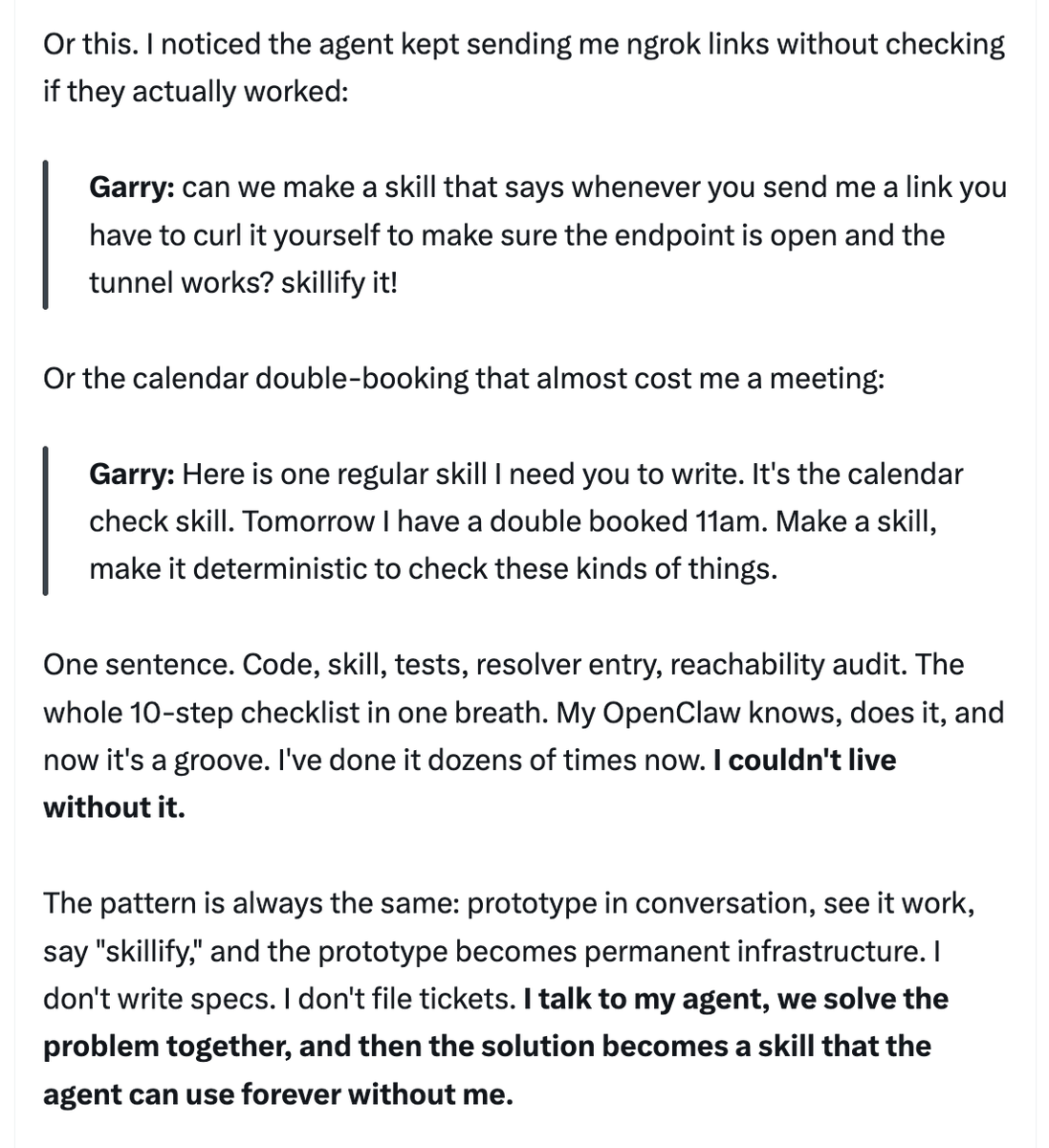
This cycle below is what has replaced 50% of my agentic coding. This is now how I am building GBrain and my own personal mini-AGI with full context on me and the things I care about.

It's not hard. It's quite fun. I do something, anything with OpenClaw, then I say SKILLIFY IT
Garry Tan @garrytan
How to really stop your agents from making the same mistakes — LangChain has raised $160 million. Three years of development. A billion-dollar valuation. LangSmith, their testing platform, is genuinely sophisticated: trajectory evals, trace-to-dataset pipelines,
♥ 885 · ⟲ 72 · 👁 132.2KView on X ↗

Higgsfield Launches Marketing Studio Powered by Hermes Agent

Higgsfield Launches Marketing Studio Powered by Hermes Agent▶

Higgsfield AI announces Higgsfield Marketing Studio, powered by Hermes Agent, which generates UGC-style video ads for websites or apps in a few clicks. The product is pitched at founders of vibe-coded products.

Original post · 1 min read
Meet Higgsfield Marketing Studio, powered by Hermes Agent.
UGC era for your vibe-coded products is here.

You can now create viral UGC ads for your website or app in a few clicks and distribute them at unmatched speed.

It's time to go global.
♥ 2.4K · ⟲ 324 · 👁 1.7MView on X ↗

Levelsio Praises Home Assistant for Open Smart Home Control

Levelsio Praises Home Assistant for Open Smart Home Control

Pieter Levels describes setting up a Home Assistant Green hub and integrating his house's KNX system, arguing that open-source Home Assistant beats walled-garden smart home platforms. He says AI can now help automate small annoyances through Home Assistant.

Original post · 2 min read
I got that little Home Assistant box home-assistant.io/green/

I can highly recommend Home Assistant in general, I was recommended it by @johnonolan and @daniellockyer I remember

When I bought my house I hated home automation and didn't want any, cause I had so many bad experiences with some app you have to install in a hotel room or Airbnb and it always sucked so bad with some stupid iPad and there's no light swtiches, gladly F off

99% of home automation is just terrible

Home Assistant is open source and it's cool because everyone else with it makes plugins (integrations) to connect any device to it

Which solves the biggest problem in home automation, there's many different walled gardens: Amazon has Alexa, Apple has Homepod, Google has Google Home, and when you buy a smart device, it'll only work with a few of them or only one

That's where Home Assistant comes in, because it's open source, people hack all these devices to work on Home Assistant, so you can actually control EVERYTHING and I mean EVERYTHING

Our house came with a KNX system installed by the electricians, KNX is some more low level home automation system but also quite open, and last week he helped me export his KNX project file and add it my Home Assistant and it's great because everything still has regular light buttons

But now I can fix tiny annoyances in this house easily with AI talking to Home Assistant, like shut off the annoying toilet vent that people forget to switch off and just auto switch off after 15 min, or make the lights red at 10pm, or kill those ugly Portugal white LED spots permanently

Home automation is best when it gets into the background and just does things and doesn't annoy you like I said that 99% of home automation integrations in hotels and Airbnb do

It should be analog by default (analog switches) and then customizable on top of that
Fer @El_Tate1
@levelsio Where do you host your HA, Pieter? And how are those lights managed to get them power?
home-assistant.ioHome Assistant GreenThe easy-to-use, versatile, and trustworthy smart home hub for everyone.
♥ 847 · ⟲ 18 · 👁 174.0KView on X ↗