Palmer Luckey responds to a Meta executive, saying America needs the tech companies to work together and that egos should not get in the way. The exchange follows his earlier post accepting an apology and noting Meta has changed since his 2016 ouster.
I am infamously good at holding grudges, but Meta has changed a lot over the past 8 years. The people responsible for my ouster and internal/external smear campaign aren't even around anymore. At some point, the Ship of Theseus has sailed. twitter.com/boztank/status/1841623880609480803
Aviral Bhatnagar compares equity index returns since June 2024, showing Nikkei up 66 percent and Nasdaq up 52 percent while NIFTY is flat, and says dollar depreciation leaves NIFTY down 13 percent in dollar terms.
Gergely Orosz comments on a Business Insider report that Amazon is recruiting former employees, including some it laid off, under a 'Boomerang Reengagement Initiative.' He notes that Amazon's hiring and firing policy was built on not rehiring most departing staff.
This is strange to see, because Amazon's complete hiring and firing policy has been built on the notion that they do NOT want to re-hire the majority of the people leaving (who are marked as non-regretted attrition, even if they are regretted - incentives!) but hire new instead
New: Amazon wants former employees back — including some it laid off. In one email, a recruiter called the push the “Boomerang Reengagement Initiative.” In another, a recruiter asked whether Amazon’s RTO policy had driven the ex-employee away.
Sheel Mohnot argues that online travel agencies such as Expedia are especially exposed to agent disintermediation because they do not control inventory and their value lies in comparison and discovery. He responds to a post in which Muse found a direct hotel booking cheaper than OTA options.
Muse checked hotel website, Expedia, booking and found direct booking is 5-10% cheaper and has free cancellation and found me a $50 hotel credit.. @alexandr_wang
Trung Phan highlights a passage from Citrini's 2028 Memo describing how consumer AI agents could dismantle the economy's rent-extraction layer, such as passive subscriptions and sneaky introductory pricing. He quotes a user whose AI agent got a $250 Delta credit and rebooked a delayed flight.
The section from Citrini’s 2028 Memo on how consumer AI agents will help users navigate the economy’s “rent-extraction layer” worth a re-read:
“It started out simple enough. Agents removed friction. Subscriptions and memberships that passively renewed despite months of disuse. Introductory pricing that sneakily doubled after the trial period. Each one was rebranded as a hostage situation that agents could negotiate. The average customer lifetime value, the metric the entire subscription economy was built on, distinctly declined.”
Flight delayed 7 hours - asked Muse to file for compensation. 5 mins later i had $250 credit in my delta account. it even found and rebooked me a new flight.
it just figured everything out. even responded to the support email itself.
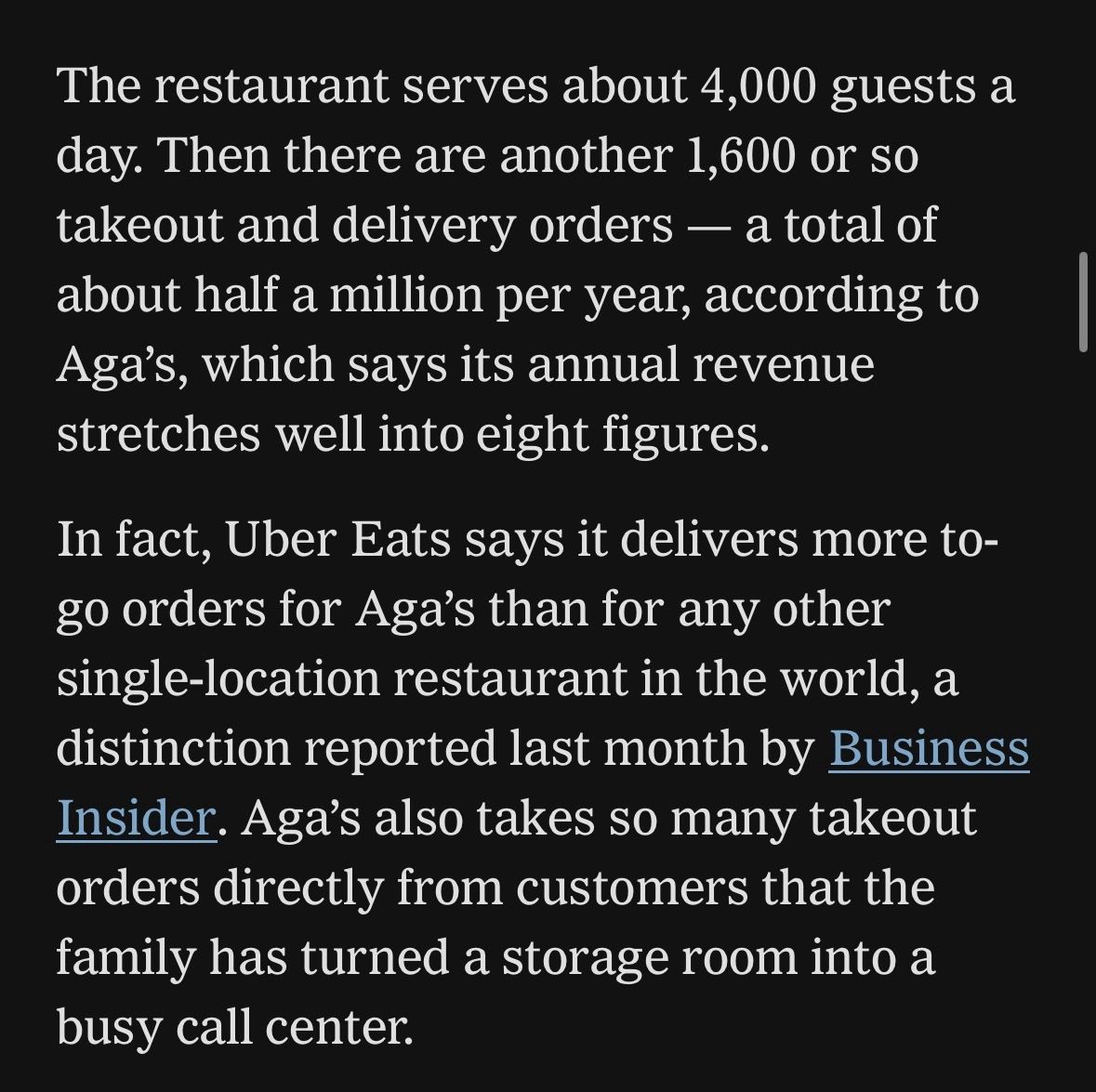
Barred in DC points to a New York Times story on an Indian restaurant in a Houston strip mall that is the world's most popular Uber Eats delivery spot, noting some drivers deliver only from there. The post includes two photos.
Interesting NYT story about the most popular Uber Eats delivery restaurant in the world - an Indian restaurant in a Houston strip mall. Some of the drivers only deliver from there,
Barred in DC shares a New York Times article reporting that Aga's, an Indian-Pakistani restaurant in Houston, generates more Uber Eats deliveries than any other single-location business worldwide. The piece is a gift article shared via link.
Levelsio argues that low-cost carriers like easyJet and Ryanair offer functional, efficient service while premium options like Qatar deliver consistent luxury, and he avoids the expensive middle tier of flag carriers. He is responding to a post defending Ryanair's low-price model.
My favorite airlines are low cost ones like Easyjet, Air Asia, Transavia (and Ryanair if they'd not fly with 737MAX) and premium ones like Qatar
The entire middle section is the one I try stay away from and where everything is expensive but usually sucks
Usually there you have national flag carriers like KLM, British Airways, Lufthansa or Swiss which have very mediocre service for a high price
With low cost airlines you don't pay a lot, but you get a basic functional no frills service, and because it's so high volume (Ryanair for example does the most flights out of any airline in Europe!), they have their workflow dialed in well
With premium airlines like Qatar you pay a lot, but you get a very premium consistent service
tbh i think ryanair is one of the best airlines in the world
they are giving poor people access to the world by reducing everything "unnecessary" to a bare minimum. if you just have a backpack and you want to see prague, you can do so for $50 or whatever ryanair tickets cost
many poor people complain about ryanair and they are wrong for doing so, they merely don't understand ryanair's mission. it's not a right to be able to see the world and ryanair actually makes it possible
UFC CEO Dana White, who sits on Meta's board, describes full-day board meetings from 9am to 6pm, followed by dinner and about three more hours, spanning two days. He praises Mark Zuckerberg and the other directors. The post also quotes Zuckerberg on AI agents interacting with each other.
Dana White says Mark Zuckerberg is an animal and reveals Meta board meetings go from 9am to 6pm, dinner, then another three hours, extending into two days
"I'm on the board of Meta and I just got home last night from a Meta board meeting, and it's one of the best decisions I've ever made was when Mark Zuckerberg called me and I said yes to that."
"And you sit in this room, and not only the people that he runs through the room all day, which are some of their high-level employees there, but the rest of the board, you literally have the smartest people in the world trying to tackle problems that are, you know, a whole another level."
"There's levels to life and to business."
"So Zuckerberg is an animal, okay. These board meetings start at nine o'clock in the morning, they go till six, then you go to dinner and it's basically another three hours of the board meeting, right?"
"And every time we'll be in there, you know, two days in the room, and every time I walk out of those board meetings, I'm so fired up and inspired by the other board members and the people who work at Meta."
Mark Zuckerberg: the whole industry treats AI agents as a single-player game but the real unlock is agents interacting with each other, which Meta has been running internally
"Right now I think most of the industry is thinking about agents as like a single player game, right? It's like you have your agent and you use it."
"And there are going to be all these interesting things that basically you can do by having the agents interact with each other."
"And we already have all these interesting examples internally where people have their agents interacting with each other."
Vinod Srinivasan links to a Mint report reconstructing a four-hour Tata Sons board meeting in which five directors reportedly outmaneuvered Noel Tata. The meeting ended with N. Chandrasekaran reappointed as chair, according to the linked article.
Mint has reconstructed the Tata Sons board meeting minute by minute. I have read it twice. I would say it changes the story from "Noel Tata lost a vote" to something more uncomfortable for everyone in that room.
A post from Jason says three upcoming IPOs are worth more than all tech IPOs from the last 45 years combined. The post includes a photo and gives no named companies or sources.
OddStats notes that QQQ rose at least 2.75% on a day the QQQ volatility index rose at least one point, and says QQQ has historically performed strongly two weeks and one month after similar days. The post includes a chart.
Melvin Invests argues that Meta's Muse agents will drive growing CPU demand as they complete more tasks, and promotes five stocks positioned to benefit. The post is a short video with a call to save it.
Jason Luongo lays out a long-dated $250 call on Amazon expiring January 2028 as leveraged exposure, citing AWS growth of 37%, a $496B backlog and custom chip revenue. He includes a standard risk disclaimer that the premium can be entirely lost.
You could buy 100 shares of $AMZN right now for about $25,800.
Or you could buy the $250 call LEAP expiring January 2028 for about $5,400. Leveraged exposure to 100 shares. ~79% less capital. Over 480 days of runway.
The trade: Strike: $250 Expiration: January 21, 2028 Premium: ~$54 per contract Breakeven: $304
If $AMZN hits $320, this LEAP returns ~30% If $AMZN hits $360, this LEAP returns ~104% If $AMZN hits $400, this LEAP returns ~178%
100 shares at $400 returns ~55%. The LEAP returns more than 3x that on a fraction of the capital.
Why I like the setup:
- Q2 revenue up 20% to $200.6B, operating income up to $27.5B from $19.2B a year ago - AWS grew 37% to $42.2B, its fastest growth in 18 quarters - AWS backlog sits at $496B, up from $364B the prior quarter - Custom chip business now runs above $25B a year, growing triple digits, with Anthropic and OpenAI both committed to Trainium for multiple gigawatts - Advertising up 26% year over year - Stock is about 10% below its August high, and next earnings are expected in late October - 487 days of runway gives this trade time to work through short-term noise
The max you can lose on a LEAP is the entire premium you paid. In this case, that's $5,400 per contract. LEAPs are leveraged and can lose value quickly if the stock drops or stays flat. Only size this so you're comfortable losing all of it.
Note: LEAPs are one tool inside a broader portfolio. Owning shares is always the primary use of capital. This is a selective add-on for high-conviction moments when conditions align.
Jason Goepfert reports that the S&P 500 rallied at least 1% to within 1% of a new high while more stocks hit new lows than highs, a pattern he says has occurred only on July 23, 1929 and December 21, 1999. He also notes that few stocks remain in long-term uptrends.
There are 2 days in history like today, when the S&P 500 $SPY rallied at least 1% to within 1% of a new high, and more of its stocks fell to new lows than highs.
Trung Phan notes AMD's market cap has risen from about $10 billion to $1 trillion since 2018, quoting Kobeissi Letter's report that the stock crossed $1 trillion. The post adds that $10,000 invested in 2016 would be worth about $3.05 million today.
AMD’s market cap has now risen 100x from $10 billion to $1 Trillion since Sky Sports asked Lisa Su if she could “speak English” at the starting grid during 2018 F1 Chinese Grand Prix.
Mostly Borrowed Ideas says it increased its Meta position after writing a deep-dive arguing Meta's Muse could transform the consumer internet. The author contrasts Meta's valuation with Airbnb's, citing asymmetric upside from Meta's optionality.
"What really compelled me to make this trade is the asymmetry of the bet. While I believe Airbnb’s stock doesn’t price such “nuclear” risk at all in today’s multiple, Meta’s valuation doesn't give it much credit for the optionality of transforming the consumer internet. The trade was admittedly a bit uncomfortable given my portfolio’s outsized bet on Meta, but on a side-by-side comparison between Meta and Airbnb, it wasn’t a difficult call for me."
Rihard Jarc argues Amazon will need to accommodate personal AI agents rather than block them, predicting its ad business could shrink as agents take over discovery. He is responding to a post reporting that Amazon cut off Meta's Muse.
I understand the first line of thinking that $AMZN doesn't like $META's Muse to shop around, and people starting to use AI agents as the entry point for commerce, but this is the future.
I don't believe $AMZN has a chance of having its own world-dominant personal AI assistant that people would fully transition to. Best case is $AMZN has an endpoint or their own agent that Muse and other personal agents talk to, and not crawl on their websites.
$AMZN's e-commerce business will still do well in the agentic era (but they have to lean into the agentic era, not go away), but their ad business (the part of it that is related to discovery on their website) will probably be worth a lot less as agents take over.
BuccoCapital Bloke says he is bullish on Meta and Muse but expects a fight over commoditization after Amazon reportedly cut off Muse. The post includes a photo of the announcement.
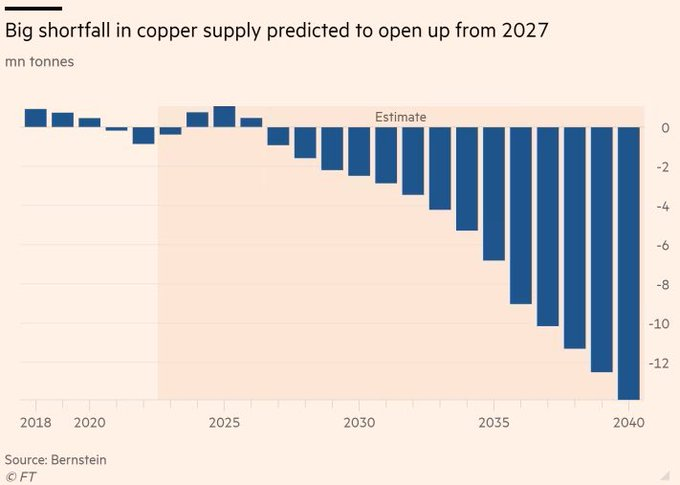
Oguz Erkan quotes Stanley Druckenmiller saying there will be no new copper supply for eight years while data center buildout adds demand. The post notes copper is up 50% over the past year, citing an FT report of an expected 2027 shortfall.
Hank Couture notes that Venky Ganesan, a partner at Menlo Ventures, wrote a thoughtful piece on venture capital, and points out Menlo invested in Anthropic early, when it was pre-revenue in 2023. The post praises the essay as a great read.
A few thoughts on the current state of venture capital.
When the Music Is Playing
In July 2007, a few weeks before the credit markets seized up, Chuck Prince, then the CEO of Citigroup, gave an interview to the Financial Times. The line everyone remembers is this one: "As long as the music is playing, you've got to get up and dance." He was mocked for it for years afterward, and he lost his job a few months later. But I have come to think he was saying something honest. He wasn't claiming the music would play forever. He was admitting that he couldn't sit down while it was still going, and n…
Venky Ganesan of Menlo Ventures argues that venture capital is in a disorienting period, with some portfolio companies growing fast while pre-revenue startups raise billions at $10 to $50 billion valuations. He frames the moment through Chuck Prince's 2007 quote and George Soros's idea of reflexivity.
A few thoughts on the current state of venture capital.
When the Music Is Playing
In July 2007, a few weeks before the credit markets seized up, Chuck Prince, then the CEO of Citigroup, gave an interview to the Financial Times. The line everyone remembers is this one: "As long as the music is playing, you've got to get up and dance." He was mocked for it for years afterward, and he lost his job a few months later. But I have come to think he was saying something honest. He wasn't claiming the music would play forever. He was admitting that he couldn't sit down while it was still going, and neither could anyone else in his seat.
I've been thinking about that quote a lot lately, because right now is the most disorienting period in venture capital I can remember, and I have been doing this for a while.
Here is what makes it disorienting. It's not that things are bad. Some things are spectacular. We have companies in our portfolio growing faster than anything I have seen in my career, and I don't say that lightly. At the same time, we have companies with no revenue, no product, and a founding team you could fit in a conference room raising billions of dollars at valuations of $10 to $50 billion. Both of these things are true at once, and if you try to reason about them with the same framework you will drive yourself crazy.
Two ideas have helped me make sense of it. Neither is mine.
The first is reflexivity, which George Soros has been writing about since the 1980s. In most of life, perception follows reality: the weather is what it is, and your opinion of it changes nothing. In markets, it runs the other way too. Prices change what participants believe, and what participants believe changes the prices. The feedback loop can run for a long time, and while it's running it looks exactly like progress.
Here is how reflexivity is playing out in AI. Full disclosure: Menlo is an investor in Anthropic, so read the following with that in mind. People watched a frontier lab go from a $4 billion valuation to $18 billion, then $60 billion, then $180 billion, then $380 billion, and now something close to a trillion. They drew the obvious conclusion: that is what a neo lab looks like. So the next neo lab gets priced off that path, not off anything it has built. Then it gets marked up in a subsequent round, and the markup itself becomes the proof. Look at Thinking Machines. Look at Reflection. At that point valuation has stopped being an output of the metrics and has become the metric. Nobody is discounting cash flows. They are discounting the last round.
Soros is very clear about one thing, and it's the part people skip: you cannot know when or how a reflexive process ends. You only know that it does. Every one of them has.
The second idea is Chuck Prince's, and it explains why smart people keep dancing even when they can see the loop for what it is. As far as I can tell, there are two groups on the dance floor.
The first group got in early. Firms like ours were in some of these AI companies before the numbers got silly, and the paper gains are enormous. When you are sitting on gains like that, you start to feel like you're playing with house money. I have been around long enough to know that house money is the most dangerous kind, because you don't respect it the way you respect money you had to earn.
The second group missed the early rounds and knows it. Their LPs know it too. So they are trying to make up for lost time by writing very large checks very late, which is the one strategy almost guaranteed to turn a missed opportunity into a real loss.
House money on one side, FOMO on the other, and reflexivity feeding both. That's the whole story. Everyone has a reason to keep dancing, and the reasons are different, which is why nobody can talk anyone else off the floor.
So what do you do? The instinct in our business is to answer with company identification: just pick the right neo lab and you'll be fine. I think that's the trap. When price has become the signal, being right about the company is not enough, because you can be right about the company and still be wrong about the price by a factor of ten. The public-market investors I admire figured this out a long time ago. They spend as much time on how much to own as on what to own.
The winners in venture over the next decade will be the firms that treat portfolio composition and position sizing as seriously as they treat sourcing. How much of the fund is in companies whose valuation rests on the last round rather than on revenue? What happens to the portfolio if the reflexive loop breaks next year instead of in five? Those are not exciting questions. They are the ones that will matter.
The music will stop. It always does. Dance if you must, but know where the chairs are.
Unusual Whales shares a Financial Times report projecting a significant copper shortfall beginning in 2027. The post includes a photo but little additional text.
Investor Hamid says his public portfolio has returned 812% against 83% for the S&P 500 over about 4.5 years. He highlights recent bets on Micron, Meta and Rivian, while noting he does not give investment advice.
My portfolio (+812%) vs. S&P 500 (+83%). In 4 1/2 years since my portfolio has been public, I've outperformed the S&P 500 by ~10x.
I've been told consistently that it's nearly impossible to beat the S&P 500, yet I've been doing just that for ~25 years! Kind of wild.
What am I buying now? My portfolio is public and 100% free (link in bio). But if you must know, this year, I've been going heavy into $MU (my AI semiconductor bet, trading at a ridiculous forward PE of just 7, or a 70% discount to FPE of the S&P500), $META (my overall "amazing business" that's growing faster than peers with huge AI upside, yet trading at a massive discount) and $RIVN (my "future is EVs + Autonomy" bet, but on a company that has a ridiculously low valuation of just $22 Billion rather than $1.4 Trillion!).
I share my views and what I'm doing publicly, including alerts of when I make trades, but I don't give investment advice. Everything I share is for awareness and helping others learn from my transactions.
If it's helped you in any way, comment and say hi!
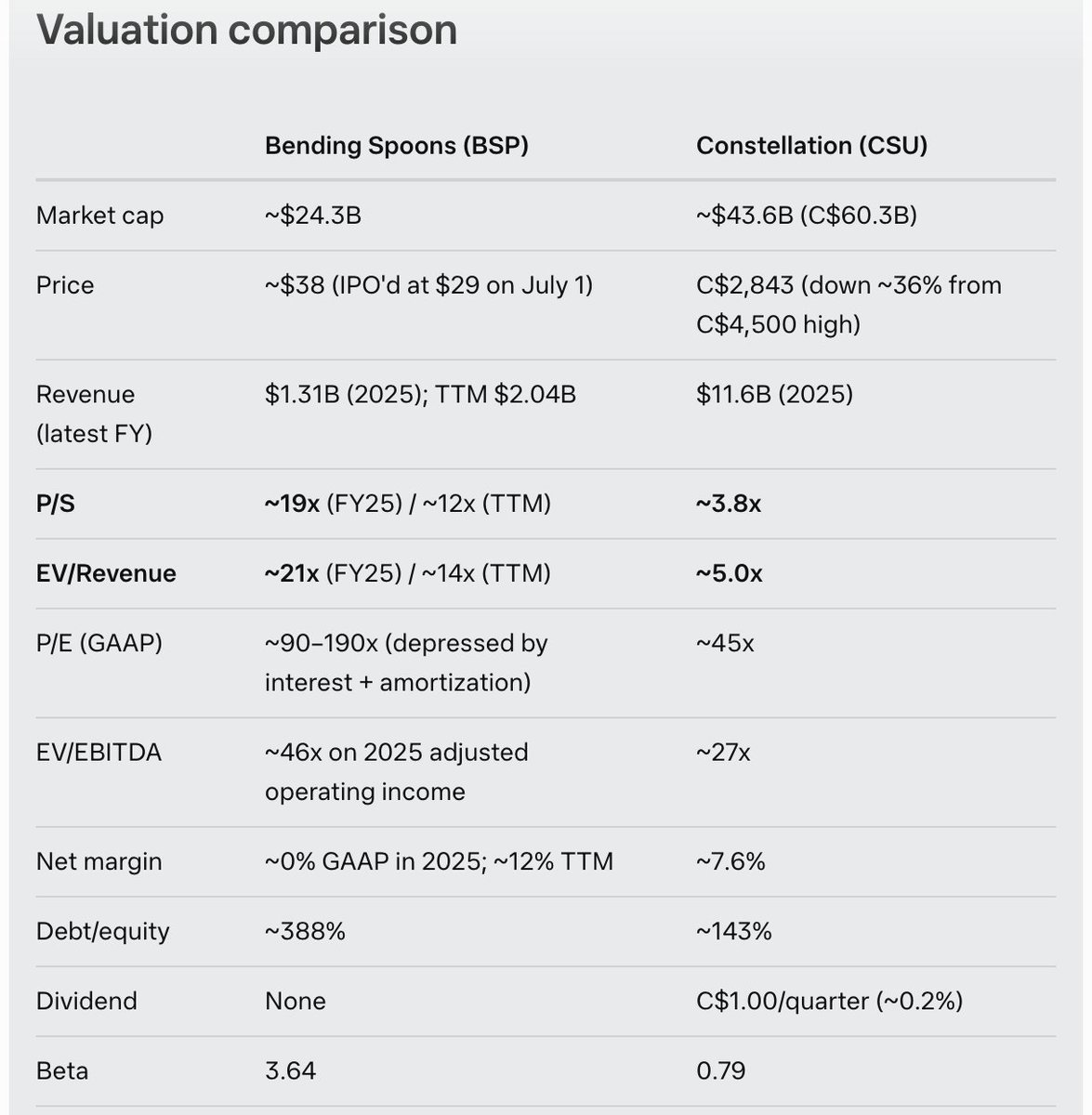
Rohit Mittal contrasts Bending Spoons and Constellation Software, arguing Bending Spoons' growth is financed on heavy debt while Constellation deleverages quickly. He cites valuation multiples, organic growth declines and interest expense as a share of revenue.
Venture folks are sophisticated about venture investments, but they put all acquirers in the same bucket.
Software company acquirers can look very different depending on: - who they acquire (types of companies) - how they grow - how they generate profits - how they finance acquisitions - revenue and profit stability
Bending Spoons has completed 50 acquisitions, while Constellation has acquired 1,400 companies.
Bending Spoons is trading at 19x FY25 sales, while Constellation trades at 3.8x.
Bending Spoons is growing at 100%+ with acquisitions, while Constellation is growing at 20%.
But they are both growing 3%-5% organically.
Bending Spoons' organic rate has halved two quarters in a row (13% → 6% → 3%).
Bending Spoons carries roughly 8–10x more debt relative to revenue than Constellation.
Bending Spoons has a much higher net debt-to-revenue ratio at 3.1x, while Constellation is at 0.2x- 0.4x.
For Bending Spoons, interest expense is 11% of revenue, while for Constellation, it's 2.6%.
Constellation can deleverage quickly, while Bending Spoons needs the next deal to pay for the previous deal.
Overall, Bending Spoons' growth is bought on credit.
Each company took a different approach to compounding revenue and cash flows, and the valuations will eventually reflect that.
Dustin claims Mark Zuckerberg said buying Meta's AI bottleneck suppliers is the easiest path to wealth, then lists five stocks that could return 10x. The only pick shown is Nebius, with a video attached.
Trading Warz claims selling S&P 500 puts changed his life, describing 186 trades and 1,500 contracts that expired worthless, and promotes a live Spaces session. The post makes unverified profit claims and reads as promotional.
I did IT TEAM - I sold puts 186 times over 1500 contracts in 18 months all expiring WORTHLESS
The dark secret in the market is they want RETAIL to chase 0 dte and OTM where the big boys are selling it! PUTS are DESIGNED to go to 0 I documented the full challenge!
I will be LIVE on X SPACES tomorrow to teach you step by step STOP GAMBLING and Follow the INSTITUTIONS
Ashlee Vance says it is hard to describe the effect Emergent Ventures is having on India, quoting Tyler Cowen's announcement of the 19th India cohort. The post links to a Marginal Revolution update.
Jason Luongo describes receiving about $3,930 in premium for selling a put on Meta at a $500 strike expiring January 2028, outlining the upside and the downside if assigned.
Someone would pay me roughly $3,930 upfront to agree to buy 100 shares of $META at $500.
One put. Expiring January 21, 2028.
If the put expires worthless, I'd keep the full $3,930.
If I get assigned, I'd buy 100 shares at $500 and still keep the premium. That's a $50,000 purchase, with an effective cost of $460.70 per share after the premium.
My existing portfolio could support the margin requirement, allowing my shares to stay invested instead of setting aside the full $50,000 in cash.
That's how a portfolio-secured put would work.
But agreeing to buy at $500 means paying $500 even if the stock falls much further.
If the stock's price is $400 at expiration, I'd be down $6,070 after the premium.
I'd be collecting $3,930 for taking on that buying commitment.