Wednesday, October 7, 2026ArchiveSearchAsk the paper

The Computomatix Times

All the posts fit to save — curated from @computomatix's bookmarks & likes on X

Business & Markets

Big tech, the economy, investing and trading

Michael Burry Warns Circular AI Financing Among Eight Firms Could Unravel
Michael Burry Warns Circular AI Financing Among Eight Firms Could Unravel

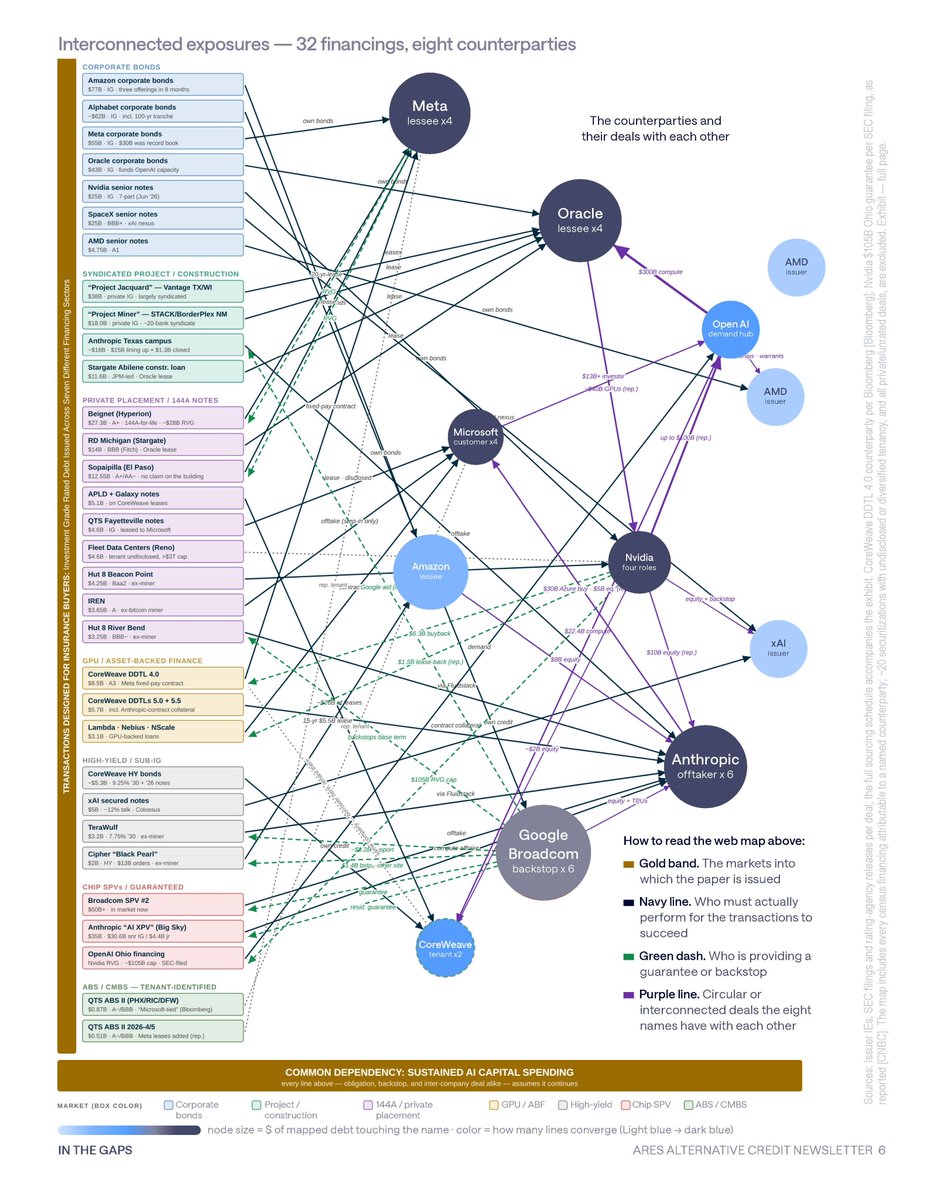
A tracker account relays Michael Burry's view that $573 billion in AI financing over the past year runs through eight companies that lend to, guarantee and buy from one another. Burry compares the setup to the 2000 telecom fiber bust and warns guarantees could be called if AI revenue disappoints.

Original post · 1 min read
Breaking: Michael Burry says the AI boom is running on one giant loop and time is running out

Here's his breakdown:

1. Burry shared a report from Wall Street lender Ares tracking $573B of AI financing from the last 12 months

2. All of it runs through just 8 companies: Meta, Oracle, Microsoft, Amazon, OpenAI, Anthropic, Broadcom and Nvidia

3. They lend to each other, guarantee each other's debt and buy from each other, so one company's loan is backed by another company's promise to keep spending

4. Every deal depends on one thing: AI spending never slowing down

5. If AI revenue disappoints for even one season, the guarantees could all get called at once, right when the companies backing them are at their weakest

6. Burry says it's the same circular financing that turned the 2000 telecom fiber boom into a bust

Burry claims the stock market in the first stage of grief and the crash is soon
♥ 4.6K · ⟲ 1.3K · 👁 343.9KView on X ↗

Navy Pays Anduril $2.9 Billion as U.S. Submarine Capacity Lags

The post argues the Navy turned to Anduril because only two U.S. yards build nuclear submarines and deliver far below the required rate, with China's shipbuilding capacity vastly larger. Anduril is investing $3.7 billion in a new Sparrows Point shipyard, Arsenal-2, with operations planned for 2030.

Original post · 1 min read
The US Navy just paid $2.9 billion to a company that has never built a submarine. Here's why they had no choice.

America has exactly two shipyards that can build nuclear subs. Electric Boat in Connecticut. Newport News in Virginia. The Navy needs two Virginia-class boats a year from them. They deliver 1.1.

Then it gets worse. Under AUKUS, America promised to sell Australia 3 to 5 Virginia-class submarines starting in the early 2030s. We signed a deal to export a product we can't build fast enough for our own fleet.

And the number behind all of it comes from the Navy's own intelligence office. China's shipbuilding capacity sits around 23 million tons a year. America's is about 100,000 tons. 230 times larger. One Chinese shipbuilder, CSSC, built more commercial tonnage in a single year than every American yard combined has built since World War II.

Both incumbent sub yards carry backlogs stretching past 2040, and the supplier base behind them shrank by thousands of companies after the Cold War. You cannot order your way out of that. There was physically no third option to call.

So the Navy invented one. Anduril adds $3.7 billion of its own money, breaks ground on the bones of Bethlehem Steel at Sparrows Point, once the largest steelworks on earth, shuttered in 2012, the yard complex that fed the fleet that won WWII. Hiring starts in 2029. Operations in 2030.

Four years from announcement to first output, and in American shipbuilding that counts as a sprint.
Anduril Industries @anduriltech
Anduril is investing $3.7B into Arsenal-2.
The next great American Shipyard.
♥ 236 · ⟲ 21 · 👁 18.1KView on X ↗

Huawei and Qualcomm Sign Broad Patent License, Cross-Licensing Deal

Huawei and Qualcomm announced a multi-year patent license agreement with cross licenses covering 5G, compute, AI and networking, plus Qualcomm's purchase of certain Huawei U.S. patents. Arnaud Bertrand calls it a notable outcome given U.S. efforts to cut Huawei out of those fields.

Original post · 1 min read
This is genuinely incredible: Huawei survived the most aggressive assault against a single company in modern history and is coming out the other side with the U.S. licensing its technology.

And ironically in the exact domains - 5G, AI, compute, networking - that the U.S. tried to cut Huawei out of.
Huawei @Huawei
Huawei and Qualcomm have announced a multi-year, broad patent license agreement that includes cross licenses to the companies' patent portfolios across a range of fields, including 5G, compute, AI, and networking, together with Qualcomm's purchase of certain Huawei U.S. patents.
♥ 5.8K · ⟲ 1.1K · 👁 161.0KView on X ↗

a16z Argues Flexible Data Centers Could Bypass Texas Grid Queue

a16z Argues Flexible Data Centers Could Bypass Texas Grid Queue

a16z's Ryan McEntush argues that data centers agreeing to curtail power during peak hours can connect to congested grids sooner. He cites Texas's queue growing to 474 GW, about 90% of it data centers, and estimates 100 GW of flexible capacity could be added without new plants.

Original post · 1 min read
Left: Texas's grid only maxes out about 200 hours a year, roughly 2% of the time.

Right: New data centers that agree to cut back during peak hours can skip the wait for more capacity. US grids could add 100 GW of them without building a single new plant.

a16z's @rmcentush on how flexible data centers get onto the grid sooner: a16z.news/p/why-texas-is-making-data-centers
Ryan McEntush @rmcentush
Why Texas Is Making Data Centers Wait — At the end of 2024, Texas’ grid operator had 63 GW of large new customers in its queue. By this June, that figure reached 474 GW, more than five times record peak demand, about 90% of it data centers.
♥ 122 · ⟲ 23 · 👁 19.4KView on X ↗

Larry Ellison Signs $40.4 Billion Guarantee for Warner Bros. Deal

Aakash Gupta reports that Larry Ellison signed a $40.4 billion personal guarantee to back the Ellison family's roughly $111 billion acquisition of Warner Bros. Discovery after Paramount's purchase, outbidding Netflix. The combined company, to be called Skydance, would include major studios, news networks and a 15% stake in TikTok's US entity.

Original post · 1 min read
A dad just signed a $40.4 billion personal guarantee so his son could buy Hollywood.

In 14 months, the Ellison family bought Paramount for $8 billion, then won a bidding war against Netflix for Warner Bros. Discovery at roughly $111 billion. Warner Bros, Paramount, CBS, HBO, CNN, DC, Nickelodeon, and TNT Sports now sit under one roof. Next week the combined company takes the name Skydance.

Netflix should have won. Warner's board had already signed an $83 billion deal with them and rejected the Ellisons twice, because the money sat in a revocable family trust the board called "illusory."

So Larry Ellison, 82 years old, answered with an irrevocable personal guarantee of $40.4 billion. One signature.

For scale, Larry has sold about $4.7 billion of Oracle stock this entire century. The guarantee was almost 9x everything he's cashed out in 25 years, backed by his 1.16 billion Oracle shares.

The merged streamer launches with around 207 million subscribers and $70 billion in projected annual revenue. And through Oracle, the family also holds 15% of TikTok's US entity.

Harry Potter, Top Gun, Batman, SpongeBob, Game of Thrones, CNN, CBS News, and a piece of TikTok's algorithm, all of it now answers to one family.
Valuetainment @valuetainment
JUST IN: HBO Max and Paramount+ are merging into a single streaming service.
♥ 545 · ⟲ 58 · 👁 77.9KView on X ↗

Valon Raises $150M Series D at $2.3B Valuation for Mortgage Software

Valon Raises $150M Series D at $2.3B Valuation for Mortgage Software▶

a16z reports that Valon raised a $150 million Series D at a $2.3 billion valuation after signing over $200 million in software deals, and describes how it became a regulated servicer before selling its platform to the industry.

Original post · 1 min read
.@Valon just raised a $150M Series D at a $2.3B valuation. Within six months of selling software, they signed over $200M in deals.

(And they're hiring!)

How the seven-year-old company got there:

- Mortgage is $13 trillion of consumer debt running on a system built before the internet, and no servicer will trust a new platform. So Valon became one.

- Co-founder Andrew Wang read every federal and state regulation, 18 hours a day for six months, and turned it into code.

- They ran their own servicer on the software until it hit 3x the industry's efficiency, sold that servicer to a larger mortgage company, and now sell the software to everyone else. One of the biggest servicers in the US is moving 4 million loans onto it, nearly 10% of the market.

Valon is hiring deployment strategists in NY and SF. Read more about their open roles: a16zjobs.substack.com/p/valon-just-raised-150m…

@xlindadu @wangandrewd
a16z @a16z
a16z's Angela Strange sits down with @Valon's Andrew Wang and Linda Du to unpack what it takes to rebuild the infrastructure underneath a $13 trillion mortgage market that still relies heavily on systems designed before the internet.

Linda and Andrew explain why Valon chose the hardest path: becoming a regulated mortgage servicer, translating decades of federal and state regulation into software, and proving the platform on its own loans before selling it to the industry. That foundation made Valon roughly 3x as efficient as traditional servicing and created the system of record it is now usi…
♥ 253 · ⟲ 22 · 👁 47.4KView on X ↗

Arista's Andy Bechtolsheim Says AI Optics Demand Is Just Beginning

Arista's Andy Bechtolsheim Says AI Optics Demand Is Just Beginning▶

Fireside Alpha shares remarks from Arista's Andy Bechtolsheim, who says AI has made optics demand roughly tenfold larger in five years and that another order of magnitude in bandwidth is needed. A companion post cites Meta's Reels watch-time gains from better recommendation models.

Original post · 1 min read
$ANET Andy Bechtolsheim says AI has made optics demand about 10 times bigger in five years and the industry is only at the "very beginning"

"So I guess I don't need to tell you that AI has been driving this incredible increase in demand for high-speed optics, which is probably now 10 times bigger than it used to be five years ago..."

"And what I want to talk to you today is that we're not at the end of this journey, but rather the very beginning. There's easily another order of magnitude increase in bits needed for the next generation kind of data centers."

"So what I want to talk about first is what's happening at the data center level, and how we as an industry have to get together to solve these problems of this very rapid and high demand growth as fast as possible, since AI can't wait."
______
For full set of takeaways to Andy's AI Datacenter and Optics lecture: firesidealpha.substack.com/p/aristas-andy-bech…
Fireside Alpha @firesidealpha
$META Devansh Tandon reveals the tokens-in, engagement-out flywheel behind Meta's recommendation system, where better models lift Reels watch time 30% and the monetization pays for the next training run

"These scaling curves aren't just academic research. They're driving real product impact at scale for some of the biggest consumer businesses in the world."

"Here's a couple of examples I have from Meta's recent earnings reports. Instagram Reels had a strong quarter, 30% year on year watch time."

"And the optimizations we made to improve the quality of recommendations included simplifying ou…
♥ 312 · ⟲ 36 · 👁 1.7MView on X ↗

Micron Sees Humanoid Robots Driving Major Memory Demand

Tanay Jaipuria reports that Micron expects humanoid robots to require memory and storage comparable to Level 4 autonomous vehicles, including over 200GB of DRAM and terabytes of NAND. Micron's CEO believes physical AI could become a significant memory demand driver by decade's end.

Original post · 1 min read
Micron expects humanoid robots to need memory and storage comparable to Level 4 AVs: 200GB+ of DRAM and terabytes of NAND

Micron CEO believes "Physical AI can become a significant driver of memory and storage demand by the end of this decade."
♥ 24 · ⟲ 3 · 👁 2.3KView on X ↗

Amazon Shuts Down Consumer Agent Access, Analyst Calls It Short-Sighted

Olivia Moore argues Amazon's decision to block consumer AI agents is rational near-term, citing advertising margins and Prime lock-in, but says it is a mistake long term because agents are inevitable for low-consideration purchases.

Original post · 1 min read
Amazon shutting down consumer agent access (now both Muse and Instinct) is both completely rational and a big mistake

They have plausible reasons:

1. Advertising accounts for ~10% of Amazon revenue, but an estimated 50-60% of operating profit because it's so high margin. People purchasing via agents = fewer consumer eyeballs to monetize

2. Amazon knows from experience how dangerous it is to give another platform a lever to ramp up / down your distribution 👀 They've done this to many retailers themselves

3. They are in a very good spot re: near-term defensibility - with ~250M Prime subs (who are habituated to buying on Amazon) + a massive logistics and distribution network that you can't vibe code

However, this logic is short-sighted (IMO). Agents are inevitable, especially for the kind of purchases people make on Amazon (low consideration, frequent, fairly urgent or recurring).

I don't think Amazon is going to come out with a first-class consumer agent on their own...and in the meantime, why anger your valuable users and make them even consider alternatives?

It's almost never a good idea to be on the wrong side of innovation. I'd much rather see them continue to greenlight agent traffic (it's pretty minimal now!) and work on adjusting to an agent-first world in the meantime.
♥ 309 · ⟲ 23 · 👁 44.0KView on X ↗

Deedy Argues Google's Bureaucracy Undermines Its Core Priorities

Deedy, a former Google employee, argues the company does middling work on its top priorities while excelling at lower ones, blaming executive behavior and internal promotion incentives during frenetic periods. He lists Google's widely used products and says it prioritizes users over profits.

Original post · 3 min read
Google is an incredible company that I’ve always rooted for that trips over its own bureaucracy in frenetic times.

They ironically do a middling job at their first priority, but crush it at their second or third. We’ve seen this with Search, Google+, Assistant, Cloud and now even AI. Why?

The internet would be unrecognizable without Google. This is a company that has Search, Chrome, Android, Workspace (Docs/Sheets), Drive, Play Store, YouTube, Gmail, Maps, Photos, Translate, Gemini, Calendar, Meet, Chromebooks, Waymo: some of the most widespread and most undermonetized products in the history of the world. It is inconceivable for most of us to live life without software Google has made available for $0.

And truly, having worked there, this is a company that continuously prioritizes their users over profits. Even as a casual reader, it might be trivial for you to imagine 100s of ways to monetize all of Google’s products. But they usually don’t. They don’t just launch experiments because it’s high engagement, but only when it’s actually good.

So how does a company like this falter?

My observation has been that these frenetic eras either attract or condone the worst behavior out of execs that trickle down to the rest of the company. The most “ambitious” L3-L7 people who feel stuck finally see a company-wide priority and their eyes light up with the gleaming prospect of a promotion. A lot of people in big orgs’ entire sense of self esteem is wrapped around their level. They will do a lot for an N+1. “Did you know Sergey is personally working on this?” “Sundar referred to my project in the all hands” In turn, everything in these orgs become a knife fight for getting the most “high impact” projects, fighting for credit, flagrantly hiding concerns around juiced metrics. More work goes into a promo packet than the actual project. Goodhart’s Law kicks in and the metrics measured for a promotion are abused beyond measure.

On the other hand, second and third priority things work brilliantly. It attracts people with genuine interest, sincerity who are willing to play longer term games. Many products have grown and thrived when left alone.

When there is immense pressure for a number to go up, it eventually does but often at the cost of product quality (the small product polish things don’t get me a promo), core innovation (why take on a high risk bet if I can get promoted for copying oai/ant) and cultural cohesion (a lot of bad blood amongst people in the org, tons of reorgs). There is a certain type of individual that thrives in this environment, and they are typically not very likable nor “Googley”. This is why an incredible number of people leave or allow jesus to take the reigns as they cash in the bag.

I lament that every time this happens, we, the billion users, lose out on yet another beautiful Google product.
♥ 1.7K · ⟲ 78 · 👁 287.6KView on X ↗

Anduril Commits $3.7 Billion to Arsenal-2 Shipyard Project

Palmer Luckey says Anduril is investing $3.7 billion in Arsenal-2, which he describes as the largest American shipyard built since World War II, and calls for bold investment in shipbuilding.

Original post · 1 min read
Anduril is building America's largest shipyard since WWII. This space needs bold investment and decisive action.

In the 1790s, Baltimoore clippers were the fastest and most advanced sailing ships of their time. King George III didn't stand a chance. Time to run the same play.
Anduril Industries @anduriltech
Anduril is investing $3.7B into Arsenal-2.
The next great American Shipyard.
♥ 46.0K · ⟲ 3.5K · 👁 1.4MView on X ↗

Levelsio Maps Government-Owned Hotels Behind Major Chains in New Filter

Levelsio Maps Government-Owned Hotels Behind Major Chains in New Filter

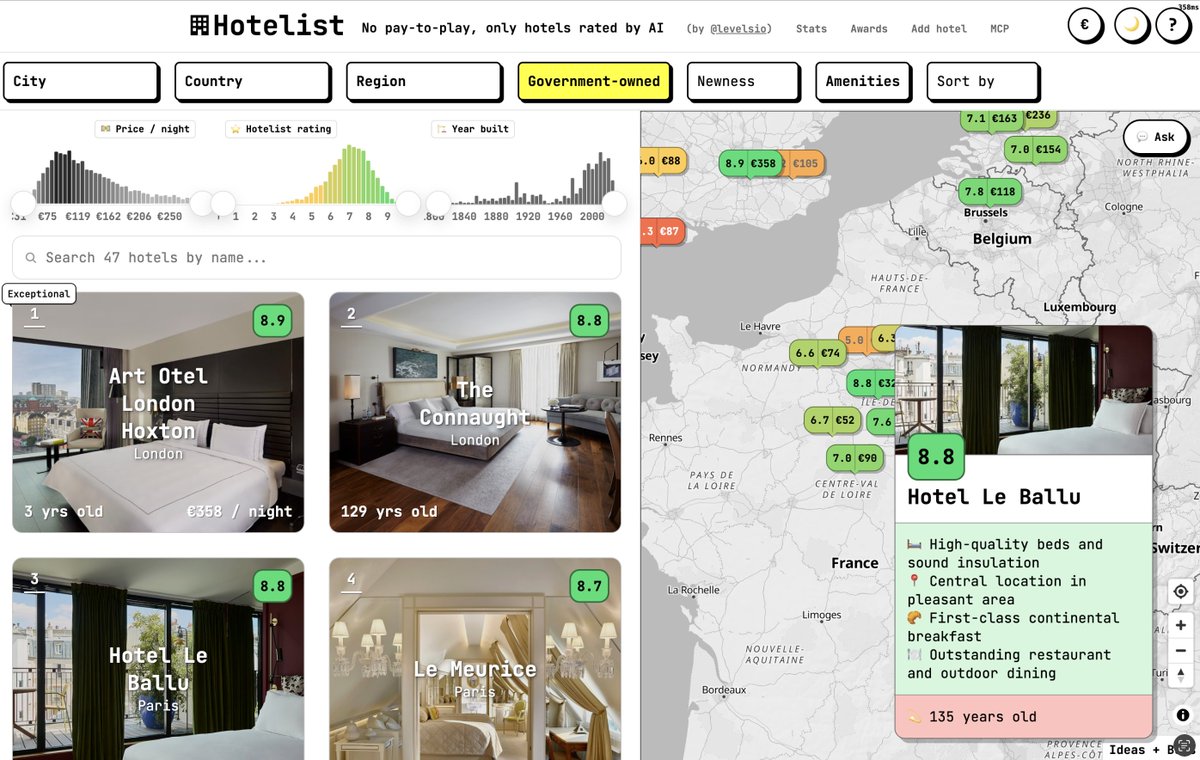
Developer Levelsio reports that many hotels are owned by governments, including Shanghai's municipality via Jin Jiang International's 539 hotels, and says he added a government-owned filter to his hotel-ownership site.

Original post · 1 min read
TIL a crazy number of hotels is owned not by public stock holders, not by private owners, not even by private equity funds, but by governments!

You don't see this easily, because you have to dig quite deep (or well dig upward actually) and they cover it up in lots of constructions

Like this hotel in Paris "Le Ballu", sounds French? Yes and it's owned by Hotels & Preference, which on paper is a French international hotel chain

Hotels & Preference itself is owned by the Louvre Hotels Group, sounds French too? Yes

But Louvre Hotels Group is owned by Jin Jiang International, that doesn't sound so French anymore? So it must be a Chinese company? Right?

No! It's the municipality of Shanghai!?

Yes the the local council of Shanghai somehow owns 539 hotels around the world including Raddison, Park Plaza, Vienna House, Golden Tulip, Campanile, Kyriad etc.

Other big government owners are the government of Dubai, Brunei and Qatar

So I added a filter [ Government-owned hotels ] and every hotel page shows the TRUE owner of a hotel, not just the chain!
@levelsio @levelsio
Also one more filter for today:

🔲 Public company
☑️ Privately owned
🔲 Government owned

I love ETFs as much as the next guy but they do put a pressure on stocks to grow by 10%/year or more

Hotels have a hard time doing that, so how do you grow? You cut costs and big hotel chains have been doing that in the name of DEI and ESG and wokeness a lot. Locking down ACs, no daily cleaning, cutting corners, etc. it all saves money

Those cost savings mean higer profit margins mean growth!

Great as an ETF or stock holder, terrible as a hotel guest

So you can now filter on privately owned

One of t…
♥ 1.4K · ⟲ 67 · 👁 64.4KView on X ↗

Matthew Berman Says Tesla Powershare Extends Home Backup Power

Commentator Matthew Berman praises Tesla's Full Self-Driving for his 83-year-old father's independence and says Powershare Home Backup, now available for new Model 3 and Model Y with Powerwall 3, can extend whole-home backup by over two days using a vehicle.

Original post · 1 min read
People don't understand how big a deal this is.

Tesla FSD already turns a car into autonomous transportation. It's one of the most impressive products I've ever used. My 83-year-old father told me he didn't think he'd be able to drive much longer. Then he got Tesla FSD and can maintain independence.

Now your Tesla can also back up your house.

The biggest drawback of battery backup vs. a gas generator has always been limited capacity. This largely solves it.

If your Powerwall runs out after two days, drive to a Supercharger, charge for 30 minutes, come home, and you've got roughly another two days of whole-home backup.
Tesla Energy @teslaenergy
Powershare Home Backup is now available for new Model 3 & Model Y with Powerwall 3

Extend your home backup by over 2 days with your vehicle
♥ 998 · ⟲ 73 · 👁 77.4KView on X ↗

Chamath Palihapitiya Shares Lessons From Winding Down VC Funds

Chamath Palihapitiya Shares Lessons From Winding Down VC Funds

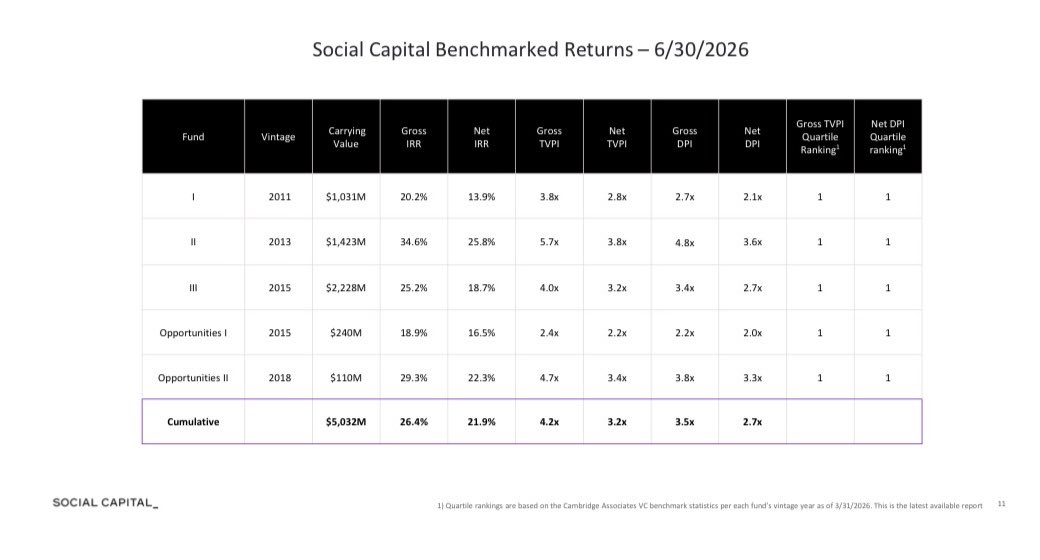
Chamath Palihapitiya says he stopped managing outside capital a decade ago and is nearing the end of his venture funds, sharing a Q2 summary. He lists three lessons for GPs and LPs: simple reporting, focusing on net DPI, and benchmarking against the Cambridge Index.

Original post · 1 min read
I stopped managing external capital about a decade ago so I could focus on compounding internal capital.

But the nature of Venture Capital is that VC funds take many years to be fully realized.

I’m at the tail end of that journey so am sharing the latest summary from Q2. I will hopefully wind down these funds in the next year or so and close this chapter.

My learnings for GPs and LPs:

1. Reporting should be simple and obvious.

2. Net DPI is all that matters. Optimizing for returns creates discipline and discipline will save you in the bad times.

3. You must compare yourself to the Cambridge Index. It’s fuel if you want to be a 🐐.
♥ 1.8K · ⟲ 90 · 👁 527.7KView on X ↗

Amanda Orson Recounts Sam Zell's Fixed-Rate Debt Strategy in Inflation

Amanda Orson Recounts Sam Zell's Fixed-Rate Debt Strategy in Inflation

Amanda Orson compares Trammel Crow and Sam Zell's real estate strategies through the 1970s rising-rate environment, quoting Zell on accumulating assets with cheap fixed-rate debt during inflation.

Original post · 1 min read
"We realized that if we could accumulate assets – particularly in an inflationary time – with cheap fixed rate debt, it was hard not to make a fortune."

- Sam Zell
Amanda Orson @amandaorson
Most of us weren't alive during the last rising-interest-rate environment in the 70s but let's rewind through the lens of two different investors:

Trammel Crow and Sam Zell

Crow pioneered warehouse development and was doing both lots of projects and some BIG projects (Embarcadero in SF, Peachtree in Atlanta). He had a decentralized partnership model. By the end of 1974 (inflation peaked around 12%) his annual cashflow was -$25M and he had hundreds of partnerships and $400M in short-term debt, of which $151M was PGed. (🤢)

By 1972, Zell not only had stopped his own apartment acquisitions (th…
♥ 743 · ⟲ 49 · 👁 61.9KView on X ↗

Steve Eisman Dismisses Burry's AI Depreciation Thesis as Academic

Steve Eisman Dismisses Burry's AI Depreciation Thesis as Academic▶

Fireside Alpha quotes Steve Eisman saying Michael Burry's argument about AI depreciation schedules is too academic and that an OpenAI failure would pose a far larger risk. The post quotes a Fireside Alpha clip that includes a separate Jensen Huang anecdote.

Original post · 1 min read
Steve Eisman says Michael Burry’s AI depreciation thesis “too academic” and says an OpenAI failure is the much larger risk

“I think, with all due respect to Michael, I think his argument is too academic."

"Put it this way: if AI succeeds because Anthropic and OpenAI grow like crazy and the hyperscalers do well, et cetera, et cetera, it’s not going to matter if the depreciation schedule changed from three to four years to five to six years."

"At the same time, if OpenAI fails and the whole chain goes in reverse, we’ll have a massive correction which has nothing to do with the depreciation schedule."

"I mean, I think what he’s deep down trying to point out is maybe there’s something wrong here, but I don’t think the thing that he’s pointing to as being wrong is important enough.”
Fireside Alpha @firesidealpha
Jensen Huang jokes ten Somaek drinks left him with no trouble kissing a Korean man on the mouth, and says he has a lot of fans, especially in Samsung's supply chain group

Jensen Huang: “And I’ll just tell you, I’ll just say this one inappropriate thing. I’ve only been kissed in the mouth by a man in Korea.”

Juju Chang: “Lori’s like, ‘Where is this going?’”

Jensen Huang: “I don’t know. And it was a Samsung employee, Jay.”

Juju Chang: “Wow, this is getting really good. Okay.”

Jensen Huang: “But we have some serious things I’ve got to say. But I just, what is that drink called where soju goe…
♥ 1.0K · ⟲ 75 · 👁 390.7KView on X ↗

AMC Theaters' Private Movie Rentals Began as a Pandemic Lifeline

Aakash Gupta explains that AMC rents whole auditoriums for as little as $99 because most seats go unsold and projection costs are nearly fixed. He says the product began during COVID, when AMC lost $561 million in one quarter.

Original post · 1 min read
Renting out an entire movie theater costs as little as $99. AMC put it right on their website in 2020, at $99 for older titles and $149 to $349 for new releases, whole auditorium, up to 20 guests.

Split with 10 friends, that's cheaper than everyone buying their own ticket in LA.

The reason theaters sell this so cheap is the fun part. Close to 9 in 10 movie theater seats in America go unsold across all showtimes, and on a weekday afternoon auditoriums run around a quarter full. The projector is digital, the staff is already on shift, the AC is already running. Playing a movie to an empty room costs the theater almost the same as playing it to a full one.

So a guaranteed $349 for a room that might have held a dozen strangers is a great trade. Even better, buyout groups hit the concession stand together, and popcorn carries a markup north of 1,000%. Concessions are where theaters make their real money, since studios take most of the ticket revenue in a film's opening weeks.

AMC only started selling this to regular people because COVID nearly killed them. They lost $561 million in a single quarter of 2020 and began renting empty rooms to anyone with a credit card just to survive. The margins were so good they kept the product after the pandemic ended.

Celebrities were the beta testers. A private screening used to signal you were a studio mogul with a theater in your basement. Now it's a birthday party option that costs less than dinner for six.
keeno @ayekeeno
Kylie Jenner shows how she has to rent out entire movie theaters when she goes to watch a movie with her friends in LA because of how famous she is 👀🍿
♥ 11.5K · ⟲ 559 · 👁 3.4MView on X ↗

Analyst Says GLP-1 Drugs Are Reshaping Consumer Packaged Goods

Bill D'Alessandro argues that GLP-1 weight-loss drugs are disrupting every category of consumer packaged goods, from snacks to supplements. He advises investors in consumer stocks to try the drugs themselves to understand the shift.

Original post · 1 min read
GLP-1s are shaking the foundations of CPG, every single category is up for grabs

Snacks, drinks, bars, cookies, crackers, meals, supplements, pick the category

Honestly - if you are investing in consumer and haven't tried a GLP-1 yourself, you don't really get it yet
♥ 82 · ⟲ 3 · 👁 10.4KView on X ↗

DHH Says AI Agents Make Apple a Poor Fit for Hackers

Apple and a Hacker’s Future

DHH quotes a Stratechery essay by Ben Thompson arguing that AI agents make Apple's walled garden feel like limitation rather than protection. DHH says he can now imagine no longer buying Apple by default.

Original post · 1 min read
"Not only am I uninterested in the company’s home device, I can, for the first time, envision a future where I don’t buy Apple by default. Indeed, this already happened..."

Anyone into the age of agents will eventually realize Apple is a bad fit.

stratechery.com/2026/apple-and-a-hackers-future/
stratechery.comApple and a Hacker’s FutureI was happy for years in Apple’s walled garden; with AI, however, their protections feel like limitations.
♥ 1.1K · ⟲ 38 · 👁 117.9KView on X ↗

Chicken Industry Depends on Two Firms' Grandparent Stock Breeding Lines

Arnaud Bertrand explains that most meat chicken farmers buy grandparent stock from Cobb-Vantress, owned by Tyson Foods, or Aviagen, controlled by Germany's EW Group. Because farmers cannot breed the pure lines themselves, they must keep buying chicks, and the post links to reports on Chinese breeds.

Original post · 4 min read
I was having dinner last night with a friend working in the chicken industry and I learned something that blew my mind.

Where do chicken farmers get their chickens? Most of us would say "from their existing chickens obviously, they breed and lay eggs."

That's what I thought too, but turns out I was dead wrong.

The reality is that the immense majority of meat chicken farmers in the world get their chickens from one of 2 companies: Cobb-Vantress, owned by Tyson Foods, or Aviagen, controlled by Germany's EW Group (the Wesjohann family).

They have a concept specific to the industry called grandparent stock: what you buy from these 2 companies is - essentially - a bunch of chickens with planned obsolescence.

The way it works is that each company keeps "pure" bloodlines on its own farms. Let's label them A, B, C and D. Those are the crown jewels - these companies' IP - and they never leave the building.

What they sell you are the "grandparents": chicks from those four lines, but each line in only one sex. You get A roosters but no A hens, B hens but no B roosters, C roosters but no C hens, D hens but no D roosters. Which means you can never breed more A, B, C or D birds yourself.

What you can do is cross them. A roosters with B hens give you the fathers, C roosters with D hens give you the mothers - these are the "parents". The parents then give you the chickens that actually end up on our plates, slaughtered at around 6 weeks.

And that's the end of the road. If you tried breeding those chickens, their chicks would be a complete genetic lottery: still chickens, sure, but without the genetic properties that make them commercially viable. They'd grow slower and less evenly, you'd have to sell them for way more than your competitors, and your business would be dead.

So you have to go back to Cobb or Aviagen for new grandparents. Forever.

Why buy grandparents at all, and raise 2 generations just to sell the third? The answer is scale. If you buy say 100 grandparents, each of them gives you around 50 parents, and each parent hen then gives you around 150 chicks: from those 100 grandparents, you have yourself some 600,000 chickens whose meat you can sell.

It makes no sense for these 2 companies to sell the final chickens directly. They'd have to hatch tens of billions of chicks a year and ship them all over the world. Much easier to simply sell the grandparents and let farmers do the multiplying and pay for the farms, the feed and the labor.

And, you knew this was coming, there is also a China angle here: as you can imagine, China isn't too pleased to be dependent on foreign companies for such a basic food item as chicken.

So China did what China does best: long-term planning. The Ministry of Agriculture and Rural Affairs launched a plan for "national broiler genetic improvement" (2021-2035), which aims for domestically bred breeds to make up at least 60% of the domestic market by 2035 (globaltimes.cn/page/202307/1294882.shtml).

And, of course, they're ahead of the plan. As of 2025, homegrown breeds held more than 30% of the market: halfway to the 2035 goal in just four years (agripost.cn/2026/08/17/chinas-top-three-domest…).

Can you escape all this as a consumer? Sure, you can buy organic or Label Rouge chicken, from slower-growing breeds raised for at least 81 days instead of 6 weeks, for two to three times the price.

Except, plot twist: the genetics behind most of those slow-growing birds come from a French company called Hubbard... which has belonged to Aviagen since 2018 (euromeatnews.com/aviagen-announces-the-acquisi…

And even if you could truly escape, you wouldn't want everyone to: we'd need vast new swathes of farmland, both for the chickens and their feed. Ironically, advocating for organic free-range chicken for everyone is one of the worst positions one can take for the planet's resources.

If you want to minimize your environmental footprint, the counterintuitive answer is to buy the cheapest supermarket chicken - or eat less meat, of course.

As my friend was saying last night, you may not like the way this industry works but, at the end of the day, it's what puts affordable protein on the plates of billions of people, using proportionally fewer resources than any other way of raising chicken.
♥ 6.3K · ⟲ 1.5K · 👁 477.1KView on X ↗

Analysts Suggest Meta May Not Need Ads Inside Muse

Sheel Mohnot shares a argument from a linked deep dive that Meta could monetize Muse indirectly: agent actions like browsing, shopping or booking create intent signals usable for ads on Instagram and Facebook.

Original post · 1 min read
This is smart and I hadn’t thought about it this way.

Meta may not need to put ads inside Muse... If Muse browses, shops, or makes reservations for you, it creates intent signals Meta can monetize later through ads on Instagram and Facebook.
Mostly Borrowed Ideas @borrowed_ideas
Why Muse May Never Need Ads $META

full piece: mbi-deepdives.com/no-ads-muse/
♥ 541 · ⟲ 24 · 👁 70.2KView on X ↗

Menlo Ventures Leads Investments in Five of Top 15 Consumer AI Apps

Menlo Ventures Leads Investments in Five of Top 15 Consumer AI Apps

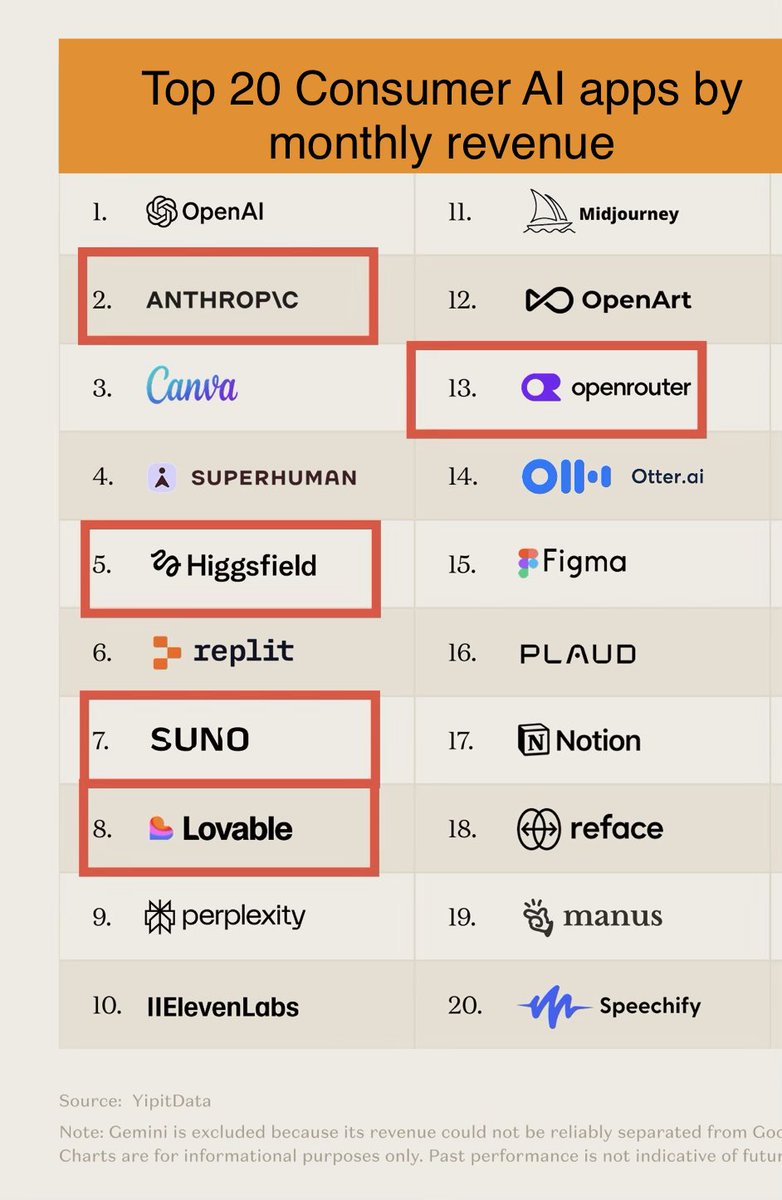
Deedy Das says Menlo Ventures is lead investor in five of the top 15 consumer AI apps by monthly revenue, despite a low-volume investing strategy. He responds to a post by Shaun Maguire highlighting Menlo's Anthropic investment and its involvement with Factory AI.

Original post · 1 min read
Menlo has tried to rebuild from the ground up how we think about investing and we are fortunate to be lead investors in 5 of the top 15 consumer AI apps by monthly revenue despite our low volume strategy.

Thanks for the shout, Shaun! Have a ton of admiration for what you have done at Sequoia. Too many people know you for your firebrand tweets and too few know your excellent investments and that you have a PhD in physics from Caltech (and it’s fun to have your cofounder be a partner!)
Shaun Maguire @shaunmmaguire
Menlo Ventures is on a tear

They led an investment in Anthropic at an ~$4B valuation

At the time, most thought OpenAI would be the singular AI winner

Maybe we’ll see something similar with @FactoryAI? 👀

Welcome to the Factory team @mmurph! twitter.com/menloventures/status/2107110275736…
♥ 471 · ⟲ 24 · 👁 61.3KView on X ↗

Sequoia's Rapid Tranche Investments Show Valuations Climbing Sharply

Tanay Jaipuria notes that Sequoia made seven tranched rounds in the past year, with first-tranche valuations averaging about $110 million and second-tranche valuations averaging about $3.4 billion. He shares a quoted Boston College investment committee presentation on AI.

Original post · 1 min read
One wild stat from presentation:

Sequoia did 7 tranched rounds in the past year.
First tranche (i.e., what they invested at): ~$110M valuation on average.
Second tranche: ~$3.4B on average.
Pat Grady @gradypb
The @BostonCollege Investment Committee (an LP and my beloved alma mater) asked for a few thoughts on what's happening in AI. I recorded a test run yesterday morning and then shared it with my partners, who encouraged me to share it more broadly... so here you go!

This is not a sales pitch, it's just a reflection on what we're seeing. And it wasn't intended to be shared, so please pardon the rough edges.

loom.com/share/c016702964a04dfba40e1777cf5f053a
♥ 246 · ⟲ 6 · 👁 65.3KView on X ↗

Profile Examines David Vélez and Nubank's U.S. Expansion

Patrick O'Shaughnessy recommends a Colossus profile of Nubank founder David Vélez, covering the bank's growth to 140 million customers, its $60 billion valuation and its challenging push into the United States.

Original post · 1 min read
Velez is one of the best CEOs out there today

This is a great profile about him and the Nubank story
Colossus @colossusmag
David Vélez is the founder of Nubank, a bank with 140 million customers and a market capitalization of $60 billion.

When he started the business in 2013, no one thought it would work, not even his investors. He has faced down regulators, oligopolies, and corruption to build Latin America's largest digital bank. Now he is bringing Nubank to the United States, where he faces his biggest challenge yet.

@gabi_imarques, who grew up four miles from Nubank's headquarters in Brazil, spent time with @velez_david in São Paulo, where the business started, and in Miami, its latest beachhead.

She profil…
♥ 230 · ⟲ 21 · 👁 49.2KView on X ↗