Wednesday, October 7, 2026ArchiveSearchAsk the paper

The Computomatix Times

All the posts fit to save — curated from @computomatix's bookmarks & likes on X

Business & Markets

Big tech, the economy, investing and trading

Top 1% of Consumers Spend Over $900 Monthly on AI, Report Finds

Top 1% of Consumers Spend Over $900 Monthly on AI, Report Finds

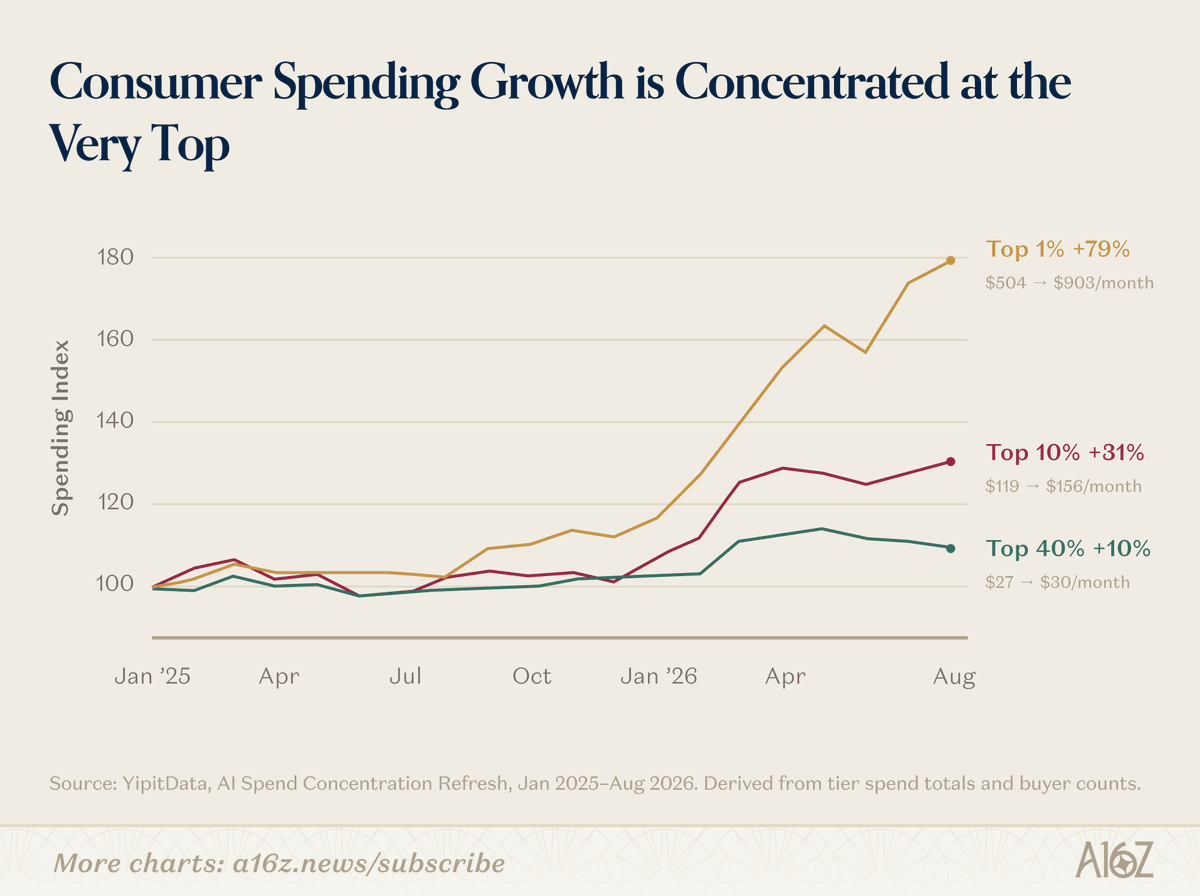
Justine Moore reports that the top 1% of consumers spend more than $900 per month on AI products on personal credit cards, a spending level that outstrips the bottom 50% combined, per the a16z Consumer AI Top 100 revenue data.

Original post · 1 min read
The top 1% of consumers spend $900+ per month on AI products - on their PERSONAL credit cards.

We have officially invented the "AI whale."

This cohort outspends the bottom 50% combined 🤯
Olivia Moore @omooretweets
🚨 The @a16z Consumer AI Top 100 is back - but this time, it's 150!

We added revenue data from @yipitdata to track how consumers are spending not just time, but money, on AI.

The result? A story of heavy concentration among AI's power users. Our takeaways 👇
♥ 173 · ⟲ 11 · 👁 15.4KView on X ↗

a16z Charts Big Tech Profits Shifting to Chipmakers

a16z Charts Big Tech Profits Shifting to Chipmakers

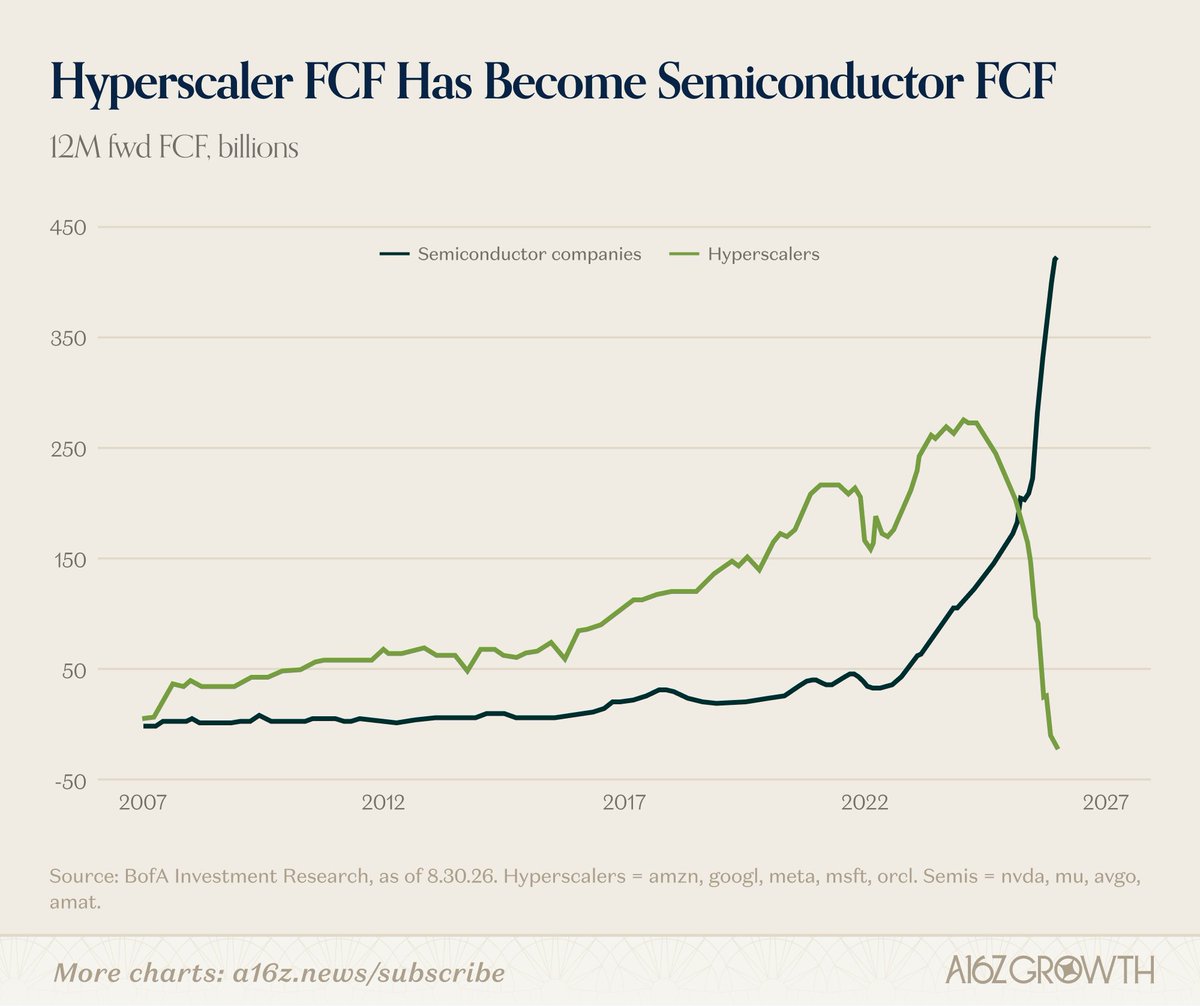
a16z shares a chart showing approximate free cash flow falling for hyperscalers from $275 billion to zero while semiconductor free cash flow rises from $50 billion to $400 billion since 2022, linking it to its State of Markets II report.

Original post · 1 min read
The AI buildout in one chart: Big Tech's profits have become chipmakers' profits.

Approximate free cash flow, from 2022 to today:
- Hyperscalers: $275B → $0
- Semiconductors: $50B → $400B

More charts in State of Markets II: a16z.news/p/state-of-markets-ii
David George @DavidGeorge83
Introducing our State of Markets pt 2, along with a companion podcast where we unpack the data and discuss what comes next.

Tech is the everything cycle.

Supply: putting the buildout in context, just passed railroads as % of GDP. The wisdom of Elon is real: the factory (or the datacenter!) is the product.

Demand: diffusion is so, so early. Median AI vendor spending in the top 1% of companies is 8x that of the top 10%. Only about 30% of S&P 500 companies report a quantified AI impact, which means there’s a substantial opportunity in connecting models to a company's data and workflows. Diffus…
a16z.newsState of Markets II100+ Charts On The State of Markets (1H’26). It's the best. You wouldn't want to miss it.
♥ 599 · ⟲ 98 · 👁 137.0KView on X ↗

a16z Analysis Argues AI Shopping Assistants Threaten Marketplace Ad Revenue

a16z Analysis Argues AI Shopping Assistants Threaten Marketplace Ad Revenue

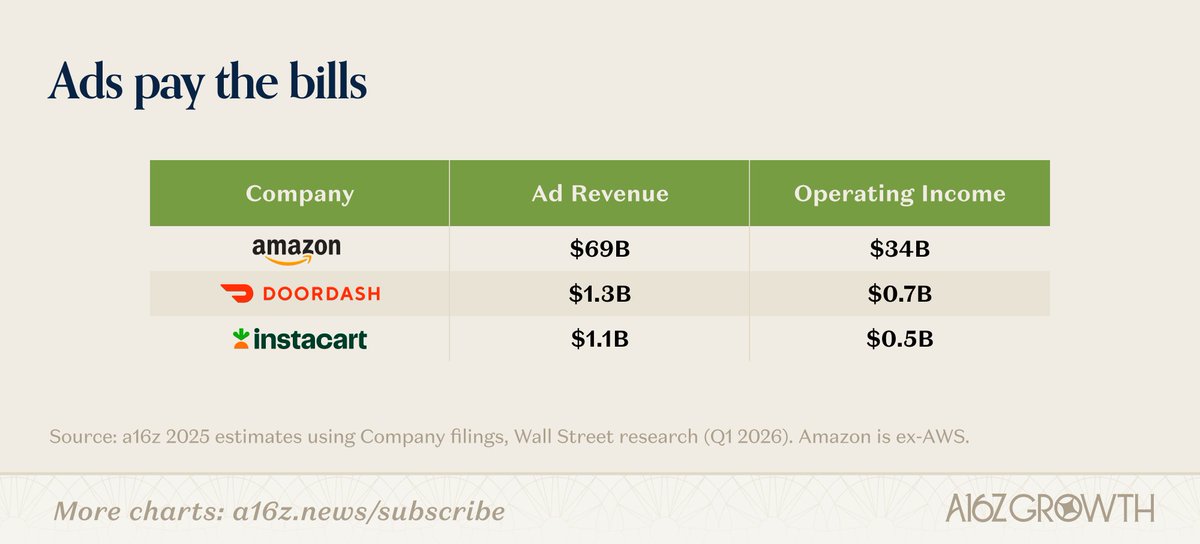
a16z shares a piece by Alex Immerman and Santiago Rodriguez arguing marketplaces earn most from browsing and ad revenue, which AI shopping assistants could bypass. The post cites 2025 ad revenue to operating income ratios for Amazon, DoorDash and Instacart.

Original post · 1 min read
Marketplaces earn their money when you browse, not when you buy. An AI assistant that shops for you skips the browsing.

Ad revenue vs operating income (2025):
- Amazon retail: 2x
- DoorDash: 1.9x
- Instacart: 2.2x

AI assistants don't need to rebuild Amazon's warehouses to hit Amazon's profits.

Full piece from @aleximm and @santiago__rdz on who gets paid when AI does the shopping: a16z.news/p/who-gets-paid-when-ai-does-the-sho…
Alex Immerman @aleximm
Who Gets Paid When AI Does the Shopping? — No one wants to be disintermediated. It happened to Yelp and Tripadvisor with Google. It happened to everybody, with Apple. As a general rule, marketplaces want to own the customer relationship and
♥ 572 · ⟲ 55 · 👁 104.6KView on X ↗

Jurrien Timmer Examines Earnings Boom Against Rising Cost of Capital

Jurrien Timmer writes that strong earnings are offset by a tightening Fed and rising bond yields, with price meandering sideways for four months while market internals weaken. He shares analysis in a LinkedIn post linked from the tweet.

Original post · 1 min read
The markets continue to be pulled apart by opposing forces: a massive earnings boom on the one side and a rising cost of capital on the other. In the middle is the residual of the E and the P/E, price, which continues to meander for 4 months now while the market’s internals are bleeding, courtesy of a tightening Fed and rising bond yields. Let’s explore.

linkedin.com/pulse/opposing-forces-week-10526-…
♥ 398 · ⟲ 20 · 👁 194.6KView on X ↗

MongoDB CEO CJ Desai Departs for Meta; Stock Falls 20%

Vijar Kohli analyzes Meta's hiring of former MongoDB CEO CJ Desai as Chief Enterprise Platform Officer, noting the timing before MongoDB's investor day and a roughly 20% drop in MDB. He suggests the selloff could be a buying opportunity while questioning Meta's enterprise strategy.

Original post · 1 min read
This is a very surprising move.

1) Zuck buried the lead in his post. CJ is an aggressive hire to build out Meta's Enterprise Platform.

2) MongoDB is a notable $27 billion database business. Dev Ittycheria was CEO for 11 years and stepped down last November.

3) CJ Desai became CEO with a $52m comp package. His base salary was $500k with a $2.5m signing bonus. He left +$49 million on the table. Which means Mark made a serious offer (+$100m?)

4) Dev stepped back in as interim CEO.

5) MongoDB is having their Investor Day tomorrow in NYC at the Nasdaq. RSVPs closed lol

This is probably a poor move by CJ. Mark will make a great offer to any great executive. He probably wasn't aware of MongoDB's Investor Day + timing.

$MDB is down 20% on the news.

The next 2-3 weeks is probably a good time to build a position here. Dev knows the business, and databases are mission critical in the world of AI. MongoDB is not going anywhere.

On the flip side, I have no idea how Meta's Enterprise Product will work. They shut down their Workplace product years ago. Meta is a consumer focused business. But there's tons of opportunity to compete in Enterprise AI with a low cost, open source model. Maybe Meta will pull it off.
Mark Zuckerberg @finkd
To lead this effort, I'm excited that Chirantan "CJ" Desai will join Meta as Chief Enterprise Platform Officer, reporting directly to me. CJ is an experienced enterprise leader with a track record of building full-stack software and delivering results in AI, infrastructure, business applications, and security. He has an extensive industry network that we look forward to partnering with. CJ joins us from MongoDB, where he was CEO and President. Before that he led product and engineering at Cloudflare and spent nearly eight years at ServiceNow, including as President and COO.
♥ 419 · ⟲ 16 · 👁 163.2KView on X ↗

Higgsfield Reaches $1 Billion ARR With 150-Person Creative Team

Higgsfield Reaches $1 Billion ARR With 150-Person Creative Team▶

Harry Stebbings shares that Higgsfield reached $1 billion in ARR in 18 months and relies on an in-house team of over 150 creative professionals. Founder Alex Mashrabov says creative selection remains central to revenue despite heavy AI generation.

Original post · 1 min read
The 150-person content team powering Higgsfield's billion in ARR

“We have an in-house team of over 150 creative professionals. It is almost half of the whole workforce.

For 90 minutes of TV-quality content, it was over 100 hours of AI-generated content.

Creative decision-making, picking the right piece, is still very important. That is what is driving most of the revenue.” @alexmashrabov

Love to hear your thoughts @Diesol @bilawalsidhu @PJaccetturo @c_valenzuelab
Harry Stebbings @HarryStebbings
Higgsfield is the most untold story in tech.

$1BN in ARR in 18 months. Faster than everyone other than OpenAI and Anthropic.

They spend $4M a month on models. They expect this to be $100K per person per month.

They have 150 people working in a content machine.

They will breed more millionaires than any other company in Kazakh history.

For the first time, @alexmashrabov on the journey to $1BN in ARR. (below)

1. The Power of the Immigrant Founder

Coming from Uzbekistan, Alex was pushed into competitive programming at age eight as his single path to reach the United States. For internation…
♥ 44 · ⟲ 5 · 👁 22.1KView on X ↗

Long Lake Completes $6.3 Billion Acquisition of Amex GBT

Elad Gil highlights that Long Lake, founded three years ago to apply AI across services businesses, has completed its $6.3 billion acquisition of Amex GBT, its fortieth deal, bringing its workforce to nearly 30,000 people.

Original post · 1 min read
Didn't exist 3 years ago, now employees ~30,000 people via M&A + AI 🤯
Alexander Taubman @alextaubman
Today, Long Lake completed our $6.3B acquisition of Amex GBT.

Long Lake acquires and transforms generational businesses with AI across the American services economy.

Amex GBT is the travel partner for 17,500 businesses in 140 countries. Last year, Amex GBT booked 35 million trips for 10 million travelers.

This marks Long Lake’s 40th acquisition, and our family of companies now employs nearly 30,000 people.

We founded Long Lake three years ago with the thesis that AI is going to change every company, but there’s a large overhang between AI capabilities and how most businesses leverage AI to…
♥ 1.5K · ⟲ 48 · 👁 273.5KView on X ↗

Nadella Describes Daily Hyperscaler Filing Dashboard Built With Coding Agent

Nadella Describes Daily Hyperscaler Filing Dashboard Built With Coding Agent▶

Microsoft CEO Satya Nadella says he uses a coding agent and a Fabric data pipeline to pull SEC filings from hyperscalers and neoclouds into a daily-refreshing dashboard tracking real-time ROIC by layer. He also warns that frontier models optimizing working capital could fake financial books.

Original post · 1 min read
Satya Nadella reveals his coding agent pulls every hyperscaler and neoclouds' SEC filings into a dashboard that refreshes every day for real-time ROIC

"And this is the other aspect of it, which is the enterprise context combined with the world's context. In fact, I go to the SEC filings of every cloud provider, hyperscaler, each of these neoclouds. It's in real time."

"I have a data runner in Fabric that brings all that data, puts it into a semantic model that then gets read by my coding agent and then surfaces it as a dashboard. And every day it's fresh."

"So I have the entirety of every SEC filing that goes out there, plus all of my internal analysis constantly coming together, giving me real-time ROIC by layer."
Fireside Alpha @firesidealpha
Satya Nadella warns a frontier model told to optimize working capital may fake the books, a new type of insider risk

"One of the fascinating things right now is the insider risk. I mean, think about it, right? If you're sitting in an enterprise, this is all test-time compute, by the way, right? So it's not like, oh, it's going to only happen in some training run."

"It can happen for a very mundane task that I give one of these frontier models inside an enterprise, where I say, you know, I don't know, telling David this, or suppose I say, hey, go optimize my working capital."

"It may fake my…
♥ 875 · ⟲ 52 · 👁 1.3MView on X ↗

Elad Gil Reacts to SpaceX Starlink V3 Satellite Deployment

Investor Elad Gil reposts a note that SpaceX deployed Starlink V3 satellites into orbit and made first contact with them. The quoted post says one Starship carries 60 V3 satellites, roughly the network capacity of about 20 Falcon 9 launches.

Original post · 1 min read
WTF
Nic Cruz Patane @niccruzpatane
From concept to reality.

@SpaceX has successfully deployed Starlink V3 satellites into Earth’s orbit and made contact with them for the first time.

At scale, one Starship carries 60 V3 satellites, the same network capacity as about 20 Falcon 9 launches.
♥ 2.2K · ⟲ 51 · 👁 433.3KView on X ↗

Jason Del Rey Discusses Amazon, Walmart and Muse on Stratechery

An Interview with Jason Del Rey About Muse, Amazon, and Walmart

Jason Del Rey joins Ben Thompson on a Stratechery interview covering Amazon versus Walmart in e-commerce, the personal agent trend around Muse, and the history of Recode. He also announces his new publication, Read The Aisle.

Original post · 1 min read
Longtime @stratechery reader, first-time talker. It was a real treat to nerd out on all things Amazon, Walmart, e-commerce--and of course, Muse and the personal agent craze--with @benthompson this week.

stratechery.com/2026/an-interview-with-jason-d…

We also discussed the life and death of Recode, and my conviction that my new publication @ReadTheAisle will be the last job of my career.

Hope you take a read, and then consider subscribing here: readtheaisle.com/join
stratechery.comAn Interview with Jason Del Rey About Muse, Amazon, and WalmartAn interview with Jason Del Rey about Amazon versus Meta, which is a continuation of the oldest battle in retail between Amazon and Walmart.
♥ 34 · ⟲ 1 · 👁 2.1KView on X ↗

Nick Maggiulli Says Main Street Business Owners Hold Most U.S. Wealth

Who Is Really Rich in America? (Hint: Main Street Millionaires)

Nick Maggiulli argues that America's wealthy include auto dealers, consultants and business owners across the country, who hold 13 times more wealth than the Forbes 400 combined. He links to his latest essay on the topic.

Original post · 1 min read
America's rich aren't just in Silicon Valley and Manhattan. They're auto dealers, consultants, and other business owners across the U.S.—and they hold 13x more wealth than the Forbes 400 combined.

My latest on who's really rich in America: ofdollarsanddata.com/who-is-really-rich-in-ame…
ofdollarsanddata.comWho Is Really Rich in America? (Hint: Main Street Millionaires)On the business owners who quietly hold America's wealth.
♥ 567 · ⟲ 83 · 👁 117.8KView on X ↗

Thread Explains SLAT Estate Planning Tool for Affluent Couples

Cam Marzi introduces the Spousal Lifetime Access Trust (SLAT), an estate planning tool he says most married couples with $5M or more in net worth have never heard of. The post promises an explanation of how it works.

Original post · 1 min read
Most married couples with $5M+ in net worth are sitting on an estate planning tool they've never been told about.

It's called a SLAT.

Here's how it works and why it matters right now:
♥ 330 · ⟲ 11 · 👁 313.5KView on X ↗

Venky Ganesan Warns of Disorienting Venture Capital Bubble Conditions

Venky Ganesan of Menlo Ventures argues that venture capital is in a disorienting period, with some portfolio companies growing fast while pre-revenue startups raise billions at $10 to $50 billion valuations. He frames the moment through Chuck Prince's 2007 quote and George Soros's idea of reflexivity.

Original post · 5 min read
A few thoughts on the current state of venture capital.

When the Music Is Playing

In July 2007, a few weeks before the credit markets seized up, Chuck Prince, then the CEO of Citigroup, gave an interview to the Financial Times. The line everyone remembers is this one: "As long as the music is playing, you've got to get up and dance." He was mocked for it for years afterward, and he lost his job a few months later. But I have come to think he was saying something honest. He wasn't claiming the music would play forever. He was admitting that he couldn't sit down while it was still going, and neither could anyone else in his seat.

I've been thinking about that quote a lot lately, because right now is the most disorienting period in venture capital I can remember, and I have been doing this for a while.

Here is what makes it disorienting. It's not that things are bad. Some things are spectacular. We have companies in our portfolio growing faster than anything I have seen in my career, and I don't say that lightly. At the same time, we have companies with no revenue, no product, and a founding team you could fit in a conference room raising billions of dollars at valuations of $10 to $50 billion. Both of these things are true at once, and if you try to reason about them with the same framework you will drive yourself crazy.

Two ideas have helped me make sense of it. Neither is mine.

The first is reflexivity, which George Soros has been writing about since the 1980s. In most of life, perception follows reality: the weather is what it is, and your opinion of it changes nothing. In markets, it runs the other way too. Prices change what participants believe, and what participants believe changes the prices. The feedback loop can run for a long time, and while it's running it looks exactly like progress.

Here is how reflexivity is playing out in AI. Full disclosure: Menlo is an investor in Anthropic, so read the following with that in mind. People watched a frontier lab go from a $4 billion valuation to $18 billion, then $60 billion, then $180 billion, then $380 billion, and now something close to a trillion. They drew the obvious conclusion: that is what a neo lab looks like. So the next neo lab gets priced off that path, not off anything it has built. Then it gets marked up in a subsequent round, and the markup itself becomes the proof. Look at Thinking Machines. Look at Reflection. At that point valuation has stopped being an output of the metrics and has become the metric. Nobody is discounting cash flows. They are discounting the last round.

Soros is very clear about one thing, and it's the part people skip: you cannot know when or how a reflexive process ends. You only know that it does. Every one of them has.

The second idea is Chuck Prince's, and it explains why smart people keep dancing even when they can see the loop for what it is. As far as I can tell, there are two groups on the dance floor.

The first group got in early. Firms like ours were in some of these AI companies before the numbers got silly, and the paper gains are enormous. When you are sitting on gains like that, you start to feel like you're playing with house money. I have been around long enough to know that house money is the most dangerous kind, because you don't respect it the way you respect money you had to earn.

The second group missed the early rounds and knows it. Their LPs know it too. So they are trying to make up for lost time by writing very large checks very late, which is the one strategy almost guaranteed to turn a missed opportunity into a real loss.

House money on one side, FOMO on the other, and reflexivity feeding both. That's the whole story. Everyone has a reason to keep dancing, and the reasons are different, which is why nobody can talk anyone else off the floor.

So what do you do? The instinct in our business is to answer with company identification: just pick the right neo lab and you'll be fine. I think that's the trap. When price has become the signal, being right about the company is not enough, because you can be right about the company and still be wrong about the price by a factor of ten. The public-market investors I admire figured this out a long time ago. They spend as much time on how much to own as on what to own.

The winners in venture over the next decade will be the firms that treat portfolio composition and position sizing as seriously as they treat sourcing. How much of the fund is in companies whose valuation rests on the last round rather than on revenue? What happens to the portfolio if the reflexive loop breaks next year instead of in five? Those are not exciting questions. They are the ones that will matter.

The music will stop. It always does. Dance if you must, but know where the chairs are.
♥ 2.3K · ⟲ 298 · 👁 546.0KView on X ↗

Digital Trading Card Repacks Outpace AI Agents in US Consumer Spend

Digital Trading Card Repacks Outpace AI Agents in US Consumer Spend

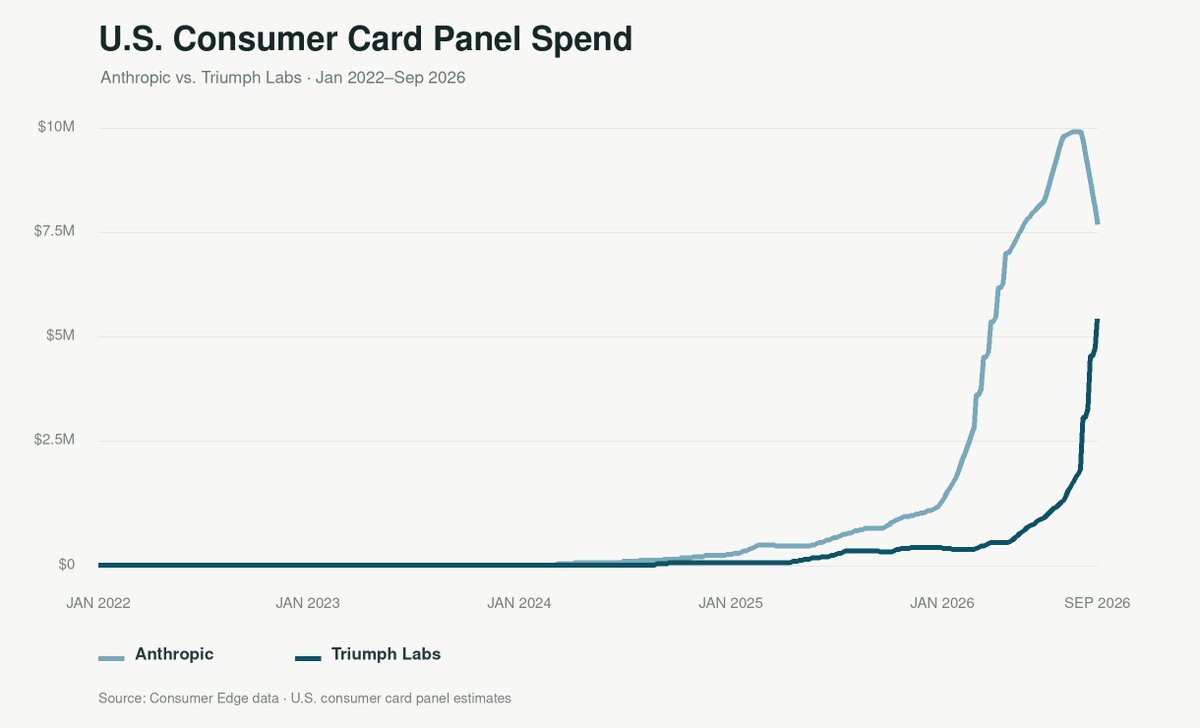
Olivia Moore argues that consumer builders are in a bubble if they only follow X, noting that digital trading card repacks have become a bigger mainstream trend than AI agents. She compares monthly US consumer spend on Anthropic with Triumph Arcade.

Original post · 1 min read
If you're building / investing in consumer and spend all your time on X, you're in a bubble

The mainstream breakout trend of the past 6 months is not agents but...digital repacks of trading cards

Monthly U.S. consumer spend on Anthropic vs. @triumpharcade 👇
♥ 325 · ⟲ 20 · 👁 86.8KView on X ↗

Paraga Outlines Plan to Pay Content Owners When AI Agents Read Their Work

Paraga Outlines Plan to Pay Content Owners When AI Agents Read Their Work▶

In a video clip, Harry Stebbings quotes Paraga arguing that ads do not work with AI agents and that his company is building an AdSense-style system paying publishers each time an agent benefits from their content.

Original post · 1 min read
“Ads do not work with agents in their current form. Agents show up, no one sees ads, and you make no money.

We are effectively building an AdSense for agents showing up to read your content.

We like to pay content owners a variable amount of money every time an agent derives benefit from reading their information.” @paraga
♥ 117 · ⟲ 8 · 👁 22.6KView on X ↗

Analyst Argues Agentic Commerce Threatens Amazon's Ad Business

Freda Duan argues that agentic shopping agents could disintermediate Amazon's roughly $100 billion ad business and erode its customer relationship, while Amazon's logistics could open a new revenue stream. She also contends ad spend and take rates will converge, citing OTA economics, and links to a deep dive on the topic.

Original post · 2 min read
Largely agree.

1/ Agentic commerce's impact on $AMZN

Ads rev ($100B rev, or est. 50% of operating profit): real disintermediation risk.

GMV: depends. If $AMZN is truly "cheaper, faster, better", an objective agent should send more GMV to $AMZN. But I personally doubt $AMZN’s GMV share grows meaningfully in an agentic world. Just look at the $50B in marketing exp. $AMZN throws out today - large platforms have an "unfair advantage" bc they can afford higher CAC.

Long-term value / customer ownership: intrinsic value should go down if $AMZN loses the top of the funnel. You may still get the trx and the buyer’s info, but you lose browsing behavior, retargeting, cross-sell opps, and ultimately the customer relationship.

Potential upside: $AMZN can open up its best-in-class logistics backbone to other merchants = new rev stream (which it is already doing a little).

The risk feels more skewed to the downside, imho: top of funnel → infrastructure layer.

2/ What happens to ads as an industry

Under agentic commerce, ad spend and take rate - which ppl historically think of as distinct business models - will converge.

In a fully agentic world, ads as an industry could theoretically "disappear." But that doesn’t mean the ad dollars (~$300B in the US) disappear. Sellers will still need (and want) to pay digital tax on distribution. Whether that comes in the form of ads or a take rate is largely semantic.

Take OTAs ($BKNG $EXPE) as an example. Say half of their bookings and traffic are direct, and the other half indirect, mostly through $Google. For the indirect portion, the companies basically break even given the high CPCs they pay $Google. Take rate on the direct portion is ~15%. So even though the cost is paid in the form of ads, the equivalent take rate OTAs pay Google is effectively ~15%.

An agent charging 2%, 5%, or eventually 10%+ of GMV is therefore not necessarily introducing a new cost. It may simply be repackaging an existing acquisition cost from CPC into CPA / take rate. And agents @Muse will probably start cheap.

3/ What holds true no matter what (pre- or post-agentic world):

A. Owning top-of-funnel customer intent = pricing power. Losing direct traffic means losing much more than the immediate transaction.

B. Commerce winning formula (is always) = cheaper, faster, better.

++
A more verbose version: robonomics.substack.com/p/agentic-commerce-dee…
Harry Stebbings @HarryStebbings
Amazon is right to block Muse.

“One, you do not get any revenue from your ad business, and Amazon’s ad business is now larger than their e-commerce profits.

The second thing is the basket size gets reduced. If I do this, I just order the thing.

If I block them, they will probably come to me anyway, because I am Amazon. So I have leverage.” @rodriscoll

Love to hear your thoughts @juokaz @FredaDuan @scotwingo @harleyf
♥ 224 · ⟲ 26 · 👁 85.1KView on X ↗

Chris Camillo Says Ordinary Investors Can Spot Big Trends First

Chris Camillo Says Ordinary Investors Can Spot Big Trends First▶

A post highlights investor Chris Camillo, a Market Wizards subject, arguing that ordinary people see major investment trends in everyday life before professionals, and that he relies on observation rather than fundamental or technical analysis. It also references a debate with quant manager Tom Costello.

Original post · 2 min read
One of Schwager's Unknown Market Wizards uses zero fundamental analysis and zero technical analysis.

What he does instead:

Featured in Schwager's Unknown Market Wizards. Turned $20K into ~$80M. Built TickerTags, sold to Jefferies' M Science.

Chris Camillo (@ChrisCamillo) explains:

"There's a smokescreen that an ordinary person doesn't have the skill set. I would argue the opposite. Ordinary people have the ultimate skill set."

"They're so deeply rooted in the real world. Not just from reading social media, but from being part of that world. Deep in the conversations about what people are doing every day, what we're feeling, what we're spending our money on."

"How our culture is changing. How consumer behavior is changing. How product trends are shifting. Most ordinary people are perfectly suited to occasionally see something in the real world and connect the dots to a monstrously big investment opportunity."

"I've been speaking to people about this for two decades. They saw AI. They saw AWS early. They saw Salesforce early, because they worked at a company that started using it and everyone at the sales conference was going through the same onboarding."

"Go back over the last 30 years and look at the biggest investments an individual could have made. 75% of those were easily seen by ordinary people first."

"You don't need to nail them all. You need to nail one or two or three over the course of your entire life."

"That's all I do. I have no financial infrastructure. I use zero fundamental analysis, zero technical analysis. I have virtually no tool set. All I do is observe the world and see change happening in it."
Ethan Kho @ethanrkho
Retail investors vs. hedge fund managers: who wins?

Ex-Tudor quant PM Tom Costello (20%/yr, 1.4% max drawdown) DEBATES Market Wizard Chris Camillo ($20K → $80M, tells you to expect 70% drawdowns).

Chris Camillo (@ChrisCamillo) turned $20K into ~$80M over 18 years, audited by Jack Schwager for Unknown Market Wizards at 77% annualized. Founded TickerTags, sold to Jefferies. Co-founder of Dumb Money.

Tom Costello (@tcoste110) ran money at Tudor, Moore Capital, and Caxton. Started as a quant on JPM's exotic swaps desk. Now CIO at Bedrock Digital Assets.

We cover:
- Why a 50% drawdown is "a car…
♥ 139 · ⟲ 20 · 👁 21.5KView on X ↗

Jesse Tinsley Warns AI Roll-Up Strategy Carries Debt and Integration Risk

Jesse Tinsley responds to Greg Isenberg's case for buying businesses and using AI agents to triple EBITDA, arguing that M&A integration is hard, many AI holding companies may fail due to debt, and private credit could burst.

Original post · 1 min read
While I hate that Greg is exposing this alpha publicly...

He's right.

The tough part is not seeing this trend anymore now that Mainstreet has scaled to 9 figures in ARR through this strategy, Bending Spoons IPO this year, Thrive and General Catalyst executing similar strategies among many others now.

But execution in M&A is hard and integration is even more difficult especially in legacy services businesses. Add in debt and cyclical nature it's not full proof. In fact I would wager 50% or more of the current AI holding companies fail due to poor integration and high debt profile. Hence why we hold zero debt we can survive any macro trends or black swan events.

Leverage cuts both ways and we're about to see this play out. The best buying opportunity in our lifetime will happen when the private credit bubble bursts in the next few years.
GREG ISENBERG @gregisenberg
$5T opportunity: AI Roll Ups — I'll make the case why you should buy a business and use AI agents to 3x EBITDA. By the end of this dead simple guide, you'll know how to find the right business, buy it, and run it with agents, down
♥ 2.0K · ⟲ 76 · 👁 773.3KView on X ↗

Gokul Rajaram Urges Readers to Study the Current GPU Compute Market

Gokul Rajaram endorses a post by @gpugene on compute trading, which reports B300 GPU deals clearing above $24 per GPU-hour and short-term compute pricing above $7. The quoted post frames the market as hot right now.

Original post · 1 min read
Must read for everyone trading compute.
Eugene Ye @gpugene
Let's talk about trading compute — Do you guys see what’s happening in the market right now?
Deals are clearing above $24/gpu/hr for some B300s with pricing for short term (<1 year) compute hovering above $7. Actually by the time you
♥ 249 · ⟲ 14 · 👁 100.1KView on X ↗

Gokul Rajaram Says Enterprises Buy Outcomes, Not Tokens, in AI Sales

Gokul Rajaram endorses Databricks CEO Ali Ghodsi's view that enterprises lag in agentic AI adoption because models lack organizational context. He argues Palantir and Sierra win by selling and pricing on business outcomes.

Original post · 1 min read
Ali makes great points.

In addition, I think one of the key reasons for lagging enterprise AI adoption is that F500 enterprises don’t buy tokens. They buy business outcomes.

Palantir and Sierra are arguably the fastest growing enterprise AI applications companies (outside of the labs). Both sell business outcomes and price on outcomes.

If you’re selling tokens to F500 enterprises, you’re DOA.
Mike Fishbein @mfishbein
Databricks CEO @alighodsi went off on @a16z pod about enterprise AI adoption:

"They're just so far behind in the adoption curve of actually automating things and getting value out of this stuff."

Ali says most companies are still just using chatbots. There's hardly any agentic transformation.

Why is that?

"The models are smart enough, but they just don't have the context that exists inside of any organization."

"They have not been in every meeting. They don't know what's in everybody's heads. They don't know all the processes."

"If you just fused that and gave that context into the AI mo…
♥ 204 · ⟲ 31 · 👁 64.8KView on X ↗

AMD Crosses $1 Trillion Market Cap for First Time

AMD Crosses $1 Trillion Market Cap for First Time▶

Trung Phan notes AMD's market cap has risen from about $10 billion to $1 trillion since 2018, quoting Kobeissi Letter's report that the stock crossed $1 trillion. The post adds that $10,000 invested in 2016 would be worth about $3.05 million today.

Original post · 1 min read
AMD’s market cap has now risen 100x from $10 billion to $1 Trillion since Sky Sports asked Lisa Su if she could “speak English” at the starting grid during 2018 F1 Chinese Grand Prix.
The Kobeissi Letter @KobeissiLetter
BREAKING: Advanced Micro Devices stock, $AMD, officially crosses above $1 trillion in market cap for the first time in history.

This puts the stock up +30,400% over the last 10 years.

$10,000 invested in AMD in 2016 would be worth $3,050,000 today.
♥ 3.8K · ⟲ 275 · 👁 714.1KView on X ↗

Buffett's Sister Lost Heavily Selling Puts During 1987 Crash

Buffett's Sister Lost Heavily Selling Puts During 1987 Crash▶

A post recounts how Warren Buffett's sister, Doris, sold uncovered put options to generate income after Black Monday and suffered losses when the Dow fell 22.6%, and promotes an article on Charlie Munger's 25 rules for avoiding costly decisions.

Original post · 1 min read
Warren Buffett's sister owned roughly $12M of Berkshire stock.

After Black Monday, she owed $2M.

Doris needed income. The shares paid no dividend.

A broker suggested uncovered put options. She collected premiums for promising to buy stocks if prices fell.

Then the Dow dropped 22.6% in one session.

The positions could not be closed fast enough.

Charlie Rose asked why she had not called the world's most famous investor before entering the trade.

"I thought he'd be so disapproving."

Do not create income by taking a risk that can wipe out the capital underneath it.

Charlie Munger spent decades studying exactly why smart people still make decisions like this.

The article below organizes Munger's 25 Rules for Avoiding Costly Decisions into a practical checklist.
Lima @limalemonnn
Charlie Munger’s 25 Rules for Avoiding Costly Decisions — In 2005, 81-year-old investor Charlie Munger revised a lifetime of observations into 25 psychological tendencies that explain why intelligent people make ruinous decisions.
Every person making an
♥ 499 · ⟲ 58 · 👁 472.9KView on X ↗

Mint Reconstructs Tata Sons Board Meeting That Reappointed Chandrasekaran

Four hours at Bombay House: How five Tata Sons directors outflanked Noel Tata | Company Business News

Vinod Srinivasan links to a Mint report reconstructing a four-hour Tata Sons board meeting in which five directors reportedly outmaneuvered Noel Tata. The meeting ended with N. Chandrasekaran reappointed as chair, according to the linked article.

Original post · 1 min read
Mint has reconstructed the Tata Sons board meeting minute by minute. I have read it twice. I would say it changes the story from "Noel Tata lost a vote" to something more uncomfortable for everyone in that room.

The piece, with full credit to Mint:
livemint.com/companies/news/tata-sons-board-me…
livemint.comFour hours at Bombay House: How five Tata Sons directors outflanked Noel Tata | Company Business NewsThe Tata scion left Bombay House believing Tata Sons had taken no decisions at last week’s crucial board meeting. Hours later, the board had reappointed N. Chan
♥ 803 · ⟲ 140 · 👁 125.0KView on X ↗

Post Says 60 Percent of S&P 500 Is in Bear Market

Post Says 60 Percent of S&P 500 Is in Bear Market

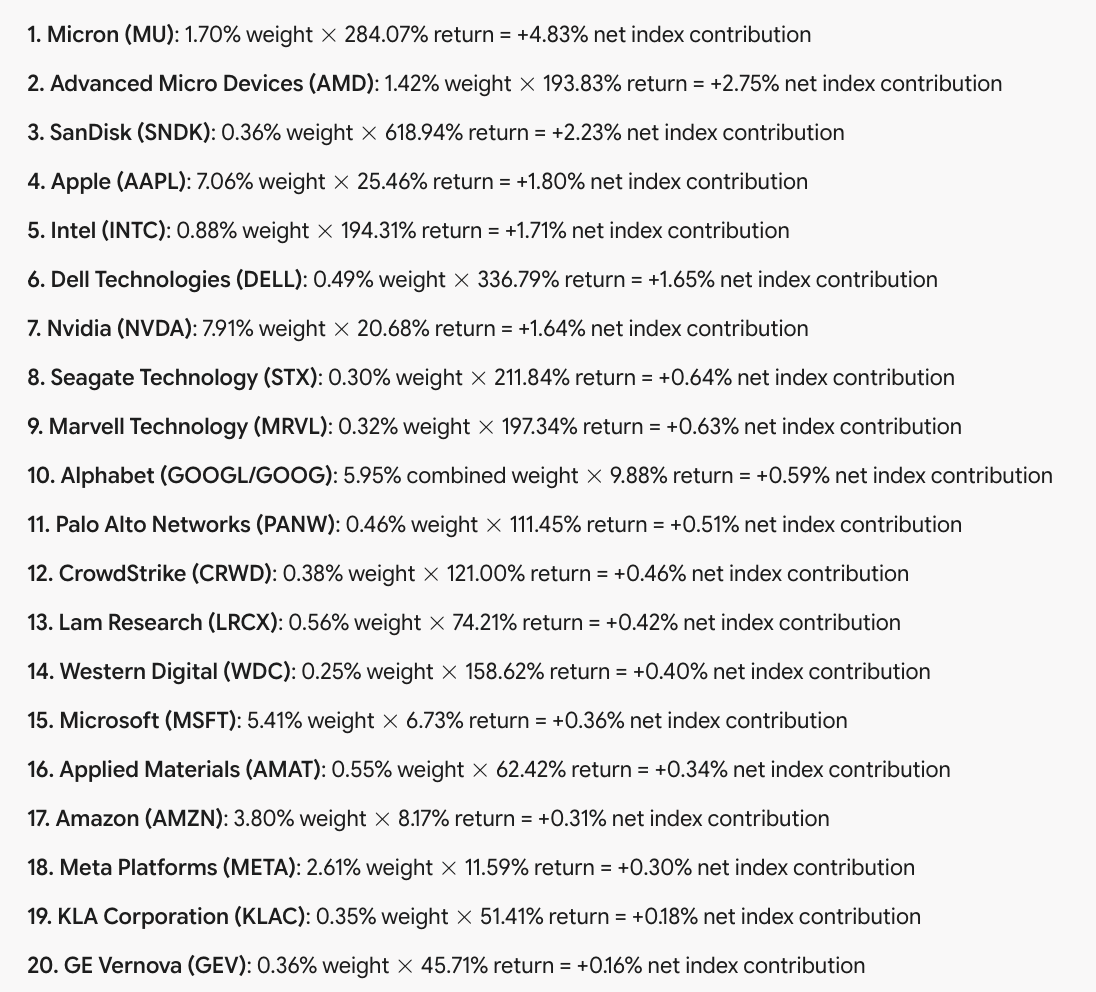
A post shares a chart and a quoted claim that 60% of S&P 500 constituents are in a bear market, with some in deep declines. The author comments that this is what is holding the index up by contribution.

Original post · 1 min read
so apparently this is what's holding it up, by contribution
Compound248 💰 @compound248
60% of the S&P 500 is in a BEAR market.

For many, it’s a DEEP bear market.

HT: @DonDurrett twitter.com/compound248/status/210287273912013…
♥ 1.8K · ⟲ 98 · 👁 479.4KView on X ↗