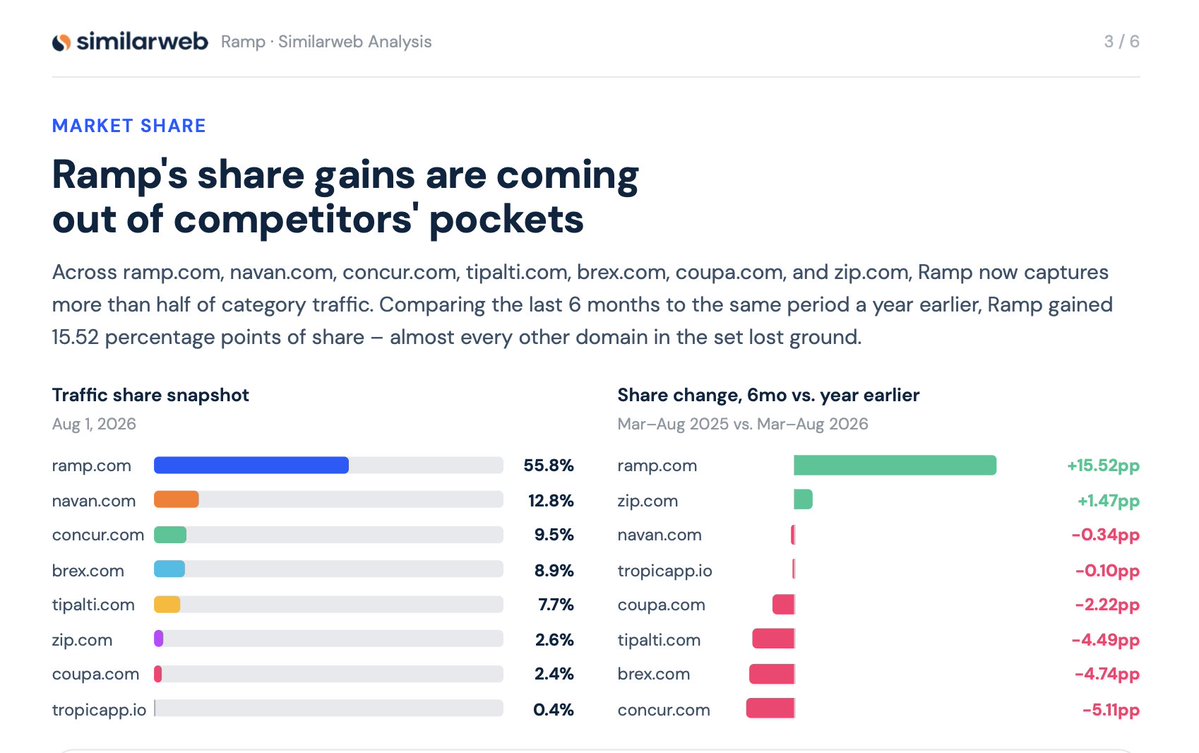
Delian of Founders Fund recalls concern in 2019 that Ramp's category was too competitive, and says Ramp steadily dominated over seven years to become one of the firm's least competitive holdings.
Aviral Bhatnagar compares equity index returns since June 2024, showing Nikkei up 66 percent and Nasdaq up 52 percent while NIFTY is flat, and says dollar depreciation leaves NIFTY down 13 percent in dollar terms.
Gokul Rajaram endorses a view that utility-priced software companies such as Zendesk are more exposed to AI than systems of record like NetSuite, since AI agents can reduce seat counts and pricing models must shift to outcomes.
Gokul (@gokulr) explains why utility-based software companies like Zendesk are more exposed to AI than systems of record like NetSuite, and why public markets aren't distinguishing between the two:
"The software companies that should be the most worried right now is where they are pricing the product based on utility. Zendesk is a good example.
Instead of paying for 50 Zendesk seats, you can pay for 20 and I can have 30 AI agents sitting next to Zendesk.
For these companies you need to change your pricing model to be based on outcome. It's going to be hard for them to stay public.
Gergely Orosz comments on a Business Insider report that Amazon is recruiting former employees, including some it laid off, under a 'Boomerang Reengagement Initiative.' He notes that Amazon's hiring and firing policy was built on not rehiring most departing staff.
This is strange to see, because Amazon's complete hiring and firing policy has been built on the notion that they do NOT want to re-hire the majority of the people leaving (who are marked as non-regretted attrition, even if they are regretted - incentives!) but hire new instead
New: Amazon wants former employees back — including some it laid off. In one email, a recruiter called the push the “Boomerang Reengagement Initiative.” In another, a recruiter asked whether Amazon’s RTO policy had driven the ex-employee away.
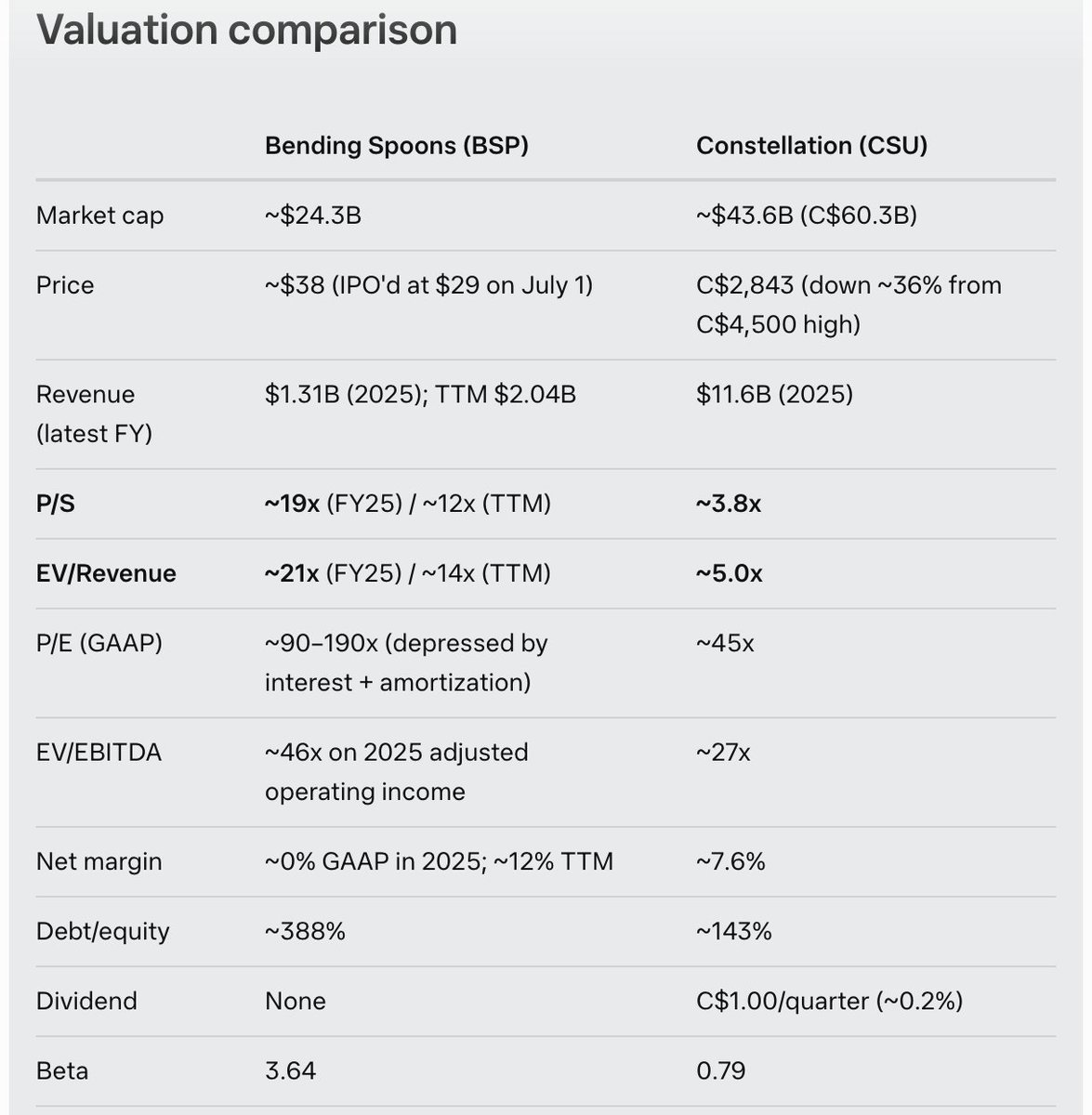
Rohit Mittal contrasts Bending Spoons and Constellation Software, arguing Bending Spoons' growth is financed on heavy debt while Constellation deleverages quickly. He cites valuation multiples, organic growth declines and interest expense as a share of revenue.
Venture folks are sophisticated about venture investments, but they put all acquirers in the same bucket.
Software company acquirers can look very different depending on: - who they acquire (types of companies) - how they grow - how they generate profits - how they finance acquisitions - revenue and profit stability
Bending Spoons has completed 50 acquisitions, while Constellation has acquired 1,400 companies.
Bending Spoons is trading at 19x FY25 sales, while Constellation trades at 3.8x.
Bending Spoons is growing at 100%+ with acquisitions, while Constellation is growing at 20%.
But they are both growing 3%-5% organically.
Bending Spoons' organic rate has halved two quarters in a row (13% → 6% → 3%).
Bending Spoons carries roughly 8–10x more debt relative to revenue than Constellation.
Bending Spoons has a much higher net debt-to-revenue ratio at 3.1x, while Constellation is at 0.2x- 0.4x.
For Bending Spoons, interest expense is 11% of revenue, while for Constellation, it's 2.6%.
Constellation can deleverage quickly, while Bending Spoons needs the next deal to pay for the previous deal.
Overall, Bending Spoons' growth is bought on credit.
Each company took a different approach to compounding revenue and cash flows, and the valuations will eventually reflect that.
Mostly Borrowed Ideas argues in a deep dive that Meta's newly announced Enterprise Platform leverages the company's strengths. The post links to the full analysis on the publication's site.
Sheel Mohnot argues that online travel agencies such as Expedia are especially exposed to agent disintermediation because they do not control inventory and their value lies in comparison and discovery. He responds to a post in which Muse found a direct hotel booking cheaper than OTA options.
Muse checked hotel website, Expedia, booking and found direct booking is 5-10% cheaper and has free cancellation and found me a $50 hotel credit.. @alexandr_wang
Jerry Capital remarks that 50% of Instinct's transaction volume is travel, in reply to a conversation listing its growth metrics. The quoted post cites over $1 billion annual volume, 10% daily growth and matching Opus 5 performance at lower cost.
Jason Goepfert reports that the S&P 500 rallied at least 1% to within 1% of a new high while more stocks hit new lows than highs, a pattern he says has occurred only on July 23, 1929 and December 21, 1999. He also notes that few stocks remain in long-term uptrends.
There are 2 days in history like today, when the S&P 500 $SPY rallied at least 1% to within 1% of a new high, and more of its stocks fell to new lows than highs.
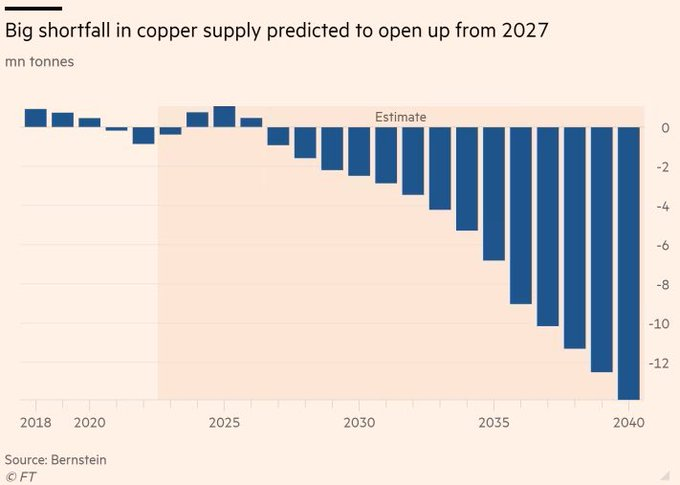
Oguz Erkan quotes Stanley Druckenmiller saying there will be no new copper supply for eight years while data center buildout adds demand. The post notes copper is up 50% over the past year, citing an FT report of an expected 2027 shortfall.
Unusual Whales shares a Financial Times report projecting a significant copper shortfall beginning in 2027. The post includes a photo but little additional text.
Trung Phan highlights a passage from Citrini's 2028 Memo describing how consumer AI agents could dismantle the economy's rent-extraction layer, such as passive subscriptions and sneaky introductory pricing. He quotes a user whose AI agent got a $250 Delta credit and rebooked a delayed flight.
The section from Citrini’s 2028 Memo on how consumer AI agents will help users navigate the economy’s “rent-extraction layer” worth a re-read:
“It started out simple enough. Agents removed friction. Subscriptions and memberships that passively renewed despite months of disuse. Introductory pricing that sneakily doubled after the trial period. Each one was rebranded as a hostage situation that agents could negotiate. The average customer lifetime value, the metric the entire subscription economy was built on, distinctly declined.”
Flight delayed 7 hours - asked Muse to file for compensation. 5 mins later i had $250 credit in my delta account. it even found and rebooked me a new flight.
it just figured everything out. even responded to the support email itself.
Palmer Luckey responds to a Meta executive, saying America needs the tech companies to work together and that egos should not get in the way. The exchange follows his earlier post accepting an apology and noting Meta has changed since his 2016 ouster.
I am infamously good at holding grudges, but Meta has changed a lot over the past 8 years. The people responsible for my ouster and internal/external smear campaign aren't even around anymore. At some point, the Ship of Theseus has sailed. twitter.com/boztank/status/1841623880609480803
Alex Mason argues the S&P 500 at record highs is a trap, citing a historical midterm-year pattern of May-to-October declines and current rate, inflation and Iran-war concerns. The post is market speculation promoting his following, with a video quoting a similar prior post.
Sheel Mohnot describes a trading bot that each month buys the Magnificent 7 stock with the worst average rank across 3-, 6-, and 12-month returns. He reports it has outperformed the Mag 7 and the S&P 500 since May 2023, with Meta bought last month and Tesla this month.
Rihard Jarc argues Amazon will need to accommodate personal AI agents rather than block them, predicting its ad business could shrink as agents take over discovery. He is responding to a post reporting that Amazon cut off Meta's Muse.
I understand the first line of thinking that $AMZN doesn't like $META's Muse to shop around, and people starting to use AI agents as the entry point for commerce, but this is the future.
I don't believe $AMZN has a chance of having its own world-dominant personal AI assistant that people would fully transition to. Best case is $AMZN has an endpoint or their own agent that Muse and other personal agents talk to, and not crawl on their websites.
$AMZN's e-commerce business will still do well in the agentic era (but they have to lean into the agentic era, not go away), but their ad business (the part of it that is related to discovery on their website) will probably be worth a lot less as agents take over.
Mostly Borrowed Ideas says it increased its Meta position after writing a deep-dive arguing Meta's Muse could transform the consumer internet. The author contrasts Meta's valuation with Airbnb's, citing asymmetric upside from Meta's optionality.
"What really compelled me to make this trade is the asymmetry of the bet. While I believe Airbnb’s stock doesn’t price such “nuclear” risk at all in today’s multiple, Meta’s valuation doesn't give it much credit for the optionality of transforming the consumer internet. The trade was admittedly a bit uncomfortable given my portfolio’s outsized bet on Meta, but on a side-by-side comparison between Meta and Airbnb, it wasn’t a difficult call for me."
UFC CEO Dana White, who sits on Meta's board, describes full-day board meetings from 9am to 6pm, followed by dinner and about three more hours, spanning two days. He praises Mark Zuckerberg and the other directors. The post also quotes Zuckerberg on AI agents interacting with each other.
Dana White says Mark Zuckerberg is an animal and reveals Meta board meetings go from 9am to 6pm, dinner, then another three hours, extending into two days
"I'm on the board of Meta and I just got home last night from a Meta board meeting, and it's one of the best decisions I've ever made was when Mark Zuckerberg called me and I said yes to that."
"And you sit in this room, and not only the people that he runs through the room all day, which are some of their high-level employees there, but the rest of the board, you literally have the smartest people in the world trying to tackle problems that are, you know, a whole another level."
"There's levels to life and to business."
"So Zuckerberg is an animal, okay. These board meetings start at nine o'clock in the morning, they go till six, then you go to dinner and it's basically another three hours of the board meeting, right?"
"And every time we'll be in there, you know, two days in the room, and every time I walk out of those board meetings, I'm so fired up and inspired by the other board members and the people who work at Meta."
Mark Zuckerberg: the whole industry treats AI agents as a single-player game but the real unlock is agents interacting with each other, which Meta has been running internally
"Right now I think most of the industry is thinking about agents as like a single player game, right? It's like you have your agent and you use it."
"And there are going to be all these interesting things that basically you can do by having the agents interact with each other."
"And we already have all these interesting examples internally where people have their agents interacting with each other."
Stratechery's weekly roundup for September 21, 2026 highlights Meta versus Amazon in the aggregator wars, General Motors adopting CarPlay, and a profile of a profiler, linking to the full article.
The best Stratechery content from the week of September 21, 2026, including Meta vs. Amazon, GM bending the knee to CarPlay, and profiling the profiler.
Investor Sam Lessin says he is reading hedge fund quarterly letters for the first time to understand how managers view the current moment. He notes that funds up about 30% in the quarter tend to discuss small businesses.
For the first time i can remember i am reading all the hedge fund quarterly letters because i am truly interested in how they are thinking about the moment... some are quite good. the ones up 30% on the quarter do like taking about small businesses.
Federico Simionato says his company acquired Airtable 21 days ago, started product work 15 days ago, and has shipped 15 improvements, jokingly raising concerns about enshittification.
Molly O'Shea shares a clip and a promotional post in which PR adviser Jen Prosek credits Ken Griffin with transforming Citadel's reputation from a feared quant shop into a respected Wall Street brand. The post also promotes a discussion on how financial and tech firms manage their reputations.
NEW: How the World's Biggest Financial Firms + Tech Co's Build & Protect Their Brands
"75%+ of negative stories start w/ employees"
Ken Griffin & Citadel, Ray Dalio & Bridgewater, Blackstone, Apollo, Meta, Jensen, Elon
$70 TRILLION in client AUM $17M in fees from ONE podcast
Now a nine-figure business ($175M in revenue !!) Jen @ProsekPR has spent 20+ years advising the most powerful firms & financiers across private markets, asset management, banking, VC & tech on how to build, protect & repair their reputations.
We sat down at @NYSE to break down: › When to fight bad press vs. stay quiet…
Hank Couture notes that Venky Ganesan, a partner at Menlo Ventures, wrote a thoughtful piece on venture capital, and points out Menlo invested in Anthropic early, when it was pre-revenue in 2023. The post praises the essay as a great read.
A few thoughts on the current state of venture capital.
When the Music Is Playing
In July 2007, a few weeks before the credit markets seized up, Chuck Prince, then the CEO of Citigroup, gave an interview to the Financial Times. The line everyone remembers is this one: "As long as the music is playing, you've got to get up and dance." He was mocked for it for years afterward, and he lost his job a few months later. But I have come to think he was saying something honest. He wasn't claiming the music would play forever. He was admitting that he couldn't sit down while it was still going, and n…
Ashlee Vance says it is hard to describe the effect Emergent Ventures is having on India, quoting Tyler Cowen's announcement of the 19th India cohort. The post links to a Marginal Revolution update.